Introduction
The advantages of blastocyst (day 5) over cleavage stage embryo (day 2/3) transfer no longer need to be demonstrated. Blastocyst transfer was shown to improve the synchronisation of the embryo with the endometrium and the selection of the most viable embryo for transfer (Adler et al., Reference Adler, Lee, McCulloh, Ampeloquio, Clarke-Williams, Wertz and Grifo2014; Teh et al., Reference Teh, McBain and Rogers2016). An extended culture programme has rendered possible single embryo transfer and cryopreservation of surplus good quality embryos, while ensuring optimal clinical outcomes. Over the past years there has been a considerable increase in the number of cryopreserved embryos, particularly following improvement in embryo cryopreservation procedures (slow freezing versus vitrification) and the development of novel embryo transfer strategies such as ‘freeze-all’ (Cobo et al., Reference Cobo, De los Santos, Castellò, Gámiz, Campos and Remohí2012; Sifer et al., Reference Sifer, Sermondade, Dupont, Poncelet, Cédrin-Durnerin, Hugues, Benzacken and Levy2012; Ortega-Hrepich et al., Reference Ortega-Hrepich, Stoop, Guzmán, Van Landuyt, Tournaye, Smitz and De Vos2013; Herrero et al., Reference Herrero, Pareja, Aragonés, Cobo, Bronet and Garcia-Velasco2014; Shapiro et al., Reference Shapiro, Daneshmand, Garner, Aguirre and Hudson2015; Ortega- Rienzi et al., Reference Rienzi, Gracia, Maggiulli, LaBarberaj, Kaser, Ubaldi, Vanderpoel and Racowsky2017). However, there is still a lack of clarity in terms of which embryos to discard. Indeed, embryo cohorts obtained after 5 days of in vitro culture often show heterogeneous embryo grades ranging from low quality embryos, division arrest, compacting morulas (with slower development kinetics) to full expanded blastocysts. Supernumerary embryos that do not meet top quality criteria at day 5, including compacting morulas and early blastocyst are often discarded because they are considered unsuitable for transfer and cryopreservation or with too poor prognosis (Gardner et al., Reference Gardner, Lane, Stevens, Schlenker and Schoolcraft2000). Extending the culture to day 6 was proposed as a tool to refine the selection of slow kinetics embryos with comparable post-warming outcomes as embryos vitrified at day 5 (Wang et al., Reference Wang, Zhen, Sun, Yu, Deng, Zhou, Wang and He2016; Kaye et al., Reference Kaye, Will, Bartolucci, Nulsen, Benadiva and Engmann2017). We believe that compacting morulas and early blastocysts obtained at day 5 are worth cryopreserving as they provide additional chances to obtain a pregnancy, with no negative effect on obstetric and perinatal outcomes (Wirleitner et al., Reference Wirleitner, Schuff, Stecher, Murtinger and Vanderzwalmen2016; Bouillon et al., Reference Bouillon, Celton, Kassem, Frapsauce and Guérif2017). Although the importance of post-thawing blastocoele re-expansion was assessed and turned out to be a predictor of pregnancy outcome (Goto et al., Reference Goto, Kadowaki, Tanaka, Hashimoto, Kokeguchi and Shiotani2011; Ahlstrom et al., Reference Ahlstrom, Westin, Wikland and Hardarson2013; Desai et al., Reference Desai, Ploskonka, Goodman, Attaran, Goldberg, Austin and Falcone2016; Du et al., Reference Du, Wang, Huang, Guo, Xiong, Yu, Yao, Shi and Sun2016), only a few studies have addressed post-warming prognosis of embryos of different expansion degree (Desai et al., Reference Desai, Ploskonka, Goodman, Attaran, Goldberg, Austin and Falcone2016; Haas et al., Reference Haas, Meriano, Laskin, Bentov, Barzilay, Casper and Cadesky2016). The objectives of the present study were to assess and to compare post-warming embryo transfer, implantation and pregnancy rates in three different day 5 embryo grades based in blastocoele expansion degree.
Materials and methods
Study design
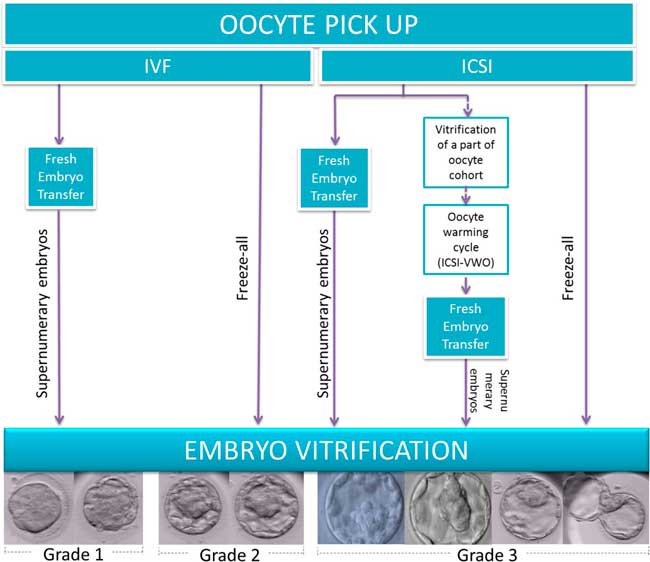
This is a retrospective study including 1139 couples benefitting from embryo vitrification at day 5 over a 5-year period. The aims of the study were to assess and to compare post-warming embryo transfer, implantation, pregnancy rates in three different day-5 embryo grades obtained after in vitro fertilization (IVF), intracytoplasmic sperm injection (ICSI) using fresh or vitrified/warmed oocytes (ICSI-VWO): grade 1 embryos included compacting morulas and blastocysts with early forming blastocoele (n=1488); grade 2 embryos encompassed early blastocyst with clear blastocoele that occupies less than half of the embryonic volume (B1–B2) (n=1312); and grade 3, full blastocysts displaying a blastocoele occupying more than half the volume of the embryo and/or increased size (>B3) (n=339).
Patients signed informed consent forms for embryo cryopreservation and warming.
Oocyte collection
Ovarian stimulation was performed with conventional protocols based on pituitary control with GnRH agonist or antagonist, administration of u-FSH or r-FSH was used to induce ovulation, and oocyte recovery was performed approximately 36 h after triggering ovulation by hCG administration, under transvaginal ultrasound-guided aspiration.
As described in Fig. 1, some embryos created after the fertilization of VWO were cryopreserved and included in the present study. Oocytes were vitrified and warmed using Kitasato vitrification and warming medium following the manufacturer’s recommendations on Cryotop® device. After warming, oocytes were incubated at 37°C for a minimum of 2 h prior to microinjection. After warming, oocyte mean survival rate was 90.2%.
Flow chart diagram describing the different scenarios leading to embryo. The three embryos grades analysed in the present study are depicted at the bottom of the figure. Dotted lines indicate the optional situation.

Embryo culture
Embryos obtained after IVF, ICSI and ICSI-VWO were cultured under the same conditions; in global medium (LifeGlobal®, France) microdrops covered with mineral oil under standard culture conditions (37°C, CO2 6%). As previously described, morphology was assessed using the simplified Gardner grading system (from B1 to B6), and recorded prospectively in an image database (Pegase software, 2iSYSTEM, France) before vitrification and after warming (Boyer and Boyer, Reference Boyer and Boyer2009; Montjean et al., Reference Montjean, Geoffroy-Siraudin, Gervoise-Boyer, Tourame and Boyer2015). Embryos were classified in three grades embryo categories based on their expansion degree as described above (Fig. 1).
Embryo vitrification and warming cycles
Embryos were individually vitrified on a Cryotop® device using Kitazato vitrification kit following the supplier’s recommendation.
Equilibration solution (ES: 7.5% ethylene glycol + 7.5% dimethylsulfoxide (DMSO) + 20% synthetic serum substitute) and vitrification solution (VS; 15% ethylene glycol + 15% DMSO + 0.5 M trehalose + 20% synthetic serum substitute) at room temperature. Embryos were incubated for 10 min in ES and then exposed to VS, placed on the Cryotop® strip in a minimum volume, and were directly immersed into liquid nitrogen within 1 min.
Embryo-warming cycles were performed using the Kitazato warming kit: the thawing solution (TS), 1.0 M trehalose in tissue culture medium + 20% synthetic serum substitute, was allowed to warm up at 37°C. The strip of the Cryotop® was immersed into the TS. Embryos were aspirated within the end of the capillary 1 min after immersion into TS. At room temperature, embryos were transferred in the diluent solution: (0.5 M sucrose) for 3 min and washed twice in droplets of wash solution (5 min and 1 min). Embryos were incubated in global medium supplemented with 20% HSA (LifeGlobal) at 37°C, CO2 6% in air.
Single embryo transfer was proposed in 85% of the cases. Vitrified/warmed embryos were transferred in spontaneous ovarian cycle (in normo-ovulatory women) or using substitute hormonal treatment (in other cases) for endometrial preparation. Survived embryos were transferred at least 1 h after warming. Pregnancies were assessed by blood hCG detection followed by ultrasound assessment of fetal heartbeat. Deliveries and births were registered prospectively
Statistics
Univariate analysis using Statistical Package for the Social Sciences (SPSS) was used to assess factors impacting embryo implantation rate (confounding factors), namely maternal age, previous early pregnancy, method for endometrial preparation for frozen embryo transfer, strategy leading to embryo vitrification, the technique used for fertilization and the number of embryos transferred.
Implantation and pregnancy rates were assessed for each embryo grade and compared using SPSS software transfer. Multivariate analyses were performed to compare outcomes according to embryo grade. We used the chi-squared test for categorical variables and analysis of variance for quantitative variables.
Results
Vitrification cycles
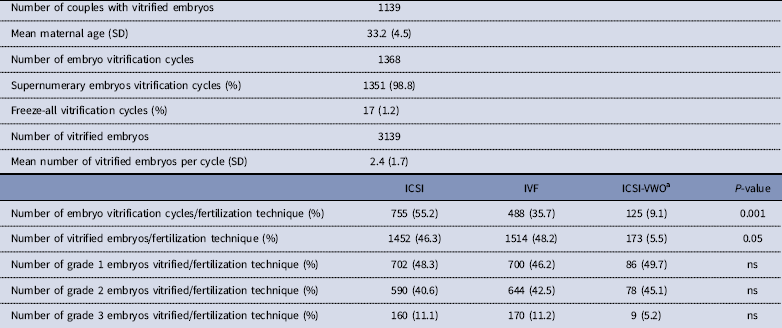
Baseline data describing patients and vitrification cycles are summarized in Table 1. Figure 1 is a flow chart diagram summarizing the different situations leading to embryo cryopreservation. In total, 1139 couples enrolled in the infertility treatment programme had embryo vitrification at day 5. Embryos were used for two purposes: most of the time (98.8%) supernumerary embryos were vitrified after fresh embryo transfer, but a freeze-all strategy was used in few cases (1.2%) to postpone embryo transfer in women at risk of ovarian hyperstimulation syndrome.
Baseline data regarding embryo vitrification cycles cryopreservation

aICSI on vitrified warmed oocytes.
In total, 48.2% of cryopreserved embryos were obtained after IVF, while 46.3% of these were produced by ICSI (P=0.05). Embryo vitrification was performed more frequently in couples receiving ICSI treatment (55.2%) than in those who had an IVF cycle (35.7%). Furthermore, our results showed comparable numbers of embryo of each grade at embryo culture day 5 after ICSI, IVF and ICSI-VWO.
Factors impacting on embryo implantation
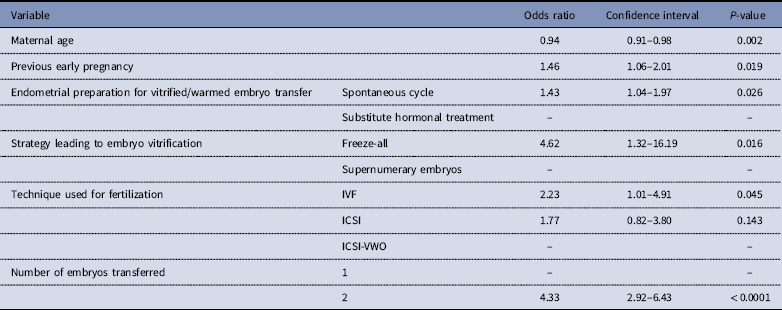
Table 2 shows the identified confounding factors, namely maternal age, previous early pregnancy, the method used for endometrial preparation in frozen embryo transfer, the strategy leading to embryo vitrification, technique used for fertilization and the number of transferred embryos. These factors were demonstrated to affect implantation rate. Our results showed that implantation rate was lower in older women (P=0.002) but was higher when:
∙ The woman has already had at least a previous early pregnancy with one fetal sac seen at the ultrasound scan (P=0.019).
∙ Frozen embryo transfer was performed in spontaneous ovarian cycle (P=0.026).
∙ Embryos in which frozen in the context of freeze-all strategy (P=0.016).
∙ Embryos were obtained after conventional IVF (versus ICSI-VWO).
∙ Two embryos were transferred (P<0.0001).
Summary of the factors impacting embryo implantation

Subsequent statistical analyses comparing the outcome of the transfer of frozen embryos of each grade were adjusted for the described confounding factors.
Post-warming data
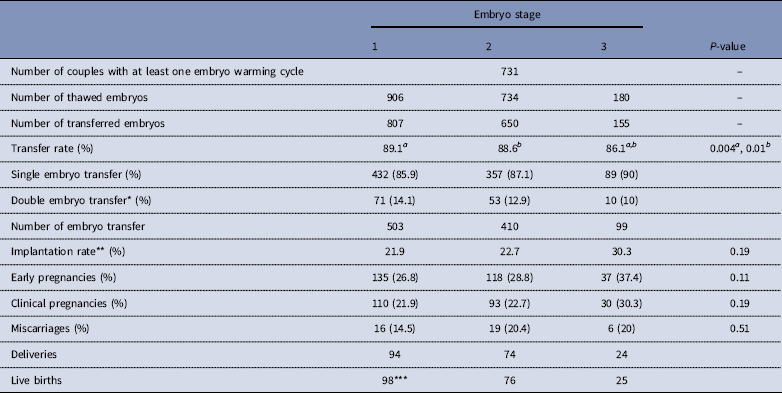
Table 3 summarizes post-warming data. Post-warming transfer rate (number transferred embryos/ number warmed embryos) for grades 1, 2 and 3 embryos were 89.1%, 88.6%, 86.1%, respectively (P≤0.01). However, after warming, embryo implantation rates (n fetal sac/n embryo transferred) were not significantly different whatever the grade (21.9%, 22.7%, 30.3%, respectively; P=0.19) although grade 3 embryos tended to implant more successfully that grades 1 and 2.
Summary of embryo post-warming data, biological and clinical outcomes

* Only embryos of same grade.
** Number of fetal sac/number of embryo transferred.
*** Including monozygotic twins.
a,b Statistical differences between two figures are identified using letters a and b.
Our results showed that the chance to obtain early (hCG level >100 UI/l; 26.8%, 28.8% and 37.4%, for grades 1, 2 and 3 embryo, respectively; P=0.11) and clinical pregnancy (fetal heart beat detected; 21.9%, 22.7% and 30.3%, for grades 1, 2 and 3 embryo, respectively; P=0.19) per transfer were equivalent when comparing the three embryo grades. Grade 3 embryos were more likely to give rise to an early pregnancy than grade 1 embryos, P=0.027. However, this difference was not found when comparing clinical pregnancy rate obtained after the transfer of grade 1 and grade 3 embryos, P=0.08. The miscarriage rate was not different when comparing the three grades (14.5%, 20.4%, 20%, respectively; P=0.51).
Discussion
The results of the present study supported our policy to cryopreserve a large range of day-5 embryos including early blastocyst and compacting morulas. Like others, we showed that if we were more restrictive on the criteria used for the selection of embryo to vitrify, we would have not cryopreserved grade 1 embryos, leading to a loss of 47.2% of clinical pregnancies reported in the present (Wirleitner et al., Reference Wirleitner, Schuff, Stecher, Murtinger and Vanderzwalmen2016).
In this study a significantly higher number of vitrification cycles were performed on embryos produced after ICSI than after IVF, because ICSI treatment was the one most frequently used for couples undergoing infertility treatment in our centre (63%). In addition, as required by law voted in 2011, we set up a method to limit embryo cryopreservation. Briefly, we propose that couples programmed for ICSI with sufficient mature oocytes at pick-up should vitrify part of the oocyte as previously described (Boyer et al., Reference Boyer, Montjean, Tourame and Gervoise-Boyer2013). Thanks to our strategy, lower numbers of embryos were created and lower numbers of embryos were cryopreserved, this explains the lower percentage of cryopreserved embryos after ICSI when compared with IVF. Oocyte warming cycles were proposed when clinical pregnancy failed to occur using fresh eggs. For the same reason mentioned above, smaller numbers of oocytes were fertilized during such cycles compared with fresh ICSI cycles to limit embryo cryopreservation (Table 1).
Embryo implantation is acknowledged to be a multifactorial process. Therefore, we have assessed the influence of several known factors on implantation rate of the studied vitrified/thawed embryos to include these in a multiple regression analysis for vitrified/thawed embryos outcome assessment (Table 2). Embryos obtained from freeze-all strategy implantation were shown to implant better than surplus embryos that were cryopreserved after fresh embryo transfer. This observation is likely to be the result of an age-related bias. Indeed, our freeze-all patients, who are usually good responders were 3 years younger (30 years) than others. In addition, embryo cohorts vitrified in the freeze-all strategy also included the ‘best’ embryo(s) that would be likely to be transferred fresh. We believe that this may participate in better outcomes after freeze-all than after conventional strategy with fresh embryo transfer and surplus embryo vitrification.
Although it was demonstrated that the cryotransfer of embryos obtained after fertilizing vitrified warmed oocytes led to similar outcomes than the cryotransfer of embryos obtained with fresh oocytes (Cobo et al., Reference Cobo, Castellò, Vallejo, Albert, De los Santos and Remohí2013). Our data showed poorer outcomes for embryos after ICSI-VWO. Our results cannot be compared with that of Cobo and colleagues, as their study included bigger numbers of vitrified/warmed embryos, younger patients and oocyte donation cycles. A significant lower transfer rate was found for grade 3 embryos as compared with grades 1 and 2. The explanation for this phenomenon may be that grade 3 embryos display larger volumes of water in the blastocoel. The latter may increase the chances for ice formation during freezing process, which impairs embryo survival rate (Vanderzwalmen et al., Reference Vanderzwalmen, Bertin, Debauche, Standaert, van Roosendaal, Vandervorst, Bollen, Zech, Mukaida, Takahashi and Schoysman2002). Performing artificial shrinkage of the blastocoel on grade 3 embryos may increase transfer rate as well as pregnancy outcome (Cao et al., Reference Cao, Zhao, Zhang, Wu, Guo and Ling2014; Kim et al., Reference Kim, Lee, Park, Choi and Yang2015; Darwish and Magdi, Reference Darwish and Magdi2016; Levi-Setti et al., Reference Levi-Setti, Menduni, Smeraldi, Patrizio, Morenghi and Albani2016).
It is widely accepted that embryo aneuploidy contributes to pregnancy loss (Brown, Reference Brown2008; Suzumori & Sugiura-Ogasawara, Reference Suzumori and Sugiura-Ogasawara2010; Hyde & Schust, Reference Hyde and Schust2015). Similarly to other factors such as oocyte maturity and paternal factors, chromosomal aberrations were found to correlate with embryo kinetics (Davis et al., Reference Davis, Christopikou, Tsorva, Karagianni, Handyside and Mastrominas2012; Lammers et al., Reference Lammers, Reignier, Splingart, Catteau, David, Barriere and Freour2015; Piccolomini et al., Reference Piccolomini, Nicolielo, Bonetti, Motta, Serafini and Alegretti2016; Del Carmen Nogales et al., Reference Del Carmen Nogales, Bronet, Basile, Martínez, Liñán, Rodrigo and Meseguer2017; Bartolacci et al., Reference Bartolacci, Pagliardini, Makieva, Salonia, Papaleo and Viganò2018; Holubcová et al., Reference Holubcová, Kyjovská, Martonová, Páralová, Klenková, Otevřel, Štěpánová, Kloudová and Hampl2019). Interestingly, embryos with slower kinetics were shown to be more prone to be aneuploid (Davis et al., Reference Davis, Christopikou, Tsorva, Karagianni, Handyside and Mastrominas2012; Piccolomini et al., Reference Piccolomini, Nicolielo, Bonetti, Motta, Serafini and Alegretti2016; Del Carmen Nogales et al., Reference Del Carmen Nogales, Bronet, Basile, Martínez, Liñán, Rodrigo and Meseguer2017). Furthermore, aneuploidy was also demonstrated to be higher in embryos showing blastulation delay such as in grade 1 embryos (Campbell et al., Reference Campbell, Fishel, Bowman, Duffy, Sedler and Thornton2013; Basile et al., Reference Basile, Del Carmen Nogales, Bronet, Florensa, Riqueiros, Rodrigo, García-Velasco and Meseguer2014). We would therefore expect embryos showing slow kinetics to be at higher risk of pregnancy loss, but our results indicated that miscarriage rate was not higher after grade 1 embryo transfer as compared with grade 3. However the number of grade 3 embryos needs to be increased to raise the statistical power of our analysis.
The present report on giving a chance to slow kinetics embryos to give rise to a pregnancy is in line with a previous study showing not only that viable embryos may be discarded if vitrification is restricted to top quality blastocysts, but also that repeated IVF cycles can be avoided by cryopreserving non-top-quality embryos (Kaartinen et al., Reference Kaartinen, Das, Kananen, Huhtala and Tinkanen2015; Wirleitner et al., Reference Wirleitner, Schuff, Stecher, Murtinger and Vanderzwalmen2016). Based on our results, we concluded that it is worth and relevant to cryopreserve compacting morulas and early blastocysts to increase cumulative pregnancy rate, while ensuring better outcome than day 3 embryos (17% pregnancy rate in our centre). Embryo vitrification on day 6 may also be considered to refine embryo viability assessment resulting in a reduction in the number of embryos vitrified and therefore the cost of vitrification. Overall, we believe that, in the interest of couples seeking parenthood, attention should be borne also for embryos with blastulation delay available at day 5.
Acknowledgements
We acknowledge Francois Lecluyse and Anne-Laure Benedetti for technical support. We would also like to thank clinical staff for sending the couples to us and for allowing their participation in the present study.
Financial support
This research received no specific grant from any funding agency, commercial or not-for-profit sectors.
Conflicts of interest
None.
Ethical standards
Not applicable.