Introduction
The natural distribution of coast redwood (Sequoia sempervirens (D. Don) Endl.) extends along the Pacific coast of northern California to southern Oregon (Roy, Reference Roy1966). It is an important timber species, but there are only a few studies concerning its range-wide genetic variation and differentiation (Hall and Langenheim, Reference Hall and Langenheim1987; Brinegar, Reference Brinegar, Standiford, Weller, Piierto and Stuart2011; Douhovnikoff and Dodd, Reference Douhovnikoff and Dodd2011). All these studies found relatively low genetic differentiation among analysed populations. On the contrary, fine scale and individual clone differentiations were highly significant (Rogers, Reference Rogers2000; Douhovnikoff et al., Reference Douhovnikoff, Cheng and Dodd2004; Ibañez et al., Reference Ibañez, Caru, Herrera, Gonzalez, Martin, Miranda and Navarro-Cerrillo2009; Narayan et al., Reference Narayan, Dodd and O'Hara2015). It seems that more genetic markers are needed to increase the efficiency of population genetic studies in coast redwood. We used publicly available expressed sequence tag (EST) and complete chloroplast genome sequence data to develop new microsatellite or simple sequence repeat (SSR) markers for coast redwood.
Experimental
Needles from 309 trees in 16 locations were collected within the natural distribution range of coast redwood in central and northern California (Online Supplementary 1). The collected needles were dried on silica gel. DNA was extracted from two needles per sample using the DNeasy 96 Plant Kit (Qiagen, Hilden, Germany) following the manufacturer's instructions. The extracted DNA was diluted in ddH2O 1:10 for polymerase chain reaction (PCR) and stored at −20°C.
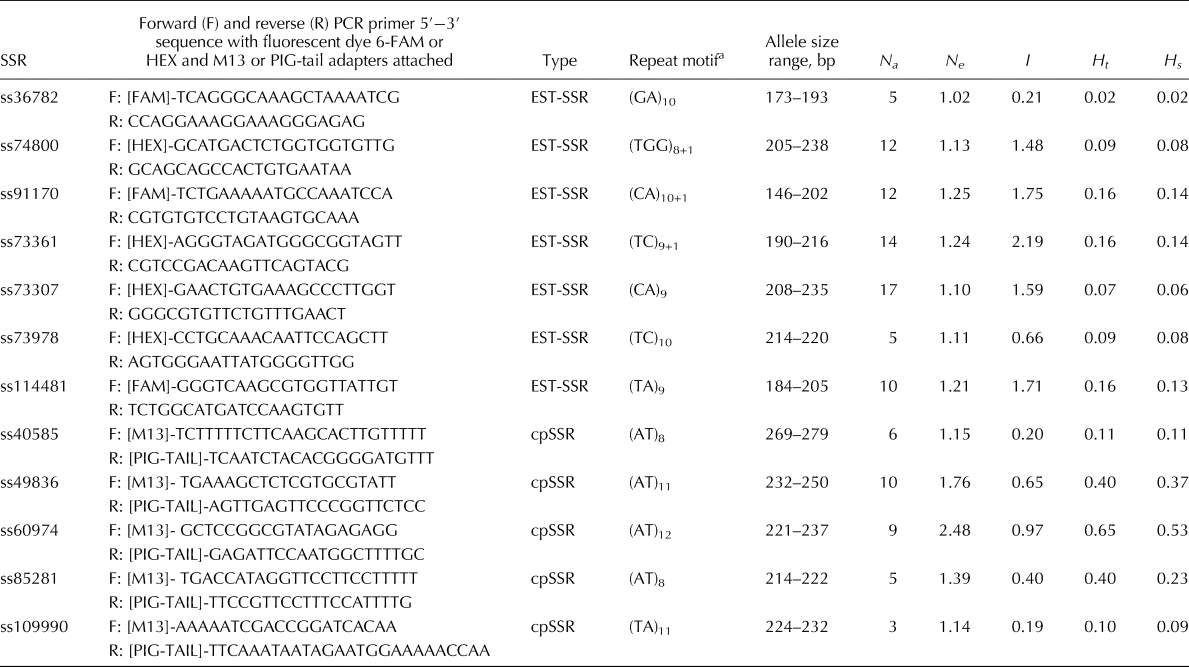
Possible microsatellite motifs were found by a search for dinucleotide and trinucleotide SSR-motifs for EST-SSRs in the transcriptome data of Scott et al. (Reference Scott, Stenz, Ingvarsson and Baum2016) and for all SSR-motifs in the complete chloroplast genome sequence (NCBI GenBank accession number NC_030372.1) using the SciRoko program (Kofler et al., Reference Kofler, Schlötterer and Lelley2007). Primer3 0.4.0 (Untergasser et al., Reference Untergasser, Cutcutache, Koressaar, Ye, Faircloth, Remm and Rozen2012) was used to design the PCR primer pairs and oligoCalc (Kibbe, Reference Kibbe2007) to check for possible dimers and hairpins. In total, 57 primer pairs for different SSR-motifs were tested. The EST-SSR forward primers were labelled with either Hex or 6-FAM (Table 1). Following Schuelke (Reference Schuelke2000), PCRs for chloroplast SSRs (cpSSRs) were performed with 5′ tailed 6-FAM dye-labelled M13 (5′-CACGACGTTGTAAACGAC-3′) forward and PIG-tailed (5′-GTTTCTT-3′) reverse primers (Kubisiak et al., Reference Kubisiak, Nelson, Staton, Zhebentyayeva, Smith, Olukolu, Fang, Hebard, Anagnostakis, Wheeler, Sisco, Abbott and Sederoff2013).
Novel EST-SSR and cpSSR markers developed in coast redwood

N a, number of alleles; N e, number of effective alleles; I, Shannon Index; H t, total gene diversity; H S, gene diversity within the population.
a Number means a number of repeat motifs in the original sequence.
For all 12 primer pairs, the following touch-down PCR program was used. First denaturation at 94°C for 15 min, followed by 17 cycles with denaturation at 94°C for 1 min, annealing at 67°C for 1 min and elongation at 72°C for 1 min, after each cycle the annealing temperature was decreased by 1°C, followed by 18 cycles with the annealing temperature at 50°C for 1 min.
PCR products were separated using the ABI genetic analyser 3130xl with GENSCAN ROX 500 as the internal size standard. GeneMapper 4.1. (Applied Biosystems) was used for visualization of the PCR products.
We finally selected seven EST-SSRs that were genotyped following the procedure suggested in Pfeiffer et al. (Reference Pfeiffer, Roschanski, Pannell, Korbecka and Schnittler2011). In total, 270 and 297 samples were genotyped for EST-SSRs and cpSSRs, respectively. For each locus number of alleles (N a), number of effective alleles (N e), Shannon Index (I), Nei's total gene diversity (H t) and Nei's within population gene diversity (H s) were calculated.
For EST-SSRs N a and I were calculated based on an input file with fragment sizes presenting the alleles for each locus, using the R-package ‘polysat’ for polyploid species (Clark and Jasieniuk, Reference Clark and Jasieniuk2011). Alternatively, fragment sizes per locus were converted into a binary input file and handled as pseudo-AFLP data for the calculation of H t and H s with PopGene (Yeh et al., Reference Yeh, Yang, Boyle, Ye and Mao1997) and N e with GenAlEx (Peakall and Smouse, Reference Peakall and Smouse2006, Reference Peakall and Smouse2012). Separately, cpSSRs were analysed using GenAlEx (N a, N e and I) and the R-package ‘hierfstat’ (H t and H s) (Goudet and Jombart, Reference Goudet and Jombart2015) with an input file based on fragment sizes as alleles.
Discussion
The program SciRoKo identified 76 microsatellites with dinucleotide motifs, six with trinucleotide motifs in ESTs, and six microsatellites with dinucleotide motifs in the chloroplast genome. From all EST-SSRs one with trinucleotide and six with dinucleotide motifs and among six cpSSRs five with dinucleotide motifs were reliable and polymorphic and selected for further analysis. Their N a, N e, I, H s and H t parameters are presented in Table 1. Due to the use of binary data to compute H t and H s for EST-SSRs, these parameters of gene diversity cannot be directly compared between EST-SSRs and cpSSRs (Nybom, Reference Nybom2004).
As expected, EST-SSRs showed lower number of alleles than the published random nuclear SSRs (nSSRs) (Douhovnikoff and Dodd, Reference Douhovnikoff and Dodd2011; Narayan et al., Reference Narayan, Dodd and O'Hara2015), which was observed also earlier in other plants including conifers (e.g., Euyal et al., Reference Euyal, Sorrells, Baum, Wolters and Powell2001; Rungis et al., Reference Rungis, Bérubé, Zhang, Ralph, Ritland, Ellis, Douglas, Bohlmann and Ritland2004), supposedly because EST-SSRs are linked with expressed genes and can be under selection (Bouk and Vision, Reference Bouk and Vision2007).
The newly designed chloroplast microsatellite markers (cpSSRs) showed similar or higher numbers of alleles and genetic diversity than the published single cpSSR marker (Brinegar, Reference Brinegar, Standiford, Weller, Piierto and Stuart2011). The high number of alleles and higher diversity are expected to increase the resolution of population structure analyses based on multiple markers compared with analyses based on a single chloroplast marker. Chloroplasts in coast redwood are inherited paternally (Neale et al., Reference Neale, Marshall and Sederoff1989), and their markers are excellent tools to study pollen-based gene flow and its contribution to population similarity. CpSSRs are usually highly polymorphic in conifer species (Vendramin et al., Reference Vendramin, Degen, Petit, Anzidei, Madaghiele and Ziegenhagen1999; Viard et al., Reference Viard, El-Kassaby and Ritland2001; Bucci et al., Reference Bucci, Gonzalez-Martinez, Le Provost, Plomion, Ribeiro, Sebastiani, Alía and Vendramin2007), and we found similar results in coast redwood.
Coast redwood is a hexaploid species (Stebbin, Reference Stebbin1948), which complicates microsatellite genotyping (Douhovnikoff and Dodd, Reference Douhovnikoff and Dodd2011; Narayan et al., Reference Narayan, Dodd and O'Hara2015). However, the microsatellite scoring approach based on the genotype verification using ramets of known clones resulted in unambiguous and reliable multilocus genotypes (Pfeiffer et al., Reference Pfeiffer, Roschanski, Pannell, Korbecka and Schnittler2011). Due to the usually less polymorphic nature of EST-SSRs and the haploid nature of cpSSRs, both marker types might be less prone to genotyping errors than nSSRs, which frequently have many alleles of similar length (Hoffmann and Amos, Reference Hoffmann and Amos2005). Therefore, additional new EST-SSR and cpSSR might increase the resolution power of microsatellite markers to study population structure and local adaptation in coast redwoods. The highly polymorphic cpSSRs can be especially useful for genotyping of individuals and clone assignment based on the specific haplotypes.
Supplementary material
The supplementary material for this article can be found at https://doi.org/10.1017/S147926211800045X.
Acknowledgements
We thank Alexandra Dolynska, Melanie Eckholdt and Babalola Jumoke for support during laboratory work. This project is funded by the ‘Fachagentur für nachhaltige Ressourcen (FNR) des Bundesministeriums für Ernährung und Landwirtschaft (BMEL)’.