


The defeat of Hillary Clinton in the 2016 presidential campaign has revivified public debate about the role of gender bias in politics. Did Clinton make strategic errors? Or did she fail to connect to many voters, and a majority of white women, because of continuing negative associations of women in powerful roles? These questions have been of perennial concern to gender scholars, but there is a growing consensus that the majority of American voters are willing to support women's bids for high political office (Dolan Reference Dolan2014; Sanbonmatsu Reference Sanbonmatsu2002; Carroll and Sanbonmatsu Reference Carroll and Sanbonmatsu2013; cf. Streb et al. Reference Streb, Burrell, Frederick and Genovese2008; Brooks Reference Brooks2013). Once partisanship and incumbency are taken into account, research shows that there is no systematic bias against female candidates (Lawless and Person Reference Lawless and Pearson2008, 67). Over time, the rising acceptance of female politicians may be due to the fact that the women who make it to the top of the political ladder are often highly qualified and more skilled than their male counterparts (Anzia and Berry Reference Anzia and Berry2011; Besley et al. Reference Besley, Folke, Persson and Rickne2017; O'Brien and Rickne Reference O'Brien and Rickne2016). But if voters differentially evaluate candidates based on gender stereotypes or expectations of social roles, bias could operate against women in subtle ways that may not be captured by election results alone (Alexander and Andersen Reference Alexander and Andersen1993; Bauer Reference Bauer2015; Barnes and Beaulieu Reference Barnes and Beauliu2014; Bos Reference Bos2011; Holman, Merolla, and Zechmeister Reference Holman, Merolla and Zechmeister2016). The women who could potentially run for office may instead opt out because they do not fit an ideal-typical demographic profile.
In this paper, we build on a vibrant literature on gender and politics to investigate three theoretically distinct sources of vote-distorting bias: outright hostility, double standards, and a double bind. Outright hostility occurs when people hold inveterate preferences against a specific group. Double standards amount to bias when traits are judged differently depending on which group holds them. Finally, double binds emerge when desirable traits require more investment, or are associated with different burdens, for members of nondominant groups. Our key theoretical contribution lies in a description of these forms of bias that might limit women's representation in politics. Empirically, we develop several new tests to explore double standards and double binds with reference to gender, but the variations of discrimination described herein, and the tests that we design, can also be used to assess bias against racial and ethnic groups, or people of different ages or abilities.
To explore these potential forms of bias, we draw on three different sources of data from the United States: a representative sample of 2,144 citizens to gauge voter preferences, and two convenience samples totaling 2,944 public officials.Footnote 1 Our analyses draw on conjoint survey experiments that ask voters and public officials to evaluate multiple pairs of hypothetical candidates for an open seat race in their party's primary.Footnote 2 Unlike typical résumé experiments that change only the gender or ethnicity of a job applicant, conjoint experiments allow for several (or all) characteristics of a hypothetical profile to be varied. We endow our hypothetical candidates with characteristics such as gender, occupation, age, marital status, political experience, and number of children, and allow each characteristic to be randomly assigned for every candidate. The range of values that each characteristic can take reflects the common gendered profiles of American politicians documented in Carroll and Sanbonmatsu (Reference Carroll and Sanbonmatsu2013).
Throughout the paper, we juxtapose mass and elite opinion toward political candidates. The comparison is important because in the American political system both voters and public officials play distinct roles in the emergence and success of political candidates, and because members of each group may have different views about gender equality.Footnote 3 On the one hand, political elites tend to be better educated and wealthier than the average voter (Carnes Reference Carnes2016), which may lead them to have more gender-egalitarian views than the public at large; on the other hand, male political elites might strategically use sexism as a way to reduce competition for office (Frechette, Maniquet, and Morelli Reference Frechette, Maniquet and Morelli2008).Footnote 4 Voter and politician preferences might also diverge in partisan primaries if voters choose more ideologically extreme candidates (Jacobson Reference Jacobson2012; Hill Reference Hill2015), but politicians have a keener eye toward electability in general contests. Thus, elites might resist electing women in primaries in strategic anticipation of a negative voter reception, even when they do not personally harbor bias against women (Bos Reference Bos2011; Niven Reference Niven1998, Sanbonmatsu Reference Sanbonmatsu2006; Burrell Reference Burrell1994; Gaddie and Bullock Reference Gaddie and Bullock1997; Rule Reference Rule1981; Studlar and McAllister Reference Studlar and McAllister1991). We hope to learn more about the hurdles faced by female candidates by using the same experimental design to study opinion among voters and political leaders.
Overall, we do not find evidence of outright discrimination against women. In fact, when we pool all respondents together, and when we evaluate most subgroups, we find a pro-female preference. Consistent with other experimental work, Republicans were the only group that did not show a clear preference for women; instead, Republicans were indifferent between male and female candidates (e.g., King and Matland Reference King and Matland2003). We also do not find evidence for double standards: male and female candidates with similar characteristics are evaluated similarly, and, to be elected, female candidates did not need more political experience than their otherwise similar male counterparts.
We do, however, find substantive evidence of a double bind. Across our surveys of voters and public officials, respondents consistently prefer both male and female candidates who are married with children compared to those who are not. These preferences present an unseen double bind for female aspirants for three reasons. First, because women with children in two-career households still do the majority of mental and physical labor necessary to run a household. Given a persistent uneven gender distribution of household labor (Bianchi et al. Reference Bianchi, Sayer, Milkie and Robinson2012; Iversen and Rosenbluth Reference Iversen and Rosenbluth2006), this means that to be electorally successful, voters and public officials implicitly require female politicians to work longer hours when including family obligations on top of political work. Second, because women with political ambition, as well as those in state legislatures and Congress, are less likely than male aspirants to be married with children.Footnote 5 Finally, the preference for married with kids presents a double bind because women's political interest and involvement is lowest during childbearing years (Quaranta and Dotti Sani Reference Quaranta and Dotti Saniforthcoming), and women's political ambition tends to be negatively correlated with marriage (Crowder-Meyer Reference Crowder-Meyer2017). In other words, the double bind emerges because female candidates without families—who could better afford the time to invest in political careers—may face greater degrees of voter disapproval, while women in more demanding family roles have less time for political work. The overlapping preferences of voters and elites for candidates with traditional family structures, combined with the incompatibility of an average woman's family role with the long working hours demanded of politicians, likely contributes to women's underrepresentation in American politics.
GENDER BIAS IN POLITICS
The million-dollar question in gender in politics is why, despite rising education levels and increased professional attainment, in most countries women have yet to reach parity in political office. Two major streams of research seek to answer this question. The first examines the factors that lead women to run for political office while the second, to which this paper contributes, examines the features that cause people to support female candidates.Footnote 6
Once a woman is on the ballot, scholars are interested in the individual- and candidate-level characteristics that lead voters to support female candidates, and a robust debate centers on the role that bias plays in thwarting women's electoral prospects. Many scholars have argued against the claim that discrimination is a key factor in women's underrepresentation (e.g., Fox Reference Fox2013; Lawless and Pearson Reference Lawless and Pearson2008; Lawless Reference Lawless2015; Palmer and Simon Reference Palmer and Simon2006; Seltzer, Newman, and Leighton Reference Seltzer, Newman and Leighton1997). And some have suggested that explicit forms of gender discrimination are less common now than 50 years ago (Sanbonmatsu Reference Sanbonmatsu2002; Carroll and Sanbonmatsu Reference Carroll and Sanbonmatsu2013; although cf. Streb et al. Reference Streb, Burrell, Frederick and Genovese2008). In the American political context, many scholars argue that bias against women is less important to candidate choice than ideology or partisanship (Dolan Reference Dolan2004; Sapiro and Conover Reference Sapiro and Conover1997; Broockman et al. Reference Broockman, Carnes, Crowder-Meyer and Skovron2017, Thomsen Reference Thomsenforthcoming).
Nevertheless, in key areas like fundraising and media coverage, most research shows that women face higher hurdles than men. Women who run for office receive less attention from the media than men (Kahn Reference Kahn1992; Kahn and Goldenberg Reference Kahn and Goldenberg1991; Kittilson and Fridkin Reference Kittilson and Fridkin2008), and what coverage they do get often focuses on stereotypical ideas of competence in particular issue areas (Carroll and Schreiber Reference Carroll and Schreiber1997; Kahn Reference Kahn1996, 10; Kittilson and Fridkin Reference Kittilson and Fridkin2008; cf. Hayes and Lawless Reference Lawless2015). And though it depends on the level of office sought (Burrell Reference Burrell1985), and may have improved over time (Carroll and Sanbonmatsu Reference Carroll and Sanbonmatsu2013, 114), female candidates may not be able to generate as much financial support as male candidates. Ultimately, women devote more time to fundraising than men (Jenkins Reference Jenkins2007), which could stem from the fact that they receive campaign donations in smaller denominations (Thomsen and Swers Reference Thomsen and Swers2017), or that they perceive fundraising to be more difficult than male candidates (Barber, Butler, and Preece Reference Barber, Butler and Preece2016; Fox Reference Fox1997; Fox and Lawless Reference Fox and Lawless2011, 67; Shames Reference Shames2017). The ability of women to secure support may also depend on whether donors from different parties prioritize female representation (Crowder-Meyer and Cooperman, Reference Crowder-Meyer and Coopermanforthcoming).
In what follows, we advance the theoretical conversation concerning support for female candidates by conceptualizing three potential sources of vote-distorting bias and by precisely defining ways to examine these biases empirically.
Outright Hostility
Female political aspirants would be unequivocally disadvantaged if voters or public officials prefer male candidates to female candidates, even when the candidates are otherwise identical. Described by economists as a “taste for discrimination” (Becker Reference Becker1957, 16), outright hostility against women might emerge due to several factors: conservative ideology (Paxton and Kunovich Reference Paxton and Kunovich2003), attitudes about gender roles that relegate women to positions outside the sphere of politics (Arceneaux Reference Arceneaux2001), or to a devaluing of the experiences that women bring to the table (Murray Reference Murray2014; Franceschet, Krook, and Piscopo Reference Franceschet, Krook and Piscopo2012). In addition, men might show hostility toward representatives from other groups because of “homophily”—which political scientists refer to as “affinity effects” (Rosenthal Reference Rosenthal1998; Zipp and Plutzer Reference Zipp and Plutzer1985; Dolan Reference Dolan2008) – that contributes to individuals’ baseline preferences for male or female leaders (Sanbonmatsu Reference Sanbonmatsu2002).Footnote 7 For example, Niven (Reference Niven1998) finds that party chairs prefer candidates with whom they share similar background characteristics. Since party chairs tend to be white and male, the reproduction of these characteristics in the candidate pool amounts to a form of bias.
Previous research has found outright hostility against women in some settings but not in others.Footnote 8 Several prominent authors suggest that explicit forms of gender discrimination may be on the decline (Carroll and Sanbonmatsu Reference Carroll and Sanbonmatsu2013; Sanbonmatsu Reference Sanbonmatsu2002). Lawless (Reference Lawless2015), for example, argues that once other factors are controlled for (such as political experience, level of race, and partisanship) there is no notable difference in women's electability. This sentiment is supported by Dolan's (Reference Dolan2004) foundational study of six presidential elections, which found that voters care much more about a candidate's party and the electoral context than they do about a candidate's gender. In more recent work, Dolan (Reference Dolan2014) confirms earlier findings by showing that partisanship dwarfs gender even among those voters who harbor abstract gender stereotypes.Footnote 9
Part of the debate boils down to what counts as a meaningful amount of bias. Taylor et al. (Reference Taylor, Morin, Cohn, Clark and Wang2008) conducted a survey experiment in which voters evaluated hypothetical political candidates with identical résumés, but where gender was randomly assigned, and argue that there is little evidence of discrimination because 69% of their respondents agreed that men and women are equally capable as political leaders. Nevertheless, a full 21% said men make better leaders, while only 6% said women do, suggesting a gap of 15 points against women. In Welch et al.’s (Reference Welch, Ambrosius, Clark and Darcy1985) earlier study of female candidacies in state-house elections in the U.S. from 1970–1980, they find a bias of around two points in favor of male candidates. Although a two-point gap may not seem very large, the cumulative effect of two-point gaps at many stages of one's electoral career may depress women's political ascent.
Indeed, Fulton (Reference Fulton2012) argues that studies of high-level elections that find no bias against women suffer from a form of selection bias: the women who actually make it to high-level political races are so highly qualified as to reduce the appearance of bias at the end of the line (Anzia and Berry Reference Anzia and Berry2011; Milyo and Schosberg Reference Milyo and Schosberg2000). In addition, a robust experimental literature in political psychology has found that respondents pose more resistance to the idea of a female president than reported in observational work (Streb et al. Reference Streb, Burrell, Frederick and Genovese2008), and several studies show that cueing for stereotypes reduces support for women in leadership positions (Mo Reference Mo2015; Bauer Reference Bauer2015; cf. Brooks Reference Brooks2013).
In this paper, we will observe outright hostility toward women if, all else equal, male candidates are preferred to female candidates.
Double Standards
Double standards refer to the use of different metrics to evaluate candidates from different groups, presumably because unconscious biases influence the criteria, the formula, or the weights given to particular attributes in an assessment of an individual's productivity (Bertrand and Duflo Reference Bertrand, Duflo, Duflo and Banerjee2017, 313; Paris and Feder Reference Paris and Feder2016). Some scholarship has found that women need to be more qualified to succeed in politics, while men are more easily accepted on potential (Mo Reference Mo2015). And several studies from the United States highlight the fact that women who win elections tend to be more highly qualified than men (Anzia and Berry Reference Anzia and Berry2011; Lawless and Pearson Reference Lawless and Pearson2008), have a greater share of their favored policies passed than men (Jeydel and Taylor Reference Jeydel and Taylor2003), and receive higher quality ratings than their male counterparts (Fulton et al. Reference Fulton, Maestas, Maisel and Stone2006).
When double standards are present, attributes that appear as red flags or nonstarters for women and minorities might be underemphasized or given a pass in discussions of men's competence. To take a hypothetical example, we might expect that a female candidate would face more opprobrium in the political sphere had she mothered children with several fathers, while a man might more easily get away with multiple marriages and affairs. Empirically, scholars have found that traits with negative valence, like corruption scandals or affairs, are penalized less heavily for men than women (Barnes, Beaulieu, and Saxton Reference Barnes, Beaulieu and Saxtonforthcoming; Eggers, Vivyan, and Wagner Reference Eggers, Vivyan and Wagner2018).Footnote 10
To summarize, people apply a double standard if certain traits are evaluated less harshly for men or if they require female candidates to be better than men. We will observe double standards if the attributes that add up to a win for men, when held by a woman, are not enough to secure her success.
The Double Bind
A third type of bias can be understood as a double bind. In this form, the attributes that are valued in leaders—regardless of their gender—might create larger burdens for some people than for other people. For example, suppose exposure to different countries is a valued qualification for public office, and everyone that has this experience receives equal increases in their probability of electoral success. In this hypothetical scenario, the qualification of world travel would not amount to a double standard because all candidates who have traveled abroad receive equal electoral payoffs, regardless of their demographic profile. Nevertheless, requiring an expensive investment in international experience can amount to to a double bind if attaining the qualification would require a more severe tradeoff for those from less wealthy backgrounds.Footnote 11
Similarly, a desire for politicians to display traditional (often heteronormative) family roles and to be highly successful in careers might constitute a double bind for women (Gimenez et al. Reference Gimenez, Karpowitz, Monson and Preece2017). As some have argued, motherhood has become increasingly politicized in contemporary American politics, with both parties offering images and rhetoric that hail women in domestic roles (Deason, Greenlee, and Langner Reference Deason, Greenlee and Langner2015). Although trends have changed since the 1970s, 29% of mothers in the United States in 2012 did not work outside the home compared to six percent of fathers who stayed at home with the children.Footnote 12 This may present deeper role conflicts for female candidates than for male candidates given the distribution of family responsibilities: it is still common for powerful men to have stay at home wives to manage their households and rear their children, whereas women who find the time and energy for politics are often those who have foregone the traditional family role in favor of public life (Carroll and Sanbonmatsu Reference Carroll and Sanbonmatsu2013).
In addition to structural features leading to potential double binds, gender scholars have described how gender norms and stereotypes can similarly put politically ambitious women in a double bind (Dittmar Reference Dittmar2015; Jamieson Reference Jamieson1995). Although Clinton herself was a mother and also married, she struggled to project a maternal image (think: cookie baking) that might have appealed to some voters, and she was often accused of staying married solely to maintain her political career. As Jalalzai (Reference Jalalzai2018, 8) argues, Clinton could not simultaneously prove her credentials independently of her husband, and maintain a feminine image of a woman uninterested in power for its own sake. Double binds can therefore arise in terms of the difficulties of framing candidacies.
In this paper, we will observe a double bind if the traits that make candidates successful are disproportionately more difficult for women to attain than men, even if the evaluation of the traits themselves is unbiased. In other words, bias in the evaluation of traits is evidence of a double standard, while the valuation of traits themselves, when they present different gender burdens, represents bias in the form of a double bind.
EMPIRICAL APPROACH
To evaluate the presence of subtle and not-so-subtle bias among American voters and officeholders, this paper draws on three original surveys of two distinct groups – a population sample of American voters and two rounds of convenience samples of public officials at all levels of government in the United States. These original surveys allow us to simultaneously measure and compare the presence of gender bias among both political elites and the mass public. Our general survey instrument was implemented using Qualtrics software (Strezhnev et al. Reference Strezhnev, Hainmueller, Hopkins and Yamamoto2014) and the conjoint routine designed by Hainmueller, Hopkins, and Yamamoto (Reference Hainmueller, Hopkins and Yamamoto2014). It was enumerated to public officials at all levels of office in September 2014 and February 2017, and to American voters in December 2014.
The public official survey began by asking respondents to answer conjoint questions for three separate pairs of candidates. Starting the survey with the conjoint was important because respondents were not “primed” to think about gender, their previous career, or any other aspect of their lives before answering the experimental questions. The survey then continued with a battery of questions about the respondent's political views, family life, and their career prior to entering politics.Footnote 13 Our goal was to sidestep “social desirability bias” that would otherwise lead survey respondents to favor female candidates if cued to think about gender equality.Footnote 14
To see whether voters’ preferences for specific candidate attributes mirror politicians' preferences, in December 2014 we conducted a similar survey using a nationally representative sample of the general population of the United States. The conjoint experiments were part of Time-Sharing Experiments for the Social Sciences (TESS) panel, conducted with GfK (formerly Knowledge Networks). The GfK panel contains answers to demographic and sociological questions, allowing us to evaluate whether results from the conjoint experiments are driven in part by respondent-specific characteristics.
Finally, to follow up on the main findings of the survey in the post-Trump era, and to investigate whether specific choices related to question wording and attribute values changed our results, we enumerated a second version of the elite survey in February 2017.
The population and sample for each of these groups is as follows:
Survey of United States Leaders (September 2014):
Population: 21,754 leaders at local, state, national level in the US.
Sample: 1,866 legislators (response rate of 8.6%); 33% of respondents were women.
Survey of United States Voters (December 2014):
Population: all American voters who are online drawn from GfK's (formerly Knowledge Networks) nationally representative sample.Footnote 15
Sample: online population sample of 2,144 voters (approximately 50% female).
Second Wave Survey of United States Leaders (February 2017):
Population: 12,341 leaders at local and state level in the US.
Sample: 1,078 legislators (response rate of 8.7%); 18% of respondents were women.
To evaluate the representativeness of these samples, Online Appendix 1.6 compares background characteristics of respondents with what we know about the initial populations that were contacted. In the 2014 survey of United States leaders, respondents closely mirrored the universe of public officials in terms of the level of government in which the respondents served, albeit with two exceptions: overall, more county-level officials responded to our survey (78%) than were in the database (68%), and fewer national level leaders responded (0.05%) than were present in the database (2.69%). We see a similar degree of representativeness in the 2017 survey.
A sufficiently large number of elected officials responded to the surveys, allowing us to examine theoretically relevant subgroups. We focus on gender and partisanship in both our mass and elite samples because of two important and overlapping literatures in American politics: one on gender voting affinity, suggesting that female voters are more likely to prefer female candidates (Carroll Reference Carroll1994; Sanbonmatsu Reference Sanbonmatsu2002, Philpot and Walton Reference Philpot and Walton2007), and a second literature that suggests that voters may use gender to infer ideology because women in both the Republican and Democratic parties tend to be more liberal than the men within those parties.Footnote 16
The response rate among public officials, nearly 9% in both 2014 and 2017, is not unusual for email-based surveys.Footnote 17 In-person interviews would likely have generated higher response rates, though not as many responses overall due to financial and logistical constraints. Some recent surveys of public officials in the United States use both email- and mail-based solicitations to achieve response rates closer to 19% making our response rate of 9% an achievement.Footnote 18
Importantly, the experimental design that we employ mitigates problems associated with a potentially nonrepresentative sample. Because we are looking at treatment effects and gender differences rather than overall population proportions, the possible nonrepresentativeness of the sample should not distort the results (Druckman and Kam Reference Druckman, Kam, Druckman, Green, Kuklinski and Lupia2011 on using nonrepresentative samples). Further, by asking each respondent to evaluate several pairs of candidate, we increase the effective sample size of each survey. This has the knock-on effect of increasing statistical power.
Conjoint Experiments
We utilize a technique known as a “paired-conjoint” survey experiment (Hainmueller, Hopkins, and Yamamoto Reference Hainmueller, Hopkins and Yamamoto2014). By randomly assigning characteristics like sex, political experience, age, and previous career, and the order in which different respondents see these attributes listed, conjoint experiments allow us to construct random profiles for hypothetical political candidates. Survey respondents are then asked to choose which candidate (among two) they would support for political office. Because profile characteristics are fully randomized across each respondent, we can use relatively simple methods to recover the average marginal component effect of each attribute on selection for political office.Footnote 19
The specific attributes that were presented in the conjoint experiments, and the values those attributes took, were informed by the literature on “gendered” pathways to office. Specifically, we randomly allocate the hypothetical candidate's gender (with a binary male or female), age (29, 45, 65), number of children (0, 1, 3), occupation (corporate lawyer, mayor, state legislator, grade 3 teacher), number of years in politics (0, 1, 3, 8), and spouse's occupation (doctor, farmer, unmarried). The values taken by these attributes were informed by literature on women in politics, which recounts the most popular feeder careers—law, business, and education—and information about marital and childrearing status (see Dolan and Ford Reference Dolan and Ford1997; Moncrief, Squire, and Jewell Reference Moncrief, Squire and Jewell2001; Lawless and Fox Reference Lawless and Fox2010: table 4.3; Darcy, Welch, and Clark Reference Darcy, Welch and Clark1994; Carroll and Sanbonmatsu Reference Carroll and Sanbonmatsu2013).
When taking the survey, each respondent was first presented with side-by-side profiles of randomly generated candidates (see Online Appendix 1.7 for an illustration of these profiles). For every candidate profile, each potential realization had an independent chance of appearing, and the order in which the attributes appeared was randomly assigned. On the same page of the profiles, respondents were presented with a forced choice between the two candidates that mimics the kind of real-world decision-making that political elites and voters must make when selecting between two candidates.Footnote 20 The specific wording across the three surveys is presented in the Online Appendix. After rating this first pair of candidates, respondents were then presented with two more pairs.
Following the empirical strategy of Hainmueller, Hopkins, and Yamamoto (Reference Hainmueller, Hopkins and Yamamoto2014), we estimate the average marginal component effect (AMCE), which represents the marginal effect of a specific attribute over the joint distribution of all other attributes. For example, the AMCE for the attribute measuring a candidate's gender measures the average difference in the probability of a candidate winning if she is female compared to male, where the average is computed given all other possible combinations of the other attributes. This is estimated by regressing an indicator for whether the respondent chooses a given candidate on the various candidate characteristics listed above. We are able to estimate this simple linear regression because each attribute was randomly assigned independently of all other attributes. The specific mathematical components of the AMCE are described in Online Appendix 2. Following Hainmueller, Hopkins, and Yamamoto (Reference Hainmueller, Hopkins and Yamamoto2014), we use cluster-robust standard errors at the respondent level to correct for potential within-respondent clustering. As a robustness test, we subset our analysis to consider the first pair of candidates that a respondent rated, and found that the substantive findings remain the same (see Online Appendix 3.2).
RESULTS
Do female candidates face outright hostility?
As a first pass at understanding whether female candidates face outright hostility, we looked at whether, all else equal, male candidates are preferred to female candidates. In both surveys and among most subgroups we do not find evidence that women are discriminated against as women. In fact, in the baseline results from each survey, presented in Figure 1, female candidates actually get a boost over men. Female candidates are favored by 7.3 percentage points in the public official survey, and 4.2 percentage points in the American general population survey (p < 0.001).
Testing for Outright Hostility Against Female Candidates among Political Elites and the Mass Public.

Recognizing, along with the gender-affinity literature, that strong gender preferences may be linked to the gender of respondents, we next examine whether female respondents drive the pro-female preference (Zipp and Plutzer Reference Zipp and Plutzer1985; Sanbonmatsu Reference Sanbonmatsu2002; Dolan Reference Dolan2008; Philpot and Walton Reference Philpot and Walton2007). Figures 2 and 3 explore subgroup heterogeneity in preferences based on the self-reported gender of the respondent (Figure 2) and his or her partisan identity (Figure 3). We use a binary male/female categorization for respondent gender because very few of the respondents self-reported a different gender category. Figure 2 shows that male and female legislators and voters all show preferences for the female candidate.
Testing for Outright Hostility (and Affinity Effects) by Respondent Sex: Do Men Favor Male Politicians and Women Favor Female Politicians?

Testing for Outright Hostility by Respondent Partisanship: Do Some Partisan Groups Prefer Men More Than Women?
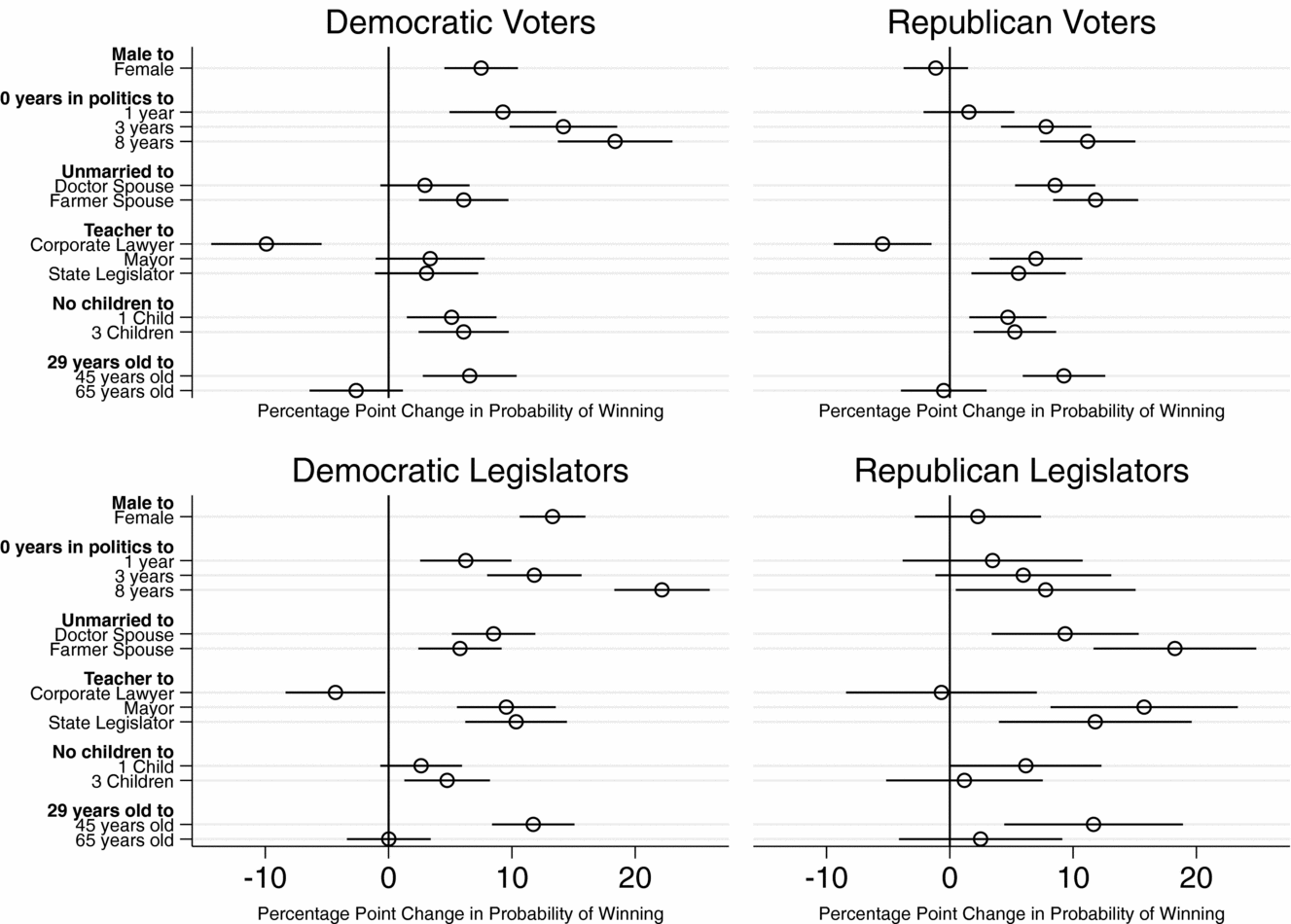
Second, in line with scholarship on the partisan gender gap, in Figure 3 we examine whether partisanship accounts for the pro-woman bias (Alexander and Andersen Reference Alexander and Andersen1993, 541; Sanbonmatsu and Dolan Reference Sanbonmatsu and Dolan2009; McDermott Reference McDermott1997; Koch Reference Koch2000, Reference Koch2002).Footnote 21 To a significant extent it does, but accounting for the partisanship of the respondent does not produce an anti-female bias either. As Figure 3 shows, when broken down by partisan identity, both Democratic voters and public officials show clear preferences for female candidates. Republican legislators show positive but not statistically significant preferences for female candidates while the Republican electorate has a slightly negative but statistically insignificant reaction against female candidates. Overall, both when looking at the baseline results and when looking at the expressed preferences of respondents of different genders and partisanship, there is little evidence of outright discrimination.Footnote 22
Do female candidates face double standards?
To search for evidence of a double standard, we ask whether specific characteristics, when attached to a female candidate, are evaluated differently than those same characteristics when attached to a male candidate. That is, is there an interaction between specific characteristics and female candidacies that drives a wedge between respondents’ preferences?
Figure 4 presents the main results for each survey broken down by the randomly assigned sex of the candidate. The first column shows the coefficients and confidence intervals when the candidate is female, while the second column shows the results when the candidate is male. The final column presents the coefficient and confidence intervals derived by a difference of means test when the coefficient for male candidates in column 2 is subtracted from the coefficient for female candidates in column 2. The null hypothesis is that women and men are treated the same when they have similar attributes. Rejecting the null hypothesis in the third column would be evidence of a double standard.
Testing for the Double Standard: Are Women Differentially Penalized or Rewarded for Possessing Different Attributes?

The difference in means (third column) can be read by saying: Suppose both a female and a male candidate move from having zero years in experience to having one year in experience. Is this change evaluated similarly for men and women? If the confidence intervals include zero, we cannot reject the null hypothesis that male and female candidates are evaluated similarly. Men do get slightly more credit for having one year of experience compared to women (a negative coefficient in the third column), but this difference is not statistically significant. In fact, with the exception of having three children, where men are slightly rewarded, there are no statistically significant differences in how respondents evaluate male and female candidates.
Next, we examine whether respondents shift goal posts to women's disadvantage by looking at the subset of candidate profiles where a man was running against a woman. This constitutes 50% of all profiles seen by respondents. We then interact each candidate attribute with the candidate's gender and conduct an F-test of the joint significance of the interaction terms.Footnote 23 By testing for an interaction between a candidate's gender and all of their other attributes in the subset of rating tasks where a female candidate faced a male candidate, we can test whether successful female candidates require different traits than successful male candidates. In the legislator sample, we fail to reject the null hypothesis that the interaction terms are statistically different from zero (p = 0.22); in the voter sample, we find similar results (p = 0.6). Full results are reported in Online Appendix 4. By failing to reject the null hypothesis of an interaction between a candidate's gender and their other attributes, we find no evidence of shifting goal posts to the disadvantage of female candidates.
To summarize our findings on double standards, we find that men and women are evaluated similarly if they have high versus low levels of political experience, if they are unmarried, and if they have particular previous occupations. However, on average, respondents reward men more for having more children than women.
Do women face a double bind?
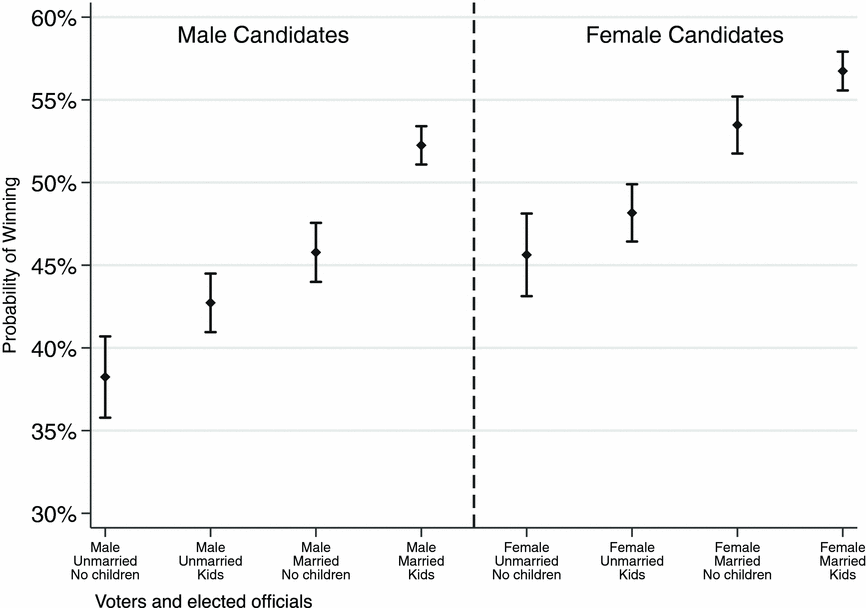
Although we do not find evidence of a double standard, it would be wrong to conclude that voters treat male and female candidates equally. Although many voters prefer female candidates “all else equal,” voters and political elites simultaneously value certain traits that are more costly to female candidates than male candidates. Recall from Figure 1 that voters and elected officials preferred candidates who were married with children. The boost a candidate gets from being married and/or having one or more child is comparable, in the judgment of these groups of respondents, to one or more years of experience in office. Figure 5 makes this point more explicit by presenting point estimates and confidence intervals for the probability of winning. The plot shows, for both male and female candidates, the increasing probabilities of being elected by having children, by being married, and being married with children, holding all other attributes at their means.Footnote 24 The probability of an unmarried, childless male candidate getting elected is 38.2%, but that same male candidate, when married with children, has a 52.2% chance of winning (this difference of 14 percentage points has p < 0.001). Similarly, the probability that an unmarried, childless female candidate gets elected is 45.6%, but that same female candidate, when married with children, wins at a rate of 56.7% of winning (this difference of 11.1 percentage points has p < 0.001). The gains for moving from married to married with children are 6.5 percentage points for men (p < 0.001) and 3.3 percentage points for women (p = 0.005). In both cases, male and female candidates benefit greatly from having traditional family traits of being married and having children.
Testing for the Double Bind: Do Respondents Prefer Politicians with Greater Family Responsibilities?
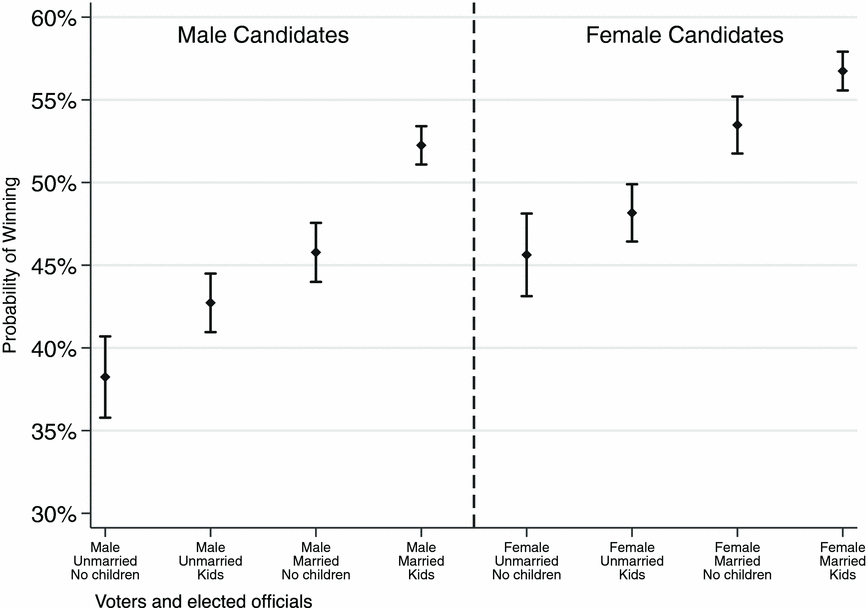
As we argue in the discussion section, the preference for gendered family roles amounts to a double bind for female candidates even though voters and political elites do not require female candidates to be (otherwise) of higher quality. In the population as a whole, 87% of adults between 18 and 40 who did not yet have children said they wanted kids someday.Footnote 25 This number is close to the actual pattern of childrearing among men in “typical feeder careers” for politics— 84% of men in the Citizen Political Ambition study had at least one child—but quite out of sync with the 66% of women in feeder careers that have children (Lawless and Fox Reference Lawless and Fox2010). Among actual office holders, men and women are as likely to have children (around 70%), but male officeholders have more children. Ultimately, the single and childless women available to serve as politicians are not favored by voters and political elites, whereas women who are married with children may be less interested in the job, or required to work extra hours because of gender-unequal family burdens (Lawless and Fox Reference Lawless and Fox2004; Carroll and Sanbonmatsu Reference Carroll and Sanbonmatsu2013, table 2.5). Thus voters’ and political elites’ avowed preference for female candidates in the abstract is potentially offset by their preference for candidates who are wives and mothers.
Inferential concerns
The findings presented above and the conjoint method itself raise several questions about the validity of making causal inferences regarding bias against women in politics. First, measuring preferences in surveys raises the concern of social desirability bias – the phenomenon where respondents give the answer they think researchers will find to be more socially acceptable. In a study of immigrant naturalization in Switzerland, where municipalities use referenda to grant citizenship to foreign residents, Hainmueller, Hangartner, and Yamamoto (Reference Hainmueller, Hangartner and Yamamoto2015) find that the real-world preferences of voters are mirrored in conjoint results. This suggests that people did not answer survey questions differently than they made real decisions about immigrants’ right to become Swiss citizens. Although we cannot measure the extent of social desirability bias in this study, the result that most groups of respondents preferred the female candidate raises the possibility of social desirability bias (Sanbonmatsu Reference Sanbonmatsu2002; Streb et al. Reference Streb, Burrell, Frederick and Genovese2008; Krupnikov et al. Reference Krupnikov, Piston and Bauer2016). Nevertheless, since the conjoint experiments force respondents to choose among candidates with randomly scrambled personal attributes, our own interest in gender would not have been obvious in the experiment. This likely lessens the degree to which our results are skewed by social desirability bias.
Second, an additional concern with conjoint experiments, and survey research more generally, is that these findings may reflect “cheap talk.” In the real-world setting where political elites must actively recruit, mentor, and assist aspiring candidates, and where voters must pay the costs of learning about candidates and voting, these biases might operate differently. Although it is possible that settings in which actions have greater costs than those imposed in survey experiments will provide more fertile conditions for bias to emerge, a highly powered recent correspondence experiment on gender and political mentorship showed that female students contemplating a career in politics were more likely to receive encouraging email responses from public officials than male students (Kalla, Rosenbluth, and Teele Reference Kalla, Rosenbluth and Teele2018), suggesting that even in a context where politicians have to exert effort to communicate, women do not necessarily face a wall of exclusion.Footnote 26
Third, we worried that the specific attributes listed, and the wording that we used, could have influenced our findings. The 2017 follow up to the elite survey decouples occupation from political offices held in some specifications, and changes “corporate lawyer” to “lawyer” in other specifications, to see if these design choices were driving our findings.Footnote 27 As we show in Online Appendix 3.3-3.5, we do not find evidence of a design effect.
Finally, while conjoint experiments allow researchers to create a controlled environment with high internal validity, one might question how generalizable these results may be to actual elections where candidates have greater ability to decide which of their biographical aspects to highlight. Some information, such as gender, does not need to be explicitly communicated to voters because it can be inferred based on the first name of the candidate (McDermott Reference McDermott1997). Parental status, on the other hand, could be concealed in a campaign, while in our conjoint setup all profiles made explicit comparisons of parental status across hypothetical candidates.Footnote 28 Although this is a potential limitation of our design, it is telling that politicians sometimes attack their rivals in ways we would predict, as when Andrea Leadsom argued that Theresa May's childlessness meant that May lacked a personal stake in Britain's future (Blakemore Reference Blakemore2016). Even if candidates choose not to reveal their marital or parental statuses, their rivals may have an incentive to do so.
DISCUSSION
Overall, we find no evidence of outright hostility toward female candidates, nor do we find the existence of double standards insofar as men and women with similar attributes are evaluated in the same way. We do, however, find that voters and political elites prefer candidates that are married with children. These preferences may penalize women relative to men because of gendered family responsibilities that present a greater burden for most women than they do for men. In other words, they amount to a double bind.
To understand the double bind in practice, consider recent evidence from time-use surveys in the United States.Footnote 29 Although there has been an unambiguous narrowing of the housework gap since the 1960s—married men with children have nearly doubled the amount of effort they put into housework while married women with children's effort has almost halved—and a marked increase in married men's care for children (from 2.6 hours per week in 1965 to 7.2 hours a week in 2009–2010)—women spend an additional 16.7 hours per week than men on childcare and housework, amounting to an average workweek that is 50% longer than men's.Footnote 30 Notably, the gender gap in housework is not erased if we consider dual earner households, households where women are very high earning, or where women earn the majority of household income.Footnote 31 Women who are primary breadwinners or high earners in dual-income households can expect a break in housework to the tune of 10–20 minutes per day when compared with women who contribute less to household earnings.Footnote 32
Because of what Arlie Hochschild famously called “the second shift,” women with kids and those in dual earner households have less time to devote to themselves or their careers. This leaves little room for additional positions in politics that are outside of their primary roles. In addition, there are very high personal costs for women who attain high-level political positions. In a study of Swedish mayoral elections, Folke and Rickne (Reference Folke and Rickne2017) show that the probability of divorce rose abruptly for women who narrowly won mayoralities relative to men who won with a similar margin. Given that the personal costs of attaining a political office may be higher for women than men, and that the burdens of housework do not abate, it should come as no surprise that marriage depresses women's political ambition.Footnote 33
In short, the double bind creates the conditions under which women are underrepresented in politics through internal and external forces. We envision at least three channels through which this operates. First, an unequal gender division of labor reduces the political ambition of professional women with children because they do more work in the home, and, if their political position would reduce household income, they would be less able to outsource domestic labor. In addition, women may feel the need to curtail displays of their career ambition (Bursztyn, Fujiwara, and Pallais Reference Bursztyn, Fujiwara and Pallais2017), and avoid careers that require it (Bertrand, Kamenica, and Pan Reference Bertrand, Kamenica and Pan2015) in order to remain married. Second, professional women without children may not see themselves as fitting the “mold” of what voters want, which will lower the ambition of this capable group. Finally, elite and voter preferences for qualified professionals means that women who are homemakers, who may have time for political work at some stages in the life cycle, may not be entrusted with political office (Gimenez et al. Reference Gimenez, Karpowitz, Monson and Preece2017).
As it turns out, the women who run for office have chosen a path of lower family obligation than the average male candidate, and of the average female voter. Within the pool of professionals in the political “feeder” careers like business and law, women are much less likely to be married than men (70% versus 86%) (Lawless and Fox Reference Lawless and Fox2004). These patterns are mirrored within the population that serves in legislatures. Among state representatives, 67% of women are married contrasted with 87% of men (Carroll and Sanbonmatsu Reference Carroll and Sanbonmatsu2013, table 2.5). And these proportions are remarkably similar for the 115th Congress, where 68% of congresswomen are married compared with 89% of congressmen (Project Vote Smart). While men and women officeholders are as likely to have children (around 70%), male officeholders have more: women have an average of 1.5 children compared to 1.9 for men. The choices that female politicians make of lower family obligation undoubtedly reflect a rational decision-making process for women with political ambition, but the double bind creeps in if those women struggle to connect with voters that implicitly favor a different candidate profile.
A growing body of scholarship reveals the ubiquity of the double bind. As Gimenez et al. (Reference Gimenez, Karpowitz, Monson and Preece2017) show, even in the relatively low-stakes election of state-level party caucus members, and even among Republicans who place greater emphasis on women's roles as mothers and caregivers, women are more likely to get elected if they are highly successful at both career and family. These findings are mirrored in other recent experimental work in Malawi which shows a preference for married women with children over other types of candidate backgrounds (Clayton et al. Reference Clayton, Robinson, Johnson and Muriaas2017). The double bind is also evident in public opinion research that uncovered Latin Americans’ heightened support for “supermadres” (e.g., Schwindt-Bayer Reference Schwindt-Bayer2010, 25). Together, these studies raise questions on how to think about voter and elite preferences, and how to study the double bind in the future.
Why might voters and elites prefer female politicians that have families over those who do not? One reason might lie with the symbolic importance of “family values” to voters. A second reason may be that people are using political ambition, in combination with the trappings of family life, as a signal about candidate quality that is independent of political experience. Perhaps people view women with kids, who still want a high level job, as having some unobserved level of energy or skill. Future work could evaluate whether there is a signaling game underlying our findings by using cues for quality other than previous political experience. A second reason that voters may prefer married women with children may be that single women are perceived to be selfish while those who are married without children are seen as too power hungry (Jamieson Reference Jamieson1995). Even with children, women who are believed to seek power for its own sake may be demonized (Jalalzai Reference Jalalzai2018).
Moving forward, as the literature on gender and candidate choice develops we should ask whether something is missing from experiments where a candidate's gender is expressed through words rather than in a more textured way. Since the contours of gender are communicated through things like voice, phenotype, dress, and looks (Bernhard Reference Bernhard2017) follow-up work might use pictures and videos followed by candidate information to more subtly probe voters’ and political elites’ electoral preferences. Future work should also examine whether the double bind performs similarly for other nondominant groups. In other words, are the traditional family preferences imposed equally for people of color or for LGBTQI politicians? To evaluate the double bind for these groups, one might juxtapose candidates' images (such as in campaign ads) with and without families. One could contrast support for politicians that have heterosexual families with gay and lesbian families, and those of different ethnic or racial backgrounds, to further probe the presence of double standards and double binds for other nondominant groups.
CONCLUSION
Voters and legislators do not seem to hold female candidates in disregard; all else equal, they prefer female to male candidates. But they reserve their highest reward for women who can both do the job of a politician and that of a wife and mother. To the degree that voters tend to choose representatives who have traditional family structures, women bear the burden to convince the public that they can do both jobs well. In other words, female candidates have to be superwomen while male candidates enjoy the luxury of delegating family work to others (Gimenez et al. Reference Gimenez, Karpowitz, Monson and Preece2017; Clayton et al. Reference Clayton, Robinson, Johnson and Muriaas2017; Schwindt-Bayer Reference Schwindt-Bayer2010). In practice, this means that bias aginst women in politics can exist even though people evaluate candidate qualifications similarly across the sexes.
The extra load that would-be female candidates must carry raises potential problems for the quality of representation. As Besley and Coate (Reference Besley and Coate1997) point out, choosing candidates that mirror typical demographic profiles, as a way of reducing agency costs, comes at the cost of undervaluing candidates who might be superior legislators in other respects. If legislative ability is unevenly distributed across the population, but we maintain a commitment to idealized versions of politicians, gendered preferences that discourage the “wrong types” of women from running for office is a drag on representational quality. These preferences for leaders with traditional families also have implications for women's decisions to emerge as candidates and party leaders’ decisions to promote women.Footnote 34
It seems, then, that female candidates have to choose their poison. Voter expectations of stereotypical family roles put female candidates at a serious disadvantage given the longer hours that women spend on family work than men (Bianchi Reference Bianchi2006; Lawless and Fox Reference Lawless and Fox2004; Iversen and Rosenbluth Reference Iversen and Rosenbluth2006). Female candidates can either cut back on family roles to compete for election and career advancement, while running the risk of being unpopular candidates; or they can strive to be the perfect wives and mothers without hours in the day to go head-to-head with their male counterparts. It is no wonder that so few women have put themselves in this implausible situation.
It remains for future work to explore how the double bind operates in politics outside the U.S. In Germany, Chancellor Angela Merkel has been a successful childless politician, while CDU Secretary General Annegret Kramp-Karrenbauer has been a successful politician with a stay-at-home spouse who cares for her three sons. If voter preferences operate similarly in Germany as in the U.S., both of them succeeded in spite of handicaps: Merkel's nonconformist childlessness and Kramp-Karrenbauer's nonconformist bread-winner role. Further, the double bind we identify may operate less powerfully in proportional representation (PR) systems because of the greater importance of partisan platforms for electoral success compared to district-based systems. Yet it is an empirical question whether climbing the leadership ladder in PR parties requires relatively greater expenditures of time, as in the business world in PR countries, or heightened displays of social conformity, as in American electoral politics.
Several decades ago, political theorist Susan Muller Okin (Reference Okin1989) recognized the grip of gendered family roles on women's chances for equality in other domains, and recommended that all paychecks be split between spouses to rebalance bargaining power within the family. Although her solution requires more state coercion in the service of gender equality than most citizens are willing to concede, it points a way out of the current equilibrium.Footnote 35 As social mores around family roles change, notably with the greater gender-egalitarian norms of same-sex families, “married with children” need no longer impose a disproportionate burden on women (Goldberg, Smith, and Perry-Jenkins Reference Goldberg, Smith and Perry-Jenkins2012). But until then, the odds are against female candidates: if women have the characteristics that voters and other public officials prize, they likely have too little time to actually take on the job.
SUPPLEMENTARY MATERIAL
To view supplementary material for this article, please visit https://doi.org/10.1017/S0003055418000217. Replication material can be found on Dataverse at: https://doi.org/10.7910/DVN/FVCGHC.






Comments
No Comments have been published for this article.