Introduction
Durum wheat (Triticum turgidum L.) represents the major ingredient of such an important food as pasta (Sissons, Reference Sissons2008). In the context of environmental changes, it is crucial to evaluate the genomic diversity of nowadays commercial varieties. Durum wheat varieties used in Portugal and previously assessed for heat stress response (Bento et al., Reference Bento, Pereira, Viegas and Silva2017) were evaluated regarding the variability of coding sequences associated with technological traits and non-coding repetitive sequences.
Glutenins are polymeric gluten proteins determinant to dough elasticity (Sissons, Reference Sissons2008) among which low molecular weight glutenin subunits (LMW-GS) form inter-molecular disulphide bonds creating polymers responsible for gluten structure and properties (D'Ovidio and Masci, Reference D'Ovidio and Masci2004). Sequences coding for LMW-GS, a diverse protein family, were previously characterized in bread wheat (Zhang et al., Reference Zhang, Liu, Yang, Liu, Sun, Guo, Li, Wang, Ling and Zhang2011). LMW-1 and LMW-2 subunits were related to durum wheat gluten viscoelasticity, being LMW-2 associated with superior dough quality (Payne et al., Reference Payne, Jackson and Holt1984).
Genomic characterization using Inter Retrotransposons Amplified Polymorphism (IRAP) and Inter Simple Sequence Repeat (ISSR) techniques has been successfully used to identify several crop species and varieties (Smykal, Reference Smykal2006; Bento et al., Reference Bento, Gustafson, Viegas and Silva2011; Carvalho et al., Reference Carvalho, Guedes-Pinto and Lima-Brito2012; Khan et al., Reference Khan, Pandey, Thomas, Akkaya, Kayis, Ozsensoy, Hamurcu, Gezgin, Topal and Hakki2015; Tomás et al., Reference Tomás, Dias, Silva, Oliveira, Suso, Viegas and Veloso2016a, Reference Tomás, Rodrigues, Varela, Veloso, Viegas and Silvab). Both methodologies uncover insertional polymorphisms: IRAP methodology using outward primers to a long terminal repeat of LTR-retrotransposons (Kalendar and Schulman, Reference Kalendar and Schulman2006) and ISSR anchored primers to SSR (Zietkiewicz et al., Reference Zietkiewicz, Rafalski and Labuda1994).
In this work, we assessed LMW-GS variability and used IRAP and ISSR fingerprinting techniques to characterize the diversity of T. durum varieties grown in Portugal.
Experimental
Six durum wheat varieties used in Portugal and previously assessed regarding tolerance to heat stress treatments in distinct developmental stages (Bento et al., Reference Bento, Pereira, Viegas and Silva2017) were used: Celta, Hélvio and Marialva (Portuguese); Saragolla and Severo (Italian); and DonDuro (Greek). DNA of at least three individual plants from each variety was isolated from leaves using Citogene® DNA Purification Kit. LMW-GS analysis used primers for conserved regions (Zhang et al., Reference Zhang, Liu, Yang, Liu, Sun, Guo, Li, Wang, Ling and Zhang2011) and specific for LMW-1 and LMW-2 subunits (D'Ovidio, Reference D'Ovidio1993). IRAP used primers targeting the LTR region of retrotransposons Angela and Fatima and ISSR used the primer (AAG)6C (online Supplementary Table S1).
PCR products were separated through electrophoresis and at least three profiles per individual plant were analysed with GelAnalyzer 2010a. Concatenated data was used to calculate similarity matrixes with simple matching (SM) coefficient and to produce PCoA scatter plot using NTSYSpc version 2.02i (Rohlf, Reference Rohlf2000), and NETWORK 5.0.0.0 (Fluxus Technology Ltd., Clare, Suffolk, England) was used to construct median joining networks.
Discussion
Previous studies showed the importance of LMW-GS genes variability in durum wheat end-use quality (D'Ovidio and Masci, Reference D'Ovidio and Masci2004; Sissons, Reference Sissons2008). The primer pair designed to characterize bread wheat varieties targeting the conserved regions of LMW-GS genes and flanking the variable ones (Zhang et al., Reference Zhang, Liu, Yang, Liu, Sun, Guo, Li, Wang, Ling and Zhang2011) yielded informative profiles in durum wheat due to the phylogenetic proximity between these two wheat species (online Supplementary Fig. S1a). No intra-varietal diversity and a marked lack of inter-varietal diversity were observed since all varieties except Hélvio showed identical banding profiles. On the other hand, the LMW-2 subunit related with superior quality (Payne et al., Reference Payne, Jackson and Holt1984; D'Ovidio, Reference D'Ovidio1993) was identified in all individuals of Hélvio, DonDuro, Saragolla, Severo and three out of four individuals from the variety Marialva as expected in commercial varieties (online Supplementary Fig. S1b). Contrastingly, one individual from the variety Marialva and all Celta individuals showed the presence of LMW-1 allelic form. The median joining network obtained from LMW-GS and LMW-1/LMW-2 concatenated data (Fig. 1(a)) highlighted the low variability observed since besides Hélvio, which is the variety that accumulated more mutational steps, only variety DonDuro was distinguished. Low variability detected among coding regions in durum wheat varieties is not surprising and was previously reported in HMW-GS and LMW-GS composition of Spanish, Italian and Moroccan cultivars (De Vita et al., Reference De Vita, Nicosia, Nigro, Platani, Riefolo, Di Fonzo and Cattivelli2007; Subira et al., Reference Subira, Pena, Alvaro, Ammar, Ramdani and Royo2014; Henkrar et al., Reference Henkrar, El-Haddoury, Iraqi, Bendaou and Udupa2017). This lack of diversity regarding end-use traits can be a direct consequence of breeding programme strategies generally used (De Vita et al., Reference De Vita, Nicosia, Nigro, Platani, Riefolo, Di Fonzo and Cattivelli2007).
Median-joining networks obtained in Triticum durum cultivars Celta, Hélvio, Marialva, DonDuro, Saragolla and Severo from (a) LMW-GS genes and LMW-1/LMW-2 subunits concatenated profiles and from (b) IRAP and ISSR concatenated profiles. Branches are proportional to the number of differences between haplotypes and nodes are proportional to frequencies of haplotypes. Black dots on branches indicate the mutational steps when more than one and white dots represent median vectors.

To further access genomic variability, we used ISSR and IRAP molecular markers targeting repetitive elements. These markers highlighted 57% polymorphic amplicons allowing the discrimination between varieties and even between individuals of the same variety (online Supplementary Tables S2 and S3). Even though the polymorphism level detected was lower than previously reported for durum wheat landraces using ISSR or IRAP (Pujar et al., Reference Pujar, Tamhankar, Gupta, Rao and Ranjekar2002; Khan et al., Reference Khan, Pandey, Thomas, Akkaya, Kayis, Ozsensoy, Hamurcu, Gezgin, Topal and Hakki2015) it was significant considering only commercial varieties. Moreover, the separated characterization of multiple individuals of each variety, contrarily to previous studies (Pujar et al., Reference Pujar, Tamhankar, Gupta, Rao and Ranjekar2002; Carvalho et al., Reference Carvalho, Lima-Brito, Macas and Guedes-Pinto2008; Carvalho et al., Reference Carvalho, Guedes-Pinto and Lima-Brito2012; Shirnasabian et al., Reference Shirnasabian, Etminan, Mohammadi and Shooshtari2014; Khan et al., Reference Khan, Pandey, Thomas, Akkaya, Kayis, Ozsensoy, Hamurcu, Gezgin, Topal and Hakki2015), allowed the determination of similarity coefficient values higher (0.60–0.92, online Supplementary Table S4) than those previously reported using ISSR in durum wheat landraces (Carvalho et al., Reference Carvalho, Lima-Brito, Macas and Guedes-Pinto2009) or advanced genotypes (Zamanianfard et al., Reference Zamanianfard, Etminan, Mohammadi and Shooshtari2015). Additionally, these multiple individual analyses disclosed a much more obvious intravarietal diversity assessed through IRAP and ISSR in comparison with LMW.
Intravarietal diversity in repetitive genome regions was expected, but the ISSR/IRAP banding profiles and the presence of LMW-1 in one Marialva individual plant similar to Celta variety were not expected. Regarding the Marialva outlier genotype, we cannot completely discard the hypothesis of seed admixture, although all varieties were maintained by controlled self-fertilization during at least four consecutive years.
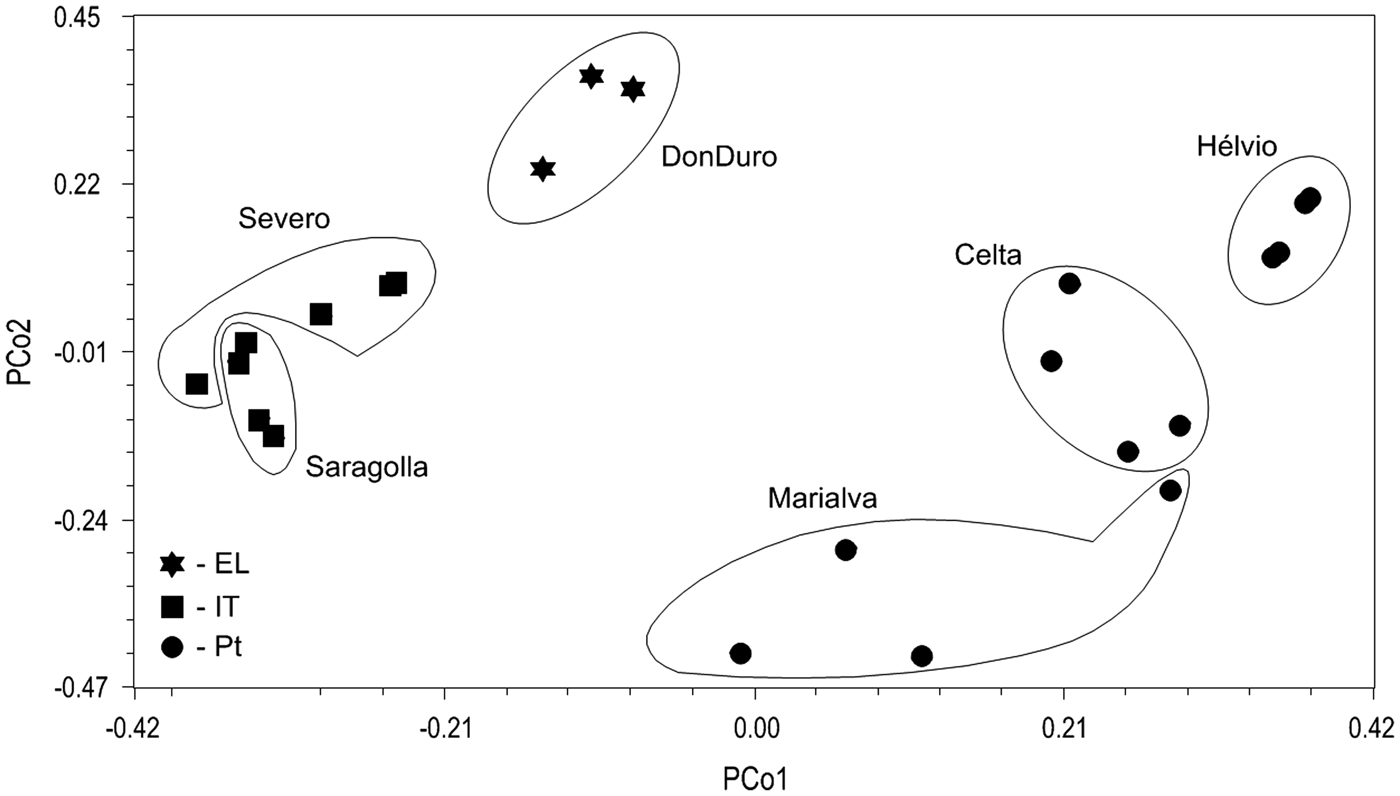
Importantly, combining ISSR and IRAP median joining network (Fig. (1b)) produced almost a unique profile for each individual (20 distinct profiles among 23 individuals). However, different individuals of the same variety were clustered, allowing inference of phylogenetic relationship between varieties. PCoA scatter plot (Fig. 2) with the first two principal components (51.9% variation) also grouped individuals by variety and separates varieties in three groups accordingly with their geographical origin.
Principal coordinate analysis of IRAP and ISSR profiles based on the geographic origin of six durum wheat varieties: Celta, Hélvio and Marialva (Portugal); Saragolla and Severo (Italy); and DonDuro (Greece).

Overall, our study revealed opposing scenarios coexisting in durum wheat genotypes regarding variability levels of coding sequences associated with important technological traits and repetitive genome domains. The first, being a target of artificial selection, showed low variability in durum wheat commercial varieties, favouring the presence of particular alleles, while more labile and less scrutinized repetitive sequences retrieved high variability levels between and within the varieties studied.
Acknowledgements
We would like to thank Eng° Benvindo Maçãs (INRB/INIAV Portugal) and Engª Joana Aleixo (ANSEME Portugal) for the seeds used in the present study. Miguel Bento was funded by an FCT (Fundação para a Ciência e a Tecnologia, Portugal) Post-doctoral research fellowship (SFRH/BPD/80550/2011) and Manuela Silva by the FCT Investigator Program (IF/00834/2014). This work was supported by the FCT LEAF Unit (UID/AGR/04129/2013).
Supplementary material
The supplementary material for this article can be found at https://doi.org/10.1017/S1479262119000133