Introduction
Stockpersonship has been defined as the human element ‘necessary in optimising health, welfare, husbandry, management and thereby both physical and financial performance in animal production’ (Beynon, Reference Beynon1991) and there exits a growing body of research that offers empirical evidence supporting this role (Hemsworth and Coleman, Reference Hemsworth and Coleman1998). Given that stockpeople can improve welfare and output, it would be advantageous if it were possible to predict the extent of this influence through psychometric methods (that is, psychological testing, for example, personality assessment). If we could effectively relate psychological measures to successful stockpersonship, it may prove possible to select employees with more appropriate psychological attributes or select those existing employees who would benefit most from training. Existing research in this area has focused on the role of personality and attitudes, two psychological concepts that are considered central in explaining the stockperson–animal relationship (Hemsworth and Coleman, Reference Hemsworth and Coleman1998). However, it should be noted that problems can arise when non-optimum measures or techniques are used to assess these constructs. Hemsworth and Coleman (Reference Hemsworth and Coleman1998, p. vii) expand this argument to contend that these problems ‘Have been exacerbated by the lack of interest shown by psychologists in this important area’. There has been a gradual evolution in the tools and measures that psychologists have developed, for example, there is now a consensus that there are five main personality factors (namely, extraversion, agreeableness, conscientiousness, emotional stability and intellect) (Costa and McCrae, Reference Costa and McCrae1976; Digman, Reference Digman1990; Hofstee et al., Reference Hofstee, deRaad and Goldberg1992). It is understandable that many researchers could use an existing personality measure that would no longer be regarded as a valid tool within the psychological community.
Personality involves enduring psychological or behavioural characteristics that can be used for comparison or prediction (Cattell, Reference Cattell1950; Guilford, Reference Guilford1959; Mischel, Reference Mischel1986; Pervin, Reference Pervin1989). It may be the case that certain personality traits predispose individuals to be better stockpeople and there has been a limited amount of important work conducted in this area. In 1972, Seabrook concluded that herdsmen’s personality influences milk yield. Seabrook attempted to determine personality by means of a structured interview; however, after interviewing three stockmen he reported that he did not regard the procedure as a successful method of measuring personality. More recently, Waiblinger et al. (Reference Waiblinger, Menke and Coleman2002) have reported on personality characteristics that correlated with dairy stockpeoples’ behaviours and attitudes. Due to time constraints, however, it was not feasible to administer an established, validated personality measure; therefore the researchers created their own 14-item (three-factor) scale. Other studies have investigated the stockperson’s personality on swine farms utilising Catell’s 16-Personality Factor Questionnaire (Ravel et al., Reference Ravel, D’Allaire and Bigras-Poulin1996) or the Myer–Briggs’s indicator (Beveridge, Reference Beveridge1996). These studies are problematic as the instruments they employed are no longer regarded by psychologists as the most optimum personality measures (Barrett and Kline, Reference Barrett and Kline1982; Smith et al., Reference Smith, Gregg and Andrews1989; Cooper, Reference Cooper1998). There has been some endeavour to measure personality in relation to stockpeople and their performance; however, little effort has been concentrated on the big-five model. Only one Czechoslovakian study has been published (Panamá Arias and Spinka, Reference Panamá Arias and Spinka2005). This is somewhat surprising since the model describes traits that many authors (for example, Tett et al., Reference Tett, Jackson and Rothstein1991; Tokar et al., Reference Tokar, Fischer and Subich1998; Barrick and Mount, Reference Barrick and Mount1991; Goodstein and Lanyon, Reference Goodstein and Lanyon1999) have suggested as being most strongly related to job performance. In Hemsworth and Coleman’s extensive review (1998, p. 105), not only do they offer a complex model and causal relationships regarding the stockperson–animal relationship but also note ‘that research on stockpeople using a big-five measure of personality needs to be done’.
Attitudes are evaluative predispositions, externally directed towards objects, which are useful in predicting behaviours (Fishbein and Ajzen, Reference Fishbein and Ajzen1974; Hemsworth and Coleman, Reference Hemsworth and Coleman1998). There is existing literature highlighting the importance of attitudes held by stockpeople in relation to their subsequent behaviour towards the animals they work with. For example, there is evidence to suggest that stockpeople who report more negative attitudes towards animals perform more negative behaviours when working with pigs (Hemsworth et al., Reference Hemsworth, Barnett, Coleman and Hansen1989; Coleman et al., Reference Coleman, Hemsworth and Hay1998) and veal calves (Lensink et al., Reference Lensink, Boissy and Veisser2000). There have also been attempts to measure the attitudes relevant to dairy stockpeople’s behaviour (Hemsworth et al., Reference Hemsworth, Coleman, Barnett and Borg2000 and Reference Hemsworth, Coleman, Barnett, Borg and Dowling2002). Currently, only two studies have related the stockperson’s attitude with the milk yield they obtain (Breuer et al., Reference Breuer, Hemsworth, Barnett, Matthews and Coleman2000; Waiblinger et al., Reference Waiblinger, Menke and Coleman2002).
The psychological correlates of personality and attitudes may be theoretically important for predicting the behaviour of the stockperson and, perhaps more importantly, output measures (for example, milk yield). As such, they may also be used to discriminate between more and less effective candidates to work with animals. Some of the existing literature, however, is open to criticism. Personality has not been evaluated with suitable inventories in certain studies (Beveridge, Reference Beveridge1996; Ravel et al., Reference Ravel, D’Allaire and Bigras-Poulin1996). Attitudes appear to be the best predictor of stockperson behaviour (Hemsworth et al., Reference Hemsworth, Barnett, Coleman and Hansen1989, Reference Hemsworth, Coleman, Barnett and Borg2000 and Reference Hemsworth, Coleman, Barnett, Borg and Dowling2002; Coleman et al., Reference Coleman, Hemsworth and Hay1998; Lensink et al., Reference Lensink, Boissy and Veisser2000) although this research is not yet sufficiently substantiated in relation to predicting milk yield (Breuer et al., Reference Breuer, Hemsworth, Barnett, Matthews and Coleman2000; Waiblinger et al., Reference Waiblinger, Menke and Coleman2002). Therefore the aim of this study was to investigate the relationships amongst the big-five personality traits and attitudes towards dairy cows and also to discover whether the attitudes and personality of the stockperson could be related to the milk yields they obtain.
Material and method
This study employed a postal questionnaire design. The names and addresses of Northern Ireland farmers who were (or had recently been) registered pedigree dairy cow breeders were obtained from the Department of Agriculture and Rural Development. Registered pedigree breeders were chosen to ensure a less-variable range of cows, and it was hypothesised that this population would have more accurate records and were more likely to complete the questionnaires. In total, 834 addresses were obtained. Each address received one questionnaire pack and the covering letter clearly requested for the questionnaires to be completed by the person who principally worked with the cows. There were 361 questionnaires returned within the 4-week deadline (response rate of 43%). Of those returned questionnaires, 50 were not included; questionnaires were not included if all the questions were not answered or if the farm no longer kept dairy cows. This resulted in a sample of 311 questionnaires.
The questionnaire pack
A questionnaire pack was created and piloted with the staff in the Agricultural Research Institute of Northern Ireland at Hillsborough. A cover letter was included to explain the aims of the study. The pack contained an attitude questionnaire and a personality questionnaire (detailed below). A range of other questions was asked to obtain milk yield and other production-related variables (for example, number of cows in herd, number of additional workers, breeds of cows, etc.). The pack also included a postage paid envelope for returning the completed questionnaires.
The personality questionnaire
The personality scale employed was an existing measure of the ‘big-five’ traits, which assessed extraversion, agreeableness, conscientiousness, emotional stability and intellect. The 50-item questionnaire was obtained from the International Personality Item Pool (2001) (http://ipip.ori.org/ipip/). These subscales demonstrated concurrent validity with the NEO-PI-R with correlations (corrected for unreliability) ranging from 0.83 to 0.92 and acceptable internal consistency with Cronbach’s alpha ranging from 0.77 to 0.86. An example of a conscientiousness item is ‘I am always prepared’; the respondent would then indicate whether they agree or disagreed with the statement on a five-point likert scale. There were 10 items for each trait, keyed in both directions to control for acquiescence.
The stockperson attitudes questionnaire
It was necessary to construct a questionnaire to assess attitudes toward working with dairy cows. This required a sample of 200 individuals who had experience working with dairy cows to complete a questionnaire and then factor analysing the subsequent data. Factor analysis identifies the number of latent factors or underlying traits in the data and the items that load on each factor (Cooper, Reference Cooper1998; Norman and Streiner, Reference Norman and Streiner2000). It was decided not to use Northern Ireland dairy farmers when constructing the questionnaire as this population would be used in the main study. Using the same sample to construct and validate a questionnaire is not the best practice (Cooper, Reference Cooper1998). Instead, students on agricultural courses were chosen in order to obtain large numbers of people who had experience working with cows. Although students did differ from the Northern Ireland dairy farmers on the variables of age and educational level, these variables were not related to the attitudinal factors that were eventually extracted.
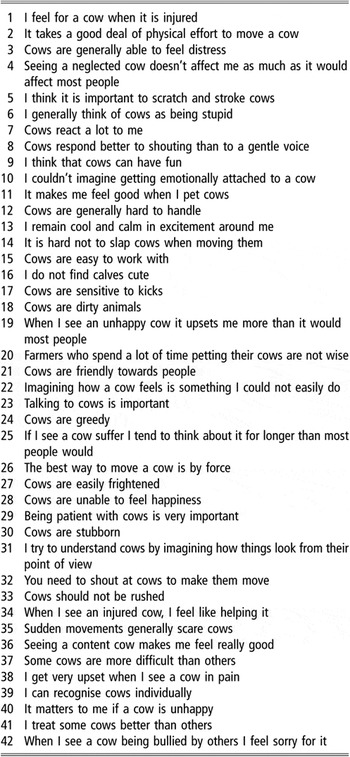
Forty-two items were created (see Table 1), aiming for high correspondence between the target (dairy cows) and action elements (physical force, verbal force, empathic feeling, etc.) that had been identified in the literature (Ajzen and Fishbein, Reference Ajzen and Fishbein1977). The format used with a number of these items was based on existing research. For example, questions 1, 7, 13, 16, 27 and 38 were modified from Coleman et al. (Reference Coleman, Hemsworth and Hay1998) and questions 4, 6, 9, 18, 19, 25, 28, 36 and 42 were adapted from Beveridge (Reference Beveridge1996). Items that appeared to assess similar areas (for example, questions relating to the use of force or questions relating to empathy) were approximately evenly distributed. To control for potential acquiescence, the items were keyed in different directions. Responses were gathered on a five-point Likert scale ranging from ‘strongly agree’ to ‘strongly disagree’.
The 42 attitude items

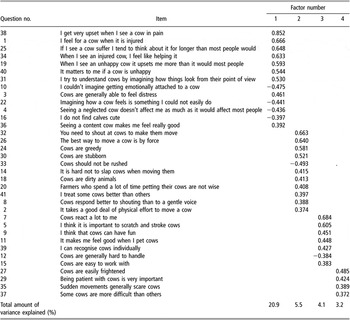
When the questionnaire was drafted and piloted, colleges throughout the UK were invited to contribute, and 18 took part in the survey. This resulted in 252 questionnaires being returned. Subsequently 51 questionnaires were removed as they were incomplete or if the respondent did not have experience with dairy cows. The remaining data from 201 respondents conformed to the required minimum sample size for conducting factor analysis, recommended as 200 by Kline (Reference Kline1986 and Reference Kline2000). Bartlett’s test of spherecity (χ 2 = 300.8, df = 861, P < 0.001) and Kaiser–Myer–Olkin measure of sampling adequacy (0.848) indicated that the data were suitable for performing factor analysis. Items that had a loading of 0.367 or greater (based on a significance level of P = 0.001 and a sample size of 201) were deemed to load on a factor (Stevens, Reference Stevens1986). A screeplot suggested that a four-factor model fitted the data (see Table 2) although other models were tested. Principal axis extraction and oblique rotation was employed (Norman and Streiner, Reference Norman and Streiner2000). The first three factors had acceptable consistency with Cronbach’s alpha, ranging from 0.86 to 0.74. Factor 4 had a lower alpha, but this can solely be attributed to the low number of items present in the scale, as justified by the Spearman–Brown formula. The four factors were labeled: empathy (for example, I try to understand cows by imagining how things look from their point of view), negative beliefs (for example, cows respond better to shouting than to a gentle voice), job satisfaction (for example, cows are easy to work with) and patience (for example, sudden movements generally scare cows). Questions 6, 13, 17, 21, 23, 28 and 42 did not significantly load on any of the four factors and were not used in further analysis. The four-factor attitude questionnaire was then included in the questionnaire pack to be posted out to dairy farmers.
The four-factor model with direct oblique rotation

Only substantial factor loadings over 0.367 are displayed to increase clarity.
Statistics
Data from the 311 questionnaires from Northern Irish dairy farms were entered into SPSS. Correlations between attitudes and personality variables were calculated using Pearson correlation as the data conformed to normality. When examining the relationships between milk yields and attitudes and personality, partial correlation was utilised to remove the effect of any potential confounding variables in the relationships. Three factors that strongly correlated with milk yield include amount of concentrate fed to the cows (r = 0.792), the number of cows in a herd (r = 0.378) and the number of people involved in the milking (r = 0.318); these variables also correlated with the attitude factors. Partial correlations were therefore run examining the relationships but controlling for the influence of concentrate, number of cows and number of workers.
Results
Farm demographics
The number of cows on each farm ranged from a minimum herd size of 27 to a maximum of 450 cows. The mean number of cows per farm across the 311 replies was 111 with a standard deviation of 59.35. Most (72%) of the farms had at least one additional full-time worker to help look after the dairy herd, with a cow to staff ratio of one stockperson per 52 cows on average. The mean amount of concentrate fed was 1.67 tonnes/cow per year with a standard deviation of 0.59.
Attitudes and personality
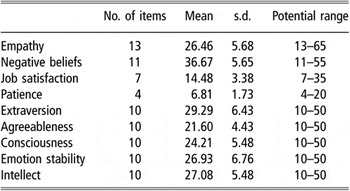
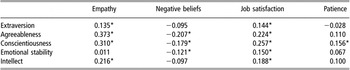
The mean and standard deviations for the four attitude scales and five personality scales are shown in Table 3. Table 4 presents correlations of the attitude scales with the big-five personality traits. Empathy had positive significant correlations with the personality traits of extraversion, agreeableness, conscientiousness and intellect. This suggested that those people who were more extraverted, conscientious and considered themselves intellectual were also more empathetic. The negative beliefs attitude scale demonstrated significant negative correlations with agreeableness, conscientiousness and emotional stability. This suggested that people who reported lower levels of these three personality traits also had stronger negative beliefs about dairy cows. The third attitude scale, job satisfaction, had positive significant correlations with each of the five personality scales. People who perceived themselves as more extraverted, agreeable, conscientious, emotionally stable and intellectual responded in a pattern suggesting that they enjoyed working with dairy cows. The only personality trait that was significantly correlated with patience was conscientiousness. Those people who scored high on the conscientiousness trait also scored high on the patience scale.
Means and standard deviations for the attitude and personality scales

Correlations of attitude scales with personality traits

*Denotes significance at 0.05 level.
Attitudes and milk yield
The milk yield (mean = 7424 l/cow per year, s.d. = 1367) was correlated with the four attitude scales and three significant (but weak) correlations were obtained (Table 5). Empathy had a significant positive correlation with milk yield (rp = 0.235, df = 308; P < 0.01). This suggested that higher empathy scores were related to higher milk yield. Attitude 2, negative beliefs, had a significant negative correlation with milk yield (rp = −0.192, df = 308; P < 0.01). This suggested that the tendency to hold a few negative beliefs about dairy cows was related to a high milk yield. Job satisfaction had a significant positive correlation with milk yield (rp = 0.223, df = 308; P < 0.01). This suggested that a high score on this factor (indicating that the individual found the experience of working with cows rewarding) was related to high milk yield. Patience was not significantly correlated with milk yield.
Partial correlations of attitude scales with milk yields controlling for concentrate, number of other milkers and number of cows

*Denotes significance at 0.05 level.
Personality and milk yield
The stockperson’s personality traits demonstrated no substantial relationships with the subsequent milk yield they obtained; all correlation coefficients ranged from 0 to 0.09.
Discussion
Personality and attitudes
The personality traits of agreeableness and conscientiousness demonstrate the strongest relationships with the attitudes towards working with dairy cows. That is, those dairy stockpeople who are more agreeable and conscientious tend to be more empathetic, patient, enjoy their work and hold less negative beliefs about cows. It has been suggested that those people who score higher on agreeableness are capable of behaving in a more adaptive manner (Center for Applied Cognitive Studies (CentACS), 2002). That is, these people may be capable of reacting in a more appropriate way with dairy cows, accepting cues from the cows rather than imposing their own inflexible behavioural norms. The conscientious respondent is more goal-focused and exhibits the reliability and consistency to achieve these goals. Therefore, highly conscientious stockpeople may attempt to develop empathetic understanding of their cows (perhaps unintentionally) to improve dairy efficiency and they may enjoy a sense of satisfaction in the proportion to the time and effort they invest with their livestock. In comparison, Waiblinger et al. (Reference Waiblinger, Menke and Coleman2002) created their own three-factor personality questionnaire and reported that their (four-item) measure of agreeableness was correlated negatively with the attitude factor of positive attitude towards awareness of cows (r = −0.37) and positively correlated with positive attitude towards contact with cows while caring for them (r = 0.32). Their personality measure of confident extravert was not significantly related to any attitude factor, while pessimistic was negatively correlated to five out of 15 attitude subscales.
Personality and milk yield
Unlike previous studies (Seabrook, Reference Seabrook1984; Ravel et al., Reference Ravel, D’Allaire and Bigras-Poulin1996) that have reported personality profiles of high-achieving stockpeople, this study employed a big-five measure of personality. Attempting to classify personality into five broad traits may fail to capture some of the finer discriminatory detail that may have been captured in a 15-factor (Ravel et al., Reference Ravel, D’Allaire and Bigras-Poulin1996) or 18-factor (Seabrook, Reference Seabrook1984) model. However, the big-five model is the current dominant theory within personality research (Digman, Reference Digman1990; Bernstein et al., Reference Bernstein, Clare-Stewart, Roy, Srull and Wickens1994) and the empirical basis of the other approaches are open to criticism (Barrett and Kline, Reference Barrett and Kline1982; Smith et al., Reference Smith, Gregg and Andrews1989; Cooper, Reference Cooper1998). It appears that no relationship exists between any of these personality traits and milk yield in this study. This finding contradicts the findings of Panamá Arias and Spinka (Reference Panamá Arias and Spinka2005) who reported a negative relationship between neuroticism and milk yield (n = 31). The current study therefore suggests that it would be inappropriate to select for certain personality traits on the basis of it being related to high productivity in dairy farming.
Attitudes and milk yield
Breuer et al. (Reference Breuer, Hemsworth, Barnett, Matthews and Coleman2000) reported that the composite attitude scale used by them was not significantly correlated with milk yield. Waiblinger et al. (Reference Waiblinger, Menke and Coleman2002) reported that out of their 15 subscales, three were significantly related to lower milk yields; these were attitudes relating to high levels of punishment, using a kick restraint and, contrary to expectations, ‘awareness of cows’. In the current study, three of the attitude scales were found to be related to milk yield. Partial correlations revealed that higher levels of empathy and job satisfaction were related to higher milk yields. English (Reference English1991) has suggested that empathy is an important component of the ‘art of stockpersonship’, although this is not universally appreciated within agriculture. English (Reference English1991) also postulated several theories relating to empathy that have been consistent with regard to the factor that has been labelled empathy in the present study; namely, that it is influenced by personality type and leads to improvements in productivity. One of the main reasons empathy may be important in stockpersonship is that empathy is thought to be important in inhibiting aggressive behaviour (Endresen and Olweus, Reference Endresen and Olweus2001; Pagani, Reference Pagani2001). Conversely, higher levels of negative beliefs were related to lower milk yields.
The methodology employed for developing the attitude scales for this study attempted to address many of the shortcomings evident in the existing research. Factor analysis was employed to construct reliable scales. Not all of the previous research has applied this technique, for example, Breuer et al. (Reference Breuer, Hemsworth, Barnett, Matthews and Coleman2000) employed criterion keying in the construction of their attitude scales. This atheoretical technique has several flaws, including potentially low reliability and multiplicity (Nunnally, Reference Nunnally1978; Kline, Reference Kline2000). As Breuer et al. (Reference Breuer, Hemsworth, Barnett, Matthews and Coleman2000, p. 285) admit ‘[A]s expected, because of the manner in which this composite score was constructed significant correlations were obtained’. Waiblinger et al.’s (Reference Waiblinger, Menke and Coleman2002) comprehensive study can be accused of multiplicity and the small sample size used in the creation of its attitude scales casts some doubt over their reliability (Kline, Reference Kline1986 and Reference Kline2000). While these studies potentially demonstrate the importance of dairy stockperson attitudes, the results must be interpreted with a degree of caution as the techniques used to create the attitude scales do not conform to best psychometric practice.
It should be acknowledged that the correlations between attitudes and milk yield are not very high. However, it is hypothesised that the attitudes influence the stockperson’s behaviours, which in turn will lead to physiological responses in the cow that affects milk let down (Hemsworth and Coleman, Reference Hemsworth and Coleman1998; Hemsworth et al., Reference Hemsworth, Coleman, Barnett and Borg2000). Simultaneously, many other important variables (for example, amount of food consumed, genetic merit, stockperson’s knowledge and skill, hygiene, etc.) will explain a large proportion of the variance in milk yield. Therefore the fact that attitudes are explaining any degree of variance in milk yield is noteworthy. The results of the present study concur with the integrative model of work attitudes, motivation and performance proposed by Katzell and Thompson (Reference Katzell and Thompson1990), which does not predict strong direct causal connections between attitudes and production, but indirect paths. This therefore accounts for the positive, although weak, correlations often found between attitudes and production across a range of industries.
It should be noted that all these measures rely on self-report and as such they rely on the accuracy and the honesty of the respondent when answering personal questions (for example, about their personality) or production questions (for example, about milk yield). Another limitation of the current study is that only the person who principally worked with the cows was asked to complete the questionnaire. In most farms there was more than one person involved with interacting with the cows; this would have a confounding effect on the results reported.
While this study offers no evidence of a direct link between personality and milk yield, it does appear that personality is related to attitudes. This study, in conjunction with previous research, suggests attitudes of the stockperson may be related to the subsequent milk yield they obtain. One application from these findings would be to use attitudes to select employees into the dairy industry and also to identify those individuals who may benefit from training. Making individuals aware of their own attitudes and personality may provide insights to address weaknesses in their own stockpersonship.