Introduction
Tomato production is one of the most promising horticultural activities in the world. In Kenya, it is an important cash crop both for small- and large-scale growers with a potential for increased income, and as a source of food and employment generation (MOARD/JICA, 2002). Globally, an estimated 126 million tonnes of tomato are produced (FAOSTAT, 2007), whereas in Kenya, an estimated 397,000 metric tonnes of tomato valued over 130 million USD are produced annually (HCDA, 2013). However, a variety of insect pests and diseases affect the productivity of the tomato crop (Varela et al., Reference Varela, Seif and Lohr2003). Amongst the pests, thrips has become one of the serious pests in many areas of the world in recent decades. Thrips can cause direct damage through feeding (Ghidiu et al., Reference Ghidiu, Hitchner and Funderburk2006; Harper and Horne, Reference Harper and Horne2012; Nyasani et al., Reference Nyasani, Meyhöfer, Subramanian and Poehling2012) and indirect damage through vectoring plant-pathogenic viruses (Ramkat et al., Reference Ramkat, Wangai, Ouma, Rapando and Lelgut2006; Birithia et al., Reference Birithia, Subramanian, Villinger, Muthomi, Narla and Pappu2012). A single thrips-vectored virus, particularly Tomato spot wilt virus causes an estimated annual worldwide loss of USD 1 billion (Prins and Goldbach, Reference Prins and Goldbach1998).
The biological characteristics that predispose thrips species as a potential threat to increased yields include pesticide resistance, polyphagy, cryptic feeding behaviour, small body size, tendency to aggregate, and invasiveness (Heming, Reference Heming, Schaefer and Leschen1993; Lewis, Reference Lewis and Lewis1997; Jensen, Reference Jensen2000; Hamilton et al., Reference Hamilton, Hall and Kirk2005; Morse and Hoddle, Reference Morse and Hoddle2006). In Kenya, control of thrips relies mainly on indiscriminate application of chemical pesticides, which have many deleterious effects (Nderitu et al., Reference Nderitu, Waturu, Olubayo, Aura and Kasina2001; Nderitu et al., Reference Nderitu, Kasina, Nyamasyo, Waturu and Aura2008). This has necessitated exploring alternative and effective management methods that can reduce the indiscriminate use of pesticides.
Coloured sticky traps are a commonly used monitoring tool for pests on crops (Harman et al., Reference Harman, Mao and Morse2007; Muvea et al., Reference Muvea, Waiganjo, Kutima, Osiemo, Nyasani and Subramanian2014). Natwick et al. (Reference Natwick, Byers, Chu, Lopez and Henneberry2007) showed that blue sticky traps can effectively monitor thrips populations and can help reduce the density of Frankliniella occidentalis (Pergande) and Thrips tabaci (Lindeman) in field vegetables. The addition of attractants to coloured traps has been reported to increase trap captures (Nielsen et al., Reference Nielsen, Worner, Chapman, de Kogel, Perry, Sansom, Murai, Muvea, Subramanian and Teulon2010). For instance, coloured traps with kairomonal attractant (Lurem-TR) have proven to be an effective method for capturing thrips infesting pepper (Harbi et al., Reference Harbi, Elimem and Chermiti2013) and French bean (Muvea et al., Reference Muvea, Waiganjo, Kutima, Osiemo, Nyasani and Subramanian2014). Prokopy and Owens (Reference Prokopy and Owens1983) outlined that plant-dwelling thrips use colour and scent as cues to detect and orientate to their hosts. The response of thrips to colour and odour in experimental bioassays implicates vision and olfaction as important host finding cues (Teulon et al., Reference Teulon, Hollister, Butler and Cameron1999; Smits et al., Reference Smits, van Deventer and de Kogel2000). However, studies evaluating the response of the thrips complex infesting tomato in East Africa to coloured sticky traps and attractants are lacking, especially on thrips indigenous to Africa such as Ceratothripoides brunneus (Bagnall); thus, it remains unknown if coloured sticky traps with Lurem-TR are an effective method for monitoring thrips infesting tomato in the region.
Monitoring thrips using coloured traps has several advantages over actual plant sampling. It provides a simple method of obtaining estimates of thrips population (Natwick et al., Reference Natwick, Byers, Chu, Lopez and Henneberry2007; Affandi and Emilda, Reference Affandi and Emilda2009; Muvea et al., Reference Muvea, Waiganjo, Kutima, Osiemo, Nyasani and Subramanian2014). Chu et al. (Reference Chu, Ciomperlik, Chang, Richards and Henneberry2006) reported that traps might provide a far more rapid estimate of pest populations than absolute methods of counting individuals, as these traps continuously catch a higher number of thrips throughout the planting period. Effective pest population monitoring is crucial for successful implementation of insect control programmes for proper timing of control applications (Palumbo, Reference Palumbo, Byrne and Baciewicz2003; Pizzol et al., Reference Pizzol, Nammour, Hervouet, Bout, Desneux and Mailleret2010). The present study aims to determine if addition of attractants/kairomones to coloured sticky traps influences the response of thrips species infesting tomato crop and evaluate this information in the context of a potential thrips-monitoring tool in a tomato crop.
Materials and methods
Study site
The study was conducted at the Kenya Agricultural Research Institute (KARI) in Thika (KARI-Thika) (now the Horticulture Research Institute, Kenya Agricultural and Livestock Research Organization). The Centre is situated within coordinates 0°59' South and 37°04' East at an altitude of 1548 m above sea level. The study site receives an average annual rainfall of 1018 mm. The soils are well-drained, deep, dark reddish-brown Nitosols (Jaetzold and Schmidt, Reference Jaetzold and Schmidt1983).
Tomato experimental plots
The experimental land was ploughed and harrowed with a tractor to fine tilth. The field was divided into four equal blocks measuring 8 × 60 m. Each block was further subdivided into six equal plots measuring 6 × 6 m in which the treatments (traps) were assigned randomly. Blocks were separated by fallows of 3 × 60 m. Tomato seeds (cv. CAL J) were raised in a nursery for 25 days. Seedlings were transplanted at an intrarow spacing of 60 cm and inter row spacing of 80 cm. At sowing, diammonium phosphate (DAP) was applied to the furrows at the rate of 200 kg/ha and mixed well with the soil before planting. Three weeks after transplanting, calcium ammonium nitrate (CAN) was applied as a top dress at the rate of 200 kg/ha. Plants were maintained using standard cultural practices recommended for the research area (Jaetzold et al., Reference Jaetzold, Schmidt, Hornetz and Shisanya2007). The experiments were carried out in two planting periods. The first planting was from February to April 2010 and the second from June to August 2010.
Monitoring of thrips populations using sticky traps and Lurem-TR
Densities of thrips species were monitored using coloured sticky traps measuring (10 × 25 cm) with and without addition of kairomones in six treatments, namely blue, blue + Lurem-TR, yellow, yellow + Lurem-TR, clear, and clear + Lurem-TR. Each treatment was erected at the centre of each plot seven days after transplanting in a randomized block design. Blue and yellow traps and Lurem-TR were obtained from Plant Research International B.V., Wageningen, the Netherlands. Lurem-TR is a commercial semiochemical whose active ingredient is methyl-isonicotinate. The aromatic substance is slowly released from dispensers and lures thrips out of their hiding places towards the sticky traps (Teulon et al., Reference Teulon, Davidson, Perry, Nielsen, van Tol and de Kogel2011). Clear sticky traps of the same dimension were made using clear lamination paper in the laboratory and coated with Tanglefoot (aerosol formula) (The Tanglefoot Co. Grand Rapids, MI). Traps were mounted vertically on wooden stakes with the bottom edge of the trap being 10 cm above the crop canopy. Traps were collected and replaced weekly for 8 and 11 weeks for planting periods 1 and 2, respectively. After removal, the sticky traps with thrips were placed in polyethylene sheets, labelled, and carried to the laboratory for counting and identification.
Plant sampling
Destructive sampling (picking flowers and leaves) (Steiner, Reference Steiner1990) and non-destructive sampling (tapping of whole plant on a white enamel tray) (Pearsall and Myers, Reference Pearsall and Myers2000) were adopted to determine absolute estimates of population densities of thrips on the crop. Three leaves and three flowers were picked from the top, middle, and bottom of the plant canopy within a radius of 2 m from the traps. The picked samples were carefully handled to avoid disturbing the thrips. The leaves were individually placed in plastic jars stuffed with a paper towel and labelled. The flower samples were dipped in vials containing 60% ethyl alcohol into which small pencil written labels were placed.
Processing and identifying thrips
Thrips were extracted from flowers and leaves then transferred into vials containing 60% ethyl alcohol for 24 h. From the eight possible grids of each trap, four grids were selected at random for the thrips sampling process. The glue on the sticky traps was carefully dissolved using kerosene, and thrips were collected using a fine brush and transferred into vials containing 60% ethyl alcohol for 24 h. Specimens from traps and absolute counts were then macerated separately in 5% NaOH for four hours followed by three washes with distilled water. The specimens were processed and slide mounted as described in the LuCID keys, Pest thrips of the world (Moritz et al., Reference Moritz, Mound, Morris and Goldarazena2004) and Pest thrips of East Africa (Moritz et al., Reference Moritz, Brandt, Triapistyn and Subramanian2013). Specimens on slides were labelled with original data and identified using the above-mentioned LuCID keys. The voucher specimens of thrips were slide-mounted and preserved in the Thrips IPM programme laboratory at the International Centre of Insect Physiology and Ecology (icipe).
Weather parameters
Daily mean rainfall and temperature were recorded from the Thika Meteorological Department located about 150 m from the experimental fields. These weather parameters were used to understand the effects of rainfall and temperature on thrips density. Rainfall and temperature were selected based on the available literature on their influence on thrips population dynamics (Morsello et al., Reference Morsello, Groves, Nault and Kennedy2008).
Statistical analysis
The number of key thrips species captured on sticky traps with and without Lurem-TR was checked for normality and homogeneity of variance using Shapiro–Wilk with package nortest (Gross and Ligges, Reference Gross and Ligges2015) and Levene tests with package car (Fox, Reference Fox2008), respectively, before being subjected to analysis of variance (ANOVA). The replicates were included as blocking factors, and the trap colours with and without lure per plot as the treatment factor. Specific mean comparisons were made using Tukey's HSD test at 5% precision level. To determine if trap captures were indicative of thrips populations on leaves and flowers, the mean number of thrips/trap was correlated with the weekly mean number of thrips/plant for each sampling date. Pearson's product–moment correlation using package polycor (Fox, Reference Fox2010) in R was used to determine correlation between the population density of thrips on the plants and two weather factors – temperature and rainfall – during the tomato planting periods. All the statistical analyses were performed in R 2.15.2 (R Development Core Team, 2012) using package Rcmdr (Fox, Reference Fox2005).
Results
Attraction of pest thrips to coloured sticky traps with and without Lurem-TR
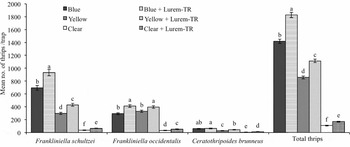
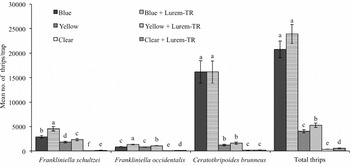
The total number of thrips caught during each planting period differed significantly among the various sticky traps used in the experiment (Planting 1: F = 926.2; df = 5, 15; P<0.001 and Planting 2: F = 431.6; df = 5, 15; P<0.001). Trap colour significantly influenced the total thrips catch for both the planting periods (Planting 1: F = 2238.8; df = 2, 15; P<0.001 and Planting 2: F = 1070.5; df = 2, 15; P<0.001). Blue-coloured traps were the most attractive irrespective of the thrips species. The trapping potential of blue traps was 1.66 and 5.08 times more than yellow traps, and 13.24 and 59.12 times more than clear traps, for planting seasons 1 and 2, respectively (Figs. 1 and 2).
Mean number ± (SEM) of adult thrips (Frankliniella schultzei, Frankliniella occidentalis, Ceratothripoides brunneus, and Total thrips) captured per sticky trap with and without Lurem-TR in planting I (February to April 2010). Treatment means for each species in the same column followed by the same letter are not significantly different (P = 0.05), Tukey's test.

Mean number ± (SEM) of adult thrips (Frankliniella schultzei, Frankliniella occidentalis, Ceratothripoides brunneus, and Total thrips) captured per sticky trap with and without Lurem-TR in planting 2 (June to August 2010). Treatment means for each species in the same column followed by the same letter are not significantly different (P = 0.05), Tukey's test.

There were significant differences in the number of F. schultzei caught on the different sticky traps (F = 311.2; df = 5, 15; P<0.001, and F = 259.8; df = 5, 15; P<0.001 for plantings 1 and 2, respectively). The addition of Lurem-TR attractants to the coloured sticky traps increased catches of F. schultzei by 1.3 times in the blue, 1.5 times in the yellow, 1.8 times in the clear traps for planting 1, and 1.5 times in the blue, 1.2 times in the yellow, and 1.7 times in the clear traps for planting 2 (Figs. 1 and 2). Blue and yellow traps were not different in the catches of F. occidentalis in tomato but they caught more of the species than the clear traps. Lurem-TR enhanced F. occidentalis catches by 1.4, 1.2, 1.6, and 1.5, 1.2, 2.8 times in blue, yellow, and clear traps for plantings 1 and 2, respectively. The most abundant thrips species infesting tomato crop in the second planting was C. brunneus. Blue traps were more attractive to C. brunneus than yellow and clear traps. Blue traps with Lurem-TR were numerically more attractive to C. brunneus than the other treatments (F = 38.5; df = 5, 15; P<0.001 and F =197.4; df = 5, 15; P<0.001, in plantings 1 and 2, respectively). The addition of Lurem-TR did not influence the preference of C. brunneus to trap colour (F = 0.9; df = 1, 15; P = 0.353).
Correlation of mean thrips captures on traps with absolute estimates on plants
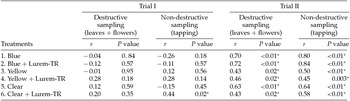
Correlation between mean thrips captures on coloured traps with actual plant sampling methods was either weak or negatively correlated in the first planting (Table 1). On the other hand, correlations between mean thrips captures on coloured sticky traps with and without Lurem-TR with actual plant sampling methods were positive in the second planting. Captures on the blue trap with Lurem-TR recorded the highest significant positive correlation (r = 0.72; df = 26; P<0.001 and r = 0.84; df = 38; P<0.001) for both plantings (Table 1).
Correlation of thrips catches on coloured sticky traps with or without Lurem-TR with absolute estimates of thrips through destructive and non-destructive plant sampling techniques on tomatoes (February to April, 2010; Planting 1 and June to August 2010; Planting 2)

*P values followed by the asterisks indicate significance at 0.05 level.
Influence of weather characteristics on the thrips population dynamics in tomato
The thrips population was low during the first planting and high during the second planting. Rainfall and temperature had significant effects on thrips population during the first planting but not in the second planting (Table 2). For instance, F. schultzei (r = 0.56; df = 6; P = 0.04), F. occidentalis (r = 0.77; df = 6; P = 0.02), C. brunneus (r = 0.72; df = 6; P = 0.04), and total thrips (r = 0.69; df = 6; P = 0.04) were significantly positively correlated with the temperature. Rainfall had a significant negative correlation with thrips population on the crops for F. schultzei (r = −0.88; df = 6; P<0.01), F. occidentalis (r = −0.82; df = 6; P = 0.01), C. brunneus (r = −0.88; df = 6; P = 0.004), and total thrips (r = −0.88; df = 6; P<0.01) (Table 2).
Correlation coefficient between thrips population density on tomato with weather parameters (temperature and rainfall) (February to April 2010 1st Planting and June to August 2010 2nd Planting)

*Correlation coefficients followed by asterisks indicate significance at P = 0.05 while the others are non-significant.
Discussion
In this study, we evaluated the use of sticky traps for monitoring thrips species infesting tomato in East Africa. The trap catches revealed the association of three major thrips species, namely F. schultzei, F. occidentalis, and C. brunneus with the tomato crop. Blue traps were the most attractive to F. schultzei and C. brunneus followed by yellow and then clear traps, suggesting that trap colour was precise and could be used as a monitoring tool to assess thrips infestation. This could be partly explained by the fact that colours reflect differently in ultra violet (UV) and hence the reflectance of blue and UV appears to be an important attribute of the trap efficacy for the species. For instance, Ranamukhaarachchi and Wickramarachchi (Reference Ranamukhaarachchi and Wickramarachchi2007) reported that blue traps were more attractive than yellow traps to C. claratris (Shumsher), a closely related species to C. brunneus. Similarly, blue colour was attractive to F. schultzei on plums (Allsopp, Reference Allsopp2010) and French beans (Muvea et al., Reference Muvea, Waiganjo, Kutima, Osiemo, Nyasani and Subramanian2014). Both blue and yellow traps were not different in the captures of F. occidentalis. A similar outcome of equal attraction of thrips to yellow and blue traps was observed for Limothrips cerealum (Haliday) on grasses (Teulon and Penman, Reference Teulon and Penman1992). Blue traps have been reported to catch more F. occidentalis in the glasshouse (Gillespie and Vernon, Reference Gillespie and Vernon1990) and field crops (broccoli, Chen et al., Reference Chen, Chu, Fitzgerald, Natwick and Henneberry2004; head lettuce and onion, Natwick et al., Reference Natwick, Byers, Chu, Lopez and Henneberry2007). This implies that different host plants may influence the performance of trap colour on thrips catches (Hoddle et al., Reference Hoddle, Robinson and Morgan2002).
The kairomone attractant (Lurem-TR) increased the captures of F. occidentalis and F. schultzei but not for C. brunneus thrips species. Lurem-TR has been reported to increase trap captures of F. schultzei and F. occidentalis (Nielsen et al., Reference Nielsen, Worner, Chapman, de Kogel, Perry, Sansom, Murai, Muvea, Subramanian and Teulon2010; Muvea et al., Reference Muvea, Waiganjo, Kutima, Osiemo, Nyasani and Subramanian2014). Broughton et al. (Reference Broughton, Cousins and Rahman2015) observed up to a fourfold increase in the captures of western flower thrips (WFT) in roses with the use of Lurem-TR in Australia. In Tunisia, blue traps with Lurem-TR caught more than twice as many WFT as those without in a pepper crop (Harbi et al., Reference Harbi, Elimem and Chermiti2013). The lack of attraction of C. brunneus to Lurem-TR could be attributed to differences in feeding niche, as the species is not a flower thrips unlike the other two mentioned in the present study. Ceratothripoides brunneus is commonly observed on the leaves as reported for the other related species, C. claratris (Murai et al., Reference Murai, Kawai, Chongratanameteekul and Nakasuji2000; Moritz et al., Reference Moritz, Brandt, Triapistyn and Subramanian2013). Lurem-TR comprises compounds analogous to floral volatiles (Teulon et al., Reference Teulon, Davidson, Perry, Nielsen, van Tol and de Kogel2011). Further, lack of response by C. brunneus to Lurem-TR could also be due to factors of incompatibility of the species with some of the compounds used to make the lure. Moreover, the negative response could also be attributed to concentration levels of some compounds in the kairomone as observed by Koschier et al. (Reference Koschier, de Kogel and Visser2000) with eugenol or benzaldehyde, which were only attractive at a specific concentration. Therefore, the reasons underlying lack of attraction of C. brunneus to Lurem-TR warrant further detailed investigation.
The first planting recorded negative correlations between numbers of thrips caught on traps and those obtained from absolute counts. This outcome could be due to adult thrips from tomato plants within ≥ 2 m radius of the trap being attracted to traps, thereby reducing populations on plants and increasing trap catches. Additionally, the negative correlation was attained when thrips densities were very low and thus traps captured the few available thrips from the crop. This finding agrees with earlier studies done by Natwick et al. (Reference Natwick, Byers, Chu, Lopez and Henneberry2007) who found a negative correlation when they compared thrips population by plant count and trap catches. However, at higher thrips densities, thrips captured on blue sticky traps with Lurem-TR correlated positively with the population in the crop. Coloured sticky traps are commonly used to monitor thrips activity for pest management (Pizzol et al., Reference Pizzol, Nammour, Hervouet, Bout, Desneux and Mailleret2010; Harbi et al., Reference Harbi, Elimem and Chermiti2013).
The lower population densities of thrips observed during first planting period (February− April) can be ascribed to the high amount of rainfall received during the crop growing period. This was strongly supported by negative correlation coefficient between thrips number and rainfall. It has been previously reported that the thrips population is negatively affected by rainfall (Lewis, Reference Lewis and Lewis1997; Gitonga et al., Reference Gitonga, Löhr, Overholt, Magambo and Mueke2002). Kirk (Reference Kirk and Lewis1997) reported that rainfall is a decisive thrips suppression factor, mainly due to thrips larval mortality. The higher number of thrips population observed during the second planting period may be due to warm and humid weather conditions, which are generally considered favourable for thrips (Waiganjo et al., Reference Waiganjo, Gitonga and Mueke2008). The hot and humid weather has been reported to increase the reproductive potential and shorten the life cycle of C. claratris (Premachandra et al., Reference Premachandra, Borgemeister, Chabi and Poehling2004). The prevailing temperatures of 17.74–19.02 °C observed during the tomato crop growing period in our study were closer to the estimated lower thermal threshold of 16–18 °C for egg-to-adult development of C. claratris (Premachandra et al., Reference Premachandra, Borgemeister, Chabi and Poehling2004). The temperature range in the experimental trials was within the optimum of 15–30 °C that allows thrips to take off and control their own flight (Pearsall, Reference Pearsall2002).
Conclusions
Blue sticky traps consistently caught more adult thrips irrespective of the species compared to yellow and clear sticky traps, and could be used as an effective thrips monitoring tool for thrips activity in tomato for timely management. Lurem-TR increased thrips captures for F. schultzei and F. occidentalis but not for C. brunneus. Hence, we suggest possible integration of kairomone-based attractants along with coloured traps for more efficient, economical, and eco-friendly management of thrips, a devastating pest insect of many crops. High temperatures increased thrips densities while rainfall reduced the thrips densities. Long-term analysis of pest−weather relationship can aid to predict/forecast the thrips incidence in tomato under changing climate regime in the region.
Acknowledgements
The authors gratefully acknowledge the financial support for this research by the following: BMZ (Federal Ministry for Economic Cooperation and Development, Germany) through GIZ (projects no. 07.7860.5-001.00 and 11.7860.7-001.00) and icipe core funding from UK Aid from the UK Government, Swedish International Development Cooperation Agency (Sida), the Swiss Agency for Development and Cooperation (SDC), Federal Ministry for Economic Cooperation and Development (BMZ), Germany, and the Kenyan Government. The views expressed herein do not necessarily reflect the official opinion of the donors. The authors are also thankful to the team of Thrips IPM programme at icipe for facilitating the research work through technical assistance and KALRO-Thika for allowing us to conduct field trials at their station.