INTRODUCTION
Although evidence suggests that the variety of species in Brazilian marine habitats is very high (Couto et al., Reference Couto, Silveira and Rocha2003), few studies have been conducted with the aim of determining the true biodiversity of the Brazilian coast. This scenario is further complicated in certain regions, such as the north-east, where knowledge of marine fauna has been evaluated as low (Migotto & Marques, Reference Migotto and Marques2003; Amaral et al., Reference Amaral, Lana, Fernandes, Coimbra, Amaral and Rossi-Wongtschowski2005). The state of Bahia, situated in north-east Brazil, has the largest stretch of coast of the country, with 1181 km of coastline and approximately 300 beaches (Semarh, 2003). However, few studies focusing on the diversity of marine fauna, and especially invertebrates, have been conducted in this region (Lana et al., Reference Lana, Camargo, Brogim and Isaac1996; Alves et al., Reference Alves, Muehe and Dominguez2006). As a result, the diversity of some traditionally understudied taxa, such as bryozoans, is still unknown.
The first bryozoan collected off the Bahia coast was the species Steginoporella magnilabris (Busk, Reference Busk1854), described as Membranipora magnilabris and collected at Abrolhos by Charles Darwin in 1830 (Vieira et al., Reference Vieira, Migotto and Winston2008). Since then, other expeditions have collected bryozoans in Bahia State. Ridley (Reference Ridley1881) studied specimens collected by H.M.S. Challenger in 1873–1876 and registered one species. Busk (Reference Busk1884) also studied the H.M.S. Challenger specimens and registered eight bryozoans, three of them new to science. Canu & Bassler (Reference Canu and Bassler1928) described 26 species, 14 new, collected by Rathbun in 1876 and the Norseman in 1877. Buge (Reference Buge and Pouyet1975, Reference Buge1979) described 11 specimens collected by H.M.S. Challenger and the Calypso in 1961. In 1985, the first study focusing on the inventory of bryozoans from Bahia was developed on board the Almirante Câmara. Later, the REVIZEE Project, on board the Navio Oceanográfico Antares, revealed bryozoans to be one of the most representative benthic phyla from Bahia (Souza & Peso-Aguiar, personal observation). Despite these studies, no taxonomic inventory has been published to date and the true bryodiversity of Bahia State remains unclear.
Vieira et al. (Reference Vieira, Migotto and Winston2008) published the first complete checklist of recent marine bryozoa from Brazil and indicated the occurrence of 346 species. This number, however, represents just a part of the diversity that has been described in recent years (Ramalho et al., Reference Ramalho, Muricy, Taylor, Hageman, Key and Winston2008, Reference Ramalho, Muricy and Taylor2009, Reference Ramalho, Muricy and Taylor2010, Reference Ramalho, Muricy and Taylor2011, Reference Ramalho, Taylor and Muricy2014; Santana et al., Reference Santana, Ramalho and Guimarães2009; Vieira et al., Reference Vieira, Gordon, Souza and Haddad2010a, Reference Vieira, Migotto and Winston2010b, Reference Vieira, Winston and Fehlauer-Ale2012, Reference Vieira, Spencer-Jones and Winston2013, Reference Vieira, Migotto and Winston2014; Winston & Vieira, Reference Winston and Vieira2013; Almeida & Souza, Reference Almeida and Souza2014; Vieira & Stampar, Reference Vieira and Stampar2014; Winston et al., Reference Winston, Vieira and Woollacott2014). Here, we provide the first taxonomic checklist of bryozoans from Bahia State, developing a preliminary database for future taxonomic, ecological and biogeographic research.
MATERIAL AND METHODS
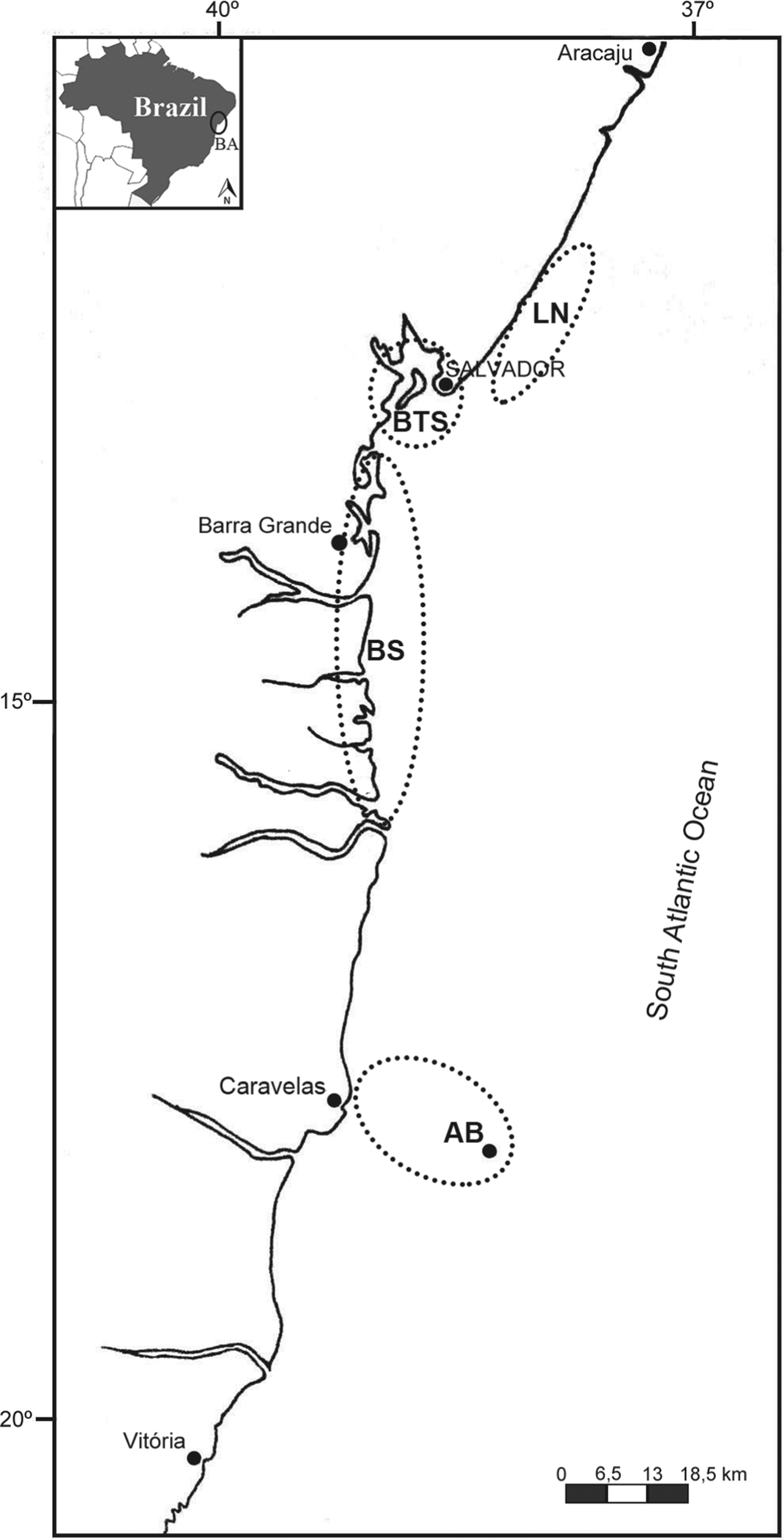
The specimens are lodged in the Bryozoa collection of the Museu de Zoologia at the Universidade Federal da Bahia (UFBA) and were collected over the last 20 years, either manually in the littoral zone or dredged on the continental shelf of Litoral Norte (11°21′S–12°37′S 37°17′W–38°47′W), Salvador and Baía de Todos os Santos (12°35′S–13°07′S 38°29′W–38°48′W), Baixo Sul (13°12′S–15°50′S 38°52′W–40°06′W) and Abrolhos Bank (16°40′S–19°30′S 37°25′W–39°45′W), Bahia State, Brazil (Figure 1).
Map of the study area in north-east Brazil. Legend: LN, Litoral Norte; BTS, Salvador and Baía de Todos os Santos; BS, Baixo Sul; AB, Abrolhos.

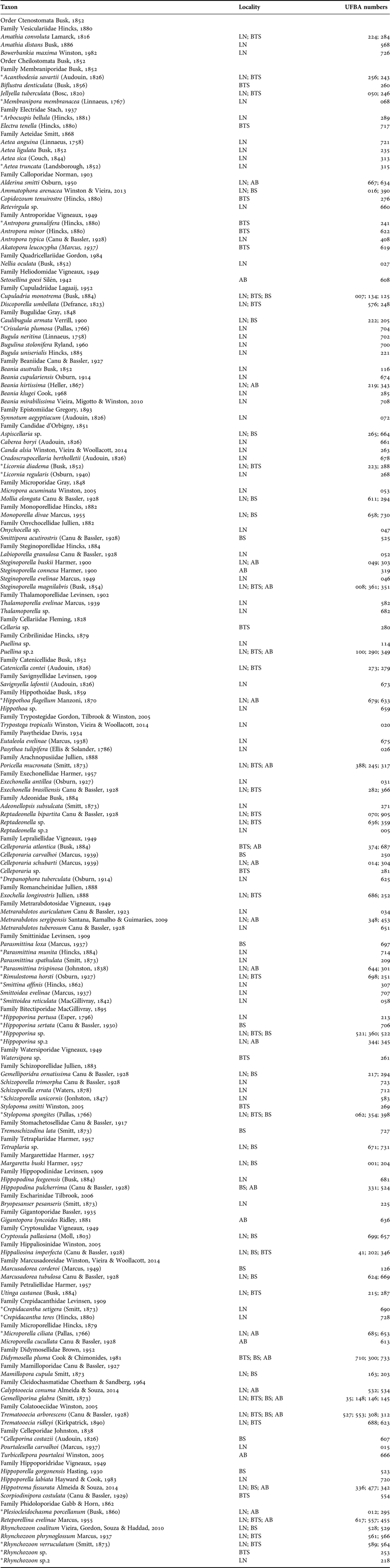
Species names, localities of occurrence and UFBA numbers are provided in Table 1. The species and family names used are consistent with recent literature, and species marked with an asterisk are doubtful and need revision (following Vieira et al., Reference Vieira, Migotto and Winston2008).
Checklist of Gymnolaemata bryozoans and their distribution along Bahia State. Localities are indicated as: LN, Litoral Norte; BTS, Salvador and Baía de Todos os Santos; BS, Baixo Sul; and AB, Abrolhos.
* Species is doubtful and needs revision (following Vieira et al., Reference Vieira, Migotto and Winston2008).
RESULTS
The results are summarized in Table 1. A total of 135 species belonging to 54 families of Gymnolaemata Allman, Reference Allmann1856 were identified. The majority belongs to the order Cheilostomata Busk, Reference Busk and MacGillivray1852 (53 families and 132 species), and only one family, Vesiculariidae Hincks, Reference Hincks1880, belongs to the order Ctenostomata Busk, Reference Busk and MacGillivray1852. Within Cheilostomata, Smittinidae Levinsen, Reference Levinsen1909 (8 spp.), Phidoloporidae Gabb & Horn, Reference Gabb and Horn1862 (7 spp.), Candidae d'Orbigny, Reference d'Orbigny1851 (6 spp.) and Schizoporellidae Jullien, Reference Jullien1883 (6 spp.) are the most diverse families, representing approximately 20% of the total. Greater species diversity is recorded for the Litoral Norte region (107 spp.), followed by Salvador and Baía de Todos os Santos (39 spp.), Baixo Sul (29 spp.) and Abrolhos (26 spp.).
DISCUSSION
Vieira et al. (Reference Vieira, Migotto and Winston2008) recorded fewer than 100 species of bryozoans from Bahia State. From Gymnolaemata, approximately 60 species were registered (Vieira et al., Reference Vieira, Migotto and Winston2008) and it is clear that this low number is due to the lack of publications on the bryozoan fauna from Bahia. The only taxonomic checklist of bryozoans from Bahia was published by Souza (Reference Souza1989) as a Congress abstract, providing an inventory of 34 species of cheilostomes.
A quantitative inventory of bryozoans from Bahia was published by Kelmo et al. (Reference Kelmo, Attrill, Gomes and Jones2004) and indicated the occurrence of 157 species. As pointed out by Vieira et al. (Reference Vieira, Migotto and Winston2008), the taxonomy in this paper should be revised because the nomenclature has not been updated and it is probable that some species are listed with two different names. Furthermore, Kelmo et al. (Reference Kelmo, Attrill, Gomes and Jones2004) affirmed that colonies were counted in situ, but this is especially problematic with bryozoans as some differences between species can only be verified with scanning electron microscopy (Gordon, Reference Gordon, Herrera-Cubilla and Jackson2000; Taylor & Mawatari, Reference Taylor, Mawatari, Moyano, Hugo, Cancino and Wyse-Jackson2005; Berning & Kuklinski, Reference Berning and Kuklinski2008; Berning, Reference Berning2012).
Notes on doubtful species
Most doubtful identification is due to the usage of names of species that were thought to have widespread distribution and are now recognized as species complexes. As indicated by Harmelin et al. (Reference Harmelin, Vieira, Ostrovsky, Cáceres-Chamizo and Sanner2012), bryozoans show multiple examples of pseudo-cosmopolitanism because of the customary use of familiar species names combined with the difficulty of defining species boundaries with the available tools. This is the case, for example, of Membranipora membranacea (Linnaeus, Reference Linnaeus1767) (Schwaninger Reference Schwaninger1999, Reference Schwaninger2008), Stylopoma spongites (Pallas, Reference Pallas1766) (Tilbrook, Reference Tilbrook2001; Vieira et al., Reference Vieira, Migotto and Winston2008) and Microporella ciliata (Pallas, Reference Pallas1766) (Harmelin et al., Reference Harmelin, Vieira, Ostrovsky, Cáceres-Chamizo and Sanner2012). In other cases, there is clearly a need for the revision of genus and/or species, including the examination and comparison with type and related species, such as Celleporaria spp. and Hippoporina spp.
It is probable that many doubtful species from Bahia represent new species (e.g. Almeida & Souza, Reference Almeida and Souza2014), but only employing the use of scanning electron microscopy and integrating genetic and morphological studies (Jackson & Cheetham, Reference Jackson and Cheetham1990; Berning & Kuklinski, Reference Berning and Kuklinski2008) will reveal the true identity of these taxa. We choose to keep these species in the inventory so as not to underestimate the real diversity of bryozoans from Bahia.
ACKNOWLEDGEMENTS
This study is part of A.C.S. Almeida's PhD thesis supported by CAPES through the Graduate Program in Animal Biology (Programa de Pós-Graduação em Biologia Animal-PPGBA) of the Departamento de Zoologia, UFPE. We are grateful to the Programa de Pós-Graduação em Diversidade Animal of the Universidade Federal da Bahia (PPGDA/UFBA), Carla Menegola (Laboratório de Biologia de Porifera e Fauna Associada, UFBA), Laboratório de Malacologia e Ecologia de Bentos (LAMEB/UFBA), Laboratório de Geoecologia dos Sedimentos Marinhos (GEOECO/UFBA) and Laboratório de Estudos Costeiros (LEC/UFBA) for logistical support. Our thanks also go to Dennis P. Gordon, National Institute of Water & Atmospheric Research, New Zealand, and to Leandro M. Vieira, Centro de Ciências Biológicas, Universidade Federal de Pernambuco, Recife, Brazil, for taxonomic revision and suggestions. We also thank Cetrel S.A., Empresa de Proteção Ambiental, for specimen collections and Centro de Pesquisa Gonçalo Moniz (FIOCRUZ/BA) for the SEM images. Finally, we thank the anonymous reviewers for helpful comments on the manuscript. Funding was provided by FAPESB (Proc. 4076/2012) to A.C.S. Almeida.