INTRODUCTION
Great thinkers of the 19th century including Max Weber, Sigmund Freud, and Karl Marx all maintained that religion would fade into oblivion with the end of the Industrial Revolution. However, today at the beginning of the 21st century, we can say with certainty that this thesis has been wrong. Attending church remains a popular pastime in industrialized western countries including the United States while, at the same time, new religious movements as well as fundamentalist religious groups have expanded across the globe. In addition, the past decades have seen numerous religiously motivated conflicts on various continents, be it in Bosnia, Sudan, or Afghanistan (Norris and Inglehart Reference Norris and Inglehart2011, 2–3). In the words of Berger (19992, 2), “the world today with some exceptions … is as furiously religious as it ever was, and in some places more so than ever.”
Religious practices and institutions exist in nearly all countries across the globe, making it an embedded part of social life. Religion still plays a major role in shaping the political beliefs and democratic credentials of individuals. Citizens might relate to political candidates whom share their religion, or might simply be interested in determining whether candidates' policies fit with a particular doctrine. Despite this, the role of religion in influencing citizens' decision to turnout on Election Day has been largely overlooked (Gill Reference Gill2001). Rather than focusing on religion, the scholarship, notably in comparative politics, has been concerned with evaluating the socio-economic and institutional indicators that influence turnout (Blais Reference Blais2006; Jackman and Miller Reference Jackman and Miller1995; Franklin Reference Franklin2004). However, while many of the traditional studies on Western countries (Powell Reference Powell1986; Jackman Reference Jackman1987) and more recent analyses concentrating on countries from the industrializing world (Blais and Dobrzynska Reference Blais and Dobrzynska1998; Pintor, Gratschew, and Sullivan Reference Pintor, Gratschew, Sullivan, Pintor and Gratschew2002; Endersby and Krieckhaus Reference Endersby and Krieckhaus2008) have linked electoral participation to compulsory voting, the electoral system type, or development, there is still a lacunae in the literature that looks at the impact of religion on aggregate turnout.
Does religion influence electoral turnout? Or more precisely, do certain religious affiliations hinder or promote citizens' likelihood to turnout on Election Day? Faced with declining turnout rates around the globe this question becomes even more important (Franklin Reference Franklin2004). In this article, we provide a first snapshot on the importance of religion on turnout by examining the influence of one religious doctrine, Islam, on citizens electoral participation. Equipped with an empirical dataset that covers turnout figures, as well as six theoretically informed covariates for all legislative elections between 1970 and 2010, for which data are available, we explore whether Muslim-majority countries have lower turnout than countries wherein Islam is not the dominant religion. Controlling for compulsory voting, the electoral system type, the decisiveness of the election, the size of the country, the regime type, material wealth, and time, we find that predominantly Muslim states register significantly lower turnout rates than majority non-Muslim states. In addition, we discover that the stronger the Islamic religion is entrenched in politics, the more detrimental the effects on turnout.
The article proceeds as follows. The first section situates the study within the broad literature on electoral participation and offers some hypotheses on the possible relationship between religion and turnout. The second part introduces our novel dataset and presents the variables that undergird this analysis. Section three focuses on the statistical procedures employed for the panel analysis. In the fourth section, we explain the results of the article. The final section summarizes the main findings of the study and provides some avenues for future research.
THE EXISTING LITERATURE
A country's political culture,Footnote 1 or a society's value and belief system (Hill Reference Hill1981; Wilson Reference Wilson2000) have been central in much of the theoretical scholarship in political science, economics, sociology, and anthropology. The term “political culture,” however, is hard to define, and even harder to operationalize. Its fluid meaning across various studies as well as substantive areas demonstrates the slippery nature of the term (Inglehart Reference Inglehart1988). In line with the dominant view in studies on citizen engagement (Almond and Verba Reference Almond and Verba1963; Verba and Nie Reference Verba and Nie1972; Inglehart Reference Inglehart1988), we opt for a narrow definition of political culture and equate the term with the orientation of a particular society's citizens toward politics, political participation, and perceptions of political legitimacy.
Embracing this narrow definition of political culture, traditional cross-country turnout studies (Verba and Nie Reference Verba and Nie1972) have shown that election dynamics are embedded in specific features of a country's economic and social environments. By reporting a positive correlation between high levels of education and wealth with increased support for democracy, classical sociological works (Wolfinger and Rosenstone Reference Wolfinger and Rosenstone1980) suggest that political participation increases as a country modernizes. Value change theorists (Inglehart Reference Inglehart1990; Reference Inglehart1997) add that as development advances the dominant values of a society change. According to this post-materialist thesis, the interests of citizens will shift from material values (e.g., social welfare) to post-materialist values (e.g., self-expression values) as a country grows affluent.
A quick glance at our data confirms this relationship. From the period between January 1970 and December 2010, turnout rates in 771 elections in less developed countries averaged 69 percent, whereas the mean participation rate in 371 elections in developed states stood at 78 percent. The correlation between wealth and democracy is widely accepted in the literature (Przeworski et al. Reference Przeworski, Alvarez, Cheibub and Limongi2000; Acemoglu and Robinson Reference Acemoglu and Robinson2006).Footnote 2 However, while there is a positive link between both increased wealth and high(er) education on turnout, it is important to note that there is no deterministic relationship between these concepts. Rather, many of the richest countries including the United States and Switzerland have comparatively low turnout rates that sometimes hover around 50 percent of all registered voters. Even more significantly, some states that are highly developed (particularly in various Middle Eastern countries, such as Bahrain) remain some of the most traditionalistic countries in the world. Because the indicator development does not capture these cultural differences, it is important to look for other cultural proxies that capture a country's value and belief system.
One additional cultural indicator that might impact political engagement is religious doctrine (Lipset Reference Lipset1990; Wood Reference Wood1997). Considerable empirical evidence has shown that religious practices continue to bear strongly on a country's social and political development. Established religions, such as Islam, Christianity, are winning new converts (Keddie Reference Keddie1998; Stark Reference Stark1999) while at the same time, new religious movements, including millenarian groups, are on the rise.Footnote 3 To support these developments, the World Values Survey reveals that over 75 percent of respondents in 43 countries place allegiance in some divine force (Gill Reference Gill2001).
More importantly, religious convictions may have a profound influence on the behavior of believers. For that reason, religion has the potential to be a powerful mobilizing agent. For example, throughout human history, religion has been invoked to persuade individuals to rally behind a cause and to channel various forms of collective action, including political protests, terrorist acts, wars, and even conventional political participation (Gill Reference Gill2001). Focusing explicitly on voting, Lijphart (Reference Lijphart1979) asserts that religion has a more significant influence on electoral behavior than class indictors even in rich developed countries. Given religion's capacity to motivate political participation, our study seeks to determine the impact of religion on turnout. In this article, we focus primarily on the Islamic religion and hypothesize that Islam may stifle turnout. To theoretically underpin our argument we start with Elazar's (Reference Elazar1970) classic distinction of three political cultures: Moralistic cultures, which tend to encourage active citizen participation; traditionalistic cultures, which favor targeted participation of elites at the exclusion of masses; and individualistic cultures, which neither enable nor constrict participation through regulatory policies (King Reference King1994, 119).
Directly or indirectly referring to Elazar's (Reference Elazar1970) categories, empirical research has shown that certain religious faiths, such as Protestantism, facilitate citizen participation while others, such as traditional Catholicism, do not (Kincaid Reference Kincaid1980; Morgan and Watson Reference Morgan and Watson1991; Sharkansky Reference Sharkansky1969). More precisely, studies (e.g., King Reference King1994, 118–119) suggest that we can expect “moralistic cultures” to promote civic engagement through laws and procedures that foster political participation in general, and high levels of voter turnout, in particular. In contrast, traditional societies may hinder citizens' involvement in the political process.Footnote 4 While we do not hold the belief that Islam is inherently incompatible with democratic values (for contrasting perspectives, see Weiffen Reference Weiffen2004; Huntington 1996; Robinson Reference Robinson1997; Esposito and Voll Reference Esposito and Voll1996), we note that Muslim-majority states tend to be more traditionalistic than others. For one, there is often no separation between the proverbial “church and the state” in many Muslim dominant countries, such as Iran, and several Islamic countries, such as Saudi Arabia, are governed by Sharia law (Blaydes and Linzer Reference Lisa and Linzer2008).
This article highlights three distinctive features of Islam, which might decrease turnout. First, the Islamic religion — typically in practice, has a formal, institutional element. In states, such as Yemen and Oman, religious institutions and experts are entrusted with the interpretation of divine scriptures and with dictating the rules of appropriate conduct to adherents. In these countries, religion profoundly directs and controls political behavior directly through religious police. Second, Islam can regulate behavior indirectly through cultural norms.Footnote 5 A strict or traditional interpretation of the Muslim religion, for instance, places constraints on conduct, appearance, and even discourse in both private and public settings (Bellin Reference Bellin2004). For example, Islamic cultures strongly require members to exhibit chastity, piety, and morality in personal appearance and behavior. This is reflected in the laws that exist in some states requiring women to veil in public places (Blaydes and Linzer Reference Lisa and Linzer2008).
Third, in various Islamic countries, citizens who do not respect Islamic laws and traditions may be punished. For instance, a woman who is found to be unchaste may be shunned, condemned as an adulterer, or in extreme cases, sentenced to corporal punishment or death. In Islam, such punishments are derived from the fiqh, or Islamic jurisprudence. Heretics and homosexuals continue to face similar treatment by different Islamic denominations across countries. Even if laws are not officially enforced, religious norms exist informally (e.g., blasphemy laws) in other officially secular predominantly Muslim countries such as Egypt, Jordan, and Turkey. Confronted with these entrenched religious values in politics, citizens might find it prudent to feign devoutness and to otherwise refrain from political engagement.
The emphasis on traditional values in some Muslim-majority states, including ideas about the role of women, patrimonialism, and the hierarchical structure of society, is not conducive to high political participation. In some Muslim states, such as Saudi Arabia, women are not considered to be full members of society (see Fish Reference Fish2002). For example, in Shari'a countries, women are restricted in their rights, including the right to initiate a divorce, the right to expression (as their testimony counts as half of the testimony of a man's), and even the right to freely choose their life partners (as they are not allowed to marry non-Muslim men, whereas men have the right to marry non-Muslim women) (see Keddie Reference Keddie1990; Cherif Reference Cherif2010). Women are also underrepresented in political offices in Muslim-majority countries. For example, women only comprise 11.3 percent of the deputies in national legislatures in the Arab states — a percentage that is nearly half of the world's average of 20 percent (Inter Parliamentary Union 2011). These figures indicate that women in majority Muslim countries are not as integrated as men in the political process.
Adding to these structural constraints, several scholars (Putnam 1996; Hall Reference Hall1999; Rothstein Reference Rothstein2001; Blaydes Reference Blaydes2006; Hay Reference Hay2007) argue that citizens in Islamic countries may be disinterested in participating in conventional forms of political actions and distrustful of officials, government authorities, or even of the state's electoral practices. Even if religious leaders entice citizens to vote, turnout may still be low.Footnote 6 For example, in the early 1990s, the state-run media in Egypt brought in religious figures that urged participation in elections and even described non-voting as un-Islamic (Traub Reference Traub2007; Blaydes Reference Blaydes2006). However, despite these efforts, official turnout remained low (e.g., official reports of turnout figures never exceeded 50 percent in the 1980s and 1990s). Another case study by Hamdani (Reference Hamdani2005) suggests that a similar relationship between Islam and turnout may exist even outside the boundaries of Muslim-majority states. Focusing on the Canadian electorate, his study reports that Muslims are “one-third less likely to vote than the Hindus and Sikhs, with whom they share some key demographic characteristics, and about 40 percent less likely than the Jewish community which has the highest voter turnout rate” (Hamdani Reference Hamdani2005, p. ii).Footnote 7
Following the literature, we assume that Muslim-majority states will have lower rates of electoral participation than non-Muslim majority states. In addition, we explore the extent to which Islamic ideas are embedded in structures that either encourage or discourage active political participation. The orthodox view in political Islam tends to be strongly patriarchal and supportive of the institution of Shari'a law (Spierings, Smits, and Verloo Reference Spierings, Smits and Verloo2009). The inclusion of such views, which meld together the church and the state, codifies norms in interactions, behavior, laws, and practices. For that reason, we hypothesize that the more deeply Islamic doctrines are embedded in a given society, the less likely it is for that society to encourage high volumes of electoral participation.
We evaluate both claims in a multivariate framework. To this end, we have constructed a large scale dataset that includes data on all legislative elections worldwide between 1970 and 2010 for which data are available.Footnote 8 In the next section, we operationalize our two variables of interest, Islam and turnout. In the subsequent part, we present our theoretically informed control variables (i.e., compulsory voting, the electoral system type, the decisiveness of the election, the size of the country, material wealth, the regime type of a country, and time), which might also have an impact on macro-level turnout and operationalize them. The final sections of the article discuss the statistical procedures, the results, and the conclusion, respectively.
THE DEPENDENT VARIABLE — TURNOUT
We use the classical definition of turnout, and measure the variable in its standard way, as the percentage of registered voters that cast ballots in their country's national legislative election.Footnote 9
The Independent Variable of Interest — Islam
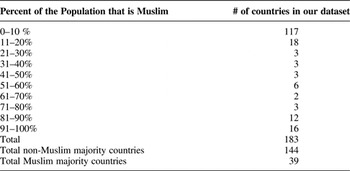
To test our first hypothesis, which suggests that predominantly Muslim countries will have lower turnout than majority non-Muslim countries, we operationalize Islam with the help of a dummy variable. We code all countries in which more than 50 percent of the population adheres to some sect of Islam as one. Countries where less than half of the population identifies as Muslim are coded zero.Footnote 10 We deem this binary measurement in Muslim majority countries and non-Muslim majority states superior to a graded measure, because there is little variation in the percentage of Muslims within each of the two groups (see Table 1). Muslim majority countries average 84 percent Muslims and in roughly 70 percent of Islamic countries four out of five citizens are Muslims. In non-Muslim majority countries, Muslims only average 4 percent of the population and in 86 percent of non-Muslim states individuals adhering to the Islamic belief make up less than 1 in 10 citizens.
The distribution of individuals with Muslim faith around the world

To examine our second hypothesis, we rely on the International Country Risk Guide (ICRG) that assesses the degree of religiosity in countries (see Political Risk Services 2012). The ICRG indicator measures religion on a seven-point scale. Countries in which religious doctrine and state doctrine are basically inseparable are coded zero, whereas politically secular countries are coded six. The ICRG measure is, to our knowledge, the only indicator that measures the degree to which religion is entrenched in politics on an international scale. As such, the indicator is very comprehensive, covering more than 140 countries from 1984 to 2009 and thoroughly constructed, drawing on multiple sources such as, assessments of the respective constitutions and surveys of the population. For the purpose of this study, we include the ICPR Religion and Politics in its raw form and interact it with the dummy variable for Islam. This interaction term represents a measure of the degree to which Islamic tenets are practiced in a society.
The Control Variables
While the main purpose of this study is to test the influence of Islam on turnout, we also control for six theoretically informed covariates (that is, compulsory voting, the electoral system type, the decisiveness of the election, the size of the country, material wealth, and regime type) that might also affect turnout. We cluster the aforementioned six indicators in institutional, socio-economic, and contextual factors.
Institutional Variables
The first institutional variable in the analysis is compulsory voting laws. If voting is mandatory in a country, we can expect that turnout will be higher (Lijphart 1997; Lever Reference Lever2008). To capture the dynamics of compulsory voting, we create a dummy variable and code all countries with mandatory voting laws zero and all other states one. To be included in the category compulsory voting states, countries must have credible sanctions for non-compliance in place. Data were collected from the International Institute on Democracy and Electoral Assistance (2011).
Second, we control for a country's electoral system type. Following the conventional wisdom in the discipline, we hypothesize countries with proportional representation to have higher turnout than states with plurality systems (Karp and Banducci Reference Karp and Banducci1999; Reference Karp and Banducci2008). A rather proportional system (PR) implies that the number of votes a party receives roughly translates into the number of seats a party gains. This indicates that regardless of the projected electoral margins of victory between the winning party and the runner-up, supporters of both parties have an incentive to turnout. The same applies to followers of secondary or tertiary parties; because of the relatively low hurdles to representation, the percentage of votes these parties normally gain roughly translates into seats (Selb Reference Selb2009). In contrast, under the condition that a district is safe, supporters of the main parties have little to no incentive to cast their ballot because their vote will not alter the outcome. Similar dynamics are at stake for supporters of secondary parties; they too have little incentive to turnout on Election Day in a majoritarian system because they know that their vote will most likely not count. To capture the possible impact the electoral system of a country might have on turnout, we create three categories: proportional systems, mixed systems, and plurality systems. We use plurality systems as the reference category and create two dummy variables; one for PR systems and one for mixed systems. Data for the electoral system type of a country comes from the Inter Parliamentary Union (2011).Footnote 11
Third, we add a control for the decisiveness of the electoral race. The motivational theory of voting suggests that more important elections (that is, the ones in which the legislature and the executive are elected at the same time) generate higher turnout than less formative elections (that is elections, which fill only part of the legislature) (see Abramson, Diskin, and Felsenthal Reference Abramson, Diskin and Felsenthal2007). We use the scheme elaborated by Blais and Dobrzynka (Reference Blais, Massicotte and Dobrzynska1998) to code the decisiveness of an election. We code an election as maximally decisive if all executive and legislative positions are filled in one election.Footnote 12 We code an election as partially decisive if one of the two chambers or the executive branch is elected on a separate day (e.g., the election in Mali where the president and the national assembly are elected on a different day). We code an election as minimally decisive, if there are separate elections for any of the two chambers or the presidency, or if not all legislative seats are filled at the same time (e.g., the United States midterm elections). To collect our data we relied on the same sources as for turnout.
Socio-Economic Variables
We control for two socio-economic variables: development and population size. Concerning the former, we expect to see a positive relationship between the level of wealth and the level of electoral participation. Highly developed countries are likely to strengthen a citizen's sense of autonomy and education; two factors that ought to foster an individual's political interest and political participation, including the likelihood to cast votes (Aart and Wessels Reference Aart, Wessels and Thomasson2005). To capture, development, we use the natural log of the indicator per capita gross domestic product. Data for the variable were retrieved from the United Nations (2011). Pertaining to the second indicator, population size, we hypothesize a negative relationship between population and the level of turnout. Two calculations entertain this hypothesis. First, in smaller countries, each vote is likely to count “more” than in large states (Downs 1957). Second, in small countries, there are likely to be closer ties between the electorate and the voters. This, in turn, is expected to lead to enhanced deliberation and increased accountability; two factors that should boost turnout (Geys Reference Geys2006). In the model, we transform the indicator population size into its natural log. Data were collected from the United Nations Statistical Division (2011).
Circumstantial Factors
Finally, we add a control variable for regime type and expect democracies to display higher levels of conventional political participation at the polls than non-democracies. Free and fair elections are at the core of a democracy; they allow citizens to select their representatives and enable them to influence policy (Katz Reference Katz1997). The open climate in a democracy should also encourage citizens to participate in the political process. In contrast, the shortage of political choices in hybrid and autocratic regimes coupled with the typically negligent posture of autocratic governments are factors that ought to discourage citizens from turning out on Election Day (Kostadinova and Power Reference Kostadinova and Power2007). In the analysis, we distinguish between three types of regimes: democracies, anocracies and autocracies. To capture these three regime types, we create an ordinal variable and code democracies as one, anocracies as two, and autocracies as three. Data for regime type were retrieved from the Polity IV database (Marshall et al. Reference Marshall, Gurr, Davenport and Jaggers2002).
DATA AND METHODOLOGY
Our dataset comprises slightly over 1100 observations, which we cluster in a pooled design. Our sample dataset offers a good representation of all regimes that hold elections. Rich industrialized countries comprise less than 30 percent of all states included in our analysis, whereas medium or low developed countries account for more than two-third of the data. Pertaining to our main independent variable of interest, we classify 39 countries as majority Muslim.Footnote 10 Concerning our dependent variable turnout, we have wide variation. Official turnout numbers range from 21 percent for the 1994 legislative election of Guatemala to over 95 percent for some former or present communist countries such as Vietnam or Laos.
To model the relationship between Islam and turnout, we engage in a three-step process. First, we run an independent sample t-test to determine whether predominantly Muslim countries have lower turnout than predominately non-Muslim countries. Second, we test the same stipulation in a multivariate regression model. Having an unbalanced panel and autocorrelation in the data requires careful modeling procedures. We use multi-level modeling (HLM) because this technique controls for dependencies in the error structure (i.e., above average turnout countries, such as Belgium, frequently have consistently above average turnout and below average turnout countries, such as Mali, often have constantly low levels of citizen participation) (O'Connell and McCoach Reference O'Connell and McCoach2008). HLM is also insensitive to unbalanced panels rendering it a propitious choice for this analysis (Raudenbush and Bryk 2002). In the equation (see Model 1), we have so-called “repeated measures,” which implies that observations are nested within countries
Third, because the data structure does not change, we use the same techniques (HLM) for our interactive model (see Model 2). To capture some of the variance over time and to allow for a purer identification of the independent variables or fixed effects, we include a time variable coded zero for 1970 and 40 for 2010 to both models. Substantively, this time trend accounts for the decline in turnout that developed and, to a lesser degree, developing countries have experienced over the past decades. Our first HLM equation (i.e., model 1) has the following equation:
 $$\eqalign{&{\rm Turnout}_{{\rm ij}} = {\rm \beta} _{0{\rm j}} + {\rm \beta} _{{\rm 1j}} \ast \left( {{\rm D}\_{\rm Islam}_{{\rm ij}} } \right) + {\rm \beta} _{{\rm 2j}} \ast \left( {{\rm D}\_{\rm Quotas}_{{\rm ij}} } \right) + {\rm \beta} _{{\rm 3j}} \ast({\rm D}\_{\rm Proportional}\cr&{\rm Representation}_{{\rm ij}} ) + {\rm \beta} _{{\rm 4j}} \ast \left( {{\rm D}\_{\rm Mixed \,\, Electoral\,\,System}_{{\rm ij}} } \right) + {\rm \beta} _{{\rm 5j}} \ast ({\rm Decisiveness}\cr&{\rm of\,\,the\,\,Election}_{{\rm ij}} ) + {\rm \beta} _{{\rm 6j}} \ast \left( {{\rm Log\,\,GDP\,\,per\,\,capita}_{{\rm ij}} } \right) + {\rm \beta} _{{\rm 7j}} \ast \left( {{\rm Log\,\,Population}_{{\rm ij}} } \right)\cr& + {\rm \beta} _{{\rm 8j}} \ast \left( {{\rm Regime\,\,Type}_{{\rm ij}} } \right) + {\rm r}_{{\rm ij}}}$$
RESULTSFootnote 13
The independent sample t-test indicates that non-Muslim countries average 73.34 percent voter turnout, whereas predominantly Islamic countries average 64.05 percent. This difference is statistically significant (p < 0.001) and substantively relevant. While this nine-point gap in turnout suggests a possible negative link between Islam and turnout, it is necessary to test the robustness of this relationship in a multivariate framework. Models 1 and 2 (see Tables 2 and 3 — online supplementary material) displays the results of the multivariate pooled-time series analysis, featuring the Islam dummy variable as the main independent variable and turnout as the dependent variable. The model largely confirms the results from the t-test. The Islam dummy variable is statistically significant and demonstrates that predominantly Muslim countries register approximately 5 percentage points lower turnout than non-Muslim states.
Thus, our model seems to confirm that the Islamic faith tends to place more emphasis on traditions (e.g., hadiths), which may directly or indirectly hinder social and political involvement of certain cohorts of the population (e.g., women). This result is confirmed by many country examples. For example, North African and sub-Saharan African Muslim states, such as Algeria, Mali, and Burkina Faso have turnout rates that consistently range around 40 percent. Similar numbers can be found in other countries, including Pakistan and Djibouti.
The coefficients of the control variables confirm some of the well-established relationships in the turnout literature (Franklin Reference Franklin2004). Unsurprisingly, compulsory voting significantly increases turnout. Countries that institute mandatory voting laws report approximately 10 points higher turnout rates than countries without such laws. Another rather strong relationship exists between the decisiveness of the electoral race and turnout. Compared to marginally decisive races, decisive elections typically see electoral participation rates that are, on average, 5 percentage points higher at the polls. There is also a positive, albeit weak, relationship between the material wealth of a country and turnout. However, our measure for material wealth, the logarithmic transformation of the per capita gross domestic product variable, is only significant at the 10 percent level. As expected, we also see that time has a negative impact on turnout. The model predicts that turnout has decreased by 0.3 points per year over the past 40 years.
In addition, the model has generated two rather surprising findings. First, the electoral system type does not impact turnout. Our equation predicts similar turnout rates across countries regardless if the country operates under a PR system, mixed system, or majoritarian system. While there is some recent support for this result (Blais Reference Blais2006), our study yields another rather surprising finding. Non-democracies appear to have higher turnout than democracies (see Blaydes Reference Blaydes2006). In fact, according to our turnout model there is a 6-percentage point gap between democracies and autocracies. At first glance, this result seems to defy the conventional definition, which is that democracies should have higher turnout (Schumpeter Reference Schumpeter1976). However, the finding may be explained by the tendency of some autocracies to report very high, and at times, manufactured turnout rates. For example, countries, such as Cuba, Laos, and Rwanda, officially record turnout figures that are consistently above 95 percent of all registered voters — a figure that is not even attained in countries with compulsory voting laws.
While the first model indicates that Islam negatively influences turnout, it still does not determine whether the intensity with which Islam is entrenched in society has an impact on turnout. In order to gauge this second relationship, Model 2 adds the ordinal six-scale Religion in Politics variable that measures the strength with which Islam is embedded in a state and displays the results of its interactive impact with Islam. The equation confirms our second hypothesis. It indicates that the strength of Islamic tenets matter both statistically and substantively. In detail, the model predicts that countries in which religious doctrine guides politics (e.g., those countries that rank one on the Religion and Politics indicator such as Sudan or Algeria during the 1990s) have approximately 15 percentage points lower turnout than non-majority Islamic countries.
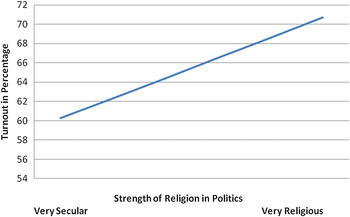
However, the interaction term illustrates that the aforementioned gap narrows by 3 percentage points for every degree a Muslim country becomes “less religious.” Figure 1 depicts the relationship between the strength of religion in Muslim majority states and turnout for a hypothetical Muslim majority country, where the elections are maximally decisive, held in a democracy under PR in 2010 in a country that has a gross domestic product per capita of 15,000 and a population of 50 million inhabitants. The figure highlights a more than 10 percentage point gap between very secular Muslim countries and very religious Muslim majority countries. Also when we compare very secular Muslim to non-Muslim countries, the gap is minute — one point. In reality, this implies that Islamic countries, where the Religion in Politics indicator has the second most secular rating (i.e., 5 percentage which is the highest ranking for secularity of any Muslim country in our dataset), have only around 2 percentage points lower turnout rates than the secular non-Muslim countries in the same category. In practice, this finding implies that Muslim states in which there is a strong separation between the state and the church, such as Turkey, have only slightly less citizen's turnout on Election Day than citizens in non-Muslim majority states. In this regard, the result of this second model indicates that it is less the Islamic religion per se, but rather the degree to which it is practiced and entrenched in politics that impacts turnout.
(Color online) Turnout in Muslim majority states.

With regard to the control variables, the second model largely confirms the results from our first model. With the exception of the per capita gross domestic product indicator, which is not significant in the second equation, all other factors have a similar magnitude to the ones in the first model. This means that turnout is still driven by compulsory voting, the decisiveness of the election, and a non-democratic regime type. In addition, time has a negative impact on macro-level electoral participation.
CONCLUSION
This study adds to the vast literature on turnout (Blais Reference Blais2006; Geys Reference Geys2006). By further unpacking the impact political culture has on the most basic form of political participation, voting, we find that compared to other religious denominations, Islam has a negative impact on turnout. More precisely, we discover that compared to non-Muslim countries, predominantly Islamic countries have approximately 6 percentage points lower turnout rates. Our results indicate that the degree to which Islam is practiced also has a strong influence on electoral involvement. We find that rather secular Muslim countries, such as Albania have only 3 points lower turnout rates than non-Muslim countries, whereas this gap widens to more than 10 percentage points in countries where the Muslim doctrine is strongly entrenched in politics.
Because Muslim majority countries are distinct from other religions — more than 80 percent of the elections in Muslim dominant countries have been held under a non-democratic regime and, with the exception of wealthy renter states, the majority of Islamic countries are located in the developing world — we do not expect to see huge changes in turnout as these countries modernize. For one, many Muslim dominant countries, including Bahrain and the United Arab Emirates, have reached high levels of development, but remain dominated by traditional Islam. In addition, some of the Arab Spring countries, such as Egypt and Morocco, which have recently undergone some democratization and which held their first rather free multi-party elections in decades, did not see a real boost in turnout. Rather, official turnout rates remained around 50 percent in all three countries' inaugural democratic legislative elections (e.g., 54 percent for Egypt and 45 percent for Morocco). These participation rates are not only similar to turnout rates prior to democratization, but they are also below the average turnout rate for Muslim majority countries, which stands at around 64 percent. Given high abstention rates, traditional religious beliefs and practices, which implicitly or explicitly prevent the participation of various cohorts of the population, are not likely to dissolve in the short run.
Although our article thoroughly evaluates the impact of Islam on turnout, it leaves many questions unanswered. Our theoretical discussion and results strongly suggest that women in some Muslim majority countries are less likely to participate in the political process. Future research using individual level voting data should try to assess this claim. More generally, more studies are needed that extrapolate the beliefs and motivations of individuals, who vote and abstain in strongly religious Muslim countries. In highly religious countries such as those that offer religious parties with clear political mandates, we expect high turnout by those who are religious. In contrast, secular individuals and citizens of a minority faith might feel excluded by or alienated from the political system, especially as more than 80 percent of the elections in the Muslim world are undemocratic.
More broadly, our study provides a first foray into the effects that religion may have on turnout. More research is necessary in order to conclusively determine the impact that different religions and faiths have on political behavior. For example, further research could engage in a systematic comparison between Protestantism, Catholicism, and Confucianism and their impact on turnout. More narrow analyses could also look at different Islamic tenets (e.g., Shi'a Islam and Sunni Islam) and their relationship with turnout. Besides providing some initial answers on the study of religion in electoral politics, we hope that this article might be an interesting starting point in the study of religion and electoral politics.