Introduction
With the large number of military personnel returning to America from Iraq and Afghanistan, recent attention has been directed towards the relationship between post-traumatic stress disorder (PTSD) and traumatic brain injury (TBI). However, little has been done to explore the occurrence of PTSD using population-based TBI samples. As defined in the Diagnostic and Statistical Manual of Mental Disorders-IV (DSM-IV; American Psychiatric Association, 1994), PTSD requires that an individual be exposed to a traumatic event. Three types of symptoms must be present for diagnosis, including intrusive recollection/re-experiencing of the event (e.g., dreams, flashbacks); avoidance of stimuli associated with the trauma and numbing of general responsiveness; and persistent symptoms of increasing arousal (e.g., difficulty sleeping, hypervigilence). These symptoms must last more than 1 month and cause clinically significant distress or impairment in functioning. The American National Comorbidity Survey reports that in the absence of TBI, lifetime prevalence of PTSD is 30.7% for women and 14% for men (Breslau, Davis, Andreski, & Peterson, Reference Breslau, Davis, Andreski and Peterson1991), with more severe traumatic events (self-selection of worst event from a listing of 24 possible events experienced) tending to result in higher prevalence of PTSD. For example, in an Australian national survey examining the 12-month prevalence of PTSD, 55% of rape survivors suffered from PTSD as compared to 7.5% of road crash victims (Creamer, Burgess, & McFarlane, Reference Creamer, Burgess and McFarlane2001).
After TBI, the most common clinical entity to be diagnosed is post-concussive syndrome (PCS; Rao & Lyketsos, Reference Rao and Lyketsos2000). Presentation includes a variety of symptoms which are classified as physical (e.g., headache, nausea, dizziness), cognitive (e.g., poor concentration and memory) and emotional and behavioural (e.g., irritability, depression, anxiety, fatigue; Ryan & Warden, Reference Ryan and Warden2003). There is emerging evidence that PCS is influenced by post-traumatic stress reactions, which suggests that addressing PTSD may be crucial in alleviating PCS as a central consequence of TBI (Bryant, Reference Bryant1996). The presence of PTSD post-TBI has been linked not only to adverse psychosocial recovery, but also to recovery of physical health (Kenardy et al., Reference Kenardy, Brocque, Hendrikz, Iselin, Anderson and McKinlay2012). Thus, identification of demographic and TBI-related risk factors associated with the development of PTSD could allow identification of those at greatest risk of PTSD and provision of appropriate interventions/monitoring to optimise recovery.
PTSD is not limited to individuals with more severe injuries, with empirical studies suggesting that between 17 and 33% of survivors of mild TBI also experience PTSD (Middleboe, Anderson, Birket-Smith, & Friis, Reference Middleboe, Anderson, Birket-Smith and Friis1991). Indeed, mild TBI appears to increase the risk of PTSD, with a military survey reporting that while only 16% of troops who sustained bodily injury developed PTSD, in those who sustained a mild TBI 44% screened positive for PTSD (Bryant, O'Donnell, Silove, Clark, & McFarlane, Reference Bryant, O'Donnell, Creamer, McFarlane, Clark and Silove2010).
Numerous studies have also reported on the occurrence of PTSD after severe TBI, despite the theoretical argument that a lengthy loss of consciousness (LOC) and memory loss for the event, which typically accompanies such injury, prevents the development of PTSD (Bryant, Reference Bryant1996; Bryant & Harvey, Reference Bryant and Harvey1998). Alternatively, it has been suggested that PTSD can occur after severe TBI through conditioned fear being mediated in the subcortical structures; with damage to the cortex therefore not precluding PTSD development (Bryant, Reference Bryant2011). Bryant, Marosszeky, Crooks and Gurka (Reference Bryant, Marosszeky, Crooks and Gurka2000) examined the presence of PTSD in a sample of 96 individuals admitted to a rehabilitation unit at 6 months post hospital discharge, and report that PTSD was diagnosed in 27.1% of the sample. However, as stated by the authors, the sampling did not include consecutive admissions, reducing generalisability and highlighting the need for studies with representative population-based samples. Unfortunately, the literature on PTSD following TBI is based upon non-representative samples, often defined according to the type of trauma experienced (e.g., combat, rape) or the severity of the TBI.
The purpose of the present study was to examine the prevalence and predictors (both demographic and injury related) of PTSD in a population-based sample of adults (aged >15 years) at 1 year following TBI, incorporating all injury causes (e.g., assault, traffic crash) and TBI severities. It was hypothesised that those experiencing mild TBI following intentional injury, and with a prior history of depression or anxiety, would be most likely to develop PTSD.
Methods
Study Sample
The study sample was drawn from a larger incidence and outcomes study, the Brain Injury Incidence and Outcomes In the New Zealand Community (BIONIC) study, and the methods are described in detail elsewhere (Feigin et al., Reference Feigin, Theadom, Barker-Collo, Starkey, McPherson, Kahan and Ametatunga2012; Theadom et al., Reference Theadom, Barker-Collo, Feigin, Starkey, Jones, Jones and Barber2012). Briefly, TBI was defined according to World Health Organisation criteria as an acute brain injury resulting from mechanical energy to the head from external physical forces (Carroll et al., Reference Carroll, Cassidy, Holm, Kraus and Coronado2004). Operational criteria for identification of TBI (which was established by practising nurses via the medical records, and then clarified via self-report at first contact of the research nurse with the injured individual) included the presence of ≥1 of the following: (1) confusion or disorientation; (2) loss of consciousness; (3) post-traumatic amnesia; (4) other neurological abnormalities (e.g., focal signs, seizure) (Carroll et al., Reference Carroll, Cassidy, Holm, Kraus and Coronado2004). For inclusion, these symptoms needed to be primarily related to TBI, and not other causes (e.g., substance use, other injuries, psychological issues, medical conditions). TBI severity was defined according to standard definitions using the Glasgow Coma Scale (GCS) and/or Westmead Posttraumatic Amnesia (PTA) scale (Teasdale & Jennett, Reference Teasdale and Jennett1974). Classification of mechanisms of TBI was guided by the ICD-10 classification system (World Health Organisation, 1992) and grouped into TBIs due to falls, vehicle crashes (including traffic and non-traffic crashes), assaults, exposure to external forces (e.g., being hit/struck by another person/animal/inanimate object) and other causes (including unspecified causes). Information on injury mechanism and intentional versus non-intentional injury was determined from medical records. If this was unclear from medical records, this was clarified during interview.
Case ascertainment for the BIONIC study used both prospective and retrospective surveillance systems to ensure registration of all TBI events in residents in the study area of all ages over 1 year (from 1 March 2010 through 28 February 2011). Multiple overlapping sources of information on all new hospitalised and non-hospitalised cases were used (for detailed description see Theadom et al., Reference Theadom, Barker-Collo, Feigin, Starkey, Jones, Jones and Barber2012). To capture non-hospitalised cases a wide range of community services was engaged and checked regularly by members of the study team, including all community-based healthcare providers (e.g., general practices, health centres, physiotherapists), schools, sports clubs, ambulance services, local prisons and regional brain injury association. Individuals could also self-refer to the study, and this was encouraged through regular promotion of the study within the local media (e.g., radio, newspapers, etc.).
Each diagnosis of TBI was confirmed by review of the medical records (or clinical details) for each patient by the study Diagnostic Adjudication Group comprised of practising neurologists. The study was approved by the Northern Y Regional Ethics Committee of New Zealand. The present analyses included all adult TBI cases identified through the BIONIC study who: (1) were aged 16 years or older at the time of injury; and (2) provided written informed consent to participate in follow-up assessments. Figure 1 shows selection of cases from the BIONIC population-based study for the present analysis.
Recruitment and selection of cases for the present study.

Assessment
BIONIC assessments were selected to measure overall recovery following injury encompassing cognitive and neurobehavioural impairments, post-traumatic amnesia (PTA), disability, health-related quality of life and community integration. The full assessment was conducted by a trained researcher, and took, on average, 2 hours to complete and could be completed across two or more sessions if required. Assessment data examined in this analysis were collected at baseline (within 2 weeks of injury) and 12 months post-TBI. Measures of interest for the present analysis, which aimed to explore the prevalence and predictors of PTSD post-TBI, included injury characteristics (e.g., severity, mechanism, presence of alcohol at time of injury); demographic characteristics (e.g., gender, ethnicity, age at injury); self-reported prior diagnoses (e.g., anxiety, depression); as well as the presence and severity of PTSD as assessed at 12 months post-TBI.
Injury severity was defined as mild, moderate or severe in accordance with accepted criteria based upon GCS (13–15 = mild, 9–12 = moderate, 3–8 = severe) and LOC (0–30 minutes = mild, 30 minutes to 24 hours = moderate, ≥24 hours = severe). In accordance with Servadei, Teasdale and Merry (Reference Servadei, Teasdale and Merry2001), mild TBI was further categorised as: low risk = GCS score 15, no skull fracture, neurological deficits, clinical findings (e.g., lost consciousness, vomiting, headache) or risk factors (e.g., drug/alcohol consumption); medium risk = GCS score 15, no skull fracture, neurological deficits or risk factors, but ≥1 clinical finding; high risk = GCS score 15 with or without clinical findings and either neurological deficits, skull fracture or risk factors, or GCS of 14 with or without clinical or radiological findings.
Assessment of PTSD was conducted during face-to-face interviews using the Post-traumatic Diagnostic Scale (PDS) to assess the presence and severity of PTSD symptomatology (i.e., intrusive recollection/re-experiencing, avoidance/numbing, and increased arousal causing significant distress or impairment in functioning) in accordance with DSM-IV diagnostic criteria (American Psychiatric Association, 1994). This was completed with specific reference to the incident which resulted in the TBI for each participant (Foa, Cashman, Jaycox, & Perry, Reference Foa, Cashman, Jaycox and Perry1997). The PDS has high face validity with items directly reflecting PTSD symptoms, high internal consistency (coefficient alpha = .92), and test–retest reliability is also satisfactory for diagnosis over a 2- to 3-week interval (kappa = .74), and for symptom severity (r = .083; McCarthy, Reference McCarthy2008); though these were not generated in TBI samples. An 82% level of agreement has been found between diagnosis using the PDS and the Structured Clinical Interview for the American Psychiatric Association's DSM-IV (Foa et al., Reference Foa, Cashman, Jaycox and Perry1997). In a sample of 34 individuals with TBI, no significant difference was found between PTSD ‘cases’ and ‘non-cases’ on the PDS and another questionnaire measure (Impact of Events Scale), nor on a clinician-administered PTSD scale; nor were any significant differences found on the PDS symptom severity score between those pursuing litigation and those not (Sumpter & McMillan, Reference Sumpter and McMillan2005).
Statistical Analyses
The first stage of data analysis examined the prevalence and characteristics of PTSD within the sample at 1-year follow-up. This included examining the frequency of symptom reporting, the number of participants that met diagnostic criteria for PTSD as well as the mean and standard deviation (SD) for the number of symptoms and symptom severity. Means and SDs for continuous demographic and injury characteristics and frequencies for categorical demographic and injury characteristics of those who met PTSD diagnostic criteria and those who did not meet the criteria were then generated. Comparisons were conducted between these two groups using parametric (ANOVA) and non-parametric statistics (Chi square), as appropriate to the data (i.e., continuous versus categorical).
Correlational analyses were then conducted (using the whole sample) to examine the degree and direction of relationships between demographic/injury characteristics and PTSD severity. Finally, the ability of injury and demographic factors to predict PTSD severity and number of symptoms experienced were examined using linear regression.
Results
Preliminary analysis was conducted to compare those incident cases who consented to follow-up assessments (N = 725) and those who did not consent (N = 644). The groups did not differ significantly in terms of gender, area of residence (Hamilton (urban) versus Waikato (rural) region), or mechanism of injury (p > .05). However, the groups did differ significantly (all p values < .0001) in terms of age (with consenting individuals being significantly younger, mean ages = 25.68 and 30.83, respectively), ethnicity (consenting having a larger proportion of non-Europeans, 24.14 versus 9.63%) and TBI severity (consenting having a lower proportion of mild low-risk injury, 15.03 versus 26.24%).
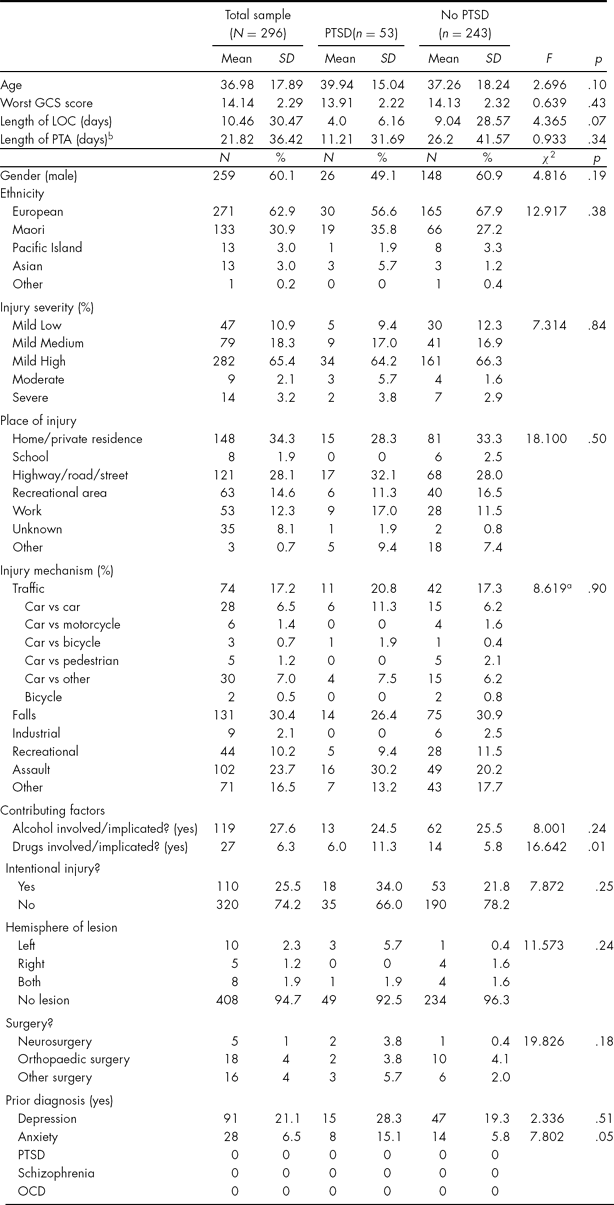
As can be seen in Table 1, the average age of participants with PTSD was 39 years, with 49% being of male gender. The greatest proportion of participants with PTSD was of European ethnicity, had experienced a mild TBI with high risk of complications, and was injured as a result of an assault (30.2%) or fall (26.4%). Average duration of LOC where this was reported was 4 days, while length of PTA for those who experienced PTA (PTA was not collected for those with mild TBI, who made up the greatest proportion of the sample, as by definition PTA is not present) was on average 11 days. Approximately one-quarter of all injuries were classified as having an intentional cause (e.g., assault), with a similar proportion having alcohol implicated. Prior mental health concerns were noted by approximately one-quarter of the participants with PTSD.
Demographic and Injury Characteristics of Those Meeting Diagnostic Criteria for PTSD (n = 53) and Those Not Meeting Criteria (n = 243)
a Analysis was conducted with primary mechanism (e.g., traffic, falls, industrial, etc.).
b Note that as PTA is not relevant to mild TBI, this was only recorded for those with moderate or severe injury (n = 23).
GCS, Glasgow Coma Scale; LOC, loss of consciousness, OCD, obsessive compulsive disorder; PTA, post-traumatic amnesia.
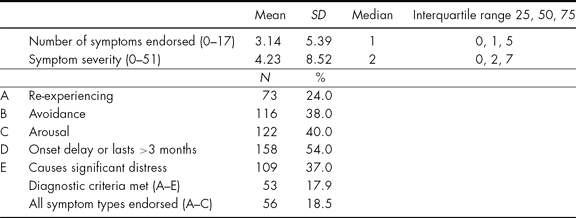
Table 2 presents the outcomes of the total sample on the PDS at 12 months following injury. Participants, on average, identified three PTSD symptoms, the most commonly reported of which was heightened arousal, followed closely by avoidance. Re-experiencing, such as nightmares and flashbacks, was the least commonly reported symptom. Of the sample, 17.9% (n = 53) met all criteria for PTSD; showing symptoms of re-experiencing the event, avoidance, arousal and with symptoms lasting more than 3 months. As can be seen in Table 1, when the sample was split to compare groups who met criteria for PTSD (n = 53) and those who didn't (n = 243), using parametric and non-parametric tests as appropriate, those with PTSD were significantly more likely to have self-reported a pre-TBI history of anxiety, and drugs were more likely to have been implicated as a factor in their injury. None of the other factors examined in Table 1 (e.g., ethnicity, age, injury severity, mechanism of injury) differed significantly between PTSD and non-PTSD groups.
Prevalence of PTSD Symptom Types Endorsed and PTSD Diagnostic Criteria Met Using the Post-traumatic Stress Diagnostic Scale at 12-month follow-up
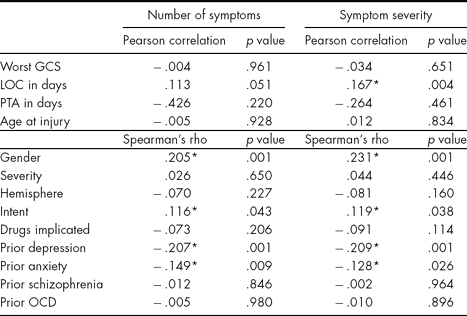
Correlational analyses (n = 296; see Table 3) were then conducted to determine if linear relationships existed between PTSD (symptom severity and number of symptoms) and the factors of interest (i.e., GCS, PTA, LOC, age, gender, injury severity, hemisphere of lesion, if the injury was intentional, if drugs were involved in the injury, and pre-TBI history of mental health concern). As seen in Table 3, increased length of LOC was found to significantly correlate with increased severity of PTSD symptoms reported. Of the categorical variables of interest, gender was significantly correlated with both the number of PTSD symptoms endorsed and symptom severity score, with females endorsing a greater number of symptoms and more severe symptoms. Intent (whether intentional injury or not), also showed a significant correlation, with those experiencing intentional injury reporting more symptoms and more severe symptoms. Prior self-reported history of depression and anxiety were also associated with a greater number of PTSD symptoms and increased severity of symptoms. None of the other correlations were significant (p < .05).
Correlations Between Symptoms (Severity and Number) and Injury and Participant Characteristics
GCS, Glasgow Coma Scale; LOC, loss of consciousness; OCD, obsessive compulsive disorder; PTA, post-traumatic amnesia.
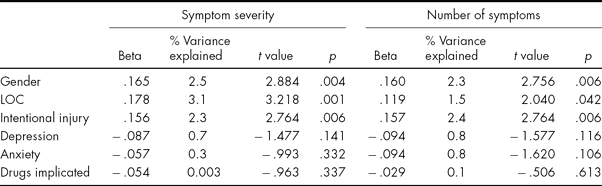
Following from the above, linear regression analysis was performed with PTSD symptom severity at 1 year being predicted from self-reported history of depression or anxiety prior to the injury, length of loss of consciousness, gender, drug involvement in the injury, and whether the injury was intentional or not. Correlational analysis suggested that multi-collinearity did not exist between predictor variables, with all the correlational values being lower than .28. Plotting residuals against predicted values resulted in a symmetrical distribution around a horizontal line, indicating linearity; while a normal probability plot of the residuals fell close to the diagonal line, suggesting normality.
The results of this analysis were statistically significant (R 2 = .109, F[6, 294] = 6.007, p < .001) with 10.9% of the variance in symptom severity being predicted. A second regression was then performed with the number of PTSD symptoms endorsed being predicted. The results of this analysis were statistically significant (R 2 = .098, F[3, 297] = 4.562, p < .001), accounting for 9.8% of the variance. As seen in Table 4, contributing significantly to prediction of both symptom severity and number of symptoms were gender, days of LOC, and whether or not the injury was intentional.
Results of Linear Regressions Predicting Symptom Severity and Number of PTSD Symptoms
LOC, loss of consciousness.
Discussion
Just under 18% of the total sample (men 14.9%, women 22.1%) met all criteria for PTSD, which is substantially higher than PTSD rates identified in the general population, although lower than the 32% reported at long-term follow-up (>1 year) in women following major trauma with and without TBI (Holbrook, Hoy, Stein, & Sieber, Reference Holbrook, Hoyt, Stein and Sieber2002). As previously noted, in the general non-TBI population 21% of women and 8% of men experience PTSD (Breslau et al., Reference Breslau, Davis, Andreski and Peterson1991), the present findings do suggest a heightened vulnerability post-TBI, particularly for men.
The prevalence of PTSD in this sample was also higher than the 5–7.5% of road traffic crash victims who develop PTSD (Creamer et al., Reference Creamer, Burgess and McFarlane2001). The higher rates of PTSD may not be unexpected given the characteristics of the injuries in this sample. Specifically, one-quarter of injuries in the sample were intentional, which, given the relationship found between intentionality and PTSD, has implications for the level of emotional trauma experienced. Of those who experienced intentional injury, 30.6% reported experiencing all three symptom types associated with diagnosis, while 16.4% met all criteria for PTSD. This is in contrast to those who experienced an unintentional injury, where these figures drop to 14.8 and 10.9%, respectively. It should be noted here that the finding is consistent with previously noted incident rates of between 17 and 33% occurring after mild TBI (Middleboe et al., Reference Middleboe, Anderson, Birket-Smith and Friis1991).
Preliminary analysis indicated that the present sample was significantly younger, more likely to be European, and less likely to have experienced a mild low-risk injury than those who did not consent to take part. Thus, the findings presented here may represent a group more likely to be experiencing difficulties post-TBI, and are not fully generalisable to the wider TBI population. Further study is therefore required to examine PTSD within those groups that were not fully represented here.
Despite the lower proportion of individuals with mild low-risk injury, it should be noted here that while TBI severity was not linked to PTSD diagnosis in this sample, the vast majority of TBIs experienced in this sample were mild. As such, one might have expected a lesser degree of traumatisation, in that a less severe injury may be less likely to result in perceived or real threat to life. However, that a large proportion of the sample did experience PTSD suggests a need to offer psychological support to those with all TBI severities, particularly following intentional injury. This finding highlights the differential between physical trauma and emotional/subjective trauma experienced. This is consistent with a study of outcomes of a large sample of survivors of a fire (N = 104), where PTSD symptoms were not associated with burn injury. Instead, the authors concluded that post-traumatic stress outcomes were related to emotional trauma, and not physical injury (Schneider et al., Reference Schneider, Trinh, Selleck, Fregni, Salles, Ryan and Stein2012). Future examinations of this issue should also consider factors such as the impact of lengthy court cases in terms of increasing persistence of symptoms through encouraging rumination about the event, which may increase the likelihood of persistent problems. Examination of this issue in jurisdictions other than New Zealand (as in New Zealand everyone has 24-hour, seven-day-a-week, no-fault comprehensive injury cover through the government Accident Compensation Corporation, and therefore individual litigation does not typically occur), where litigation is likely to occur following other forms of injury (e.g., car crashes), would also be informative.
With regard to the topography of PTSD in this sample, the most commonly reported symptom was heightened arousal, followed closely by avoidance. Re-experiencing, such as nightmares and flashbacks, was the least commonly reported symptom. In contrast, a previous study, not limited to TBI, found re-experiencing to be the most commonly reported symptom (59.1%) followed by arousal (51.3%) and avoidance (31.7%; Ullman, Reference Ullman1995). However, this author also reported that the presence of re-experiencing was significantly related to the type of trauma experienced, with the highest rates related to events not included in the present sample (e.g., combat). It must still be noted, however, that the absence of re-experiencing may suggest that the difficulties present in our sample are more representative of an anxious depression rather than PTSD. This is particularly relevant given that a pre-TBI history of depression and/or anxiety was significantly related to the severity of PTSD symptoms experienced after TBI. This is an important distinction as anxious depression tends to present with a more severe and chronic course than depression alone, and is typically related to poorer response to treatment (Rao & Zisook, Reference Rao and Zisook2009). However, in relation to this study, anxious depression requires that individuals meet criteria for a major depressive disorder which was not assessed, and can occur in the absence of a specific trauma. Symptomatology in the present analyses was specifically linked to the event that resulted in TBI.
The present study found that a number of factors (i.e., female gender, length of LOC and intent) were associated with the presence of PTSD reported 1 year after TBI. It must be noted here, however, that the proportion of variance in PTSD explained by these factors was limited, indicating that there is potentially a large number of personal and environmental factors not included here which are contributing to the occurrence of PTSD. As would be expected given the existing literature (Punamäki, Komproe, Quota, Elmasri & de Jong, Reference Punamäki, Komproe, Quota, Elmasri and de Jong2005; Rosner, Powell & Butollo, Reference Rosner, Powell and Butollo2003), female gender was predictive of both an increase in symptom severity and in the number of symptoms reported. Women are commonly described as being more vulnerable to PTSD following traumatic events, showing a twofold risk; with this increase in risk being particularly evident after disasters and accidents and least evident as a result of violence or in response to a diagnosis of chronic disease (Ditlevsen & Elkli, Reference Ditlevsen and Elkli2012). The present findings did indicate that women were likely to report more PTSD symptoms and greater symptom severity than men; in contrast to Ditlevsen and Elkli (Reference Ditlevsen and Elkli2012), violence in the form of intentional assault was associated with more severe PTSD symptoms and a greater number of symptoms reported; although it must be remembered that this is within the context of TBI-related injuries, and so trauma types such as disasters and diagnosis of chronic disease were not included.
With regard to the finding that increased length of LOC was predictive of more symptoms and more severe PTSD symptoms, it has been proposed that even a mild TBI injury, particularly when associated with loss of consciousness, reflects exposure to a significantly traumatic event that is likely to be perceived as a threat to loss of life and significantly increases the risk of PTSD (Hoge et al., Reference Hoge, McGurk, Thomas, Cox, Engel and Castro2008). This finding replicates previous work on PTSD after non-neurological injury. In an examination of 250 patients in a trauma registry but without severe neurotrauma, 39.7% of variance in PTSD was explained by intentional injury (beta = 0.27) at 6 months post-injury (Michaels et al., Reference Michaels, Michaels, Zimmerman, Smith, Moon and Peterson1999). While prevalence of a prior history of depression and anxiety did differ between those who met criteria for PTSD and those who did not, and was related to severity and number of symptoms experienced, it did not contribute significantly to prediction of PTSD symptom severity or number.
The strength of this study lies in its sample, which was large and population based, so all severities of TBI are represented, and includes individuals who did not seek hospitalisation. A good proportion of participants met criteria for PTSD, which allowed examination of factors predictive of PTSD. Further, self-report data were available on prior mental health and other chronic health conditions, as well as the mechanism of injury and possible contributing factors. A final strength was the measurement not only of the presence/absence of PTSD but also symptom severity.
The primary limitation of this study is in its generalisability. While the sample was drawn from a population-based incidence and outcomes study, those who consented to the follow-up assessments (and who were therefore included in these analyses) represent only a portion of the total sample, and were significantly younger, significantly more likely to be of European ethnicity, and significantly less likely to have experienced a mild low-risk TBI than the main incidence sample. It must be noted here that this profile of having a very mild injury and being from an ethnic minority is also associated with a lower likelihood of seeking medical services (Hefford, Crampton, & Foley, Reference Hefford, Crampton and Foley2005), which may mean that the present sample is more representative of those seeking medical attention after injury than would be the incidence sample as a whole. Additional limitations of the study include the lack of information on the level of subjective trauma experienced at the time of the TBI and on prior history of traumatic exposure which could have impacted the findings. There were also a relatively large number of consenting participants who provided no data at 1-year follow-up (n = 128, 30%) or who did not fully complete the PDS assessment at 1-year follow-up (n = 7, 2%). In addition, it must be remembered that all assessment data related to the PDS and prior history were obtained via self-report and are therefore subject to potential biases associated with this type of data.
Conclusion
Prevalence of PTSD in a population-based sample of TBI 1 year post-injury was just under 18%. Female gender, longer loss of consciousness and intentional injury were predictive of PTSD symptom severity, though this only explained a small proportion of the variance in outcome. These findings highlight the need for psychological support for those experiencing TBI (even mild TBI), particularly for those experiencing intentional injuries, such as through assault. The findings also suggest that there are other factors not identified here which contribute to PTSD development.
Acknowledgments
This study was funded by the Health ResearchCouncil of New Zealand.
Declaration of Interest
The authors of this work report no conflicts of interest.