1. Introduction
The baseline scenario in ITER for achieving fusion yield of
 $Q=10$
(Shimada Reference Shimada2007) – that is to say, 10 times more fusion power out than the power required to initiate plasma burn – is expected to have sawtooth oscillations in the plasma core. The sawtooth instability in the core of tokamak fusion plasmas (Levinton et al.
Reference Levinton, Batha, Yamada and Zarnstorff1993) has been observed in every tokamak and is manifest as a redistribution of the core plasma during a magnetic field reconnection event (Kadomtsev Reference Kadomtsev1976; Hastie & Hender Reference Hastie and Hender1988). Both theory (Hastie & Hender Reference Hastie and Hender1988; Porcelli Reference Porcelli1991) and experimental evidence (Park et al.
Reference Park, Luhmann, Donné, Classen, Domier, Mazzucato, Munsat, van de Pol and Xia2006; Chapman et al.
Reference Chapman, Scannell, Cooper, Graves, Hastie, Naylor and Zocco2010b
) suggest that this reconnection process occurs due to the growth of a plasma magnetohydrodynamic (MHD) kink instability with
 $m=n=1$
, where
 $m$
and
 $n$
are the poloidal and toroidal periodicities, respectively. Whilst these quasi-periodic redistribution events are not anticipated to be detrimental to the performance of ITER plasmas as long as the period between reconnection events is longer than the slowing-down time of the fusion-born alpha particles, the triggering of other MHD instabilities by the sawteeth can have implications for fusion yield. It has been observed that sawteeth trigger higher-
 $m$
neoclassical tearing modes (NTMs) (Sauter et al.
Reference Sauter, Westerhof, Mayoral, Alper, Belo, Buttery, Gondhalekar, Hellsten, Hender, Howell, Johnson, Lamalle, Mantsinen, Milani, Nave, Nguyen, Pecquet, Pinches, Podda and Rapp2002), and that this triggering is exacerbated at low plasma rotation, as expected in ITER. Furthermore, the presence of fusion-born alpha particles is expected to have a stabilising influence on the internal kink mode (Porcelli, Boucher & Rosenbluth Reference Porcelli, Boucher and Rosenbluth1996; Hu, Betti & Manickam Reference Hu, Betti and Manickam2006), which leads to longer sawtooth periods, which have been empirically observed to increase the likelihood of triggering NTMs (Chapman et al.
Reference Chapman, Buttery, Coda, Gerhardt, Graves, Howell, Isayama, La Haye, Liu, Maget, Maraschek, Sabbagh and Sauter2010a
). This observation has resulted in efforts to deliberately destabilise the sawtooth oscillations, to avoid the long sawtooth periods associated with triggering NTMs at lower core pressures. An ancillary purpose for sawtooth control (which is to say the deliberate timing of the sawtooth period and ensuing determination of the amplitude of the crash) is to affect the population of impurities in the plasma core. The advent of tokamaks with tungsten divertors as planned for ITER, such as JET (Romanelli et al.
Reference Romanelli2015) or ASDEX Upgrade (Zohm et al.
Reference Zohm2015), has highlighted the need to develop mechanisms to remove the high-
 $Z$
impurities that occur due to erosion of the divertor plates, as well as removing the helium ash from the plasma core, which is known to adversely affect plasma confinement (Nunes et al.
Reference Nunes, Balboa, Baruzzo, Challis, Drewelow, Frassinetti, Frigione, Garcia, Hobirk, Joffrin, Lomas, Lowry, Rimini, Sips and Wiesen2015). The two primary mechanisms for destabilising sawteeth are either by increasing the local magnetic shear near the rational surface where sawteeth are localised, the
 $q=m/n=1$
surface, where
 $q$
is the safety factor (Porcelli et al.
Reference Porcelli, Boucher and Rosenbluth1996; Eriksson et al.
Reference Eriksson, Johnson, Mayoral, Coda, Sauter, Buttery, McDonald, Hellsten, Mantsinen, Mueck, Noterdaeme, Santala, Westerhof and de Vries2006), or by tailoring the energetic ion population to reduce the potential energy required to drive the kink mode (Graves Reference Graves2005, Reference Graves2009).
The sawtooth control actuators envisaged for ITER (Chapman et al.
Reference Chapman, Graves, Sauter, Zucca, Asunta, Buttery, Coda, Goodman, Igochine, Johnson, Jucker, La Haye and Lennholm2013a
) are electron cyclotron current drive (ECCD) to affect the local magnetic shear and ion cyclotron resonance heating (ICRH) to tailor the fast-ion distribution and by so doing counteract the stabilising effects of the alpha population. The presence of fusion-born alphas in a burning D–T plasma is expected to be so stabilising to the
 $n=m=1$
kink mode that ICRH will be necessary to complement current drive schemes (Chapman et al.
Reference Chapman, Graves, Sauter, Zucca, Asunta, Buttery, Coda, Goodman, Igochine, Johnson, Jucker, La Haye and Lennholm2013a
), which have been demonstrated to be particularly effective even at low power in present-day machines (Goodman et al.
Reference Goodman, Felici, Sauter and Graves2011; Igochine et al.
Reference Igochine, Chapman, Bobkov, Günter, Maraschek, Moseev, Pereversev, Reich and Stober2011; Chapman et al.
Reference Chapman, La Haye, Buttery, Heidbrink, Jackson, Muscatello, Petty, Pinsker, Tobias and Turco2012, Reference Chapman, Igochine, Maraschek, McCarthy and Tardini2013b
). In this paper we concentrate on the effects of tailoring the distribution of energetic particles using ICRH to control sawteeth. In recent years, ICRH sawtooth control has been demonstrated on JET using resonant frequency (RF) heating schemes with the resonance on either the low- or high-field side of the magnetic axis, as well as for various concentrations of the minority species resonant with the ion cyclotron waves from low (
 $n_{\mathit{min}}/n_{\mathit{bulk}}<10\,\%$
) to high (
 $n_{\mathit{min}}/n_{\mathit{bulk}}\sim 30\,\%$
) concentrations. Furthermore, the toroidal direction of propagating waves has also been changed in JET, with ensuing variations in both the radial and pitch-angle space distributions of the ICRH super-Alfvénic ions.
This paper summarises the efficacy of the different ICRH schemes for sawtooth control in JET and so infers the likely optimal solution for ITER. In § 2 the mechanisms for sawtooth control are briefly recapitulated together with a brief review of the ICRH capability in ITER. The effect of the resonance position of the ICRH deposition on the effectiveness of sawtooth control in JET is compared to numerical modelling in § 3, before the effect of the minority concentration on ICRH sawtooth control is discussed in § 4. Finally, the merits of the different schemes are discussed for ITER application in § 5 before conclusions are drawn.
2. Review of sawtooth control mechanisms and ITER capability
2.1. Sawtooth control mechanisms
A heuristic model for the triggering of a sawtooth crash was developed in Porcelli et al. (Reference Porcelli, Boucher and Rosenbluth1996). Whilst this model does not capture all the known effects on the stability of the internal kink mode, it has had significant success in interpreting the behaviour of sawteeth in a number of tokamak plasmas (Angioni et al. Reference Angioni, Pochelon, Gorelenkov, McClements, Sauter, Budny, de Vries, Howell, Mantsinen, Nave and Sharapov2002, Reference Angioni, Goodman, Henderson and Sauter2003; Zuc Reference Zucca2008; Kim et al. Reference Kim and Sauter2014). The model consists of three different criteria, the satisfaction of which is predicted to incur a sawtooth crash. In plasmas with a large fast-ion population, the criterion that ultimately determines the crash is that
 $$\begin{eqnarray}s_{1}>\min \left(s_{\mathit{crit}}=\frac{4{\it\delta}W}{{\it\xi}_{0}^{2}{\it\epsilon}_{1}^{2}RB^{2}c_{{\it\rho}}\hat{{\it\rho}}},s_{\mathit{crit}}({\it\omega}_{\ast })\right).\end{eqnarray}$$
Here the ideal growth rate normalised to the Alfvén frequency is
 ${\it\gamma}_{I}/{\it\omega}_{A}=-{\rm\pi}{\it\delta}{\hat{W}}/s_{1}$
, where the change in the normalised potential energy of the kink mode is
 ${\it\delta}{\hat{W}}={\it\delta}W/(2{\rm\pi}^{2}{\it\xi}_{r}^{2}R_{0}B_{0}^{2}{\it\epsilon}_{1}^{2})$
, with the change in the potential energy of the kink mode given by
 ${\it\delta}W={\it\delta}W_{f}+{\it\delta}W_{KO}+{\it\delta}W_{h}$
, where
 ${\it\delta}W_{f,KO,h}$
are the potential energy change due to the fluid drive (Bussac et al.
Reference Bussac, Pellat, Edery and Soule1975), the thermal ions (Kruskal & Oberman Reference Kruskal and Oberman1958) and the fast ions (Graves et al.
Reference Graves, Chapman, Coda, Johnson, Lennholm, Paley and Sauter2011), respectively. The magnetic shear at the
 $q=1$
surfaces is
 $s_{1}=\text{d}q/\text{d}r$
,
 $R_{0}$
and
 $B_{0}$
are the major radius and magnetic field at the position of the magnetic axis, respectively,
 $\hat{{\it\rho}}$
is the normalised Larmor radius,
 $c_{{\it\rho}}$
is a constant of order unity,
 ${\it\epsilon}_{1}=r_{1}/R_{0}$
is the inverse aspect ratio,
 $r_{1}$
is the minor radius at the
 $q=1$
position,
 ${\it\xi}_{r}(r)$
is the leading-order rational eigenfunction of the
 $m=n=1$
mode at the magnetic axis and finally the critical magnetic shear determined by the pressure gradient is given by
 $s_{1}>s_{\mathit{crit}}({\it\omega}_{\ast i})$
where
 ${\it\omega}_{\ast i}$
is the ion diamagnetic frequency. The inequality condition given in (2.1) indicates that a sawtooth crash can be instigated either by increasing the local magnetic shear,
 $s_{1}$
, or by reducing the potential energy of the kink mode, primarily through the contribution from fast particles,
 ${\it\delta}W_{h}$
. The ICRH can modify (2.1) via either or both of these quantities since the high-energy ion populations born from RF heating can also give rise to a fairly strong local current perturbation, which when appropriately positioned can affect
 $s_{1}$
(Eriksson et al.
Reference Eriksson, Johnson, Mayoral, Coda, Sauter, Buttery, McDonald, Hellsten, Mantsinen, Mueck, Noterdaeme, Santala, Westerhof and de Vries2006). Two ion cyclotron current drive (ICCD) schemes have been used, namely (i) minority ICCD, where a minority ion species resonates with the fundamental cyclotron frequency of the ICRH wave, absorbing the RF power and carrying the fast-ion current, and (ii) second harmonic ICCD, where an ion species (not necessarily a minority species) resonates at its second harmonic cyclotron frequency,
 ${\it\omega}=2{\it\omega}_{ci}$
with the RF waves.
The current drive resulting from resonant minority wave–particle interactions at cyclotron frequencies, or majority ions at harmonics of the cyclotron frequency, relies on an asymmetry in the passing ion distribution induced by directed wave spectra (i.e. waves propagating preferentially in one direction) and on the velocity dependence of the collisional pitch angle scattering (Fisch et al.
Reference Fisch1987). The resonance condition between a wave and the cyclotron motion of the resonant particles is given by
 ${\it\omega}-n{\it\omega}_{ci}-k_{\Vert }v_{\Vert }=0$
, meaning that preferentially propagating waves can resonate with either co-transiting or counter-transiting ions, depending on the direction of wave propagation and the location of the interaction with respect to the cyclotron resonance. The Fisch et al. (Reference Fisch1987) model predicts that waves propagating in the co-current direction (
 $k_{\Vert }>0$
) result in driven current with a dipole structure characterised by a positive part with respect to the plasma current on the low-field side of the cyclotron resonance and a negative part on the high-field side. For counter-propagating waves, the currents in the dipole structure change sign. This mechanism is reviewed in Bhatnagar et al. (Reference Bhatnagar, Start, Jacquinot, Chaland, Cherubini and Porcelli1994) and Eriksson et al. (Reference Eriksson, Johnson, Mayoral, Coda, Sauter, Buttery, McDonald, Hellsten, Mantsinen, Mueck, Noterdaeme, Santala, Westerhof and de Vries2006).
As well as the potential to drive current and change the local shear, the ICRH also generates very energetic particles, of course. These energetic ions directly contribute to
 ${\it\delta}W$
since (Porcelli Reference Porcelli1991; Porcelli et al.
Reference Porcelli, Stankiewicz, Kerner and Berk1994; Briezman et al.
Reference Briezman, Candy, Porcelli and Berk1998)
 $$\begin{eqnarray}{\it\delta}W_{h}=\frac{1}{2}\int \text{d}{\it\Gamma}\,(Mv_{\Vert }^{2}+{\it\mu}B){\it\delta}f\mathop{\sum }_{m}{\bf\kappa}\boldsymbol{\cdot }{\bf\xi}^{(m)\ast }(r,t)\text{e}^{-\text{i}(n{\it\phi}-m{\it\theta})},\end{eqnarray}$$
where
 ${\it\theta}$
is the poloidal angle,
 ${\bf\kappa}=\boldsymbol{b}\boldsymbol{\cdot }\boldsymbol{{\rm\nabla}}\boldsymbol{b}$
is the magnetic curvature vector,
 $\boldsymbol{b}=\boldsymbol{B}/B$
,
 ${\it\delta}f$
is the change in the energetic particle distribution function due to the
 $n=m=1$
kink perturbation,
 ${\it\mu}$
is the magnetic moment,
 ${\it\Gamma}$
is phase space,
 $M$
is the particle mass,
 $v_{\Vert }$
is the parallel velocity of the particle,
 $r$
is the radial position of the particle, and
 ${\it\phi}$
and
 ${\it\theta}$
are the toroidal and poloidal angles. For many years it has been known that trapped energetic particles result in strong stabilisation of sawteeth (Porcelli Reference Porcelli1991). However, passing fast ions can also significantly influence sawtooth behaviour. For highly energetic ions, the radial drift motion becomes comparable to the radial extent of the kink mode. The strong contribution of the circulating particles comes from the ions close to the trapped-passing boundary where their orbit widths,
 ${\it\Delta}_{b}$
, are large,
 ${\it\delta}W_{h}^{p}\sim {\it\Delta}_{b}$
. Passing fast ions can destabilise the internal kink mode when they are co-passing and the fast-ion distribution has a positive gradient across
 $q=1$
, or when they are counter-passing, but the deposition is peaked outside the
 $q=1$
surface. This mechanism is described in detail in Graves (Reference Graves2004, Reference Graves2009) with an overview of fast-ion effects in Chapman et al. (Reference Chapman2011a
).
Recent experiments in JET have isolated the dominant mechanism for sawtooth control with ICRH as the effect from energetic ions (Graves et al.
Reference Graves, Chapman, Coda, Lennholm, Albergante and Jucker2012, Reference Graves, Lennholm, Chapman, Lerche, Reich, Alper, Bobkov, Dumont, Faustin, Jacquet, Jaulmes, Johnson, Keeling, Liu, Nicolas, Tholerus, Blackman, Carvalho, Coelho, Van Eester, Felton, Goniche, Kiptily, Monakhov, Nave, Perez von Thun, Sabot, Sozzi and Tsalas2015). By using
 $^{3}\text{He}$
-minority heating, the ion cyclotron-driven current is negligible due to the current dragged by the background plasma, which tends to cancel the
 $^{3}\text{He}$
current (Laxåback & Hellsten Reference Laxåback and Hellsten2005), but yet the control of sawteeth is still highly efficient (Graves et al.
Reference Graves, Chapman, Coda, Lennholm, Albergante and Jucker2012). The dominance of the fast-ion contribution was unequivocally demonstrated by variation of the minority concentration. At very low concentration, the absorbed power is reduced, and consequently the effect on the sawteeth was mild. Similarly, at high concentration, the energy tail of the energetic ion population is lower, so the radial drift excursion of the ICRH fast ions which intersect the
 $q=1$
surface is smaller, and so the ability to affect the sawteeth is again reduced. However, at minority concentrations intermediate between these extremes, the radial orbit drift of the energetic ion distribution tail and the absorbed power are both sufficient to have a strong effect on the sawteeth, even in H-mode in the presence of a population of stabilising core fast ions when there is negligible drive current. Furthermore, experiments with low-field side H-minority ICRH showed that any phasing of the ICRH (
 $-90^{\circ }$
,
 $+90^{\circ }$
or dipole) has a destabilising effect on the sawteeth, i.e. reduces the sawtooth period, when the resonance position is just outside the
 $q=1$
surface. Whilst the driven current is mild, in all cases the magnetic shear at
 $q=1$
is actually reduced, which should stabilise the sawteeth, whilst a marked destabilisation is observed, emphasising that the conventional ‘change in magnetic shear’ interpretation for the control of sawteeth cannot apply in these H-minority low-field side experiments, and furthermore that the fast-ion effects on the kink mode could be inferred to be typically the dominant effect of ICRH.
2.2. ITER capabilities
ITER is expected to have 20 MW of ICRH as part of the portfolio of 73 MW of auxiliary heating and current drive tools. Ion cyclotron waves will be strongly damped in ITER, leading to various possible heating schemes: second harmonic tritium or fundamental
 $^{3}\text{He}$
heating; fundamental D heating (although a low deuterium concentration is required for efficient wave damping, making this low relevance); electron Landau damping (ELD)/transit time magnetic pumping (TTMP), both of which are fast wave current drive scenarios leading to insignificant fast-ion populations; or off-axis
 $^{3}\text{He}$
heating, which has moderate absorbed power density but can result in a significant population of ICRH energetic ions near the
 $q=1$
surface. At full magnetic field in ITER (
 $B_{0}=5.3~\text{T}$
), the ICRH antenna design precludes high-field side resonance positions. Variable-frequency ICRH is currently planned for ITER. The ICRH frequency will be able to vary in real time between 40 and 55 MHz (Lamalle et al.
Reference Lamalle, Beaumont, Kazarian, Gassmann, Agarici, Ajesh, Alonzo, Arambhadiya, Argouarch, Bamber, Berger-By, Bernard, Brun, Carpentier, Clairet, Colas, Courtois, Davis, Dechelle, Doceul and Dumortier2013). The
 $^{3}\text{He}$
resonance just outside
 $q=1$
is likely to require a frequency of approximately 47 MHz. It will be possible to rapidly change the RF frequency in a preset 2 MHz band, which is equivalent to moving the resonance location by approximately 20 cm, which should provide sufficient scope for real-time sawtooth control. In the
 $^{3}\text{He}$
-minority heating scheme envisaged for ITER, the resultant current drive is negligible (Laxåback & Hellsten Reference Laxåback and Hellsten2005; Graves Reference Graves2009).
3. The effect of the ICRH resonance position on sawtooth control in JET
The ICRH system in JET has a wide frequency variation, meaning that resonance positions on either the low- or high-field side of the magnetic axis are possible. In this section we describe the merits of high-field side heating with either H- or
 $^{3}\text{He}$
-minority species compared to low-field side heating with H minority. Figure 1 shows the configuration of typical JET plasmas which have the ICRH resonance on the low-field side (37 MHz with
 $B_{t}\in [2.7,2.35]~\text{T}$
using fundamental H-minority resonance) and on the high-field side (33 MHz with
 $B_{t}\in [2.88,2.96]~\text{T}$
using fundamental
 $^{3}\text{He}$
-minority resonance) compared to the approximate position of the
 $q=1$
surface found from the sawtooth inversion radius measured by soft X-ray emission in JET discharge 84 500, which is typical of the plasmas used in this study. In both cases an optimal minority concentration is employed.
The plasma configuration used in JET discharge 84 500 at 15 s, which is representative of the plasmas studied in this paper, showing the
 $q=1$
surface and the ICRH resonances for
 $^{3}\text{He}$
on the high-field side and H on the low-field side.

3.1. Sawtooth control with low-concentration
 $^{3}\text{He}$
-minority ICRH resonance on the high-field side

Sawtooth control was demonstrated with
 $^{3}\text{He}$
-minority heating on the high-field side, whereby the current drive was minimised to verify that the passing fast-ion effect dominated (Graves et al.
Reference Graves, Chapman, Coda, Johnson, Lennholm, Alper, de Baar, Crombe, Eriksson, Felton, Howell, Kiptily, Koslowski, Mayoral, Monakhov, Nunes and Pinches2010, Reference Graves, Chapman, Coda, Lennholm, Albergante and Jucker2012). In order to demonstrate the effect of the ICRH fast ions on the sawtooth behaviour, the ICRH resonance position has been moved with respect to the
 $q=1$
surface by ramping the magnetic field to move the ICRH resonance and the current commensurately to keep the
 $q$
profile fixed. Typically the ICRH resonance is moved from outside the
 $q=1$
surface, where the ICRH barely affects the sawtooth behaviour, to inside it, where it is known that the ICRH trapped energetic particles have a strongly stabilising effect, increasing the sawtooth period. Through sweeps like this, the change in the sawtooth period when the resonance position is just in/outside
 $q=1$
can be studied, since it is at this point that the fast-ion population with radial drift excursions cutting the rational surface is maximised, and it is this population deliberately placed near the
 $q=1$
surface that affects kink stability (Graves Reference Graves2009). Figure 2 shows the sawtooth behaviour as the ICRH resonance is swept from outside to inside the
 $q=1$
surface when the resonance is on the high-field side of the magnetic axis. It is evident that the sawtooth period is minimised as the RF resonance is positioned just inside the
 $q=1$
surface. Note that this occurs for
 $r_{\mathit{res}}<r_{\mathit{inv}}$
even though
 $R_{\mathit{res}}>R_{\mathit{inv}}$
when the resonance is on the high-field side. For effective sawtooth destabilisation, i.e. a minimisation of the sawtooth period, the location of the RF resonance must be highly accurately placed with respect to the rational surface, with a localisation closer than
 ${\sim}2~\text{cm}$
. Given significant uncertainty in the radial localisation of the
 $q=1$
surface in ITER, and the ray tracing to predict the resonance position being subject to uncertainties in the plasma density profile as well as approximations in the ray propagation models, this narrow window for effective sawtooth control implies that a real-time feedback scheme is needed for robust high-field side ICRH sawtooth control (Lennholm et al.
Reference Lennholm, Blackman, Chapman, Eriksson, Graves, Howell, de Baar, Calabro, Dumont, Graham, Jachmich, Mayoral, Sozzi, Stamp, Tsalas and de Vries2011).
Time traces for JET pulse 78 764 showing (a) the auxiliary NBI and ICRH heating power, (b) the central electron temperature measured by the electron cyclotron emission diagnostic demonstrating the sawtooth activity, (c) the resonance position of the high-field side ICRH compared to the radial position of the sawtooth inversion radius, and (d) the sawtooth period. The ICRH had
 $-90^{\circ }$
phasing. The toroidal magnetic field was ramped linearly from 2.85 to 2.95 T and proportionately the plasma current was ramped from 1.95 to 2.05 MA.

It is found that the toroidal phasing of the ICRH antenna configuration has a marked affect on the sawtooth control for high-field side resonance (Graves et al.
Reference Graves, Chapman, Coda, Johnson, Lennholm, Alper, de Baar, Crombe, Eriksson, Felton, Howell, Kiptily, Koslowski, Mayoral, Monakhov, Nunes and Pinches2010). When the ICRH has
 $-90^{\circ }$
phasing, the ICRH resonance just inside the
 $q=1$
surface gives rise to destabilisation of the kink mode, and so shortening of the sawtooth period, whilst
 $+90^{\circ }$
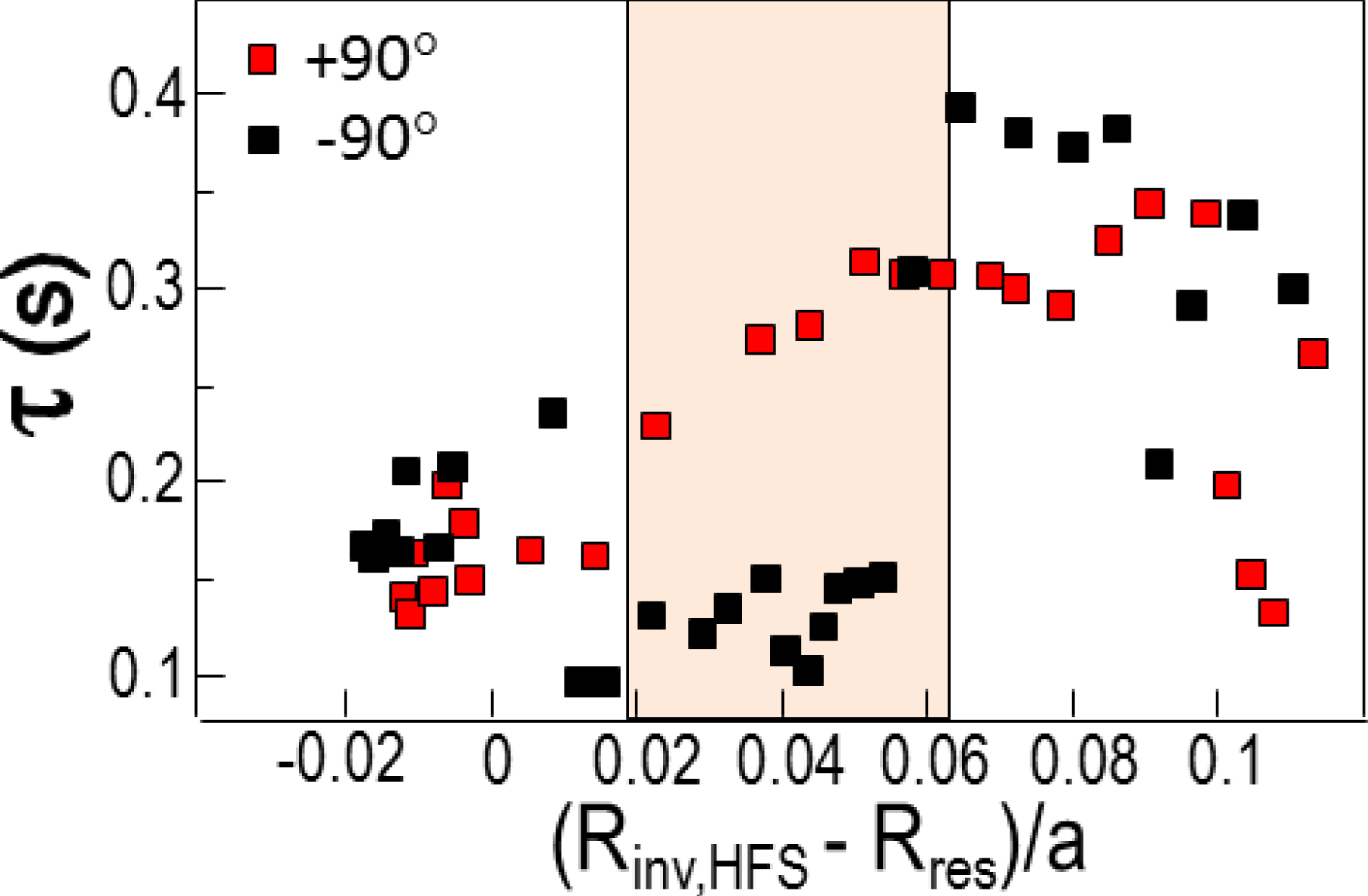
phasing has the opposite effect, stabilising the sawteeth. This is illustrated in figure 3, which shows the sawtooth period as a function of the resonance position with respect to the
 $q=1$
surface for both
 $\pm 90^{\circ }$
phasings when the ICRH resonance is on the high-field side. It is clear that when the resonance is just inside
 $q=1$
the counter-propagating waves give rise to a minimum in the achievable sawtooth period, significantly lower than the reference case without ICRH, whilst the co-propagating waves result in a significant increase in the sawtooth period. In this case, the lengthening of the sawtooth period to
 ${\sim}1~\text{s}$
actually results in the triggering of an NTM, even in L-mode at
 ${\it\beta}_{N}=0.8$
(well below the target level of the
 $Q=10$
scenario for ITER, where
 ${\it\beta}_{N}=1.8$
). At this point it is worth pointing out that phased ICRH waves are considered sub-optimal compared to dipole phasing because of the slightly lower absorbed power and, importantly, the enhanced plasma–wall interaction due to RF sheath redistribution effects (Czarnecka et al.
Reference Czarnecka, Zastrow, Rzadkiewicz, Coffey, Lawson and O’Mullane2011), which is a considerable limitation in devices with metal walls owing to the sputtering of tungsten.
The sawtooth period as a function of the resonance position with respect to the inversion radius for different ICRH phasings in JET for ICRH with low (
 ${\sim}0.5\,\%~^{3}\text{He}$
)-minority concentration located on the high-field side. The shaded area represents the region with an ICRH resonance just outside the
 $q=1$
surface, where the fast ions have the strongest effect on the sawtooth behaviour.

In order to understand the effect of these different fast-ion distributions on the stability of the internal kink mode, coupled hybrid kinetic–MHD numerical modelling has been employed. The ICRH fast-ion population is modelled with either the SELFO (Hedin et al.
Reference Hedin, Hellsten, Eriksson and Johnson2002) or SCENIC (Jucker et al.
Reference Jucker, Graves, Cooper and Johnson2011) ICRH wave codes, whilst the neutral beam injection (NBI) distribution is modelled with the NUBEAM model within the TRANSP code (Budny et al.
Reference Budny, Bell, Biglari, Bitter, Bush, Cheng, Fredrickson, Grek, Hill, Hsuan, Janos, Jassby, Johnson, Johnson, LeBlanc, McCune, Mikkelsen, Park, Ramsey, Sabbagh, Scott, Schivell, Strachan, Stratton, Synakowski, Taylor, Zarnstorff and Zweben1992). Meanwhile, the plasma equilibrium is constrained by the sawtooth inversion radius and reconstructed using the HELENA (Huy Reference Huysmans1991) Grad–Shafranov solver. The linear MHD stability of this equilibrium is then studied using the MISHKA code (Chapman et al.
Reference Chapman, Sharapov, Huysmans and Mikhailovskii2006) to find an unstable
 $n=m=1$
eigenfunction. The interaction between this unstable kink mode and the fast ions is then studied with the drift-kinetic HAGIS code (Pinches et al.
Reference Pinches, Appel, Candy, Sharapov, Berk, Borba, Breizman, Hender, Hopcraft, Huysmans and Kerner1998), which calculates
 ${\it\delta}W_{h}$
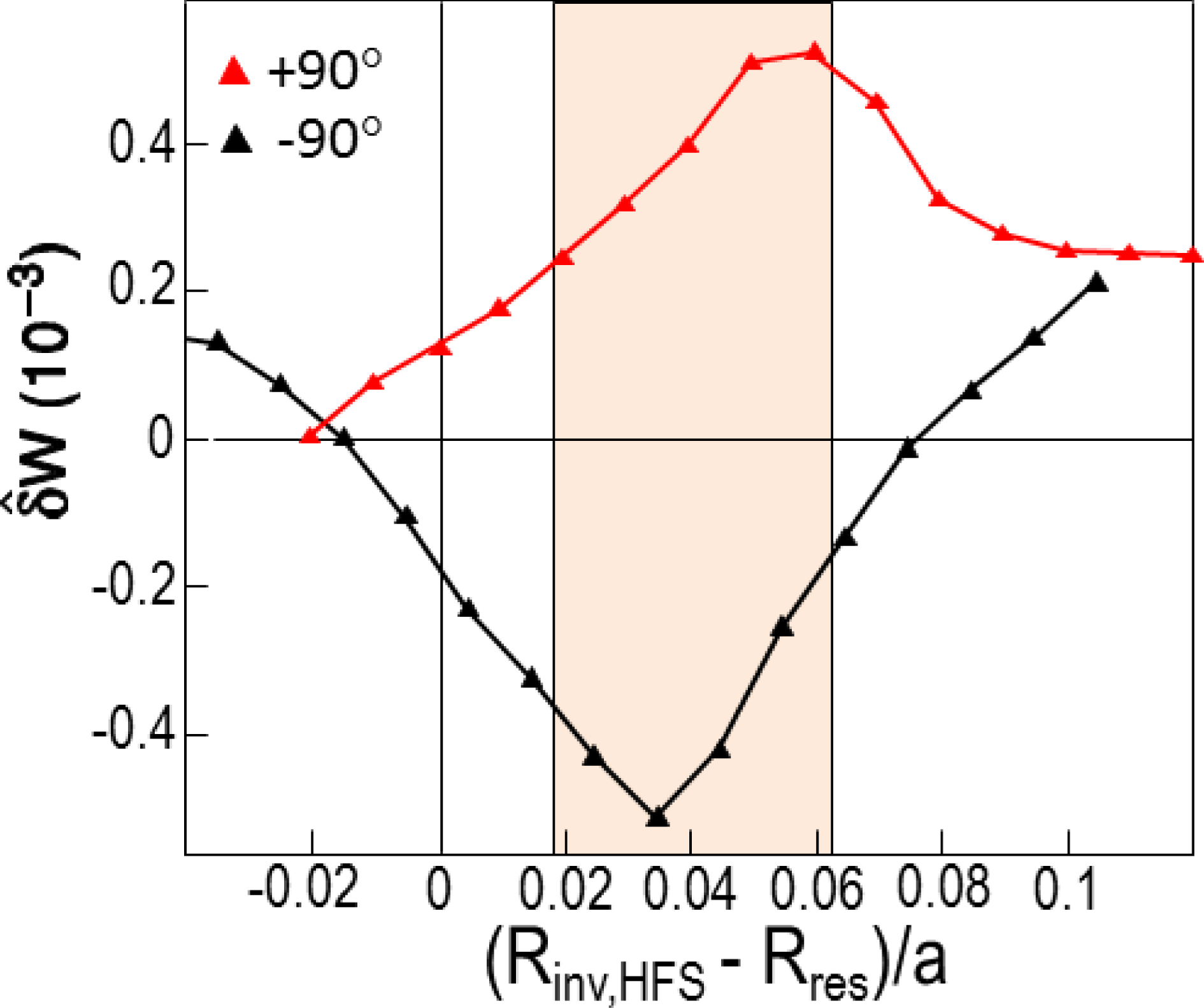
. Figure 4 shows the change in the potential energy of the kink mode as a function of radial position of the peak of the ICRH distribution with respect to the
 $q=1$
surface position. It is evident that the
 $-90^{\circ }$
phasing reduces
 ${\it\delta}W_{h}$
, consistent with the reduction in the sawtooth period observed in JET, whilst the
 $+90^{\circ }$
phasing increases
 ${\it\delta}W_{h}$
, once again consistent with the experimental sawtooth behaviour. The effect on kink stability is governed by the asymmetry in the parallel velocity of the ICRH distribution function, and specifically in the radial variation of this asymmetry. When the population of fast ions is such that the number of co- and counter-passing ICRH ions whose radial drift is large enough that it cuts across the
 $q=1$
surface is unequal, they result in a change in the kink mode potential (Graves Reference Graves2009; Chapman et al.
Reference Chapman2011a
).
The
 ${\it\delta}{\hat{W}}_{h}$
calculated by HAGIS for different ICRH phasings with the ICRH resonance on the high-field side and the ICRH distribution taken from SELFO modelling. The shaded band is the same as in figure 3, demonstrating that for
 $-90^{\circ }$
phasing the
 ${\it\delta}{\hat{W}}_{h}$
is negative, i.e. destabilising in this region, in line with the shorter sawtooth period seen in figure 3. Conversely, the
 $+90^{\circ }$
phasing in the same region gives positive
 ${\it\delta}{\hat{W}}_{h}$
, i.e. sawtooth stabilisation, commensurate with the longer sawtooth period observed experimentally.

3.2. Sawtooth control with low-concentration H-minority ICRH resonance on the low-field side
Similar sweeps of the ICRH resonance position across the
 $q=1$
surface have been performed with the resonance located on the low-field side of the magnetic axis in JET, as expected for ITER at full magnetic field. In JET this means using H-minority ICRH heating, which does drive a small ion cyclotron current, but, as demonstrated in Graves et al. (Reference Graves, Lennholm, Chapman, Lerche, Reich, Alper, Bobkov, Dumont, Faustin, Jacquet, Jaulmes, Johnson, Keeling, Liu, Nicolas, Tholerus, Blackman, Carvalho, Coelho, Van Eester, Felton, Goniche, Kiptily, Monakhov, Nave, Perez von Thun, Sabot, Sozzi and Tsalas2015), the effect on the sawteeth is dominated by the fast-ion mechanisms over the shear mechanism. Figure 5 shows the sawtooth behaviour as the ICRH resonance is swept from outside to inside the
 $q=1$
surface when the resonance is on the low-field side of the magnetic axis. It is evident that the sawtooth period is minimised as the RF resonance is positioned close to the
 $q=1$
surface. However, in contrast to the result with high-field side resonance, the window for effective sawtooth destabilisation, i.e. a reduction of the sawtooth period, is significantly wider. In the case of low-field side resonance, the resonance position must be in a window of only
 ${\sim}15~\text{cm}$
around the
 $q=1$
surface to achieve sawtooth destabilisation, which is much broader than for high-field side ICRH. If this can be replicated in plasma with a dominant core fast-ion population, this would negate the requirement for real-time control of the RF frequency, greatly simplifying the coupling of the RF waves to the plasma.
Time traces for three similar JET pulses with different ICRH phasings showing (a) the auxiliary NBI and ICRH heating power, (b) the resonance position of the low-field side ICRH compared to the radial position of the sawtooth inversion radius and (c–e) the central electron temperature measured by the electron cyclotron emission diagnostic, demonstrating the sawtooth activity for
 $+90^{\circ }$
,
 $-90^{\circ }$
and dipole ICRH phasing, respectively. The toroidal magnetic field was ramped linearly from 2.7 to 2.35 T and proportionately the plasma current was ramped from 2.4 to 2.05 MA.

The toroidal phasing of low-field side RF schemes has also been varied in order to compare to the result from high-field side heating, where the sawtooth control was strongly dependent upon the ICRH phasing. Figure 6 shows the sawtooth period as a function of the resonance position with respect to the
 $q=1$
surface for
 $-90^{\circ }$
,
 $+90^{\circ }$
and dipole phasings when the ICRH resonance is on the low-field side. In contrast to high-field side ICRH sawtooth control, all phasings have a destabilising effect on the sawteeth when the resonance is on the low-field side. Again, this is positive for ITER if it can be sustained in plasmas with a high fast-ion fraction, since using dipole phasing does not have the by-product of enhanced plasma–wall interaction.
The sawtooth period as a function of the resonance position with respect to the inversion radius for different ICRH phasings in JET for ICRH with
 ${\sim}4\,\%$
H-minority concentration located on the low-field side.

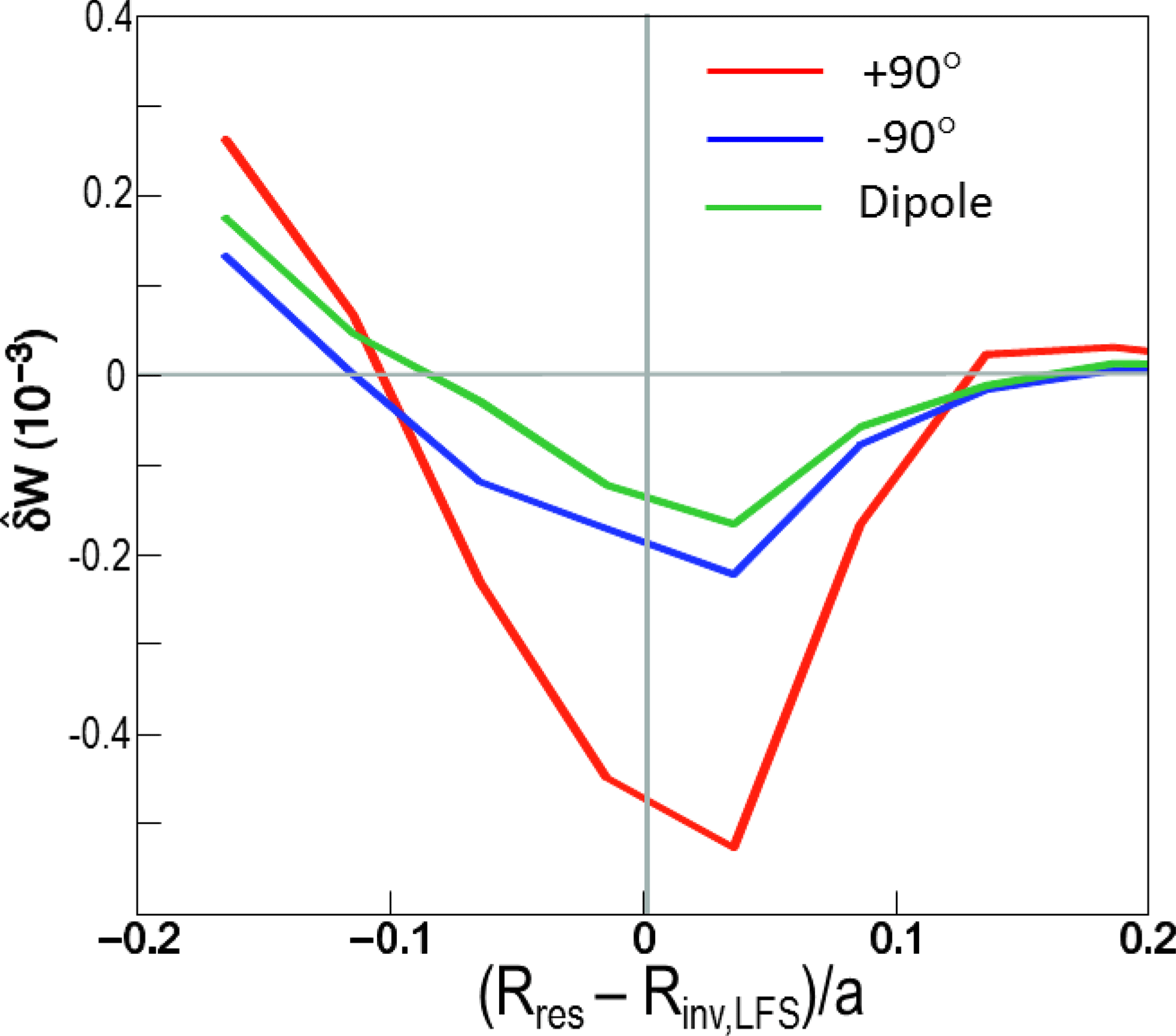
Finally, the change in the kink mode stability resulting from the low-field side ICRH fast-ion populations has also been modelled using the hybrid MHD–kinetic code package as before. Figure 7 shows the change in the potential energy of the kink mode as a function of the radial position of the peak of the ICRH distribution with respect to the
 $q=1$
surface position. Whilst the
 $+90^{\circ }$
ICRH population has the most destabilising effect on the kink mode, as expected from Graves (Reference Graves2009), all of the phasings do reduce
 ${\it\delta}W_{h}$
. Qualitatively these simulations verify the empirical observations, namely that with the ICRH resonance on the low-field side the
 $+90^{\circ }$
phasing is most destabilising, but that all phasings do reduce kink stability provided the resonance is centred just outside
 $q=1$
. Furthermore, the window in
 $r_{\mathit{res}}-r_{1}$
for which
 ${\it\delta}W_{h}$
is reduced is much broader for low-field side heating than when the resonance is on the high-field side.
The
 ${\it\delta}{\hat{W}}_{h}$
calculated by HAGIS for different ICRH phasings with the ICRH resonance on the low-field side and the ICRH distribution taken from SCENIC modelling.

4. The effect of the minority concentration on sawtooth control
It was shown in Graves et al. (Reference Graves, Chapman, Coda, Lennholm, Albergante and Jucker2012) that sawtooth destabilisation from high-field side ICRH was extremely sensitive to the minority species concentration. This is essentially due to the fast-ion (de)stabilisation mechanism dependence on the need to develop an asymmetry in the parallel velocity of the passing fast ions that cross the
 $q=1$
surface. If the minority concentration is too high, there is an insufficient number of fast ions that have sufficient energy to have a broad radial drift excursion and so cut across
 $q=1$
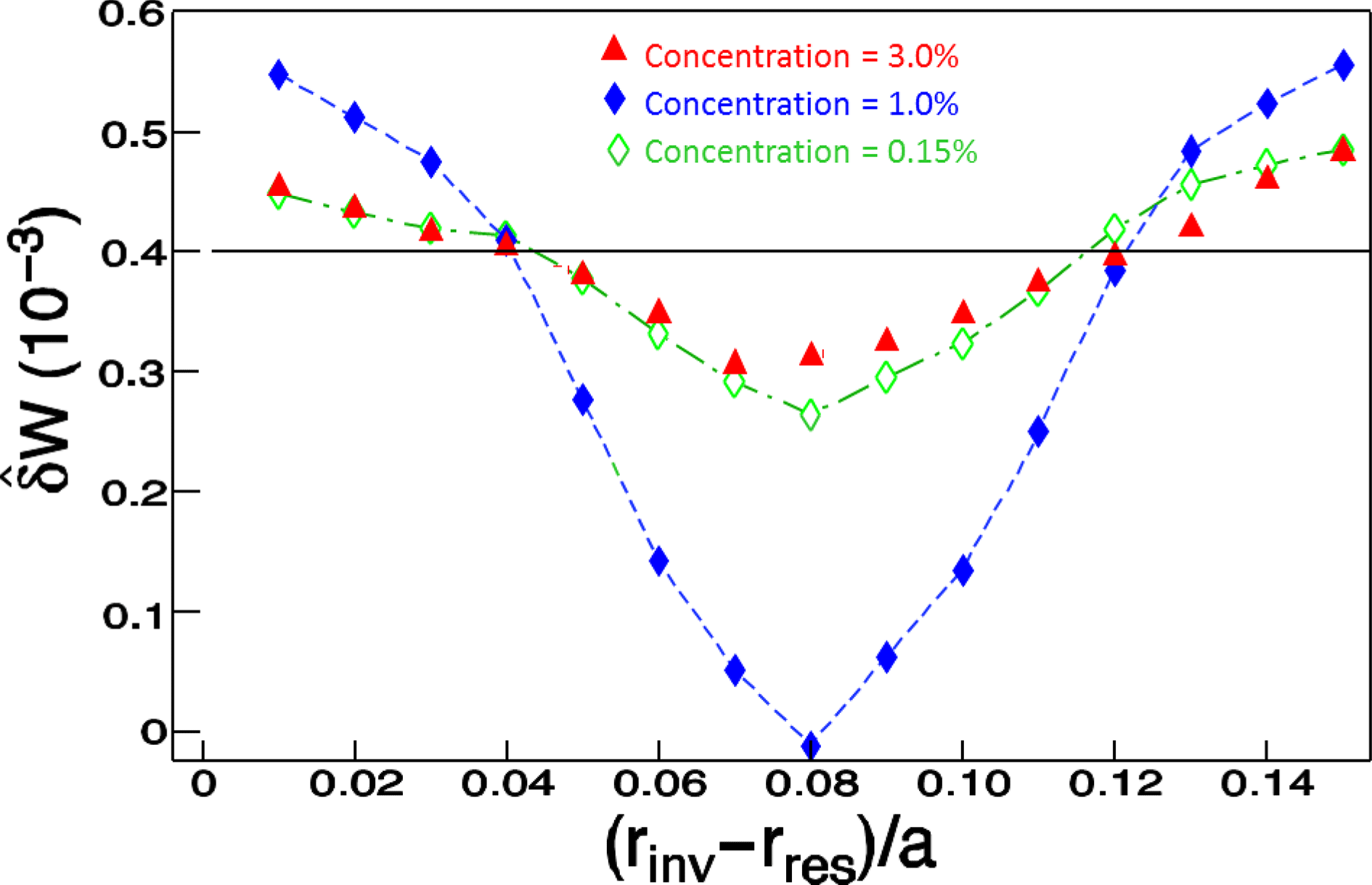
. Equally, if the minority concentration is too low, whilst there is a long tail in the energy distribution with a large fraction of very energetic particles with large effective orbit width, the total absorbed power is too low to compete with the stabilising NBI fast ions. This dependence on the minority concentration is demonstrated in figure 8, where the
 ${\it\delta}W_{h}$
modelled by HAGIS is shown for ICRH with a resonance position located on the high-field side with
 $-90^{\circ }$
antenna phasing as the resonance is swept from outside to inside the
 $q=1$
surface. Strong destabilisation is only observed for intermediate minority concentration (
 $n_{^{3}\!\text{He}}/n_{\mathit{bulk}}\sim 1\,\%$
), whilst a weak effect on the sawteeth is seen for both low (
 $n_{^{3}\!\text{He}}/n_{\mathit{bulk}}\sim 0.15\,\%$
) and high (
 $n_{^{3}\!\text{He}}/n_{\mathit{bulk}}\sim 3\,\%$
) concentrations.
The
 ${\it\delta}{\hat{W}}_{h}$
calculated by HAGIS as a function of the resonance position with respect to the sawtooth inversion radius in JET plasmas when the ICRH resonance is on the high-field side for different
 $^{3}\text{He}$
-minority concentrations.

5. Discussion of the merits of ICRH control schemes in ITER and conclusions
In § 3 it is shown that low-field side resonance heating has a significantly broader window in the resonance position to destabilise the sawteeth. With high-field side ICRH, the resonance must be placed within
 ${\sim}2~\text{cm}$
of the
 $q=1$
surface in JET in order to reduce the sawtooth period. Conversely, with low-field side ICRH, this window is increased to
 ${\sim}15~\text{cm}$
, greatly reducing the likely need for real-time control of the resonance position through changing the RF frequency (Lennholm et al.
Reference Lennholm, Frigione, Graves, Beaumont, Blackman, Carvalho, Chapman, Dumont, Felton, Garzotti, Goniche, Goodyear, Grist, Jachmich, Johnson, Lang, Lerche, de la Luna, Monakhov, Mooney, Morris, Nave, Reich, Rimini, Sips, Sheikh, Sozzi and Tsalas2015). Furthermore, heating with a resonance on the low-field side is effective no matter which phasing of the ICRH antenna is employed. Even ICRH waves injected perpendicular to the magnetic field can destabilise the sawteeth, whereas dipole phasing is always observed to be stabilising on the high-field side. In § 4 it is demonstrated that by simultaneously optimising the coupled RF power and the energy of the ICRH distribution tail such that the radial width of the orbit excursion of particles crossing the
 $q=1$
surface is maximised, the effect on the sawteeth is optimised. This occurs for intermediate minority concentrations (
 $n_{\mathit{min}}/n_{\mathit{bulk}}\sim 3{-}6\,\%$
) in JET for H minority, but at lower concentration (
 $n_{\mathit{min}}/n_{\mathit{bulk}}\sim 0.5{-}1\,\%$
) for
 $^{3}\text{He}$
minority.
The anticipated ICRH heating scheme in ITER uses 51 MHz RF heating of a low-concentration
 $^{3}\text{He}$
-minority species on the low-field side of the plasma. The results from JET coupled with the numerical modelling in §§ 3 and 4 suggest that this is the optimal ICRH antenna design for sawtooth control, for two reasons. (i) Low-field side heating means that any toroidal phasing of the ICRH (
 $90^{\circ }$
,
 $+90^{\circ }$
or dipole) has a destabilising effect on the sawteeth, i.e. reduces the sawtooth period, meaning that dipole phasing can be employed, since this is preferable due to less plasma–wall interaction from RF sheaths (Czarnecka et al.
Reference Czarnecka, Zastrow, Rzadkiewicz, Coffey, Lawson and O’Mullane2011) with a metal wall. (ii) The resonance position of the low-field side ICRH does not have to be very accurately placed to achieve sawtooth control. This relaxes the necessity for real-time control of the RF frequency. Calculations of the change of the kink mode potential energy due to ICRH fast ions using the SCENIC and HAGIS codes, as described in § 3, have been carried out for low-field side ICRH heating in ITER using
 $^{3}\text{He}$
minority with different antenna phasings and for different minority concentrations (Chapman et al.
Reference Chapman, Graves, Johnson, Asunta, Bonoli, Choi, Jaeger, Jucker and Sauter2011b
). It is found that the most destabilising effect on the internal kink mode is achieved for
 $n_{^{3}\!He}/n_{\mathit{bulk}}\sim 1\,\%$
and, whilst
 $+90^{\circ }$
phasing is optimal, a strong effect is attained even with dipole phasing. Together with the empirical observations from JET, this numerical modelling suggests that the ICRH antenna design for ITER is well positioned to provide a control actuator capable of having a significant effect on the sawtooth behaviour, and, coupled with the electron cyclotron current drive, can keep the sawtooth period below that expected to trigger NTMs (Chapman et al.
Reference Chapman, Graves, Johnson, Asunta, Bonoli, Choi, Jaeger, Jucker and Sauter2011b
).
Acknowledgements
This work has been carried out within the framework of the EUROfusion Consortium and has received funding from the Euratom research and training programme 2014–2018 under grant agreement no. 633053 and from the RCUK Energy Programme (grant no. EP/I501045). To obtain further information on the data and models underlying this paper, please contact PublicationsManager@ccfe.ac.uk. The views and opinions expressed herein do not necessarily reflect those of the European Commission.