INTRODUCTION
Suicidality in adolescents and young adults is a well-recognized public health problem (Kessler et al. Reference Kessler, Borges and Walters1999; Welch, Reference Welch2001). Globally, suicide is the fifth leading cause of death in young individuals, especially men, taking between 100 000 and 200 000 lives each year (Blum & Nelson-Mmari, Reference Blum and Nelson-Mmari2004; St-Laurent & Bouchard, Reference St-Laurent and Bouchard2004). Rates of non-fatal antecedents of suicide are even higher, ranging from 0·8% to 10% for suicide attempts (Fergusson & Lynskey, Reference Fergusson and Lynskey1995; Wichstrom, Reference Wichstrom2000) and from 6% to 63% for suicidal ideation (Garrison et al. Reference Garrison, Addy, Jackson, McKeown and Waller1991; Fergusson et al. Reference Fergusson, Horwood and Lynskey1996). Non-fatal suicidal behaviors are usually more prevalent in women and girls (D'Eramo et al. Reference D'Eramo, Prinstein, Freeman, Grapentine and Spirito2004).
As distribution and trends in milder suicidal behaviors may be important indicators of the trends in their more serious equivalents, research priorities have centered on following their natural histories. It has been shown, for example, that suicidal ideas predict suicide attempts (Wichstrom, Reference Wichstrom2000). Moreover, both suicidal ideation and attempts are risk factors for suicide completions and future attempts (Brent et al. Reference Brent, Perper, Moritz, Allman, Friend, Roth, Schweers, Balach and Baugher1993; Lewinsohn et al. Reference Lewinsohn, Rohde and Seeley1996).
However, despite the wealth of such empirical evidence, little is known about the nature of suicidal diathesis. Among the theoretical approaches guiding these efforts, two have been particularly interesting: the categorical approach suggests suicidal behaviors to be distinct, although possibly overlapping, phenotypes (Farberow, Reference Farberow1981; Linehan et al. Reference Linehan, Chiles, Egan, Devine and Laffaw1986), each with a subset of unique risk factors. Suicidal ideation, for example, is considered to be non-specific and heterogeneous. In some populations, such as adolescents, it may be a normative response to stress, while in others it may be an irreversible mental state and a correlate of psychiatric diseases (Vilhjalmsson et al. Reference Vilhjalmsson, Kristjansdottir and Sveinbjarnardottir1998; Hintikka et al. Reference Hintikka, Pesonen, Saarinen, Tanskanen, Lehtonen and Viinamaki2001; Van Heeringen, Reference Van Heeringen2001). When it comes to suicide attempts, repeaters are thought to represent a very distinct population of attempters because they exhibit dysfunction in multiple areas (Rudd et al. Reference Rudd, Joiner and Rajab1996). Moreover, from an epidemiological point of view, suicide attempts and suicide completions are considered to be quite different phenomena (Hawton & Van Heeringen, Reference Hawton and Van Heeringen2000).
The alternative to the categorical model is the dimensional approach, which suggests that suicidal behaviors may be ordered on a continuum; phenotypes with lower suicidal intent – such as suicidal thoughts – occupy one end, and those that are more serious – suicide attempts of increasing severity and completions, for example – the opposite end (Maris et al. Reference Maris, Berman, Maltsberger and Yufit1992). Underlying this suicidality continuum, furthermore, are shared risk factors whose contribution to progressively more serious phenotypes increases in a dosage-dependent fashion. Consequently, individuals displaying more severe suicidal behaviors may have higher loading of risk factors from multiple domains.
Of the two models, the continuum approach has received more attention, although evidence is mixed (Fergusson & Lynskey, Reference Fergusson and Lynskey1995; Van Heeringen, Reference Van Heeringen2001; Norlev et al. Reference Norlev, Davidsen, Sundaram and Kjoller2005). Relevant studies have, for the most part, focused on finding support for one model rather than also trying to exclude alternative explanations. To our knowledge, no study has compared the two approaches directly using objective, statistical criteria. One of our primary goals, therefore, was to investigate whether statistical criteria favour dimensional or categorical conceptualization of suicide attempts of different age of onset. We focused on early and late-onset suicide attempts, defined as attempts first occurring in adolescence and adulthood respectively. We hypothesized that the relationship of these two phenotypes would be better explained by the continuum model for two reasons: first, they are closely related phenotypes and likely to have some common risk factors. Second, early-onset suicide attempts may be more serious, given that they occur in adolescence and possibly in childhood for some of our participants. As such, as is the case with more severe psychiatric phenotypes in general, they may be associated with greater biogenetic susceptibility (Brent et al. Reference Brent, Oquendo, Birmaher, Greenhill, Kolko, Stanley, Zelazny, Brodsky, Firinciogullari, Ellis and Mann2003) and heavier loading of risk factors than late-onset attempts.
Given the multifactorial nature of suicide attempts (Beautrais, Reference Beautrais2000), in a series of secondary hypotheses we tested whether an increase in the severity of attempts was accompanied by an increase in risk loading across psychiatric, sociodemographic, personality and experiential domains. We first hypothesized that such a gradient would be seen for persistent, re-occurring suicidal thoughts and adolescent and adult Axis I diagnoses. We considered suicidal thoughts not only because they are among the most relevant risk factors for suicidal acts (Fergusson et al. Reference Fergusson, Horwood, Ridder and Beautrais2005) but also because their intensity and degree of persistence may be of strong predictive value for suicide attempts (Lewinsohn et al. Reference Lewinsohn, Rohde and Seeley1996). In addition, because evidence indicates that most suicidal acts occur in the context of externalizing and internalizing psychiatric disorders, we tested disruptive disorders (Kelly et al. Reference Kelly, Cornelius and Clark2004) and substance abuse/dependence (O'Boyle & Brandon, Reference O'Boyle and Brandon1998), in addition to mood and anxiety (Beautrais, Reference Beautrais2000; Boden et al. Reference Boden, Fergusson and John2007) diagnoses, expecting positive associations. Our selection of experiential variables – childhood physical and sexual abuse (Santa Mina & Gallop, Reference Santa and Gallop1998), low social support (Kaslow et al. Reference Kaslow, Thompson, Meadows, Jacobs, Chance, Gibb, Bornstein, Hollins, Rashid and Phillips1998; Kirkcaldy et al. Reference Kirkcaldy, Siefen, Urkin and Merrick2006), and stressful life events (King et al. Reference King, Schwab-Stone, Flisher, Greenwald, Kramer, Goodman, Lahey, Shaffer and Gould2001) – is consistent with the belief that such events make an important contribution to the variance in suicidal phenotypes. In addition, considering that proximal and distal socio-economic and demographic factors, such as financial problems (Fanous et al. Reference Fanous, Prescott and Kendler2004; Butterworth et al. Reference Butterworth, Fairweather, Anstey and Windsor2006), disadvantageous family environment (King et al. Reference King, Schwab-Stone, Flisher, Greenwald, Kramer, Goodman, Lahey, Shaffer and Gould2001) and female gender (Bland et al. Reference Bland, Newman and Dyck1994; Beautrais, Reference Beautrais2000), may also contribute to suicidal tendencies, we postulated that they would show positive associations with suicide attempts of increasing severity.
Our final secondary hypothesis concerned the involvement of personality traits. Given that they may contribute by shaping our interactions with the environment and peers across contexts and life stages, we predicted that high scores in traits influencing how we perceive (cognitive-perceptive dysregulation) and relate to (impulsivity, affective instability, conduct problems, insecure attachment, stimulus-seeking, anxiousness) our surroundings and ourselves (identity problems) would be directly related to suicide attempt risk (Dean & Range, Reference Dean and Range1996; Brezo et al. Reference Brezo, Paris and Turecki2006). These traits also contribute to broader dimensions of emotional dysregulation and impulsive-aggression, factors believed to mediate suicide risk (Rudd et al. Reference Rudd, Joiner and Rajab1996).
In addition to comparing categorical and dimensional approaches, our second major goal was to investigate the natural history and trends in several adolescent and adult suicidal behaviors: suicidal ideation, attempts, and completions. Across both of these important life stages, we expected suicidal ideas and attempts to be higher in females and suicide completions in males.
In investigating our primary and secondary hypotheses, we benefited from a comprehensive, multipoint assessment of suicidal behaviors in a longitudinal, school-based community sample of French Canadians. Extensive information on and simultaneous consideration of multiple risk domains allowed us to better understand unique contributions of individual domains, as well as to obtain more complete profiles of persons displaying suicidal behaviors of varying severity.
METHOD
Study participants and data collection
In 1986–88, families of children attending kindergarten in public francophone schools in Quebec were recruited using a multistage sampling procedure. Of 4488 participating children, two subsamples were selected for follow-up: (1) a randomly selected group of 1001 boys and 999 girls, the representative subsample (R); and (2) a group of 593 boys and 424 girls oversampled for children exhibiting disruptive behaviors, the disruptive subsample (D). To reduce cultural heterogeneity, only children whose parents were born in Canada and whose mother tongue was French were included. Eighty-eight per cent were non-Hispanic Whites.
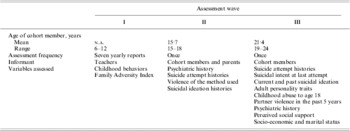
The assessment schedule had three stages (Table 1): Wave I (sample sizes R: 2000, D: 1017); Wave II (sample sizes R: 1233, D: 482); and Wave III (sample sizes R: 1144, D: 540). Participants who died, refused participation, had incomplete data or could not be contacted accounted for an overall attrition rate of 44% (R: 43%, D: 47%). To account for this, we performed multivariate analyses with and without weights, representing participants' probabilities of being in the original sample conditional on two variables related to attrition: (1) family socio-economic adversity, which was higher in non-responders [R: 0·32 v. 0·25, F(1, 1894)=40·64, p<0·05; D: 0·39 v. 0·32, F(1, 946)=16·33, p<0·05]; and (2) gender, as males were over-represented among non-responders [R: 50% v. 35%, χ12=46·05, p<0·05; D: 55% v. 36%, χ12=36·30, p<0·05].
Cohort assessment schedule

n.a., Not applicable.
Measures
All instruments were administered in French. Psychometric indices are not provided for measures where we used only a subset of questions rather than entire subscale(s) (see A2; B1–4; C2, 5–6, 9–11).
A. Wave I
(1) The socio-economic Family Adversity Index reflecting the quality of family environment was based on parental age at first child's birth, levels of education, socio-economic status, and living arrangements.
(2) The Social Behavior Questionnaire (Masse & Tremblay, Reference Masse and Tremblay1997) has 38 items measuring several childhood behaviors and traits. We used teacher-assessed anxiousness (six items) at ages 6 and 12.
B. Wave II
(1) Diagnostic Interview Schedule for Children (DISC-2; Breton et al. Reference Breton, Bergeron, Valla, Berthiaume and St-Georges1998) using DSM-III-R criteria. Given the number of diagnoses and our interest in their collective impact, we considered disruptive (attention-deficit-hyperactivity, oppositional-defiant, and conduct disorders), anxiety (simple and social phobias, separation anxiety, panic, avoidant, overanxious, and generalized anxiety disorder), and mood disorders (major depression and dysthymia) collectively. The interviewers, who were psychology students, attended 1–1·5 days of training and a practice session.
(2) Violence of the Method used at the most recent suicide attempt was assessed with a forced-choice question. Options included methods that were subsequently classified as violent (hanging, jumping from a high place/under a vehicle, shooting a firearm, and cutting) or non-violent (drug overdose, drowning, and carbon monoxide poisoning) (Heila et al. Reference Heila, Isometsa, Henriksson, Heikkinen, Marttunen and Lonnqvist1997). One response option, ‘other’, could not be classified in this way and was reported separately.
(3) Suicidal Ideation was assessed with one question: ‘Have you already seriously thought about suicide?’
(4) Early-onset Suicide Attempts: their presence and frequency over a lifetime and 6 months were assessed using parental/adolescent responses to three DISC-2 questions from the major depression module: ‘Have you already attempted suicide?’, ‘How many times?’ and ‘Have you attempted suicide during the last 6 months?’ Either parental report or self-report was sufficient for a person to be classified as an attempter.
C. Wave III
(1) Adult income in the previous year.
(2) Diagnostic Interview Schedule for Adults using DSM-III-R criteria (Robins et al. Reference Robins, Cottler, Bucholtz and Compton1995). To reduce the number of statistical tests and evaluate their collective impact, mood (major depressive episode, mania, and dysthymia), and anxiety (generalized anxiety, panic and phobias) disorders were considered collectively. Given the evidence of their independent contribution to suicidality, abuse and/or dependence on drugs, alcohol and nicotine were considered individually. The interviewers, who were psychology students, had a 1–1·5 days of training and a practice session.
(3) The Scale for Suicidal Ideation (SSI; Beck et al. Reference Beck, Kovacs and Weissman1979) is a 19-item scale measuring current attitudes towards living/dying, characteristics of suicidal ideation, and actualization of contemplated attempt. Cronbach's α was 0·63.
(4) The Suicidal Intent Scale (SIS; Beck et al. Reference Beck, Schuyler, Herman, Beck, Resnik and Lettier1974) is a 20-question instrument administered to suicide attempters. It assesses the ‘intensity’ of the wish to die at the most recent suicide attempt. Cronbach's α was 0·64.
(5) Suicide Attempts (late-onset, adult, lifetime, repeated): Suicide attempt history in adulthood was assessed with two SSI scale questions (‘Have you already attempted suicide?’, ‘How many attempts have you made prior to the one in question?’). Late-onset suicide attempters made their first attempt after age 18. Repeated attempters attempted suicide more than once according to parental or self-reports. Lifetime suicide attempt status was based on both adolescent and adult assessments.
(6) Suicidal Ideation (lifetime, persistent) was a three-level composite index based on (1) current suicidal thoughts (SSI scale); (2) lifetime suicidal thoughts reported in adulthood (DIS scale, major depression module): ‘Have you ever thought of suicide?’ and (3) adolescent suicidal ideation (see B3). Individuals scoring 0, 1 or 2–3 on this index were classified into non-ideators, transient and persistent ideators respectively.
(7) Diagnostic Assessment of Personality Pathology (Livesley et al. Reference Livesley, Jang and Vernon1998): seven personality traits scales evaluated affective instability, anxiousness, conduct problems, cognitive-perceptive dysregulation, identity problems, insecure attachment, and stimulus-seeking. Cronbach's α ranged from 0·85 to 0·93.
(8) The Barratt Impulsiveness Scale (Barratt, Reference Barratt, Spence and Izard1985) is a 30-item instrument assessing trait impulsivity by inquiring about general ways of acting/thinking across situations. Cronbach's α was 0·81.
(9) Childhood Physical Abuse (Straus et al. Reference Straus, Hamby, Boney-McCoy and Sugarman1996): we selected a subset of 14 questions evaluating the presence and frequency of severe/very severe physical aggression, abuse, and injuries perpetrated by each parent against the respondent as a child.
(10) The Childhood Sexual Abuse (Felitti et al. Reference Felitti, Anda, Nordenberg, Williamson, Spitz, Edwards, Koss and Marks1998) scale measures incidences of sexual violence to age 18. We selected items evaluating abusive acts involving physical contact [fondling or sexual (vaginal, anal, oral)], perpetrated by family members, school peers/personnel, short/long-term romantic acquaintances, or strangers.
(11) Stressful Life Events in the past year included atypical/severe stressful events related to finances, school/work, death of a close person, illness/serious injury to self/others, parental separation/divorce, and partner/children difficulties. Except for parental separation/divorce questions, items were adapted from another instrument (Horney, Reference Horney, Meier, Kennedy and Sacco2001).
(12) The Social Support Scale (Turner, Reference Turner1983) measures perceived support by friends and family using 15 Likert-style statements. Cronbach's α was 0·88.
Data analyses
Univariate analyses
We preselected variables for inclusion in multivariate analyses using χ2/analysis of variance (ANOVA), correcting for number of tests (p=0·0018; 28 tests). Domains of interest were: sociodemographic: socio-economic adversity at ages 6 and 12; adult income; gender; psychiatric: adolescent/adult mood and anxiety diagnoses; adolescent disruptive disorder and adult nicotine, alcohol and drug dependence/abuse; lifetime co-morbidity and lifetime suicidal ideation; experiential: childhood physical and sexual abuse, social support, stressful events; personality traits: childhood and adult anxiousness; adult impulsivity, affective instability, conduct problems, cognitive-perceptive dysregulation, identity problems, insecure attachment, and stimulus-seeking traits.
Multivariate analyses
Analyses were adjusted for disruptive subsample membership because disruptiveness may be related to the impulsive-aggressive dimension linked to suicidality, and for mood disorder because it was not completely independent of the outcome (see B4, C5). Our response variable classified participants into non-attempters (‘0’), late-onset (‘1’) and early-onset suicide attempters (‘2’). Multivariate analyses were performed with and without weights, representing participants’ probabilities of being in the original sample conditional on early socio-economic adversity and gender, variables related to attrition.
To select best multinomial and ordinal regression models, we used a hierarchical model-building strategy (Hosmer & Lemeshow, Reference Hosmer and Lemeshow2000). Starting with the univariately preselected variables, we identified significant correlates from within and then from across risk domains. Unlike multinomial regression, which treats levels of the response variable as categorical/unordered, ordinal regression uses the parallel slopes test to examine ordinality of variable levels, testing whether coefficients linking predictors with different outcome levels differ significantly. The success of ordinal and multinomial regression models in explaining the data was compared with Bayesian [BIC=−2LL+ln (N)k] and Aikaike Information Criteria (AIC=−2LL+2k), where LL=log likelihood, N=sample size, and k=number of parameters.
RESULTS
Natural history
Suicidal thoughts
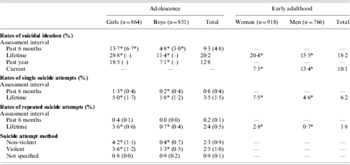
Table 2 presents several measures of suicidal ideation, assessed in adolescence and adulthood. At each stage, about 20% of participants reported having suicidal thoughts at least once in lifetime. Shorter-interval rates (current rates of serious suicidal ideation in adults and those over 6- and 12-month intervals in adolescents) were similar, ranging from 9% to 13%. Suicidal thoughts were up to three times higher in adolescent girls than boys. Self-reported suicidal thoughts over a lifetime were, similarly, higher in girls and women than in their opposite-sex peers, in contrast to current suicidal thoughts, which were higher in men. Parents underestimated 6-month rates of suicidal ideas in their children about two times. Retrospective examination of three measures of suicidal thoughts yielded an adjusted lifetime estimate of 33·0% (women: 38·0%; men: 26·5%; χ32=22·55, p=0·0005). Ideating women were also more likely to report persistent suicidal ideas (15·4%) than ideating men (9·0%) (χ12=15·09, p=0·0005).
Suicidal ideation and suicide attempts: rates and characteristics

Values given are self-reported, those in parentheses are from parental reports; —, not assessed.
* p<0·05, significant sex differences.
Suicide attempts
In adulthood, the lifetime rate of one-time attempts was 6·2%, with more women than men reporting such attempts (Table 2). The equivalent rate of single suicide attempts in adolescents (3·5%) was about half the rate reported by adults. One-time attempters outnumbered repeaters at both life stages. Approximately 2·0% of adolescents and adults reported making multiple attempts, with 4–5 times greater rates in females than in males. Only girls (n=3) reported making multiple attempts in the 6 months prior to the adolescent assessment. Self-reports suggested that boys were more likely to use violent means when making attempts (χ12=4·85, p=0·028). We observed no gender differences in suicidal intent at last suicide attempt, which was assessed in 135 adult attempters. Intent scores exhibited normal distribution (mean: 12·3, median: 12, mode: 13) and suggested, on average, serious intent. Parents generally underestimated different types of suicide attempts in their adolescents, especially girls. Their reports on the age distribution of first suicide attempts (median: 13 years of age), however, mostly agreed with adolescent reports (Fig. 1). Taking into account self-reports of lifetime suicide attempts in both adolescence and adulthood yielded an adjusted lifetime rate of 9·3% (n=199). About 30% (n=60) of all attempters were repeaters and 78% of the latter were women. When approached in adulthood, 31% (n=32) of adolescent attempters declared no prior attempts and 14% of adolescent repeaters (n=15) reported attempting suicide only once. Adjusting for these discrepancies, 53% (n=105) of suicide attempters were classified as early-onset attempters, having made their first attempt before age 18. Among them, 29% (n=9) of the boys and 42% (n=31) of the girls were adolescent repeaters. About 94 of all suicide attempters made their first attempt after the age of 18. Close to 16% of them, mostly women (n=14), were repeaters.
Age at first suicide attempt. □, Parental report;
 , self-report.

Suicide completions
Five cohort members (0·17%) died by suicide, including four men and one woman. All suicides were completed by individuals between 14 and 20 years of age. All completers used violent methods (hanging, n=3; suffocation/strangulation, n=1; firearms, n=1). Earlier psychosocial information was available for one victim who had reported having suicidal thoughts but no prior suicidal acts or psychiatric diagnoses.
Categorical versus dimensional operationalization of early and late-onset suicide attempts
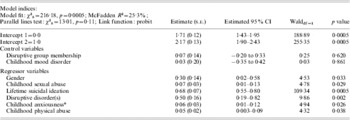
As expected, the ordinal model, that is treating levels of our final outcome as ordered, performed better than the multinomial model. In unweighted analyses, their AICs were 567.55 and 616.59 and BICs were 635.67 and 723.83 respectively. In weighted reanalyses, the ordinal model (AIC: 567.55; BIC: 635.67) once again performed better than the multinomial one (AIC: 616.59; BIC: 723.83). After adjustment for covariates (subsample membership and childhood mood disorder), which were non-significant, there were five significant correlates of suicide attempts: psychopathology (disruptive disorder(s)), history of persistent suicidal ideas, traumatic experiences (childhood sexual and physical abuse), personality traits (childhood anxiousness), and sociodemographic factors (female gender) (Table 3). In our weighted analyses, with the exception of childhood anxiousness and childhood physical abuse, which showed statistically significant trends at p=0·071 and p=0·081 respectively, all variables remained significant.
Ordinal regression model: correlates of early-onset suicide attempts

s.e., Standard error; CI, confidence interval; df, degrees of freedom.
Continuous variables were centered. * Assessed at age 12.
DISCUSSION
Natural history of suicidal behaviors
Our sample's epidemiological profile exhibited three general trends. First, as hypothesized, suicidal behaviors showed gender differences. The ratio of male to female suicides, for example, was 4:1, and, as such, similar to earlier reports (Van Heeringen, Reference Van Heeringen2001; St-Laurent & Bouchard, Reference St-Laurent and Bouchard2004).
Compared with their male peers, women were, furthermore, two times more likely to report prior, especially adolescent, suicide attempts, a trend seen by others (Rudd et al. Reference Rudd, Joiner and Rajab1996). Women and girls were also more likely to make multiple suicide attempts, as reported elsewhere (D'Eramo et al. Reference D'Eramo, Prinstein, Freeman, Grapentine and Spirito2004). They were more likely to have made their first attempt somewhat earlier in life than males. Finally, female gender was an important multivariate correlate in our models.
Most measures of suicidal ideation were, similarly, significantly higher in females, as reported by most related studies (Lewinsohn et al. Reference Lewinsohn, Rohde and Seeley1996; Gunnell et al. Reference Gunnell, Harbord, Singleton, Jenkins and Lewis2004). Current thoughts of suicide were the only exception to this gender bias, having been reported by a higher proportion of men. Whether this reversal in ideation rates may be a chance occurrence or a developmental phenomenon related to the well-known increase in suicidality in males approaching their thirties and forties needs longitudinal examination. At present, explanations for gender differences in suicidality invoke socialization, hormonal make-up, prevalence of internalizing versus externalizing psychopathology, and personality trait differences (Langhinrichsen-Rohling et al. Reference Langhinrichsen-Rohling, Lewinsohn, Rohde, Seeley, Monson, Meyer and Langford1998; Fergusson et al. Reference Fergusson, Beautrais and Horwood2003).
The second general observation concerns our finding that cross-sectional assessments of non-fatal suicidal behaviors over lifetime underestimate their true prevalence. Lifetime rates of suicidal ideation based on several retrospectively examined reports, for example, were, at 33%, higher than self-reported lifetime estimates obtained with single questions in adolescence (20%) and adulthood (18%). Others have also reported that 19–57% of self-reported suicidal ideators fail to report previous suicidal ideas (Hintikka et al. Reference Hintikka, Pesonen, Saarinen, Tanskanen, Lehtonen and Viinamaki2001; Spirito et al. Reference Spirito, Valeri, Boergers and Donaldson2003). Similarly, lifetime suicide attempt measures in young adults suggested an overall rate of 8%, in contrast to our adjusted rate of 9·3%. The fact that a number of adolescent suicide attempters reported no or fewer prior suicide attempts when approached in adulthood may be related to forgetting, recall bias, and minimization of ‘clinical significance’ of adolescent suicidality later in life (Goldney et al. Reference Goldney, Smith, Winefield, Tiggeman and Winefield1991; Giuffra, Reference Giuffra and Risch1994).
The third general observation concerns the degree of discrepancy between informants assessing adolescent suicidality. Parents generally underestimate rates and onset of suicidality in their children (Breton et al. Reference Breton, Tousignant, Bergeron and Berthiaume2002; Dhossche et al. Reference Dhossche, Ferdinand, van der Ende, Hofstra and Verhulst2002). As was the case in our study, this under-reporting may be a function of the child's gender and of greater magnitude for parents of girls (Sourander et al. Reference Sourander, Helstela, Haavisto and Bergroth2001).
Categorical versus dimensional operationalization of early and late-onset suicide attempts
The statistical comparison of ordinal and multinomial regression models, treating the dependent variable as ordered/dimensional or categorical respectively, suggests that suicide attempts of different onset age are better explained by the ordinal model. As hypothesized, early-onset suicide attempts occupy a more severe end of the suicidality continuum relative to later-onset suicide attempts. Psychopathological phenotypes manifesting earlier in life are commonly regarded as associated with stronger biogenetic predisposition (Brent et al. Reference Brent, Oquendo, Birmaher, Greenhill, Kolko, Stanley, Zelazny, Brodsky, Firinciogullari, Ellis and Mann2003).
Our findings also generally support our secondary hypotheses testing whether a gradient in the loading of multiple risk factors will accompany progression to the more serious, early-onset suicide attempts. First, the degree of persistence of suicidal ideation was indeed related to suicide attempt histories, and, in particular, to early-onset suicide attempts, indicating that non-fatal suicidal tendencies that manifest earlier in life tend to co-occur and are likely to be of more enduring nature. This is consistent with evidence for a moderate to strong association between suicidal thoughts and attempts (Rudd et al. Reference Rudd, Joiner and Rajab1996; Fergusson et al. Reference Fergusson, Horwood, Ridder and Beautrais2005). Nevertheless, the correlates and circumstances under which ideators progress to more serious forms of suicidality are largely unknown. Our findings suggest that one promising research avenue may be to examine how specific characteristics of suicidal ideas (their intensity, persistence and onset age) are related to suicide attempts (Lewinsohn et al. Reference Lewinsohn, Rohde and Seeley1996; Statham et al. Reference Statham, Heath, Madden, Bucholz, Bierut, Dinwiddie, Slutske, Dunne and Martin1998).
Only one of our predictions concerning Axis I disorders was supported: disruptive disorders contributed significantly to lifetime histories of suicide attempts. Disruptive disorder symptoms have been not only linked to suicide attempts (Kelly et al. Reference Kelly, Cornelius and Clark2004) but also to suicidal thoughts (Gould et al. Reference Gould, King, Greenwald, Fisher, Schwab-Stone, Kramer, Flisher, Goodman, Canino and Shaffer1998) and suicide completions (Renaud et al. Reference Renaud, Chagnon, Turecki and Marquette2005). This link may be mediated by the impulsive-aggressive behavioral component shared by individuals with disruptive disorders and suicidal tendencies (Turecki, Reference Turecki2001). In contrast to previous suggestions (Renaud et al. Reference Renaud, Chagnon, Turecki and Marquette2005), we found no evidence that substance abuse disorders may be involved as mediators between disruptive disorders and suicidal outcomes. Neither was adolescent nor adult internalizing psychopathology significant in our final regression models. One explanation is that internalizing disorders contribute through a shared variance component that was already adequately represented by suicidal thoughts in our models.
As for experiential variables, childhood physical abuse showed a significant effect in unweighted and a trend in our weighted analyses. Published evidence has, similarly, offered inconsistent support for its role in suicidality (Straus & Kantor, Reference Straus and Kantor1994; Evans et al. Reference Evans, Hawton and Rodham2005). Our data, by contrast, support the evidence suggesting that childhood sexual abuse may have long-term psychiatric consequences (Santa Mina & Gallop, Reference Santa and Gallop1998). Adult measures of stressful experiences, contrary to our expectations, did not contribute significantly. Perhaps consequences of stress for most individuals, especially in a normative and young sample such as ours, may not be as relevant for suicidality as are earlier, more traumatic experiences such as childhood sexual abuse.
In terms of personality traits, childhood anxiousness contributed about 10% to its variance. Similar internalizing constructs in children have already been found to predict later suicide attempts in adulthood (Caspi et al. Reference Caspi, Moffitt, Newman and Silva1996). Anxiety may, in fact, be a marker of sensitivity to environmental stressors. Using maladaptive coping techniques, such as avoiding anxiety-provoking situations, may, over time, lead to impaired social relationships on the one hand and affect confidence in one's ability to successfully negotiate stressful events on the other. Ultimately, these processes may lead to feelings of hopelessness and psychache, which, in turn, may be involved in the etiology of suicidal behaviors. As was the case with childhood physical abuse, given its weaker contribution in our weighted analyses, it does appear that its effects may be mediated or moderated by other variables, possibly gender and early family adversity.
Implications
Non-fatal suicidal behaviors in adolescents and young adults are more common than suggested by cross-sectional studies and parental reports. Early adolescence may be an important period for first suicide attempts and mid- to late adolescence for completed suicides. Of clinical and research relevance are also pervasive gender differences in the prevalence and characteristics of suicidal behaviors. When assessing risk for non-fatal suicidal acts, clinicians need to continue considering multiple risk factors. Researchers, however, need to better characterize developmental relationships of these factors to suicidal phenotypes of different degree of severity.
Limitations and strengths
Most measures were retrospective and subject to recall bias. Psychometric properties of the suicidal intent and suicidal ideation scales were lower than expected, possibly due to translation problems. Nevertheless, our assessment of suicidality relied on a number of other measures in addition to these two scales. Several measures of suicidality were based on the DIS scale mood-disorder module. As such, they were not completely independent of the mood disorder diagnoses. Nevertheless, these diagnoses were not identified as significant covariates. Furthermore, our outcome variables were also based on information obtained by additional instruments and parental and adolescent self-reports. Finally, our findings are based on a culturally homogeneous community sample and therefore of limited generalizability to other cultural and clinical populations.
This study has notable methodological strengths: its population-based, longitudinal design; comprehensive, multipoint, and multinformant-based assessments of a number of suicidal phenotypes; simultaneous consideration of cross-sectional and longitudinal relationships; objective, information criterion-based comparison of two alternative models; and weight-based investigation of the impact of attrition.
ACKNOWLEDGMENTS
We gratefully acknowledge the contributions and assistance of Helene Beauchesne, Raouf Tao and Dr Shmidt in the planning stages of this project. This work was supported by a CIHR fellowship.
DECLARATION OF INTEREST
None.