


I. Introduction
Government procurement is a major market, accounting for 12% of world GDP in 2019 (Bosio et al., Reference Bosio, Djankov, Glaeser and Shleifer2022). The COVID-19 pandemic and the Ukraine–Russian Federation crisis since 2022 have further emphasized the role of governments in large sectors of the economy, including health, medical equipment, and defense.Footnote 1 As a result, the use and allocation of government procurement funds have come under increased scrutiny due to their sheer size and importance.
Governments often use public procurement to pursue socioeconomic objectives, such as supporting the development of small- and medium-sized local firms or promoting environmentally friendly practices. However, these objectives can come at a cost to economic efficiency, and can result in protectionist policies that limit the participation of foreign suppliers in procurement auctions. These policies can take various forms, including inflating the price bid by foreign firms to provide a preference margin to domestic bidders, requiring products and services to have a certain level of local content, mandating the use of specific technologies, or imposing strict licensing requirements.
The implementation of discriminatory regulations against foreign suppliers can result in significant barriers to trade and can increase the prices at which governments source goods and services. This raises important questions about the extent to which governments around the world implement domestic regulations that discriminate against foreign suppliers and the effects of these regulations on trade. To what extent do governments around the world implement domestic regulations that discriminate against foreign suppliers? What are the effects of these regulations on trade openness and cross-border government procurement flows?
This paper aims to explore these questions by examining rules that could be characterized as protectionist in government procurement and the impact on cross-border trade. By shedding light on these issues, we contribute to the debate on the role of protectionist policies in government procurement and the broader implications for international trade.
To begin our analysis, we introduce a novel dataset about domestic laws that discriminate against foreign suppliers of goods and services in government procurement. For 142 countries, we examined procurement laws that can come from national initiatives and ratifications of international treaties such as the Government Procurement Agreement of the World Trade Organization (WTO GPA) and Preferential Trade Agreements (PTAs). We read and manually coded the texts of these laws over the period 2021–2022, to identify instances of measures that can be characterized as protectionist. We classified them into three types which are commonly regarded as the main ones: lack of equal treatment provision, preferential treatment in favor of domestic bidders (e.g., preference margin), and domestic sourcing (e.g., ‘made in the country’ provisions). Such data can characterize ‘de jure’ protectionism in government procurement, and may not reflect the application of government procurement laws.
A descriptive analysis of the data reveals that the majority of countries in our sample adopt protectionist policies in their procurement regulations. Of the 142 countries, 124 have preferential treatment provisions, and 37% of the legal systems in the sample lack a basic national treatment clause, while 58% of the countries apply domestic sourcing provisions. There is significant overlapping between the domestic sourcing and preferential treatment provisions; of the 83 countries where the law includes a ‘made in the country’ provision, 81 also provide for preferential treatment in favor of domestic bidders.
We explore the main determinants of variation in protectionism across countries. As expected, we find that countries that participate in international agreements, such as the WTO GPA and the EU, have a lower protectionism index. This is also true of high-income countries (relative to the other, middle-income countries in the sample) and of countries with better institutions, as measured by the World Governance Indicators.
The main objective of our empirical analysis is to estimate the relationship between protectionist laws and trade openness. To achieve this, we leverage the variation in the adoption of discriminatory laws across countries, and identify the correlation with the import share in total expenditure. Data on the value of bilateral imports by industry are sourced from the ITPD-E database, which includes information on domestic sales. By considering the relationship between procurement laws and total trade (whose cross-border procurement component represents a small part), we aim to include the effects of laws on imports by domestic firms that win procurement contracts. In the Appendix, we also report the results of the empirical analysis performed with data from the TiVA inter-country input–output (ICIO) tables, which separate out estimates of cross-border government procurement flows from the rest of trade flows. While the data on protectionism in government procurement laws refer to a sample of countries around 2021–2022, the data on trade flows from ITPD-E and TiVA are for previous years. The empirical estimates can thus suffer from reverse causality, as current protectionism can be affected by past trends on trade flows. Because of this and other data limitations (such as the lack of measures of ‘de facto’ protectionism) as well as the lack of an empirical strategy to identify causal effects, we interpret our empirical results as suggestive of the association (or lack thereof) between protectionism in the law and trade flows.
In the main cross-country regression specification, the outcome variable equals the value of imports from all countries, relative to total spending. We estimate the association between the import share in aggregate expenditure and indicators of protectionism in procurement law across countries, controlling for the influence of participation in the WTO GPA and EU, as well as other country-level variables, such as economic development and institutional quality. The results suggest that differences in the presence of protectionist laws correlate negatively with variation in trade openness across countries. The magnitudes of the implied relationship are substantial. We find that the import share in total expenditure is 9 percentage points lower in countries that have protectionist laws in government procurement (as classified by our three indicators) relative to a country with average trade openness. The results apply across industries, even if they are less precise for services. When we estimate the association for government and private purchases separately using the TiVA data, we confirm the finding that countries with more protectionist procurement laws import less in both public and private markets.
To address some of the potential biases in our cross-country analysis, we adopt a second empirical approach based on a gravity equation for bilateral flows. This approach accounts for standard bilateral determinants of trade costs, such as distance, contiguity, and colonial history, as well as time-varying fixed effects specific to the exporters and to the importers, which absorb the influence of multilateral resistance terms and other country-specific determinants of trade (Head and Mayer, Reference Head, Mayer, Gopinath, Helpman and Rogoff2014). We identify the impact of our country-level measures of protectionism on bilateral imports by interacting them with an indicator for domestic trade. Specifically, we examine whether protectionist measures lead governments, firms and households to buy relatively more from domestic suppliers than from foreign ones – an effect on the so-called ‘border effect’ in gravity models (McCallum, Reference McCallum1995).
The gravity estimates confirm the suggestive evidence from the cross-country regressions. The interaction coefficient is positive indicating that the difference between domestic and international trade is larger in countries with protectionist procurement laws. This result is driven by the presence of preferential treatment provisions. For countries that give preferential treatment to domestic bidders, the estimates suggest that domestic purchases are around 16 times bigger on average than international ones, whereas for importers without a preferential treatment clause, domestic purchases are seven times bigger than international ones.
Industry-level results suggest that the negative relationship between cross-border trade and protectionism in government procurement related to preferential treatment provisions is significant across primary, manufacturing and services sectors. Using data from the international input–output tables from TiVA, we further find that the negative association between trade and protectionism in government procurement concerns public and private purchases in qualitatively similar ways. This finding corroborates our initial hypothesis that protectionism in government procurement can extend beyond the conduct of procurement auctions and affect the sourcing decisions of private firms as well (notably, the domestic ones who are awarded procurement contracts).
The rest of the paper is organized as follows. Section 2 scopes out the existing literature on trade policy and government procurement. Section 3 describes the construction of the indicators of protectionism based on national laws on government procurement, and the trade data. We then present in Section 4 the results from the cross-country regressions and from the estimations of the gravity model, both investigating the relationship between protectionism in the law and trade openness. Section 5 concludes by summarizing the evidence and outlining limitations and policy implications.
2. Literature Review
This paper examines the importance of protectionist rules in government procurement across countries and assesses their impact on cross-border flows, drawing on insights from different strands of the literatures in law and economics. An important body of research has sought to identify and quantify the effects of protectionism in procurement, both in terms of trade flows and efficiency.
Theoretical papers in economics have investigated the impact of protectionism in government procurement on trade patterns, production, and welfare. The first general equilibrium model of trade with ‘distorted’ public expenditure, proposed by Baldwin (Reference Baldwin1970), suggests that protectionism in government procurement would have no effect on trade flows and specialization, as consumers offset the government’s shift towards domestic goods by importing more. However, subsequent research has shown that the impact of protectionism in government procurement is more nuanced in settings with differentiated goods (Miyagiwa, Reference Miyagiwa1991) and incomplete information (McAfee and McMillan, Reference McAfee and McMillan1989). Furthermore, when increasing returns to scale are allowed, trade barriers in government procurement can change the patterns of specialization and alter the agglomeration of economic activity (Brülhart and Trionfetti, Reference Brülhart and Trionfetti2001, Reference Brülhart and Trionfetti2004). Home-biased government procurement, which decreases demand for foreign varieties, can lower the price of imported goods and increase the size of government spending. However, this comes at the cost of welfare, as cheap foreign varieties are replaced by domestic ones that are more expensive (Larch and Lechthaler, Reference Larch and Lechthaler2013).
While the theoretical literature has largely assumed protectionism in government procurement, empirical work has attempted to identify the extent to which governments favor domestic firms over foreign ones in procurement contracts and how this behavior affects trade flows. We contribute to the literature that uses aggregated industry- and country-level data. Previous studies, such as those by Rickard and Kono (Reference Rickard and Kono2014) and Gourdon and Messent (Reference Gourdon and Messent2019), have used aggregate trade and public spending data, without separating out cross-border procurement flows. These studies find that countries with higher government spending import less, suggesting the presence of protectionism in government procurement. Shingal (Reference Shingal2011) finds evidence for home bias in procurement of services by Japan and Switzerland. We follow this strand of the literature by investigating the effects of variation in protectionist rules in government procurement across countries (irrespective of whether this comes from participation in trade agreements) on trade openness.
The literature also examines the effects of trade reforms aimed at liberalizing procurement markets, such as the WTO GPA and of PTAs, using a gravity model for bilateral trade. The evidence is mixed, with the WTO GPA having a liberalizing role (in Rickard and Kono (Reference Rickard and Kono2014) and Gourdon and Messent (Reference Gourdon and Messent2019), but no significant effect found by Shingal (Reference Shingal2011, Reference Shingal2015) for Switzerland and Japan), but little effect found for PTAs. Chen and Whalley (Reference Chen and Whalley2011) show that even when controlling for the share of procurement value that is above the thresholds where the provisions of the agreement apply, the WTO GPA has a positive impact on trade.
The estimates from the studies that employ gravity-like empirical specifications might be biased as they omit controls for price and country-level unobserved factors (multilateral resistance terms in the structural gravity model). Building on these shortcomings, Mulabdic and Rotunno (Reference Mulabdic and Rotunno2022) employ a structural gravity model to estimate the effects of PTAs with provisions specific to government procurement, accounting for these omitted factors. Their findings confirm the previous evidence of a strong home bias in government procurement, relative to purchases by firms and households, and highlight significant positive effects of PTAs on cross-border procurement, especially in services. Moreover, they identify that policies that are ‘multilateral’ promote cross-border procurement the most, and EU membership has the largest effect on trade in government procurement.Footnote 2 Given that our empirical analysis focuses on domestic laws that apply equally to foreign firms from different countries, we draw on a similar gravity structural model as Mulabdic and Rotunno (Reference Mulabdic and Rotunno2022), but consider the effects on total trade (in government procurement and private purchases).
A few studies have mobilized ‘micro’ contract-level data to investigate the issue of home bias in government procurement. This work is normally on single countries or regions (e.g., the US, the EU, Norway, and the Republic of Korea), and identifies cross-border procurement as contracts awarded to firms located abroad (or to a different region when home bias is defined locally).Footnote 3 Overall, the micro studies confirm the evidence from cross-country macro data. Using EU data and the gravity-style estimation approach, Herz and Varela-Irimia (Reference Herz and Varela-Irimia2020) find that government authorities award disproportionally more to firms located within their countries and their region. García-Santana and Santamaría (Reference García-Santana and Santamaría2026) confirm this result in a subsample of French and Spanish procurement contracts, and show that the public home bias is driven by sub-national authorities.Footnote 4
A related strand of the literature highlights the impact of winning government contracts on firms’ outcomes, thus stressing the economic relevance of government procurement. Lee (Reference Lee2021) and Ferraz, Finan, and Szerman (Reference Ferraz, Finan and Szerman2015) find that winning a procurement contract increases long-term firm growth in employment, sales, and value-added in Korea and Brazil. Furthermore, receiving a procurement contract allows small and financially constrained firms to acquire credit (di Giovanni et al., Reference Di Giovanni, García-Santana, Jeenas, Moral-Benito and Pijoan-Mas2023), and increase investments (Hebous and Zimmermann, Reference Hebous and Zimmermann2021). The firm-level studies confirm how crucial the allocation of government contracts can be for productivity and economic efficiency.
3. Data and Descriptive Evidence
3.1 Protectionism in National Law on Government Procurement
To explore the relationship between trade openness and protectionism in domestic law, we compile a unique dataset that combines a text analysis of procurement laws from over 150 countries, with trade data from the ITPD-E database. The legal analysis involves the interpretation and manual coding of national procurement laws, with a focus on identifying provisions that discriminate against foreign firms, goods, and services or give preferential treatment to domestic suppliers. With this approach, we develop indicators that provide a comprehensive snapshot of protectionism in government procurement around the world as of 2021–2022.
For our analysis, we focus on aspects that relate to discrimination of and barriers to participation in procurement auctions against foreign firms, goods, and services. We identify three main ways the law can allow for discrimination in procurement auctions. For each area a dummy variable is assigned with a value of 1 if the law is discriminatory and 0 otherwise.
The first feature of protectionism is the absence of a general provision for non-discrimination between domestic and foreign firms (or goods and services) in government procurement. An indicator for preferential treatment further identifies laws that allow for discriminating against foreign bids, for instance by inflating them. This policy is equivalent to the application of an import tariffs on foreign goods (Cole, Davies, and Kaplan, Reference Cole, Davies and Kaplan2017).Footnote 5 In addition to preference margins, governments may favor domestic goods and services in procurement auctions by imposing domestic sourcing, for instance through ‘made in the country’ provisions.
To summarize the information from these indicators, we construct a composite indicator that equals 1 if the law is categorized as protectionist for all the three areas – lack of an equal treatment provision, preferential treatment, and domestic sourcing. Table A.5 in the Appendix reports the indicators on the three policy areas (two instruments – preferential treatment and domestic sourcing – and a general provision) that governments often use to restrict access to procurement markets, as well as the values of the composite indicator. Protectionism is widespread in our sample of countries. Around 37% of the countries lack a general provision of equal treatment between domestic and foreign firms when it comes to government procurement. Only 17 of the 141 countries for which data are available do not include preferential treatment clauses against foreign bidders. A domestic sourcing provision is present in 58% of the sample. Because of the strong overlapping between preferential treatment and domestic sourcing (81 of the 83 countries that have domestic sourcing provision also have preferential treatment provisions in their procurement law, whereas 43 of the 124 countries with preferential treatment do not have a domestic sourcing provision), we use a composite indicator that equals 1 if the country is protectionist in all the three areas (discrimination, preferential treatment, and domestic sourcing).
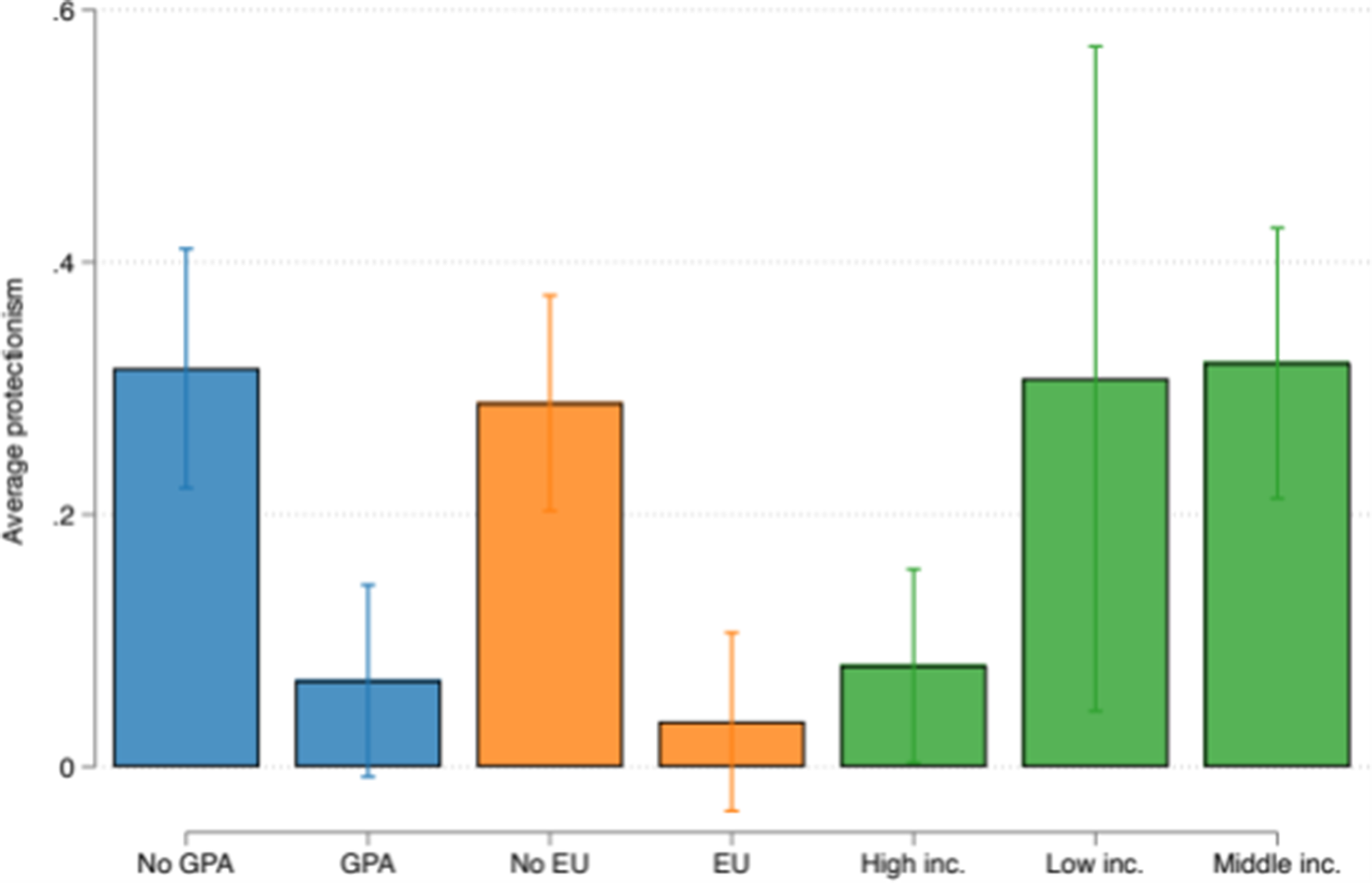
Figures 1 and 2 display the relationship between the protectionist indicators derived from the coding of procurement law and relevant economic and institutional characteristics. The national legal provisions might reflect the commitments that governments have taken in international agreements concerning their procurement markets. This is supported by our data. Countries that are members of the WTO GPA, a plurilateral agreement promoting openness in government procurement, have a significantly lower level of protectionism.Footnote 6 A portion of the difference between WTO GPA signatories and non-signatories can be attributed to EU member countries, as these represent 65% of WTO GPA members. As depicted in Figure 1, the average value of the protectionist index is indeed lower for EU countries. We also find that middle- and low-income countries have legal systems that are more protectionist than those of high-income countries in our sample (as classified by the World Bank).
Protectionism in government procurement, participation in trade agreements, and income status.

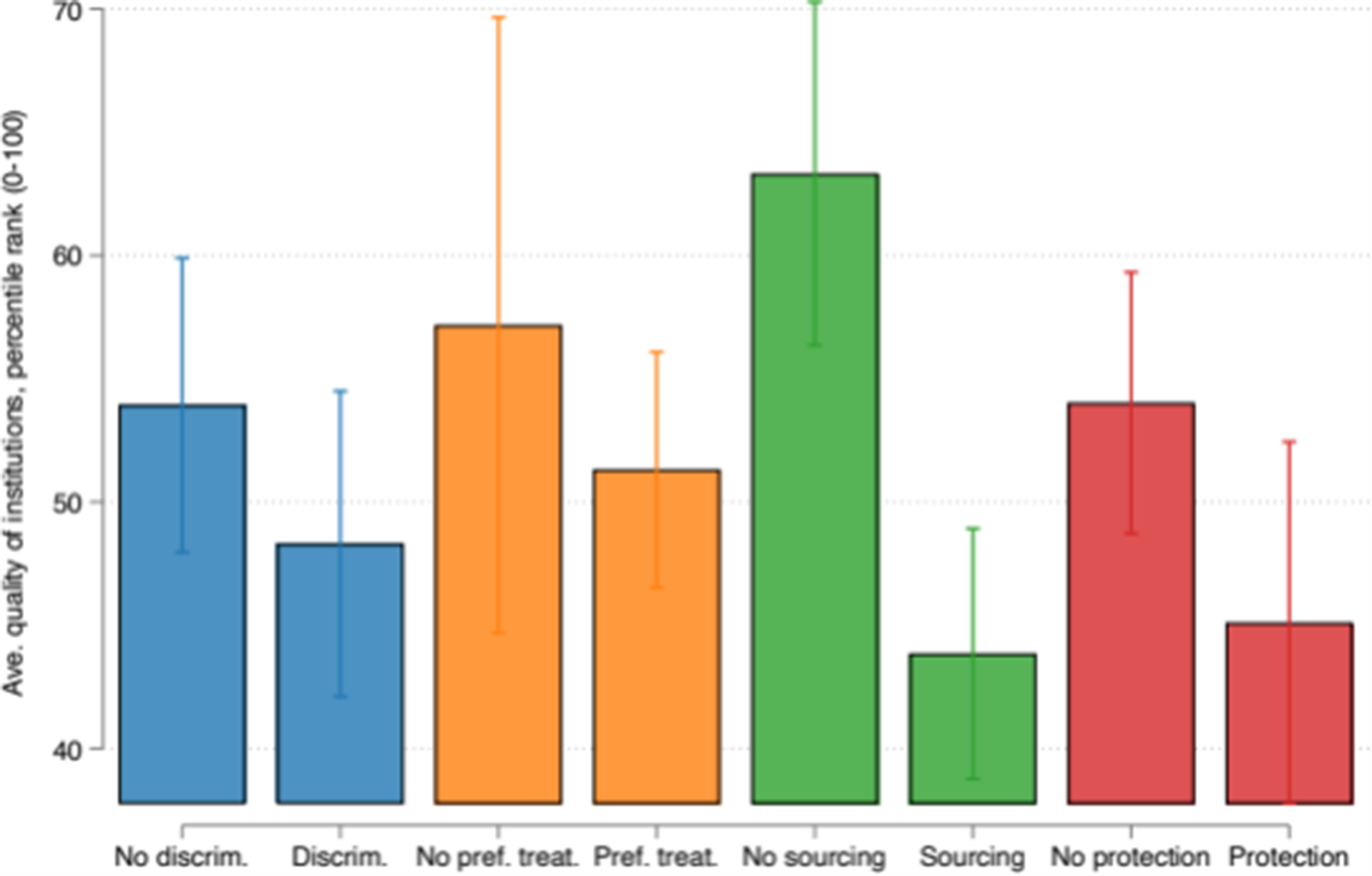
Protectionism in government procurement and the quality of institutions across countries.

In Figure 2, we explore the relationship between the protectionist indicators and institutional characteristics, as measured by the World Governance Indicators (WGI) database. We calculate the average percentile rank across the six governance indicators (voice and accountability, political stability, government effectiveness, regulatory quality, rule of law, and control of corruption) for each country, using available data for each year. We then take the average across years for each country. Figure 2 shows a negative correlation between this overall measure of quality of institutions and protectionism in government procurement. Countries where procurement laws lack an equal treatment provision, provide for preferential treatment, or impose domestic sourcing have worse institutions on average, with the difference being particularly large when considering domestic sourcing. Given the strong correlation between the different WGI indicators, we will use the average measure from Figure 2 in our empirical analysis. Overall, since the legal, economic, and institutional characteristics considered in Figures 1 and 2 might well correlate with imports as well, we will control for their influence in our empirical analysis.
3.2. On the Compatibility between the Law Data and the Trade Data and the Interpretation of the Empirical Estimates
Data on the value of bilateral trade by industry are sourced from the ITPD-E database. It collates only official and administrative data, and includes information on domestic trade. We consider annual data between 2000 and 2019, when trade in services is also measured. Using trade data that do not distinguish between different types of buyer (government vs. others) has three main advantages over alternative approaches based on inter-country input–output (ICIO) tables that permit to split cross-border procurement from other trade flows.
First, using aggregate trade data enables us to incorporate in our estimates the effect that protectionist laws in government procurement can have on the sourcing strategies of domestic firms. This is important because while governments might not vary much in their propensity to award contracts to domestic (rather than foreign) firms, they can impose different restrictions to the input sourcing of the awardees, for instance through ‘made in the country’ provisions. By capturing these provisions, the ‘domestic sourcing’ dummy can partly reflect restrictions on the sourcing of awardees. Second, bilateral imports are computed from administrative data, while the trade data from ICIO tables are estimated based on different proportionality assumptions (Antràs and Chor, Reference Antràs, Chor, Gopinath, Helpman and Rogoff2022; Johnson, Reference Johnson2018). Finally, data from ITPD-E database cover all countries in the world. We can thus include in the analysis all the countries for which we have coded information on procurement law (140 countries), whereas the ICIO data are generally available for a subset of countries – in our application, 66 countries. For these reasons, we carry out our baseline empirical analysis with the aggregate trade data from ITPD-E, and discuss the results using estimated data for cross-border procurement flows from ICIO tables in the Appendix.
One drawback of using aggregated data from ITPD-E is that missing values (imputed or not as 0s) at the detailed industry level are treated as 0s in the aggregation. This issue is more consequential for domestic trade – where genuine 0s are rare, since virtually all countries record some domestic transactions in every industry – than for cross-border flows. The practical consequence is that ITPD-E likely understates total expenditure, and therefore overestimates the import share in total expenditure, relative to ‘squared’ data from ICIO tables in which all trade flows (including domestic ones) are reported by construction. We return to this issue in the next section, where we examine the implications of this issue for our estimates by comparing results across the two datasets.
Before moving on to the econometric analysis linking the variable on protectionist rules in government procurement and the variable on cross-border trade flows, it is important to address some caveats that could limit the significance of a relationship between the two variables. First, it should be noted that the data resulting from the analysis of the text of national laws only capture ‘de jure’ protectionism. As with many coding of legal texts, there may be discrepancies between the text of the law and its implementation.
To check how our ‘de jure’ indicators correlate with implemented policies, we source data from the Global Trade Alert (GTA) on the number of observed measures that discriminate against foreign firms. In the GTA, we can identify measures specific to government procurement – see also Evenett and Shingal (Reference Evenett, Shingal, Francois and Hoekman2019). Table A-6 in the Appendix shows the average number of restrictive measures introduced since 2009 (the first year in the GTA data) and in force as of 2022 across two country groups: countries that are classified as having protectionist laws in government procurement, and other countries that are ‘non-protectionist’ in government procurement.
Two main patterns emerge. First, countries that are categorized as protectionist in government procurement have a higher number of observed discriminatory measures in the same area. The difference from other countries is largest on the full sample, but remains high (almost five-fold) even when we exclude the US, which has by far the highest number of protectionist measures in government procurement. Second, the difference in the number of discriminatory measures in areas other than government procurement between the two country groups is much lower than the difference in discriminatory measures specific to government procurement. As a result, the share of government procurement in the total number of restrictive measures observed in GTA is higher for countries that are classified as protectionist. Taken together, this descriptive evidence supports our interpretation of the ‘de jure’ indicators of protectionism in government procurement as capturing barriers to trade, partly reflecting also the ‘de facto’ implementation of the laws, e.g. by enabling legal challenges against improper practices, and providing a framework for accountability. Furthermore, the comparisons in Table A-6 indicate that the indicators reflect cross-country variation in government procurement protectionism more than generalized discrimination against imports.Footnote 7
Another limitation of the text analysis is that it provides a static picture of the national law on government procurement as of 2021–2022, whereas the annual trade data cover the 2000–2019 period. Although we know the year a decree was first promulgated, we have no information about possible amendments introduced or how the law looked before the decrees entered into force. Therefore, in our empirical analysis, we are assuming that the characteristics coded in 2021–2022 apply over the entire period of the trade data. Any deviation from this assumption can introduce bias in our estimates. It can create a reverse causality link going from past trade flows to current government procurement laws. If not systematically related to the determinants of trade, it can introduce measurement error and work against finding a significant association between our protectionism indicators and trade openness.
Another partial discrepancy between the law and the trade data concerns the object of discrimination, which can refer to either firms or the goods and services being procured. In the trade data, the country of origin corresponds to the place of origin of the good or service.Footnote 8 The protectionism indicators can apply to the nationality of firms, of goods and services, or of both. For instance, the (lack of) national treatment indicator applies to both firms and goods/services, while provisions for preferential treatment apply to firms. Domestic sourcing obligations, however, refer to the nationality of goods and services and are consistent with the definition of nationality used in the trade data. The composite indicator includes rules that depend on the nationality of both firms and goods and services. By investigating also the impact of each type of protectionist measure, we can provide suggestive evidence on the role of the different nationality principles.
Because of these data limitations, our empirical strategy relies on simple cross-country regressions and gravity models of bilateral trade. Our estimates are interpreted as correlations suggesting the existence (or lack thereof) of a relationship between trade openness and the protectionism measures. Reverse causality and omitted variables can introduce biases that prevent us from interpreting the estimates as causal. Countries whose markets have been historically open to foreign firms might have designed their law in ways that accommodate such a trend, thus creating a link going from trade openness to the (low) protectionism level of the law.Footnote 9 Furthermore, unobservable country characteristics (for instance, legal aspects that are not measured by the coding of national laws) that correlate with both the coding of the law and the trade flows can influence the estimates of the relationship of interests. For these reasons, the estimates found in the econometric analysis are suggestive of the relationship between trade openness and protectionism of the law, without indicating causal effects.
4. Results on the Relationship between Trade Openness and Protectionism in National Laws on Government Procurement
We move beyond descriptive evidence and examine the relationship between protectionism in government procurement, as measured by a coding of the national law, and trade flows. We first estimate this relationship in cross-country regressions while controlling for potential confounding factors that could correlate with both protectionism and trade flows, as demonstrated in the descriptive analysis. In a second step of the econometric analysis, we estimate how the protectionist indicators relate to bilateral trade flows in a gravity model.
4.1 Cross-country Regressions
We use the import share in total spending (for intermediate use and final consumption) as our dependent variable in cross-country regressions. Since the coded law should only distinguish between domestic and foreign firms, treating all imports equally irrespective of their source is an appropriate choice. The import share in government procurement is averaged over the period 2000–2019 and taken in logs.
Table 1 presents the results of the cross-country regressions of the import share on indicators measuring protectionism in the three main areas coded from the national law on government procurement (discrimination, preferential treatment, and domestic sourcing). Consistent with our expectations, we find a negative association between import openness and the different indicators of protectionism in government procurement laws. Countries with more protectionist laws in government procurement tend to have lower foreign penetration in the total value of expenditure. This negative correlation emerges as we control for the effect of participating in the WTO GPA and EU trade agreements, as well as for other country characteristics (even-numbered columns in Table 1). Our findings thus suggest that countries with more protectionist domestic laws in government procurement have lower import shares, beyond the influences of their international obligations (e.g., coming from membership in trade agreements) already reflected in their domestic laws, and other macroeconomic variables such as economic development and institutional quality.
Import share of total expenditure and protectionism in government procurement (cross-country)

Table 1 Long description
Eight cross-country regressions relate the log of import share in total government spending to several protectionism indicators in government procurement, with and without added controls. Overall protectionism in government procurement has a negative and significant coefficient. The effect is driven by preferential treatment and domestic sourcing, while coefficients on discrimination are small and not significant. Among the controls, the most consistent association is for WTO GPA membership, which is negative across all models that include it, indicating lower import shares for GPA members. EU membership is negative but not statistically significant in the models shown. GDP per capita, income-group indicators, and institutional quality have small coefficients and are generally not statistically significant, though middle- and low-income indicators are sometimes weakly negative. Sample sizes range from 137 to 139 countries, and models with controls have higher fit than those with only the protectionism measure. Results are associations from country averages over 2000 to 2019 and should not be read as causal effects.
Notes: The dependent variable is the import share in total spending averaged by country over the 2000–2019 period, in logs. The ‘protectionism’ dummy equals the variables reported in Table A-5. EU and WTO GPA variables are indicators for being EU and WTO GPA members respectively as of 31 December 2018. The Ln(GDP cap) variable is the country’s GDP per capita, in logs, averaged across the years. Middle income and Low income are indicators for middle income and low-income countries, respectively. Institutions WGI is the average percentile rank across the six WGI indicators. All regressions include a constant term. Standard errors robust to heteroskedasticity are in parenthesis.
* stands for statistical significance at the 10% level, ** at the 5% level and *** at the 1% level.
The estimated coefficients on the protectionist indicators are economically significant. Using the specification with controls in column (8) as the baseline, the estimates imply that the import share of total spending is 17% lower in countries whose procurement laws are classified as ‘protectionist’ (i.e., they do not provide for an equal treatment provision, they give preferential treatment to domestic firms and adopt a domestic sourcing provision) than in other countries. Relative to the average import share of 56%, this difference amounts to a 9 percentage points lower share. The results also suggest that preferential treatment is the type of protectionist law that has the most negative effect on the import share.
We include several control variables in our cross-country regressions to account for factors that may be associated with both protectionism and import penetration in government procurement. One set of control variables measures a country’s participation in international agreements that can shape its national laws on government procurement, including EU membership (arguably the most comprehensive regional trade agreement) and WTO GPA membership. Because of the cross-country empirical setup, we cannot properly control for membership in other preferential trade agreements, which is something that we can do in the gravity estimations.
While EU and WTO GPA members have less protectionist laws in our data (see Figure 1), we find that these memberships correlate negatively with trade openness, with the coefficient on the GPA dummy being statistically significant. This counterintuitive result – suggesting that WTO GPA members are less open than non-members – can be explained by domestic trade flows, and hence the denominator in the import share, being underestimated in the ITPD-E data, especially in developing countries that are not GPA members.Footnote 10 As discussed in the data section, country-level domestic trade in ITPD-E can be underestimated because many trade flows at the industry level are unreported (or imputed as 0s), and enter the aggregation as 0s. Figure A-7 in the Appendix illustrates the resulting bias: in ITPD-E, non-GPA countries display disproportionately higher import shares in total expenditure than GPA members, whereas in TiVA – where the trade matrix is ‘squared’ and trade flows are reported by construction – no clear difference emerges between the two groups.Footnote 11 Consistent with this pattern, when we re-estimate the cross-country regression using TiVA data (Table A-1 in the Appendix), the GPA coefficient turns positive, though not statistically significant.Footnote 12
Importantly, the measurement issue we document affects the GPA coefficient specifically and does not propagate to our main result. The estimated coefficients on the protectionism indicators in Table A-1 are similar across specifications using ITPD-E and TiVA data on the common 66-country sample, indicating that the mechanism inflating import shares for non-GPA countries does not materially shift our central estimates.
These results are indicative of a negative correlation between protectionist laws on government procurement and aggregate trade openness. In section A of the Appendix, we investigate how this correlation holds up for purchases by governments and those by private agents, measured from the ICIO tables of the TiVA database. We confirm a negative correlation that is not significantly different across the public and private sector (Table A-2). The relationship between protectionism and trade openness is weaker in the restricted sample of 66 countries of the TiVA data than in the full ITPD-E sample, but this attenuation reflects the smaller sample rather than the change of dataset (see Table A-1). Under the assumption that the TiVA data can capture, at least partly, true differences in purchasing patterns between governments and the private sector, the lack of differences in the results between these two buyers in Table A-2 suggests that our indicators of protectionism in government procurement can identify restrictions that operate also on the sourcing decisions of firms.Footnote 13
To gain further insights into the relationship between trade openness and protectionism in government procurement, we leverage the industry dimension of the ITPD-E database. There are 170 industries in the data, 118 in manufacturing, 35 in the primary sector (agriculture, forestry, fishing and mining), and 17 in the service sector. Because of missing data on internal trade, especially in primary and services industries, we estimate the cross-country regressions in Table 1 with controls by aggregate sector, and retrieve the coefficient on the protectionism indicator of interest. The results are displayed in Figure 3. The import shares across the primary, manufacturing, and services sectors are lower in countries with laws in government procurement that provide preferential treatment to domestic firms and contain provisions for domestic sourcing, whereas there is no significant difference with respect to the inclusion of a clause on national treatment. Overall, the coefficients are often imprecisely estimated, especially for the service sector, though the point estimates on the preferential treatment and domestic sourcing indicators retain the expected negative sign – a direction that is consistent with significant effect of the preferential treatment dummy found for services and other sectors in the gravity specification (Table 2). The lack of statistical significance in the cross-country specification for the service sector does not appear to reflect a composition effect across digitally and non-digitally delivered services.Footnote 14
Import share and protectionism in government procurement by sector, cross-country regressions.

Figure 3 Long description
A) Coefficient plot titled, Coefficient on discrimination dummy. The y axis lists Primary, Manufacturing, Service. The x axis shows tick labels, minus 1, minus 0.5, 0, 0.5, 1. A vertical reference line is drawn at 0. Primary has a point estimate slightly below 0 with a horizontal interval spanning from about minus 0.6 to about 0.2. Manufacturing has a point estimate slightly below 0 with a horizontal interval spanning from about minus 0.2 to about 0.1. Service has a point estimate slightly below 0 with a horizontal interval spanning from about minus 0.9 to about 0.6. B) Coefficient plot titled, Coefficient on pref. treatment dummy. The y axis lists Primary, Manufacturing, Service. The x axis shows tick labels, minus 1, minus 0.5, 0, 0.5, 1. A vertical reference line is drawn at 0. Primary has a point estimate below 0 with a horizontal interval spanning from about minus 0.7 to about 0.1. Manufacturing has a point estimate below 0 with a horizontal interval spanning from about minus 0.3 to about 0.1. Service has a point estimate below 0 with a horizontal interval spanning from about minus 0.9 to about 0.6. C) Coefficient plot titled, Coefficient on dom. sourcing dummy. The y axis lists Primary, Manufacturing, Service. The x axis shows tick labels, minus 1, minus 0.5, 0, 0.5, 1. A vertical reference line is drawn at 0. Primary has a point estimate below 0 with a horizontal interval spanning from about minus 0.6 to about minus 0.1. Manufacturing has a point estimate slightly below 0 with a horizontal interval spanning from about minus 0.2to about 0.1. Service has a point estimate below 0 with a horizontal interval spanning from about minus 0.9 to about 0.1. D) Coefficient plot titled, Coefficient on protectionism dummy. The y axis lists Primary, Manufacturing, Service. The x axis shows tick labels, minus 1, minus 0.5, 0, 0.5, 1. A vertical reference line is drawn at 0. Primary has a point estimate below 0 with a horizontal interval spanning from about minus 0.7 to about 0.1. Manufacturing has a point estimate slightly below 0 with a horizontal interval spanning from about minus 0.3 to about minus 0.1. Service has a point estimate above 0 with a horizontal interval spanning from about minus 0.5 to about 0.7. Across the four plots, each sector is shown as a single dot with a horizontal interval and each plot includes the same 0 reference line and the same three sector labels.
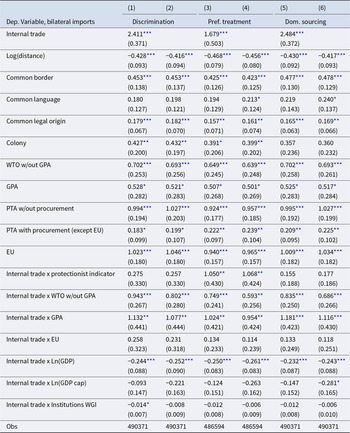
Bilateral imports and indicators of protectionism in government procurement, gravity estimations

Table 2 Long description
Six gravity-model regressions estimate how bilateral imports relate to geography, historical ties, trade agreements, and procurement protectionism indicators interacted with an internal trade dummy. Internal trade has a large, statistically significant positive association with imports in the baseline specifications for discrimination, preferential treatment, and domestic sourcing (about 1.7 to 2.5). Distance is consistently negative and statistically significant across all columns (about minus 0.42 to minus 0.47), while sharing a border is consistently positive (about 0.42 to 0.48). Common language is small and only sometimes statistically significant, whereas common legal origin is positive and statistically significant in all specifications; colonial ties are positive in some columns but not consistently significant. Membership indicators for WTO without the procurement agreement, the procurement agreement, preferential trade agreements, and the European Union are generally positive and often statistically significant. The interaction between internal trade and the protectionism indicator is positive and statistically significant for the preferential-treatment measure (about 1.05 to 1.07), and not for discrimination or domestic sourcing. Interactions of internal trade with WTO without the procurement agreement and with the procurement agreement are positive and statistically significant, while interactions with gross domestic product are negative and significant, suggesting the internal-trade premium is smaller in larger economies. Results are conditional on extensive fixed effects and clustered standard errors, so coefficients describe associations within those controls rather than simple cross-country differences.
Notes: The dependent variable is the value of bilateral imports. Annual data from 2000 to 2019. All columns include importer-year and exporter-year fixed effects. Even-numbered columns add interactions between the internal trade dummy and year dummies. Standard errors three-way clustered by undirected country-pair, importer and exporter in parenthesis.
* stands for statistical significance at the 10% level, ** at the 5% level, and *** at the 1% level.
Table A-8 in the Appendix summarizes the results of the cross-country regressions by industry. Because of missing or incomplete data on internal trade, we lose 14 industries, five in the service sector and nine in the primary one. The table shows the five industries with the largest negative and statistically significant coefficients associated to the protectionism dummy variables, and some summary statistics on the industry-specific coefficients. The correlation between import shares and the protectionism dummies is significant in a minority of industries – 16% when we use our composite protectionism indicator. All significant coefficients except one have a negative sign. The industries with the largest significant coefficient are in the manufacturing and primary sectors, whereas the estimates for service industries are not significant. The estimates suggest that on average the negative correlation between import shares and protectionism in government procurement is slightly stronger in the primary than in the manufacturing sector, with important heterogeneity as shown by the number of manufacturing industries in the top-five list in Table A-8.
4.2 Results from Gravity Estimations
We further investigate the relationship between trade openness and protectionism in government procurement in a canonical gravity model for bilateral trade, where the unit of observation is a country-pair consisting of an exporter and an importer. While our cross-country regression framework is suitable to estimate the relationship between trade and our protectionism indicators, which are constant across exporting country, recent extensions of the gravity model allow us to estimate the trade effects of ‘unilateral’ policies and economic characteristics that do not discriminate across exporters (Heid, Larch, and Yotov, Reference Heid, Larch and Yotov2021; Sellner, Reference Sellner2019; Beverelli et al., Reference Beverelli, Keck, Larch and Yotov2024; Piermartini and Yotov, Reference Piermartini and Yotov2016). We estimate the following gravity model,
 \begin{equation}X_{ij,t}\,=\,\exp\left(m_{j,t}\,+\,e_{i,t}\,+\,\alpha T_{ij,t}\right)\times\,\varepsilon_{ij,t}\end{equation}
The dependent variable  ${X_{ij,t}}$ equals the value of imports by importer j coming from exporter i in year t, which goes from 2000 to 2019. The
 ${m_{j,t}}$ and the
 ${e_{i,t}}$ are importer-year and exporter-year fixed effects that control for the multilateral resistance terms that are common to different structural gravity models (see the reviews by Head and Mayer (Reference Head, Mayer, Gopinath, Helpman and Rogoff2014); and Anderson (Reference Anderson2011)), income and other country-specific determinants of bilateral imports. Therefore, the importer-year fixed effects absorb the level effect of trade costs variables specific to the importer that do not vary across exporters, such as the indicators of protectionism in government procurement. The term
 ${T_{ij,t}}$ collects bilateral variables that measure the level of trade frictions between the importer and the exporter, and
 $\alpha $ is the vector of coefficients associated to each variable. In our baseline specification, the bilateral trade cost term is defined as,
 \begin{equation}\alpha {T_{ij,t}}\, \equiv \,{\alpha _1}{D_{ij}}\, + \,{\alpha _2}{F_{ij,t}}\, + \,{\beta _1}\left( {internaltrad{e_{ij}}\, \times \,protectionis{m_j}} \right)\, + \,{\beta _2}\left( {internaltrad{e_{ij}}\, \times {V_{j,t}}} \right)\end{equation}
The vector  ${\alpha _1}$ collects the coefficients associated to the matrix
 ${D_{ij}}$ of bilateral time-invariant determinants of trade costs: distance (in logs) and dummies for internal trade flows, for countries that share a border, an official language, the legal origin, and colonial history. These variables are sourced from the CEPII Gravity Database (Conte, Cotterlaz, and Mayer, Reference Conte, Cotterlaz and Mayer2022). The coefficient on the internal trade dummy measures the ‘border effect’ (McCallum, Reference McCallum1995; Anderson and van Wincoop, Reference Anderson and van Wincoop2003) – how much domestic purchases (and sales) are higher than trade with other countries, after controlling for bilateral determinants of trade and multilateral resistance terms. Following the insights of Heid, Larch, and Yotov (Reference Heid, Larch and Yotov2021) and Beverelli et al. (Reference Beverelli, Keck, Larch and Yotov2024), we identify the effect of our importer-specific measures of protectionism in government procurement (the protectionism variable) by interacting them with the dummy for internal trade. The coefficient
 ${\beta _1}$ associated with this interaction term measures how much the border effect varies between more and less protectionist countries in government procurement. Importers whose law is coded as more protectionism should display thicker borders in government procurement, indicating a higher gap between domestic and foreign purchases. Conceptually, this empirical strategy is close to the cross-country regressions, where we compared import shares in total spending across countries with varying degrees of protectionism in government procurement.Footnote 15 As in the cross-country regression, we control for other importer-specific variables that are likely to correlate with both protectionism in government procurement and trade openness: dummies for membership in the WTO, WTO GPA, EU, and GDP (in logs), GDP per capita (in logs) and the average index of quality of institutions (fixed over time). These controls collected in the term
 ${V_{j,t}}$ are thus interacted with the internal trade dummy. Finally, we control also for the influence of time-varying determinants of bilateral imports that come from entry into trade agreements: WTO membership and PTAs, collected in the matrix
 ${F_{ij,t}}$. Because of our interest in indicators that code national laws in government procurement, we include dummies for membership of both the importer and the exporter in the WTO, WTO GPA, PTAs without provisions on government procurement, PTAs with provisions in government procurement (except the EU) and the EU. The data on WTO and EU memberships come from the CEPII Gravity Database, whereas information on WTO GPA membership comes from the WTO website. Data on PTAs membership and provisions on government procurement are sourced from the Deep Trade Agreements Database (Mattoo, Rocha, and Ruta, Reference Mattoo, Rocha and Ruta2020).
Following the literature, the gravity models are estimated with the Poisson estimator (hence, the exponential function in the gravity equation), which permits to include zero trade flows (around 30% of our country-level sample) and accommodates heteroskedasticity in trade data (Santos Silva and Tenreyro, Reference Santos-Silva and Tenreyro2006). Following Egger and Tarlea (Reference Egger and Tarlea2015), we cluster the standard errors by importer, exporter, and undirected country pair (the ij and ji pairs belong to the same cluster).
Unlike the literature that deals with estimation of trade effects of trade agreements (Baier and Bergstrand, Reference Baier and Bergstrand2007; Piermartini and Yotov, Reference Piermartini and Yotov2016), our empirical specification lacks bilateral fixed effects because our variables of interest (indicators of protectionism in government procurement laws) are time-invariant: their interaction with the internal trade dummy would be absorbed by the country-pair fixed effects. This limitation of our empirical setting prevents us from credibly identifying causal effects. Besides adding an exhaustive set of control variables as explained above, we try to lessen potential omitted variable bias by further controlling for interactions between year dummies and the internal trade dummy (included in the  ${V_{j,t}}$ term in eq. (1)). As Bergstrand, Larch, and Yotov (Reference Bergstrand, Larch and Yotov2015) argue, controlling for trends in the border effect can net out important variation, which in our case might well correlate with the interaction between internal trade and protectionism in government procurement laws.
In Table 2, we show the results of the gravity estimations using each of the three indicators of protectionism in government procurement separately (lack of national treatment clause – ‘discrimination’; preferential treatment and domestic sourcing). Odd-numbered columns report the results of a gravity specification without time-varying border effects, while the other columns report our baseline specification that controls for interactions between the internal trade and year dummies. The coefficients on the standard gravity variables have the expected signs: the positive and large coefficient on the internal trade dummy indicates that trade is disproportionally domestic even when controlling for other determinants of bilateral trade; distance depresses trade; and sharing a border, a common official language, a common legal origin, or a colonial relationship boosts bilateral imports.
Participation in trade agreements (WTO, WTO GPA, PTAs, and the EU) is associated with higher trade flows. Beyond this average effect, the positive coefficients on the interactions between the WTO and WTO GPA dummies and the indicator for internal trade suggest that membership in these agreements is associated with larger internal trade, controlling for the effect operating through domestic procurement laws (which is absorbed by the protectionist indicators). For the GPA dummy, this pattern mirrors the negative cross-country coefficient in Table 1 and admits the same explanation: in the ITPD-E data, domestic trade flows are systematically lower for non-GPA members, which inflates the relative weight of cross-border trade (see Figure A-7 and the discussion above). Re-estimating the gravity on TiVA data confirms this reading: the coefficient on the internal trade x GPA interaction attenuates and becomes statistically indistinguishable from 0 (see Table A-3 in Appendix), consistent with the coefficient on the GPA dummy in the cross-country regression under TiVA discussed above. By contrast, the coefficients on the interactions between the protectionism indicators and the internal trade dummy retain the same signs and comparable magnitudes across ITPD-E and TiVA, suggesting that the measurement issue with ITPD-E data does not affect our main variables of interest. Crucially, the lack of country-pair fixed effects in the gravity specification prevents a causal interpretation of the coefficients on the trade agreements dummies (Head and Mayer, Reference Head, Mayer, Gopinath, Helpman and Rogoff2014; Baier and Bergstrand, Reference Baier and Bergstrand2007).
The main coefficient of interest is the one on the interaction between the internal trade dummy and the indicators for protectionism in government procurement. As for the cross-country regressions, we find that preferential treatment provisions have a strong and significant relationship with protectionism in trade data, as measured by the difference between internal and international trade. The estimates suggest that for importers whose laws have preferential treatment for domestic bidders in government procurement, domestic purchases are around 16 times bigger on average than international ones, whereas for importers without a preferential treatment clause, domestic purchases are seven times bigger than international ones. Lacking a national treatment provision or having a domestic sourcing provision increases the border effect, but not significantly so.
Using the composite indicator for protectionism in government procurement laws (equal to 1 if the laws lack a national treatment provision, they provide preferential treatment to domestic bidders, and establish domestic sourcing clauses), Table A-7 in the Appendix reports the results of the gravity estimations. The estimates suggest that the border effect is higher in importing countries that are classified as protectionist in their procurement laws, but the difference relative to other importers is not statistically significant. This pattern is consistent with the mixed significance of the coefficients on the three components of the composite index shown in Table 2.
In Figure 4, we display the coefficient on the interaction between the internal trade dummy and the protectionism indicator obtained by estimating our baseline gravity regression across broad aggregate sectors. The specification includes all the bilateral as well as the importer-specific controls (even-numbered columns in Table 2 and column (4) in Table A-7). We confirm the finding from Table 2: the border effect is significantly higher for countries whose law on government procurement has a preferential treatment provision, and this holds across the primary, manufacturing, and service sectors. The coefficient on the ‘discrimination’ interaction is negative and significant for services, suggesting that importers without a national treatment clause appear to have a lower border effect. As noted in the cross-country regressions, this indicator captures a general legal principle whose relationship with trade openness may be confounded by other unobserved determinants. The counterintuitive sign is confined to this indicator and to services; it is reversed for importers with preferential treatment provisions.
Border effect and protectionism in government procurement by sector.

The results by industry summarized in Table A-9 in the Appendix are less conclusive than the results by sector, because of the incompleteness of the data at this level of disaggregation.Footnote 16 They nonetheless confirm that the border effect is greater for importers with preferential treatment provisions in government procurement, and more precisely estimated for manufacturing industries.
We also estimate the gravity specification using the TiVA data and distinguishing between government procurement and private bilateral imports. The results are reported and discussed in section A.2 in the Appendix. They are consistent with the evidence from the cross-country regressions suggesting that the negative relationship between trade and protectionism in government procurement is present for public and private purchases. If anything, the enlarging effect of protectionism on the border effect is slightly stronger for bilateral trade in private markets than in government procurement.
5. Concluding Remarks
In this paper, we introduced a novel dataset on the protectionist content of national laws across 142 countries and investigated how it relates to trade openness. The information on national laws concerning government procurement is organized into three areas representing the main policy tools that governments use to discriminate against foreign firms, goods, and services (lack of a national treatment clause, preferential treatment for domestic firms, and domestic sourcing). For each of these areas and for the combination of the three, we construct a dummy variable equal to 1 if the protectionist character emerges from the law.
The data reveal that protectionism in government procurement is widespread. Around 37% of the countries lack a general provision of equal treatment between domestic and foreign firms when it comes to government procurement. It is only in 17 of the 141 countries for which data are available that the law does not include preferential treatment clauses against foreign bidders. A domestic sourcing provision is present in 58% of the sample. We find that the share of countries with protectionist laws in government procurement is lower among countries that participate in major international agreements that liberalize procurement markets, the WTO GPA and the EU, and in high-income countries. We also find that this share tends to be lower in countries with institutions of better quality, as measured by the World Governance Indicators.
To further validate the national law data and investigate the variation in trade openness across countries, we estimate the relationship between import share in total spending and the protectionism index. Because the national law data were collected during 2021–2022 while the trade data cover the 2000–2019 period, and in absence of an exogenous shifter for the protectionism variables, we interpret the empirical estimates as suggestive of the correlation between trade and the protectionist character of national laws. The results indicate a systematically negative correlation between import shares and the protectionism in government procurement, which is robust to controlling for the influence of other country characteristics and different definition of government procurement in the trade data. Lower import shares in government procurement are especially observed in countries where the law provides for preferential treatment of domestic bidders. These results from cross-country regressions are confirmed in estimations of gravity models for bilateral imports. In particular, we find that the ‘border effect’ (how much the country’s spending market is local relative to international, after controlling for standard determinants of bilateral trade) increases with protectionism in government procurement, with the effect being again stronger for preferential treatment provisions.
The empirical exercise that we propose in this paper is subject to a number of limitations. In addition to the lack of a credible identification strategy that could support a causal interpretation of the estimates, there are measurement issues in protectionism in government procurement. Most notably, our data can measure ‘de jure’ protectionism in government procurement, but lack precise information on the implementation of domestic laws. This can explain why our estimates reveal correlations between trade openness and protectionism, as observed in the law, that are imprecisely estimated for some components of the law.
With these caveats in mind, our findings have important implications for government procurement policies. The relationship between protectionism in government procurement and overall trade underscores the significance of procurement laws for the sourcing decisions of domestic firms, namely those who win procurement contracts. Future work might dissect the stringency and role of provisions constraining the sourcing of inputs by awardees of government contract in shaping trade patterns. It also highlights the possibility that the presence of this type of protectionism can well mask protectionism in other policy areas, unobserved to us, that matter for overall trade.
Supplementary material
The supplementary material for this article can be found at https://doi.org/10.1017/S1474745626101633.
Data availability statement
The data that support the findings of this study are openly available in Harvard Dataverse at https://doi.org/10.7910/DVN/XXR8PA.
Acknowledgements
We are indebted to Jose Signoret for his guidance and comments throughout the project. The project was implemented and the paper drafted while Lorenzo Rotunno was at Aix-Marseille University. The views expressed in this paper are those of the authors and do not necessarily represent the views of the World Bank and the IMF, the Executive Directors of the World Bank and the IMF, or management of the World Bank and of the IMF.




 Open access

