

INTRODUCTION
The incidence of breast cancer increases with ageReference Greenlee, Hill-Harmon and Murray1 and breast cancer is the most common cancer in women >70 years.Reference Yancik2 In Western countries, ∼50% of women with breast cancer are >65 years. In developing countries, the scenario is different. In India, life expectancy of a female at birth is 62.5 years,3 so we considered patients aged ≥60 years as elderly. Older women are also less likely to receive standard breast cancer treatments than younger women.Reference Hutchins, Unger and Crowley4–Reference Townsley, Selby and Siu7 Elderly patients tend to receive less aggressive therapy and relatively few elderly patients are accrued in clinical trials. Treatment strategies for older women have been extrapolated from clinical trials conducted in younger women. Age at diagnosis strongly influence the natural history of breast cancer.Reference Diab, Elledge and Clark8–Reference Hughes, Schnaper and Berry13 Under treatment strongly decreases prognosis of breast cancer in elderly women.Reference Bouchardy, Rapiti and Gerald14 As the population of women aged ≥65 years is increasing, studies to define optimum treatment in this group are required. Improvements in life expectancy increases the incentive to allow older women with breast cancer to be treated without major barriers related to age, functional status and social support.
The benefits of adjuvant treatment must be critically assessed in elderly populations, and cannot simply be extrapolated from studies conducted in younger women. To provide evidence about breast cancer treatment in older women from India, we did an analysis in women aged ≥60 years to plan future studies and, thereby, improve treatments for elderly patients.
METHODS
This retrospective analysis included 228 women aged ≥60 years with breast cancer treated between January 1992 and December 2002 in two tertiary care centers in north India. All patients had a histologically confirmed diagnosis of breast cancer. We documented age, associated co-morbid disease, cancer history, tumour size, type of surgery, result of axillary node dissection, the result of oestrogen/progesterone receptor (ER/PR) status, tumour grade and the presence of lymphatic vessel invasion LVI to mean lymphovascular invasion. For each patient, we collected information from the medical record associated with disease stage, RT, the use of chemotherapy or hormone therapy, and other clinical and/or pathological characteristics. We coded primary surgical therapy as mastectomy (modified radical mastectomy or total mastectomy) or breast conservation (partial mastectomy, segmental mastectomy, lumpectomy, quadrantectomy, tylectomy, wedge resection or excisional biopsy) and documented whether adjuvant RT or systemic therapy was planned. We documented whether a patient received adjuvant RT, systemic therapy–hormonal therapy only, chemotherapy only, or hormonal therapy and chemotherapy—according to the adjuvant therapy information coded on the medical record. We used the Index of Coexistent DiseaseReference Greenfield, Blanco and Elashoff15 to classify severity of co-morbid disease as none, mild, moderate or severe. Univariate analysis was done using the Log-rank test. Multivariate analysis was done using the Cox proportional hazards model for age, tumour stage, histological type and grade, nodal status, surgical margins, extracapsular extension, LVI, ER/PR status, radiotherapy (RT) given, chemotherapy, hormones and co-morbid disease. Outcomes studied were locoregional recurrence (LRR), distant metastases, disease-free survival (DFS) and overall survival (OS) using univariate and multivariate analyses. Kaplan–Meier method was used to estimate DFS and OS. All tests for statistical significance were performed using the χReference Yancik2 method for categorical variables. All statistical tests were two-tailed and differences were considered to be statistically significant if p < 0.05. Statistical analysis was performed using SPSS software, version 12.0 (Statistical Package of Social Science, Chicago, IL)
RESULTS
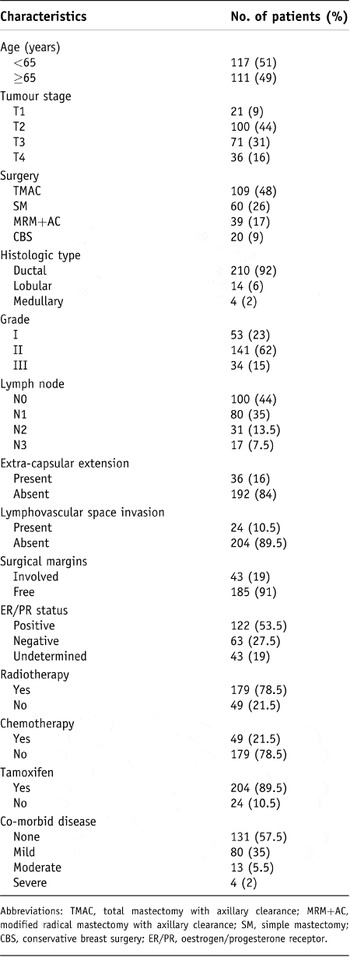
Mean age of the study population was 64 years. Median follow-up was of 80 months. Patient and treatment characteristics were as shown in Table 1. Mastectomy was done in 208 (91%) patients and CBS only in 20 (9%) patients. Axillary dissection was done in 168 (74%) patients. Positive lymph nodes were seen in 128 (56%) patients. ER/PR status was positive in 122 (53.5%) patients and undetermined in 43 (19%) patients. Moderate-to-severe associated co-morbidity was seen in 17 (7.5%) patients. Out of 228 patients, 20 (9%) received no adjuvant local or systemic treatment. Majority of the patients 179 (78.5%) received adjuvant RT. RT was completed by all the patients. Systemic therapy in the form of chemotherapy was given only to 49 (21.5%) patients, hormonal therapy to 204 (89.5%) and both chemotherapy as well as hormonal therapy to 42 (18%) patients. Out of 49 patients, 3 did not complete full course of chemotherapy, due to haematological toxicity in the form of leucocytopaenia in 2 patients and neutropaenia in 1 patient. So the compliance for chemotherapy was 94%. Hormonal therapy was completed by all patients.
Patient and treatment characteristics

Abbreviations: TMAC, total mastectomy with axillary clearance; MRM+AC, modified radical mastectomy with axillary clearance; SM, simple mastectomy; CBS, conservative breast surgery; ER/PR, oestrogen/progesterone receptor.
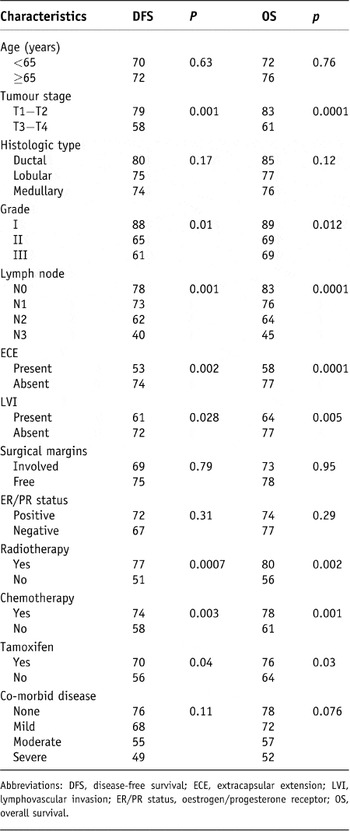
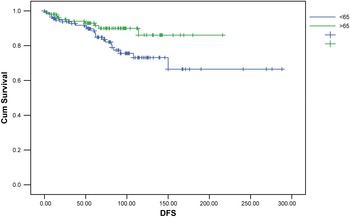
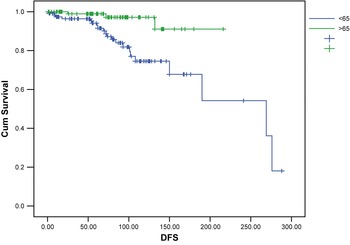
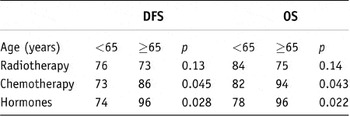
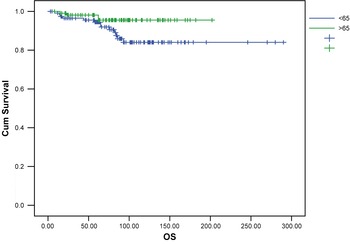
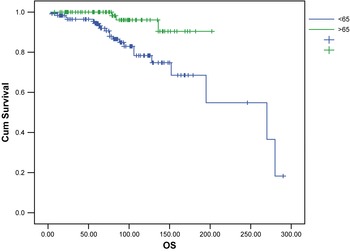
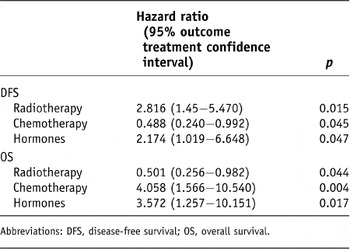
The frequency of LRR with or without distant metastases was 7% and distant metastases was seen in 19.3% of the patients. DFS at 10 years was 69%. In all patients, 10 year DFS was 77% with RT (Table 2) as compared to 51% without RT (p = 0.001). When stratified for age, DFS was 76%, in patients aged <65 years as compared 73% in aged ≥65 years (p = 0.13). It was 73 and 86%, respectively, with adjuvant chemotherapy (p = 0.041, Figure 1). Similarly, DFS with adjuvant hormonal therapy was significantly better in patients aged ≥65 years, 96% as compared to 74% in aged <65 years, respectively (p = 0.028, Figure 2). The OS was 74% at 10 years. Associated co-morbid disease did not significantly affect DFS or OS. OS with RT was 80% as compared to 56% without RT (p = 0.002) in all patients. Adjuvant RT led to comparable OS in the two age groups, it was 75% in patients aged ≥65 years as compared to 84% in patients <65 years of age (p = 0.14), respectively (Table 3). Statistically significant OS was seen with adjuvant chemotherapy for patients ≥65 years of age, 94% as compared to 82% in patients <65 years, respectively (p = 0.044, Figure 3). With adjuvant hormonal therapy, OS was 96% in patients aged ≥65 years as compared to 78% in patients <65 years, respectively (p = 0.020, Figure 4). On multivariate analysis, adjuvant RT, chemotherapy and hormonal therapy use were also significant treatment parameters affecting DFS and OS in elderly patients with breast cancer (Table 4).
Prognostic factors for DFS and OS at 10 years: univariate analysis

Abbreviations: DFS, disease-free survival; ECE, extracapsular extension; LVI, lymphovascular invasion; ER/PR status, oestrogen/progesterone receptor; OS, overall survival.
Ten-year disease-free survival with chemotherapy.

Ten-year disease-free survival with hormonal therapy.

DFS and OS according to age groups

Ten-year overall survival with chemotherapy.

Ten-year overall survival with hormonal therapy.

Multivariate analysis for various treatment outcomes in elderly patients

Abbreviations: DFS, disease-free survival; OS, overall survival.
DISCUSSION
Literature describes age-dependent variations in breast cancer treatment, showing that older women are less likely to receive standard treatment than younger women. In this retrospective study of women aged ≥60 years treated for breast cancer, it is evident that CBS rate and use of systemic chemotherapy is very low. CBS was done only in 9% of the patients despite the fact that >50% of the patients had T1–T2 tumours. CBS rate was just equivalent to patients with T1 tumour (Table 1). The reasons for this low CBS rate could be the patient’s fear of the cancer, as they just want to get rid of the organ that has developed such a dreadful disease (patient preference/fear), inadequate surgical skills, poor cosmetic outcome and physician concern regarding RT side effects in elderly patients with breast cancer.
Several studies have suggested that age bias exists in the selection of adjuvant therapy for women with breast cancer.Reference Buchholz, Theriault and Theriault16–Reference DeMichele, Putt and Zhang23 Older women are less likely to receive standard-of-care surgery, RT after CBS and adjuvant chemotherapy.Reference Buchholz, Theriault and Theriault16,Reference Giordano, Duan and Kuo17 In this study, also the use of systemic chemotherapy was very low. Only 21.5% of the patients were given chemotherapy despite the fact that 47% of the patients had T3–T4 tumour and positive nodes were seen in >50% of the patients. The reasons for this low prescription rate of chemotherapy could be older age, associated co-morbidities, oncologists’ introspection regarding poor tolerance to chemotherapy among older patients, reluctance of many oncologists to expose older women to the toxic effects of chemotherapy, patients choice, poorer performance status, lack of social support, cost, difficulty with transportation, patient or family preference, concerns about quality of life and lower life expectancy.
The Early Breast Cancer Trialists Collaborative Group reported a 10% reduction in mortality for women aged 60–69 years.Reference Clarke, Collins and Darby24 The St. Gallen Consensus guidelines and the National Institutes of Health guidelines have also provided clear recommendations for chemotherapy use in high-risk women with breast cancer aged ≤70 years.Reference Glick, Gelber and Goldhirsch25–27 This study also shows a significant improvement in DFS (Figure 1) as well as OS (Figure 3) in patients aged ≥65 years, who were given chemotherapy. However, for women over the age of 70 years, there is sparse information from randomised–controlled trials. In addition, the magnitude of risk reduction from chemotherapy declines with age, and the risk of death from competing causes increases— leading to additional decline in the benefit of chemotherapy for older patients.Reference Yancik, Wesley and Ries28,29 However, in this study, the benefit with chemotherapy was more in case of the elderly patients, i.e. aged ≥65 years (Table 3), therefore only age should not be considered the deciding factor for chemotherapy use. The decision analysis by Extermann et al.Reference Extermann, Balducci and Lyman30 have also demonstrated that the percentage risk of relapse needed to justify the use of chemotherapy is higher in older women than in younger.
In our cohort of patients, RT was delivered to 78.5% of the patients. All patients with CBS were given adjuvant RT. There was no bias pertaining to religion or culture/ethnicity in delivering RT. Studies that have examined the predictors of surgery and adjuvant RT have found that chronologic age was associated with substandard therapy independent of performance status or co-morbidities, suggesting that physicians may be under-treating healthy older women.Reference Giordano, Hortobagyi and Kau31,Reference Mandelblatt, Hadley and Kerner32 In a study by Giordano et al.Reference Giordano, Hortobagyi and Kau31 advancing patient age was associated with poorer concordance with treatment guidelines and non-white women were significantly less likely to receive RT after CBS. Similarly Mandelblatt et al.Reference Mandelblatt, Hadley and Kerner32 have reported that older black women were twice as likely as older white women to omit RT. The author pointed out that race could be confounded by patient’s socio-economic status, insurance status, availability of transportation, or patient choice (Indian women may prefer mastectomy instead of CBS). It is also possible that cultural beliefs may impact whether women choose to have RT. In a recent study by Smith et al.Reference Smith, Haffty and Hurria33 post-mastectomy radiation was associated with a 15% relative reduction in the risk of death and a 6% absolute improvement in 5-year survival in older women with high-risk breast cancer. This study has also demonstrated that RT improved both DFS as well as OS in all patients (Table 4).
In our study, age was not a significant predictor for delivering adjuvant RT after CBS. This is in contrast to the findings from larger population-based studies that have found that older women have a lower likelihood of receiving RT after lumpectomy.Reference Goel, Burns and Phillips19,Reference Mandelblatt, Hadley and Kerner32,Reference Du, Freeman and Goodwin34 At tertiary referral centers, physicians may be more aggressive in treating older women than physicians in community practice; or, conversely, women who are more motivated and who are more likely to accept therapy are those who travel to referral centers for treatment. There is also existing controversy on the benefit of post-lumpectomy radiation in older women with early-stage ER-positive tumours.Reference Hughes, Schnaper and Berry13,Reference Fyles, McCready and Manchul35 However, our study proved significant DFS as well as OS advantage with adjuvant RT irrespective of age. Among women ≥50 years with small hormone receptor–positive breast tumours, radiation plus tamoxifen significantly reduced the risk of recurrence after lumpectomy.Reference Fyles, McCready and Manchul35 In a similar study of women aged ≥70 years with stage-I ER-positive tumours, RT reduced the risk of local recurrence from 4 to 1%; however, given the baseline low risk, the authors concluded that omission of radiation in this group of patients can be a reasonable choice.Reference Hughes, Schnaper and Berry13
In this study, 90% of women were offered adjuvant tamoxifen. Data for the 50–69 years age group from the Early Breast Cancer Trialists Collaborative Group36 reported that for women with endocrine responsive disease, endocrine therapy provides the majority of the advantage associated with adjuvant treatments. Tamoxifen therapy has been shown to reduce the risk of contra-lateral breast cancer, whereas chemotherapy has not.Reference Geiger, Thwin and Buist37,Reference Yadav, Sharma, Patel, Ghoshal and Kapoor38 Moreover, tamoxifen therapy has been shown to have other benefits. It may prevent osteoporosisReference Love, Mazess and Barden39 and lower cholesterol levels.Reference Reis, Costantino and Wickerham40 Reports from Europe have suggested that tamoxifen reduces the risk of hospitalization for cardiovascular disease and for fatal myocardial infarction.Reference Nordenskjold, Rosell and Rutqvist41,Reference Rutqvist and Mattsson42 However, in a study by Silliman et al.Reference Silliman, Guadagnoli and Rakowski43 they have reported that only 53% of women aged 65–69 years and 74% of women aged 70–79 years were given adjuvant tamoxifen. The less frequent use of hormonal therapy in the oldest group of women may be due to physician beliefs, patient’s preference, financial considerations, lack of insurance, or increasing prevalence of specific co-morbidities that may preclude the use of tamoxifen, such as thromboembolic disease.
Our study has certain limitations. First, this is a retrospective analysis. Second, the cohort of patients is from two tertiary care institutions from northern India and may not be representative of all patients in the general population. In addition, we have not examined the role of patient preferences in treatment decisions. However, strengths of this study include a large cohort of patients with comprehensive information on patient demographics, tumour pathology, and details of multimodality treatment, including surgery, radiation and adjuvant systemic therapies.
We have evaluated patterns of care in the treatment of older women across several breast cancer treatment modalities, yet it remains unclear why some women were not treated in spite of definitive indication for a particular modality. Many reasons exist, including those that are clinically valid, which could include medical contraindications or early disease recurrence. It is possible that older women are more likely to refuse CBS or chemotherapy. Adjuvant RT, chemotherapy and hormonal therapy offered a therapeutic advantage in these patients. We hope that our long-term data may contribute to the research literature in this field. Further research is needed to establish standard of care for the adjuvant treatment of older women with breast cancer.