


Introduction
Colonic diverticulitis is a common indication for hospital presentations. More than half of the over-65 population in the western world are affected by diverticular disease, Reference Commane, Arasaradnam, Mills, Mathers and Bradburn1 3%–7% are complicated by acute diverticulitis in long-term follow-up up. Reference Loffeld2,Reference Shahedi, Fuller and Bolus3 A computed tomography (CT) scan is recommended for suspected first presentations to confirm the diagnosis and assess for complications. Reference Peery, Shaukat and Strate4 Most patients requiring hospitalization are managed non-operatively with careful observation, bowel rest, and intravenous (IV) fluids. Reference Hjern, Josephson and Altman5 It is well-established that uncomplicated diverticulitis does not routinely require inpatient antibiotic treatment, and those who can tolerate a liquid diet and have no signs of systemic inflammatory response syndrome may be managed as outpatients. Reference Jaung, Nisbet and Gosselink6–Reference Chabok, Pahlman, Hjern, Haapaniemi, Smedh and Group8 However, antibiotics are nevertheless commonly prescribed. Guidelines advise antibiotic therapy for complicated cases, such as those with evidence of systemic inflammation, abscess formation, or perforation. Recommended regimens are typically broad-spectrum, with gram-negative and anaerobic coverage. Reference Peery, Shaukat and Strate4 Upfront surgery is uncommon and tends to be reserved for patients with diffuse peritonitis, hemodynamic instability, or recurrent presentations. Reference Khaoudy, Sabbagh, Brac and Regimbeau9,Reference You, Sweeny, Cooper, Von Papen and Innes10
There is a paucity of high-quality clinical trials to inform the optimal non-operative management of diverticulitis, including the selection of antibiotics. Guidelines and retrospective studies suggest the risk of treatment failure (as defined by needing additional treatment, including surgery) is low. Furthermore, antibiotic choice and duration appear unlikely to influence the risk of failure, which is more likely predicted by the degree of disease complication. Reference Khaoudy, Sabbagh, Brac and Regimbeau9–Reference Klinker, Fitzsimmons, Borgert and Fisher11
In Australia, Therapeutic Guidelines: Antibiotic, version 16 (eTG) serves as an independent, evidence-based, and up-to-date source to inform appropriate antimicrobial prescribing. Its guidelines on diverticulitis cite international guidelines and clinical trials. It is authored by a multidisciplinary expert group composed of physicians and surgeons. 12 eTG also serves as the basis of antimicrobial stewardship activities at multiple institutions, including the authors. Several existing studies assessing guideline compliance in the management of uncomplicated diverticulitis have demonstrated poor compliance. They have also shown the rate of treatment failure was not associated with guideline compliance. Reference Dalby, Orru and Sundh13–Reference Azhar, Aref and Brorsson15 However, rates of guideline-compliance in complicated diverticulitis remain uncertain. Moreover, it is unclear whether patient outcomes are affected by adherence to eTG.
The purpose of this study was to assess the degree of compliance to eTG at the authors’ center for patients admitted with diverticulitis. Additionally, it aimed to evaluate any associated differences in patient outcomes with relation to guideline-compliance.
Methods
This retrospective cohort study evaluated adult patients admitted to Mater Adult Hospital (MAH) with acute diverticulitis between 1st January 2019 and 31st December 2023. MAH is a 390-bed, tertiary, public hospital located in central Brisbane, Queensland, Australia. 16 Patients were screened by International Classification of Diseases-Version 10 (ICD-10). Diagnosis was confirmed by review of clinical documentation and radiological diagnosis. Patients who did not require inpatient admission were excluded. The relevant ICD codes are outlined in Figure 1.
Inclusion process. *ICD-10 codes included K57.02, K57.12, K57.22, K57.23, K57.32, K57.33, K57.42, K57.92, K57.93.

Key clinical, pathological, and radiological data were recorded. Patient characteristics and comorbidities were recorded, and a Charlson Comorbidity Index (CCI) was calculated for each patient. Complicated diverticulitis was defined according to eTG: positive blood culture result, perforation, peritonitis, sepsis/septic shock, or abscess formation >5 cm in diameter, as seen on admission CT. Biochemical data collected at presentation included leukocytosis (defined as white cell count > 11.0 x 10³ cells/mm Reference Shahedi, Fuller and Bolus3 ), and C-reactive protein (CRP).
The broadest-spectrum IV antibiotic regimen as prescribed by the specialist team was assessed for compliance. Both intravenous (IV) and oral (PO) selection and duration were recorded. Empirical treatment was defined as compliant if it was one of the regimens outlined by eTG’s “Diverticulitis” page (published 2019, with no practice-changing updates since) as of January 2025. Amoxicillin/ampicillin + gentamicin + metronidazole (MET), ceftriaxone (CTR)/cefotaxime (CTA) + MET, or amoxicillin + clavulanate (AMC) are recommended first line therapy. If microbiological and susceptibility information was available, compliance was defined by appropriate targeted treatment. The decision was made to not include duration in the compliance definition as the focus of the study was on the initial antimicrobial management of diverticulitis.
The primary outcome was overall guideline compliance. Secondary outcomes include factors associated with non-compliance, differences in clinical outcomes (length of stay, 90-day readmission for recurrent diverticulitis, 90-day need for surgery, and 90-day mortality) between compliant and non-compliant prescribing groups, prescribing practices over time, and descriptive microbiological information.
Statistical analysis was performed using Stata version 16 (StataCorp, College Station, TX, USA). Categorical variables were analyzed using chi-squared or Fisher’s exact test. Numerical variables were analyzed using Student’s t test or Mann-Whitney U test. A threshold of P ≤ .1 in a simple logistic regression model was used for inclusion of covariates in the multivariate logistic regression model. The Cochran-Armitage test was used to perform a trend over time analysis. Ethics approval was granted by the Mater Misericordiae Ltd HREC Office, an institutional ethics committee.
Results
A total of 944 patients were screened. 334 patients who did not require admission were excluded. A further 165 patients were excluded after being assessed as not presentations for acute diverticulitis. Finally, a total of 445 patients were included in the audit, (Figure 1). Of these, 155 (35%) presented with complicated diverticulitis, 290 (65%) presented with uncomplicated diverticulitis. To confirm the diagnosis, 436 (98%) patients had CT, 2 had ultrasonography, 1 had magnetic resonance imaging, and 6 had no imaging. Patient demographics are outlined in Table 2.
Overall guideline compliance was 252/445 (57%). Compliance was lower for complicated diverticulitis (55/155 (35%) vs 197/290 (68%), P < .01), (Table 1).
Guideline compliance, overall and by disease complication

Table 1. Long description
A table comparing guideline compliance for diverticulitis by disease complication. The table has four rows and three columns. Column headers are Total diverticulitis, Complicated diverticulitis, and Uncomplicated diverticulitis. Row labels are Guideline non-compliant and Guideline compliant. Row 1: Total diverticulitis, 193; Complicated diverticulitis, 100; Uncomplicated diverticulitis, 93. Row 2: Total diverticulitis, 252; Complicated diverticulitis, 55; Uncomplicated diverticulitis, 197. The table also includes a P value of less than 0.01.
Comparing guideline-compliance and non-compliance with regards to patient characteristics and key outcomes

Table 2. Long description
A table comparing patient characteristics and key outcomes based on guideline compliance. The table has 12 rows and 5 columns. Column headers are Total, Guideline non-compliant, Guideline compliant, and P. Row labels include Female sex, Age > 50, Charlson comorbidity index (IQR), Leukocytosis, CRP—mg/L (IQR), Complicated at presentation, Empiric IVAB prescribed, Total IVAB duration—days (IQR), Mean length of stay—days (IQR), 90-day recurrence, 90-day surgery, and 90-day mortality. Each row provides specific values for each category. Notable trends include higher leukocytosis and CRP levels in the guideline non-compliant group, and a higher percentage of complicated presentations in the same group. The guideline compliant group shows a lower 90-day recurrence and surgery rate.
a leukocytosis = white cell count > 11 x 103 cells/mm3.
b IVAB, Intravenous antibiotics.
c Amoxicillin-Clavulanate.
d Piperacillin-Tazobactam.
e Ceftriaxone + Metronidazole.
The non-compliant group included significantly more complicated diverticulitis (52% vs 22% P < .001), was associated with longer IVAB duration (5 d; IQR 3–7 vs 3 d; IQR 2–5, P < .001), and was associated with a longer length of stay (4 d; IQR 3–6 vs 3 d; IQR 2–5, P < .001). Rates of 90-day recurrence were higher in the non-compliant group (18% vs 10%, P = .03) as was need for surgery (9% vs 4%, P = .02). A total of 12 patients (2.7%) died at 90 days. All were greater than 50 years of age, 4 had a malignancy (2 were metastatic), the mean CCI in this group was 5.75 (IQR 3–8.5). There was no significant difference in mortality between the two groups. Piperacillin-tazobactam (PIT) was the most prescribed antibiotic in the non-compliant group (91%) with AMC being most common in the compliant group (52%), (Table 2). A multivariate regression analysis of factors associated with non-compliance revealed that complicated diverticulitis at presentation was the only statistically significant variable (OR = 2.73, 95% CI 1.68–4.46, P < .001), (Figure 3). Ten patients did not have CRP data (5 compliant group, 5 non-compliant group), representing 2% of all CRP data. Exclusion of these patients and re-analysis did not alter the results.
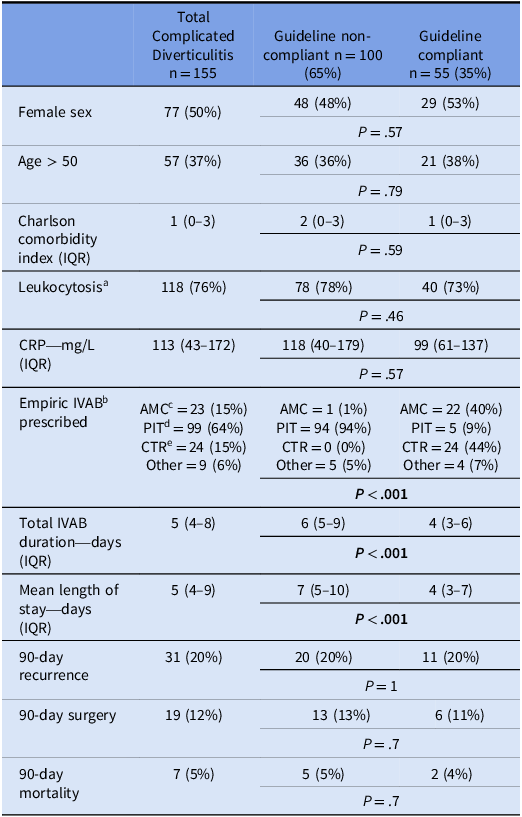
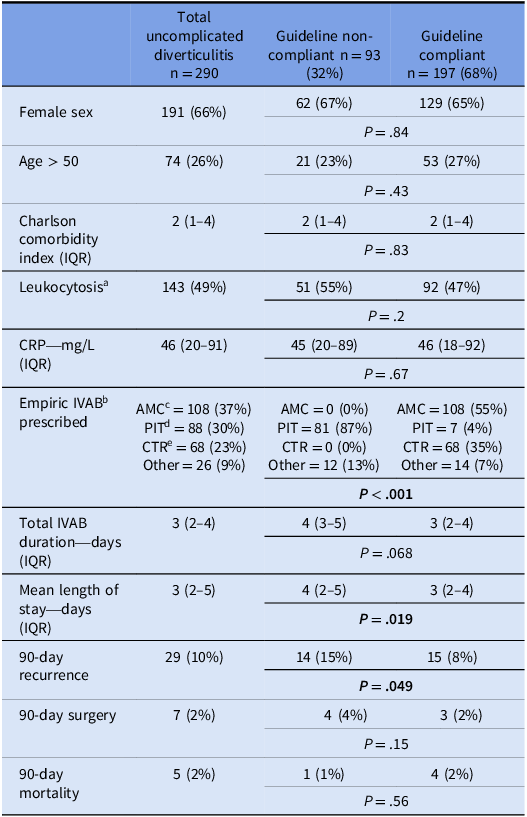
Subgroup analyses were performed in those with complicated and uncomplicated diverticulitis, (Tables 3 and 4). There were no significant differences in baseline patient characteristics in either subgroup. There were also no significant differences in baseline biochemical markers of disease severity (leukocytosis, CRP) within each subgroup.
Complicated diverticulitis subgroup. Comparing guideline-compliance and non-compliance with regards to patient characteristics and key outcomes

Table 3. Long description
A table comparing patient characteristics and key outcomes in complicated diverticulitis based on guideline compliance. The table has 12 rows and 4 columns. Column headers are Total Complicated Diverticulitis n = 155, Guideline non-compliant n = 100 (65 percent), and Guideline compliant n = 55 (35 percent). Row labels include Female sex, Age > 50, Charlson comorbidity index (IQR), Leukocytosis, CRP—mg/L (IQR), Empiric IVAB prescribed, Total IVAB duration—days (IQR), Mean length of stay—days (IQR), 90-day recurrence, 90-day surgery, and 90-day mortality. Each row provides specific values for each column, detailing the comparison between guideline-compliant and non-compliant groups. Notable trends include differences in empiric IVAB prescribed, total IVAB duration, and mean length of stay.
a Leukocytosis= white cell count > 11 x 103 cells/mm3.
b IVAB, Intravenous antibiotics.
c Amoxicillin-Clavulanate.
c Piperacillin-Tazobactam.
e Ceftriaxone+Metronidazole.
Within the complicated subgroup, non-compliance was associated with a longer total IV antibiotic duration (6 d; IQR 5–9 vs 4 d; IQR 3–6, P < .001). Non-compliance was also associated with a longer length of stay (7 d; IQR 5–10 vs 4 d; IQR 3–7, P < .001). There were no significant differences at 90 days in readmission for recurrence, need for surgery, or mortality. (Table 3).
Within the uncomplicated subgroup, non-compliance was associated with a longer mean length of stay (4 d; IQR 2–5 vs 3 d; IQR 2–4, P = .019). It was also associated with significantly more frequent 90-day recurrence (15% vs 8%, P = .049), (Table 4).
Uncomplicated diverticulitis subgroup. Comparing guideline-compliance and non-compliance with regard to patient characteristics and key outcomes

Table 4. Long description
A table comparing patient characteristics and key outcomes for uncomplicated diverticulitis based on guideline compliance. The table has 12 rows and 5 columns. Column headers are Total uncomplicated diverticulitis, Guideline non-compliant, and Guideline compliant. Row labels include Female sex, Age > 50, Charlson comorbidity index (IQR), Leukocytosis, CRP—mg/L (IQR), Empiric IVAB prescribed, Total IVAB duration—days (IQR), Mean length of stay—days (IQR), 90-day recurrence, 90-day surgery, and 90-day mortality. Each row provides specific data points for each category. Notable trends include differences in the mean length of stay and 90-day recurrence rates between guideline-compliant and non-compliant groups.
a Leukocytosis= white cell count > 11 x 103 cells/mm3.
b IVAB, Intravenous antibiotics.
c Amoxicillin-Clavulanate.
d Piperacillin-Tazobactam.
e Ceftriaxone+Metronidazole.
IV antibiotic prescribing practices changed over time. Among the total 445 patients, 410 received either AMC, PIT, or CTR. The number of annual patients treated rose from 67 in 2019 to 99 in 2023. In 2019, 42% patients were prescribed CTR, 16% received AMC, and 42% received PIT. In 2023, 9% were prescribed CTR, 40% were prescribed AMC, and 51% received PIT. (Figure 2).
Trend of intravenous antibiotic prescription. AMC, amoxicillin-clavulanate; PIT, piperacillin-tazobactam; CTR, ceftriaxone+metronidazole.

Multivariable analysis of factors associated with non-compliance. A threshold of P ≤ .1 in a simple logistic regression model was used for inclusion of covariates.

A majority of patients were subsequently prescribed oral antibiotics. Data was available for 384 out of the total 445 patients (86%). Missing oral antibiotic data was attributed to no oral antibiotic prescribed, missing prescription record, or absent documentation. Median oral antibiotic (POAB) duration was 5 days (IQR 5–7) for both compliant and non-compliant groups. Among those with available data, oral AMC accounted for the majority of oral antibiotic step down (n = 337, 88%). 156 patients prescribed PIT had oral antibiotic data (83%). Of these, 146 were stepped down to oral AMC (94%).
A total of 138 (31%) patients had blood cultures taken during their admission. Of these, 10 (7%) were bacteremic, two were polymicrobial. Blood culture isolates included Escherichia coli (n = 3), Pseudomonas aeruginosa (n = 2), Bacteroides sp. (n = 2), Clostridium perfringens (n = 1), Morganella morganii (n = 1), Enterobacter cloacae (n = 1), Klebsiella pneumoniae (n = 1), and Streptococcus agalactiae (n = 1). Out of the 54 patients with complicated diverticulitis who received percutaneous or operative management (31 operative, 18 percutaneous drainage, 5 both), 33 returned a microbiological diagnosis. Of these, 22 were polymicrobial. E. coli was the most cultured organism (n = 21, 39%), seven (13%) cultured P. aeruginosa.
Discussion
This study has demonstrated that compliance with local prescribing guidelines in patients with colonic diverticulitis was poor. There is a paucity of existing literature specifically addressing antibiotic compliance in complicated diverticulitis. A multicenter retrospective cohort study assessed guideline compliance in the management of uncomplicated diverticulitis. Compliance (no antibiotics) varied significantly between centers, ranging from 37% to 96%. Reference Dalby, Orru and Sundh13 A smaller study assessing the implementation of an antibiotic-free treatment protocol in a single center also found poor rates of compliance (60%) and no differences in complications Reference Azhar, Kulstad, Pålsson, Kurt Schultz, Lydrup and Buchwald14 . This study demonstrates similarly poor rates of guideline compliance in complicated diverticulitis. It has shown complicated disease was the only statistically significant variable associated with non-compliance. Meanwhile, no differences in premorbid patient characteristics were observed between groups. It was also notable that a large proportion of those admitted with diverticulitis and prescribed antibiotics had uncomplicated disease (290/445). Multiple studies have demonstrated that antibiotics or even hospitalization are unnecessary for these patients. Reference Daniels, Unlu and de Korte7,Reference Chabok, Pahlman, Hjern, Haapaniemi, Smedh and Group8 This further suggests that routine prescription of broad-spectrum antibiotics for hospitalized diverticulitis patients is unnecessary.
Different guidelines do exist internationally and between institutions. Some advocate for upfront use of broader spectrum antibiotics, including PIT, particularly for patients presenting with sepsis or septic shock. One such example is The Surgical Infection Society Revised Guidelines on the Management of Intra-Abdominal Infections (SIS Guidelines). Reference Mazuski, Tessier and May17 It is important to note that local susceptibilities must be considered, and rates of antimicrobial resistance differ. Even so, the SIS Guidelines advocate for broad-spectrum agents for higher-risk patients based on clinical severity and patient comorbidities. It is evident in this study, that although complicated presentations were associated with more non-compliant prescribing, patient comorbidities were not. Particularly within the complicated subgroup, compliant prescribing was not associated with statistically significant differences in biochemical markers of disease severity. This suggests that although the complicated subgroup was more likely to receive non-compliant antibiotics, disease severity in this subgroup did not impact prescribing. Similarly in the uncomplicated subgroup, there were no statistically significant differences in CRP, leukocytosis, or CCI. This contrasts with some existing literature, where non-compliance to guidelines was associated with higher CRP values and more comorbidities. Reference Dalby, Orru and Sundh13,Reference Azhar, Kulstad, Pålsson, Kurt Schultz, Lydrup and Buchwald14 Interestingly, the vast majority of those non-compliantly prescribed PIT were stepped down to oral AMC. This further reflects that antibiotic choice was more driven by clinician familiarity rather than clinical necessity.
The non-compliant use of broader spectrum antibiotics was not associated with improved 90-day outcomes. In fact, non-compliance was in total associated with more frequent 90-day recurrence and need for surgery. This is likely because patients with complicated diverticulitis received more non-compliant antibiotics. Accounting for this, the complicated subgroup experienced essentially identical 90-day rates of recurrence, surgery, and mortality—regardless of compliance. A retrospective study investigated the impact of antibiotic duration on the outcome of non-operatively managed diverticulitis. That study included a variety of antimicrobial regimens. It was noted that the only statistically significant risk factor for treatment failure was the size of the diverticular abscess, not the choice or duration of antibiotics. Reference Khaoudy, Sabbagh, Brac and Regimbeau9 This study has replicated those results to some extent and found no differences in the rates of treatment failure based on antibiotic selection (compliant or otherwise) in patients with complicated diverticulitis. Interestingly, within the uncomplicated subgroup, non-compliance was associated with higher rates of 90-day recurrence, although there were no differences in need for surgery or mortality. It is unclear from the data collected as to why this may have been. Other markers of disease severity (and likelihood of relapse), including the clinician’s subjective assessment, may have driven non-compliant prescribing.
The 90-day mortality rates in this study are comparable to the 2022 Cochrane Review examining the use of antibiotics in uncomplicated diverticulitis. Three randomized control trials in that review with follow-up periods of up to 12 months had overall mortality rates of approximately 4.6%. Reference Dichman, Rosenstock and Shabanzadeh18 Another trial examining short course antibiotics for source-controlled intra-abdominal infection on the other hand demonstrated mortality rates of around 1% at 30-day follow-up. Reference Sawyer, Claridge and Nathens19 The slightly higher mortality rates in the present study likely reflects the older age group and higher burden of comorbidities among that group of patients.
Although guideline non-compliance does not necessarily equate to inappropriate prescribing, it would nevertheless be expected to carry a higher rate of inappropriate prescribing, with various downsides. The association between antibiotic exposure and the emergence of resistant organisms at both the individual and ecological levels is well established. Reference Holmes, Moore and Sundsfjord20 Although important, this risk is often not appreciated in the immediate clinical context. To this end, this study has also been able to demonstrate more readily appreciable harm in inappropriate prescribing. Namely, it was identified that prolonged antibiotic prescribing beyond clinical necessity was commonplace and represented a significant portion of non-compliant prescription. Although not an outcome measured in this study, the association between longer duration and rates of adverse effects of antibiotics has been repeatedly demonstrated in other studies. One study found a 2.4-times increase in relative risk of antibiotic adverse effects with as few as 3 more days of additional exposure. Reference de Wijkerslooth, Boerma and van Rossem21 With further regards to antibiotic exposure, patients in this study on average received 5 days of additional oral therapy, irrespective of intravenous duration. Several studies have demonstrated short-course total treatment is non-inferior in complicated intra-abdominal infections. Reference Sawyer, Claridge and Nathens19,Reference Montravers, Tubach and Lescot22 Therefore, the seemingly standard practice of 5 days of oral antibiotic is likely unnecessary. Furthermore, although PIT was heavily prescribed in the non-compliant group, this study has demonstrated relatively low rates of P. aeruginosa, with two (0.4%) bloodstream infections and seven (1.6%) intra-abdominal cultures. The utility therefore of routine empirical anti-pseudomonal therapy appears weak.
Although assessing the factors influencing antibiotic prescription was outside of the scope of this study, some conjectures can be made. Prescribing decisions likely reflect prior training, institutional and alternative guidelines, as well as established practice patterns. There is also interesting existing literature in sociology and economics which examine some possibilities. The pressure of mitigating perceived short-term risks of infection may outweigh the responsibility of appropriate prescribing and longer-term stewardship. Surveys have also demonstrated the desire to appease senior colleagues can be of great influence within antibiotic decision-making. Reference Broom, Broom, Kirby and Adams23 Peer behavior and perceived normal prescribing practices within an organization have also been correlated with such decision-making. Reference Carlsson, Jacobsson, Lampi and Rönnerstrand24
To the best of the authors’ knowledge, this study is unique in assessing the rates of compliance to local antibiotic guidelines. Analysis of guideline compliance with respect to patient outcomes also appeared novel. That said, there are several notable limitations to this study. Firstly, a portion of oral antibiotic data was not available to the authors. However, the use of subsequent oral antibiotics was not the focus of this study. The available data effectively reflected that patients were switched to narrower-spectrum antibiotics despite receiving broad-spectrum treatment in hospital, suggesting again that familiarity more than necessity may be the reason behind many prescriptions. The small proportion of absent oral antibiotic data did not impact on the ability to assess guideline compliance of initial management. Secondly, the authors chose to only assess the broadest spectrum agent prescribed by the treating team to present a relatively simple overview of prescribing practices. The authors observed numerous instances of broadening treatment without clear clinical justification. Future studies analyzing exact proportions of patients’ antibiotic courses with regards to compliance would be of interest. Particularly investigating the rates of broadening or narrowing therapy and the justifications of such decisions. Thirdly, the definition used for complicated diverticulitis differs slightly from that of the American Gastroenterological Association, which includes presence of abscess, peritonitis, obstruction, stricture and/or fistula as markers of complicated diverticulitis. Reference Peery, Shaukat and Strate4 Although this may limit generalizability of findings, the authors felt using the standard Australian antimicrobial guidelines definition best emulated local clinical practice. Including positive blood culture among the definition for complicated diverticulitis is relatively unique, which was felt to be a biologically plausible consequence of greater disease burden. Fourthly, granular clinical markers of disease severity (such as heart rate, blood pressure) were not captured. This may have limited the study’s ability to find additional associations with non-compliance. Finally, the study’s retrospective nature inevitably introduced bias. It was also limited to only observing statistically significant differences without being able to definitively assign causation. The period of follow up was also relatively short, which may overlook morbidity/mortality beyond the 90-day time frame.
Conclusion
In patients presenting with acute colonic diverticulitis, overall compliance to local antibiotic prescribing guidelines was poor. PIT was the most-commonly prescribed antibiotic in the non-compliant setting, with complicated diverticulitis being the only statistically significant variable associated with non-compliance. Compliant prescribing was not associated with adverse 90-day outcomes. No differences in 90-day mortality were observed between compliant and non-compliant groups. Despite the over-prescribing of piperacillin-tazobactam, microbiological data did not support a necessity for anti-pseudomonal therapy, with most patients subsequently receiving oral amoxicillin-clavulanate.
Data availability statement
The datasets generated during and/or analyzed during the current study are not publicly available due to patient privacy concerns, but are available from the corresponding author on reasonable request.
Acknowledgements
None
Author contribution
All authors substantially contributed to the conception of the work. DZ, and MA performed data collection. IG performed statistical analysis. DZ drafted the manuscript. IG and MA revised the manuscript critically for important intellectual content. IG provided supervision. PG facilitated the work throughout and provided support for data collection and ethics approval. All authors gave final approval for the version to be published and agree to be accountable for all aspects of the work in ensuring that questions related to the accuracy or integrity of any part of the work are appropriately investigated and resolved.
Financial support
The authors declare that no funds, grants, or other support were received during the preparation of this manuscript.
Competing interests
The authors have no relevant financial or non-financial interest to disclose.
Ethical standard
Ethics approval was granted by the Mater Misericordiae Ltd HREC Office, an institutional ethics committee.





 Open access

