The sixth Mughal emperor Aurangzeb (r. 1658–1707) was born in Gujarat, in the town of Dohad (modern Dahod, now in Madhya Pradesh), and maintained a regard for the province of his birth throughout his life. He spent a formative nineteen months there as governor when he was a young man. While in Gujarat he got to know a number of Gujarati clerics and officials, some of whom became close advisers who helped shape his signature policies. Gujarati politics played an unexpectedly powerful role in shaping Aurangzeb as a person and as a ruler. While the emperor remembered his birthplace with fondness, not all the region's inhabitants reciprocated his sentiments. This should not surprise anyone: there is a powerful prevalent narrative that Aurangzeb imposed a narrow-minded and censorious version of Sunni Islam and persecuted Hindus, Shi‘as and others who failed to conform to his authoritarian line. From this perspective, Aurangzeb is seen as the opposite of his great-grandfather Akbar (r. 1556–1605) whose empire is seen as a capacious, difference-encompassing canopy, almost a precursor of modern secular India.Footnote 1
A number of arguments have been made to counter or nuance this popular, dichotomising, perception of Aurangzeb.Footnote 2 One strand of revisionist thought holds that Aurangzeb's austere religious proclivities were largely personal and did not transform the empire or governance fundamentally. This discussion includes Katherine Schofield's argument that while Aurangzeb was tortured by his forbidden love for music, he did not succeed in restricting music throughout the empire, nor did he really attempt to do so.Footnote 3 In a similar vein are arguments that his imposition of jizya (tax levied on non-Muslims) in 1679 was limited and largely ineffective,Footnote 4 that his orders to have temples destroyed were generally aimed at political rivals and rebels,Footnote 5 and that his actions against religious rebels were political and contingent. To argue that Aurangzeb's acts of bigotry should always be seen in close political context, historians point to his patronage of Hindu medical asceticism,Footnote 6 his grants of land for temples,Footnote 7 and his large number of senior Hindu courtiers and generals. While critics of the ‘Aurangzeb as arch-bigot’ line of thinking concede that Aurangzeb was driven by a literalist Sunni legalism, they do not believe that he was able to change the essential tendencies of the Mughal empire (and South Asian civilisation) towards catholicity, diversity, and religious accommodation.Footnote 8
While such revisionist arguments have nuanced Aurangzeb's actions, many current scholars are reluctant to interrogate, or even name, his Islamism or examine its legacy in South Asia. This is in line with a common tendency among secularist historians (understandable, given that emphasising Aurangzeb's Islamist tendencies increases the likelihood of provoking communal passions and, consequently, violence) to privilege pragmatism over discourse, especially with respect to Muslim rule in South Asia. In other words, historians have tended to downplay the triumphalist Islamist rhetoric of some of the courtly sources and the intense antipathy to Aurangzeb in the records of his opponents in favour of emphasising his regime's more business-like or conciliatory actions. But surely this risks, as Shahid Amin warned, abandoning “the field of sectarian strife as the special preserve of sectarian and ‘communal’ histories”?Footnote 9 Can we start to subject Aurangzeb's version of Hanafi Sunni legalism to the same careful historicising as his more pragmatic actions? Perhaps we need to return to Aurangzeb's more ‘bigoted’ and ‘orthodox’ legal and political actions to examine their outcomes—some of which favoured religious minorities—but also the intent, rhetoric and practice of such actions. In other words, what was Aurangzeb trying to achieve by evoking (and shaping) normative Sunni practices while eschewing well-established Mughal and South Asian conventions of inclusivity? And, importantly, how were these normative practices configured not only with reference to non-Muslims—which prior scholarship has addressed to a greater degree—but also in records of the emperor's encounters with Muslim groups considered heretical or challenging by his regime?
In the pages that follow, I offer a new turn to the generally-accepted revisionist perspective of the sixth Mughal emperor. First, I suggest that Aurangzeb, in certain limited arenas, was attempting a more profound refiguring of law and sovereignty than many historians would like to admit. He was beset by constraints—military, administrative, fiscal, institutional and personal—of which the most restrictive was perhaps the mould of sacred kingship created by his ancestors. Even as a prince Aurangzeb had been uncomfortable with certain aspects of Mughal kingship and had started to unravel some of its key manifestations. In doing so he was effectively sawing off the branch on which he sat, for his authority rested on being accepted as a sacred king. By circumscribing the previously capacious vocabulary of sacred kingship with recourse to sectarian (Sunni Hanafi) law, Aurangzeb excluded charismatic, messianic strands of popular belief from finding shelter under the imperial canopy.
His dilemma was manifested most dramatically, I will suggest, not in his administration's dealings with Hindus and other non-Muslims, but in encounters with Shi‘i, ‘Alid and messianic groups. Such groups increasingly found themselves stigmatised and shut out from previously available pathways to imperial discipleship or service and, thus, came to reject the fundamental principles of Mughal sacred kingship and authority. It was in such encounters that Aurangzeb's administration began to revise the old charismatic absolutism in favour of a politically contingent application of Sunni Hanafi law, risking in the process a demystification of the emperor and the Mughal empire itself. Whether we attribute such change to political exigency or to deliberate intent—on which more below—Aurangzeb's partly disenchanted rule represents a new form of early modernity.Footnote 10
Secondly, I argue that we need to consider regional politics more closely in our consideration of the Mughal empire. In spite of brilliant new work on seventeenth-century India, we still pay too little attention to how regional politics affected imperial state-making. Some of Aurangzeb's key policies and practices—and legal modernisation, if you will—were shaped in response to regional exigencies and personalities, including those of Gujarat. As the western coastline of India became ever more affluent and cosmopolitan, the Mughals faced a constant need to redefine the relationship between the imperial centre and the prosperous peripheries, some of which—the Shi‘i sultanates of the Deccan (Qutb Shahis and ‘Adil Shahis in particular), Shi‘i intellectuals, courtiers and merchants, as well as Isma‘ilis of different persuasions—looked towards Persia and at Persianate models of political and religious authority. Aurangzeb's strategy against the Persianate and Shi‘i-oriented cosmopolitanism that was chipping away at the moral and economic centrality of the empire was to shore up Sunni groups and institutions. In his attempts to build resistance to such tendencies, Aurangzeb found a deep well of support in Gujarat, especially among Sunni clerics who had family histories of anti-Shi‘i activism or scholarly linkages with Mecca and the Hadramaut. For its disproportionate effect on subsequent politics, Gujarat may be considered the crucible that shaped Aurangzeb's subsequent pattern of behaviour towards Persian-oriented Shi‘i and millenarian groups.
Aurangzeb's cohort of Gujarati Sunni allies was deeply enmeshed in the sectarian politics of the region. In addition, and partly as a result of their association with the crown, they were players with growing economic stakes in a region of considerable trade and agrarian prosperity. Aurangzeb's links to Gujarat and the motivations of his Sunni allies, as we shall see, cannot be explained only in political or religious terms; they bear an essential link to the political economy of the region.
Mughal millenarianism
Sanjay Subrahmanyam has argued that political millenarianism was a key element of early modern kingship from the Mughal empire to Portugal, an essential attribute closely guarded from pretenders.Footnote 11 Such millenarianism promised a perfect, just, future world foretold by portents and prophecies discernible in the present. It occasionally afforded a common language and symbolism across religious denominations in the sixteenth century, as in reported conversations between the Jesuit Father Monserrate and Akbar.Footnote 12 At least in the sixteenth century, it was not always a language for overturning established hierarchies. On the contrary, it was often used by states and rulers to shore up their power. Sixteenth-century Mughal emperors, as Azfar Moin has shown, made adroit use of millenarian and messianic symbolism to define and personify their sovereignty as the Islamic millennium approached in 1592.Footnote 13 Akbar used a ‘non-sectarian Islamic Messianism’ to provide an ideology that could draw in a range of groups, including non-Muslims. Much of this potent Mughal millenarianism, and indeed Mughal kingship itself, was forged from Shi‘i or non-Shi‘i ‘Alid sources as well as astrological, alchemical, Zoroastrian, Christian and Indic motifs. In Akbar's day, millenarian rivals tended to be assimilated into the regime and their ideologies appropriated for imperial purposes.Footnote 14 Three generations later, groups and states who professed a millenarian mode of discipleship and authority emerged as a profound challenge to the Mughal monopoly on millenarianism.
A growing body of research suggests that Aurangzeb's administrative innovations have been overstated and that he followed his forefathers’ practices more than he has been given credit for. Careful new work shows that Aurangzeb retained and even promoted manifestations of ‘millennial sovereignty’: he continued to patronise astrologyFootnote 15 and music.Footnote 16 He publicly paraded a goat and a lion to assert his even-handed justice.Footnote 17 Although he curtailed practices such as jharokha-darshan (the practice inaugurated by Akbar of appearing to the public framed by a window), the celebration of the Persian new year Nawruz, and public weighing, he recognised that the Mughal model of millennial sovereignty provided the moral justification for his occupation of the office of emperor. But, as I will show below, there was a profound contradiction between Aurangzeb's continued adherence to established Mughal conventions of sovereignty and his promotion of Sunni legalism that came to the fore in his dealings with groups and individuals who professed millenarianism, thus challenging the imperial millenarian monopoly.
While Akbar had met such challenges with a combination of force and creative appropriation, the response of Aurangzeb and his close associates was to shore up imperial authority with legalistic techniques (interrogations, checklists of appropriate Sunni behaviour, punishment), neutralising leaders and groups who pretended to millennial authority by calling them out as un-Islamic or insufficiently Islamic on Sunni Hanafi grounds. There was no longer a way for the regime to assimilate, condone or appropriate Muslim millenarianism without compromising Aurangzeb's professed Islamic ideals and alienating his closest advisers. At the same time, legalistic responses could undermine his authority as the semi-divine embodiment of justice and sacred kingship, unveiling him as an all-too-human, opinionated individual surrounded by bigoted, even venal, officials. In some cases this is exactly what happened, and explains the dichotomous image that survives of Aurangzeb today. Indeed, it is perhaps the case that Aurangzeb's success and failure both lay in his displacement of the millennial Mughal image in the face of millenarian challenge. His success lay in generating a systematising code and institutions of law; his failures lay in provoking armed resistance and shrinking the canopy of Mughal justice. The ‘image’ of Aurangzeb that survives from resulting encounters with Muslim and other millenarian mystics embodies some of the fundamental contradictions of his rule. Let us turn to some examples.
The Mahdavis (1645-47)
Prince Aurangzeb was appointed the governor of Gujarat in 1645, reaching Gujarat in April with Shaykh ‘Abd al-Qavi, one of his teachers and close advisers.Footnote 18 The following year, he was called upon to adjudicate a dispute relating to the Mahdavi community whose headquarters were in Palanpur, a town in the district of Patan in north Gujarat. Accounts diverge about what happened next. One relates that a group of Panni Pathans, arriving in Ahmedabad from Burhanpur to sell horses, fell into dispute with some of the religious authorities of the town, including Shaykh ‘Abd al-Qavi and Qazi ‘Abd al-Wahhab, about their Mahdavi persuasion.Footnote 19 Smelling a way to enter the favour of the religiously scrupulous prince, the mullahs counselled Aurangzeb to summon the Mahdavi leader, Sayyid Raju, to Ahmedabad to be questioned. The Mirāt-i Aḥmadī has a slightly different tale in which Sayyid Raju was already in Ahmedabad, having come with members of his community to Ahmedabad to enter Aurangzeb's service (possibly as soldiers or horse-dealers). In this account, the prince had praised Sayyid Raju as a virtuous and brave man before hearing about their belief that the promised Mahdi, or messiah, had already come and gone.Footnote 20
It was well known at the time that the Mahdavis were not Shi‘a. The community's origins went back to a mystic named Sayyid Muhammad Jaunpuri (1443-1505) who came to Gujarat in the late fifteenth century. Although his followers claimed to be Sunnis and to follow the Hanafi school of law, their founder professed that he was the personification of the Mahdi, the figure who, in Shi‘i eschatology, will return to reorder the world at the end of the millennium. In spite of some interest shown by the then sultan of Gujarat, the ‘ulama had Jaunpuri expelled from Ahmedabad and then from Patan. He eventually died in Baluchistan or southern Afghanistan.
The Mahdavis had political interests even during Jaunpuri's lifetime.Footnote 21 His followers, initially mostly Afghans, grew in influence in Gujarat, in the Deccan, and also in North India among certain Afghan groups. In the sixteenth century, the Mahdavis signalled millenarian defiance to court officials and clerics. Mahdavi disciples, “clad in a curious mix of rags (to signify their poverty) and coats of mail (to signify their militancy)”, were seen as a threat by the ‘ulama of Islam Shah Sur's court in 1550.Footnote 22 Gujarat was the most important centre of their activities and Palanpur, near Patan, their headquarters. Some accounts even claim that the sultans of Gujarat, Mahmud III (r. 1537–54) and Muzaffar III (r. 1561–73 and 1583–4), were Mahdavis who lost the support of Sunni Muslims by raising taxes on them.Footnote 23
The third Mughal emperor Akbar did not find the Mahdavis threatening. In fact two of Akbar's closest advisers—the brothers Abu'l Fazl and Abu'l Faiz (Faizi)—were sons of a prominent Gujarati Mahdavi sympathiser, Shaykh Mubarak Nagauri. When Akbar invaded Gujarat in 1572, the Sunni clerical establishment in north Gujarat was led by the anti-millenarian jurist Muhammad b. Tahir Patani who assembled a coalition of ‘alims to circumvent Akbar's eclectic interests and “enforce a juristic orthodoxy in Gujarat”.Footnote 24 Although the clerics managed to get the Mahdavi Shaykh Mustafa Gujarati imprisoned and interrogated by the governor (Akbar's foster-brother) Mirza ‘Aziz Koka, they were not successful in turning away the emperor's interest in Mahdavi doctrine. Akbar met Shaykh Mustafa at Patan in 1572 and in 1574–75, invited him to participate in religious discussion at his court.Footnote 25 It has even been argued that Akbar flirted with a Mahdi-like persona or “a Mahdavi-derived millennial state ideology” as the Islamic millennium approached in 1592, to project himself as the Lord of the Conjunction.Footnote 26 He certainly used Shaykh Mustafa's Mahdavi arguments to annoy his court ‘ulama, a tendency that probably intensified the orthodox scholars’ relentless opposition, especially in regions like Patan where the Mahdavis were active.
After Akbar's invasion of Gujarat in 1572, the Mahdavis appear to have taken a ‘quietist’ approach, giving up political ambitions.Footnote 27 Their early phase of recruiting literati and powerful officials gave way to a policy of recruitment from the artisanal castes in north Gujarat and southwestern Rajasthan who supported the Mahdavi leadership through the tithe. Rituals were now carried out in private, enabling Mahdavis to participate in the outside world without fear of censure. “As long as the Mahdawiyah was perceived as challenging the state through the active recruitment of an oppositional elite from within groups constituting the state, the Mahdawiyah appears to have been repressed. It was not the doctrine of the Mahdi by itself that led to the suppression of the movement, but the class, location and political volatility of its supporters”.Footnote 28
Akbar, as we have seen, showed no inclination to use force against the Mahdavis. Nevertheless, for his opponents, like Muhammad b. Tahir Patani, the Mahdavis were not only heretics, they were rivals on his home turf of Patan.Footnote 29 He raged against Mahdavi intellectuals such as Shaykh Mustafa, who, at Akbar's ‘Ibādat khāna (house of religious debate) in 1574–75, referred to ‘alims such as Patani as mukhannaṣ (unmanly, effeminate) and even kāfirs (infidels), much to Akbar's amusement. Akbar's indulgence of—even attraction to—these Mahdavi tendencies surely enraged Muhammad b. Tahir even more. Although there was no overt persecution of Mahdavis after Akbar's death, and the Mahdavis detached themselves from oppositional politics in north India (although not in the DeccanFootnote 30), Gujarati clerics did not forget their antipathy towards this millenarian group and its leaders.
Returning to Aurangzeb's Gujarat in 1646, we find the Sunni ‘ulama of Ahmedabad united in disapproval of the Mahdavis. They convinced the prince to invite the Mahdavi leader Sayyid Raju to a public interrogation, which took place on 21 May 1646 in Aurangzeb's presence. According to the Mirāt-i Aḥmadī, Sayyid Raju was asked about his belief in the Mahdi, the “rightly-guided one” who is to reappear at the millennium. Raju proclaimed, “He has come and gone”.Footnote 31 Aurangzeb turned to the assembled clerics for their opinion. They asserted, on the basis of the ḥadīth (the traditions of the Prophet), that the Mahdi would manifest towards the end of the world. How then could Sayyid Muhammad Jaunpuri be considered the Mahdi? At this repudiation, Sayyid Raju declared “The sword is our proof”. As it appeared that a violent fight would break out, Aurangzeb dismissed the assembly and had Raju and his followers expelled from the city, backed by a decree delivered by the clerics.Footnote 32
The Mahdavis did not return compliantly to Palanpur. Sayyid Raju and his followers camped north of the city in Rustam Bagh, where they summoned more supporters—many of whom were “weavers, carders, dyers, milk-sellers”—and assumed a “defiant attitude”.Footnote 33 The chief qāẓī again ordered them to leave their encampment. When they refused, they were attacked by the kotwāl of Ahmedabad and his troops.Footnote 34 In the ensuing conflict, Sayyid Raju and twenty-two of his followers were killed and were buried close to where they fell. The author of the Mirāt-i Aḥmadī heard reports from an old man—although he disclaims responsibility for their veracity—that the killing of Sayyid Raju, by then known as Raju Shahid or martyr, had been personally ordered by the prince.Footnote 35 Whether or not Aurangzeb had a personal hand in the massacre, the clerics and officials of Ahmedabad were firmly opposed to the Mahdavis’ millenarian beliefs and were determined to thwart Sayyid Raju's attempts to bring his relatively prosperous horse-trading and martial group into Mughal service. While Mahdavi courtiers reached exalted positions in Akbar's court, they were not welcome in Aurangzeb's evolving order.
Aurangzeb left Gujarat at the end of the year and we do not hear more about the Mahdavis for almost forty years. Later in his life Aurangzeb took a more benign approach to the Mahdavis, accepting that they were Sunnis and excusing their former misguided belief in the Mahdi. MacLean quotes a discussion that took place in 1683 in Ahmadnagar between the emperor, his chief qāẓī Abu Sa‘id, and a delegation of Mahdavis. The qāẓī had interrogated the Mahdavis and then pronounced them to be “simply a legal school (madhhab), not a sect or heresy”. On these grounds there was no justification for executing, imprisoning, or banishing members of the Mahdavi community. This ruling satisfied Aurangzeb who is said to have responded:
I am pleased to know this, for they are orthodox (mutasharri‘) in thought and deed. They conducted the interrogation with proofs from the Qur'an, the traditions, and the words of established religious scholars. They speak the kalima (‘creed’) of our Prophet, are not opposed to religious law, act in agreement with the command of God and the prophet, and follow the orthodox community (ahl-i sunnat wa jamā‘at). They do say that the Mahdi has come and gone, but this phrase does not require any legal penalty. Give them permission to depart.Footnote 36
In an earlier time, the Mahdavis’ beliefs about the Mahdi had got them into deep trouble. Although the qāẓī Abu Sa‘id was a Gujarati, the son-in-law of the infamous Qazi ‘Abd al-Wahhab, he and Aurangzeb accepted the Mahdavis’ ‘quietist’ face. According to MacLean, a compromise had been reached and “[t]he Mughal state clearly did not perceive its legitimacy threatened by a millennial movement whose theology had turned inward and whose lay members could be manipulated like any other”.Footnote 37 Whatever their private religious inclination, the Mahdavis had now formally abjured messianism and could be accepted as regular, observant, Sunni subjects.
The Isma‘ili (Da'udi) Bohras
The confrontation with the Mahdavis may have been Aurangzeb's first collaboration with the anti-Shi‘i, anti-millenarian Sunni clergy of Gujarat, some of whom would go on to become his staunch allies. At the time, the ‘ulama of Ahmedabad were not mere provincial clerics. A senior Gujarati ‘alim, Sayyid Jalal Bukhari of the Bukhari Sufi family, had been since 1642 the chief ṣadr (officer in charge of religious grants) and the highest ranking cleric in the empire. His son Sayyid Ja‘far was the guardian of the Bukhari tombs and lineage in Ahmedabad.Footnote 38 An even more lasting connection would be forged with the grandson of Akbar's old adversary, Muhammad b. Tahir Patani. Shaykh ‘Abd al-Wahhab was a prominent jurist in Patan, in north Gujarat, the author of a laudatory biography of his grandfather, Risāla-i manāqib, and an inheritor of the latter's antipathy towards Shi‘i and messianic groups, in particular the Mahdavi community, many of whom lived in and near his hometown of Patan. It is likely (although not certain) that Aurangzeb met ‘Abd al-Wahhab in 1645–46. ‘Abd al-Wahhab later became the chief judge of the Mughal empire and Aurangzeb's close companion until the former's death in 1675.
The fallout from local tensions between Sunni clerics and their rivals in Patan, Palanpur and Ahmedabad continued to play out across the empire throughout Aurangzeb's long reign. A couple of months after the Mahdavi episode in 1646, the governor-prince took on another millenarian group, this time one that was openly Shi‘i. Unlike the Mahdavis, the merchant-dominated community of Isma‘ili Bohras had no political ambitions. Nevertheless, they were persecuted throughout Aurangzeb's regime.
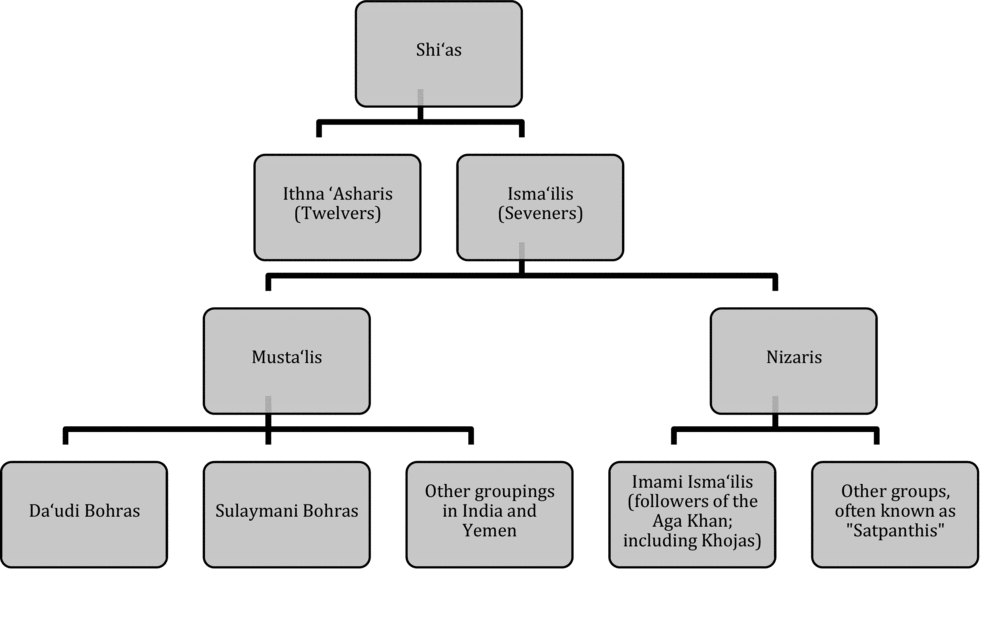
The Bohras are a Shi‘i Isma‘ili group (also called Musta‘lian and Tayyibi) who accept the authority of the first seven Shi‘i imāms (up to Imam Ja‘far al-Sadiq), and then the Isma‘ili imāms in the lineage of Isma‘il b. Ja‘far al-Sadiq up to al-Musta‘li b. al-Mustansir (r. 1094–1101) who they believe went into occultation. In their understanding, the imām in hiding will reappear at the millennium. Until that time the community is subject to the spiritual and temporal authority of the dā‘ī, or summoner.
Shi‘i groupings in South Asia.

The Bohras had begun settling in Gujarat in the twelfth century and from then on had enjoyed a precariously prosperous position. In the fifteenth century, they had been subject to Sunni ‘re-education’ and persecution during the rule of the Gujarat sultan Ahmad Shah and again in the early sixteenth century under Muzaffar II. This had caused a split in the community between those who remained Isma‘ili and others, like Muhammad b. Tahir Patani's family, who became Sunni and came to be known as Sunni Bohras. During Akbar's reign, a property dispute had led one of the dā‘īs, Da'ud b. Qutbshah, to seek the emperor's intervention, leading to a split in the community between the Da'udis, whose headquarters were (and are) in Surat, and the Sulaymanis, whose dā‘ī lived in Yemen. As a result of Akbar's ruling in 1597–98, the Isma‘ili Bohra community was left relatively unmolested for a number of years. When Aurangzeb came to Gujarat in 1645, Sayyidna Qutb al-Din (known as Qutb Khan in the Mughal records) held the office of dā‘ī of the Da'udi Bohras.
As with Mahdavi leaders (Sayyid Muhammad Jaunpuri by the ‘ulama of Gujarat, Shaykh Mustafa Gujarati at the hands of Mirza ‘Aziz Koka, and Sayyid Raju by Aurangzeb), the Bohra dā‘ī was subjected to an interrogation. A Bohra eyewitness, Sayyidi Hasanji Badshah b. Sayyidi Shams Khan, relates that ‘Abd al-Qavi, Aurangzeb's ṣadr and teacher, prepared the case against the Bohras, alleging that the leader of the Bohras was an apostate (rafḍī) and had changed the pillars of Islam (arkān al-Islām).Footnote 39 These were serious charges, calling upon long-standing pejorative notions of Shi‘as, both Twelver and Isma‘ili, as rāfiẓī (literally, rejecters or deserters, rāfiḍī or rafḍī in Arabic). Other Bohra accounts relate further charges, that the Bohras regarded ‘Ali as divine, that they prostrated themselves before the dā‘ī, believed that dues paid to the dā‘ī were equivalent to performing the pilgrimage to Mecca, and finally, that they observed the ‘Id festival earlier than other Muslims. Footnote 40 Venerating ‘Ali as divine was another common imputation against Shi‘as. Disavowing the long-established Mughal and South Asian Sufi tradition of revering ‘Ali as a saintly, heroic and messianic figure, the indictment implied that the Bohras practiced idolatry. The charge that Bohras paid part of their income to their summoner, dā‘ī, rather than undertaking the recommended pilgrimage to Mecca was another serious accusation, one that suggested abrogation of one of the five pillars of Islam. The final, calendrical, offence was one also recorded by the author of the Mirāt-i Aḥmadī. Aware that the Bohras kept their beliefs secret because of persecution, he remarked that their calendar was of ‘Hindu’ derivation. This meant that the Bohras began and ended the month-long fast of Ramadan a day or two earlier than Sunni Muslims and their feast for the end of Ramadan was held while Sunnis were still fasting. During Aurangzeb's reign, he relates, “these people were forced to take food on the last day of Sha‘ban and abstain from it on the closing day of Ramazan”.Footnote 41 The indictment suggested grave infractions by the Bohras, deriving from both millenarian Shi‘ism and from Hinduism.Footnote 42
Following the charge, the dā‘ī Qutb al-Din was imprisoned and his books were impounded to be examined by Sunni scholars while ‘Abd al-Qavi prepared the case for the prosecution. Meanwhile the Bohra community rallied around their leader. A hastily-raised ransom to get him released was angrily rejected by the puritanical prince. In due course, a formal interrogation was held in Aurangzeb's presence. ‘Abd al-Qavi asked the dā‘ī to admit he was a rafḍī and to repent. Qutb al-Din refused to do so and declared he and his followers were true Sunni Muslims. He declared, “My faith is the faith of Islam which Muhammad—blessings and peace upon him—brought. I bear witness to what he called people to bear witness to, that is, that there is no God but Allah, and that Muhammad is the prophet of God. We recite the Qur'an and say prayers to the Merciful, and fast during the month of Ramaḍān, during which the Qur'an was sent down, and we give alms and we go on pilgrimage to the Revered House of God”.Footnote 43 Fearing this argument would convince Aurangzeb, ‘Abd al-Qavi declared that he was certain Qutb al-Din was an apostate and that it was essential to execute him lest he corrupt others. Qutb al-Din replied, “If you kill me with no proof that would necessitate killing me, and without manifesting [my guilt] and with no interrogation and no reason, then you would have killed my body that would eventually be annihilated even if you do not kill it. But you have no power on my soul which is ascending to the Merciful”.Footnote 44
As Qutb al-Din's declarations appeared to sway the judge and Aurangzeb, ‘Abd al-Qavi was obliged to suspend the trial, ordering Qutb al-Din back to prison while he resorted to less scrupulous means. According to Sayyidi Hasanji, ‘Abd al-Qavi forged an affidavit in Qutb al-Din's name, confessing to being an apostate, and induced unwitting courtiers to sign it. The judge, however, insisted on hearing the confession with his own ears. Eventually, ‘Abd al-Qavi promised Qutb al-Din's son and brother that the dā‘ī would be released if they denounced him in court. In the presence of Aurangzeb and the judge, ‘Abd al-Qavi asked the men questions about their faith and doctrine and whether Qutb al-Din believed the same. Although the unnamed judge suspected trickery, he had no option but to issue an order for Qutb al-Din's execution.Footnote 45 Continuing to proclaim that ‘Abd al-Qavi had brought him to his death “without asking me about my affairs, and without a sin that would necessitate it to kill me”, Qutb al-Din was executed on 27 Jumadi II, 1056 (August 9, 1646). Since his death, the dā‘ī Qutb al-Din has been revered as shahīd, or martyr, among the Bohras, while Aurangzeb and ‘Abd al-Qavi are reviled in the strongest terms.
Soon after this event, in September, Shah Jahan recalled Aurangzeb from Gujarat and dispatched him to the border wars in Afghanistan. The prince departed from Gujarat in November. According to Bohra records, he also took with him Pir Khan Shuja‘ al-Din, the son of the executed Bohra dā‘ī, who was released after a while and returned to his community in Ahmedabad.Footnote 46 The new governor, Shaista Khan, lifted restrictions on the Bohras but trouble broke out again under the next governor, Ghairat Khan, who was ruling as the deputy of Aurangzeb's elder brother, Prince Dara. This time the problem was money. Again according to Bohra records, Ghairat Khan attempted to extort from the wealthy Bohra community the large sum of money that had been raised to ransom the late dā‘ī Qutb Khan and that Aurangzeb had rejected. The new dā‘ī refused to pay Ghairat Khan and was promptly imprisoned and sent to Agra for eight months.Footnote 47
While Pir Khan was away in Aurangzeb's entourage, a rival faction arose within the Bohra community. In 1653, they complained to the new governor, this time the youngest prince, Murad, and again secured Pir Khan's imprisonment. It took large bribes, some allegedly paid directly to Murad, to get the dā‘ī released this time. These payments seem to have secured some peace for the Bohras for the next decade or so, but after Aurangzeb became emperor, an order from the eighth year of his accession (1667) stipulated that Bohra mosques should have Sunni-style prayers five times a day and Sunni imāms and muezzins were deputed to Bohra mosques.Footnote 48 Aurangzeb clearly continued to keep an eye on the Isma‘ili Bohras’ practices in Gujarat.
We may suspect the hand of the powerful Sunni Bohra qāẓī ‘Abd al-Wahhab (and perhaps other Gujarati Sunni clerics) in this continued campaign against the Isma‘ili Bohras of Gujarat. But Aurangzeb continued to target the Bohras long after ‘Abd al-Wahhab's death in 1675, in fact until the end of his reign.Footnote 49 In 1682, the governor of Gujarat, Mukhtar Khan, received reports against the Bohra dā‘ī, Sayyid ‘Abd al-Tayyab Zaki al-Din.Footnote 50 The dā‘ī escaped to Jamnagar where he lived for a while until trouble started between him and the exiled ruler which led to the imprisonment of the dā‘ī’s son. Meanwhile, several prominent Bohras of Ahmedabad were arrested and sent to Aurangzeb. This inaugurated, according to Bohra accounts, a new phase of taqiyya or protective dissimulation.
According to the Mirāt-i Aḥmadī, these events took place twenty years later. In 1703, the emperor heard (from the ṣadr of Ahmedabad, Shaykh Akram al-Din, grandson of Qazi ‘Abd al-Wahhab) that two Bohra cloth merchants named ‘Isa and Taj were engaged in spreading “evil” doctrines (bad-maẓhab) in Ahmedabad.Footnote 51 Crucially, they were individuals from whom Prince Muhammad A‘zam had formerly taken a “bond” (muchalkā), possibly financial in nature. They were arrested and sent to the court. Soon after, Aurangzeb received news that Mulla Khanji, the deputy of Qutb al-Din (the dā‘ī executed in 1646) was collecting money to have the imprisoned Bohras released and had sent twelve missionaries (dā‘ī) to instigate their people. He had raised 114,000 rupees and in addition, he possessed about sixty religious books of the Bohra community. Aurangzeb ordered the governor and judge of the province to arrest the men and confiscate the money and “heretical books”, sending them all to the court. In addition he ordered that Bohra children and illiterates be given Sunni religious instruction, the costs of which were to be borne by the Bohra community.Footnote 52
Clues about the persecution of the Isma‘ili Bohras can be discerned in the repeated invocation of money. The Bohras were prosperous merchants and their religious difference made them excellent candidates for extortion. In each subsequent account of Bohra persecution, we hear of large sums raised to pay ransoms or to bribe officials. Clearly, the persecution of the Bohras was only partly ideological. They were an easy and lucrative target, unprotected by any military authority.
Other millennial challenges
The Mahdavis and the Isma‘ili Bohras were by no means the only groups who presented Gujarat-based millenarian challenges to Aurangzeb's preferred order. Gujarat was one of the richest provinces of the empire but was also known as lashkar-khez, a land “bristling with soldiers”.Footnote 53 Millenarian challenge could quickly develop into military challenge. Aurangzeb had seen for himself the influence of the Isma‘ili Bohras and Mahdavis during his governorship. Some years later he would also be struck by the support that his more ‘millennial’ brother, Dara, received from zamindars and religious figures in Gujarat.Footnote 54 Among Dara's supporters were Rao Tamachi (r. 1654–62) of Kachchh, who gave his daughter in marriage to Dara's son, and the Jam of Nawanagar. Both ruling houses, though nominally Rajputs, were linked to Isma‘ili practices and histories.Footnote 55 After Aurangzeb's first coronation in 1658, Dara fled to Gujarat where he raised, with his allies, a substantial army with which to face his brother. Among the accusations against Dara drawn up in the ‘Alamgīr nāma were terms used regularly to characterise Shi‘i and millenarian opponents: bad-maẓhab, ibāḥat (free-thinking) and ilḥād (heresy).Footnote 56
Soon after his accession, Aurangzeb ordered the trial and execution (in 1661–62) of Sarmad, a Jewish-Sufi mystic who had received attention from his brother Dara.Footnote 57 A charismatic naked poet-renunciant with the gift of prophecy, Sarmad had once declared that Dara would become emperor. Once Aurangzeb came to the throne, he had Sarmad tried and questioned by ‘Abd al-Qavi (who had also handled the Ahmedabad trials in 1646). After his trial and conviction, Sarmad was put to death. While Sarmad is popularly believed to have been accused of heresy, Rajeev Kinra makes the persuasive case that Aurangzeb was more annoyed by his prediction of Dara's succession than his heterodoxy. At a time when Aurangzeb's authority was still shaky, a proclamation by a popular renunciant such as Sarmad “constituted a threat to the very legitimacy of Awrangzib's nascent political authority”.Footnote 58 Sarmad's millenarian temerity had to be proved wrong.
In 1672, Aurangzeb put down a massive millenarian uprising by the Satnamis. Although this uprising did not feature explicitly Shi‘i motifs, observers were struck by the fervour of the shaven-headed Satnamis and their fierce resistance to imperial rule. The author of the Ma’āsir-i ‘Alamgiri, one of the official histories of Aurangzeb's reign, described the Satnamis disdainfully as “a rebellious horde of low people like goldsmiths, carpenters, scavengers, tanners, and members of other menial professions, who are naturally weak and foredoomed to slaughter. . .” (Note the similarity with descriptions of Mahdavi adherents—weavers, carders. . . .) These shaven-headed rebels “sprang out of the ground like termites (winged ants) and descended from the sky like locusts. It was said that these wicked people considered themselves immortal, and believed that if one of them was slain, seventy others would spring up in his place”.Footnote 59 A closely fought battle followed; Aurangzeb's generals faced serious resistance, and many casualties, before the rebellion was suppressed. According to Khafi Khan, Aurangzeb had to channel his own sacred authority to suppress these millenarian protestors: “He then wrote some prayers and devices with his own hands, which he ordered to be sewn on the banners and standards, and carried against the rebels”.Footnote 60
A less violent but no less millenarian movement was that of the Pranamis in Gujarat and central India. Led by the charismatic preacher Prannath (1618-94), the Pranamis developed a complex theology in which Prannath himself was regarded as an avatār or as the manifestation of the promised Mahdi.Footnote 61 Prannath's hagiography describes how he tried in the 1670s to find a niche at the Mughal court in the manner of Mahdavis, Jains and other groups in the past. When he was barred from an audience with the emperor, he and his merchant followers began to strategise a way for Prannath to reach the emperor, characterised as “amal saitān” or agent of Satan, to enlighten him about true Islam.Footnote 62 In 1679, the year when Aurangzeb imposed jizya (tax on non-Muslims), Prannath preached about “nabī aur nārāyaṇ”—the prophet and God (usually Vishnu)—at one of the gates of Delhi.Footnote 63
Prannath and his followers, displaying a close familiarity with the structures of power in Delhi, then wrote to five of Aurangzeb's courtiers to try to get an audience with the emperor. The first three are easily identifiable as senior clerics of the empire: Kazi Shaykh Islam (qāẓī al-quẓāt Shaykh al-Islam and son of Shaykh ‘Abd al-Wahhab), Razavi Khan (Raẓavī Khān, the ṣadr al-ṣudūr and son of Sayyid Jalal Bukhari of Ahmedabad), Shaykh Nizam (the compiler of Aurangzeb's monumental compendium of Hanafi law, the Fatāwā-i ‘Alamgīrī). The others, Amir Aqil KhanFootnote 64 and Kotwal Sidi Faulad,Footnote 65 are equally easily identified as senior Delhi officials. None responded to the letters. Next we hear that one of Prannath's followers—an attendant of Aurangzeb—pasted the group's manifesto where the emperor could not miss it. In a nice illustration of Aurangzeb's standard legalistic technique, the hagiography tells us that after the emperor rebuked and demoted the attendant, he had the group arrested and questioned by the kotwāl, Sidi Faulad, and the chief qāẓī, Shaykh al-Islam. He directed, “Tum unkī bātāṃ suniyo, pūch dekho buniyād” (Listen to what they say, ask about their beliefs). Shaykh al-Islam advised the emperor not to meet Prannath and his associates in private. Denied an audience with the emperor, they were granted a hundred rupees and told to leave.Footnote 66 That was when Prannath and his companions realised that because the emperor was none other than dajjāl (a ruler whose tyranny signals the end of time), all efforts to meet him would inevitably come to naught. Soon after, Prannath formed a successful alliance with Chhatrasal Bundela, the ‘rebellious’ ruler of Bundelkhand, who had posed a serious challenge to Mughal authority since 1671, and after 1681, ruled Bundelkhand virtually independently.
In Prannath's hagiography we may discern several motifs common in accounts of Aurangzeb's rule. A millenarian leader finds no way of hitching his wagon to the hierarchy of Mughal discipleship. He is cross-questioned and turned away, lucky to escape with his life, by the clerics and officials who surround the emperor. Thus thwarted, he realises that the emperor is not in fact the Lord of the Conjunction, the Mahdi, or a great Sufi master, but is the ultimate tyrant who must be overthrown. Prannath's anathematisation of Aurangzeb is a perfect example of how the new order had no room to assimilate openly millenarian impulses. The only option was confrontation.
In 1685, Aurangzeb was faced with another major millenarian challenge from Gujarat, the Matiya rebellion of Nizari Isma‘ili peasants and agriculturists whose appearance and customs corresponded to those of their neighbouring Hindus.Footnote 67 The governor of Gujarat, Shuja‘at Khan, had heard that disciples of the Matiya leader honoured him by paying a tithe and showering coins on his outstretched feet. He ordered Sayyid Shahji, a member of the Satpanthi Isma‘ili lineage of Pirana, to present himself to be interrogated in Ahmedabad. When the Sayyid refused, he was arrested and brought to the capital where he mysteriously died. The Matiyas, incensed by the arrest and death of their leader, marched on the Mughal fort of Bharuch, killed its commander, and captured it for several days, succeeding in disrupting the lucrative traffic between north India and Surat.Footnote 68 Although Aurangzeb's forces soon put down the uprising and massacred the Matiya rebels, these events were another reminder of Aurangzeb's inability to assimilate or head off millenarian revolt. Once again, the regime's attempt to investigate, interrogate, and correct religious ‘heterodoxy’ provoked violence and contributed to the emperor's growing reputation for legalistic intolerance.
Along with explicitly millenarian groups, Shi‘i individuals could face censure or be stigmatised for political opposition or disobedience. In 1672, an old courtier named Muhammad Tahir, was put to death, accused of “cursing the three caliphs”, a common euphemism for Shi‘i practice. “According to the canonical law and the insistence of the chief of the Ulemā, Mullā ‘Auz Wajih, he was beheaded on the 3rd November, 22nd Rajab”.Footnote 69 Another anathematised Shi‘a was Abu'l Hasan, the last Qutb Shahi ruler of Golkonda (r. 1672–87) who put up a long resistance to the Mughal forces before being captured in 1687.
[He] was stupid and sunk in sinful lust; misled by his evil fortune, he shut his eyes to the sins punishable in the next world, and made vagabond Hindus the managers and administrators of the affairs of his State, and gave currency to the rites of that accursed race. And, those travellers in the wrong path of futile wandering and ignorance, those carrion-eating demons (ghul) of the wilderness, (namely) the Persians (i.e., Shias) with the support of that worthless sect (the Hindus) began to practice there publicly all kinds of shameful sins. No respect was left for Islam and its adherents; mosques were without splendour, while idol-temples flourished; the requisites of canonical practice remained closed under bolts, while the gates of irreligious practices (bid‘at) were flung open. . .Footnote 70
While Azfar Moin is right to point us to the long and difficult relationship of the Mughals and Safavids as part of the context for Sunni-Shi‘a confrontations in Mughal India, in Aurangzeb's time we also need to pay attention to the foreclosing of Shi‘i and ‘Alid strands in the imperial vocabulary and the increased ‘othering’ of groups and individuals with such loyalties.
Shaykh ‘Abd al-Wahhāb and the Sunni Bohra faction
As we have seen, ‘Abd al-Wahhab, a qāẓī and member of an old family of the ancient city of Patan in north Gujarat, had met Aurangzeb when the prince was governor either of Gujarat (1645-46) or of the Deccan (1652-59).Footnote 71 The prince and the jurist found kindred souls in each other. While in the Deccan, ‘Abd al-Wahhab joined the prince's retinue with the title of mufti (legal expert) of the army and soon became one of Aurangzeb's closest and most powerful advisers.
In 1659, Aurangzeb's elder brother and crown prince, Dara, was executed and Aurangzeb made a bid to be declared emperor even though their father Shah Jahan, imprisoned in Agra fort, was still alive. In keeping with Mughal convention, the empire's most senior jurist was commanded to read the Friday sermon, the khuṭba, in the name of the new emperor. When the judge refused, on the grounds that it was illegal to proclaim the son when the father was living, Shaykh ‘Abd al-Wahhab stepped forward. He disputed with the qāẓī, arguing that Shah Jahan's enfeebled state allowed for the khuṭba to be read in his son Aurangzeb's name.
The Shaikh declared after refutation of theological problems, rational arguments and narrative proofs that His Majesty (Shah Jahan) has become very weak. He has lost his consciousness. He has lost control over administrative machinery of the empire such as organization of affairs, welfare and comforts of people who are the wonderful deposits of the Almighty Creator. Recitation of the Khutbah, under these circumstances, in the name of the son who is worthy of Saltanat and Khilafat is permissible and allowable in the holy religion. He quoted many reliable traditions in this respect before the Chief Qazi, other ‘Ulama and scholars. He convinced all of them.Footnote 72
Aurangzeb gave ‘Abd al-Wahhab permission to read the prayers and rewarded him by appointing him the supreme judge of the empire, qāẓī al-quẓāt, a position he held until his death in 1675. In return, ‘Abd al-Wahhab became one of the new emperor's closest aides, helping to carry out his wishes. He was a ‘stickler for religion’ and believed himself to be carrying out the emperor's wishes by stamping out ‘heresy’ (bid‘at, rafḍ/rafẓ)—terms which often meant the kind of millenarian or Shi‘i influenced movements Aurangzeb opposed from the start of his career—on the principle that the maintenance of the far-flung empire depended on the strict application of laws against heresy.Footnote 73
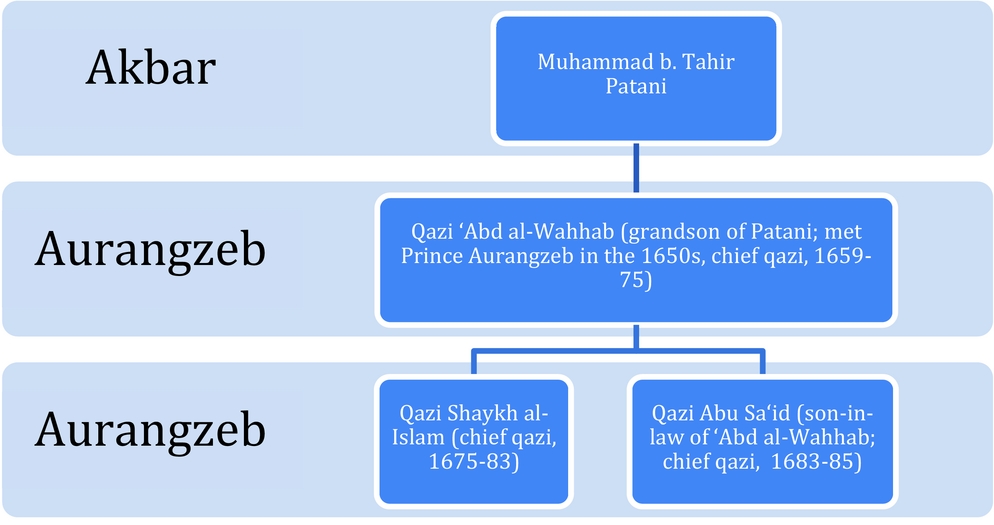
‘Abd al-Wahhab's animosity towards Shi‘as and those of similar millenarian tendencies arose from his own family history. He belonged to the Sunni Bohra community of Patan, a community that rose in wealth and influence in Aurangzeb's time. The Sunni Bohras had split in the fifteenth century from the Shi‘i Isma‘ili Bohras, resident in Gujarat since the twelfth century.Footnote 74 Their divergence had become increasingly rancorous in the sixteenth century, helped along by the efforts of ‘Abd al-Wahhab's grandfather, the aforementioned Muhammad b. Tahir Patani (d. 1578), who had dedicated his life to opposing Mahdavis and ‘re-educating’ Isma‘ili Bohras to accept Sunni ways. “They say he had made a vow that until the blackness of Shīism and other heresies had been cleansed from the hearts of his tribe he would not bind his turban on his head”.Footnote 75 He was encouraged in his efforts when Akbar, during his campaign in Gujarat in 1572–73, personally tied a turban on his head and pledged to assist him in his efforts. Later, Muhammad b. Tahir took off his turban, disappointed that Akbar's government advanced some Shi‘as and had even included them in the administration of Gujarat.Footnote 76 He set off towards Agra to appeal to Akbar again but was killed while travelling between Sarangpur and Burhanpur in 1578.Footnote 77
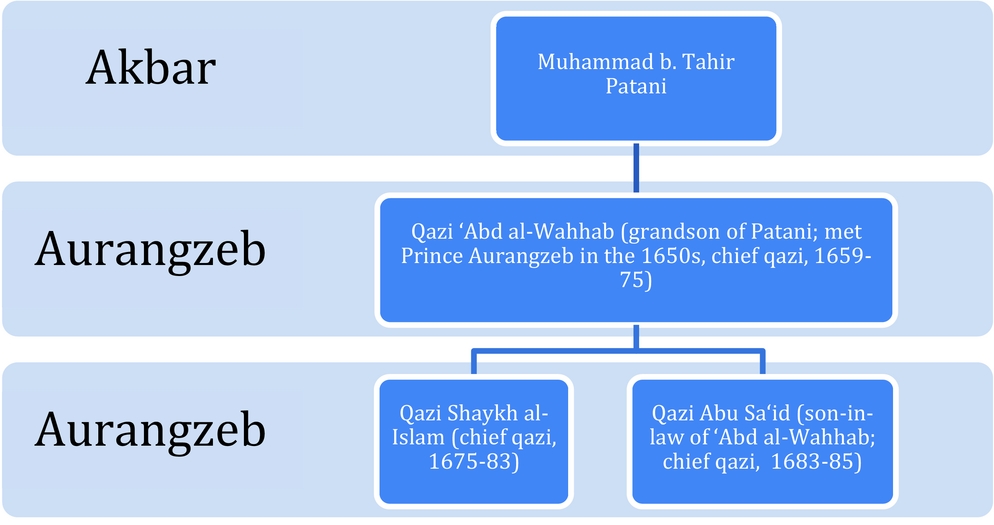
The Sunni Bohra family of Qazi ‘Abd al-Wahhab.
In spite of ‘Abd al-Wahhab's reputation as a powerful censorious qāẓī, there were rumours that belied his façade. Manucci wrote in 1699, “It was so common to drink spirits when Aurangzeb ascended the throne, that one day he said in a passion that in all Hindustan no more than two men could be found who did not drink, namely, himself and ‘Abd-al-Wahhab, the chief qāẓī appointed by him. . . . But with respect to ‘Abd-al-Wahhab he was in error, for I myself sent him every day a bottle of spirits (vino), which he drank in secret, so that the king could not find it out”.Footnote 78 While we might discount Manucci as a notoriously unreliable source of information, we also hear from the Ma’āsir al-umara that for all his piety, the qāẓī was not above pecuniary concerns: “. . . they say that the Qāẓī had a long arm for hauling and snatching, and collected large sums of money”.Footnote 79 When he died he left a large inheritance to his sons, “a lac of ashrafīs and five lacs of rupees, besides jewels, etc”, some of which, Shah Nawaz Khan suggests, he had acquired through bribes and by charging commissions for tasks like marriage and dowry certificates.Footnote 80
‘Abd al-Wahhab's large fortune may also have had to do with his commercial interests. He founded a neighbourhood in Ahmedabad known as Wahhab Ganj, ordering that “different kinds of aromatic roots and drugs—imports from Surat—should be sold here free of excise duty, so as to increase the population and prosperity of the suburb”.Footnote 81 It is likely that Wahhab Ganj and the neighbouring Cloth Market, run by ‘Abd al-Wahhab's son-in-law Muhammad Jamal, generated a nice income for the qāẓī’s family. It may not be coincidence, in light of the business interests of some of his closest associates, that in 1665 Aurangzeb had customs duty on Muslims fixed at 2 ½ per cent and on non-Muslims at 5 per cent. In 1667, customs duty on Muslims was abolished altogether. Those with a religious motive in promoting Muslim business also had a commercial motive that would give them an edge over rival Jains and Hindus in Gujarat's wealthy and fiercely competitive markets.
After ‘Abd al-Wahhab died in 1675, Aurangzeb quickly appointed his son Shaykh al-Islam to succeed him as qāẓī al-quẓāt, a post the latter accepted only with reluctance.Footnote 82 Shaykh al-Islam, by all accounts, was a principled man, not one to accept bribes or commissions. It was during his tenure, in 1679, that Aurangzeb imposed the jizya tax on non-Muslims. Some years later, Shaykh al-Islam fell out with his master for refusing to sanction as jihād the emperor's campaign against the Shi‘i sultanates of the Deccan in 1683.Footnote 83 Although he was relieved of his duties and sent off to Mecca, Aurangzeb retained a respect for this independent-minded cleric, even offering him a job on his return from the pilgrimage. He was succeeded as qāẓī of the imperial camp by ‘Abd al-Wahhab's son-in-law, Abu Sa‘id, who remained in his post for less than two years and was replaced in 1685.
Although members of ‘Abd al-Wahhab's family remained close to Aurangzeb throughout the emperor's long and eventful career, their influence was not universally accepted. In 1682, one of his sons, Shaykh Muhyi al-Din, who held several portfolios in Ahmedabad including those of judge, amīn or senior tax collector, collector of jizya, and price-recorder, was accused of taking bribes and fixing the price of corn. Popular unrest broke out against him, an incident that may have contributed to the dismissal of his brother, Shaykh al-Islam, in 1683.Footnote 84 In spite of the allegations, the family remained loyal information-gatherers for the emperor. In 1703, Muhyi al-Din's son, Shaykh Akram al-Din was the powerful ṣadr of Ahmedabad who informed on the activities of the Bohra merchants ‘Isa and Taj to Aurangzeb.
‘Abd al-Wahhab and his sons were not the only Sunni clerics with Aurangzeb's ear. There were several others. One prominent Gujarati family was that of the Bukhari Sufis of Ahmedabad, descendants of the fifteenth century Shah-i ‘Alam and Qutb-i ‘Alam Bukhari. Sayyid Jalal Bukhari was Shah Jahan's chief ṣadr when Aurangzeb was governor of Gujarat in 1645–47.Footnote 85 His son, Sayyid ‘Ali, titled Raẓawī Khan, became ṣadr al-ṣudūr during Aurangzeb's reign, from 1669 to his death in 1680.Footnote 86 When ‘Abd al-Wahhab's son-in-law Qazi Abu Sa‘id was relieved of the post of qāẓī in 1685, he was replaced by another Gujarati ‘alim, this time the former qāẓī of Ahmedabad, Khwaja ‘Abd Allah, who remained in post until 1698.Footnote 87 Between Aurangzeb's accession to power in 1659, and his death in 1707 was a period of 48 years. Qazi ‘Abd al-Wahhab was at his side even before he came to power. After ‘Abd al-Wahhab's death, Gujarati ‘alims held the post of chief qāẓī for another twelve years. It is no wonder that Aurangzeb was so well-informed about goings on in Gujarat and no wonder that his administration found every opportunity to monitor the activities of millenarian groups.

Further, the persecution of the Isma‘ili Bohras during Aurangzeb's time coincided with the rise to prosperity of Sunni Bohra merchants, including one of the richest men of the time, the celebrated Mulla ‘Abd al-Ghafur (d. 1718). The latter was the head of the Bohra merchants from Patan, a man who rose very quickly to wealth and influence after coming to Surat in the 1660s or 1670s. Although he generallyFootnote 88 stayed out of politics, he once tried to cobble together a jihadi coalition against the Portuguese, ultimately unsuccessful, and at his death he left seventeen ships and eight million rupees. He was not the only Sunni Bohra merchant prominent in Surat's commercial life; others included ship owners and merchants such as Kasim Bhai, Haji Kadir and Haji Kasim.Footnote 89 I have not found a direct connection between ‘Abd al-Wahhab's family and the Sunni Bohra merchants of Surat, but it would seem possible that the latter benefited from the exalted connections of the qāẓīs.
While the anti-Shi‘a, anti-millenarian outlook of the Gujarati clerics clearly derived from their personal and historical circumstances, it is equally clear that ‘bigotry’ could be profitable. Imperial officials in Aurangzeb's Gujarat singled out non-conformist groups who showed signs of wealth and influence. For officials, carrying out the emperor's orders might as well be profitable (and as we have seen, ‘Abd al-Wahhab's family profited from imperial policy and their exalted status). The Isma‘ili Bohras were an easy target who repeatedly faced demands for money. The Matiyas came to imperial notice when they became visibly prosperous and disputes arose about property. Even the Mahdavis originally came to Prince Aurangzeb's notice in 1646 in a dispute about service and horse ownership, but later they ceased to be a threat either politically or economically. Money talked in Aurangzeb's Gujarat. Even if Aurangzeb's desire was to create a lofty system of Qur'anic justice for all his subjects, the mercenary transactions and petty score-settling carried out by his closest underlings undermined his efforts and caused him to be reviled by the targets of his reforms.
Aurangzeb's Hanafi legalism
Aurangzeb's attempts to control and face down millenarian and Shi‘i orientations among his subjects persisted throughout his career, from his early days as governor of Gujarat to the very end of his life. More work needs to be done on comparing the specifics of the trials from official and community accounts, but it would seem that the emperor's method of dealing with Shi‘i-style messianic and millenarian groups was standard.Footnote 90 The leader would be arrested or summoned for questioning. The trial, featuring questions about practice as well as doctrine, was generally conducted by a senior judge. (Before his murder in 1667, this was generally Aurangzeb's trusted teacher and jurist, ‘Abd al-Qavi.) If found guilty, the leader was punished. In some cases, as with the Bohra dā‘ī and Sayyid Shahji, the leader's son or senior disciples were made to join the imperial entourage, thus learning the ways of the court and becoming acculturated to Mughal ways. Meanwhile, ordinary followers were subjected to various forms of persuasion, from ‘re-education’ according to Sunni norms, to fines and even the threat of death.
The actual trial procedure did not differ much from the guidelines to judges set out in the Āīn-i Akbarī: “He shall begin with asking the circumstances of the case and then try it in all its parts. He must examine each witness separately upon the same point and write down their respective evidence. Since these objects can only be effectually obtained by deliberateness, intelligence and deep reflection, they will sometimes require that the cause should be tried again from the beginning and from the similarity or disagreement, he may be enabled to arrive at the truth”.Footnote 91 Compared to his predecessors, Aurangzeb paid more attention to judicial matters, was more diligent in attending court, and systematised judicial procedures. Aware of the potential for corruption, he introduced penalties for corrupting judges,Footnote 92 and charged newly appointed judges to be honest and to reject gifts and invitations from the populace they served.Footnote 93
These trials of millenarian and Shi‘i leaders were part of Aurangzeb's larger effort to establish a more standardised form of Hanafi law in his realms and to strengthen the religious judiciary at both the central and provincial levels. His elevation of clergy over senior courtiers, as with ‘Abd al-Wahhab, was one instance of his method. But Aurangzeb was not content with appointing powerful judges and scholars to high office. Between 1667 and 1675 he commissioned a massive compendium of Hanafi rulings that came to be known under his name as the Fatāwā-i ‘Alamgīrī, a volume intended to be used as a ready reference of Hanafi law for judges throughout the Mughal empire. The compilation of the volume was directed by a senior scholar, Shaykh Nizam, who oversaw forty or more scholars over a period of several years, and who answered directly to the emperor.Footnote 94 While most of the contents of the Fatāwā were copies of authoritative judgments by Hanafi scholars of the past, significant portions were based on the writings of Indian scholars. Some sections—especially those on conversion, apostasy and personal law—were based on current practice in the Mughal empire.Footnote 95 According to Mouez Khalfaoui, the purpose of the volume was to ward off Persianate customs, standardise and make available legal convention, and correlate current practice with the legal rulings of the Hanafi school of law.
While the intended systems treated subjects unequally and privileged observant Sunni Muslims, what is more significant is that they were systems. Once they accepted their station and duties in the new dispensation, subjects could expect to be treated according to predetermined Shari‘a-derived laws.Footnote 96 Regularised religious trials, the development of a judicial bureaucracy with considerable power and autonomy, and a standardised book of law—one with local precedents when it came to matters of religious belonging and apostasy—surely suggest a political system that was beginning to rely less on the emperor as the absolute fount of justice. The judicial system was becoming, at least in theory, increasingly distinct from the person of the emperor. While Aurangzeb continued to keep a close hold on the implementation of justice, especially in sensitive cases of millenarian challenge, judges were increasingly being empowered to act based on their training and judicial precedents as laid out in the Fatāwā.
Nevertheless, and regardless of Aurangzeb's intentions, his cadre of judges and close courtiers were inadequate for the task of overhauling and systematising the judicial administration of the empire. In practice, the emperor and his courtiers were all too human, even venal, and their application of law was always subject to local rivalries and politics. As we have seen, clerics from Gujarat held immense power over the religious administration of the empire for forty years without a break, helping shape the emperor's systematisation of governance. But the circumstances in which these clerics tested their authority arose out of contingent local rivalries. Law and ideology often turned out to be ways to settle local scores or to ensure the enrichment of a particular family or community. Aurangzeb's apparent bigotry and legalism were not borne out of a transcendent or predetermined Islamism but were intimately tied to his experiences in Gujarat. In turn, his experiences in Gujarat likely set the tone for his approach to the rest of his empire.
Final thoughts
Two final questions. Firstly, was it coincidence that Gujarati clerics rose to such levels in Aurangzeb's regime? I suspect that it was no accident. Gujarat offered particularly fertile ground for religious cosmopolitanism. Since the fifteenth century, and even earlier, Gujarat's trade prosperity had drawn religious entrepreneurs, many of whom established orders and lineages. A significant number of such religious orders owed allegiance to millenarian Shi‘i or ‘Alid practice in one way or another. Since the reign of the sultan Mahmud Begada (1458-1509), one key role of the state had been to assimilate and stabilise this proliferation of religious difference.Footnote 97 Aurangzeb's administration was attempting similar stabilisation, albeit with a different vocabulary of religion and politics from those that had gone before. Where the sultans had encouraged a diverse set of religious entrepreneurs, often with land grants, and where Akbar had harnessed Mahdavi millenarianism and protected Isma‘ili Bohra practices, Aurangzeb's strategy—through his clerics—was to exact uniformity in religious practice. What transpired in Gujarat cast long shadows over the rest of the kingdom. Aurangzeb's experience with Gujarat and the solutions he pursued in the region to exert control over unruly and intractable populations suggests it was a source or test case for his decisions in handling other parts of the empire.
Secondly, how are we to assess the impact of Aurangzeb's legal and political experiments? As we have seen, Aurangzeb's ‘Islamism’ was born out of a combination of factors. To recapitulate only a few of those that have come up here, there is first his early encounters with millennial groups in Gujarat, perhaps compounded by his subsequent service against ‘turbulent’ groups in Afghanistan, Sindh and the Deccan. Second, there is his deep and bloody rivalry with his millennially-oriented elder brother Dara Shukoh. And finally there is his patronage of an anti-millennialist Gujarati faction of clerics who were embroiled in political and economic rivalries with Shi‘as, Isma‘ilis, Jains and Hindus. In each of these encounters, Aurangzeb drew on the resources of legalistic Sunni Islam. Although distracted by almost constant military conflict, he grew increasingly more ambitious in his recourse to Islamic law over Mughal precedent, especially with the commissioning of the monumental Fatāwā-i ‘Alamgīrī as a resource-book for judicial practice in the empire. In many ways Aurangzeb's efforts failed: his descendants repudiated much of his Islamism, Shi‘i and millenarian groups continued to flourish in the eighteenth century, and the empire shrank dramatically in the decades after his death.Footnote 98 Nevertheless, his legacy had a longer-term impact. The Fatāwā-i ‘Alamgīrī became influential throughout the Hanafi Sunni world, formed a significant component of Anglo-Muhammadan law, and filtered into Muslim law codes in both India and Pakistan. As Mughal sacred kingship crumbled, Sunni legalistic resistance to messianism continued to grow.Footnote 99 It is now time to acknowledge that even if Aurangzeb's attempts to revise Mughal sacred kingship by building Islamic systems and institutions had only a partial and temporary effect at the time, they prefigured key modern movements of political Islam and went on to have a foundational effect on South Asian modernity.