


Few issues in American politics have received as much attention and scrutiny as the existence of, and the basis for, the incumbency advantage in congressional elections. To some, the incumbency advantage is indicative of an electorate that is, by and large, content with the performance of its elected representatives. To others, however, the incumbency advantage raises serious concerns about democratic accountability. Indeed, pundits and academics alike question whether the potential advantages that accrue to sitting legislators make it impractical for challengers to mount effective campaigns, and in turn for voters to hold Congress accountable. How can we expect legislators to be responsive to their constituents, so the argument goes, if incumbents have little reason to fear defeat?
Indeed, numerous political observers trace many of the perceived ills of modern American politics—from partisan polarization to uncompetitive elections to rampant pork-barrel spending—to the electoral advantages created for, and by, incumbent legislators. Thus, it is with good reason that political scientists have labored hard to measure and understand the electoral rewards of incumbency. Beginning with the work of scholars who first recognized the bulging margins by which House incumbents were winning reelection in the mid-1960s (see, e.g., Erikson 1971; Mayhew 1974) and continuing with more recent attempts to pinpoint the exact source and extent of that ongoing advantage (see, e.g., Ansolabehere, Snyder, and Stewart 2000; Cox and Katz 1996, 2002; Gelman and King 1990), political scientists have generated a large and sophisticated literature on the causes and consequences of the incumbency advantage.
Nevertheless, important unanswered questions remain. Do incumbent politicians use the resources and perks of office to generate an electoral advantage (Fiorina 1989)? Are incumbents simply better politicians, expert at the art of electioneering (Jacobson and Kernell 1981; Zaller 1998)? Or is it some mixture of both? The weights attached to each of these explanations have direct implications for assessing the nature of representation and electoral accountability in the United States.
In an attempt to shed new light on this central debate in American politics, we turn to a different historical era. Specifically, we examine elections to the U.S. House of Representatives between 1870 and 1900. Why focus on this particular era? Beyond knowing little about whether or not an incumbency advantage existed during the late nineteenth century, we argue that turning to history provides analytical leverage to test and expand contemporary theories of electoral politics in a very different institutional context. Most traditional explanations of the incumbency advantage would suggest a weak or null effect during this era. House members did not have personal staffs (except for committee chairs), offices in the district, nor, in most cases, easy travel back home. Representatives often found it difficult to devote their career to service in the House, as the salary and benefits did not keep up with the cost of living far away from home in Washington DC (Alston et al. 2006). Moreover, congressional elections in many regions of the country were highly competitive and turnover was high (Brady 1988; Kernell 2003). Perhaps most importantly, local party organizations heavily regulated the nomination process. To be on the congressional ballot, a candidate typically had to have the blessing of local party officials.
These differences allow us to more fully assess the extent and sources of advantages accruing to incumbents. If we find evidence of an incumbency advantage in an era when resources of office were, at best, modest, then we can be more confident that congressional resources are not the driving force behind the modern incumbency advantage. Likewise, if we find that the quality of candidates was important in this era of strong parties, it would suggest that the growth in the importance of candidate quality cannot be the only force driving the success of modern-day incumbents (see, e.g., Cox and Katz 1996, 2002). Assessing the incumbency advantage in this era allows us to draw causal conclusions that simply cannot be made by looking only at contemporary data.
Our analysis draws on 30 years worth of candidate-specific data in U.S. House races, offering a unique opportunity to evaluate the role of candidate quality and the incumbency advantage across different historical eras. We begin by summarizing the debate over the incumbency advantage in congressional elections, then turn to an analysis of congressional candidates during the partisan era of the mid-to-late nineteenth century. Contrary to the conventional view of elections during this era, we find that the presence of quality candidates on the ballot enhanced the overall attractiveness of the party ticket, boosting the party's vote shares at the polls. We also find strong evidence that competitiveness was increased by party control over the entry and exit decisions of prospective candidates. The ability of parties to coordinate candidacies, through their cartel-like control over access to the ballot, rendered incumbents far less safe than under the modern system of voluntary candidate entry decisions.
THE INCUMBENCY ADVANTAGE IN CONGRESS
Building on early work that first recognized the rising vote margins by which incumbents were getting reelected (see, e.g., Erikson 1971; Mayhew 1974), several distinct explanations have been offered to account for the incumbency advantage. One prominent school of thought emphasizes the resources and perks incumbents have access to, and that challengers do not. These include, among others, opportunities to perform casework (Fiorina 1977), franking privileges (Cover and Brumberg 1982), and disproportionate access to campaign donors (Abramowitz 1991). Another school of thought stresses electoral factors such as weakened party identification among voters and incumbent-friendly gerrymandering (Erikson 1972).
More recently, Cox and Katz (1996, 2002) have presented a novel argument for the abrupt increase in the size of the incumbency advantage in the mid-1960s. Using a modified version of a technique developed by Gelman and King (1990), they decompose the incumbency advantage into three distinct components: a direct effect (e.g., constituency service), candidate quality (e.g., campaigning skill), and a scare-off effect (e.g., the ability to deter other quality opponents from running). Estimating this model from 1946 to 1990, Cox and Katz (1996) find that the increase in the incumbency advantage was largely driven by increased disparity in the quality of candidates who ran for Congress (i.e., incumbent legislators became better campaigners relative to their challengers).
Building on these findings, Cox and Katz (2002) argue that the court-led reapportionment revolution of the 1960s helped drive this increasing importance of candidate quality. First, the court decisions regularized the redistricting process, ensuring that states redrew district boundaries every 10 years. This regularization of the redistricting cycle provided a focal point for incumbents and experienced challengers to coordinate their respective entry decisions (i.e., avoid each other). As a result, after 1964, incumbents and challengers with previous electoral experience faced off at a considerably lower rate than in the immediate post-World War II era. Thus, when incumbents ran after 1964 they tended to face weak or inexperienced challengers, consequently boosting incumbent victory margins. Cox and Katz (2002: 153) maintain that this greater degree of electoral coordination between incumbents and challengers is a primary cause of much of the increase in the incumbent vote margins.
Second, the radical redrawing of district boundaries throughout the nation, to comport with the court's “one-person, one-vote” doctrine, tore asunder the geographic foundations of many previously stable local party organizations. Congressional districts, prior to 1964, were often made up of one or more whole counties, providing a natural congruence between districts and local party organizations. With the new district lines often dividing counties, local party organizations became less involved in recruiting congressional candidates and running their campaigns. As a result, the vote getting power of experienced candidates began to outstrip that of amateurs by an increasing margin. Incumbents reacted to this by seeking reelection at a higher rate against nonquality challengers and retiring at a greater rate when facing a high-quality candidate. Thus, we agree with Cox and Katz (2002, 199) that:
[T]he wave of 1960s redistricting actions led to more isolated decisions on entry. What we mean by this is that the local parties could less often entice a reasonably good candidate to run against long odds, with the promise of payment elsewhere … In an increasingly candidate-centered world, more entry decisions were made strictly on the merits of the opportunity at hand and the opportunity costs it would entail for the individual candidate. Thus, the odds of winning the congressional race played a larger role—and voluntary exits by incumbents were more often bad tidings for their party.
This explanation suggests that an electoral system with cartel-like control of ballot access—such as that held by nineteenth-century political parties—may produce competition in races that the modern market system of entry does not otherwise sustain. Without local party organizations to compel reluctant candidates to run in risky races, quality challengers are now much less likely to enter into potentially difficult-to-win contests. This argument suggests that looking at an era of stronger party control over candidate recruitment and nomination may provide important insights into the development of the modern incumbency advantage.
Yet, with limited exceptions, research on incumbency and candidate quality has not ventured back in time and examined how stricter party control of nominations and candidate recruitment affected the dynamics of electoral coordination, and in turn the electoral impact of incumbency. The few major studies of incumbency that have turned to the nineteenth century present conflicting findings, leaving the issue unresolved. For instance, Garand and Gross (1984) argued for a modest incumbency advantage beginning in the early 1890s, and peaking in the 1920s. Yet, in a follow-up study, Alford and Brady (1989) contend that this conclusion is based on faulty measurement. Examining two traditional indicators of incumbency advantage—sophomore surge and retirement slump—Alford and Brady instead find little evidence of an advantage in this time period.
By contrast, in a recent study, Ansolabehere, Snyder, and Stewart (2000) uncover “tantalizing evidence of an incumbency advantage during the third party system, pre-1896 …” (27). They do this by comparing how well an incumbent does in territory they have represented before with territory new to their district brought on by redistricting. The difference in vote share between these two geographic categories, all else equal, serves as a measure of the incumbent's personal vote (2000, 18). Examining the period from 1872 to 1990, they find that a large part of the growth in the overall incumbency advantage stems from increases in legislator's personal vote. Notably, they also find a significant, but modest, personal vote for incumbents in the late nineteenth century.
Thus, the studies by Cox and Katz (1996, 2002) and Ansolabehere, Snyder, and Stewart (2000), despite being arguably the most comprehensive and precise in the voluminous literature on the incumbency advantage, still leave open important questions. Much of the Cox and Katz argument is based on the premise that the incumbency advantage is primarily a post-1964 phenomenon. But, based on the “tantalizing evidence of an incumbency advantage” that Ansolabehere, Snyder, and Stewart (2000, 27) identified prior to 1900, a reexamination of elections during this era may be warranted. Moreover, given the emphasis placed on candidate quality by Cox and Katz, it would be highly instructive to examine the importance of candidate experience in the nineteenth century. Indeed, Ansolabehere, Snyder, and Stewart acknowledge this consideration but because of data limitations—which they readily admit—were not able to directly estimate the effects of candidate quality.1
In their analysis, candidate quality is controlled for by the inclusion of a fixed-effect for each congressional race.
After compiling detailed data on the backgrounds of congressional candidates from 1870 to 1900, we now have the necessary information to combine the best attributes of both the Cox and Katz (1996, 2002) and Ansolabehere, Snyder, and Stewart (2002) studies. With data on thousands of candidates, we can present more precise estimates of both candidate quality and the incumbency advantage in the late nineteenth century. These data allow us to assess whether candidate quality exerted an effect on election outcomes even in a party-centered electoral system. To provide the necessary context for our data and findings, we first examine the role of congressional candidates during the partisan era of American politics.
CONGRESSIONAL CANDIDATES IN A PARTISAN ERA
The formal rules and structures governing American politics have remained essentially constant since the founding. Yet, the conduct of congressional elections has changed dramatically since the nineteenth-century. Modern House elections exhibit little turnover and a dearth of competitive races (Jacobson 2004). By contrast, nineteenth-century elections were ‘characterized by high levels of partisanship and electoral competitiveness, and slight shifts in voting or turnout could turn whole elections’ (Argersinger 1985–1986, 671). The U.S. House of Representatives directly reflected the volatility of the electorate. Individual turnover of legislators was substantial (Polsby 1968) and control of the chamber frequently alternated between the two major parties (Engstrom and Kernell 2005). Some of this fluctuation was driven by the nature of political careerism as election to the House was often viewed as a temporary stop in an ongoing political career. But even those politicians who aspired to a long stint in the House often found the electoral road tough-going. Although the period from 1870 to 1900 was one of emerging careerism, incumbents found that rotation in office (Kernell 1977), competitive elections (Brady and Grofman 1991), and frequent partisan redistricting (Engstrom and Kernell 2005) all served as barriers to long congressional careers.
Candidate recruitment practices in the late nineteenth century were starkly different as well. Prior to the widespread adoption of the direct primary in the early 1900s, House candidates were nominated almost exclusively by party caucuses (Dallinger 1897; Ostrogorski 1964). These caucuses were typically dominated by coalitions of local party organizations—themselves often comprised of smaller factions—who sought to recruit candidates that were loyal to the party and able to mobilize other partisans (Bensel 2004; Swenson 1982). This resulted in legislators who were largely agents of local and state party organizations.
The institutional structure of voting also made it easier for parties to exert control over the electoral process. This was especially true prior to the adoption of the Australian or “secret” ballot by the states starting in the 1890s. Each party prepared and distributed its own ballot, listing only candidates of their party, from presidential electors down to local offices, on a single ticket. As a result voters typically chose a Republican or Democratic slate of candidates. For a voter to cast a split ticket he would have to physically mark out or paste over a name on a party ballot and replace it with a different candidate (Summers 2004). This act was cumbersome and—given the lack of secrecy at polling stations—would have taken place in full view of party officials (Bensel 2004). Empirical evidence from this period suggests that straight-ticket voting, although not universal, was common (Engstrom and Kernell 2005; Rusk 1970).
What role could individual candidates play in this highly partisan environment? One answer might be—very little. Party organizations recruited candidates and shouldered the responsibility for conducting elections. It would have been difficult for incumbents to develop a personal vote because citizens were essentially voting for a party slate and not making office-by-office choices. Indeed, Jacobson (1989, 787) contends that in an era of party-centered politics, “the quality of individual candidates would be of small electoral consequence.”
Yet, we also know from previous research that local party organizations often did their best to recruit experienced candidates to run in competitive districts. For instance, Carson and Roberts (2005) find that candidates with prior electoral experience were more likely to run for office when national and local conditions favored their candidacy. National economic conditions, an incumbent with a small electoral margin of victory, and the presence of an open seat were all related to experienced candidates' entry decisions. Similarly, incumbents during this era responded to changes in their district boundaries brought on by redistricting, running in favorable districts, and bailing out when given an unfriendly district (Carson, Engstrom, and Roberts 2006).
How can we reconcile these competing perspectives? The explanation we propose is to think about parties in this era as teams (Aldrich 1995; Cox and McCubbins 1993). Much like a firm in which each individual brings certain skills to the collective output, the more productive each individual team member, the greater the collective output (Alchian and Demsetz 1972).2
This presumes that the parties were able to solve the standard collective dilemmas associated with team production (i.e., free riding, costly monitoring, etc.). In fact, efforts to overcome these problems likely help explain the delegation of authority to “party bosses” (Aldrich 1995; Cox and McCubbins 1993).
To see this more clearly, consider equation (1), in which we modify the standard candidate entry model to better reflect the calculus facing nineteenth-century candidates:

The first part of the equation is a familiar rational entry model where the expected utility of running for an office (r) is a function of the probability of victory (p), the benefit of the target office (b), and the monetary and opportunity costs of running (c). The addition of the Insurance term represents the payment—in the form of a patronage position or a promise of future opportunities to run for office—the party is willing to offer a prospective candidate in the event they lose. If we assume that the insurance term is non-negative, then the costs of running will be partially offset by the party. Given the reduced costs of office seeking, we should see a greater willingness of quality candidates to run in competitive congressional districts. However, modern professional politicians with no insurance to fall back on are rationally less willing to take such a risk. Thus the cartel-like nature of the electoral system, with strong party organizations controlling access to the ballot, helped ensure a better crop of candidates running on the slate as opposed to the market-driven system that is more common in today's candidate-centered environment.
What “qualities” did experienced candidates bring to the partisan ticket? Skilled, well-known candidates could help enhance the attractiveness of the overall ticket. Because presidential candidates rarely traveled, and instead waged front-porch campaigns, it was often up to state and local politicians to stump for the ticket on the campaign trail. In an era of torchlight parades and door-to-door canvassing, skilled campaigners were critical for rallying the party faithful. Quite often the real danger to party fortunes was that loyal partisans would stay home and not vote (Summers 2004). Thus, voter turnout was critical and rousing orators could help mobilize to win close elections. For instance, in 1876 the New York Times attributed overall Republican successes in Ohio and Indiana to the efforts of the Republican congressional candidates:
It is worthy of note that the excellent character of Congressional nominations in Ohio and Indiana brought out the full strength of the party in a way that nothing else could have done. All the energetic canvass of the State tickets, with the aid of the national organization and many outside laborers, was not worth so much—valuable as it was—as the sterling character of the Congressional candidates in doubtful districts. (New York Times, October 12, 1876 p. 4)
There is also reason to suspect that voters were cognizant of individual politicians and were not always casting votes based on immutable partisan loyalties. Indeed, Silbey (1991) claims campaigns served to “rouse” the public with individuals frequently and openly discussing vote choice with their neighbors:
Something else lay behind voters' choices as well. The electors were not an inert mass blindly reacting to party cues without thinking. Political leaders could only work effectively when they successfully struck responsive chords in their hearers. The latter were definers as well … Because of the way they regularly participated in politics, voters became socialized into paying close attention; they expected to be instructed, absorbed what was stake, and reacted. (Silbey 1991, 174)
The preceding discussion raises several important questions regarding our understanding of nineteenth-century electoral politics and has direct implications for explanations of the development of the modern incumbency advantage. How important was candidate quality in determining electoral outcomes during the nineteenth century relative to the modern era? To what extent did the cartel-like control over nominations affect electoral competition? The absence of many modern features of the U.S. Congress in the nineteenth century provides an important and almost ideal opportunity to test explanations for the incumbency advantage that simply cannot be assessed by only examining contemporary data.
DATA
One of the biggest challenges to testing modern theories in an historical context is the difficulty of finding the necessary data. Thankfully, recent years have seen a number of new data sources become available that facilitate such research. In terms of our analysis, information on incumbent electoral margins was coded from Dubin's (1998) United States Congressional Elections, 1788–1997, the most comprehensive source for electoral data over time. From this, we were able to collect relevant information on the names of the incumbent and related challengers, the vote totals in each race, as well as partisan affiliation of each candidate. The latter was supplemented with information contained in Martis (1989) to fill in gaps in party identification.3
We omit races in which a third-party candidate either won an election or finished second. Excluding these races in our models does not change any of the substantive findings, but does allow for more parsimonious modeling.
Less straightforward is the coding and collection of information on candidate quality. Throughout our analysis, we measure candidate quality as whether or not a candidate currently holds or has previously held elective office. Although other, more nuanced, measures exist, we chose not to employ them for two specific reasons. First, and most importantly, almost all studies have demonstrated that the simple dichotomy performs as well as more sophisticated measures in other studies of challenger quality (see Jacobson 2004); thus the dichotomous measure gives us a more parsimonious model without suffering any substantive loss. Second, it would be extremely difficult to construct a scale measure that would compare the “quality” of previous offices held in this time period. That is, although the simple dichotomy is a blunt measure and may indeed be an imprecise measure of candidate quality, we think that constructing a more nuanced measure for this time period may increase measurement error for some offices, while providing very little additional precision in other cases.
The extensive election coverage provided by sources such as CQ Weekly Report or the Project Vote Smart website make the collection of candidate quality for modern elections relatively clear-cut, but it becomes much more difficult as we move back in time. Rather than being able to rely on a single source it was necessary to cull through a variety of historical documents to gather the appropriate candidate background information. Our first strategy was systematically searching through the Biographical Directory of the U.S. Congress. The Directory is a comprehensive source providing a detailed career history for every politician who has ever served in Congress. From here we could obtain the relevant previous political experience for any candidate who won an election to Congress. Given the high amount of legislative turnover in this period, this source enabled us to capture a substantial number of candidates. The second strategy was an extensive search of “The Political Graveyard” (www.politicalgraveyard.com), a Web site with biographical data on over 138,000 politicians. The Directory and the Political Graveyard provided the vast majority of information on candidates in our dataset. After gathering as much information as these two sources would allow, we then searched through various historical biographical directories of state legislatures, Google™, and, for a few select years, Ancestry.com (a searchable Web site of local newspapers). 4
We located and searched historical legislative directories for the following states: California, Connecticut, Indiana, Minnesota, Missouri, New York, North Carolina, Ohio, Oregon, South Carolina, Virginia, and Wisconsin. We searched Ancestry.com for the years 1872 and 1882 but found very few additional cases.
We found background data on all incumbents seeking reelection and more than 65% of nonincumbent candidates.
The next question was how to deal with the candidates for which we could not find background information. We considered three possible methods of dealing with the issue. The first approach would be to simply listwise delete the races for which we could not uncover challenger information. This approach, however, can lead to severe estimation bias as the missing cases are certainly not missing at random (King et al. 2001). That is, we know that the missing cases never served in Congress, never attained prominent state or national positions, and, in the states for which we have historical legislative directories, never served in the state legislature (a likely stepping stone to running for the U.S. House). Thus it is certainly more likely that these missing cases are nonquality rather than quality. A second approach would be the one used by Jacobson (1989). He assumes that all the candidates for whom there is no background information are nonquality. This approach has the advantage of taking into account some of the information we know about the overall pool of candidates, but because we would be applying this distinction almost exclusively to losing candidates there is the distinct possibility of biasing the results in support of our hypotheses.
In the end we chose to impute the missing data using the multiple imputation approach developed by King et al. (2001). This technique has the advantage of using the information about the cases we could find to make inferences about the cases we do not have. As King et al. note, “ … multiple imputation will normally be better than, and almost always not worse than, listwise deletion” (51). Thus, although the presence of missing data in a key variable is not ideal, imputing the missing data is an improvement over the alternatives.6
We imputed candidate quality values for the 25% of candidates for whom we could not locate career background data. The imputation was done using the AMELIA software developed by King et al. (2001). The predictors in the imputation equation were the district presidential vote, previous candidate quality in the district, previous congressional vote in the district, and the number of outlets we had searched. We set the program to produce a binary imputation (i.e., quality or nonquality). The distribution of imputed values varied by year and party; but, overall, 35% of the missing candidates were imputed as quality and 65% as nonquality. As a comparison, in the “nonmissing” portion of the dataset the proportion of quality candidates was approximately 70%. We have also fit our models using two other methods—listwise deletion and assuming all missing cases are nonquality—and the substantive results are similar across all the specifications.
ANALYSIS AND FINDINGS
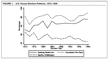
We begin by looking at some of the basic, but critical, descriptive patterns of nineteenth-century House elections. In the modern era, more than 90% of incumbents seek reelection, and of those seeking reelection, more than 90% win reelection—a pattern with remarkable stability during the past 3 decades. As Figure 1 reveals, however, the late nineteenth century House pattern was considerably more varied. The percentage of incumbents seeking reelection hovered between 50% and 60% during the 1870s, averaged 65% through the 1880s and the early 1890s, then approaches 80% just prior to the end of the decade. In terms of electoral success, reelection rates for incumbents who sought reelection were always below 80% in the 1870s, hovered around 80% throughout the 1880s and the first half of the 1890s, climbed above 80% from 1894 through the end of the decade, and reached 90% by 1900. Incumbents faced candidates with prior experience much more frequently during this era, averaging 33%. In contrast, less than 20% of incumbents typically face a quality challenger during the contemporary era (Jacobson 2004). During this 30-year period, however, the proportion of incumbents facing quality challengers declined from over 40% in the 1870s to about 25% by 1900, a change that coincides with the development of careerism, alterations in ballot structure, and the decline in competition brought on by the realigning elections of the mid-1890s.

U.S. House Election Patterns, 1872–1900
To assess the extent to which candidate quality and incumbency may have mattered for electoral outcomes, we build on each of the approaches developed by Cox and Katz (1996) and Ansolabehere, Snyder, and Stewart (2000). Cox and Katz break the incumbency advantage into two components: a direct effect attributable to things such as professional staff, franked mail, convenient travel, and so forth; and an indirect effect which is the product of the “quality” advantage held by the incumbent's party and the ability of an incumbent to “scare off” experienced challengers. The incumbency advantage (IA) is the sum of the direct effect (D) and the indirect effect, which is the product of the quality advantage (Q) and the scare off effect (S), thus: IA = D + (Q*S).
We estimate the incumbency advantage by employing the two-equation approach used by Cox and Katz (1996, 2002). The first equation (2) regresses the Democratic share of the two-party vote in a given district (DTPit) on lagged Democratic vote (DTPit−1), the party of the incumbent candidate at time t and t − 1 (Pit, Pit−1), whether or not an incumbent was running (Iit), and the Democratic quality advantage at time t and t − 1 (DQAit, DQAit−1. Incumbency (I) is coded −1 for Republican incumbents, 0 for open seats, and +1 for Democratic incumbents. Democratic Quality Advantage (DQA) is coded −1 when the Republican party has a quality advantage (the Republican is either an incumbent or quality challenger and the opponent is neither), 0 if neither party has an advantage (incumbent vs. quality challenger, two quality opponents in an open seat, or two political novices), and +1 when the Democrats have a quality advantage. This gives us the following model, which is estimated via ordinary least squares:

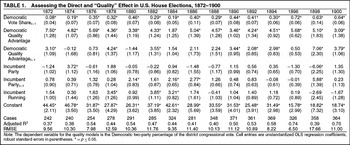
where β4 is the estimated direct effect of incumbency (D) and β5 is the estimated quality advantage effect (Q). The results for this model are presented in Table 1.

The second equation (3) regresses the Democratic quality advantage (DQAit) on the lagged Democratic vote (DTPit−1, lagged Democratic quality advantage (DQAit−1 the party of the incumbent candidate at time t and t − 1 (Pit, Pit−1, whether or not an incumbent was running (Iit), and is estimated via ordinary least squares:7
We also estimated this equation as an ordered probit and found no substantive differences in the two models. We elected to keep the OLS framework to make our results comparable to Cox and Katz (1996).

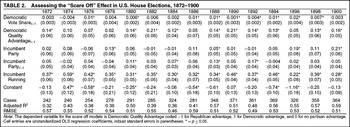
where Θ5 is the estimated “scare off” effect (S) due to an incumbent seeking reelection. The results for this model are presented in Table 2.

The models in Table 1 contain estimates of both the quality effect (Democratic Quality Advantage) and the direct effect of incumbency (Incumbent Running) for the years 1872 to 1900. Of the 15 elections in our sample, we find a positive and statistically significant “quality effect” in 14. Substantively, we find that the average benefit to a party from having a candidate quality advantage ranges from a little over 3% of the vote in 1900 to more than seven percent of the vote in 1872. The average quality effect over all 15 elections is 4.51, which is larger than the 3.02 average that Cox and Katz find for the time period 1946 to 1990. In addition to the quality effect, incumbents received an average of a little more than 3% of the two-party vote simply by being an incumbent in the years in which we find a statistically significant direct effect of incumbency. Overall, however, the direct effect of incumbency is substantively small and does not appear to be consistent during this time period.
As noted previously, Cox and Katz (1996) argue that one of the greatest advantages of incumbency in the post-World War II era is that high-quality challengers are reluctant to face off against incumbents, preferring instead to wait until the seat is vacated. They assert that the combination of candidate-centered campaigns and the predictability of redistricting have produced a political market with fewer “collisions” between incumbents and quality challengers—incumbents are scaring off high-quality challengers. We know from the evidence in Figure 1 that the baseline collision rate was much higher in the nineteenth century, but Figure 1 cannot tell us if parties indiscriminately recruited candidates or if they were responding to the electoral environment and the recruitment decisions by the other party. In Table 2, we fit the Cox and Katz scare off model from equation (3) to assess the dynamics of entry and exit decisions by both challengers and incumbents during this time period.
The results in Table 2 reveal that something akin to a scare off effect was present and quite strong during the late nineteenth century. Even after controlling for previous vote share in the district and the party currently holding the seat, having an experienced candidate (e.g., an incumbent) in the race made it less likely that a quality candidate from the other party would run. It is likely, however, that this deterrence effect was most pronounced in uncompetitive districts. A strategic party would only allocate insurance, and thereby recruit candidates, in districts where the marginal payoff was greatest. This would most likely be in competitive districts. In sure-loser districts a party would not want to waste resources chasing a hopeless cause and in sure-winner districts they would not need to recruit as they would find that many quality candidates would be eager to run.8
Note that we considered whether the scare-off effect differed for winning and losing parties by constructing a measure of parties' differential capacity to deliver patronage—a variable indicating party control of the state legislature coded 1 for unified Democratic control, −1 for unified Republican control, and 0 for divided government—and introduced it into our scare-off models in Table 2. We found some evidence that controlling for the state legislature was associated with an increase in candidate emergence, but the effects were minimal, inconsistent from year to year, and did not affect the other variables in our model, hence we did not report these results.
Overall, then, we find evidence of only a small direct effect of incumbency, but compelling evidence of a quality effect. If the conventional wisdom about the lack of a quality effect were true, we would not expect to find an association between the types of candidates running in these races aside from the partisan composition of the district. However, we find that the effect of having an incumbent in the race is consistently positive and statistically significant across all 15 elections in our sample. As such, these results suggest that candidates, and the parties that nominated them, behaved strategically during this era.
The results in Tables 1 and 2 lead to two related and important conclusions. First, even though political parties certainly played a prominent role in recruiting candidates and conducting elections, this did not necessarily prevent differentials between experienced and nonexperienced candidates from affecting electoral outcomes. Second, the growth in the incumbency advantage during the late twentieth century cannot be due solely to an increase in the importance of candidate quality.
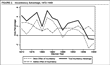
In Figure 2 we combine the key results from Tables 1 and 2 to provide a summary of the size and source of the incumbency advantage in this era. The direct effect is the coefficient on the incumbent running variable in Table 1 whereas the indirect effect is the product of the quality advantage in Table 1 and the incumbent running variable in Table 2. The indirect effect of incumbency is the largest and most consistent source of the incumbency advantage in this era. Even though we find only modest evidence that incumbents performed better at the ballot box (i.e., direct effect of incumbency) than other high quality candidates, their presence on the ballot suppressed the entry of other quality candidates and resulted in an electoral advantage for their party.
As Figure 2 reveals, these effects varied considerably across the different election years, but on average, the electoral advantage of running an incumbent amounted to 2.7% of the vote share. This effect may not be large by modern day standards, but the fact that we find an effect in this time period suggests that the current understanding of late nineteenth century House elections is at best incomplete, and in many instances, incorrect. Further, the finding of scare off and quality effects in this time periods suggests that these factors are not solely late-twentieth-century phenomena.

Incumbency Advantage, 1872–1900
Although the models presented in Tables 1 and 2 provide evidence that the quality of candidates mattered for electoral outcomes, they do not allow us to determine how much quality mattered relative to the incumbent's personal vote. That is, we know that having a quality advantage increased the vote share for a party, but we do not know how much of this increase was due to the reputation of incumbents (i.e., personal vote) relative to the traits that all experienced candidates brought to a race. Like Ansolabehere, Snyder, and Stewart (2000), we take advantage of the fact that redistricting occurred regularly during this era and that district lines tended to follow county boundaries to assess the personal vote accruing to incumbents. Unlike Ansolabehere, Snyder, and Stewart (2000), however, we are able to assess the effects of candidate quality and the personal vote independently. To do so we estimate the following equation9
This is analogous to equation one in Ansolabehere, Snyder, and Stewart (2000).

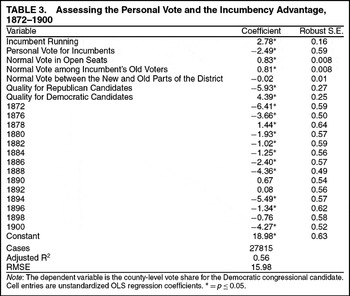
where Vijt is the Democratic vote in county i, district j, and year t,; Ijt is a variable measuring incumbency status in district j, and year t, coded −1 for Republican incumbents, 0 for open seats, and +1 for Democratic incumbents; Nijt is a dummy variable indicating whether or not the county is new to the district; Pit is a measure of the normal vote in county i in year t, measured as the two-party democratic presidential vote in each county averaged over this 30-year period; QDjt is a dummy variable for quality of the Democratic candidate; QRjt is a dummy variable for quality of the Republican candidate; and Xt are year-fixed effects. The coefficient on β1 provides an estimate of the total incumbency advantage, whereas the coefficient on β2 provides an estimate of the personal vote by measuring the average vote loss for an incumbent in a new county. The results of this model are presented in Table 3 along with year-specific fixed effects.

The results in Table 3 reinforce our findings that candidate quality matters in elections during this era. When the Republican Party fields a quality candidate the Democratic vote declines by an average of almost 6%. Likewise, a Democratic quality candidate increases that party's average vote share by more than four percent. In addition, similar to Ansolabehere, Snyder, and Stewart (2000) we find support for a personal vote during this era. On average an incumbent running during this era had an advantage of 2.8% of the vote, and given the size of the personal vote coefficient (2.5%), nearly all of the incumbency advantage can be attributed to the personal vote. Given the absence of vast “resources of office” it is likely that most of this personal vote resides in the local recognition of candidates.
Taken together, our results offer several new insights about late nineteenth-century House elections and raise important implications about the growth in the incumbency advantage across time. Contrary to much of the conventional wisdom about this era, we find evidence that quality House candidates enhanced the attractiveness of the party ballot, and that parties responded by actively recruiting high-quality candidates to run in competitive races. Moreover, the effects of candidate quality appear to have affected the entry decisions of other congressional candidates. Thus, our findings suggest that Cox and Katz's (1996, 2002) assertion that a growth in the quality and scare- off effects is largely responsible for the growth of incumbency advantage, although accurate for the post-World War II era, is incomplete as a broader theoretical statement. Candidates in the late nineteenth century benefited from a quality advantage and strategically coordinated their entry decisions. Yet, at the same time, the prospects for individual candidates to continuously rack up victories were tenuous as parties often were able to entice high-quality candidates to oppose them. For example, we estimate that incumbency provided a 5% vote boost in 1882, and over 80% of incumbents won. However, in 1874, the advantages of incumbency were around 3%, and over 35% of the incumbents who sought reelection lost.
CONCLUSION
Are incumbents routinely reelected as a result of their normal political activity? Or is the electoral deck somehow stacked in their favor? Since the early 1970s, students of congressional politics have actively searched for the source of these advantages. In an attempt to shed new light on this debate, we turned to congressional elections held during the latter part of the nineteenth century. Our examination uncovered strong evidence of a candidate quality effect and signs, albeit modest, of a direct incumbency effect even during the highly partisan era of the late nineteenth century.
From one perspective, this era looks more similar to modern elections than many scholars may have previously recognized. Experienced candidates did better at the ballot box than political amateurs. Yet, in contrast to their modern counterparts, nineteenth-century incumbents were far less able to translate campaign experience into repeated victory. One reason, our results indicate, is that opposition parties were more adept at recruiting experienced challengers to take on incumbents. Although modern incumbents rarely find themselves facing strong challengers, incumbents in the nineteenth century could more often count on a closely fought and competitive race.
These results point to a striking tradeoff between party and candidate-centered electoral systems. The strong party organizations of the nineteenth century, partly through their ability to recruit experienced candidates to run in risky races, were able to manufacture heightened electoral competition in many parts of the country. Between 1870 and 1900, nearly 40% of House elections were decided by ten points or less. Yet, this heightened competition came with considerable cost. The “smoke-filled” nominating caucuses of the nineteenth century were often dens of corruption, closed to the mass public, and part and parcel of an electoral system that provided incentives for party leaders to sometimes employ coercive and fraudulent methods to win elections (Bensel 2004; Cox and Kousser 1981; Summers 2004).
The passage of progressive reform legislation at the turn of the century—such as civil service reform, secret ballot laws, and direct primaries—removed many of the egregious forms of electoral corruption. At the same time, these reforms, many of which were explicitly designed to free candidates from the thumb of party bosses, helped set the preconditions for the gradual development of candidate-centered politics. Enervated local party organizations lacked the resources to compel reluctant candidates to challenge incumbents and had fewer incentives to bear the collective action costs of campaigning for the party slate. The net result has been the emergence of numerous lopsided races, as prospective quality challengers opt not to run in contests their equally situated counterparts would have 120 years ago. Thus, for those looking to restore vigorous competition in America's congressional elections, a major challenge is determining how to induce strong challengers to take on incumbents while minimizing the negative aspects that can come with strong centralized parties. Solving this thorny dilemma is of paramount importance to the continuing health of the U.S. Congress—the central representative institution of American democracy.



Comments
No Comments have been published for this article.