INTRODUCTION
Canola (Brassica napus) is the world's third largest source of edible oil after soyabean and palm oil (Afzal et al. Reference Afzal, Aslam, Mahmood, Hameed, Irfan and Ahmad2004); however, in Iran canola yield is very low as compared with its potential production. Of the many constraints on production, low seedling establishment is of prime importance. In central zones of Iran, the optimum time for canola sowing is the first week of September, but sowing is often delayed until mid-October because of late harvesting of the preceding crop. In late-planted canola, low temperatures prevailing during germination substantially affect germination and seedling emergence. Researchers have reported that after mid-September a day's delay in sowing of canola results in a yield loss of 1% (Hua et al. Reference Hua, Lin, Hussain, Zhang, Yu, Ren, Ding and Zhang2014). Canola cultivars have different responses to changes in sowing dates so it is necessary to identify the appropriate cultivars suited to delayed sowing. The decline is most important in cultivars having a long growth duration, i.e. days to maturity.
Good crop establishment is one of the major challenges to crop production and its importance is recognized by farmers as well as researchers (Chivasa et al. Reference Chivasa, Harris, Chiduza, Nyamudeza and Mashingaidze1998). Sub-optimal temperatures reduce emergence and stand establishment of canola (Blackshaw Reference Blackshaw1991). This causes delays in germination and seedling emergence due to water imbibitional injury (Afzal et al. Reference Afzal, Basra, Shahid, Farooq and Saleem2008), obstructs seedling growth, and reduces root water uptake and its transport to the shoot, causing cell membrane injury (Rymen et al. Reference Rymen, Fiorani, Kartal, Vandepoele, Inzé and Beemster2007). Other obvious effects of cooling injuries include reductions in membrane permeability, chlorophyll pigments and enzymes activities through production of reactive oxygen species (ROS) (Farooq et al. Reference Farooq, Aziz, Basra, Cheema and Rehman2008). To prevent this, plants have developed a variety of antioxidant enzymes and scavenging molecules (Hasegawa et al. Reference Hasegawa, Bressan, Zhu and Bohnert2000). The most important among them are peroxidase (POD), ascorbate peroxidase (APX), glutathione reductase, superoxide dismutase (SOD) and catalase (CAT), which play important roles in protecting cells from oxidative damage (Fazeli et al. Reference Fazeli, Ghorbanli and Niknam2007; Farooq et al. Reference Farooq, Wahid, Kobayashi, Fujita and Basra2009).
Seed-priming techniques can be used effectively to improve the performance of late-sown crops (Rehman et al. Reference Rehman, Iqbal, Basra, Afzal, Farooq, Wakeel and Wang2015). Harris et al. (Reference Harris, Joshi, Khan, Gothkar and Sodhi1999) promoted a low-cost, low-risk technology called ‘on-farm seed priming’ that would be appropriate for all farmers, irrespective of their socio-economic status. On-farm seed priming involves soaking the seed in water, surface drying and sowing the same day. The rationale is that sowing soaked seed decreases the time needed for germination and may mitigate the effects of deteriorating soil physical conditions. Besides better establishment, farmers have reported that primed crops grew more vigorously, flowered earlier and gave higher yields (Farooq et al. Reference Farooq, Aziz, Basra, Cheema and Rehman2008). Seed priming has been commonly employed to reduce the time between seed sowing and seedling emergence, and the synchronization of emergence. Seed priming not only improves the speed and uniformity of germination (Khalil et al. Reference Khalil, Mexal, Rehman, Khan, Wahab, Zubair, Khalil and Mohammad2010), but also stimulates various biochemical changes in the seed, which are vital in breaking dormancy, the mobilization or hydrolysis of seed reserves, enzyme activation and the emergence of embryonic tissues (Asgedom & Becker Reference Asgedom and Becker2001). Various seed-priming techniques have been reported to improve germination and seedling establishment at low temperatures. For example, soaking rice seed in various concentrations of proline, betaine, putrescine, spermidine and spermine has been shown to increase low-temperature tolerance (Naidu & Williams Reference Naidu and Williams2004). He et al. (Reference He, Hu, Zhu, Ruan and Song2002) reported that chilling tolerance in rice was significantly improved by priming with calcium chloride (CaCl2). In wheat, seed priming with various concentrations of IAA (indole-3-acetic acid), potassium chloride (KCl), zinc sulphate (ZnSO4), sodium sulphate (Na2SO4) and water increased low-temperature tolerance (Kant et al. Reference Kant, Pahuja and Pannu2006). Rehman et al. (Reference Rehman, Iqbal, Basra, Afzal, Farooq, Wakeel and Wang2015) also noted that maize growth was promoted by water, CaCl2 and salicylic acid treatment under low temperature. In another study, Farooq et al. (Reference Farooq, Aziz, Basra, Cheema and Rehman2008) reported improved chilling tolerance in late-sown wheat by seed priming with CaCl2. A field experiment was conducted by Bassi (Reference Bassi2005) to monitor the effect of various seed-priming treatments on late-sown wheat. Results showed that gibberellic acid treatment enhanced germination and emergence percentage (EP; 94 and 82%, respectively) when compared with non-primed seed treatment (85 and 77%, respectively). The objective of the current study was to explore the effects of two seed-priming treatments (water and ZnSO4 solution) on some seedling emergence characteristics and leaf antioxidant content of three canola cultivars at different sowing dates.
MATERIALS AND METHODS
Site description
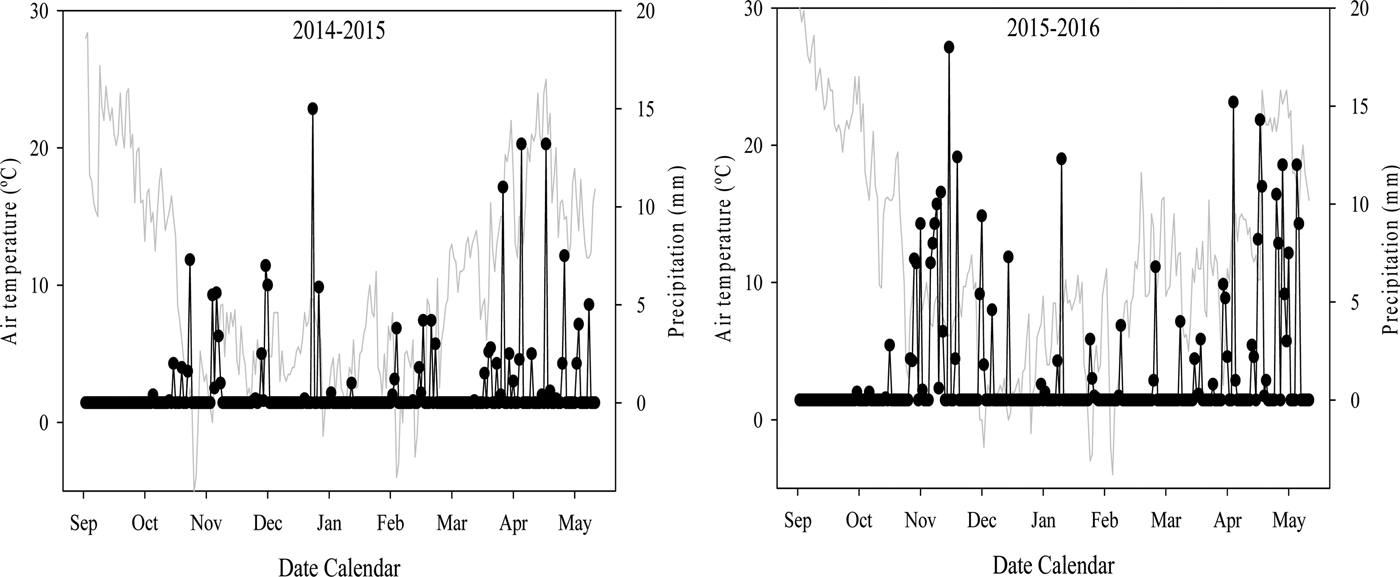
The present study was conducted during the growing seasons of 2014/2015 and 2015/2016 at the experimental farm of Islamic Azad University, Karaj Branch, Iran (35°45′N, 51°6′E, 1313 m a.s.l.), in a semi-arid climate. The soil type was a silty clay (10·33 sand, 46·33% silt and 43·34% clay), with 9·8 g/kg organic matter and pH of 7·4. Daily rainfall and temperature were obtained from a meteorology station located 7 km away from the experimental field (Fig. 1).
Daily mean temperatures (solid line) and daily total precipitation (•) during the experimental years.

Experimental details
The field was irrigated before conducting the experiment and after drainage of excess water (2 days later), the soil of all experimental units was tilled by mouldboard ploughing to a depth of 30 cm, followed by disking to slice plant residue and incorporate fertilizers into the soil. Canola seeds were obtained from the Seed and Plant Improvement Institute (SPII), Karaj, Iran. Fertilizers (nitrogen [N], phosphorus [P] and potassium [K]) were applied at 150 : 80 : 80 N:P:K kg/ha using urea (46% N), diammonium phosphate (18% N, 46% P2O5) and sulphate of potash (50% K2O) as sources of N, P and K, respectively, during each experimental year, with P, K and one-third of N applied before sowing. Other portions of N were used at the end of the rosette stage (GS2·0, Sylvester-Bradley Reference Sylvester-Bradley1985) and the beginning of flowering (GS3·3). Each experimental plot included six rows 6 m × 30 cm: sown at a density of 80 seeds/m2. The fields were irrigated five times in two growing seasons. The number of emerged seeds was recorded daily according to the seedling evaluation handbook of the Association of Official Seed Analysis (AOSA 1983). Emergence data were recorded when the number of seedlings was deemed constant, by counting the number of seedlings emerged in 1-m row lengths at three randomly selected rows in each plot, and EP calculated (Ellis & Roberts Reference Ellis and Roberts1981).
Seedling emergence rate (ER) and coefficient of uniformity of emergence (CUE) were calculated using Eqns (1) and (2), respectively (Farooq et al. Reference Farooq, Aziz, Basra, Cheema and Rehman2008). The CUE measures variability in germination time among seeds in relation to the mean emergence time of the sample. Lower CUE value indicates less uniform emergence.
 $${\rm ER} = \displaystyle{{\sum n} \over {\sum {(t_x)(n_x)}}} $$
 $${\rm CUE} = \displaystyle{{\sum n} \over {\sum {{\left( {\bar t - t_x} \right)}^2n_x}}} $$
where n is the the total number of seeds emerged; n
x
the number of newly emerged seeds at time t
x
; and
 $\bar t$
the average seed emergence time.
Antioxidant enzymes assays
Leaf samples were collected at the stem elongation stage to determine the enzymatic activity of SOD, POD and CAT. Canola leaf samples (0·5 g) were ground in 5 ml of 50 mm phosphate buffer (pH 7·8) and the ground sample centrifuged at 15 000 rpm for 20 min at 4 °C. The supernatant was stored in a 2 ml micro-centrifuge tube for further assay to determine SOD, POD and CAT. The protocol devised by Giannopolitis & Ries (Reference Giannopolitis and Ries1977) was used to determine SOD activity at 560 nm using an ultraviolet (UV) spectrophotometer (UV-4000, O.R.I. Germany). One unit of SOD was quantified by the amount of enzyme required to cause 50% inhibition of the rate of NBT (nitro blue tetrazolium) reduction. Activities of POD and CAT were determined using the protocol described by Chance & Maehly (Reference Chance, Maehly, Colowick and Kaplan1955), by recording absorbance at 240 and 470 nm, respectively, using a UV spectrophotometer (UV-4000, O.R.I. Germany), whereas CAT activity was measured as units (μm hydrogen peroxide (H2O2) decomposed/min/mg protein) and POD unit activity was defined as the change of 0·01 absorbance unit/min/mg protein.
Statistical analysis
The experiment was laid out in a randomized complete block design as split-plot factorial with three replications that was combined over 2 years. Main factor included five sowing dates (5, 15 and 25 September, 5 and 15 October in both seasons) and three canola cultivars (Okapi, Zarfam and Talayeh, which are commercially cultivated in Iran as winter cultivars) and priming treatments including priming with water, priming with ZnSO4 and control (no priming) as a factorial in sub-plots. Seed priming was achieved by soaking in water and 35 ppm ZnSO4 solution for 10 h at 20 °C. Zinc sulphate with 22% Zn was manufactured by the Eksir Farayand Espadana Corporation of Iran. The concentration of ZnSO4 solution and duration of priming seeds had already been determined in a preliminary experiment inspired by research conducted by Harris et al. (Reference Harris, Rashid, Miraj, Arif and Yunas2008). Primed seeds were dried in the shade at 28 ± 2 °C to become close to their original weight (Basra et al. Reference Basra, Zia, Mehmood, Afzal and Khaliq2002). The combined analysis of variance and Pearson's correlation analyses were performed using SAS (Version 9.1, SAS Institute, Cary, NC, USA) and means comparison was done using LSD test at 0·05 level of probability by MSTAT-C (Version 2.1, Michigan State University, 1991).
RESULTS
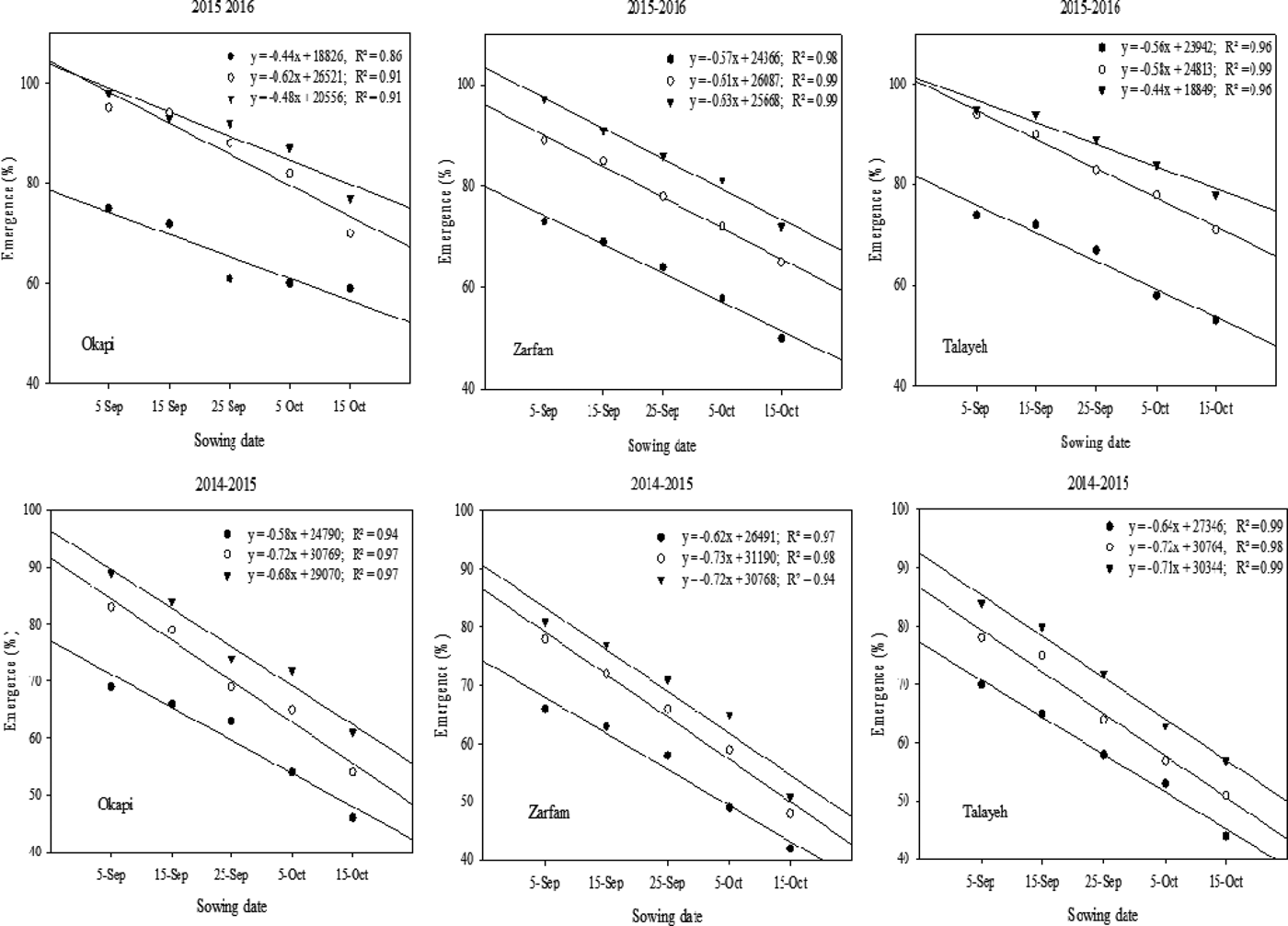
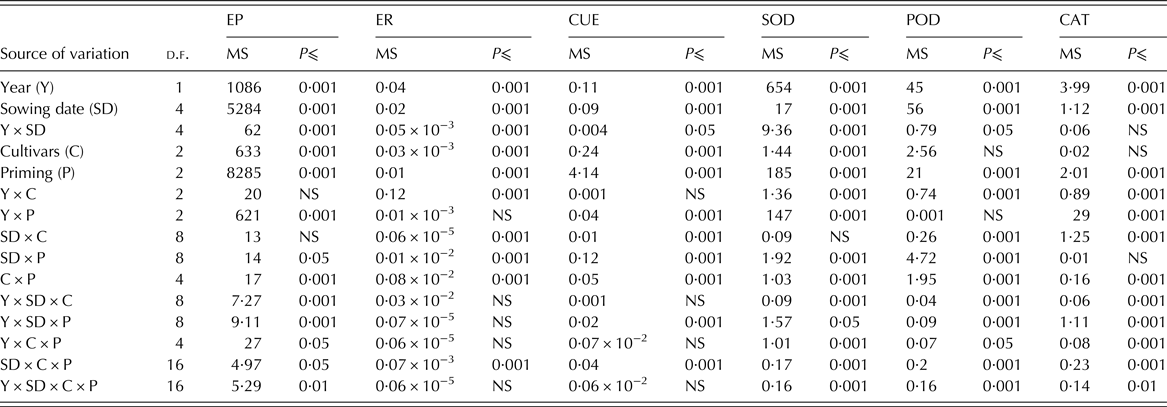
Results showed that canola EP was significantly (P ⩽ 0·01) affected by year × sowing date × cultivars × priming interaction (Table 1). The results indicated that in both growing seasons, seed priming with water and ZnSO4 improved EP in all three canola cultivars compared to the non-primed treatment. The data revealed that seed emergence in 2015/16 was higher than in 2014/15 (Fig. 2) and that EP was higher in priming with water than the control; however, priming with ZnSO4 was even more effective than water priming. The results revealed a strong negative correlation between EP and sowing delay (Fig. 2). The highest EP occurred in the earlier sowing dates in both years. On 5 September, in cvar Okapi, EP increased from 73% in the no-primed treatment to 89 and 93% in hydropriming and osmopriming treatments, respectively (data averaged across both years). In cvar Zarfam, EP increased to 83 and 89% in the hydropriming and osmopriming treatments, respectively, in comparison with 69% recorded in the no-primed treatment. In cvar Talayeh, EP was 72% in the no-primed treatment, which improved to 81 and 89% in the hydropriming and osmopriming treatments, respectively (Fig. 2). Under the latest sowing date (15 October) in both years, higher EP was observed in the cultivars Okapi and Talayeh (Fig. 2).
Seedling emergence of the three cultivars among different sowing dates under seed-priming treatments of ZnSO4 priming (▾), hydropriming (○) and control (•) in 2014/15 and 2015/16 seasons (LSD0·05 = 4·93).

Mean squares (MS) and significance levels of analysis of variance combined over 2014/15 and 2015/16

EP, emergence percent; ER, emergence rate; CUE, coefficient of uniformity of emergence; SOD, superoxide dismutase; POD, peroxidase; CAT, catalase; NS, not significant.
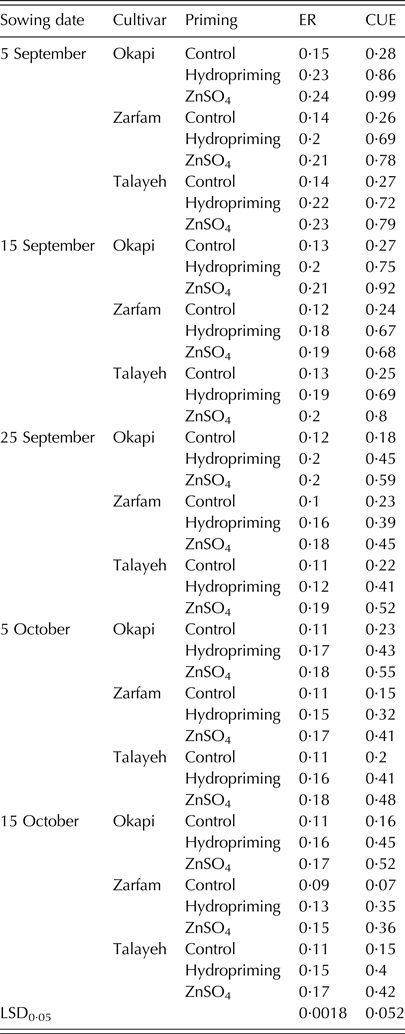
Seedling ER and CUE of canola were significantly affected by sowing date × cultivar × priming interaction (Table 1). Emergence rate and CUE declined significantly (P ⩽ 0·001) as the sowing date was delayed from 5 September to 15 October in canola cultivars under priming with ZnSO4 and water (Table 2).
Seedling emergence rate (ER) and coefficient of uniformity of emergence (CUE) of Okapi, Zarfam and Talayeh cultivars among different sowing dates under seed-priming treatments

Generally speaking, priming with ZnSO4 improved ER and CUE compared with the control and hydropriming. In all cultivars, ER on 5 September was higher under priming treatments compared with the control in both seasons, especially using ZnSO4 solution. The percentage increases in ER for ZnSO4 and water-priming treatments were 60 and 53%, respectively, in Okapi, 61 and 57% in Zarfam and 64 and 57% in Talayeh. Maximum CUE was recorded from priming with ZnSO4 at the optimal sowing date (5 September): Okapi, Zarfam and Talayeh cultivars reached CUE values of 0·99, 0·77 and 0·79, respectively. The lowest ER and CUE were found on 15 October in non-primed treatment (Table 2).
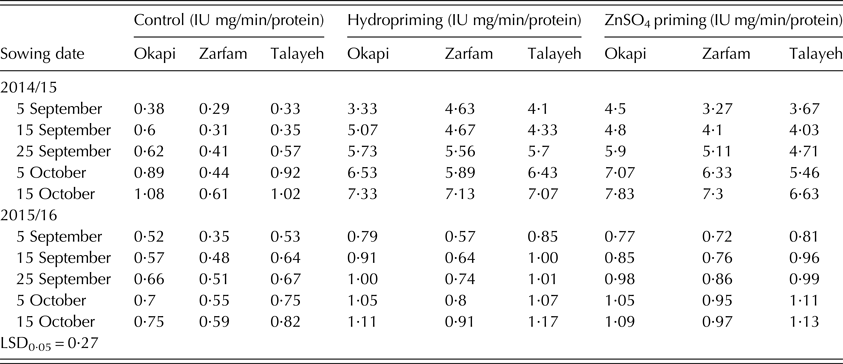
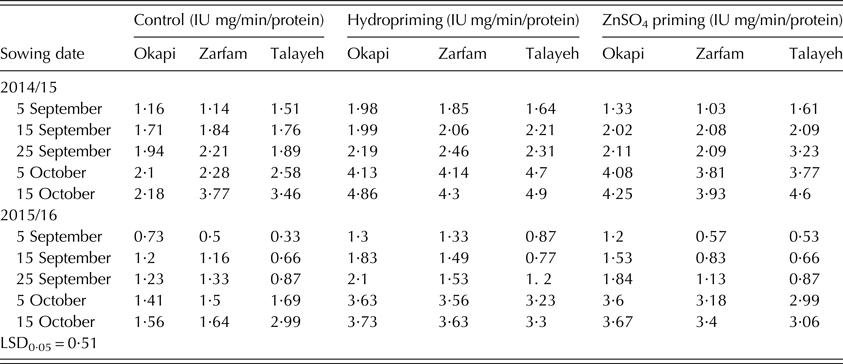
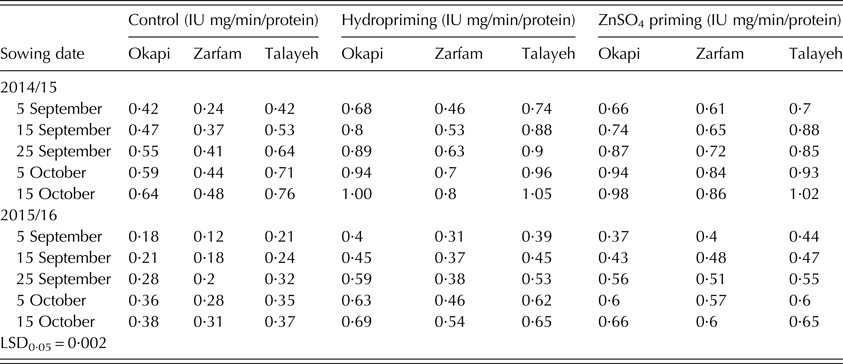
Antioxidant activities were significantly affected by year × sowing date × cultivar × priming interaction (Table 1). Results showed that all antioxidant activities including SOD, POD and CAT decreased significantly (P ⩽ 0·001) in all treatments, by 58%, when comparing 2015/16 with 2014/15 (Tables 3–5). Seed priming with water and ZnSO4 increased SOD, CAT and POD activities compared with the control in all varieties. Cultivar analysis of total antioxidant content activities indicated that the maximum increase was observed in Okapi and Talayeh (Tables 3–5). Higher activities of SOD, POD and CAT were recorded in the ZnSO4 seed priming agent as compared with hydropriming. According to these results, the activity of SOD, POD and CAT was increased more by the ZnSO4 treatment than by hydropriming (Tables 3–5). The lowest activities were observed for all enzymes under the control conditions. In both years, especially the first, sowing delay increased all enzyme contents. The lowest levels of enzymes were observed for the earliest sowing date, 5 September.
Superoxide dismutase of Okapi, Zarfam and Talayeh cultivars among different sowing dates under seed-priming treatments in 2014/15 and 2015/16 seasons

Peroxidase of Okapi, Zarfam and Talayeh cultivars among different sowing dates under seed-priming treatments in 2014/15 and 2015/16 seasons

Catalase of Okapi, Zarfam and Talayeh cultivars among different sowing dates under seed-priming treatments in 2014/15 and 2015/16 seasons

DISCUSSION
Although winter canola is somewhat tolerant to low temperature, extremely low temperatures experienced as a result of delayed sowing can cause damage (Yin et al. Reference Yin, Kropff and Goudriaan1996; Thingnaes et al. Reference Thingnaes, Torre, Ernstsen and Moe2003). Seed priming improves the germination rate, speed and uniformity even under less than optimum field conditions (Lee & Kim Reference Lee and Kim2000; Kant et al. Reference Kant, Pahuja and Pannu2006). Indeed, primed seeds have been shown to exhibit faster water imbibition compared towith non-primed seeds (Saleh et al. Reference Saleh, Yajing, Dongdong, Jie, Aamir, Qijuan, Weimin, Mingyu and Jin2015). Nagarajan et al. (Reference Nagarajan, Pandita, Joshi and Sinha2005) reported that improvement of germination by priming with polyethylene glycol (PEG) might be directly related to increasing the seeds’ ability to absorb water. Furthermore, Saleh et al. (Reference Saleh, Yajing, Dongdong, Jie, Aamir, Qijuan, Weimin, Mingyu and Jin2015) reported that seed priming facilitated entry of water into the seed through creation of a vacuum in the seed tissue. The present study indicates that priming with water and ZnSO4 improves seed emergence. Ajouri et al. (Reference Ajouri, Asgedom and Becker2004) found that priming with Zn was the most effective technique for improving the growth of barley seedlings and stand establishment. Saleh et al. (Reference Saleh, Yajing, Dongdong, Jie, Aamir, Qijuan, Weimin, Mingyu and Jin2015) reported that osmo-hardening with CaCl2 is a good priming technique in improving germination percentage, germination index, energy of germination and mean germination time. Zinc uptake in plants is critical, as it plays many essential and unique biological functions. It is well known that a vast array of proteins use zinc for stabilizing their structures (Christianson Reference Christianson1991). Zinc has major role in biochemical and physiological processes and even slight deficiencies may affect emergence and seedling vigour. Singh & Rao (Reference Singh and Rao1993) stated that osmopriming effectively improved germination, seedling growth and seedling vigour index of the seeds of sunflower varieties with low germination rates. In barley and mungbean, hydroprimed seeds showed early germination, better establishment and increased yield (Rashid et al. Reference Rashid, Hollington, Harris and Khan2006, Reference Rashid, Harris, Hollington and Ali2004). In the present study, priming with ZnSO4 was more effective than hydropriming for improvement of the emergence of canola cultivars. Rehman et al. (Reference Rehman, Iqbal, Basra, Afzal, Farooq, Wakeel and Wang2015) reported that osmopriming with 0·5 m ZnSO4 and 0·1 m ZnCl2 were more effective than hydropriming for earlier and synchronized germination and emergence in wheat. Kathiresan et al. (Reference Kathiresan, Kalyani and Gnanarethinam1984) found that priming of sunflower seed with ZnSO4, CaCl2 and NaCl improved seedling emergence and growth. Begum et al. (Reference Begum, Gul, Hamayun, Rahman, Ijaz, Sohail, Iqbal, Afzal, Afzal, Ullah and Karim2014) reported that seed priming with ZnSO4 and CuSO4 improved germination percentage, rate of germination, the length of plumule and root in canola seedlings.
In the present study, it is clearly shown that different sowing dates significantly affected seedling emergence. This result indicates that late sowing is not beneficial for canola growth and development. The present study suggests that performance of late-sown canola can be improved by employing seed-priming techniques. The prevalence of low temperatures at late sowing dates results in poor seedling emergence and establishment. Priming broadens the range of temperatures tolerated during emergence and this will ultimately improve crop performance (Murray Reference Murray1990; Zheng et al. Reference Zheng, Wilen, Slinkard and Gusta1994). Maximum seed emergence was recorded in the three cultivars on the optimal sowing date (5 September) under hydropriming and priming with ZnSO4. Seedling emergence from the 15 October sowing date was the lowest in the two seasons. The main reason for this reduction was low temperatures at sowing time. In 2014/15 and 2015/16, mean temperatures during the 30 days after sowing (DAS) on 15 October were 5 and 10 °C, respectively. Low temperatures reduce seedling emergence, particularly in those crops such as canola which require optimal temperatures between 20 and 25 °C for germination (Zhang et al. Reference Zhang, Jiang, Yang, Li, Yan and Hu2015). Sub-optimal temperatures reduce both the percentage and rate of germination and seedling emergence (Livingston & de Jong Reference Livingston and de Jong1990; Blackshaw Reference Blackshaw1991). Therefore, emergence and stand establishment of canola cultivars sown on 15 October are often slow and erratic, particularly under cool conditions. In 2014/15, the EP percentage for all sowing dates generally decreased compared with 2015/16, possibly due to low temperatures and lower precipitation (Fig. 1). In 2014/15 and 2015/16, the mean temperature from September to January (the first 120 DAS) were 9 and 13 °C, respectively. In the current experiments, the beginning of the 2014/15 growing season was drier than 2015/16: rainfall during the first 60 DAS 2014/15 and 2015/16 was 13 and 31 mm, respectively.
The present study revealed that late sowing had a negative effect on ER and CUE. Low temperatures after sowing caused considerably longer emergence duration at the four delayed sowing dates (15 and 25 September; 5 and 15 October). The slow ER, CUE and problems due to cooler conditions at the late sowing dates could be overcome by the application of seed priming (Kant et al. Reference Kant, Pahuja and Pannu2006; Farooq et al. Reference Farooq, Aziz, Basra, Cheema and Rehman2008). Seed priming improves germination rate, speed and uniformity even under less than optimum field conditions (Lee et al. Reference Lee, Kim, Hong, Yun and Park1998; Kant et al. Reference Kant, Pahuja and Pannu2006), thus enabling the establishment of uniform good crop stand. Maximum ER and CUE were recorded in all three cultivars on the optimal sowing date (5 September) under ZnSO4. Despite decreasing ER and CUE for late sowing dates, seed-priming treatments resulted in better stand establishment for canola cultivars seedlings under late-sown conditions. The current results are in agreement with the findings of Ali et al. (Reference Ali, Iqbal, Shahzad, Sarwar, Ahmad and Mehmood2013), who showed that hydropriming and on-farm priming decreased the mean emergence time of late-sown wheat. The lowest values for ER and CUE were found on 15 October in the non-primed treatment. In the present study, mean temperature 14 days after the 15 October sowing date was approximately 10 °C. Kondra et al. (Reference Kondra, Campbell and King1983) indicated that the maximum ER and CUE are seen between 21 and 25 °C for canola. Thus, low temperature after emergence can slow seedling growth rate for the 15 October sowing date.
Under different stress conditions, ROS generation often exceeds the overall cellular antioxidative potential leading to stress-induced adverse effects on plant growth and physiology (Venkateswarlu & Shanker Reference Venkateswarlu, Shanker, Venkateswarlu, Shanker, Shanker and Maheswari2012). Reactive oxygen species play two divergent roles in plants: at low concentrations, they act as signalling molecules for the activation of defence responses under stresses, whereas at high concentrations, they cause exacerbating damage to cellular components (Hasanuzzaman et al. Reference Hasanuzzaman, Hossain, da Silva, Fujita, Venkateswarlu, Shanker, Shanker and Maheswari2012). A steady, balanced state is required to protect plant cells from oxidative damage. Priming can increase free radical scavenging enzymes such as SOD, CAT and POD in seedlings and leaves, which also improve the capacity of a plant to maintain its growth behaviour under stress conditions (Chang & Sung Reference Chang and Sung1998). The current results showed that seed priming with water and ZnSO4, compared with the non-primed control, increased the activity of scavenging enzymes in canola leaves. The present study also suggests that enzymatic antioxidant activities were substantially induced at the late sowing date compared with those grown at optimal sowing. Maximum antioxidant activities were recorded under priming conditions (water and ZnSO4) on the 5 and 15 October sowing dates in the three cultivars. These sowing dates were much cooler than those in September. However, the impact of low temperature on antioxidant activities on the 5 and 15 October sowing dates was much more profound than at early sowing dates, because at the later dates most of the leaves were not differentiated when canola suffered low-temperature stress. The improvement of low-temperature stress tolerance is often related to the enhanced activities of enzymes of antioxidant systems in plants (Hasanuzzaman et al. Reference Hasanuzzaman, Hossain, da Silva, Fujita, Venkateswarlu, Shanker, Shanker and Maheswari2012). Xu et al. (Reference Xu, Hu, Li, Ma, Zheng and Zhu2011) found that seed priming improved the chilling tolerance in tobacco during seed germination and seedling growth by the activation of antioxidant system in the plant tissues. Potassium nitrate (KNO3) and hydropriming increased sunflower germination and enzymatic antioxidants under drought stress (Yan Reference Yan2015). Seed priming with PEG increased the germination and early seedling growth of barley under drought stress condition (Amini Reference Amini2013; Tabatabaei Reference Tabatabaei2013). Plants exposed to low temperatures use several non-enzymatic and enzymatic antioxidants to cope with the harmful effects of oxidative stress; higher contents of antioxidant defence enzymes are correlated with higher chilling tolerance (Kang & Saltveit Reference Kang and Saltveit2002; Huang & Guo Reference Huang and Guo2005). Antioxidant enzymes have higher activity in chilling-tolerant cultivars than in susceptible ones (Guo et al. Reference Guo, He, Liu, Bai, Gu, Wei and Luo2005). Huang & Guo (Reference Huang and Guo2005) found higher efficiencies of antioxidant enzymes in chilling-tolerant rice cultivars than in chilling-susceptible cultivars: they observed that the activities of SOD, CAT and POD content of tolerant cultivar (Xiangnuo-1) remained high, while those of a chilling-susceptible cultivar (IR-50) decreased under chilling. In the current work, the antioxidant activities on all sowing dates in 2014/15 generally increased compared with the 2015/16 season, possibly due to decreased temperature and moisture. In 2014/15 and 2015/16, mean temperature were 9 and 13 °C, respectively. The solubility of gas increases with decreasing temperature, leading to a higher concentration of oxygen gas (O2) and thus enhances the risk of oxidative stress at low temperature, which leads to the increased production of O2 −, hydrogen peroxide (H2O2), singlet oxygen (1O2) and hydroxide (OH−) (Guo et al. Reference Guo, Ou, Lu and Zhong2006). Low-temperature conditions aggravate the imbalance between light absorption and light use by inhibiting the Calvin–Benson cycle. In addition, enhanced photosynthetic electron flux to O2 and the over-reduction of respiratory electron transport chain causes ROS accumulation during chilling (Hu et al. Reference Hu, Song, Shi, Xia, Zhou and Yu2008). In the current work, the 2014/15 season was drier than 2015/16: during the first 120 DAS, rainfall in the first season was 66 mm vs 145 mm in the second. Reactive oxygen species accumulation and oxidative stress increase under drought conditions (Li et al. Reference Li, Li, Wuyun, Wu and Jiang2010). Mohammadkhani & Heidari (Reference Mohammadkhani and Heidari2007) observed a strong positive correlation between antioxidant enzymes and drought stress while investigating the responses of Zea mays L. var. 704 (drought-tolerant) and var. 301 (drought-sensitive). Shehab et al. (Reference Shehab, Ahmed and El-Beltagi2010) reported an increase in the activity of various antioxidant defence enzymes (SOD, APX, GR and CAT) in rice, representing protective activity to counteract the oxidative injury caused by drought.
CONCLUSIONS
The results of the current study showed seed priming enhanced seedling emergence characteristics: seed priming with ZnSO4 solution was more effective than hydropriming treatment in all canola cultivars. A delay in sowing resulted in increased activity of all three antioxidant enzymes measured in leaves, especially POD. Seed-priming treatment, regardless of type, created a significant increase in SOD and POD in the last sowing date of the first growing season. Overall, it can be concluded that seed priming of canola with ZnSO4 solution may be recommended as an effective and cost-effective approach that may improve the adverse impacts, which imposed by delay in sowing date in canola.
This research was funded by the Bu Ali Sina University, in the form of research grants.