


I. Introduction
In ancient Greek contexts, children have been dismissed as ‘invisible’ or archaeologically ‘inaccessible’ in domestic spaces. Yet investigation of houses from historical periods confirms that children used domestic space differently from adults, leaving distinct material signatures in excavated houses.Footnote 1 This paper argues that the key to identifying evidence of children in any archaeological context, ancient or historical, is a comprehensive understanding of the material culture with which juveniles directly and regularly interacted.Footnote 2 I explore what the distribution of material culture indicates about how children used and experienced domestic space in Classical Attica and Olynthus across the fifth and fourth centuries BC. My recent analyses of Athenian pottery and marble gravestones showing children with objects and juvenile burials in which children were interred with a range of associated funerary objects, have illuminated the material cultures of children and of childhood in ancient Attica and perhaps Greece more widely.Footnote 3 Pottery, gravestones and burials establish links between children and an array of objects (fig. 3); some of which were almost exclusively associated with children and are found as signatures of their presence in archaeological (including domestic) contexts.
Households are the key arenas in which the enculturation and socialization of children take place cross-culturally.Footnote 4 Until they started their schooling or were married, children in ancient Greece passed most of their time in domestic spaces: literary sourcesFootnote 5 and iconographyFootnote 6 confirm this, so it is not ethnocentrically biased to suggest that juvenile experiences were primarily focused within oikoi. Thus, it stands to reason that children left signatures upon the archaeological records of Greek houses, which it should be possible to identify when excavated houses are analysed. Based on existing evidence, fully analysing children’s use of domestic space is problematic: this is likely one reason why children are typically overlooked in household archaeology.Footnote 7 Most ancient Greek houses are insufficiently preserved, inadequately recorded and too poorly understood to enable comprehensive analyses of the use of space within them.Footnote 8 However, artefact assemblages have been recovered and recorded in many houses and close evaluation of the distribution of certain artefacts associated with juveniles (fig. 3), and especially patterning across multiple case studies, identifies the spaces children frequented within houses. Consideration of other objects found in those spaces suggests how children interacted with other members of their household in domestic contexts. This is not an attempt to identify ‘playrooms’ or ‘nurseries’ in ancient Greek houses, not least because it is unlikely children occupied separate spaces to adults in premodern contexts,Footnote 9 but rather a concerted effort to understand how the use of domestic space impacted children’s lives and experiences in Classical Greece.
II. Investigating ancient Greek houses: artefact distribution and access analyses
Ancient Greek houses have been excavated since the 19th century,Footnote 10 though evidence of rural houses remains limitedFootnote 11 and well-contextualized evidence in urban centres like Athens is still constrained because of redevelopment over the centuries.Footnote 12 It was not until David Robinson’s pioneering work at Olynthus in the 1920s and 1930s that significant effort was put into recovering and recording small finds in domestic contexts,Footnote 13 despite finds being key to understanding the use of domestic space, since Greek houses incorporated few fixed features.Footnote 14 In recent decades, scholarship has focused on understanding houses as inhabited (social) spaces, a welcome development beyond considering them only as architectural features.Footnote 15 Research in this vein has confirmed the utility of artefact distribution and spatial analyses in aiding understandings of the social use of domestic spaces.Footnote 16 However, their full potential has yet to be realized. Analyses have assumed that space was used similarly by all household members sharing gender and status markers, failing to explore how individuals of different ages may have experienced domestic space differently. I argue that detailed analyses of certain small finds in houses enable a focus on the particular demographic of children,Footnote 17 who until now have been marginalized in the household archaeology of ancient Greece.Footnote 18
Some scholars have been sceptical of the merits of artefact distribution analyses,Footnote 19 and certain methodological issues must be considered when applying them to ancient Greek houses. The archaeological remains of houses are not typically representative of a single phase of use; rather they result from a multitude of formation processes and are palimpsests of domestic activity from throughout the house’s life cycle, which may extend across several generations of habitation.Footnote 20 The negative effects of this are mitigated by using case studies that almost certainly had only one period of use. Artefact distribution analyses are also complicated by the fact that assemblages may not be excavated in their original contexts of use, for example, because most items were removed when the house was abandoned, objects were used and stored in different locations and post-depositional factors have moved finds from their original places of deposition.Footnote 21 ‘Normal’ abandonments distort the archaeological record more than catastrophic abandonments,Footnote 22 for reasons including higher removal rates. Olynthus is a useful case study in this respect because the sacking of the city in 348 BC resulted in rapid desertion and subsequent reuse of the site has been minimal.Footnote 23 The most significant issues associated with artefact distribution analyses can be addressed using a holistic methodology, which consults other evidence, including literary sources and iconography, to critically evaluate deposits and validate the conclusions drawn. Evaluating patterning is also key: trends corroborated across multiple houses suggest cultural conventions and norms more securely.Footnote 24
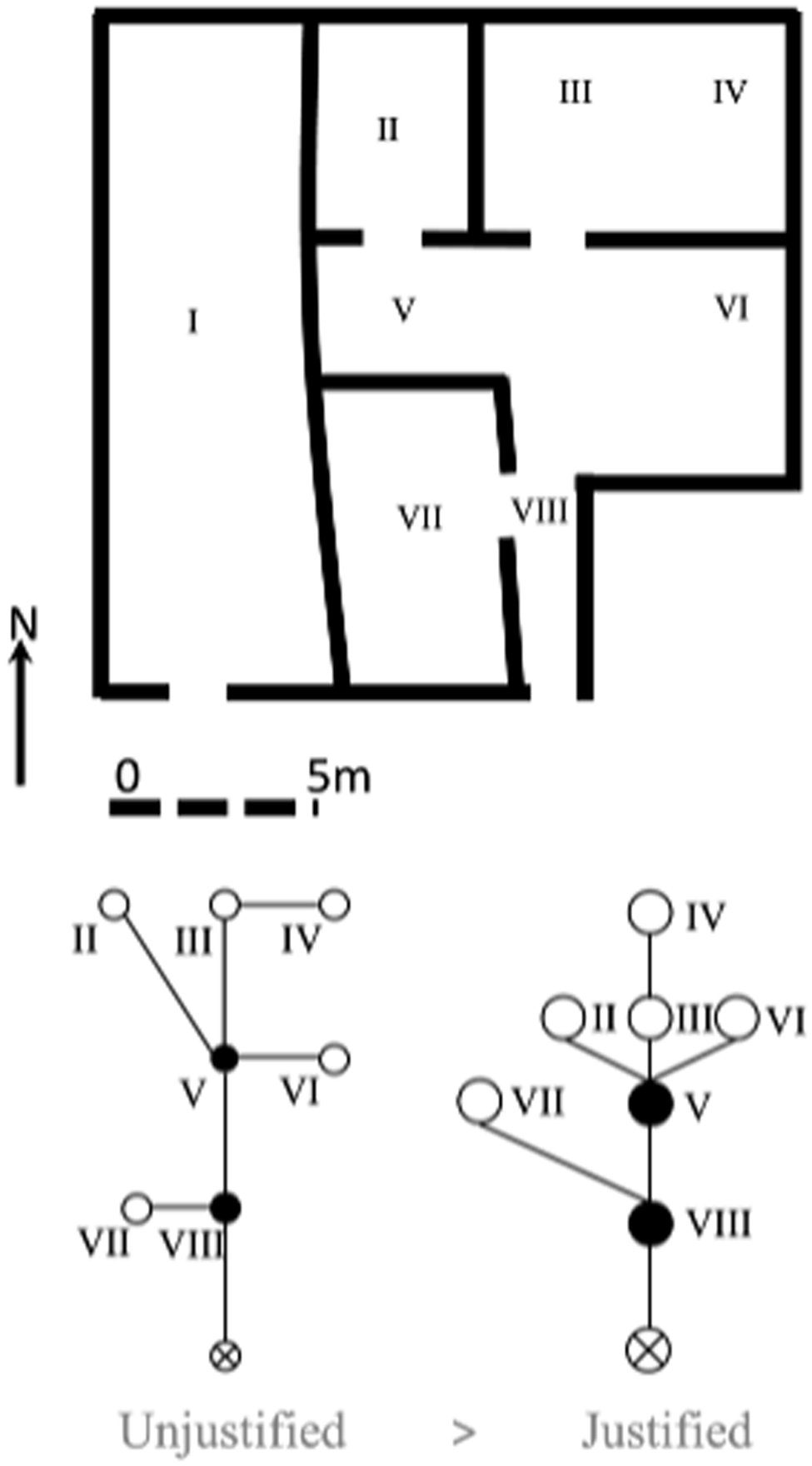
For further corroboration, conclusions about the use of ancient Greek domestic space can be interrogated using architectural theory.Footnote 25 Bill Hillier and Julienne Hanson’sFootnote 26 access analysis,Footnote 27 which maps the movement of an undifferentiated ‘inhabitant’ through bounded space(s) to investigate the relative complexity of the activities focused in different areas, proves useful to elucidate how individuals used spaces in ancient Greek houses. Hillier and Hanson’s method is based on the principles that (a) boundaries are created when spaces are enclosed and separated from one another by architectural features like walls, and (b) human behaviour has a reflexive relationship with architecture in which (i) human behaviour is cued by the built environment and (ii) the organization of architecture is influenced by human behaviour.Footnote 28 The theory underpinning the method suggests the more boundaries (thresholds) that are crossed to enter a space, the more complex the social activities taking place within it.Footnote 29 It follows that more private activity takes place in more bounded spaces. Mapping the placement and relative accessibility of bounded spaces in a building generates its access analysis map (fig. 1), which demonstrates the routes and patterns of movement required to access each space using standardized symbols (fig. 2). Existing research has focused on the generalized use of domestic spaces by non-specific household members, but I suggest that using access analysis in conjunction with juvenile-focused artefact distribution analyses makes possible a concentrated evaluation of how children used domestic space.
Production of a justified access map, using the example of Olynthus House Avi8.

Fig. 1. Long description
Top: house floorplan with each space labelled. Bottom left: unjustified access map, each space a labelled symbol placed as on the plan, the symbols connected by lines. Bottom right: justified map, the symbols placed according to how many boundaries are crossed to enter the spaces from outside.
Key to access analysis maps.

Fig. 2. Long description
Circle with cross inside representing the outside world. Solid line representing a threshold or doorway. Dashed line representing a possible threshold or doorway. Circle with no infill: a defined space, a so-called ‘room’. Circle infilled black: a transitional space, for example a courtyard. Circle infilled orange with a standard outline: a defined space with material culture of children. Circle infilled orange with a bold outline: a transitional space with material culture of children.
The utility of conducting access analyses on ancient housing has been questioned by some scholars,Footnote 30 and again some methodological issues must be addressed. Primarily, access analysis was developed in modern contexts, so it assumes that the spaces under investigation are well understood and the entry points are known.Footnote 31 Ancient Greek houses were typically mud-brick and so can be relatively ephemeral archaeologically: it is often difficult to judge their full extent, including whether they had upper floors and what upper-storey space was used for if they did.Footnote 32 Attic houses excavated to reveal full ground plans are few, and often have imprecisely recorded finds assemblages, making a comprehensive understanding of their use impossible. These issues are mitigated by using detailed case studies from Olynthus that demonstrate clear evidence of having been single-storey dwellings with stone socle foundations fully preserved. Where scholars have suggested that access analysis fails to illuminate the social use of space, I argue that the use of a holistic methodology, along with a focus on a specific demographic group, facilitates a more experience-directed analysis of ancient Greek domestic space that is inherently social. Such an analysis allows for judgement on the types of spaces children could access within houses and which members of their households they interacted with in them, besides evaluation of the likelihood that children interacted with outsiders. In addition, the standardized nature of access analysis results makes them particularly useful for comparative appraisal to identify patterns that indicate social norms.
III. Exploring evidence for children: material cultures of children and childhood
Sally Crawford recently argued that the level of proof regularly required to justify that artefacts could have been used by children is prohibitively high, and it is this, besides overly narrow definitions of what toys were historically, that often leads to the purported archaeological ‘absence’ of children in domestic contexts.Footnote 33 It is possible to identify objects associated with children in ancient Greece through material culture-focused analyses of juvenile burials, which include associated funerary objects, and iconography depicting children with things. Literary sources also mention items considered appropriate for children (fig. 3). These objects, made for children’s use and use in caring for juveniles, can be termed a material culture of childhood. Some, including diagnostic pottery like small Type III oinochoai (choes jugs), feeding cups, terracotta highchairs and rattles, were used most often, if not exclusively, by children, and provide archaeologically robust evidence: they can be found in stratified contexts in excavated houses, and their distribution can be mapped to understand children’s use of domestic space.
Material culture associated with children in ancient sources (AS), on Geometric pottery (GP), black-figure pottery (BF), red-figure pottery (RF), in burials (B), on gravestones (GS) and on white-ground pottery (WG).

Fig. 3. Long description
Rollers and toy carts found and represented in ancient sources, on black-figure pottery, on red-figure pottery, on gravestones and on white-ground pottery. Terracotta figurines discussed in ancient sources, found in burials and represented on gravestones and white-ground pottery. Astragaloi (knucklebones) discussed in ancient sources, represented on red-figure pottery, found in burials and represented on gravestones. Balls represented on black-figure and red-figure pottery, found in burials and represented on gravestones. Rattles discussed in ancient sources and represented on red-figure pottery and gravestones. Hoops represented on red-figure and white-ground pottery. Yoyos represented on red-figure pottery. Choes (small oinochoe jugs) represented on black-figure and red-figure pottery, found in burials and represented on gravestones. Feeders (feeding cups) represented on red-figure pottery and found in burials. Miniature pots found in burials. Amulets represented on red-figure and white-ground pottery. Shells found in burials. Birds represented on black-figure and red-figure pottery, on gravestones and on white-ground pottery. Dogs represented on black-figure and red-figure pottery and on gravestones. Other animals represented on Geometric, black-figure and red-figure pottery and on gravestones. Highchairs represented on red-figure pottery. Furniture represented on black-figure and red-figure pottery, on gravestones and on white-ground pottery.
A more expansive alternative to a material culture of childhood is a material culture of children; that is, all the objects children interact with, whether they were made to be used by juveniles or not.Footnote 34 Identifying evidence of this archaeologically is more challenging, and often, unfortunately, unfeasible.Footnote 35 That said, it is useful to approach evidence with an awareness of a material culture of children, mindful of the fact the meanings, values and users of objects often change throughout their life cycles.Footnote 36 Psychological investigation of cognitive development in modern contexts demonstrates that children as young as two to three start to use objects in pretend play scenarios, which often include the repurposing of objects and substitution of one for another, because from this age children understand that objects can be put to uses other than those for which they were made.Footnote 37 Ethnographic study demonstrates that play is a cross-cultural practice,Footnote 38 and patterns in exploratory play are also observable in primates,Footnote 39 so it is reasonable that conclusions drawn about children in modern contexts can also be applied to juveniles of similar ages in antiquity. Anthropological, ethnographic and sociological investigation in modern contexts also confirms the extent to which children repurpose and transform the uses of objects not made for them, that is objects not defined as ‘toys’ by adults.Footnote 40 Infants as young as six months old have been shown to mimic adults’ use of general objects, and this remains key to their use of objects until around the age of two years.Footnote 41 Further studies demonstrate that one- and two-year-old children do not necessarily privilege ‘toys’ in their home environments, but are just as likely to play with non-toys.Footnote 42 Additionally, play is only one of the ways in which children use toys, they also use objects for exploration, for construction and as tools.Footnote 43 In short, children have their own agendas when engaging with objects, and these are often different from adults’ agendas when engaging with the same things.Footnote 44 Thus a material culture of children can comprise a much wider range of objects than a material culture of childhood. In the context of ancient Greek houses, working with an awareness of a material culture of children suggests that even if a figurine, miniature pot or loom weight was not initially designed and made for children, it could easily be appropriated by them and can be considered as evidence of their presence if found in a suitable context;Footnote 45 for example, an odd loom weight alongside an otherwise matching set could easily be representative of a child’s play thing deposited alongside a signature of the activity of the adult woman who was the child’s primary caregiver.Footnote 46 Likewise, miniature vessels and figurines found in the absence of an altar or other signifier of household cult can arguably be taken as representative of a child’s presence,Footnote 47 especially if found amidst evidence of women’s other daily domestic tasks. Thus, some miniature vessels, as well as terracotta figurines of dolls and animals, and loom weights not clearly part of a set can also be sought in domestic assemblages, and their distributions can be mapped, alongside those of choes, feeders, highchairs and rattles, to explore children’s activities and social interactions in ancient Greek houses.
IV. Children in the Classical oikos: Attica
Greek houses changed markedly across the Geometric, Archaic and Classical periods, which undoubtedly impacted how children experienced domestic space.Footnote 48 But, whilst it is possible to make some observations about the representation of children’s objects in earlier houses (see Appendix), only the Classical evidence allows for robust comparative analysis towards understanding how children experienced ancient Greek domestic space.
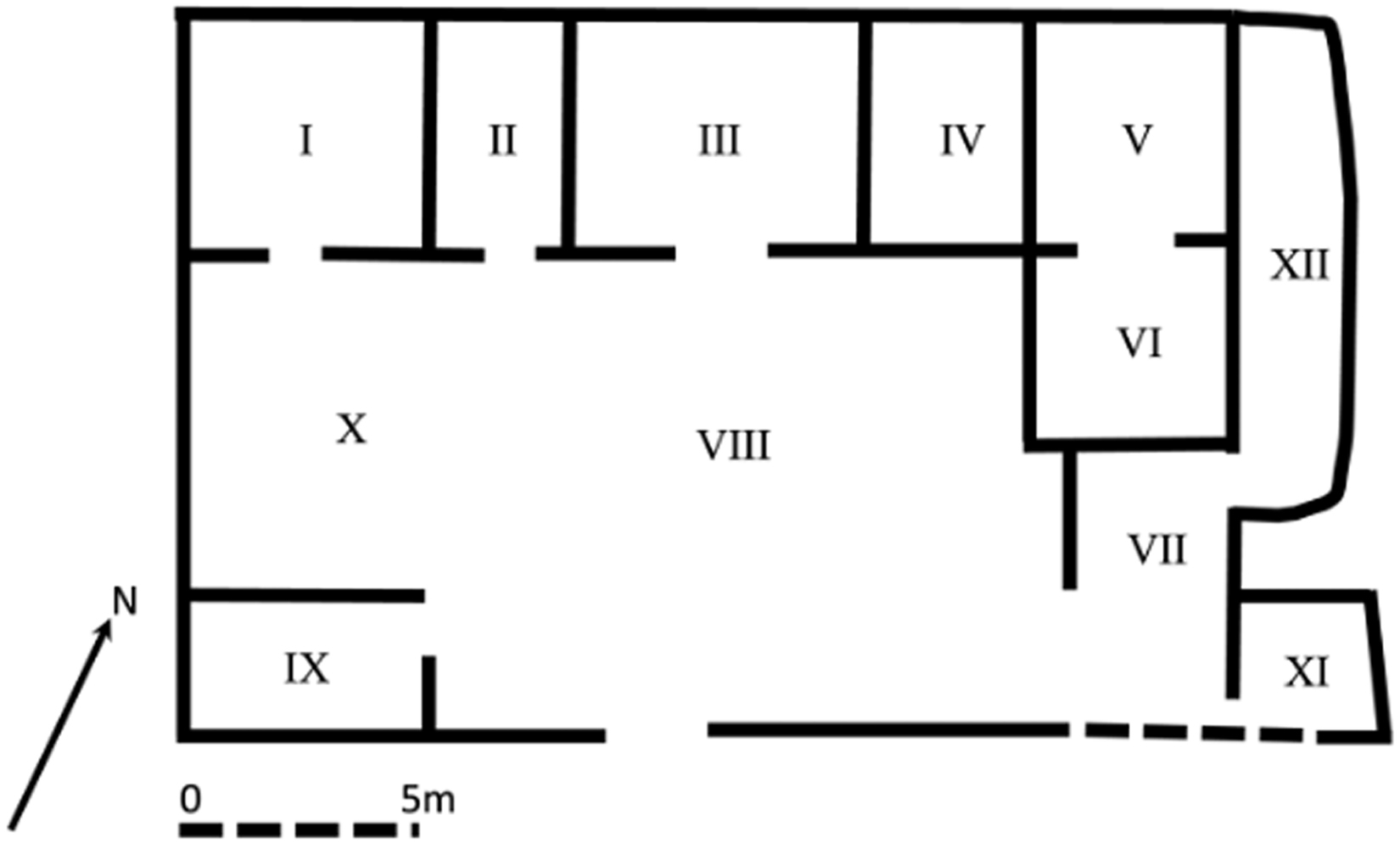
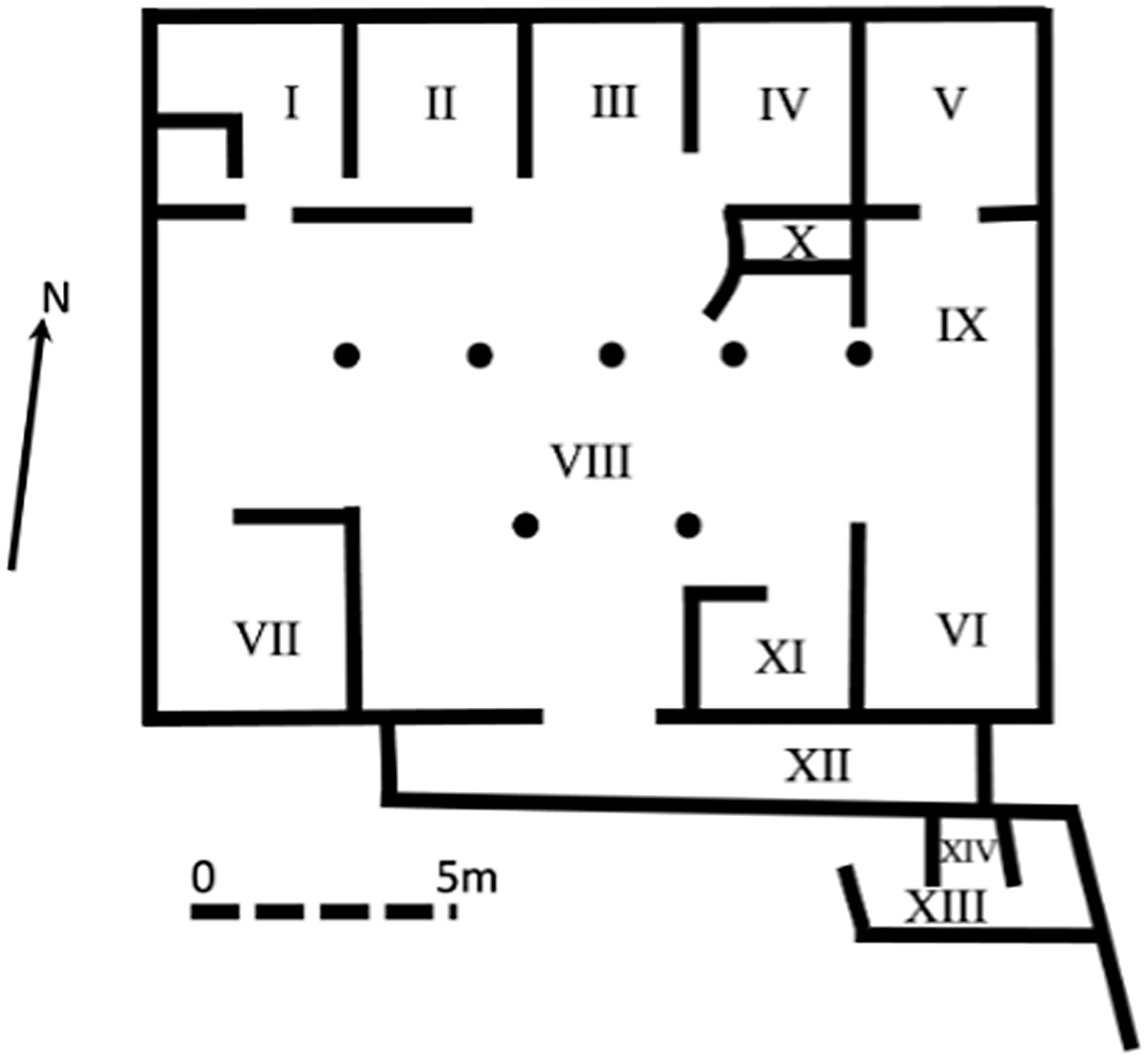
In Athens, most Classical houses have been only partly excavated with imprecise find-spots recorded.Footnote 49 The Dema and Vari houses in Attica prove more useful for understanding activity at rural dwellings.Footnote 50 The recorded finds assemblages for both houses are sparse, suggesting normal abandonment with significant clearance beforehand.Footnote 51 The Dema House was inhabited, possibly seasonally,Footnote 52 for one phase, between 425 and 400 BC (fig. 4). Fragmentary choes represent potential diagnostic evidence of children, but precise find locations were not recorded. Nonetheless, they could indicate the presence of juveniles at the site. The Vari House was primarily occupied circa 350–275 BC, though previous fifth-century occupation is also likely (fig. 5). The occupation may have been seasonal, and associated with the nearby sanctuary of Pan, with the residents living in a neighbouring deme centre during the winter.Footnote 53 Two black-glaze choes found in a secondary waste deposit in Room II are most indicative of the presence of children, but they may predate the main occupation of the site.Footnote 54 At both the Dema and Vari houses, then, imprecise recording of finds limits how far patterns of activity can be reconstructed; the houses also demonstrate the greater difficulties apparent in working with houses that were deliberately cleared when abandoned. That said, consideration of rural houses is not uninformative. Objects typically left behind upon abandonment are those difficult to transport, easy to replace or approaching the end of their useful lives.Footnote 55 Personal possessions are usually removed when residents leave of their own accord. Given that most objects in the Dema and Vari houses were household waste, the fact that material diagnostic of children was not prevalent confirms that material culture of children was conceptualized as personal effects. Thus, the lack of children’s objects is not indicative of children’s absence, but of the fact that items children treasured were treated like adults’ possessions and not carelessly discarded. The Dema and Vari houses are also useful to highlight that there would have been significant differences, including in childcare strategies, across dwellings in urban centres and those in rural villages and deme centres. As ethnographic studies show, domestic activity typically extends beyond the domestic structure and the nucleus of the settlement in rural contexts, and this naturally extends to children’s activities being more dispersed.Footnote 56 At the Dema and Vari houses evidence of the residents’ activities may have been dispersed across the associated landholdings, rather than entirely focused within the structure of the house. Thus, evidence of children and their activities may also have been left unexcavated or unrecorded in the wider landscape surrounding the houses.
The Dema House. After Jones et al. (Reference Jones, Sackett and Graham1962) fig. 1, with permission of the British School at Athens.

Fig. 4. Long description
Twelve internal spaces, rooms around a central courtyard (VIII). Spaces labelled in Roman numerals. I to V vertically adjoining to top. VI then VII beneath V to the right. XII far right. XI bottom right. IX bottom left. X between IX and I left.
The Vari House. After Jones et al. (Reference Jones, Sackett and Graham1973) fig. 2, with permission of the British School at Athens.

Fig. 5. Long description
Ten internal spaces around a central courtyard (VIII). I to V vertically adjoining to top. X beneath IV and IX then VI beneath V to the right. VII bottom left. XI bottom right beside VI. XII (entrance) bottom centre and right, with XIV then XIII beyond.
There are therefore limits to what finds assemblages currently reveal about children’s use of domestic space in Classical Attica, but considering architecture as well is more informative. Most Classical single-family dwellings, including the Dema and Vari houses, conformed to the ‘single-entrance courtyard house’ model.Footnote 57 Thus their morphology suggests a strong desire to minimize and control interaction between the household and outsiders, a concern in contemporary sources.Footnote 58 Most spaces were observable from the courtyard,Footnote 59 but the household remained shielded from the outside world because access was restricted to one entrance, which was often off-set to break sight lines between entrances and courtyards.Footnote 60 Consequently, children could have freedom of access in Classical houses, whilst also being diligently supervised and permitted minimal contact with outsiders.
V. Children in the Classical oikos: Olynthus
The North Hill settlement at Olynthus, inhabited from 432 BC,Footnote 61 is well suited to exploring children’s use of domestic space in greater detail (fig. 6). The settlement had links with the Athenian Empire, and Olynthian and Athenian houses were likely used similarly.Footnote 62 Complete ground plans are available for many houses and the Macedonian sacking of the city in 348 BC resulted in almost total abandonment, which preserved relatively extensive finds assemblages within them (fig. 7).Footnote 63 Methodological issues arise because of a lack of precise stratigraphic recording, resulting in limited information about upper-floor accommodation.Footnote 64 These issues are addressed by the fact that object distribution patterns are comparable across single- and double-storey structures, indicating that upper floors do not significantly distort artefact distribution analyses.Footnote 65 Eighteen houses are considered for what they suggest about children’s activities, which spaces they frequented, the accessibility of those spaces and other activities taking place around them in domestic space at Olynthus. In each case, patterns of behaviour and access across the house’s use-life are analysed, rather than only the moment of abandonment.
Athens and Olynthus, within Greece. Mapswire© CC-BY 4.0; transparency and location annotations added by author.

Olynthus, as excavated. After Cahill (Reference Cahill2002) fig. 6, reproduced with permission of N. Cahill and Yale University Press.

Fig. 7. Long description
North Cemetery left, with Riverside Cemetery and Resetnikia River below. North Hill settlement central with terraces of houses. Larger houses to centre and bottom right. All on grid plan. South Hill to centre bottom.
i. House A viii 4
House A viii 4, excavated in 1938, had a double entrance into space n and a smaller entrance into space l, which probably accessed a ‘shop’ in spaces g and k.Footnote 66 The house is typical of the Olynthian pastas type.Footnote 67 The ground floor comprised 15 spaces around a courtyard. The excavator noted at least 38 finds (SM fig. 1; SM = supplementary material). One, a miniature jug with strainer akin to a feeder (m), represents material culture of childhood. A further five, an animal-shaped plastic vase and female figurine (o), miniature saucers (n and o) and a small skyphos (k), are material culture of children (SM fig. 2). The cup was likely associated with non-domestic activity. Loom weights, normally representing women’s activity, were associated in space m, but the objects in space m were probably in storage, or refuse.Footnote 68 Thus, finds distribution suggests a restricted focus of juvenile activity around space o and its entrance from space n. Therefore children were active in a relatively accessible space, reached by crossing two of a possible five boundaries from the exterior (SM fig. 3). This may suggest that the childhoods experienced in House A viii 4 were relatively public but is arguably more representative of the house’s limited assemblage and can be better understood when compared to other houses and thus a baseline for the settlement.Footnote 69
ii. House B vi 7
House B vi 7, also excavated in 1938, was denoted the House of Asclepius because a statue of Asclepius was found in space f.Footnote 70 The house had one entrance, into space b. Its plan is atypical; many rooms were not accessed from the focal courtyard, and some may have been organized into suites. The ground floor was divided into three zones, comprising 11 spaces.Footnote 71 One hundred and thirteen finds were recorded in the house (SM fig. 4). One, a fragmentary strainer comparable to those integrated into feeders (k), possibly constitutes discarded material culture of childhood. A further ten, an animal terracotta, a dancing-girl figurine (e), three fragmentary terracottas and miniature oinochoai (g and i), and a small bowl and skyphos (a), are material culture of children (SM fig. 5).Footnote 72 An odd pyramidal loom weight found amongst others in space c could also constitute material culture of children.Footnote 73 The items in space a were associated with an altar, so were more likely cultic.Footnote 74 Finds distribution, analysed critically, therefore suggests foci of children’s domestic activity (alongside women’s) in spaces c, e, g and i. Children did not apparently access the andrōn (f), used to host symposia with outside guests and for other relatively public occasions regardless of the gender of the participants.Footnote 75 Overall, children were active in relatively private areas in the house; in spaces accessed by crossing at least two and up to four (the maximum) boundaries (SM fig. 6). Thus, childhoods experienced in House B vi 7 could have been largely private, unless children ventured outside the home or were deliberately exposed to visitors.
iii. Houses with material culture of children
Besides houses A viii 4 and B vi 7, full ground plans are available for 16 others with assemblages including material culture of children that is associated with evidence of women’s domestic activities, in the form of loom weights.Footnote 76 This makes it more likely that the objects represent signatures of children because women were children’s primary caregivers, according to iconography and literature.Footnote 77 TenFootnote 78 houses contained terracotta figurines and miniatures and an additional sixFootnote 79 contained figurines.Footnote 80
House A iv 5 (the House of Ariston) incorporated half of the neighbouring A iv 7 to constitute one dwelling, with two entrances into spaces a and n.Footnote 81 Flans found in spaces n and p suggest coin-minting (or counterfeiting) activity in the house.Footnote 82 Material culture of children was distributed across the house, associated with loom weights in spaces c, i, n and p (SM fig. 7): a terracotta bird (c), terracotta figurine head (d), another figurine (i), a plastic vase in the form of three children (l), more figurines and miniatures (n), an animal terracotta (p) and further figurines (o and q). Figurines and miniatures in space m were likely in storage. Thus, children’s activities could be identified at one boundary from the outside, but were more concentrated in spaces accessed by crossing two or more, up to five, boundaries in House A iv 5/7 (SM fig. 8). This is broadly consistent with houses A viii 4 and B vi 7.
House A iv 9 incorporated three independent shops facing on to Avenue B.Footnote 83 The house had one entrance, into space c, with an external staircase.Footnote 84 Loom weights evidence textile production within the house.Footnote 85 Material culture of children: a miniature skyphos (g), a plastic vase in the form of Silenus (h) and another skyphos and figurine (j), indicate children’s activity concentrated around a kitchen complex (h-j-k-m)Footnote 86 and women’s workroom with looms (g-i) (SM fig. 9). Thus, children were active in some of the most private areas, accessed by crossing three or four of a maximum of five boundaries, in House A iv 9 (SM fig. 10).
House A v 1 was accessed via an alleyway into space i, which connected it to A v 3. Material culture of children indicates children’s activity focused in outdoor space and adjacent areas (SM fig. 11): anthropomorphic and animal figurines and miniature vessels (c), further terracottas (d, e and i) and a female figurine (j).Footnote 87 Thus, childhoods experienced in House A v 1 could have been relatively public, with activity at only one remove from the outside,Footnote 88 or markedly private, in spaces three and four (the maximum) crossed boundaries from the exterior (SM fig. 12). Variation likely depended on factors including seasonality, scheduling and the activities in question.
House A v 9 demonstrated evidence of weaving and incorporated an independent shop (k).Footnote 89 The house was accessed by an alleyway into space m and a doorway into space g. Material culture of children was concentrated in outdoor, transitional space and the kitchen complex (a-b-c, SM fig. 13): a bone doll (c), miniature cup (e) and female figurine (m). Protomes in space b were likely in storage. Overall, juvenile activity was at least two, but more typically three to five, removes from the outside world in House A v 9 (SM fig. 14). Children likely frequented the more accessible space when women were outside weaving in favourable light.
Houses A viii 7 (the House of Loomweights) and A viii 9 were combined into one property. Almost 300 loom weights represent the remains of weaving activity on an larger scale than found elsewhere at Olynthus.Footnote 90 Material culture of children suggests children’s activity focused in the pastas and an adjoining room of House A viii 7 (SM fig. 15): a miniature jug (b) and another jug, lead astragaloi and female figurine (d). An odd pyramidal loom weight in space d may also have been a child’s object. Overall, children’s activity was concentrated in spaces accessed by crossing two or three boundaries in House A viii 7/9, which by now constitutes the Olynthian baseline (SM fig. 16).
Like A iv 9, House B vi 9 (the House of the Bronze Hoard) incorporated independent shops, to the east. The house probably had an entrance into space a.Footnote 91 Material culture of children was concentrated in the pastas (SM fig. 17): a satyr and male figure terracottas (e/f). Figurines and a skyphos are unlikely to constitute de facto signatures of children in the vestibule (a). Thus, children were again active in areas accessed by crossing two or three boundaries in House B vi 9 (SM fig. 18).
House C x 7 (the House of Paspalis) was subdivided into separate units, each constituting a relatively modest oikos. Footnote 92 The entrance was into space c, with an adjacent doorway leading into a ‘shop’ (d-h). Material culture of children was concentrated in a small four-room unit beside the entrance (SM fig. 19): a juglet (g). An odd pyramidal loom weight in space g may also have served as a child’s toy. A figurine of Artemis in space h was probably not associated with domestic activity. Thus, children’s lives in House C x 7 would have been relatively conspicuous within the property but still at two removes from the exterior (SM fig. 20).
House D v 6 (the House of Zoilos) was irregular in plan with an unusually small courtyard. The house was accessed by an entrance into space p, whilst integrated ‘shops’ had entrances into spaces m and n. Guttae in spaces a and d may represent material culture of childhood, because feeders are often reported as guttae, and they were found with loom weights. Material culture of children was found in space b (SM fig. 21): a juglet. Overall, children’s lives experienced in House D v 6 would have been secluded, focused in areas at five to seven (the maximum) removes from the outside world (SM fig. 22). This is atypical at Olynthus, but consistent with domestic seclusion idealized in contemporary literature.
In the Villa Section,Footnote 93 House F ii 9 (the House of Many Colours), named after its colourful decoration, demonstrates evidence of commercial and ritual besides residential activity.Footnote 94 The finds assemblage comprised almost 300 objects, including 98 complete vessels.Footnote 95 Material culture of children was concentrated in the women’s work room,Footnote 96 an adjoining secondary courtyard and a possible andrōn anteroom (SM fig. 23): an animal terracotta, miniature cups and bowls (a/b) and further miniatures (f). Miniatures in space e with altars were more likely cultic, and terracottas and miniatures in space i were in a flue, so probably refuse. Overall, children were active in spaces accessed by crossing at least two and more typically four (the maximum) boundaries from the outside, which suggests that children’s lives were relatively cloistered in a larger house like F ii 9 (SM fig. 24).
House F iii 9 (the House of the Tiled Prothyron) was possibly a priest’s residence; the assemblage, including multiple altars, presents significant evidence of cult practice.Footnote 97 The house was probably accessed via an entrance into space j. Material culture of children, including fragmentary figurines (e, h and l), a doll’s arm (f), and miniature cups (k), was concentrated in the pastas and an adjoining three-room unit (f-g-k). All items were associated with loom weights but not altars (SM fig. 25). Cups with altars in space g were more likely cultic. Overall, children’s activity was evidenced in areas two or more, up to five (the maximum), boundaries away from the outside world in House F iii 9, in keeping with the Olynthian norm (SM fig. 26).
In other houses, with only figurines, evidence was concentrated at least two and often three and four crossed boundaries from the outside. In House A 10 (the House of Polyxenus) figurines were found with loom weights in a women’s workroom at four to five removes from the exterior (SM figs 27, 28). In House A 11 (the House of Archidamus) anthropomorphic terracottas were found in a central space two removes from the exterior (SM figs 29, 30). In House A xi 10, figurines, one with a loom weight inside, were found in a kitchen complex three and four crossed boundaries from the outside (SM figs 31, 32). In House B vi 5, figurines were with evidence of a loom in situ in space h, as well as in the pastas and courtyard, all at two to four removes from the outside (SM figs 33, 34). In House ESH 4, a figurine and an odd squat loom weight were indicative of children in the kitchen complex, whilst figurines elsewhere were found with altars, so were more likely cultic (SM fig. 35). ESH 4’s oikos space was immediately accessible from the exterior through a secondary entrance (SM fig. 36). Finally, a jointed doll, miniature couch model and astragalos in House F v 2 (South Villa), one of the biggest houses at Olynthus,Footnote 98 again suggested evidence of children in the oikos, at three removes from the outside (SM figs 37, 38).
VI. Discussion
Dwelling is a social process, with the architecture of houses generating cues for social behaviours by compartmentalizing space and creating an ‘inside’ and ‘outside’.Footnote 99 Cross-cultural investigation demonstrates that the way in which domestic space is compartmentalized and used is moulded by patterns of domestic social behaviours, themselves configured by social norms.Footnote 100 Given that boys did not begin schooling until the age of seven and girls did not routinely leave the oikos before marriage in ancient Greece, children were predominantly socialized and introduced to social norms through intergenerational interaction in domestic contexts. Investigating children’s activities and interpersonal interactions in houses is thus key to understanding children’s social identities more broadly in ancient Greece.
In the literary sources, details about life in the oikos are typically throwaway comments which largely present an elitist, androcentric perspective, so archaeological evidence is key to understanding wider experiences, including those of children, in ancient Greek domestic space. Considered together, the archaeological and literary evidence reveal discrepancies which indicate that the use of domestic space in ancient Greece was fundamentally dynamic and could be negotiated and scheduled;Footnote 101 it was changeable in accordance with the season, time of day and presence/absence of outsiders.Footnote 102
The evidence from Olynthus indicates that children enjoyed more flexibility in their use of domestic space than has typically been imagined. Eighteen of the 70 houses excavated at Olynthus include material culture of children, objects with which children likely interacted with some frequency, and that have been preserved, excavated and recorded such that their distribution within them can be analysed. Clearly, this evidence is not wholly representative of children’s presence and activities. It stands to reason that children inhabited almost all of the houses across the settlement, but analyses of Olynthus as a sample does allow for fruitful discussion towards drawing some interesting conclusions. As noted above, patterns replicated across multiple houses are of particular importance. Thus key findings are that children’s activities were concentrated around women’s work, in oikos-complexes and women’s workrooms,Footnote 103 and they were not attested in what have traditionally been labelled ‘men’s rooms’, used when entertaining outsiders, when houses had dedicated andrōn spaces.Footnote 104 This reiterates that women, be they mothers, other female relatives or domestic slaves, were children’s predominant caregivers in domestic settings. Material culture of children was also often found in courtyards and the adjoining pastas;Footnote 105 it was then that children’s activities were in closest proximity to the world beyond the oikos, taking place at only one or two crossed boundaries from outside. Justified access maps for the 18 houses demonstrate that they typically incorporated four to six boundaries. Children’s activities were concentrated in spaces accessed by crossing two or three, but significant variability is apparent (fig. 8). The data therefore indicate that childhoods could be relatively secluded within the oikos at Olynthus, so children likely experienced minimal ‘unpoliced’ interactions with outsiders and had little in the way of a social identity beyond their family group as a consequence. That said, the variability apparent in the data also shows that children were active in multiple areas and were not necessarily always cloistered in the most private parts of the house: much likely depended on changeable factors like seasonality, scheduling and the nature of the activities that children, and their caregivers, were engaged in. One can easily imagine that another factor was variability in precisely which children were represented by the objects in each case: the activities of two genders and various ages are represented across the material culture of children, and a two-year-old boy would undoubtedly have used a terracotta figurine (found in most houses) very differently from a 12-year-old girl, not least with significantly more direct supervision and less autonomy! Hence, though it is beyond the scope of this article, the methodology developed here has clear potential to reveal an increasingly nuanced understanding of how different children experienced domestic space in future research: with the material culture of children subcategorized to link certain objects to certain age groups, it would become possible to achieve a distinct and detailed understanding of the experiences of those two- and 12-year-olds (and their fellow juveniles).
Access analysis summary.

Fig. 8. Long description
House Aviii4 with 1 space containing material culture of children, accessed by crossing 1 or 2 boundaries. The house with a maximum of 3 boundaries. House Bvi7 with 4 spaces containing material culture of children, accessed by crossing 2, 3 or 4 boundaries. The house with a maximum of 4 boundaries. House Aiv5/7 with 4 spaces containing material culture of children, accessed by crossing 1 or 2 boundaries or 4 or 5 boundaries using a secondary entrance. The house with a maximum of 6 boundaries. House Aiv9 with 3 spaces containing material culture of children, accessed by crossing 3 or 4 boundaries. The house with a maximum of 5 boundaries. House Av1 with 4 spaces containing material culture of children, accessed by crossing 1, 2, 3, or 4 boundaries. The house with a maximum of 4 boundaries. House Av9 with 3 spaces containing material culture of children, accessed by crossing 2, 4 or 5 boundaries or 3 boundaries using a secondary entrance. The house with a maximum of 6 boundaries. House Aviii7/9 with 2 spaces containing material culture of children, accessed by crossing 2 or 3 boundaries. The house with a maximum of 4 boundaries. House Bvi9 with 2 spaces containing material culture of children, accessed by crossing 2 or 3 boundaries. The house with a maximum of 5 boundaries. House Cx7 with 1 space containing material culture of children, accessed by crossing 2 boundaries. The house with a maximum of 4 boundaries. House Dv6 with 3 spaces containing material culture of children, accessed by crossing 5, 6 or 7 boundaries. The house with a maximum of 7 boundaries. House Fii9 with 3 spaces containing material culture of children, accessed by crossing 2 or 4 boundaries. The house with a maximum of 4 boundaries. House Fiii9 with 6 spaces containing material culture of children, accessed by crossing 2, 3, 4 or 5 boundaries. The house with a maximum of 5 boundaries. House A10 with 2 spaces containing material culture of children, accessed by crossing 4 or 5 boundaries. The house with a maximum of 6 boundaries. House A11 with 1 space containing material culture of children, accessed by crossing 2 boundaries. The house with a maximum of 5 boundaries. House Axi10 with 1 space containing material culture of children, accessed by crossing 3 boundaries. The house with a maximum of 4 boundaries. House Bvi5 with 2 spaces containing material culture of children, accessed by crossing 2 or 3 boundaries. The house with a maximum of 4 boundaries. House ESH4 with 1 space with material culture of children, accessed by crossing 2 boundaries. The house with a maximum of 5 boundaries. House Fv2 with 1 space with material culture of children, accessed by crossing 3 boundary or 1 boundary using a secondary entrance. The house with a maximum of 6 boundaries.
Reflection on the evidence from Attica, in light of the results from Olynthus, reiterates the point that though the visible archaeological record of children in houses is often limited, in part because objects associated with children have been discarded and/or gone unrecorded in excavations,Footnote 106 material cultures of children clearly did exist in ancient Greece, and they are usually represented in houses. At both the Dema and Vari houses, which were probably only occupied seasonally and have limited finds assemblages, objects that can be classified as ‘material culture of children’ were still recorded. The lack of more concrete ‘material culture of childhood’ in the houses can also be explained by their removal as personal possessions when the houses were abandoned (see Appendix, supplementary material). In addition, ethnographic evidence demonstrates that children’s activities are typically dispersed across the landscape surrounding a dwelling in rural contexts,Footnote 107 so that significant evidence of children has likely remained unrecovered in archaeological excavations that have focused on the built structures at the Dema and Vari sites. It stands to reason that children spent a greater proportion of their time out of doors in rural contexts, because it was safer and practicable for them to do so, compared to busy urban environments. Unfortunately no rural housing has yet been excavated and recorded to an extent sufficient to inform us of children’s use of the surrounding landscape, but this is undoubtedly something that will become feasible as more evidence for rural housing becomes available.
Ultimately, working with the evidence currently available, with the cases considered here I have conducted preliminary testing of a holistic methodology to open up a new avenue of research in household archaeology. These cases have confirmed that a juvenile-centric archaeology of domestic space is both feasible and worthwhile, but it is also clear that there remain further steps to take towards developing a fully nuanced understanding of children’s use of domestic space in ancient Greece. Moving forward, the keys to this are: (a) a positive approach that actively seeks out children in the material record of houses rather than ascribing adult-centric functions to objects by default (this can be achieved through sustained work with the concept of a material culture of children, which accounts for all of the objects juveniles could interact with frequently), whether or not children were their sole/primary users; and (b) an appreciation of the diversity of activities, experiences and individuals represented by that material culture of children, to critically explain its variegated dispersal across excavated houses. With the evidence currently available, a possible next step is to evaluate domestic assemblages with a view to identifying objects made by children. As material culture of childhood, these objects would more securely attest to the presence and activities of children within houses.Footnote 108 Close typological analyses of figurines and miniatures in child burials against those in houses could prove useful, to try to identify certain types specifically made for children, and possibly for children of distinct ages and gender. Beyond this, Lisa Nevett has recently argued for commonality in the use of domestic space across Greece,Footnote 109 so there is work to be done testing the hypotheses presented here in wider Greek contexts. As more evidence becomes available, exploring diachronic change in how children experienced domestic space will be key to understanding the changing significance of children in society. Initial analyses suggest an incongruent relationship between the real and the purported visibility of children in society beyond the house across the Geometric, Archaic and Classical periods. Whilst the morphology of Geometric houses suggests that children spent much of their time outside (see Appendix), the Classical evidence considered above indicates that later childhoods were more cloistered, with children spending much of their time in confined areas of already privacy-focused houses, only interacting with outsiders when desirable. This in spite of the fact that it was from the fifth century that children were particularly celebrated, included in iconography on painted pottery and public grave stelai, besides being given formal burial to an unprecedented degree. This indicates that the increasing visibility of children in iconography and the funerary landscape was primarily ideological, rather than reflective of a changing society in which children spent more time in public view,Footnote 110 but cognizance of the full significance of the changes requires further application of the methodology developed here as and when a more robust archaeological record of Greek housing becomes available, which includes highly detailed recording of all small finds.Footnote 111
Supplementary material
To view supplementary material for this article, please visit https://doi.org/10.1017/S0075426926100548
Acknowledgements
I extend my heartfelt thanks to my supervisors, Dr Sally Waite, Dr Matthew Haysom and Professor Chris Fowler, and my examiners Dr April Pudsey and Professor Mark Jackson, as well as the anonymous reviewers and Professor Lin Foxhall, for feedback and support received and enriching discussions that have made this piece better than it could otherwise have been.
Funding statement
This article is drawn from my Ph.D. research conducted at Newcastle University, which was funded, in part, by a Northern Bridge Consortium Doctoral Training Partnership studentship.
Abbreviations
AiGO Archaeology in Greece Online




 Open access

