Introduction
Eating disorders that involve the use of self-induced vomiting (SIV) and objective binge eating episodes (OBE; eating a large amount of food in a short period of time accompanied by a feeling of loss of control) are typically associated with the diagnosis of bulimia nervosa (BN), although such behaviours also occur in other eating disorders. Whilst many studies have examined risk factors for BN (for a review see Jacobi et al. Reference Jacobi, Hayward, de Zwaan, Kraemer and Agras2004), fewer studies have examined differential risk factors for OBE and SIV. If different specific risk factors for SIV and OBE exist with only a moderate overlap between the latent risk factors, this would constitute some support for consideration of a purging disorder that occurs in the absence of OBE and a binge eating disorder that occurs in the absence of purging as diagnostic entities separate from eating disorders where the two behaviours co-occur.
Two twin studies have suggested some degree of overlap in latent risk factors for overeating (defined as eating large amounts of food in a short period of time but omitting the ‘out of control’ aspect of the definition) and purging, but also indicated substantial lack of overlap in risk factors. One study examined overlap between BN and overeating, finding only moderate overlap between latent risk factors, where 50% of the genetic factors influencing BN were unique to BN and not shared with overeating, and 66% of the environmental factors were unique to BN (Wade et al. Reference Wade, Bulik, Sullivan, Neale and Kendler2000). Another study investigated the degree of overlap with respect to the genetic and environmental risk factors for overeating and vomiting. Sullivan and colleagues (Reference Sullivan, Bulik and Kendler1998) found that around 55% of genetic risk factors for overeating and vomiting were shared, and around 23% of the environmental risk factors were shared. Perhaps as a consequence of omitting the ‘feeling out of control’ criterion required for OBE, they found a relatively high prevalence of binge eating (23.6%) compared to vomiting for weight control (4.8%).
A variety of risk factors for eating disorders that include overeating or OBE have been identified in the research literature. A Swedish study (Engstrom & Norring, Reference Engstrom and Norring2001) of an adolescent sample found that living alone, moving away from home early and the experience of bullying was associated with an increase of overeating. Similarly, a recent study of American women (Striegel-Moore et al. Reference Striegel-Moore, Dohm, Kraemer, Schreiber, Taylor and Daniels2007) identified elevated levels of perceived stress as being associated with lifetime disorders where OBE were present. A study of American adolescent girls (Stice et al. Reference Stice, Presnell and Spangler2002) showed that growth in OBE was predicted by elevated dieting, pressure to be thin, modelling of eating disturbances, appearance over-evaluation, body dissatisfaction, depressive symptoms, emotional eating, higher body mass index (BMI) and low levels of self-esteem and social support. The work of Birch and colleagues (Davison et al. Reference Davison, Francis and Birch2005; Galloway et al. Reference Galloway, Fiorito, Francis and Birch2006) suggests that, in young children, parental comments or behaviour can be associated with either restrictive eating practices or overeating and obesity. In one study, higher levels of neuroticism have been found to be associated with overeating but not BN (Wade et al. Reference Wade, Bulik, Sullivan, Neale and Kendler2000). One of the few studies to examine predictors of purging investigated women across different eating disorder classifications and showed that women who used vomiting for weight regulation had lower self-directedness and higher novelty seeking than those women who did not vomit (Reba et al. Reference Reba, Thornton, Tozzi, Klump, Brandt, Crawford, Crow, Fichter, Halmi, Johnson, Kaplan, Keel, LaVia, Mitchell, Strober, Woodside, Rotondo, Berrettini, Kaye and Bulik2005).
Overall, research to date suggests that there may be different specific risk factors for SIV and overeating, and that there is only moderate overlap between risk factors for each behavioural disturbance. However, we know less about the overlap of risk factors between OBE and SIV. Therefore, there were two main aims of the present study. The first was to examine the degree of overlap in latent genetic and environmental risk factors between lifetime OBE and SIV. This was achieved by examining two waves of data from a large-community Australian twin population. The second aim was to examine specific prospective predictors of lifetime OBE and SIV, including variables measuring BMI, stressful life events (including parental interactions when growing up), and temperament. In addition, ‘retrospective correlates’ (Jacobi et al. Reference Jacobi, Hayward, de Zwaan, Kraemer and Agras2004) or retrospectively recalled life events that occurred before the onset of OBE or SIV were also considered. In terms of what has previously been reported in the literature, it was hypothesized that there would be moderate overlap in risk factors between OBE and SIV, with variables related to BMI and stressful life events being more likely to predict OBE, and temperament being more likely to predict SIV.
Method
Participants
Participating twins were originally derived from a cohort of twins born during 1964–1971, who were registered as children with the Australian Twin Registry during 1980–1982, in response to media and systematic appeals through schools (Heath et al. Reference Heath, Howells, Kirk, Madden, Bucholz, Nelson, Slutske, Statham and Martin2001). The twins in this group were enrolled by their parents and at that stage were not involved in any data collection and therefore their status as potential respondents was unknown. Female–female twins who had subsequently participated in at least one of two waves of data collection, the first (wave 1) during 1989–1992 when the twins were aged 18–25 years (50.9% of the original sample), and the second during 1996–2000 when the median age of the sample was 30 years (77.7% of the original sample), were approached during 2001–2003 to participate in a third wave of data collection (wave 3). Of the 2320 twins (1140 complete pairs) approached for wave 3, 1083 individual twins actively consented to participate (47%), of whom 1002 completed a telephone interview and 1016 completed a questionnaire, with 962 women completing both, a total of 1056 females (46%). This included 348 complete sister–sister pairs (226 MZ, 122 DZ) and 360 incomplete pairs (170 MZ, 190 DZ) where only one twin participated. Zygosity was determined on the basis of responses to standard questions about physical similarity and confusion of twins by parents, teachers, and strangers, methods that have been found to give better than 95% agreement with genotyping (Eaves et al. Reference Eaves, Eysenck, Martin, Jardine, Heath, Feingold, Young and Kendler1989). The mean age of the women at the time of data collection was 35 years (s.d.=2.11, range 28–40), and the mean age of these women at wave 1 was 24 years (s.d.=2.10). The Flinders University Clinical Research Ethics Committee approved the study and written informed consent was obtained after the procedures were fully explained.
Measures
Eating behaviour and diagnoses at wave 3
The telephone interview utilized the Eating Disorder Examination (EDE), 14th edition (Fairburn & Cooper, Reference Fairburn, Cooper, Fairburn and Wilson1993) that included questions relating to behavioural features of eating disorders, including OBE and purging (use of self-induced vomiting, laxatives and diuretics) over both a 3-month time-frame as well as the lifetime using DSM-IV diagnostic criteria. No skip rules were employed. In order to be consistent with current DSM practice, lifetime threshold OBE and/or purging behaviours had to occur at least twice a week for a 3-month period with breaks of no more than 2 weeks. Follow-up questions included the age range during which the behaviour occurred in order to assess the co-occurrence of these behavioural features, in addition to a question asking if the behaviours had occurred at the same time. A full description of the diagnosis of eating disorders in this population has previously been provided (Wade et al. Reference Wade, Bergin, Tiggemann, Bulik and Fairburn2006b, Reference Wade, Bulik, Sullivan, Neale and Kendlerc). All interviewers were postgraduate clinical psychology trainees (n=10) who were trained in use of the EDE. Interviews were taped and corrective feedback was provided until the interviewer reached criterion, and different interviewers interviewed each member of a twin pair. The inter-rater reliability of the four subscales of the EDE (last 4 weeks) was high, ranging from 0.93 to 0.98. Across 22 taped interviews (nine featuring lifetime BN, five with binge eating disorders and eight where purging had occurred in the absence of objective binge episodes) there was agreement about the absence or presence of objective binge episodes on all occasions except one.
Eating behaviour at wave 1
The presence of disturbed eating was obtained from self-report at wave 1. Purging was assessed for four behaviours (self-induced vomiting, laxatives, fluid tablets, or slimming tablets) with a stem question that enquired: ‘Have you used any of the following methods (now or previously) to control your weight?’ Finally, a question enquired ‘Have you ever suffered from or been treated for binge eating?’
Prospective risk factors
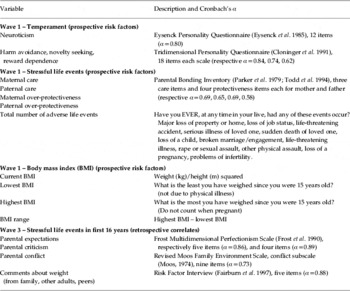
Risk factors were all assessed by self-report questionnaire at wave 1 and divided into three categories. Each of the 14 variables is described in Table 1. The first category, temperament, included five variables. The second category included five types of life-event measures. The fourth category related to BMI. The mean item score for each of the variables from the first two categories was used in the analyses.
Description of the self-report variables examined as prospective risk factors or retrospective correlates

Retrospective correlates
This category included four life-event variables that had occurred over the first 16 years of life and were recalled at wave 3, where the mean item score for each variable was used in the analyses.
Statistical analyses
Bivariate twin analyses: overlap in latent sources of variance
First, the relationship between zygosity and the risk factor variables was examined using logistic regression. Second, the method of maximum likelihood using Mx (Neale, Reference Neale1997) was used to examine the bivariate relations between presence or absence of wave 3 lifetime OBE and lifetime SIV, where models are fit to raw data from all twins, including those with missing data and those pairs where only one twin participated. Given that previous analyses showed no relation between participation in the current wave of data collection and variables from the previous two waves, including the number of eating problems, personality variables, or lifetime depression (Wade et al. Reference Wade, Bergin, Martin, Gillespie and Fairburn2006a), this statistical approach can reduce the impact of any respondent bias when the data are missing at random (Little & Rubin, Reference Little and Rubin1987).
In the traditional bivariate twin modelling, the sources of variation in liability to each disorder (i.e. presence or absence of purging and OBE) are divided into that proportion accounted for by three different influences: additive genetic (a2), common or shared environmental (c2), and non-shared or unique environmental (e2). This latter factor also contains the variance of any error measurement. Each factor is latent and not directly observed. Thus, two separate sets of estimates are obtained, one for each behaviour, along with 95% confidence intervals (CI). In addition, three distinct and independent correlations are estimated corresponding to the degree of overlap between a2p, c2p, and e2p for purging and a2OBE, c2OBE and e2OBE for OBE (labelled r a, r c, and r e). Initially, a full model (ACE) was fit to the data, followed by an AE model, a CE model, and a model containing only non-shared environment (E). In order to assess the improvement in fit of the models, we compared twice the difference in log-likelihood between the models that yields a statistic that is asymptotically distributed as χ2 with degrees of freedom equal to the difference in their number of parameters, as well as examining Akaike's Information Criterion (AIC; Akaike, Reference Akaike1987), where the more negative the value, the better the fit of the model. The goal of model fitting is to explain the observed data as an optimal combination of goodness-of-fit and parsimony.
Specific prospective risk factors and retrospective correlates
Three groups of women who had completed both wave 1 and wave 3 assessments were selected for analysis. First, with respect to purging, the first group comprised those women who had reported not using lifetime SIV at either wave 1 or wave 3. The second group comprised those women who had reported lifetime SIV at wave 1 but may or may not have reported lifetime SIV at wave 3. This third group of women had not reported lifetime SIV at wave 1 but did report lifetime SIV at wave 3.
Second, with respect to OBE, the first group comprised those women who had reported not lifetime binge eating at either wave 1 or wave 3. The second group comprised those women who had reported lifetime binge eating at wave 1 but may or may not have reported lifetime OBE at wave 3. The third group included those women who had not reported lifetime binge eating at wave 1 but had reported lifetime threshold OBE at wave 3. Across both SIV and OBE, comparison of the first and third group can inform our knowledge about prospective risk factors, and the use of the second group can inform us about retrospective correlates.
As the twin data contains correlated observations and the assumption of independent sampling was violated, comparisons of the level of the continuous variables between the two groups (those women who had never had eating disorder behaviour and those who had developed the behaviour between waves 1 and 3) were conducted using linear mixed effects modelling with SPSS version 13.0 (SPSS Inc., Chicago, IL, USA), using fixed-effects models with non-residual errors. This procedure specifies a more general covariance structure for the residual errors, thus adjusting the standard errors for non-independent observations. When examining the onset of OBE, lifetime purging as reported at wave 3 was included as a covariate in order to remove the influence of vomiting on the results. Similarly, when examining the onset of SIV, lifetime OBE as reported at wave 3 was included as a covariate.
Results
Descriptive statistics for the whole sample at wave 3
In the whole sample (n=1002) at wave 3, 26 women (2.5%) reported both threshold OBE and SIV over their lifetime, 35 (3.3%) reported SIV only and 40 (3.8%) reported lifetime OBE only.
Descriptive statistics for women who initiated purging between waves 1 and 3
Of the women who were assessed at both waves 1 and 3, 676 reported not using lifetime SIV at both waves 1 and 3, 68 reported SIV at wave 1 but may or may not have met criteria for lifetime threshold purging at wave 3, and 17 women had not reported lifetime SIV at wave 1 but reported lifetime SIV at threshold levels at wave 3. The mean age of initiating SIV in the second group of women was 19.30 years (s.d.=3.10) with an age range of 13–27 years, and the mean age of initiating SIV in the third group was 21.53 years (s.d.=5.50) with an age range of 14–30 years. There was not a significant difference between ages of onset for the two groups (p<0.05).
Descriptive statistics for women who initiated binge eating between waves 1 and 3
Of the women who were assessed at both waves 1 and 3, 710 reported absence of binge eating at both waves 1 and 3, 28 reported lifetime binge eating at wave 1 and may or may not have met criteria for lifetime threshold OBE at wave 3, and 40 women had reported absence of lifetime binge eating at wave 1 but reported lifetime OBE at threshold levels at wave 3. The mean age of initiating OBE in the second group was 19.00 years (s.d.=4.14) with an age range of 13–25 years, and the mean age of initiating OBE in the third group was 19.70 years (s.d.=5.91) with an age range of 6–29 years. There was not a significant difference between ages of onset for the two groups (p<0.05).
Bivariate twin modelling
Before model fitting, the impact of zygosity on purging and OBE were examined. Zygosity did not predict SIV status (OR 1.23, 95% CI 0.73–2.07) or OBE status (OR 1.06, 95% CI 0.64–1.76), indicating that OBE and SIV did not differ in families containing MZ versus DZ twin pairs.
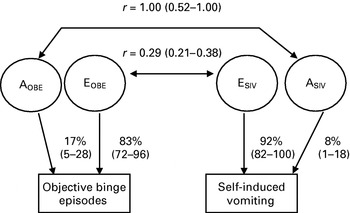
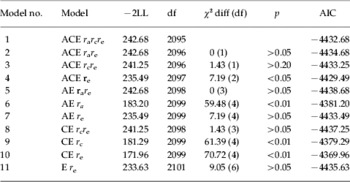
A series of bivariate twin models were fit to the observed data of the presence of absence of lifetime threshold purging and OBE. In addition to the full model, allowing for three latent sources of variance (a2, c2, e2) as well as correlations between the three latent variables (r a, r c, r e), we tested 10 submodels where the parameters were systematically varied, as shown in Table 2. It can be seen that four of the submodels can be rejected as being significantly worse fitting than the full model, namely models 4, 6, 9 and 10. We had insufficient power to discriminate between the other six submodels but examination of the most parsimonious model with the best fit (i.e. the more negative AIC value) was model 5 (AE r ar e), which had the same parameter estimates as the full model where the c2 estimate for both purging and OBE was 0. The next best-fitting model was model 8 that allowed for no genetic influences. Model 5 is shown in Fig. 1.
The most parsimonious and best-fitting Bivariate Cholesky Pathway model showing the overlap in variance contributed to the two phenotypes [lifetime threshold objective binge episodes (OBE) and self-induced vomiting (SIV)] by the latent genetic (A) and non-shared environmental (E) sources of variance (95% confidence intervals in parentheses).

Fit statistics for bivariate twin analyses between lifetime purging and objective binge episodes

Additive genetic variance (A), shared environmental influence (C) and non-shared environmental influence (E) are signified for both purging and objective binge episodes, with the correlation term referring to the correlations between the latent factors contributing to the two disorders.
Prospective predictors and retrospective correlates of purging
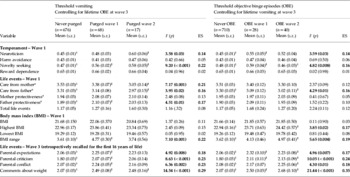
As summarized in Table 3, wave 1 variables that prospectively predicted lifetime threshold SIV at wave 3 included higher levels of neuroticism and novelty seeking and lower levels of care from both parents. Of the retrospectively recalled life events from the first 16 years, higher levels of comments about weight or eating were associated with SIV initiation. In addition to this, the group that had initiated purging before wave 1 reported a larger BMI range and higher levels of parental expectations, criticism and conflict.
Differences between those women who never vomited/binged and those who commenced between waves 1 and 3 (F statistics are in bold where significant)

ES, Between-group effect size, Cohen's d, where 0.2–0.49 is small, 0.5 to 0.79 is medium, and above 0.8 is large.
Numerical superscripts indicate that the means are significantly different across the groups within each behavioural category.
a Enquired for the time period: ‘when you were growing up’.
Prospective predictors and retrospective correlates of OBE
Also summarized in Table 3 are the wave 1 prospective predictors of wave 3 lifetime threshold OBE, namely lower levels of perceived care from father, a higher maximum BMI and a wider BMI range. All of the retrospective correlates were associated with OBE initiation, namely higher levels of parental expectations, parental criticism, parental conflict, and comments about weight or eating. In addition to this, the group that had initiated OBE before wave 1 reported higher levels of neuroticism and novelty seeking.
Discussion
The current study examined the degree of overlap of risk factors between lifetime OBE and SIV in two ways. First, we used the whole twin population to examine sources of latent variance associated with OBE and SIV and the degree of overlap between them. Second, we examined those twins who had developed OBE and/or SIV between our two waves of assessment and compared wave 1 variables between this group and women who had never experienced OBE and/or SIV, as well as retrospective correlates. In the current sample, of women who reported lifetime OBE and/or SIV, only 25.7% reported doing both, either contemporaneously or at separate times in their lives.
The twin modelling revealed that the contribution of genetic variance to either of the two behaviours was no more than 28% of the total variance. The actual overlap between latent genetic risk factors for the two behaviours was unclear, due to the wide confidence intervals obtained. The majority of variance contributing to both threshold purging and OBE was due to unique environmental factors, although some of this variance will be attributable to measurement error, where little overlap between the environmental risk factors for the two behaviours was indicated, at no more than 14% of the variance. Results relating to the degree of genetic and environmental influence on OBE and SIV contrast with the only other examination of such shared risk factors between overeating and vomiting. Sullivan and colleagues (Reference Sullivan, Bulik and Kendler1998) reported the same type of best-fitting model (one that incorporated genetic and non-shared environmental variance), but they found that 46% and 72% of the variance of overeating and vomiting respectively was due to genetic influences. Clearly our results find far less role for genetic influences. There are four possible explanations for these discrepant findings. First, the Virginian sample examined in Sullivan's work reported lifetime behaviours over 1992–1995, compared to 2001–2003 in the present sample. Given that the mean age of the samples were the same at the time of interview, it may be that over the years the influence of the environment has become more important. For example, there may have been more widespread reporting of the use of SIV for weight control in the media. Second, only overeating was included in the Virginian sample, whereas OBE was included in the present sample, and this may well influence the heritability estimates for this behaviour. Third, the phenotypes analysed in the Sullivan study included ever having eating binges or using vomiting to control shape and weight. In other words, the behaviour may have occurred on just one occasion. In contrast, the current study required a threshold frequency for the phenotype. Previous findings indicate that the number of eating disorder behaviours is heavily influenced by the environment (Wade et al. Reference Wade, Bergin, Martin, Gillespie and Fairburn2006a), and this may also be the case for frequency of behaviours. Finally, and perhaps less plausibly, there may be a gene–environment interaction at work, where the influences of Virginian culture are less buffering of body dissatisfaction compared to the Australian culture, thereby increasing heritability for weight control behaviours in the former culture. Clearly further investigation of the genetic and environmental variance contributing to OBE and SIV is warranted.
As hypothesized, there was a lack of overlap between specific prospective risk factors for the two behaviours, where only two of the 17 risk variables for OBE and purging were shared, namely the retrospectively reported comments about weight when growing up and prospectively reported lower levels of parental care. Both of these measures, despite ostensibly focusing on the environment, are also likely to be influenced to some degree by genetic variance, where the heritability contribution to reports of parenting behaviour by the child can be considered to account for about one quarter of the variance, where some of this can be accounted for by genetically influenced temperament of both parents and children (Kendler & Baker, Reference Kendler and Baker2007). In the context of our results relating to low heritability, it may be that the heritability associated with parents may wield more of an influence on the reporting of parental behaviour in the present study.
Overall, temperament was more indicated with respect to purging, and variables related to BMI and stressful life events were more likely to predict OBE. With respect to temperament, higher levels of neuroticism and novelty seeking predicted the initiation of purging. Initiation of OBE but not purging was predicted by the issues related to weight at wave 1, namely having a significantly higher maximum BMI and a greater fluctuation in BMI over their lifetime. Whilst evidence related to our retrospective correlates is less compelling, given the potential for retrospective recall to be influenced by the eating disorder, those women experiencing threshold OBE during their lifetime reported less satisfactory relationships with parents whilst growing up than the women who purged in terms of higher levels of parental expectations, criticism and conflict. Evidence from previous studies suggests at least moderate heritability of temperament styles (Heath et al. Reference Heath, Cloninger and Martin1994) and BMI (Maes et al. Reference Maes, Neale and Eaves1997), which may contribute to the genetic variance associated with OBE and purging in the present study.
It is of interest to compare results of the women who had already initiated OBE or SIV by wave 1, which informs knowledge about retrospective correlates, to the results of women who initiated these behaviours between waves 1 and 3, which informs knowledge about prospective risk factors. With respect to SIV, these results concurred for novelty seeking and care from mother, but only retrospective correlates were supported for over-protection from father, BMI range, and all the four wave 3 life events. With respect to OBE, these results concurred for three of the wave 3 life events, but only retrospective correlates were supported for neuroticism and novelty seeking. It could be suggested that the occurrence of the behaviour influences subsequent reporting in the case where only retrospective correlates were supported, and that these are not true risk factors. However, this suggestion should be interpreted in the context of our small groups and lack of potential power to definitively identify either retrospective correlates or prospective risk factors.
In terms of considering the environmental mechanisms that may be at play with respect to OBE, it may be that children who are overweight are more likely to elicit negative reactions from parents and significant others in their social network and thus may use binge eating as a coping mechanism, a tendency which may be reinforced by any habitual dietary restraint in response to being overweight.
In contrast, the environmental mechanisms influencing purging behaviour do not seem related to weight, but to a temperament related to neuroticism and novelty seeking. These types of temperaments may lead to eliciting negative reactions from people in their environment, or to ‘self-selection into pathogenic environments’ (Kendler, Reference Kendler2001), and purging may perform some mood-stabilizing function, or be a form of self-harm that represents a punitive function.
The ability of these results to inform prospective risk factors, which were based on women who initiated behaviours between waves 1 and 3, should be interpreted with some caution. The mean age of initiating SIV in the group of women who had purged by wave 1 was 19.30 years (s.d.=3.10), compared to 21.53 years (s.d.=5.50) in women who initiated SIV between waves 1 and 3. The mean age of initiating OBE in the group of women who were bingeing by wave 1 was 19.00 years (s.d.=4.14), compared to 19.70 years (s.d.=5.91) in women who initiated OBE between waves 1 and 3. There was no significant difference between the ages of onset for either group across OBE or SIV. These ages can be compared to findings of previous epidemiological studies that have included women aged >25 years, which tell us that: (a) there is an almost linear increase in onset for bulimia between the ages of 14 and 25 years (Bushnell et al. Reference Bushnell, Wells, Hornblow, Oakley-Browne and Joyce1990); (b) the mean age of onset for BN is 18.1 (±3.8) years (Woodside & Garfinkel, Reference Woodside and Garfinkel1992) to 19.7 (±1.3) years (Hudson et al. Reference Hudson, Hiripi, Pope and Kessler2007); (c) the mean age of onset for binge eating alone is 25.4 (±1.2) years (Hudson et al. Reference Hudson, Hiripi, Pope and Kessler2007); and (d) the mean age of onset of SIV in the absence of OBE is 21.00 (±5.09) years (Wade et al. Reference Wade, Bergin, Martin, Gillespie and Fairburn2006b). Overall, there is no clear indication that the prospective results are not applicable across populations who have different ages of initiation of OBE or SIV, especially where only OBE or SIV are present over the lifetime as was the case in 74% of our sample. It may be possible that these prospective risk factors are of less relevance for women with BN, where OBE and SIV co-occur and seem to be initiated earlier.
The results of this study should also be interpreted in the context of four further important limitations. First, we had a moderate response rate (47%), commensurate with some large population studies in Australia (Brown et al. Reference Brown, Bryson, Byles, Dobson, Lee, Mishra and Schofield1998) but lower than others (Hay, Reference Hay2003). There was no indication that a past history of disordered eating influenced response and neither did a previous study of Australian twins using interviews focused only on eating indicate that response was biased by previous eating problems (Wade et al. Reference Wade, Tiggeman, Martin and Heath1997). However, those with poor outcome with respect to the eating disorder may have been under-represented in the present study. Second, while we used a highly reliable and valid eating disorder interview, the accuracy of the EDE for reporting retrospective eating disorder symptoms is unknown, although previous research has also shown that reliability of lifetime reporting is increased with the severity of the eating symptomatology (Field et al. Reference Field, Colditz, Herzog and Heatherton1996), as might be expected for behaviours that had to reach a certain threshold of frequency and duration as in the current study. Third, the internal reliability of some of our measures, notably reward dependence and the parental care variables, have less than acceptable internal reliability, this introducing some degree of error variance in our results. Fourth, the quality of our wave 1 measures of eating disorder behaviour are not the same as our wave 3 measures, and are likely to be less reliable. However, these measures have previously been shown to be associated with five latent factors, including syndromes consistent with overweight and overeating, anorexia nervosa, BN, and weight control including non-purging and purging behaviours (Wade et al. Reference Wade, Tiggemann, Abraham, Heath, Treloar and Martin1996).
In summary, our results suggest some important differences in risk factors for these two behaviours, where women who initiated OBE were likely to experience greater weight fluctuations and battle overweight, and experience more life stress, whereas women who purged reported higher levels of neuroticism and novelty seeking. These results constitute further support that purging that occurs in the absence of OBE and OBE that occurs in the absence of purging may be two separate diagnostic entities that could require different treatment approaches.
Acknowledgements
Grant 160009 from the National Health and Medical Research Council (NHMRC) supported this work. The authors thank the twins for their participation in this research, and Ms Jacqueline Bergin for coordinating the data collection. Administrative support for data collection was received from the Australian Twin Registry that is supported by an Enabling Grant (ID 310667) from the NHMRC administered by the University of Melbourne.
Declaration of Interest
None.