INTRODUCTION
The domestication of plants and animals has been one of the most significant cultural and evolutionary transitions of the Anthropocene (Larson et al. Reference Larson, Piperno, Allaby, Purugganan, Andersson, Arroyo-Kalin, Barton, Vigueira-Climer, Denham, Dobney, Doust, Gepts, Gilbert, Gremillion, Lucas, Lukens, Marshall, Olsen, Pires, Richerson, Rubio de Casas, Sanjur, Thomas and Fuller2014). It represents a complex process of human, animal, and plant interactions that occurred over several millennia, driven by multiple ecological, biological, and cultural factors (Price and Bar-Yosef Reference Price and Bar-Yosef2011; Gepts et al. Reference Gepts, Famula, Bettinger, Brush, Damania, McGuire and Qualset2012). The genetic and archaeological evidence generated over the past 15 years indicates that agriculture began independently at different time periods and locations, including at 11 geographic regions designated as centers of origin for many cultivated plants (Barker Reference Barker2006; Fuller Reference Fuller2010; Piperno Reference Piperno2011; Price and Bar-Yosef Reference Price and Bar-Yosef2011; Fuller et al. Reference Fuller, Denham, Arroyo-Kalin, Lucas, Stevens, Qin, Allaby and Purugganan2014). Mesoamerica is the center of domestication of many of the modern crops currently grown around the planet (Vavilov Reference Vavilov1992). Over the last 50 years, archaeobotanical research has been crucial to understand the origin of agriculture in the region, providing relevant evidence concerning the origins of several crops, including some of the fundamental components of the Mexican diet: maize (Zea mays ssp. mays L.), squash (Cucurbita sp.), and bean (Phaseolus vulgaris L.). This evidence has been found most often in rock shelters in which extremely dry conditions have contributed to preserve macro- and micro-botanical remains, including a large collection of maize cobs found in Mexico (Mangelsdorf et al. 1964, Reference Mangelsdorf, MacNeish and Galinat1967; MacNeish 1958, 1964, Reference MacNeish1981; Johnson and MacNeish Reference Johnson and MacNeish1972; Smith Reference Smith1997), the southern United States (Smith 1950, Reference Smith1965; Swarts et al. Reference Swarts, Gutaker, Benz, Blake, Bukowski, Holland, Kruse-Peeples, Lepak, Prim, Romay, Ross-Ibarra, Sanchez-Gonzalez, Schmidt, Schuenenmann, Krause, Matson, Weigel, Buckler and Burbano2017), and Honduras (Kennett et al. Reference Kennett, Thakar, VanDerwarker, Webster, Culleton, Harper, Kistler, Scheffler and Hirth2017).
Archaeobotanic, taxonomic, and genetic evidence suggests that maize was domesticated from an annual species of teosinte (Zea mays ssp. parviglumis) native to the Balsas River Basin, on the Pacific slopes of the states of Michoacán and Guerrero (MacNeish Reference MacNeish1967; MacNeish and Cook Reference MacNeish and Cook1972; MacNeish et al. Reference MacNeish, Fowler, Cook, Peterson, Nelken-Terner and Neely1972; Doebley Reference Doebley1990; Doebley et al. 1990, Reference Doebley, Stec and Gustus1995; Dorweiler et al. Reference Dorweiler, Stec, Kermicle and Doebley1993; Buckler and Holtsford Reference Buckler and Holtsford1996; Wang et al. Reference Wang, Stec, Hey, Lukens and Doebley1999; Piperno and Flannery Reference Piperno and Flannery2001; Hubbard et al. Reference Hubbard, McSteen, Doebley and Hake2002; Matsuoka et al. Reference Matsuoka, Vigouroux, Goodman, Sanchez, Buckler and Doebley2002; Smith Reference Smith2005; Vollbrecht et al. Reference Vollbrecht, Springer, Goh, Buckler and Martienssen2005; Upadyayula et al. Reference Upadyayula, da Silva, Bohn and Rocheford2006; Sigmon and Vollbrecht Reference Sigmon and Vollbrecht2010; Studer et al. Reference Studer, Zhao, Ross-Ibarra and Doebley2011; van Heerwaarden et al. 2011). Based on microsatellite molecular markers and stepwise mutation models applied to different samples of a large collection of maize and teosinte, it is currently accepted that maize was domesticated once, and that its divergence from teosinte initiated close to 9000 years BP (Matsuoka et al. Reference Matsuoka, Vigouroux, Goodman, Sanchez, Buckler and Doebley2002). To date, the oldest maize macro-specimens found in Mexico are from the Guilá Naquitz cave in Oaxaca, directly dated to 5410±40 (6290–6170 cal BP) (2σ) and 5420±60 BP (6305-6015 cal BP) (2σ) (Benz Reference Benz2001; Piperno and Flannery Reference Piperno and Flannery2001); however, excavations at the Xihuatoxtla rock shelter in Guerrero yielded micro-specimens corresponding to maize phytoliths and starch grains indirectly dating to 8700 cal BP (Piperno et al. Reference Piperno, Ranere, Holst, Iriarte and Dickau2009). Previously, a pioneering expedition led by Richard MacNeish in the 1960s identified the Tehuacán valley as an important center of early Mesoamerican agriculture (MacNeish 1981, Reference MacNeish1985; Mangelsdorf et al. Reference Mangelsdorf, MacNeish and Galinat1967; MacNeish and Cook Reference MacNeish and Cook1972). After extensively exploring five rock shelters (Coxcatlán, Purrón, El Riego, Tecorral and San Marcos; McNeish and Cook 1972; Mangelsdorf et al. 1964, Reference Mangelsdorf, MacNeish and Galinat1967; Long et al. Reference Long, Benz, Donahue, Jull and Toolin1989; Vallebueno-Estrada et al. Reference Vallebueno-Estrada, Rodríguez-Arévalo, Rougon-Cardoso, Martínez-González, García-Cook, Montiel and Vielle-Calzada2016), the MacNeish expedition uncovered a large collection of ancient crop remains, of which more than 24,100 specimens corresponded to maize. Based on indirect radiocarbon (14C) dating of wood and charcoal remains associated with maize paleobotanical specimens, MacNeish et al. (Reference MacNeish, Anderson, Brunet, Callen, Chadwick, Culter, Flannery, Galinat, Kaplan, Smith, Stephens, Whitaker and Mangelsdorf1967)—and later Johnson and MacNeish (Reference Johnson and MacNeish1972)—reported that the earliest maize cobs in Tehuacán corresponded to the Coxcatlán rock shelter, dated to 6600±250 BP. However, subsequent work by Smith (Reference Smith2005) reassessed the age of plant specimens found in Coxcatlán by direct accelerator mass spectrometry (AMS) dating, showing that they are significantly younger than expected.
Long et al. (Reference Long, Benz, Donahue, Jull and Toolin1989) also dated the same collection, showing that the San Marcos rock shelter contained the earliest maize macro-samples found in the valley, obtaining dates comprised between 4700±110 BP (5600–5300 cal BP) (1σ) and 4700±60 BP (5500–5300 cal BP) (1σ), close to 2000 years younger than the oldest dates reported by Johnson and MacNeish (Reference Johnson and MacNeish1972). Guilá Naquitz and Tehuacán are not the only locations that have provided maize collections in Mexico (Blake et al. Reference Blake, Benz, Moreiras, Masur, Jakonsen and Wallace2017); other recent macro-specimens include a small collection of cobs found at Ocampo cave (Tamaulipas, México) directly dated between 3930±50 BP (4500–4200 cal BP) (2σ) and 2340±40 BP (2700–2200 cal BP) (2σ) before being processed for ancient DNA (aDNA) extraction and sequencing (Jaenicke-Després et al. Reference Jaenicke-Després, Buckler, Smith, Gilbert, Cooper, Doebley and Pääbo2003), and a few cobs found in El Abra caves in Guerrero, dating between 2080±40 BP (2200–1900 cal BP) (2σ) and 120±40 BP (280–9 cal BP) (2σ) (Ranere et al. Reference Ranere, Piperno, Holst, Dickau and Iriarte2009). Recently, several maize cobs found in El Gigante cave (Honduras) were AMS dated between 3870 ±15 BP (4400–4200 cal BP) (2σ) and 1285 ±15 BP (1300–1200 cal BP) (2σ) suggesting that domesticated landraces of maize existed in Central America by 4300 cal BP (Kennett et al. Reference Kennett, Thakar, VanDerwarker, Webster, Culleton, Harper, Kistler, Scheffler and Hirth2017).
In 2012 and 2015 we conducted new excavations in several rock shelters of the Tehuacán valley, including San Marcos, Purrón and Coxcatlán, uncovering 132 non-manipulated macro-specimens of maize that currently serve as a platform for morphologic, genetic, and genomic investigations. Here, we present the direct AMS dating of 43 macro-specimens of maize from San Marcos, Coxcatlán, and Purrón, complementing the temporal chronologies previously reported on the basis of specimens found during the original MacNeish expedition. By comparing our results with samples reported by Long et al. (Reference Long, Benz, Donahue, Jull and Toolin1989) and the Ancient Maize Map (Blake et al. Reference Blake, Benz, Moreiras, Masur, Jakonsen and Wallace2017), we provide a non-manipulated specimen collection available from these rock shelters and show that maize was already present in Purrón by 3060±30 BP, 1500 years earlier than previously reported. These new specimens and their chronology will allow paleogenomic comparisons to establish the degree of genetic similarity between ancient maize from equivalent temporal intervals, but grown at antipodal locations of the valley.
MATERIALS AND METHODS
Outline of the Valley
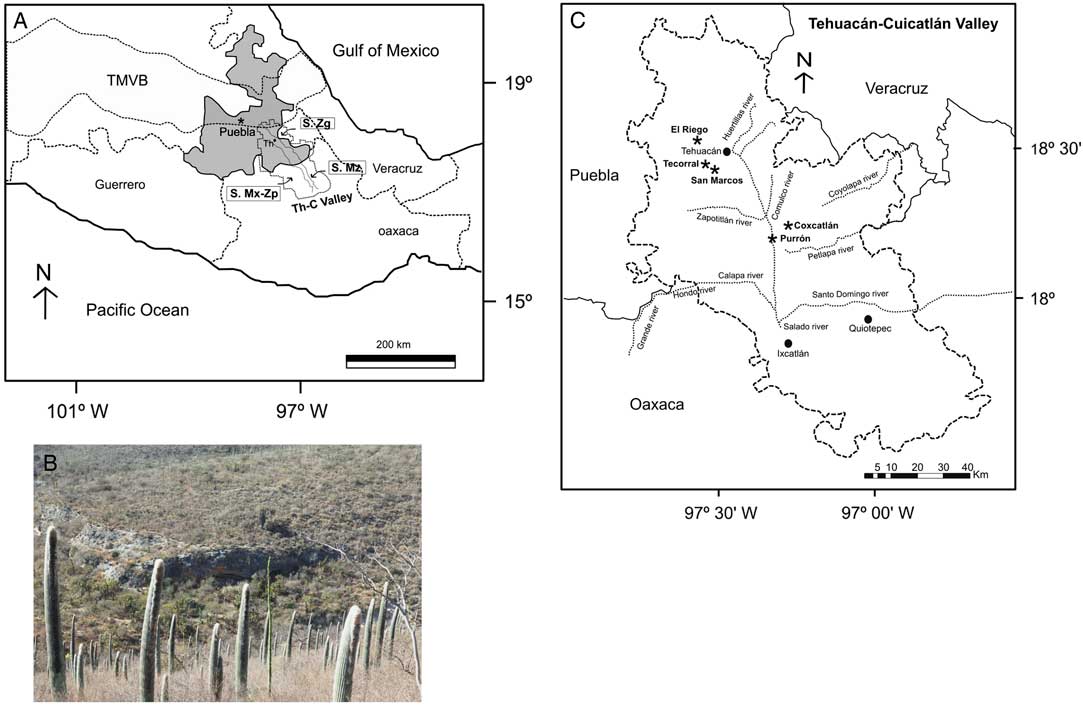
The Tehuacán-Cuicatlán valley (17º20′–18º53′N, 96º55′–97º44′W) is located in the southern part of the state of Puebla and northern Oaxaca, covering an area of approximately 10,000 km2 (Figure 1A). The region is part of the Sierra Madre del Sur physiographic system and was declared a Biosphere Reserve in 1998. The valley has a complex topography with several internal sub-valleys (Cuicatlán, Huajuapan, Tehuacán, Tepelmeme, and Zapotitlán), separated by mountain sequences with altitudes ranging from 500 to 3200 meters above sea level (Villaseñor et al. Reference Villaseñor, Dávila and Chiang1990; Valiente Reference Valiente1991; Dávila et al. Reference Dávila, Villaseñor, Medina, Ramirez, Salinas, Sànchez-Ken and Tenorio1993). The Tehuacán valley that contains all rock shelters mentioned in this study is located in the NNW-SSE tectonic basin, bordered by the Sierra Mixteca-Zapoteca on the western side and by the Sierra Mazateca and the Sierra de Zongolica on the eastern and southeastern sides (Fig. 1A). The dominant substrate is sedimentary but there are igneous and metamorphic rocks. The main type of soils are litosols and to a lesser extent rendzinas and regosols. The Tehuacán valley comprises different climatic types: arid dry (BS), temperate (C), warm and semi-warm A(C), receiving mean annual precipitations oscillating between 400 and 600 mm yearly (Villaseñor et al. Reference Villaseñor, Dávila and Chiang1990; Valiente Reference Valiente1991; Dávila et al. Reference Dávila, Villaseñor, Medina, Ramirez, Salinas, Sànchez-Ken and Tenorio1993; Dávila et al. Reference Dávila, Arizmendi, Valiente-Banuet, Villaseñor, Casas and Lira2002).
Geographic context of the Tehuacan valley and San Marcos rock shelter. (A) Map of central Mexico; the Transmexican Volcanic Belt (TMVB) and the location of Puebla State (dark grey) are indicated. The Tehuacán-Cuicatlán Valley (Th-C Valley) as well as Sierra Zongólica (S. zg), Sierra Mazateca (S. Mz), and Sierra Mixteca-Zapoteca (S. Mx-Zp) are indicated in dotted lines. (B) San Marcos rock shelter. (C) Location of five main rock shelters explored during the MacNeish expedition in the 1960s: El Riego, Tecorral, San Marcos, Coxcatlán and Purrón; Tehuacán city is indicated by a black circle.

Rock Shelter Locations and Archaeological Excavations
All excavations were conducted under authorization and guidance of Consejo de Arqueología, Instituto Nacional de Antropología e Historia (INAH, México). San Marcos (Tc254), Coxcatlán (Tc50), and Purrón (Tc272) rock shelters were discovered by the MacNeish expedition in the early 1960s (Figure 1B). Whereas San Marcos is located in the so-called western travertine slopes of the Tecorral canyon (Figure 1C), about 20 km west from Tehuacán city. Coxcatlán is located in an isolated monticule known as the Agujereado hill, 10 km south of Coxcatlán village. Purrón rock shelter is located in a narrow creek, at the edge of the hills bordering a stream known as Arroyo Lencho Diego, about 4.5 km south of Coxcatlán rock shelter, at the far south of the main Tehuacán valley axis. All three sites were extensively dug by the MacNeish expedition in the early 1960s. Based on the original maps kept by Angel García Cook, who acted as MacNeish’s main assistant at all three sites during the original expedition (MacNeish Reference MacNeish1967), several surface spots that remained intact were identified and explored during the 2012 and 2015 excavations. In the case of San Marcos, explored quadrants were located in S1W3, N1E2, and N1E3, following the nomenclature described in MacNeish (Reference MacNeish1967), and the large rocks located at the edge of Square 0-0 were uplifted to explore surfaces that remained inaccessible during the original expedition. At all quadrants, most of the area surveyed proved to be unaltered as the stratigraphy was well contextualized and respected the contour maps down to the rock floor, reaching surfaces of Zone D and E, as previously reported (MacNeish Reference MacNeish1967). In the case of Coxcatlán, available maps proved that more than 95% of the surface located within the edge of the roof (dropping plane) were exhaustively dug during the original expedition; a single square meter was only superficially excavated by the original expedition, located at the far depth western edge of the rock shelter, known by Garcia Cook to have served for tool and debris deposit in the 1960s. Finally, in the case of Purrón, most of the far depth deposits running across the rock shelter in the west to east axis remained intact. A single square meter located at the far west edge of the cave was dug up to the 4th sedimentary layer, reaching a maximum of 1.1 m in depth; more than 93 maize specimens were found in that location.
Analysis of Maize Specimens
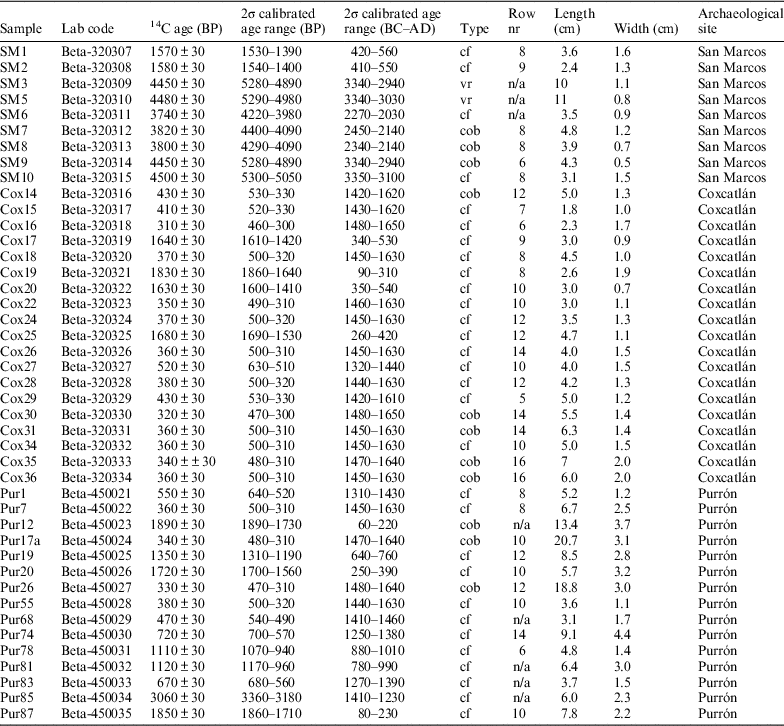
Sampling was performed following all necessary procedures to avoid human-related or cross-sample contamination. Personnel working within the excavation quadrants wore shoe covers, hazmat coverall suits, nitrile gloves, and surgical masks. Specimens were collected using previously bleached forceps, wrapped in aluminum foil, and placed in individually sealed bags that were kept at the ancient DNA facilities of Langebio CINVESTAV. For dating, 10–20 mg of each specimen was analyzed by accelerator mass spectrometry (AMS) using the service provided by Beta Analytic (Miami, Florida) (Table 1). Results were compared with those of Long et al. (Reference Long, Benz, Donahue, Jull and Toolin1989) and the Ancient maize Map project (Blake et al. Reference Blake, Benz, Moreiras, Masur, Jakonsen and Wallace2017). We also included micro-specimen data reported for the Xiahuatoxtla-Tlaxmalac canyon in the State of Guerrero (Piperno et al. Reference Piperno, Ranere, Holst, Iriarte and Dickau2009). Because dates presented by Long et al. (Reference Long, Benz, Donahue, Jull and Toolin1989) were calibrated using curves by Stuiver and Pearson (Reference Stuiver and Pearson1986) and Pearson and Stuiver (Reference Pearson and Stuiver1986), all conventional 14C dates were calibrated to a calendar year time scale using the IntCal13 data set (Reimer et al. Reference Reimer, Bard, Bayliss and Beck2013) in the online version of OxCal 4.2 (Bronk-Ramsey 2013). We report the calibrated age ranges (95% confidence ranges) (2σ) in years calibrated before present (BP), and years calibrated BC/AD. All Beta Analytic reference numbers are provided in Table S1.
AMS-dated maize from the Tehuacán-Cuicatlán valley, México. Ranges (95% confidence ranges; 2σ) are in years calibrated before present (BP) and years calibrated BC/AD. We indicate type of maize macro-specimen and general measures like kernel row number, length (cm), width (cm), and the archaeological site where the samples were collected; n/a: not available, vr: vegetative remains.

RESULTS AND DISCUSSION
Maize Sample Description
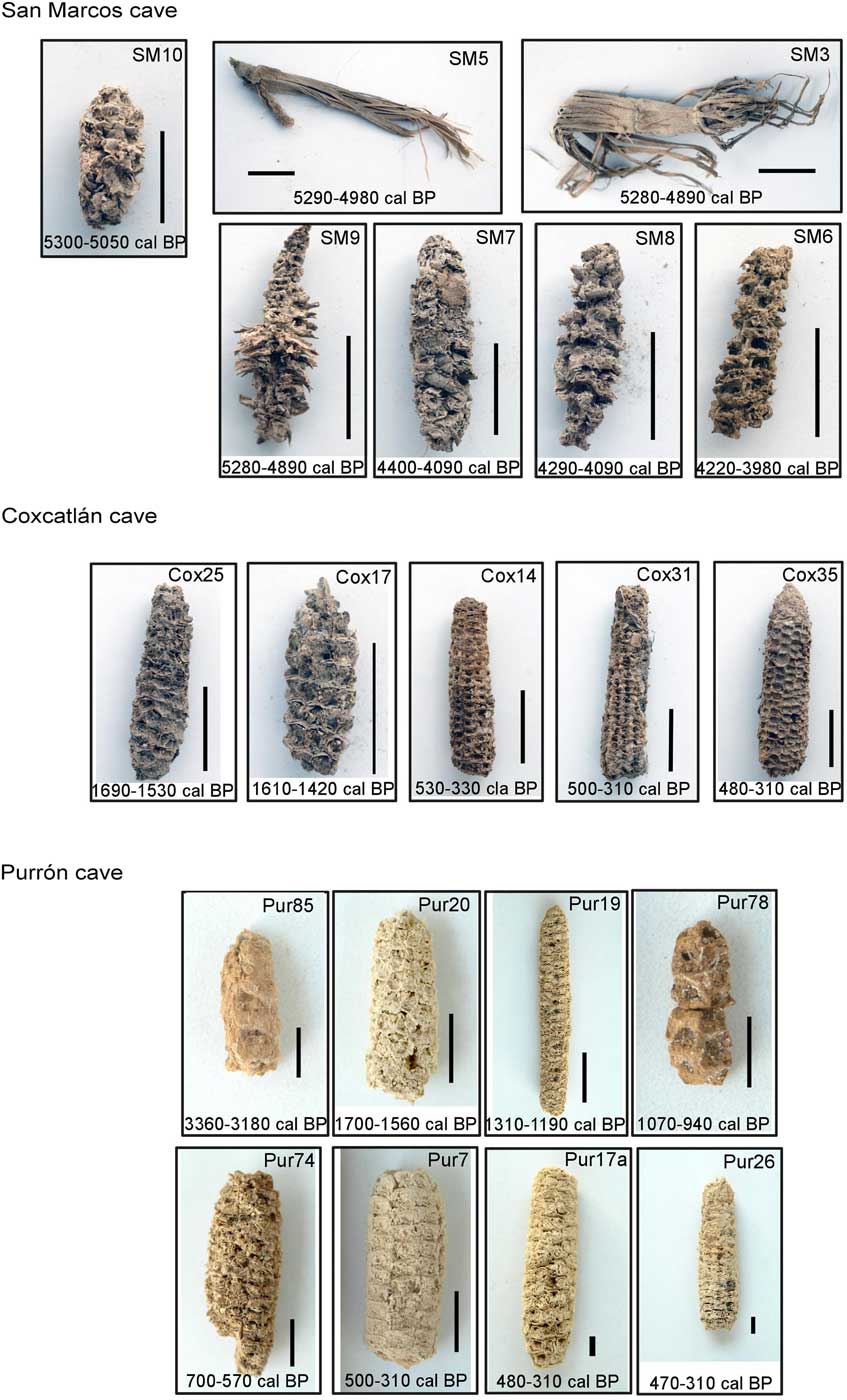
The expeditions to Tehuacán rock shelters (February 2012 and February 2015), under the guidance of authorized personnel from Instituto Nacional de Antropología e Historia (INAH), resulted in the discovery of 132 maize macro-samples: 93 of them were found in Purrón, 29 in Coxcatlán, and 10 in San Marcos. Whereas most correspond to fragmented (102) or entire (21) cobs, we also found remains of vegetative organs, including stem-roots (3), stem (1), leaves (3), and internodes (2) (Figure 2). Only 7 out of 132 specimens were carbonized, including two cobs from San Marcos, four cobs from Coxcatlán, and one from Purrón. We obtained direct AMS dates for 43 maize macro-specimens (Table 1). Seven from San Marcos (SM1, SM2, SM6-SM10) correspond to maize cobs, while two (SM3 and SM5) are fragments of vegetative organs. Specimens from San Marcos were highly reminiscent to those found in Zone E during the MacNeish expedition (MacNeish Reference MacNeish1967). Entire cobs are 2.4–4.8 cm long and composed of 6 rows, with soft and long spikelet glumes; cob fragments are variable in size and having up to 8 or 9 rows. Other San Marcos specimens include a well-preserved basal stalk containing most of the distal lateral root system, and an aerial leaf sheet containing part of a stem internode. All specimens from Coxcatlán and Purrón are entire cobs or cob fragments. In general, entire cobs are larger than in San Marcos, ranging from 5.0 to 7.0 cm in length and from 1.3 to 2.0 cm in width for Coxcatlán, and from 13.4 to 20.7 cm in length and up to 3.0 cm in width for Purrón. Cob fragments in both are variable in size having row numbers between 6 and 16 in the case of Coxcatlán, and 6 to 14 in the case of Purrón (Table 1).
New macro-specimens found in rock shelters of the Tehuacán valley. Specimens are presented in chronological order from the earliest on the basis of their calibrated age range (2σ) in years before present (BP). Scale bar=2 cm.

Age of AMS-Dated Specimens
The AMS 14C dating results obtained for 43 new specimens are reported in Table 1. The oldest AMS date is 5300–5050 cal BP (3350–3100 cal BC) and corresponds to cob SM10 from San Marcos. The youngest AMS date is 460–300 cal BP (1480–1650 cal AD) and corresponds to a cob found in Coxcatlán (Table 1). Except for samples SM1 and SM2, ages at San Marcos range between 5300 and 3980 cal BP (3350–2030 cal BC). In Coxcatlán, we were able to find non-manipulated cobs with ages ranging from 1860 to 300 cal BP (90–1630 cal AD). Results from the excavation in Purrón are particularly interesting, as we were able to find a specimen (Pur85) that dated 3360–3180 cal BP (1410–1230 cal BC), at least 1500 years older than any maize specimen previously found in that rock shelter (Mangelsdorf et al. 1964, Reference Mangelsdorf, MacNeish and Galinat1967). Other specimens from Purrón were dated at ranges previously reported, 1890–310 cal BP (60–1640 cal AD).
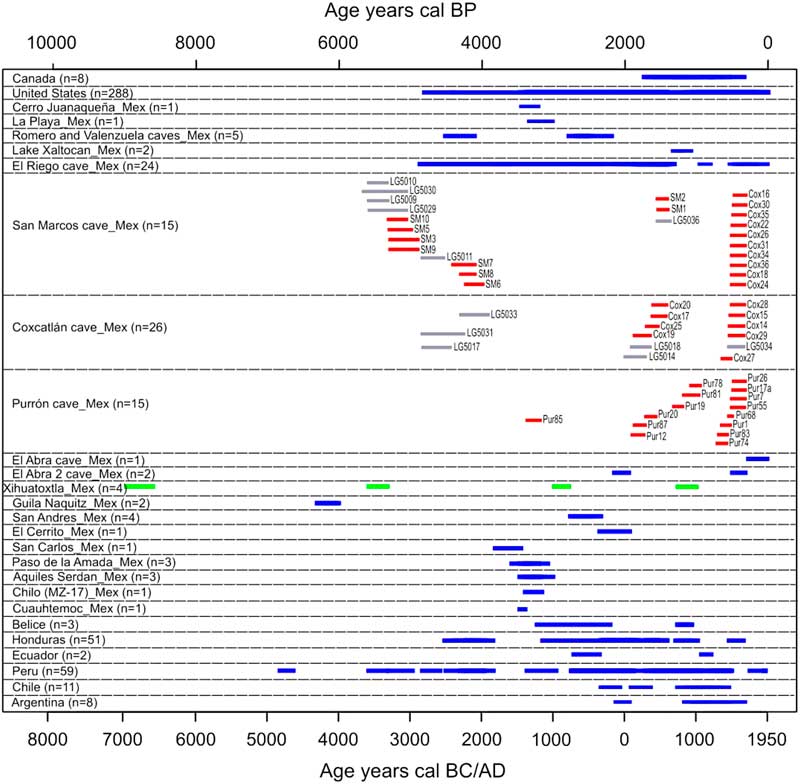
The earliest specimens from San Marcos (SM10 and SM5; BP 4500±30 BP and 4480±30 BP; 5300–5050 and 5290–4980 cal BP respectively) are similar in age to those obtained by AMS and reported by Long et al. (Reference Long, Benz, Donahue, Jull and Toolin1989) (ranging between BP 4700±110 and 4700±60; see Table S1 for calibration details), confirming that the oldest macro-specimens of maize found to this date in Tehuacán are rarely older than 5300 cal BP. Based on this temporal convergence, a total of 55 AMS dates corresponding specimens from Tehuacán are currently available (43 reported here and 12 reported in Long et al. Reference Long, Benz, Donahue, Jull and Toolin1989). Their chronology corresponds to six temporal intervals (Figure 3). Interval 1 is represented by the eight earliest macro-specimens, with ages ranging from approximately 5600 to 4900 cal BP (3700–2900 cal BC); all specimens from Interval 1 have been found in San Marcos rock shelter, four of which were found during our recent expeditions (2012 and 2015). Interval 2 is represented by seven specimens (four from San Marcos and three from Coxcatlán) that date between 4800 and 3900 cal BP (2900–2000 cal BC); three of them are non-manipulated cobs from San Marcos, found during the most recent expedition. Interval 3 is represented by a single specimen (Pu85) found in Purrón rockshelter, and dating 3360–3180 cal BP (~1410–1230 cal BC). Interval 4 is represented by 12 specimens dating approximately from 2000 to 1400 cal BP (cal BC ~40 to cal AD 590); our recent expeditions uncovered nine of these specimens at three different locations: San Marcos (2), Coxcatlán (4), and Purrón (3). Interval 5 is represented by three new samples found in Purrón and dating 1300–940 cal BP (640–1000 cal AD). Finally, interval 6 is represented by the 24 youngest samples dating 700–300 cal BP (1250–1650 cal AD), 23 of them recently found in Coxcatlán (15) and Purrón (8).
Temporal chronology and quantity of maize macro-specimens available to date. The chart shows a series of temporal intervals corresponding to each of the archaeological sites in which maize macro-specimens have been uncovered; micro-samples form the Xihuatoxtla monolith are also included as a temporal reference. The age is indicated in calibrated years before present (cal BP) and years calibrated BC/AD; n is the total number of maize macro-specimens reported for each site; new specimens described in this study are shown in red. (See online version for colors.)

Figure 3 illustrates a comparison of previously reported AMS results by Long et al. (Reference Long, Benz, Donahue, Jull and Toolin1989) and Blake et al. (Reference Blake, Benz, Moreiras, Masur, Jakonsen and Wallace2017) with the new dated specimens presented here. Based on conventional 14C dating combined with stratigraphic analysis of inorganic artifacts and plant remains, the original MacNeish expedition described a continuous chronology of cultural development and human occupation in Tehuacán valley, covering a temporal range that initiates ~10,000 years ago (MacNeish 1958, 1964, Reference MacNeish1981; Johnson and MacNeish Reference Johnson and MacNeish1972; Smith Reference Smith1997). The chronology is composed of nine cultural phases that range from the Ajuerado phase ~10,000–7200 BC (~12,000–9200 yr BP) to the Venta Salada phase 700–1500 AD (~1300–450 yr BP). Based on these cultural phases, we propose that maize cultivation in Tehuacán initiated during the Coxcatlán (5200–3400 BC) (~7200–5400 yr BP) to Abejas (3400–2300 BC) (~5400–4300 yr BP) transition, and continued during Abejas, and the early part of Purrón (2300–1500 BC) (~4300–3500 yr BP), Ajalpan (1500–900 BC) (~3500–2900 yr BP), Palo Blanco (200 BC–700 AD) (~2200–1300 yr BP), and Venta Salada (700–1500 AD) (~1300–450 yr BP) phases. Except for macro-specimen Pu85, the dates of macro-specimen appearance are in agreement with results reported by Long et al. (Reference Long, Benz, Donahue, Jull and Toolin1989); however, cal BP 7900 phytolith and starch remains from maize and not teosinte were found below the Xihuatoxtla rock shelter, in the central Balsas River valley (Piperno et al. Reference Piperno, Ranere, Holst, Iriarte and Dickau2009). Although the Xihuatoxtla maize record is limited only to the presence of micro-specimens, its greatest importance is that its estimated age is consistent with an earlier age for the initiation of maize domestication. Of particular interest is Pu85, a 6.0-cm-long and 2.3-cm-wide basal cob fragment found in Purrón rock shelter, dated to 3360–3180 cal BP. The size of the kernel locule is approximately 0.60 cm2, slightly larger than the size of locules found in San Marcos (average: 0.40 cm2). The general shape of the fragment is cylindrical, reminiscent of the contemporary Chapalote landrace. Previous expeditions to Purrón had only yielded macro-specimens younger than 2100 cal BP, suggesting that consumption of maize in San Marcos and Coxcatlán rock shelter preceded that of Purrón. This new specimen—the first one in Tehuacán valley directly dated to an interval comprised between 3360 and 3180 cal BP, demonstrates that maize was being consumed in Purrón at least 1500 years earlier than previously expected, suggesting that other specimens of similar age are still likely to be found in the southeastern region of Tehuacán valley, likely including the Abejas rock shelter (MacNeish Reference MacNeish1967).
The overall archaeobotanical evidence from the Guilá Naquitz cave (Oaxaca) and rock shelters in the Tehuacán valley (Puebla) suggests that maize from the Mexican highlands—on average grown above 1800 m above sea level (asl)—is the most primitive form of corn; however, the current geographic location of teosinte parviglumis in central and southern Mexico suggests an origin for maize in the lowlands, that is below 1800 m asl (Smith Reference Smith2001). Although initial thoughts favored that maize originated in the highlands of Mexico (Smith 1998, Reference Smith2001), most genetic evidence provided to date indicates that maize originated in the Mexican lowlands (Piperno and Pearsall Reference Piperno and Pearsall1998; van Heerwaarden et al. 2011). Additionally, based on general phylogenies and paleogenomic analysis, two geographic routes have been proposed to explain maize early dispersal from the Mexican highlands to the rest of the American continent: one occurring through western and northern Mexico into the southwestern United States and then into the eastern coast and Canada (da Fonseca et al. Reference da Fonseca, Smith, Wales, Cappellini, Skoglund, Fumagalli, Samaniego, Caroe, Ávila-Arccos, Hufnagel, Korneliussen, Vieira, Jakobsson, Arriaza, Willerslev, Nielsen, Hufford, Albrechtsen, Ross_Ibarra and Gilbert2015), and a second route leading from the western and southern lowlands of Mexico into Guatemala, the Caribbean Islands, the lowlands of South America, and finally the Andes. An exhaustive morphological analysis of a large collection of ancient maize cobs found at El Gigante cave (Honduras) indicates that by 4400 cal BP, maize was sufficiently domesticated to serve as a staple crop in the Honduran highlands, in a region where teosinte parviglumis populations are absent (Kennett et al. Reference Kennett, Thakar, VanDerwarker, Webster, Culleton, Harper, Kistler, Scheffler and Hirth2017). Finally, the presence of well-preserved cobs from the coastal Peruvian site of Paredones and dating to approximately 6800 cal BP suggests a rapid rate of dispersal into the south, contributing to the diversity of racial complexes characteristic of the Andean region in the pre-ceramic era (Grobman et al. Reference Grobman, Bonavia, Dillehay, Piperno, Iriarte and Holst2012).
Macro-Specimen Chronology in the American Continent
Figure 3 illustrates a complete chronology of all new macro-specimens reported here in the context of other macro-specimens found across the continent and their time frames. Within Mexico, Guilá Naquitz and San Marcos rock shelters have yielded the oldest macro-specimens found to date, followed by specimens found at several locations within the Tehuacán valley (Coxcatlán, Purrón, El Riego). Other locations in central Mexico, including Xaltocan Lake in Estado de México (1300–1200 cal BP) (680–770 cal AD), and El Abra caves in Guerrero (2200 cal BP) (200 cal BC), have yielded significantly younger dates. Macro-specimens found at northern locations such as La Playa (Sonora), Cerro Juanaqueña (Chihuahua) and Romero-Valenzuela (Tamaulipas) are dated to 3800–2800 cal BP (1900–850 cal BC). For the southeast, macro-specimens from San Andrés (Tabasco) and El Cerrito, San Carlos, Paso de la Amada, Aquiles Serdán, Chilo-MZ-17 and Cuauhtemoc (Chiapas) have dated to 3300–2900 cal BP (1400–950 cal BC). In the case of San Andrés, phytolith analysis of sediments suggest a spread of maize cultivation to the tropical Mexican Gulf Coast >7,300 calendar years before present (Pohl et al. Reference Pohl, Piperno, Pope and Jones2007). For Central and South America, there are similar dates to those reported for southeast and northern Mexico. There is also a large collection of specimens found at El Gigante cave (Honduras) whose dates are comprised between 4400 and 4200 cal BP (2500–2300 cal BC) and 1300 and 1200 cal BP (650–750 cal AD). Finally, while some dates for maize found at locations in the United States are slightly older than other specimens found in central Mexico (up to 4800 cal BP; in Los Pozos, Arizona), maize records from Canada correspond to the youngest maize record for the American continent. Overall, these results show that the current archaebotanical record does not yet reflect the chronology of dispersal from center to northern or southern regions of the American continent, opening the possibility for finding the missing links of the dispersal chronologies in subsequent archaebotanical expeditions within the Mexican territory.
CONCLUSIONS
∙ Based on AMS dating of 43 macro-specimens from rock shelters of the Tehuacán valley, we document a large collection of non-manipulated samples ranging from cal BP 5300 to 300 cal BP, that can be used for ancient DNA extraction and paleogenomic studies.
∙ We report having found a macro-specimen in Purrón rock shelter that dated to BP 3060±30 BP (3360–3180 cal BP), approximately 1500 calendar years earlier than any other previously found at that site.
∙ Our studies confirm that maize dispersal by human communities was rapid in Tehuacán, opening possibilities for still finding macro-specimens of equivalent ages at contrasting geographical locations across the valley, and perhaps at other locations in central Mexico.
ACKNOWLEDGMENTS
We would like to thank Jaime Padilla Calzada and Ana Lily Solorzano for technical help. This research was supported by CONACyT Grant CB256826 and the Instituto Nacional de Antropología e Historia, through the Centro de Investigación y de Estudios Avanzados del Instituto Politécnico Nacional and Instituto Nacional de Antropología e Historia collaboration.
SUPPLEMENTARY MATERIAL
To view supplementary material for this article, please visit https://doi.org/10.1017/RDC.2018.29