Nowadays, society is confronted with the constant challenges of increased competitiveness and unpredictability in the world of organizations, mainly as a result of globalization (Gilley et al., Reference Gilley, McMillan and Gilley2009; Grant, Reference Grant2014). This phenomenon may frequently trigger situations which present negative consequences for workers, such as higher stress levels (Davis & Gardner, Reference Davis and Gardner2004; McHugh, Reference McHugh1997; Sablonnière et al., Reference Sablonnière, Tougas, Sablonnière and Debrosse2012). Thus, a number of studies have attributed importance to analyzing job factors of a motivational nature which boost the well-being of workers (Joo et al., Reference Joo, Jeung and Yoon2010; Oldham & Cummings, Reference Oldham and Cummings1996). Moreover, the emergence of the first references to Positive Psychology (Seligman & Csikszentmihalyi, Reference Seligman and Csikszentmihalyi2000), has enabled research to pursue a different trajectory, geared more towards further understanding the favorable functioning of individuals in a work setting and the mechanisms that underlie heightened positive psychological states, such as engagement (Schaufeli & Bakker, Reference Schaufeli and Bakker2004a).
Indeed, given the various benefits of this state to individuals (Melamed et al., Reference Melamed, Shirom, Toker, Berliner and Shapira2006; Reijseger et al., Reference Reijseger, Peeters, Taris and Schaufeli2016), it has become increasingly important to understand how engagement can be fostered, and job resources have been found to play a fundamental role here, owing to their motivational capacity (Bakker & Demerouti, Reference Bakker and Demerouti2008). The motivational nature of certain job resources such as autonomy, peer support, supervisory support and Perceived Organizational Support (POS) has been broadly studied and observed (Hon, Reference Hon2012; Meng & Ma, Reference Meng and Ma2015; Rhoades et al., Reference Rhoades, Eisenberger and Armeli2001; Swanberg et al., Reference Swanberg, McKechnie, Ojha and James2011). However, the positive effects demonstrated by high levels of these resources and the relatively scarce literature on their role as promoters of engagement point to the need to study autonomy, peer support, supervisory support and POS as direct predictors of a higher degree of this positive psychological state. In fact, research needs to empirically verify the plausibility of the assumptions that constitute the motivational engagement process (Schaufeli & Bakker, Reference Schaufeli and Bakker2004a). Furthermore, in contrast with the intrinsic resources, autonomy, peer support, supervisory support and POS have a contextual character and can be changed or induced with the implementation of human resource practices (Demerouti et al., Reference Demerouti, Nachreiner, A and Schaufeli2001).
On the other hand, in addition to the importance attributed to these job resources and their consequences, several studies have observed the impact of affective commitment, one of the three components of organizational commitment identified by Meyer and Allen (Reference Meyer and Allen1991), as a moderating variable in the relationship between triggers of stress and job strain (Irving & Coleman, Reference Irving and Coleman2003; Siu & Cooper, Reference Siu and Cooper1998). Indeed, the afore-mentioned commitment component has been found to minimize the adverse effects of these triggers on job strain (Begley & Czajka, Reference Begley and Czajka1993; Donald & Siu, Reference Donald and Siu2001). Notwithstanding, and to our knowledge, although references to the motivational capacity of affective commitment may be found (Greguras & Diefendorff, Reference Greguras and Diefendorff2009), the literature does not present conclusions or results regarding the moderating function of this component of commitment in the relationship between job resources and engagement. In accordance with Conservation of Resources theory (Hobfoll, Reference Hobfoll2011) the more resources individuals have, the less vulnerable they are to their loss and the greater their ability to obtain new resources (Hobfoll, Reference Hobfoll2011). Thus, this requires further analysis so that one may better understand whether the presence of this contextual resource, namely affective commitment, interacts with job resources (in this case, autonomy, peer support, supervisory support and POS) to significantly increase the positive effect of the latter on the well-being of workers, more specifically in terms of their engagement.
Moreover, the importance of the consultancy sector in the Portuguese economy (Instituto Nacional de Estatística; INE, 2017) points to how relevant and necessary it is for research to seek to understand whether the afore-mentioned job resources actually promote work engagement. Furthermore, the clear growth trend of this sector (Observatorio Sectorial DBK, 2017) highlights the importance of studying constructs, such as affective organizational commitment, which may possibly boost the well-being of workers in this professional area, so that the observed growth continues to be promoted. In addition, as Portugal is on an upward economic path with expected gross domestic product (GDP) growth of 1.9% by 2020 (Organisation for Economic Co-operation and Development; OECD, 2019), it is crucial to understand how we can foster psychological well-being. of the working population and therefore increase productivity levels. In our view, a synergy between research on contextual labor variables and the prospects for economic growth is crucial, so that promising expectations can indeed be a reality.
Therefore, the aim of the present study is to understand whether affective commitment enhances the positive relationship established between the afore-mentioned job resources and workers’ engagement. The study further seeks to broaden knowledge on the moderating function of the affective component of commitment. The confirmation of a significant increase in work engagement, as a result of the moderation effect of the affective commitment, is a contribution to the literature, as the importance of this construct as a driver of positive relationships is reinforced. Furthermore, it corroborates the need for more Human Resources policies geared towards fostering this emotional attachment.
Job Demands-Resources Model and the Motivational Engagement Process
From the perspective of Schaufeli et al. Reference Schaufeli, Salanova, González-Romá and Bakker2002, engagement may be defined as a psychological state of a positive and persistent nature, characterized by the dimensions of vigor, dedication and absorption of the individual in his/her work (Schaufeliet al., Reference Schaufeli, Salanova, González-Romá and Bakker2002; Salanova & Schaufeli, Reference Salanova and Schaufeli2008). Vigor may be defined as the presence of high energy levels and resilience in the individual, enabling him/her to correctly respond to job demands and deal with the difficulties that may emerge in the course of his/her work. Dedication is characterized by the presence of enthusiasm, pride, inspiration and, above all, the worker’s involvement in his/her professional activity. Finally, absorption is defined by the individual’s high concentration level and focus on his/her work.
As a result of diverse research, engagement has been found to present positive consequences, not only for the individual but also in terms of increased motivation to learn (Schaufeli & Bakker, Reference Schaufeli and Bakker2004a), reduced occurrence of depression (Schaufeli & Bakker, Reference Schaufeli and Bakker2004b) and coronary disease (Hallman et al., Reference Hallman, Burell, Setterlind, Oden and Lisspers2001), and higher optimism and self-efficacy (Xanthopoulou et al., Reference Xanthopoulou, Bakker, Demerouti and Schaufeli2007). Engagement also has a favorable effect on organizations, as workers with engagement also present lower rates of absenteeism (Darr & Johns, Reference Darr and Johns2008), higher performance levels (Reijseger et al. Reference Reijseger, Peeters, Taris and Schaufeli2016) and increased proactive behaviors (Salanova & Schaufeli, Reference Salanova and Schaufeli2008).
The Job Demands-Resources model (JD-R) may be used to explain the emergence of engagement (Bakker & Demerouti, Reference Bakker and Demerouti2008; Schaufeli & Bakker, Reference Schaufeli and Bakker2004a). The assumption is that this positive psychological state results from job resources that present an intrinsic motivational function (Bakker & Demerouti, Reference Bakker and Demerouti2007), as they promote satisfaction of the three fundamental psychological needs considered in the Self-determination Theory (Ryan & Deci, Reference Ryan and Deci2000). When the context makes provisions for the individual’s required needs, so that he/she may accomplish job objectives and deal effectively with demands, the worker’s motivational levels are increased, and a consequent engagement from the job may be observed (Demerouti et al., Reference Demerouti, Nachreiner, A and Schaufeli2001). According to the Self-Determination Theory (Ryan & Deci, Reference Ryan and Deci2000), the basic needs are autonomy - it refers to the need that any individual has to freely control their own behaviors - competence - refers to desire that people have to hone and develop new knowledge and skills - and the sense of belonging - that is the need to be part of a group of individuals or collectivity (Baumeister & Leary, Reference Baumeister and Leary1995; van den Broeck et al., Reference van den Broeck, Ferris, Chang and Rosen2016).
Autonomy at Work: A Promotional Resource of Engagement?
A work setting that fosters more freedom in decision-making for the worker and in the way his/her duties are performed, promotes autonomy (Joo et al., Reference Joo, Jeung and Yoon2010). In fact, according to the Self-Determination Theory (Ryan & Deci, Reference Ryan and Deci2000), autonomy is one of the three essential psychological needs, therefore organizations that ensure satisfaction of this need will have workers with higher intrinsic motivation (Joo et al., Reference Joo, Jeung and Yoon2010). In order to boost autonomy and, subsequently, workers’ intrinsic motivation, organizations should grant them the possibility of controlling and managing their work (Hoskins, Reference Hoskins2014). This feeling of control in the worker may be enhanced by informative performance evaluation, instead of feedback that is simply regarded as a form of control (Amabile & Pillemer, Reference Amabile and Pillemer2012). By means of psycho-physiological measures, Meng and Ma (Reference Meng and Ma2015) found that work settings that provide greater autonomy and enable their workers to choose how and when their duties are performed, present workforces with far higher intrinsic motivation levels.
Hence, as autonomy is a characteristic of an intrinsic motivational nature, it may be considered a job resource. Thus, considering the afore-mentioned motivational engagement process, we established that:
Hypothesis 1a: The perception of higher levels of autonomy at work is positively related to engagement.
Peer-support: An Intrinsic Motivational Resource
In addition to autonomy, the support provided by peers is an important job resource of an organizational and contextual nature (Demerouti et al., Reference Demerouti, Nachreiner, A and Schaufeli2001; Schaufeli & Bakker, Reference Schaufeli and Bakker2004a). Indeed, if we take the Self-Determination Theory (Ryan & Deci, Reference Ryan and Deci2000) as a basis, it is possible to ascertain that the social support of peers promotes the worker’s sense of belonging (Bakker & Demerouti, Reference Bakker and Demerouti2008), another one of the three fundamental psychological requirements, and characterized by innatism and universality (Baumeister & Leary, Reference Baumeister and Leary1995). It may, therefore, be said that peer support at work enables workers increased intrinsic motivation.
In fact, individuals with a higher degree of peer support have been found to present higher levels of intrinsic motivation and more creative solutions for the correct accomplishment of their job duties (Hon, Reference Hon2012). Peer-support is conducive to increased worker well-being (Häusser et al., Reference Häusser, Mojzisch, Niesel and Schulz-Hardt2010) while it simultaneously promotes lower dependence on resources of a personal nature (Lin, 1999, cited by Fila et al., Reference Fila, Purl and Griffeth2017). In addition to fostering increased well-being, peer support also contributes to the perception that the work context is devoid of stress-causing factors (Carlson & Perrewe, Reference Carlson and Perrewé1999).
Hence, considering the motivational nature shown in the support provided by peers at work, and the fact that resources of an organizational nature foster the emergence of engagement, we established that:
Hypothesis 1b: The perception of higher peer support at work is positively related to engagement.
Direct Supervisory Support as a Job Resource
Another important contextual resource is the support provided by the direct supervisor, as this individual is able to offer psychological support that is crucial to the worker (Garcia et al., Reference Garcia, Ng, Capezio, Restubog and Tang2017), thus fostering increased motivation in the worker to perform his/her professional duties (Swanberg et al., Reference Swanberg, McKechnie, Ojha and James2011).
In conjunction with this data, the literature highlights that supervisors who provide support to their workers tend, by rule, to give informative feedback, geared towards the individual’s professional development (Deci & Ryan, Reference Deci and Ryan1987). Thus, as supervisory support facilitates enrichment of the resources available to the worker, it may be assumed that this support fosters satisfaction of the competence requirement, in other words, the individual’s need to believe he/she has the crucial resources required for the accomplishment of professional tasks (Meyer et al., Reference Meyer, Stanley and Parfyonova2012). Moreover, Olafsen et al., (Reference Olafsen, Halvari, Forest and Deci2015) found that the support provided by the supervisor not only promotes competence, but also the need for autonomy. It may, therefore, be said that the support offered by the direct supervisor is of an intrinsic motivational nature.
Thus, taking the motivational nature of supervisory support into account, coupled with the fact that the opportunity to develop and deal with personal and professional demands is granted to the worker by the supervisor (e.g. Garcia et al., Reference Garcia, Ng, Capezio, Restubog and Tang2017; Swanberg, et al., Reference Swanberg, McKechnie, Ojha and James2011), Hypothesis 1c considers that:
Hypothesis 1c: The perception of greater support provided by the direct supervisor is positively related to engagement.
Perception of Organizational Support and its Impact on Work Engagement
In line with studies on other work resources, research has also further investigated POS as a valuable contextual resource (e.g. Riggle et al., Reference Riggle, Edmondson and Hansen2009). Perceived organizational support is related to workers’ beliefs regarding the support provided by the organization at times when more demands are observed, and also regarding the concern demonstrated for the well-being of its workers (Eisenberger et al., Reference Eisenberger, Huntington, Hutchison and Sowa1986). The emergence of this job resource frequently stems from other organizational resources that are present in the work context, such as direct supervisory support and autonomy levels (Eisenberger et al. Reference Eisenberger, Rhoades and Cameron1999).
Furthermore, when workers perceive high levels of support on the part of the organization, they present higher affective commitment (Rhoades et al., Reference Rhoades, Eisenberger and Armeli2001), more organizational citizenship behaviors and high engagement (Wang et al., Reference Wang, Zhang, Thomas, Yu and Spitzmueller2017). In addition, the perception of a high level of organizational support enables the worker to feel less fatigued (Cropanzano et al., Reference Cropanzano, Howes, Grandey and Toth1997), in other words, he/she experiences the adverse effects triggered by work demands to a lesser degree. Furthermore, this contextual resource promotes better integration within the organization (Rhoades & Eisenberger, Reference Rhoades and Eisenberger2002), and consequently fosters a sense of belonging.
Therefore, as perceived organizational support allows for the satisfaction of one of the three fundamental psychological needs identified by the Self- Determination Theory (Ryan & Deci, Reference Ryan and Deci2000), it may be said that this resource manifests an intrinsic motivational nature. Hence, considering the aforementioned motivational engagement process, we established Hypothesis 1d:
Hypothesis 1d: The perception of higher support provided by the organization is positively related to engagement.
Affective Organizational Commitment as Moderating Variable
Although the individual’s commitment to the organization is characterized by a diversity of definitions, perceptions and conceptions (Klein et al., Reference Klein, Molloy, Cooper, Klein, Becker and Meyer2009), it may be said that commitment is a force that connects the individual psychologically to an entity, in this case to the organization in which he/she works and, subsequently, to the duties he/she performs (Meyer et al., Reference Meyer, Becker and van Dick2006). One of the most important explanatory theoretical models on this subject is that of the three components of commitment (Meyer & Allen, Reference Meyer and Allen1991, Reference Meyer and Allen1997), referred to as normative, continuance and affective commitment. Each of these components is characterized by a specific mindset, whereby normative commitment is related to a sense of obligation to keep one’s job position, and continuance occurs when the worker takes the costs involved in leaving the organization into account (Meyer & Allen, Reference Meyer and Allen1991; Meyer & Parfyonova, Reference Meyer and Parfyonova2010). Affective commitment is related to the emotional involvement and identification the worker establishes with the organization (Meyer et al., Reference Meyer, Stanley and Parfyonova2012). When the worker identifies with a company, is involved in its activity and, at the same time, shares its values, foundations are laid for his/her affective commitment to the organization (Meyer & Herscovitch, Reference Meyer and Herscovitch2001). Although the three components generate positive effects for the individual and the company alike, affective commitment represents more significant benefits in terms of job satisfaction, reduced possibility of turnover and worker stress (Meyer et al., Reference Meyer, Stanley, Herscovitch and Topolnytsky2002). Indeed, this type of commitment fosters increased organizational citizenship behaviors in the worker (Gellatly et al., Reference Gellatly, Meyer and Luchak2006).
Another interesting feature of affective commitment is its moderating effects which may buffer or boost the expressiveness of a relationship between variables, namely between job stressors and the worker’s psychological tension (Meyer & Maltin, Reference Meyer and Maltin2010). Some studies have sought to discover the extent to which commitment acts as a buffer in the relationship between variables, namely between job stressors and the worker’s psychological tension (e.g. Irving & Coleman, Reference Irving and Coleman2003; Siu & Cooper, Reference Siu and Cooper1998). Indeed, some authors have found that when affective commitment is higher, the positive relationship between the stressor and psychological tension becomes less significant (e.g. Schmidt, Reference Schmidt2007).
However, to our knowledge, the moderating effect of this commitment component has not been fully studied in relationships between positive variables. Therefore, in our opinion, it is important to apply the rationale of positive psychology (Seligman & Csikszentmihalyi, Reference Seligman and Csikszentmihalyi2000) in the research on the moderating role of affective commitment. Considering that a sense of belonging, one of the three fundamental psychological requirements (Ryan & Deci, Reference Ryan and Deci2000), is fostered by commitment to the organization (Mowday et al., Reference Mowday, Porter and Steers1982), the intrinsic motivational nature of commitment is, therefore, quite clear. In fact, according to Greguras and Diefendorff (Reference Greguras and Diefendorff2009), affective commitment is positively related to satisfaction of the competence and autonomy requirements, in addition to a sense of belonging. This conclusion points to the intrinsic motivational nature of the affective component of commitment, while also enabling it to be regarded as an important organizational resource. By the same token, in order to justify the possible leverage effect of affective commitment in the relationship between other resources and engagement, it is worth reflecting on the implications of extrinsic motivational elements on the individual’s intrinsic motivation. Some authors have found these elements to attenuate the positive impact of intrinsic motivation on, for example, performance (Cerasoli, Nicklin, & Ford, Reference Cerasoli, Nicklin and Ford2014) and the altruistic behaviors advocated by the individual (Warneken & Tomasello, Reference Warneken and Tomasello2008). Thus, extrinsic motivational features present a buffering effect on the relationships between elements that foster intrinsic motivation and positive variables that reveal well-being, such as engagement (Liang et al., Reference Liang, Wang, Wang and Xue2018). In turn, we believe that the promoting elements of intrinsic motivation may behave in a similar way and may have not a buffering but a boosting effect on the relationships between intrinsic motivational resources and well-being, in the form of engagement. Therefore, it may be said that affective commitment, as an intrinsic motivational organizational resource, may boost the effects of other job resources such as autonomy, of interpersonal relationships, namely peer and supervisory support, and of broader interpersonal relationships, such as POS. Furthermore, this boost effect could result from the resources accumulation (Hobfoll, Reference Hobfoll2011): When workers have an emotional liaison with the organization, they work in a context where the motivational effect of job resources are stronger than when they do have an affective liaison.
Hence, we established:
Hypothesis 2a: Affective commitment moderates the relationship between perception of greater autonomy and engagement to such an extent that this relationship is stronger when commitment is high than when it is low.
Hypothesis 2b: Affective commitment moderates the relationship between perception of greater peer support at work and engagement, to such an extent that this relationship is stronger when commitment is high than when it is low.
Hypothesis 2c: Affective commitment moderates the relationship between perception of greater support from a director supervisor and engagement, to such an extent that this relationship is stronger when commitment is high than when it is low.
Hypothesis 2d: Affective commitment moderates the relationship between perception of greater support from the organization and engagement, to such an extent that this relationship is stronger when commitment is high than when it is low.
Method
Procedures and Sample
The empirical data used to conduct this study is part of a project on psychosocial risks and was obtained from a consultancy company. The questionnaire was applied in an online format and was answered voluntarily by the workers of this organization whose anonymity was guaranteed.
The sample consists of 554 individuals, 284 (51.3%) of whom are males and 270 (48.7%) females. As for participants’ tenure with the consultancy company, 150 (27.1%) had been working there for under 1 year, 201 (36.3%) between 1 and 5 years, 104 (18.8%) between 6 and 10 years, 46 (8.3 %) between 11 and 15 years and 53 (9.6%) for over 15 years.
Measures
Autonomy: In order to measure this construct, three items (e.g. “I have control over what happens in my work”) of the Job Content Questionnaire (Karasek et al., Reference Karasek, Brisson, Kawakami, Houtman, Bongers and Amick1998) were used. Answers were given on a 5 point Likert scale, ranging from Totally disagree (1) to Totally agree (5). Cronbach alpha was .70.
Peer support at work. In order to measure this construct, 6 items (e.g. “My peers take a personal interest in me”) of the Job Content Questionnaire (Karasek et al., Reference Karasek, Brisson, Kawakami, Houtman, Bongers and Amick1998) were used. Answers were given on a 7 point Likert scale, ranging from Totally disagree (1) to Totally agree (7). Cronbach alpha was .89.
Supervisory support: The measurement of this construct was carried out by applying five items (e.g. “My direct supervisor pays attention to what I say”) of the Job Content Questionnaire (Karasek et al., Reference Karasek, Brisson, Kawakami, Houtman, Bongers and Amick1998). Answers were given on a 7 point Likert scale, ranging from Totally disagree (1) to Totally agree (7). Cronbach alpha was .91.
Perception of organizational support: This construct was measured by using eight items (e.g. “The company would be available to help me if I needed a special favor”) of the short version of the scale proposed by Eisenberger et al. (Reference Eisenberger, Huntington, Hutchison and Sowa1986). Answers were given on a 7 point Likert scale, ranging from Totally disagree (1) to Totally agree (7). Cronbach alpha was .93.
Engagement. The measurement of this construct was carried out by use of the Portuguese version of the nine items scale (e.g. “I am enthusiastic about my job”) of Schaufeli et al. (Reference Schaufeli, Bakker and Salanova2006). In line with previous studies (Chambel et al., Reference Chambel, Lopes and Batista2016; Sonnentag et al., Reference Sonnentag, Binnewies and Mojza2010) a one-dimensional solution was used and the highest scores on this scale indicate higher levels of engagement. Answers were given on a 7 point Likert scale, ranging from never (1) to every day (7). Cronbach alpha was .94.
Affective commitment. In order to measure this construct, the six items scale (e.g. “I experience the problems of this company as if they were mine”) of Meyer and Allen (Reference Meyer and Allen1997) was used. Answers were given based on a 7 point Likert scale, ranging from I do not agree at all (1) to I fully agree (7). Cronbach alpha was .90.
Control variables. Tenure is related to workers’ level of engagement (Reguera-Alvarado & Bravo, Reference Reguera-Alvarado and Bravo2017). On the other hand, workers’ gender is also related to engagement (Chen, Reference Chen2017). The following variables were taken into consideration – tenure (1= under 1 year, 2 = between 1 and 5 years, 3 = between 6 and 10 years, 4 = between 11 and 15 years and 5 = over 15 years) and gender (0 = male and 1 = female) -, so as to control their possible statistical effects.
Results
Measurement Model
By considering all the latent variables (autonomy; peer support; supervisory support; POS; engagement, affective commitment), this model displayed a suitable fit for the observed indices, χ2(181) = 743.02, p < .001; RMSEA = .075; IFI = .92; TLI = .91; CFI = .92. This measurement model was then compared with the single-factor model which assumes saturation of all the study items in just one latent variable. However, the single- factor model did not present a suitable fit, χ2(187) = 1,565.84, p < .001; RMSEA = .12; IFI = .81; TLI = .79; CFI = .81. In short, the theoretical model appeared to be the one with the best fit to the data, Δχ2(6) = 822.82, p < .001.
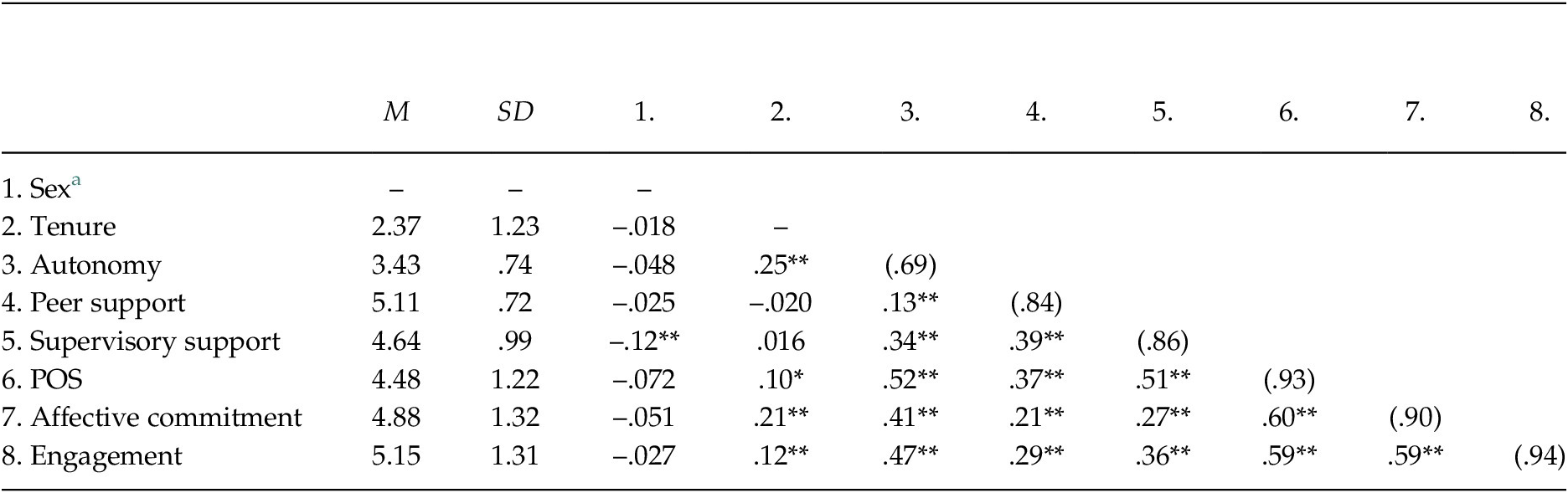
The results began to be analyzed by studying the descriptive statistics. The values considered may be observed in Table 1.
Means, Standard Deviations and Correlations among Study Variables

Note. N =554.
a dummy variable (0 = Male; 1 =Female).
*p ≤ .05. **p < .01. 54 **p $ <.01$ .
Hypothesis Testing
Hypothesis testing was conducted with model 1 of the Process tool (Hayes, Reference Hayes2013), supported by the SPSS program. Considering there were four independent variables, autonomy, peer support, supervisory support and POS, we were able to conceive four different models when we tested our hypotheses. Hence, according to the moderation analysis, Hypotheses 1a and 1b were supported, as there is a positive and significant relationship between autonomy and engagement (b = .50, p < .001) and between peer support and engagement (b = .23, p < .001). As far as Hypotheses 1c and 1d are concerned, it may be observed that they were also supported. There is, in fact, a positive and significant relationship between direct supervisory support and the aforementioned psychological state (b = .25, p < .001) and between POS and engagement (b = .40, p < .001).
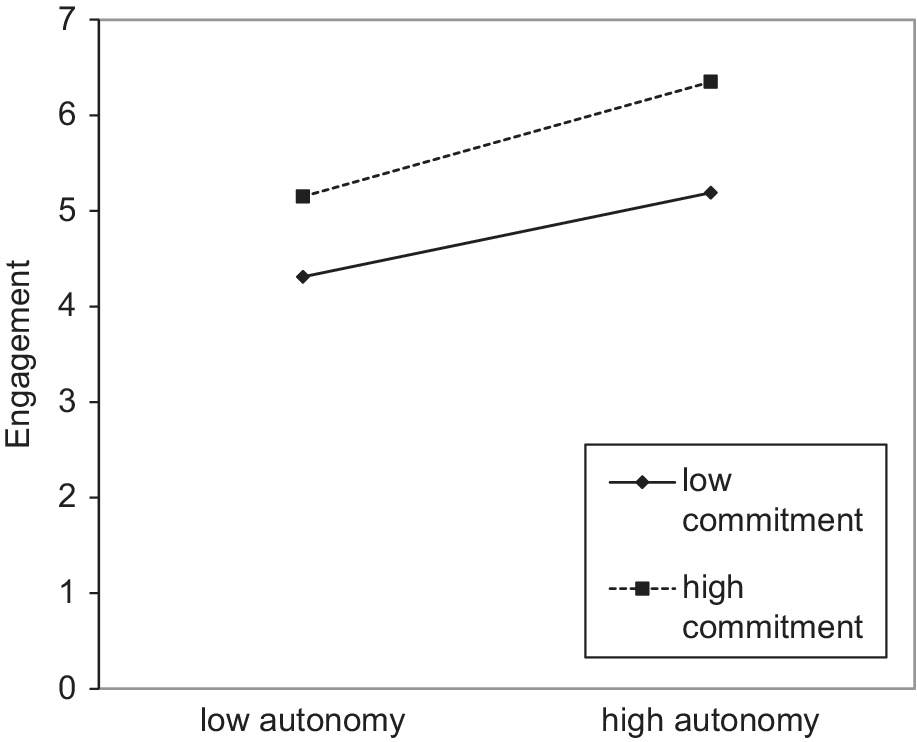
As regards Hypotheses 2a and 2b, the former was supported while the latter was rejected. Indeed, the relationship between higher levels of autonomy and engagement, moderated by affective commitment, is observed to be significant, F(3, 550) = 131.67, p < .001, and has  $ {R}^2$= .42, p < .001, showing that 42% of the variance of engagement is explained by this model. Additionally, the interaction between autonomy and affective commitment is observed to be significant to predict the levels of the dependent variable, b = .08, p < .05, and the variance of engagement increases with commitment as a moderating variable (
 $ {R}^2$= .01, p
 $ \le$ .05). Thus, 2a was supported. The interactive effect may be observed in Figure 1.
The Moderating Effect of Affective Commitment on Autonomy-engagement Relationship

We may also observe that the relationship between perception of higher levels of peer support and engagement, moderated by affective commitment is significant, F(3, 550) = 114.22, p < .001) and has  $ {R}^2$= .38, p < .001, showing that 38% of the variance of engagement is explained by this model. However, the interaction between perception of higher peer support and affective commitment is not found to be significant to predict the levels of the dependent variable (b = –.06, ns), and the variance of engagement does not increase with the presence of commitment as a moderating variable (
 $ {R}^2$= .001, ns). Thus, Hypothesis 2b was rejected.
As for Hypotheses 2c and 2d, both were rejected. In fact, the relationship between perception of higher direct supervisory support and engagement, moderated by affective commitment is observed to be significant, F(3, 550) = 122.29, p < .001) and has  $ {R}^2$= .40, p < .001, showing that 40% of the variance of engagement is explained by this model. However, the interaction between supervisory support and affective commitment is not found to be significant to predict the levels of the dependent variable, b = –.03, ns, and the variance of engagement does not increase with the presence of commitment as a moderating variable (
 $ {R}^2$= .001, ns). Thus, Hypothesis 2c was rejected.
We may also observe that the relationship between perception of higher POS and engagement, moderated by affective commitment is significant, F(3, 550) = 1,143.268, p < .001, and has  $ {R}^2$= .44, p < .001, showing that 44% of the variance of engagement is explained by this model. Nevertheless, the interaction between perception of higher POS and affective commitment is not found to be significant to predict the levels of the dependent variable, b = –.01 ns, and the variance of engagement does not increase with the presence of commitment as a moderating variable,
 $ {R}^2$= .001, ns. Thus, Hypothesis 2d was rejected.
Discussion
The main aim of the present study was to understand the impact of job resources, namely autonomy, peer support, supervisory support and POS, on the engagement levels of workers, taking the moderating effect of affective commitment to the organization into consideration. Perceptions of higher autonomy, higher peer support, higher supervisory support and higher levels of POS were found to be positively related to job well-being. In turn, affective commitment was observed to enhance the interaction between perceptions of higher autonomy and engagement. This research reinforces the area of study related to job resources and, above all, contributes to the literature by stressing the importance of the moderating function of affective commitment in relationships between variables that are promoters of well-being.
First and foremost, as expected, the perception of higher levels of autonomy was positively and significantly related to engagement. This conclusion highlights the role of autonomy as a job resource and demonstrates the motivating potential of this resource, in line with previous studies (Joo et al., Reference Joo, Jeung and Yoon2010; Meng & Ma, Reference Meng and Ma2015). Moreover, confirmation of this hypothesis supports one of the assumptions defended by the Self-Determination Theory (Ryan & Deci, Reference Ryan and Deci2000), namely that a context which promotes satisfaction of the autonomy requirement also fosters the intrinsic motivation of the individual, thus reinforcing the plausibility of one of the foundations of the motivational engagement process (Schaufeli & Bakker, Reference Schaufeli and Bakker2004a): Given their motivational function, job resources promote this positive psychological state.
Secondly, as expected, workers with perceptions of higher peer support were observed to present higher engagement levels. Verification of this relationship provides a reinforcement to the literature in terms of the positive role of peer support at work (Häusser et al., Reference Häusser, Mojzisch, Niesel and Schulz-Hardt2010; Matthews et al., Reference Matthews, Bulger and Barnes-Farrell2010), thus enabling consolidation of the idea that this support is an important interpersonal resource. Furthermore, this observation brings legitimacy to the idea that a sense of belonging to a context is one of the fundamental needs of the Self-Determination Theory (Ryan & Deci, Reference Ryan and Deci2000).
A positive and significant relationship between supervisory support and engagement was also confirmed in this study. Corroboration of this hypothesis sheds light upon the motivational nature of this contextual resource and is in line with the findings of other studies (Garcia et al., Reference Garcia, Ng, Capezio, Restubog and Tang2017; James et al., Reference James, McKechnie and Swanberg2011; Swanberg et al., Reference Swanberg, McKechnie, Ojha and James2011). Moreover, this observation demonstrates the importance of the construction of close relationships between peers and supervisors and enables reflection on the most suitable leadership styles to be adopted.
Finally, as expected, perception of higher support on the part of the organization was found to be positively and significantly related to work engagement. Thus, it may be said that individuals present higher psychological well-being at work when they believe the organization for which they work is concerned with their levels of stress and satisfaction. This finding is in keeping with other observations made in previous studies that have highlighted the advantages associated with this variable (Cropanzano et al., Reference Cropanzano, Howes, Grandey and Toth1997; Wang et al., Reference Wang, Zhang, Thomas, Yu and Spitzmueller2017). Indeed, this confirmation consolidates POS as a broad-ranging contextual resource, which enables better integration of the individual (Rhoades & Eisenberger, Reference Rhoades and Eisenberger2002) thus, fostering a sense of belonging to the work context.
Furthermore, a number of interesting conclusions may be drawn from this research. Affective commitment was found to enhance the relationship between job resources and engagement. As predicted, commitment moderates the relationship between autonomy and the above-mentioned psychological state, making this relationship more robust. This finding stresses the previously observed (Greguras & Diefendorff, Reference Greguras and Diefendorff2009) motivational capacity of affective commitment and its role as a contextual resource. Other studies have already demonstrated that engagement promotes affective commitment (Halbesleben, 2010, cit. by Mills & Fullagar, Reference Mills and Fullagar2017), however the findings of this study provide further information on how affective commitment may be considered a valuable contextual resource that boosts the effect of job resources (i.e. autonomy) on this positive psychological state at work. In fact, confirmation of the active role of commitment contradicts the idea that it is merely the consequence of the action of other variables (Levy & Williams, Reference Levy and Williams1998).
Notwithstanding, although favorable and significant relationships were observed between peer support, supervisory support and engagement, and between POS and the dependent variable under study, it cannot be concluded that affective commitment enhances these relationships. The fact that only the affective component of commitment was analyzed, and the normative and continuance facets were not taken into consideration, may explain the absence of a moderating effect. As the impact of one of the components of commitment on the behavior of the individual depends on the magnitude of the other two (Gellatly et al., Reference Gellatly, Meyer and Luchak2006), it is therefore likely that the occurrence/non-occurrence of a moderating effect by the affective facet will depend on the levels of the normative and continuance components. In other words, a leverage effect in these relationships may result from a particular profile, with specific commitment conjugations. Additionally, the fact that the organization under study was not undergoing changes may justify the absence of the moderating effect in these relationships. According to the Conservation of Resources Theory (Hobfoll, 1998, cit. by Hobfoll, Reference Hobfoll2001), resources gain importance when the context fosters their loss. Thus, it may well be the case that the stable phase of the organization under study did not enable affective commitment to reach its “maximum positive impact”. Consequently, it does not provide for a strengthening of the relationship between the analyzed interpersonal resources and engagement. In fact, studies observing a moderating effect of affective commitment have used samples of workers whose companies were undergoing changes or restructuring processes (Armstrong-Stassen, Reference Armstrong-Stassen2004; Begley & Czajka, Reference Begley and Czajka1993; Irving & Coleman, Reference Irving and Coleman2003).
As is the case with all research studies, the present study also has its limitations and less positive features. First, its cross-sectional design may constitute a potential limitation. As engagement is a “persistent, affective and emotional” psychological state (Salanova & Schaufeli, Reference Salanova and Schaufeli2008), a longitudinal study may be advantageous. A more detailed analysis of engagement levels could be constructed over a specific period of time, according to oscillations in perceptions of degree of autonomy, peer and supervisory support and POS levels. Indeed, as moderating variables may undergo changes across time, owing to variations in the perceptions of resources, such as higher work autonomy generating higher commitment (Deci et al., Reference Deci, Olafsen and Ryan2017), a longitudinal study would be useful. On the other hand, the legitimacy of a generalization of the results is a limiting factor. For example, a worker’s tenure in an organization may have an effect on commitment, and this may decrease when the worker has been at the organization for a longer period of time (Stout et al., 1988, cit. by Ng & Feldman, Reference Ng and Feldman2013). In the organization under study, tenure is not, in fact, very high. Most of the workers have been at the organization from 1 to 5 years, therefore commitment levels may be lower in companies whose workers have higher tenure and, consequently, the moderating effect observed in this study may not be found in these contexts.
Even so, this research enables us to draw a number of interesting conclusions which, undoubtedly, may have favorable implications for the lives of organizations and workers. Firstly, it may be concluded that autonomy, peer support, supervisory support and POS represent a crucial role as job resources. The positive relationships established with engagement highlight, above all, the motivational nature of these variables and the importance of their implementation and promotion within the organizations. Therefore, companies should promote work contexts in which more autonomous work management is possible, with closer proximity among workers, higher levels of supervisory support and, finally, where workers feel they are appreciated, and their needs are met. In practical terms, autonomy may be encouraged when supervisors evaluate workers’ performance, with a view to informing them rather than controlling them (Shalley & Perry-Smith, Reference Shalley and Perry-Smith2001). In order to promote the perception of higher peer support, initiatives geared towards increased proximity among workers should be created, so that there are higher levels of exchange among them and, thus, greater satisfaction at work (Langston, 1994, cit. by Simon et al., Reference Simon, Judge and Halvorsen-Ganepola2010). POS may be fostered by increased justice in organizational procedures (Moorman et al., Reference Moorman, Blakely and Niehoff1998). Finally, the perception of higher levels of supervisory support may be achieved by investing in transformational leadership (Niessen et al., Reference Niessen, Mäder, Stride and Jimmieson2017).
However, the most innovative implication of this study is centered on the role of active commitment at the time of its interaction with job resources. Indeed, if the aim is to increase the engagement of workers by fostering autonomy, then measures geared towards increasing affective commitment should be implemented. In other words, if a job resource is promoted, in this case autonomy, a contextual resource should also be promoted, in this situation affective commitment, to foster engagement. These conclusions are considerably important and relevant: they alert organizations to the importance of affective commitment as a driver of positive relationships between job resources and engagement; they consolidate the foundations of Positive Psychology (Seligman & Csikszentmihalyi, Reference Seligman and Csikszentmihalyi2000), by focusing on the study of variables that indicate well-being; moreover, considering that the branch of consultancy in Portugal has been seen to increase, particularly in 2016 (Observatorio Sectorial DBK, 2017), these results are relevant for an improvement of the lives and growth of the workers of this sector. Indeed, these results and the growing importance that the consulting industry has in certain regions of the world, such as East Asia (Consultancy.eu, 2018), should stimulate the growing literature on the impact of resources and the affective commitment have on the workforce, psychological well-being and employees’ productivity.
Future research should further analyze the moderating potential of affective commitment in the relationship between personal resources and job engagement. For example, commitment may enhance the positive relationship between higher levels of workers’ self-efficacy and the afore-mentioned psychological state, previously observed by Xanthopoulou et al. (Reference Xanthopoulou, Bakker, Demerouti and Schaufeli2007). Given that the literature has been considering human conduct as a result of the interaction between contextual variables and others of an individual character (Schaufeli & Taris, Reference Schaufeli, Taris, Bauer and Hämmig2014), it would be interesting for future studies to contemplate the effects exerted by personal resources. Future research should also observe the moderating effect of affective commitment in the relationships between positive variables in companies of different sizes, considering that workers of larger organizations feel less committed (James & Jones, 1974, cit. by Sommer et al. Reference Sommer, Bae and Luthans1996); this effect should also be studied in other professional sectors.
Finally, future research should also consider the moderating effect of the three components of commitment (Meyer & Allen, Reference Meyer and Allen1991) taken together. In fact, these components may be grouped and constitute different profiles (Meyer & Herscovitch, Reference Meyer and Herscovitch2001). Hence, as the effect of one of the components of commitment on the individual’s behavior is dependent on the remaining two (Gellatly et al., Reference Gellatly, Meyer and Luchak2006), and as workers with commitment conjugations in which there are higher levels of the affective and normative components are benefited (e.g. they present lower levels of job stress) (Wasti, 2005, cit. by Meyer et al., Reference Meyer, Stanley and Parfyonova2012), it would be pertinent to observe the extent to which this specific profile can boost the relationships established between job resources and engagement.
It would also be interesting to analyze the moderating role of commitment in relationships between resources and well-being in individuals whose organizations are undergoing structural changes. Indeed, the literature points to peer and supervisory support as consolidated promoters of commitment (Chiaburu & Harrison, Reference Chiaburu and Harrison2008; Simon et al., Reference Simon, Judge and Halvorsen-Ganepola2010). In turn, commitment stemming from the presence of these resources could moderate their relationship with engagement.