INTRODUCTION
Organizations are experiencing fierce competition as well as operating in a highly interdependent and global economy. In such an environment, organizations can succeed by facilitating innovation at work (Yukl & Lepsinger, Reference Yukl and Lepsinger2006). Analyses of the Dow Jones industrial index and the Kauffman Index of entrepreneurial activity (2007) reveal that the economic slowdown has cultivated innovation leading to new business creation (Chakravorti, Reference Chakravorti2010). Innovation is a key driver for economic growth and well-being of developed as well as emerging economies (Global Innovation Index, 2014).
However, to compete and flourish in the global market, emerging economies like India need to explore new ways of doing business and launch new products and processes. Currently, India has a far lower number of patents as compared with developed countries as recorded by United States Patent and Trademark Office. Patents/inventions/new products and processes under the name of a country can be increased through employee innovative work behavior
Examining innovative work behavior in India assumes all the more importance as, the present Indian Prime Minister has emphasized on ‘Make in India’ campaign (Press Information Bureau, Government of India, 2014). The target of the campaign is to promote manufacturing in India and hence improvise economic growth. Even though emerging economies like India can pursue their agenda of economic growth by encouraging innovative work behavior, research on this area in the Indian context is limited (Bhatnagar, Reference Bhatnagar2012; Kheng, June, & Mahmood, Reference Kheng, June and Mahmood2013). The present study aims to fill this gap by exploring factors that may promote innovative work behavior in the Indian context.
Further, China and India have emerged as preferred locations for multinationals establishing their research and development centers. Therefore, it is desired to have knowledge on innovation at the workplace on a more global scale (Bruche, Reference Bruche2009). Shalley and Gilson (Reference Shalley and Gilson2004) advocated the need for research that explores individual and contextual conditions in various cultures. Cappelli, Singh, Singh, and Useem (Reference Cappelli, Singh, Singh and Useem2010) reported that Indian chief executive officers considered employee innovation and its execution by their superiors as valuable tools to deal with competition. Bhatnagar (Reference Bhatnagar2012) reported that innovation at work is a critical factor for success in India. These studies indicate the importance of exploring factors which may facilitate innovative work behavior in India.
Research on innovation has been multifaceted and multidisciplinary, thus exploring its different aspects such as product, service, market, business model, operational innovation (Gallouj & Djellal, Reference Gallouj and Djellal2011). One of the crucial aspects of innovation is the behavioral aspect, which studies employee’s innovative behavior. Studying factors that facilitate innovative work behavior can promote success in competitive environments (Anderson, Potocnik, & Zhou, Reference Anderson, Potocnik and Zhou2014). Many researchers have considered ‘employees’ as a crucial factor for promoting innovative actives at the workplace. For example, Community Innovation Survey (2012) indicated around 50% of the innovative companies in Europe consider employees a crucial source of innovation. Appelbaum, Bailey, Berg, and Kalleberg (Reference Appelbaum, Bailey, Berg and Kalleberg2000) have identified that employees have special knowledge of the production process, which helps in the quick recognition of the root problem and therefore identification of a suitable solution in a short span of time. The ideas suggested by employees are also found to be relatively low cost. Since employees own these ideas, their implementation becomes easier. Further, these ideas are context-specific, and therefore the possibility of replication by competitors is also less (Robinson & Schroeder, Reference Robinson and Schroeder2004).
Even though emerging economies like India can pursue their agenda of economic growth by promoting innovative work behavior, research on this area is limited (Bhatnagar, Reference Bhatnagar2012; Kheng, June, & Mahmood, Reference Kheng, June and Mahmood2013). This study aims to fill this gap by exploring factors that may promote innovative work behavior in the Indian context.
Considering the importance of behavioral aspect, this study focuses on innovative work behavior. This study considers innovative work behavior as an individual’s perception of involvement in the generation, introduction, and application of a new idea for the benefit of the organization or parts within it (Janssen, Reference Janssen2005). Predictors for exhibiting innovative work behaviors are largely classified into individual, organizational, or environmental category (Crossan & Apaydin, Reference Crossan and Apaydin2010). This study aims to explore the relationship between psychological capital (which is an individual-level predictor) and innovative work behavior.
Psychological capital is a positive, higher-order and individual-level characteristic that is open for development (Luthans, Avey, & Patera, Reference Luthans, Avey and Patera2008). It is measured through four constructs: hope, self-efficacy, optimism and resilience (Luthans, Avolio, Avey, & Norman, Reference Luthans, Youssef and Avolio2007). Innovative work behavior is characterized by tension (Bledow, Frese, Anderson, Erez, & Farr, Reference Bledow, Frese, Anderson, Erez and Farr2009), contradictions (Smith & Tushman, Reference Smith and Tushman2005) and dilemmas (Benner & Tushman, Reference Benner and Tushman2003). Adoption of innovative work behavior, due to its very nature requires intrinsic motivation, positivity, assertiveness, and self-confidence (Yeo & Neal, Reference Yeo and Neal2004; Chen, Wu, & Chen, Reference Chen and Aryee2010). Therefore, psychological capital would be a vital characteristic for meeting some of the behavioral requirements of adopting innovative work behavior.
In addition to psychological capital, supervisory support can nurture innovative work behavior. Employees are highly dependent on their supervisors for information, resources and socio-political support required to promote and apply their new ideas (Janssen, Reference Janssen2005). They will, therefore, need their supervisor’s support for dealing with various issues that they may encounter while suggesting and practicing new ideas. Bledow, Frese, and Mueller (Reference Bledow, Frese and Mueller2011) emphasized that accurate measures adopted by supervisors can even control dysfunctional influences of organizational culture on innovation. The importance of supervisory support can also be explained by social exchange theory (Blau, Reference Blau1964). Social exchange theory emphasizes that when individuals interact over a period of time they have the urge to return favors (norm of ‘reciprocity’). Indeed, individuals feel more motivated to reciprocate support and assist than most benefactors predict (Flynn, Reference Flynn2003). The urge to reciprocate implies to the current relationship as support and facilitation from supervisors may make employees feel obliged to adopt innovative work behavior, which is desired by the supervisor. Therefore, at a contextual level, it is important to study the role of supervisor support for promoting innovative work behavior in an emerging economy like India.
This study also aims to explore the impact of work-to-family enrichment and family-to-work enrichment in the development of psychological capital. Psychological capital has been identified as a state-like construct and hence is flexible for change and development. Underpinned by the broaden-and-build theory (Fredrickson, Reference Fredrickson1998), this empirical study attempts to determine the role of work-to-family enrichment and family-to-work enrichment in the development of psychological capital. As explained by broaden-and-build theory (Fredrickson, Reference Fredrickson1998) the positive experiences (such as work-to-family enrichment and family-to-work enrichment) broaden an individual’s capacity for effective action and builds upon their personal resources (such as psychological capital). Thus, this research also contributes to the limited literature on the constructs that may enhance individual’s psychological capital (Luthans, Avey, & Patera, Reference Luthans, Avey and Patera2008) and builds a business case for managers to concentrate on critical issues like the work–family status of their employees.
It is important to highlight here that the two theories, social exchange theory and broaden-and-build theory that support the proposed theoretical framework are consistent with each other as they both are based on the element of ‘positivity.’ To elaborate this further, social exchange theory explains a direct relationship between supervisory support and innovative work behavior. When supervisors provide support through resources and benefits, employees feel obliged to reciprocate by adopting innovative work behavior. A feeling of positivity is attached to the reciprocal relationship. Similarly, the broaden-and-build theory explains that an individual’s psychological capital may develop through ‘positive experiences’ such as work-to-family enrichment and family-to-work enrichment. Thus, the broaden-and-build theory also uses positivity to support the relationship between bi-directional work–family enrichment and psychological capital. While the broaden-and-build theory considers the role of positivity from an intrapersonal angle, the social exchange theory explores the same from an interpersonal perspective.
The next section discusses literature review, hypotheses, and models. Following this, the section on methodology provides details on the data collection process and measures used for data collection. The next section presents results and discusses inferences. The last section highlights contributions, limitations, and future directions.
LITERATURE REVIEW, HYPOTHESES, AND MODELS
Relationship between work-to-family enrichment, family-to-work enrichment, and psychological capital
Work–family enrichment is explained as ‘experiences in Role A (work or family) can improve the quality of life in Role B (family or work)’ (Greenhaus & Powell, Reference Greenhaus and Powell2006: 72). Work–family enrichment is a bi-directional phenomenon as it measures enrichment from both work-to-family and family-to-work direction (Carlson, Kacmar, Wayne, & Grzywacz, Reference Carlson, Kacmar, Zivnuska, Ferguson and Whitten2006). When an individual plays multiple roles (in work or family domains) various kinds of resources like skill-set, material, social capital and psychological support are generated. These resources irrespective of the domain in which they are generated can be transferred and utilized to improve the quality of life in the receiving domain (Greenhaus & Powell, Reference Greenhaus and Powell2006). Researchers have found work-to-family enrichment and family-to-work enrichment as positive phenomena, which have direct relationship with employee’s physical health (Carlson, Kacmar, Zivnuska, Ferguson, & Whitten, Reference Carlson, Hunter, Ferguson and Whitten2011), mental health (Gareis, Barnett, Ertel, & Berkman, Reference Gareis, Barnett, Ertel and Berkman2009), personal well-being (Kinnunen, Feldt, Geurts, & Pulkkinen, Reference Kinnunen, Feldt, Geurts and Pulkkinen2006; Mauno, Kinnunen, & Rantanen, Reference Mauno, Kinnunen and Rantanen2011), life satisfaction (McNall, Nicklin, & Masuda, Reference McNall, Nicklin and Masuda2010), reduced emotional exhaustion (Van Steenbergen, Ellemers, & Mooijaart, Reference Van Steenbergen, Ellemers and Mooijaart2007) and improved sleep quality (Williams, Franche, Ibrahim, Mustard, & Layton, Reference Williams, Franche, Ibrahim, Mustard and Layton2006). Work–family enrichment also diminished negative outcomes due to poor health conditions like burnout (Van Steenbergen, Ellemers, & Mooijaart, Reference Van Steenbergen, Ellemers and Mooijaart2007), depression (Nitzsche, Jung, Pfaff, & Driller, Reference Nitzsche, Jung, Pfaff and Driller2013) and anxiety (Grzywacz & Bass, Reference Grzywacz and Bass2003).
Psychological capital is individual’s positive state of mind, which focuses on strengths within an individual (Demerouti, van Eeuwijk, Snelder, & Wild, Reference Demerouti, van Eeuwijk, Snelder and Wild2010). Since work-to-family and family-to-work enrichment is positively related to factors that are responsible for individual’s positive state of being such as physical health, mental health, well-being, reduced emotional exhaustion, and depression, it was expected that it would also positively impact psychological capital.
The relationship between bi-directional enrichment and psychological capital can be further explained through the broaden-and-build theory, which states that positive feelings may broaden people’s thoughts and actions, thus building their physical, intellectual, social and psychological resources (Fredrickson, Reference Fredrickson1998). These resources are long-lasting and are thus not limited to the time when the individual is having a positive experience (Fredrickson, 2001). Thus with the help of broaden-and-build theory, it can be suggested that when a person undergoes positive experiences in work or family domain, then she/he may feel more positive and confident about self, energized to deal with adverse situations. For example, a workshop on ‘making and delivering presentations’ at work can make the individual feel more confident not only at the workplace but also while facilitating her/his daughter’s school project. Similarly, a relaxed and pleasurable weekend can make one feel optimistic and hopeful. Such positivity may also be useful in completing a difficult work assignment that may be due in the coming week. Mishra, Gupta, and Bhatnagar (Reference Mishra2014) and Mishra (Reference Mishra, Gupta and Bhatnagar2014) interviewed Indian professionals and inferred that bi-directional work–family enrichment boosts individual’s self-efficacy, optimism, hope, and resilience and, thereby, the psychological capital. By the above description, we posit that:
Hypothesis 1 : Work-to-family enrichment is positively and significantly related to psychological capital.
Hypothesis 2 : Family-to-work enrichment is positively and significantly related to psychological capital.
Relationship between psychological capital and innovative work behavior
Research has demonstrated, psychological capital is an integration of four subconstructs of self-efficacy, hope, resilience, and optimism (Luthans, Youssef, & Avolio, Reference Luthans, Youssef and Avolio2007). Extant literature has suggested that these four subconstructs complement each other and hence provide a better prediction for the rational results when studied collectively as a higher-order construct of psychological capital rather than when individually explored (Luthans, Youssef, & Avolio, Reference Luthans, Youssef and Avolio2007; Avey, Luthans, & Jensen, Reference Avey, Luthans and Jensen2009). Moreover, to the best of authors’ knowledge, there is no published literature, which has studied the impact of psychological capital on innovative work behavior. Hence, inference for a possible relationship between the two is drawn by examining the independent association of the four subconstructs of psychological capital with innovative work behavior.
Individuals with high hope possess an enormous capacity to set and pursue goals, which are realistic and challenging (Avey, Luthans, & Jensen, Reference Avey, Luthans and Jensen2009). They are motivated and energized throughout the process and possess high internal control (Snyder, Reference Snyder2002). Hopeful individuals are risk-takers and look for alternative pathways when old ones are blocked (Luthans & Jensen, Reference Luthans and Jensen2002). Luthans, Youssef, and Avolio (Reference Luthans, Youssef and Avolio2007) found that hopeful employees are likely to be creative and resourceful, even with tight budgets. Hopeful individuals look at problems and opportunities from different angles and work on creative ideas for solving problems (Zhou & George, Reference Zhou and Buehler2003); therefore, they may successfully exhibit innovative work behavior.
Self-efficacy is an individual’s belief in her/his ability to produce positive outcomes. Bandura and Locke (Reference Bandura and Locke2003) have indicated that confidence in one’s self-efficacy helps to cope with distressing and self-debilitating emotional states that may act as obstructions in achieving the goal. Researchers have pointed out that efficacious individuals have high intrinsic motivation (Gong, Huang, & Farh, Reference Gong, Huang and Farh2009), confidence to deal with challenging situations (Deci & Ryan, Reference Deci and Ryan2000), are resourceful (Bandura, Reference Bandura2000) and creative (Amabile, Reference Amabile1996; Tierney & Farmer, Reference Tierney and Farmer2002); thus, they may exhibit innovative work behavior.
Optimism helps an individual concentrate on the positive aspects of the task in the past, present and future (Luthans, Youssef, & Avolio, Reference Luthans, Youssef and Avolio2007). Expecting a positive outcome also increases the motivation and probability of participating in the activity (Avey, Nimnicht, & Pigeon, Reference Avey, Nimnicht and Pigeon2010). Rego, Sousa, Marques, and Cunha (Reference Rego, Sousa, Marques and Cunha2012) demonstrated a positive association between creativity and optimism. Optimism may lead to constructive thinking patterns. Constructive thinking patterns are essential in the first stage of the innovative process where one needs to recognize problems and generate ideas for their solution (Carmeli, Meitar, & Weisberg, Reference Carmeli, Meitar and Weisberg2006). With a positive attitude and constructive thinking, it is expected that an optimistic attitude is likely to play a crucial role in various stages of innovative work behavior.
Resilient individuals have an extraordinary capability to manage and adapt to change (Avey, Patera, & West, Reference Avey, Patera and West2006). They are realistic (Coutu, Reference Coutu2002), emotionally balanced (Masten & Reed, Reference Masten and Reed2002), capable of positive coping (Fredrickson, Reference Fredrickson2004), and open to new experiences (Block & Kremen, Reference Block and Kremen1996). An employee of relatively high resilience is likely to deal with difficult situations as she/he will have the capability to bounce back from setbacks while maintaining high efficiency (Tugade & Fredrickson, Reference Tugade and Fredrickson2004). Thus, an individual needs to be high on resilience to outperform innovative work behavior which may be challenging, risky and stand alone, especially in the early stages (Stenberg & Lurart, Reference Stenberg and Lurart1995; Torrance, Reference Torrance1995). Further, resilient individuals bring out positive emotions in themselves as well as in others (Fredrickson, Reference Fredrickson2004), which may also create a supportive environment that facilitates innovative work behavior. In this regard, resilience is significant as it gives energy to individuals to deal with adverse situations and refocus on the goal activity.
Based on the above literature, we hypothesize as below:
Hypothesis 3 : Psychological capital is positively and significantly related to innovative work behavior.
Mediating effect of psychological capital
Work-to-family enrichment and family-to-work enrichment are positive experiences that individual may undergo at family and workplace, respectively. These enriching experiences are likely to make an individual feel more confident, optimistic, resilient and hopeful, thus developing their psychological capital. For example, an individual facing a setback at the workplace and having support of his/her family is expected to recover faster and respond effectively (family-to-work enrichment) than those without support. Such an experience may enhance individual’s resilience and confidence. On the other hand, an individual facing a crisis in the family life and having satisfying experience at the workplace, may draw strength from successes in his/her work life and thus not blame self but some external factors for the failures in family life. Such an outlook will also make him/her more hopeful and optimistic about future, thus developing his/her psychological capital. Individuals with high psychological capital are usually optimistic about their aspirations and successfully cope with hurdles that they may encounter. These positive ‘feelings’ influence individual’s ‘behaviors’ as they provide strength to practice risky and demanding activity like innovative work behavior (Coakes & Smith, Reference Coakes and Smith2007).
As stated earlier, enhanced psychological capital is expected to encourage innovative work behavior. Besides, there have been certain studies, which indicate the possibility of the mediating role of psychological capital. For example, psychological capital has the potential to overcome the stress and frustration that may be stimulated in an employee due to demand of creative performance (Sweetman, Luthans, Avey, & Luthans, Reference Sweetman, Luthans, Avey and Luthans2011). Further, psychological capital is also expected to influence individual’s personality, intrinsic motivation, and proactivity, that are crucial for exhibiting innovative work behavior. Luthans, Youssef, and Rawski (Reference Luthans, Youssef and Rawski2011) found that psychological capital is positively related to problem solving and innovation. Abbas and Raja (Reference Abbas and Raja2015) conducted a study in Pakistan and reported psychological capital is positively related to innovative performance and job stress. Ziyae, Mobaraki, and Saeediyoun (Reference Ziyae, Mobaraki and Saeediyoun2015) conducted a study on the innovative application of information technology between branches of agriculture bank in Iran and found psychological capital is directly related to innovation. Psycological Capital has been shown to add variance to desired attitudinal and behavioral outcomes beyond the demographics and well-known positively oriented constructs such as core self-evaluations, personality traits and person–organization and person–job fit (Avey, Nimnicht, & Pigeon, Reference Avey, Nimnicht and Pigeon2010). Psycological capital is positively related with desirable attitudes, behaviors, and performance (Avey et al., 2011), psychological well-being of employees (Avey, Nimnicht, & Pigeon, Reference Avey, Nimnicht and Pigeon2010) and negative relationships with cynicism, intentions to quit (Avey, Nimnicht, & Pigeon, Reference Avey, Nimnicht and Pigeon2010) and importantly stress (Avey, Luthans, & Jensen, Reference Avey, Luthans and Jensen2009).
Thus, on the basis of review of the literature and Hypotheses 1–3 this study proposes that psychological capital fully mediates the relationship between bi-directional enrichment and innovative work behavior:
Hypothesis 4 : Psychological capital fully mediates the relationship between work-to-family enrichment and innovative work behavior.
Hypothesis 5 : Psychological capital fully mediates the relationship between family-to-work enrichment and innovative work behavior.
Relationship between supervisory support for innovative work behavior and innovative work behavior
The supervisory support not only encourages employees to present an innovative idea, but it also provides crucial resources and information that can facilitate implementation of the idea (Janssen, Reference Janssen2005). Besides, support from a supervisor becomes crucial as it can attract support from coworkers and other managers and thus, increasing chances for the success of an idea. It also helps in integration of group processes and competencies required for successful implementation of the idea (West, Reference West2002). It is likely that supervisors may play pivotal role in enabling innovative activities as they foster a learning environment, show tolerance for failed ideas (Madjar, Oldham, & Pratt, Reference Madjar, Oldham and Pratt2002), accept risk-taking norms (King, Reference Kim, Hon and Lee1992; West & Anderson, Reference West and Anderson1996) and promote diversity within the group (Crossan & Apaydin, Reference Crossan and Apaydin2010). Moreover, in the absence of supervisory support, employees may fear jeopardizing their image if their innovative ideas fail (Kleysen & Street, Reference Kleysen and Street2001). Therefore, it is likely that an individual may be more encouraged to adopt innovative work behavior when a new idea and its implementation is supported by the supervisor (Hülsheger, Anderson, & Salgado, Reference Hülsheger, Anderson and Salgado2009).
This relationship of supervisory support and innovative behavior can be further explained through the social exchange theory (Blau, Reference Blau1964). Social exchange theory suggests that when an individual feels obliged, he/she wants to reciprocate by engaging in desired behaviors and providing future assistance. Social exchange involves a series of interactions, which over a period of time generate obligations and liberties between workplace social network members (Maurer, Pierce, & Shore, Reference Maurer, Pierce and Shore2002; Åmo, Reference Åmo2006). Thus an employee, satisfied with the workplace relationship, may respond by fulfilling obligations they have toward their supervisor and/or employing organization. While numerous characteristics of social exchange exist, the most significant is reciprocity (Cropanzano & Mitchell, Reference Cropanzano and Mitchell2005). In this paper, we consider positive reciprocity whereby supportive and fair exchanges between two parties (individuals or groups) result in favorable behaviors and attitudes. Supervisor’s support for promoting/implementing the idea and for dealing with failures/difficult situations may develop an organizational mechanism, which may encourage employees to practice innovative work behavior. Such support and encouragement may have a cascading effect to further positively reciprocate by engaging in innovative work behavior.
Researchers have indicated that it is important to understand the role of a contextual factor (supervisory support for innovative work behavior) in interaction (as predictor or moderator) with a personal factor (psychological capital) on innovative work behavior. Based on the preceding understanding, we posit that:
Hypothesis 6a : Supervisory support for innovative work behavior moderates the relationship between psychological capital and innovative work behavior.
Hypothesis 6b : Supervisory support for innovative work behavior is positively and significantly related to innovative work behavior.
Models
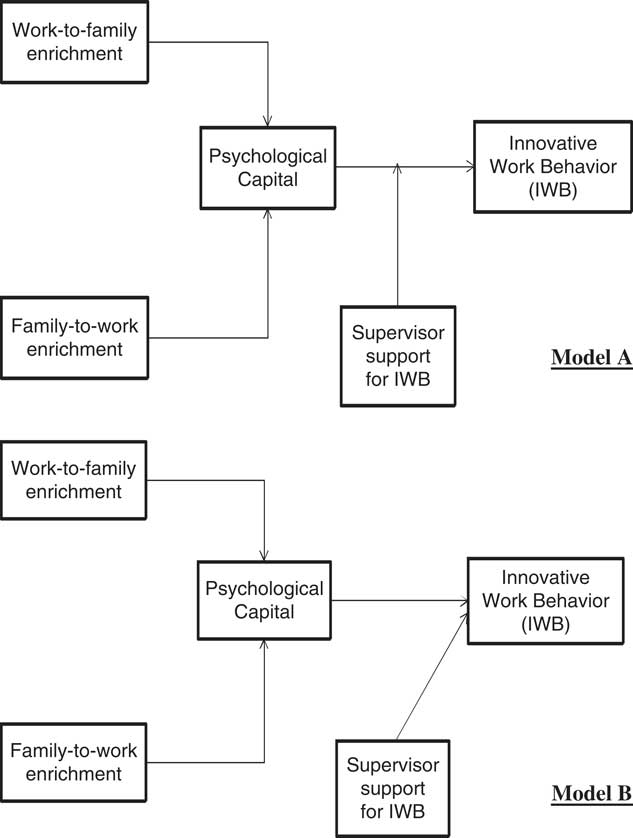
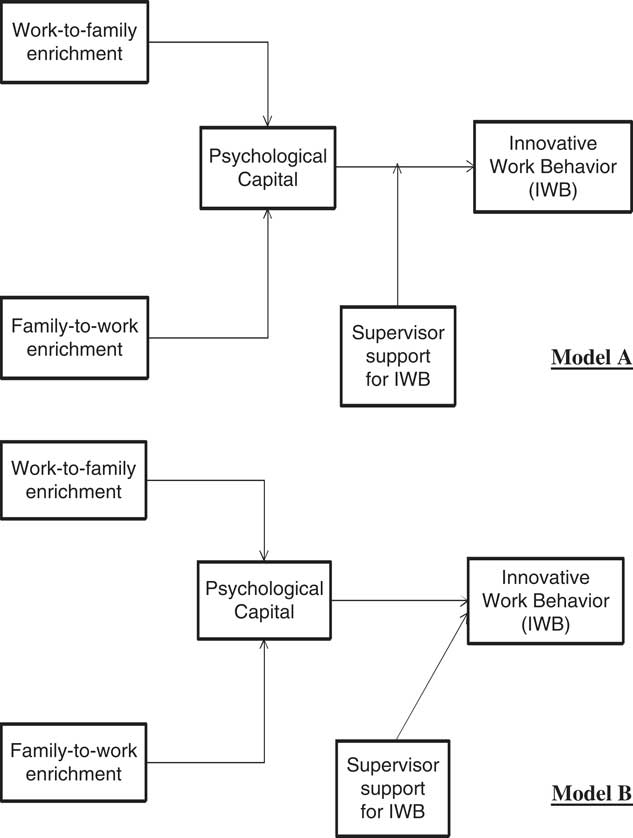
Based on the above discussions, two models (Figure 1) have been tested. The models examine work-to-family enrichment and family-to-work enrichment as the predictors of psychological capital; the mediating role of psychological capital; and the relationship between bi-directional work–family enrichment and innovative work behavior. Though, in general, supervisor’s support is considered to be significant for promoting new ideas, we need to explore more specifically in the emerging economy context. In this respect, Model A explores the role of supervisor support as a moderator of the relationship between psychological capital and innovative work behavior, while Model B investigates supervisor support as a predictor.
Path diagrams for the proposed models
METHOD
Data collection procedure
Multistage sampling was adopted for data collection. A self-administered questionnaire was distributed to 600 married individuals working in service-sector organizations. These organizations were in the field of information technology, software, insurance, banking, consulting and telecommunications). The number of valid responses was 398 (response rate of 66.3%). This response rate is within the accepted limits (Babbie, Reference Babbie1990). Instructions to fill the questionnaire were provided in the beginning. To avoid any evaluation nervousness by the respondents, it was mentioned that ‘there are no right or wrong answers.’ For clarity, different scales were separated by organizing them into different sections. As suggested, by Babbie (Reference Babbie1990) at the beginning of each section a short explanation about the objective of the concern section was provided. The questionnaire included a supplementary section related to demographic variables, such as gender, age, family type, experience, education and number of children.
Sample
The age of respondents varied between 29 and 42 years, with 208 respondents (52.3%) in the age group of 29–35 years. In total, 137 respondents (34.4%) were female and 261 respondents (65.6%) were male. Their minimum experience level was 2 years. The number of respondents belonging to a nuclear family (consisting of one married couple and their unmarried children) was 215 (54%). In total, 183 (46%) respondents were from extended family setup, which included one or more married couples with their parents and children staying in the same household. Further, 267 respondents (67.1%) had one or more children.
We decided to choose married individuals for this study considering that there is a high probability of unmarried individuals either not having a family or living far away from their family. A significant number of people from small towns stay separately from their families because jobs are available in larger towns and cities in India. Moreover, there is extant literature (Young, Reference Young1996; Fu & Shaffer, Reference Fu and Shaffer2001; Mishra, Reference Mishra, Gupta and Bhatnagar2014) which, shows that ‘married’ and ‘unmarried’ individuals attach different meanings to ‘work’ and ‘family.’ Hence, it would have been inappropriate to group them together.
Measures
Work-to-family enrichment
Work-to-family enrichment was measured using a 9-item scale by Carlson et al. (Reference Carlson, Kacmar, Zivnuska, Ferguson and Whitten2006). An example item is: ‘My involvement in my work makes me cheerful, and this helps me be a better family member.’ The items were rated on a 5-point Likert scale (1=‘completely disagree,’ 5=‘completely agree’). The scale’s reliability was 0.96.
Family-to-work enrichment
Family-to-work enrichment was measured using a 9-item scale by Carlson et al. (Reference Carlson, Kacmar, Zivnuska, Ferguson and Whitten2006). An example item is: ‘My involvement in my family requires me to avoid wasting time at work and this helps me be a better worker.’ The items were rated on a 5-point Likert scale (1=‘completely disagree,’ 5=‘completely agree’). The scale’s reliability was 0.94.
Psychological capital
A 12-item scale (Caza, Baggozi, Woolley, Levy, & Caza, Reference Caza, Baggozi, Woolley, Levy and Caza2010), which is a short form of the original psychological capital scale (Luthans, Youssef, & Avolio, Reference Luthans, Youssef and Avolio2007) was used. An example item is: ‘I usually take stressful things at work in stride.’ The items were rated on a 5-point Likert scale (1=‘completely disagree,’ 5=‘completely agree’). The scale’s reliability was 0.96.
Supervisor support for innovative work behavior
Supervisor support for innovative work behavior was measured using three items from the responsiveness dimension of the ‘Supervisor as voice manager scale,’ developed by Saunders, Sheppard, Knight, and Roth (Reference Saunders, Sheppard, Knight and Roth1992). An example item is: ‘My supervisor takes action in pursuance of my ideas we discussed.’ The items were rated on a 5-point Likert scale (1=‘completely disagree,’ 5=‘completely agree’). The scale’s reliability was 0.90.
Innovative work behavior
Innovative work behavior was measured using 6 items from Kleysen and Street (Reference Kleysen and Street2001) scale. An example item is: ‘In my current job I recognize opportunities to make a positive difference in my work, department, organization, or with customers.’ The items were rated on a 5-point Likert scale (1=‘completely disagree,’ 5=‘completely agree’). The scale’s reliability was 0.93.
Analysis
Structural equation modeling using AMOS (version 18.0) was used for the analysis. The covariance matrix was used as the input for analysis. The benefit of using structural equation modeling is that it simultaneously estimates a series of interrelated relationships in a hypothesized model (Byrne, Reference Byrne2001). Various fit measures (Hair, Black, Babin, Anderson, & Tathham, Reference Hair, Black, Babin, Anderson and Tathham2005) were considered in assessing the two models. A model is seen as fit if χ2≤3, RMSEA ≤0.05, SRMR ≤0.8, and CFI >0.95 (Hair et al., Reference Hair, Black, Babin, Anderson and Tathham2005). Among the two models, the model with the lower AIC is preferred. To reduce the Type 1 error, the significance level was set at 0.05. Common latent factor analysis (<0.2) confirmed any undue effects on the findings due to the common method bias.
Structural equation modeling analysis was performed in two stages. In the first stage, confirmatory factor analysis was conducted by accessing the measurement model (the relations between latent variables and their indicators). In the second stage, structural model analysis was performed to test the potential dependencies between the variables.
RESULTS
Descriptive statistics
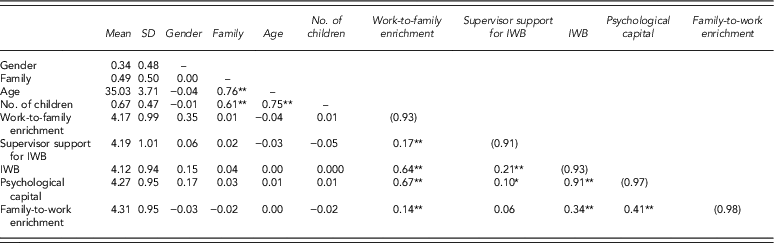
Table 1 presents means, standard deviations, correlations, and reliability estimates. The correlations among variables were as expected. As expected, age group and number of children were correlated (0.75**) suggesting that older respondents had one or more kids as compared with younger respondents. Similarly, family type and age group were correlated (0.76**) suggesting that older the respondents more were the chances of her/him staying in a joint family setup. Work-to-family enrichment and psychological capital exhibit reasonably high correlation (0.67**) as per the proposed hypothesis. The correlation between psychological capital and innovative work behavior was high (0.91**) although the two constructs are theoretically different as defined in the literature.
Descriptive statistics of the variables

Note. Values in the bracket are the critical ratio.
Gender was coded as 0=male, 1=female; family was coded as 0=nuclear, 1=joint family; no. of children was coded as 0=no children, 1=one or more children.
IWB=innovative work behavior.
**, *Correlation is significant at 0.01, 0.05 level, respectively (two-tailed).
Measurement model
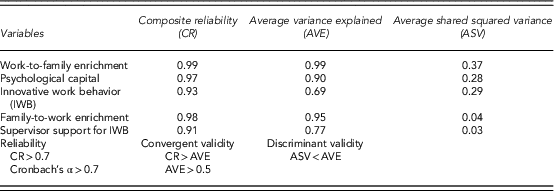
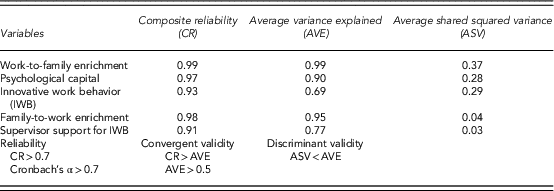
Prior to testing specific hypotheses we conducted a series of dimension-level confirmatory factor analysis to examine whether the five variables of the study capture distinct constructs versus common source effects. We first examined the fit of a five-factor model including innovative work behavior, supervisory support for innovative work behavior, family-to-work enrichment, work-to-family enrichment, and psychological capital. The higher-order constructs were the average of their respective subscale scores. As expected, the proposed five-factor model demonstrated acceptable fit. The key indices of the measurement model were: C Min=1,237.514, df=682; RMSEA=0.045; CFI=0.963; and P close=0.974. All indices were within the prescribed limit (Hair et al., Reference Hair, Black, Babin, Anderson and Tathham2005). Reliability, convergent validity, and discriminant validity for all the scales are provided in Table 2.
Convergent and discriminant validity of variables
Structural model
Model fit
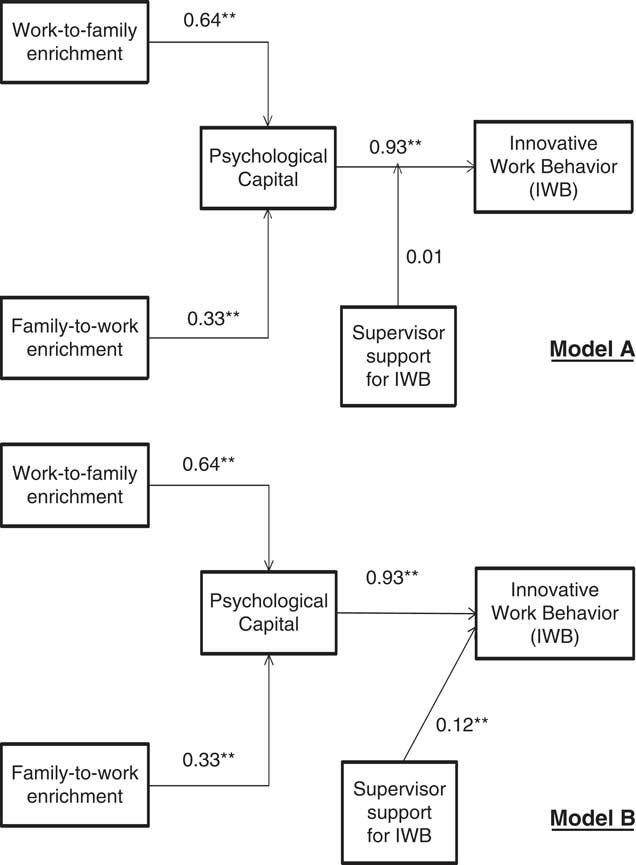
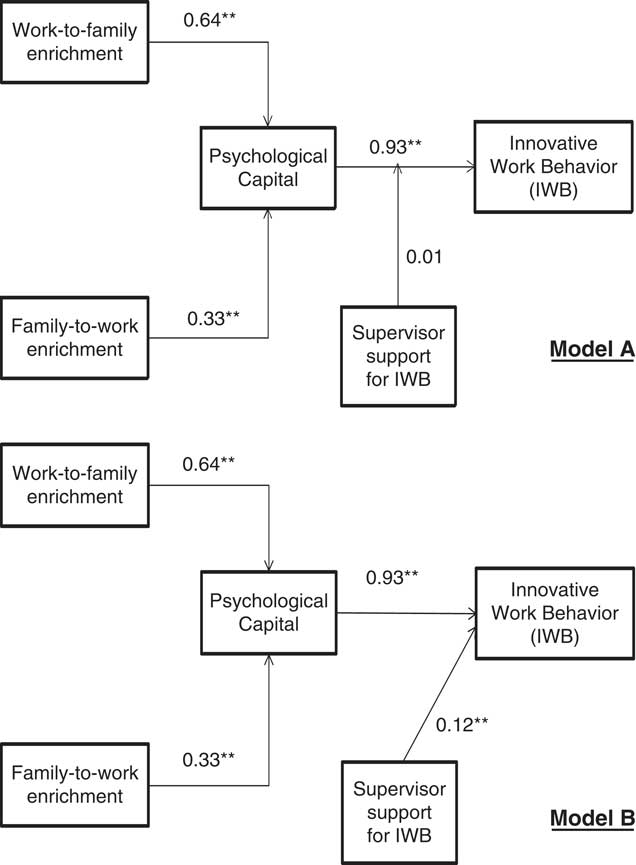
Two structural models, Model A and Model B (described in the Model section), were tested for the model fit. Figure 2 provides a summary of standardized path coefficients and significance levels. Considering the various indices used for examining the fit of the models (Table 3), Model B proved to be a better fit.
Path diagrams for the analyzed models. **Statistical significance at 99% confidence interval
Comparative fit of Models A and B

Test of mediation
We adopted Baron and Kenny (Reference Baron and Kenny1986) procedure to test for mediation in our accepted model (Model B), which also identifies the partial/full mediation. The four conditions given by Baron and Kenny (Reference Baron and Kenny1986) are:
i. Independent variable (IV) is significantly related to the mediator;
ii. mediator is significantly related to dependent variable (DV);
iii. IV is significantly related to DV and;
iv. the relationship between IV and DV becomes less significant or insignificant when the mediator is introduced.
The above conditions were examined by carrying out step-wise regressions: (a) psychological capital (mediator) was regressed on family-to-work enrichment (IV), (b) innovative work behavior (DV) was regressed on psychological capital (mediator), and (c) innovative work behavior (DV) was regressed on family-to-work enrichment (IV). After controlling for the effect of demographic variables, family-to-work enrichment was positively related to innovative work behavior (β=0.37, p<.05) and psychological capital (β=0.42, p<.01). Psychological capital was positively related to innovative work behavior (β=0.96, p<.05), fulfilling the first three conditions. The fourth condition was assessed by regressing innovative work behavior (DV) simultaneously on family-to-work enrichment (IV) and psychological capital (mediator). The relation between family-to-work enrichment and innovative work behavior became insignificant (β=0.03, p<.05) in the presence of psychological capital. Hence, it is established that psychological capital fully mediates the relationship between family-to-work enrichment and innovative work behavior.
Similarly, it was found that psychological capital fully mediates the relationship between work-to-family enrichment and innovative work behavior. After controlling for the effect of demographic variables, work-to-family enrichment was positively related to psychological capital (β=0.703, p<.05) and innovative work behavior (β=0.68, p<.05). Psychological capital was positively related to innovative work behavior (β=0.91, p<.05). The relation between work-to-family enrichment and innovative work behavior became insignificant (β=0.05, p<.05) in the presence of psychological capital.
Based on the above analysis, Hypotheses 1, 2, 3, 4, 5 and 6b were accepted.
DISCUSSION
Relationship between work-to-family enrichment, family-to-work enrichment, and psychological capital
One of the objectives of this study was to examine the relationships between (i) work-to-family enrichment and psychological capital (Hypothesis 1) and (ii) family-to-work enrichment and psychological capital (Hypothesis 2). As expected, both the hypotheses were supported.
These results suggest that work-to-family and family-to-work enrichment are positive experiences that lead to expand one’s resources by enhancing self-confidence, making one feel more optimistic and hopeful, and improving the capability to sustain in adverse situations. The study reemphasizes that in India ‘family’ role is equally important as ‘work’ role (Shangle, Reference Shangle1995; Medora, Reference Medora2007) and hence when interaction between work and family is positive, it boosts their psychological capital and eventually promotes innovative work behavior.
These results are in line with the past studies, which reported that work-to-family and family-to-work enrichment have positive effects on individuals. Literature has identified various consequences of work-to-family and family-to-work enrichment such as job satisfaction, job performance, psychological health, work engagement, marital satisfaction, parenting quality, affective commitment, life satisfaction, negative turnover intentions, reduced job exhaustion (Hakanen, Peeters, & Perhoniemi, Reference Hakanen, Peeters and Perhoniemi2011; Lu, Reference Lu2011; Lim, Choi, & Song, Reference Lim, Choi and Song2012; Akram, Malik, Nadeem, & Atta, Reference Akram, Malik, Nadeem and Atta2014; Van Steenbergen, Kluwer, & Karney, Reference Van Steenbergen, Kluwer and Karney2014; Cooklin, Westrupp, Strazdins, Giallo, Martin, & Nicholson, Reference Cooklin, Westrupp, Strazdins, Giallo, Martin and Nicholson2015; McNall, Scott, & Nicklin, Reference McNall, Scott and Nicklin2015; Timms et al., Reference Timms, Brough, O’Driscoll, Kalliath, Siu, Sit and Lo2015; Vadivukkarasi & Ganesan, Reference Vadivukkarasi and Ganesan2015; Zhou & Buehler, Reference Zhou and George2015; Chan, Kalliath, Brough, Siu, O’Driscoll, & Timms, Reference Chan, Kalliath, Brough, Siu, O’Driscoll and Timms2016). Further, work-to-family enrichment explains a significant proportion of the variance in career satisfaction (Carlson, Hunter, Ferguson, & Whitten, Reference Carlson, Kacmar, Wayne and Grzywacz2014). In addition, the ‘effect’ component of family-to-work enrichment explains a significant proportion of the variance in family satisfaction (McNall, Nicklin, & Masuda, Reference McNall, Nicklin and Masuda2010; Carlson et al., Reference Carlson, Hunter, Ferguson and Whitten2011; Jaga & Bagraim, Reference Jafri2011). Using the theoretical foundation of broaden-and-build theory (Fredrickson, Reference Fredrickson1998, Reference Fredrickson2004), this study provides insights on the positive relationship between bi-directional work–family enrichment and individual’s psychological capital. The current study contributed to the literature by identifying psychological capital as a consequence of work-to-family and family-to-work enrichment.
Relationship between psychological capital and innovative work behavior
It was found that psychological capital was positively and significantly related to innovative work behavior (Hypothesis 3 is supported). Innovative work behavior is stressful and requires dealing with various social, technological and structural challenges (Mukherjee & Ray, Reference Mukherjee and Ray2009). Psychological capital is expected to address many challenges associated with innovative work behavior. For example, as innovative work behavior is considered a risky activity (Torrance, Reference Torrance1995) traits like self-efficacy and resilience are crucial to conducting the same successfully. Moreover, employees with high psychological capital imply that they have high hope, optimism, self-efficacy, and resilience. Individuals with high self-efficacy are confident. An optimistic and hopeful person will be positive about the success of his/her idea, and a resilient will show the courage to deal with difficult situations. These traits also go hand-in-hand with the fact that employees practice innovative work behavior when they hope their ideas can help the organization and also improve their performance (Yuan & Woodman, Reference Yuan and Woodman2010). Thus, psychological capital is expected to be a characteristic, which is desirable to implement a new idea in the workplace successfully.
To illustrate further, optimistic and efficacious employees are likely to have positive expectations of achieving their goal, successfully coping with challenges, and dealing with adverse situations. The optimism, self-confidence, hopefulness and resilience are in turn likely to broaden or multiply the pathways that are generated in exhibiting innovative work behavior. If a setback or challenge occurs during the process, such individuals are likely to attribute the setback to external, one-time circumstances and immediately consider alternative pathways to goal success, demonstrating hope and resilience. Tugade and Fredrickson found that ‘high-resilient individuals tend to experience positive emotions even amidst stress’ (Reference Tugade and Fredrickson2004: 331).
Mediating role of psychological capital
It was reported that psychological capital fully mediated the relationship between (i) work-to-family enrichment and innovative work behavior, and (ii) family-to-work enrichment and innovative work behavior (Hypotheses 4 and 5). The findings of this study provide support to the existing body of research that has shown positive impact of psychological capital on employee well-being (Avey, Nimnicht, & Pigeon, Reference Avey, Nimnicht and Pigeon2010), employee performance (Luthans, Avey, & Patera, Reference Luthans, Avey and Patera2008; Rego, Marques, Leal, Sousa, & Pina e Cunha, Reference Rego, Marques, Leal, Sousa and Pina e Cunha2010) and organizational commitment (Larson & Luthans, Reference Larson and Luthans2006; Luthans, Avey, & Patera, Reference Luthans, Avey and Patera2008). In India, it has been found that psychological capital has a positive relation with citizenship behavior (Shukla & Singh, Reference Shukla and Singh2013), employee engagement (Sihag & Sarikwal, Reference Sihag and Sarikwal2014), and organizational commitment (Lather & Kaur, Reference Lather and Kaur2015). Our study is also in line with a survey carried out by Gupta (Reference Gupta2012) in the research and development sector of India that reported psychological capital plays a mediating role between leadership and employee creativity. Recently, Jafri (Reference Jaga and Bagraim2012) has shown a positive relationship between psychological capital and innovative work behavior in apparel fashion industry in India.
Above finding is in line the cultural classification made by Trompenaars and Hampden-Turner (Reference Trompenaars and Hampden-Turner1998). Trompenaars and Hampden-Turner (Reference Trompenaars and Hampden-Turner1998) have classified India as ‘outer direction’ culture in which individuals believe that their environment controls them. People seek reassurance and outside support, which make them more confident. Thus, when individuals go through positive experiences like support from people in their work and family life, it not only builds their psychological capital but also motivates innovative work behavior. These findings have added to the existing literature. To the best of authors’ knowledge, no study explores the relationship between work-to-family enrichment, family-to-work enrichment, psychological capital, and innovative work behavior.
Relationship between supervisor support and innovative work behavior
As identified by Anderson, Potocnik, and Zhou (Reference Anderson, Potocnik and Zhou2014) researches exploring the impact of supervisory behaviors on creativity/innovation are limited. In this study, supervisor support was tested both as the predictor for innovative work behavior (Hypothesis 6b) and as a moderator in the relationship between psychological capital and innovative work behavior (Hypothesis 6a). Model B (Hypothesis 6b), analyzing supervisor support as a predictor of innovative work behavior demonstrated a better model fit.
Above-identified relationship can be further explained by some of the cultural characteristics of Indian society being high power distance, collectivist and low on uncertainty avoidance. In a high power distance society, employees consider their supervisors as the key actors who have the authority to grant or deny the necessary resources required for the development, protection, and application of new ideas in the workplace. Moreover, India being a collectivist country, it is likely that an individual would prefer to take consent from everyone involved, especially the supervisor to initiate any new activity. Further, considering India is low on uncertainty avoidance, and consequently, the innovative work behavior perceived as a risky activity (Torrance, Reference Torrance1995; Coakes & Smith, Reference Coakes and Smith2007), the support from a supervisor becomes critical as the employee stands to share the risk of any uncertainty or failure.
A direct positive link between supervisor support and innovative work behavior can also be explained with the help of social exchange theory (Blau, Reference Blau1964). The act of providing support and its effects on performance behavior are well discussed in the social exchange theory and the principles of reciprocity (Gouldner, 1960; Marcoux, 2009). Social exchange theory explains that employees will increase their loyalty, efforts, engagement, and work performance since they are obliged to return the act of kindness that they have received (Aselage & Eisenberger, 2003). Employees feel indebted toward the supervisors who set positive examples and efficient mechanisms that demonstrate support toward new ideas. Employees positively reciprocate by further exhibiting innovative work behaviors. Hence, when supervisors provide support for innovative work behavior, employees perceive more trust and fairness in the organization. The positive feeling not only makes the employee feel responsible and committed to demonstrating the behavior preferred by the supervisor but also, in turn, make the employees feel obliged to take on the extra role behavior (Organ, 1997) which is important in seeding innovative work behavior.
Theoretical and managerial implications
This study has significant theoretical and managerial contributions. In the existing literature, research on family-to-work enrichment direction is limited (Wayne, Musisca, & Fleeson, Reference Wayne, Musisca and Fleeson2004; Michel & Clark, Reference Michel and Clark2009; Carlson et al., Reference Carlson, Hunter, Ferguson and Whitten2011). This study adds to family-to-work enrichment research. In addition, we also responded to a call from Luthans, Avey, and Patera (Reference Luthans, Avey and Patera2008) to identify factors that may develop psychological capital. This study identifies work-to-family and family-to-work enrichment as factors promoting the development of psychological capital. Considering benefits which work-to-family enrichment and family-to-work enrichment bring to the individual and to the organization, this study builds a business case to develop a family-friendly culture and promote family-friendly policies.
This study also provides external validity to psychological capital by conducting research in an eastern context, as the construct is developed and primarily tested in a Western context. Individual’s traits, styles and skills may effect innovative work behavior like problem-solving style (Scott & Bruce, Reference Scott and Bruce1998), self-leadership competencies (Carmeli, Meitar, & Weisberg, Reference Carmeli, Meitar and Weisberg2006), self-esteem and perceived insider status in the organization (Chen & Aryee, Reference Chen, Wu and Chen2007), personality (Sung & Choi, Reference Sung and Choi2009), proactivity (Kim, Hon, & Lee, Reference King2010), expected positive performance outcomes (Yuan & Woodman, Reference Yuan and Woodman2010), and commitment (Jafri, Reference Jafri2010). This study advances the literature by adding psychological capital as another crucial individual-level factor for innovative work behavior. The findings here, show that the psychological capital fully mediates the relationship between work–family enrichment and innovative work behavior, suggesting that employees’ psychological capacities play a vital role in influencing their efforts to adopt innovative behavior at work. The findings of the study provide support to the existing body of research, which identify psychological capital as antecedent of employee well-being (Avey, Nimnicht, & Pigeon, Reference Avey, Nimnicht and Pigeon2010), employee performance (Luthans, Avey, & Patera, Reference Luthans, Avey and Patera2008; Combs, Clapp-Smith, & Nadkarni, Reference Combs, Clapp-Smith and Nadkarni2010), job satisfaction (Fu, Sun, Wang, Yang, & Wang, Reference Fu, Sun, Wang, Yang and Wang2013), and organizational commitment (Larson & Luthans, Reference Larson and Luthans2006; Luthans, Avey, & Patera, Reference Luthans, Avey and Patera2008).
Further, sparse literature is available on the interplay of individual and contextual factors and how these affect innovative work behavior (Yuan & Woodman, Reference Yuan and Woodman2010). This study highlights psychological capital as a crucial individual-level factor, and supervisor support as an important contextual level for encouraging innovative work behavior.
This study also has certain managerial contributions. Shalley, Zhou, and Oldham (Reference Shalley, Zhou and Oldham2004) explained the need to examine conditions that may promote the implementation of new ideas in the organization. This study identifies that supervisor support is essential for employees to exhibit innovative work behavior. With this reasoning, it is suggested to impart orientation programs to the supervisors and sensitize them to respond to innovative practices of the employees with sufficient promptness. Further, supervisors should reward innovative work behavior, thus creating role models for other employees. They can organize brainstorming sessions where employees should be encouraged to share innovative ideas. Supervisors should focus on creating environment which stimulate innovative work behavior, build uninhibited communication, and ensure ease accessibility of required resources to employees.
It has been reported that finding the right people and aligning them for innovation is the greatest struggle for the top management (McKinsey global survey, 2007). In this respect, this study suggests that psychological capital should be considered as a significant characteristic for selecting employees for tasks that require innovation. This may help in aligning the job requirement with desired and appropriate individuals. Apart from selection, it may be possible to design training programs that can enhance required competencies to promote innovative work behavior. Organizations should also concentrate on HR practices that may impact innovative work behavior, such as providing a facilitating work climate, autonomy at work, and aligning reward structure with innovative work behavior.
Having been conducted in the Indian cultural context, the present study contributes to the body of knowledge that exists on Indian employees, and their needs and perceptions. Moreover, in Indian culture ‘family’ is of great value as people work for their family (Sinha, Reference Sinha2004). Therefore, in family-centric societies like India, it is important that organizations do not just make strategic efforts to develop people through organizational interventions, but also consider their family as an integral part (Gupta, Reference Gupta1999; Verma, Reference Verma2007). It is important to conduct sessions between employee families and the employer to establish arrangements that are mutually beneficial. For example, an HR executive may be appointed to a set of families with the responsibility of holding periodic meetings to address their concerns. Such interventions will not only benefit the personal growth of the employees but will also promote innovative work behavior. The present work should provide valuable insights to those interested in studying factors impacting innovative work behavior in Indian cultural context.
Limitations and future directions
This study has few limitations. First, the cross-sectional design prevents conclusions about causality. A longitudinal study may be carried out to explore the relationships over time. Second, this study is limited to the individual level; however, future studies can explore system-level interactions (e.g., exploring the impact of enrichment on employee’s spouse or coworkers).
Third limitation is that the data were solely self-reported, which increases the chances for common method bias. For innovative work behavior, few studies have suggested, collection of data from the concerned supervisors (Hülsheger, Anderson, & Salgado, Reference Hülsheger, Anderson and Salgado2009). We considered self-reported measure for innovative work behavior as this study defines it in terms of an individual’s perception of involvement in the generation, introduction and/or application of a new idea. It would not have been possible for employee’s colleague or family member to respond. Moreover, as explained in the ‘Analysis’ section, this study is less likely to be influenced by the common method bias.
Finally, since data were collected from employees working in service-sector organizations these findings may have limitations for organizations in other sectors such as the manufacturing sector.
Moving forward, a qualitative study may be useful for understanding high correlation reported between psychological capital and innovative work behavior. Further, it may be insightful to explore changes in the strength of the relationship between psychological capital and innovative work behavior when psychological capital is generated from different sources (other than work-to-family enrichment and family-to-work enrichment). Future studies may also examine if work-to-family enrichment or family-to-work enrichment have any unique impact on a particular dimension of psychological capital.
Future research may also investigate nonmanagers who may be expected to face a different nature of challenges, at both work and family levels. The relationships may also be explored from the point of single, divorced and single parents. Findings related to the moderating influences of gender, family type and number of children may be further explored.
It is also important to explore other mediating factors through which bi-directional work–family enrichment can influence innovative work behavior. Variables such as emotions, personality, role preferences, and community support can be explored as possible mediating and moderating variables for the relationship.
Lastly, with teams of employees becoming increasingly common as a unit of work in organizations, the testing of the impact of work–family enrichment and psychological capital on team-level innovative work behavior represents an important topic of research by which organizations can develop performance advantages.
CONCLUSION
The present study suggests that psychological capital plays a significant mediating role between work-to-family enrichment, family-to-work enrichment and innovative work behavior. Supervisor support has been found to be an essential moderator between psychological capital and innovative work behavior. We also demonstrate that bi-directional work–family enrichment not only can benefit an individual by building on his/her psychological capital but can also benefit the organization as it may also lead to innovative work behavior. Thus, this study provides managers a strong reason to form and implement policies, which may help employees to acquire, positive work–family experiences. The study also highlights crucial interventions, which may facilitate innovative work behavior.
Acknowledgement
The authors will like to thanks Dr. Tui McKeown (the editor) and anonymous reviewers for their time and valuable feedback.