The current study investigates processes involved in the online production of inflected words in late bilinguals, that is, in individuals who have learned a new language after acquiring their first language (L1) in late childhood or as adults. Our linguistic focus is on regular and irregular past-tense forms of English. The question of how inflected word forms are mentally represented, processed, and acquired is controversial, with, broadly speaking, two competing viewpoints: dual- and single-mechanism accounts. Dual-mechanism accounts (e.g., Pinker & Ullman, Reference Pinker. and Ullman2002) hold that regular and irregular inflected word forms engage different mechanisms, at least in native speakers, with irregular forms directly retrieved from memory and regular forms typically composed from their component parts (stem + affix; for a review, see Clahsen, Reference Clahsen and Brown2006). Single-mechanism accounts hold that regular and irregular inflections employ the same representational and processing mechanisms, either associative patterns or schemas (e.g., Bybee, Reference Bybee1995; Patterson & McClelland, Reference Patterson and McClelland2002), or rulelike operations (e.g., Stockall & Marantz, Reference Stockall and Marantz2006; Yang, Reference Yang2002). An open question is whether morphological encoding processes in second language (L2) production distinguish regular and irregular inflection in the same way as in the L1.
Previous experimental research on morphological processing in bilinguals has focused on word recognition, speeded judgments, and sensitivity to grammatical violations in the L2. A number of studies have identified L1/L2 differences in this domain, particularly (but not only) with respect to complex inflectional and morphosyntactic phenomena; see Clahsen, Felser, Neubauer, Silva, and Sato (Reference Clahsen, Felser, Neubauer, Silva and Sato2010) for a review. Consider, for example, results from behavioral priming studies. In these experiments, an inflected prime word (e.g., walked) is presented before a morphologically related target word (e.g., walk); the dependent variable in these experiments is the participants’ response time to the target word in a lexical decision or naming task. While previous L1 priming research revealed efficient priming effects, that is, a significant reduction of the target words’ response times for morphologically related prime-target pairs (relative to the unrelated condition), particularly for regularly inflected word forms, this has not been the case for L2 processing, even in advanced fluent bilinguals. In L1 English, for example, regularly inflected prime words such as walked were found to produce the same amount of facilitation on the recognition of the target word (e.g., walk) as an identity prime, for example, walk as a prime for the target walk; see Stanners, Neiser, Hernon, and Hall's (Reference Stanners, Neiser, Hernon and Hall1979) seminal study and Marslen-Wilson (Reference Marslen-Wilson and Gaskel2007) for a review of much subsequent work. Maximal or full priming effects of this kind have been interpreted to reflect the presence of shared morphological constituents in the prime and in the target; see Pinker (Reference Pinker1999, chap. 5) for a review. In the case of prime-target pairs such as walked–walk, a regularly inflected word form is thought to be decomposed into its morphological constituents (e.g., walk + −ed) by which the base stem is isolated and directly facilitates recognition of the target word. Unlike for L1 native speakers, none of the morphological priming studies with late bilinguals revealed a full stem-priming effect; see Kirkici and Clahsen (Reference Kirkici and Clahsen2013) for a review.
It is true that Basnight-Brown, Chen, Hua, Kostić, and Feldman (Reference Basnight-Brown, Chen, Hua, Kostić and Feldman2007) and Feldman, Kostić, Basnight-Brown, Filipović Durdević, and Pastizzo (Reference Feldman, Kostić, Basnight-Brown, Filipović Durdević and Pastizzo2010) found priming effects for inflected word forms of English in L1 speakers as well as late learners. However, these studies did not include an identity condition, which means that it is not possible to verify from these studies whether or not there were full stem-priming effects for any of the inflected word forms. Silva and Clahsen (Reference Silva and Clahsen2008) included an identity condition and obtained a full priming effect for –ed forms in L1 native speakers of English, whereas the same materials did not produce any morphological priming in late bilinguals. Likewise, full priming effects for regular –t participles were found in L1 German, but not in Polish and Russian L2 learners of German (Jacob, Fleischhauer, & Clahsen, Reference Jacob, Fleischhauer and Clahsen2013; Neubauer & Clahsen, Reference Neubauer and Clahsen2009). These findings have been taken to indicate that late bilinguals rely less on morphological decomposition during word recognition than L1 comprehenders do.
Using self-paced reading, Pliatsikas and Marinis (Reference Pliatsikas and Marinis2013) tested regular and irregular past-tense forms, both correct and incorrect (i.e., regularized and irregularized) ones, in a sentence context. They found similar patterns for correct past-tense forms in L1 and in proficient L2 readers of English, with “all groups show[ing] longer RTs [response times] in regulars than irregulars” (Pliatsikas & Marinis, Reference Pliatsikas and Marinis2013, p. 958), which they attributed to the additional cost of –ed segmentation for regulars, but not for irregulars. If this interpretation was correct, however, one would have expected the same contrast for regularized versus irregularized past-tense forms, because the former (e.g., taked) involve –ed segmentation. This was found for one subgroup of L2 learners (the so-called NE group), but not for L1 readers and for the second L2 group (the so-called CE group) who both showed shorter response times for regularized than for irregularized items in the two critical segments 4 and 5 (see Pliatsikas and Marinis, Reference Pliatsikas and Marinis2013, p. 957). These observations are not consistent with the proposed interpretation for correctly inflected verb forms and indicate L1/L2 differences in this domain.
One important (as yet unanswered) question is whether L1/L2 differences in morphological processing are specific to recognition or whether similar differences can also be found for processes involved in the production of morphologically complex words. Do late bilinguals compose regularly inflected words from their component parts or do they retrieve them as wholes from lexical memory? In contrast to recognition, however, there are to our knowledge only three studies that investigated morphological encoding during production in late bilinguals. These studies measured production latencies for regular and irregular verb forms of Dutch (Lalleman, van Santen, & van Heuven, Reference Lalleman, van Santen and van Heuven1997), English (Beck, Reference Beck1997), and Spanish (Bowden, Gelfand, Sanz, & Ullman, Reference Bowden, Gelfand, Sanz and Ullman2010) in late learners, in comparison to L1 speakers. However, the results from these studies are inconsistent and partly surprising. Whereas most experiments found a response time advantage for high-frequency over low-frequency irregular forms, this was not the case for the L2 group in Beck's (Reference Beck1997, p. 105) experiment 2. For the production of regular forms, some experiments yielded no differences between low- and high-frequency forms (Bowden et al., Reference Bowden, Gelfand, Sanz and Ullman2010, L2 group), some found longer production latencies for low-frequency than for high-frequency regulars (experiment 1 in Beck, Reference Beck1997; Lalleman et al., Reference Lalleman, van Santen and van Heuven1997), and some experiments produced the opposite contrast, longer latencies for high-frequency than for low-frequency regulars, a surprising antifrequency effect (experiments 3 and 4 in Beck, Reference Beck1997). Given these inconsistencies, it is difficult drawing any strong conclusions from these behavioral production studies.
A well-established approach to investigate different subprocesses of language processing of native and nonnative speakers is the recording of event-related brain potentials (ERPs). Due to their excellent temporal resolution, ERPs provide information about the temporal sequencing of language processing. While ERPs have also been used to investigate bilingual language processing (for reviews see Moreno, Rodríguez-Fornells, & Laine, Reference Moreno, Rodriguez-Fornells and Laine2008; Mueller, Reference Mueller2005), most previous studies have examined processes involved in language comprehension (Strijkers & Costa, Reference Strijkers and Costa2012). To take a recent example, Lehtonen et al. (Reference Lehtonen, Hultén, Rodríguez-Fornells, Cunillera, Tuomainen and Laine2012) compared highly proficient Swedish–Finnish early bilinguals to monolingual speakers of Finnish in a visual lexical decision task with simultaneous EEG recording testing inflected (case-marked) Finnish nouns. They found longer response latencies and larger N400 amplitudes in the L2 than in the L1 control group. These differences were attributed to extra effort in the L2 group because even in a highly proficient bilingual's lexicon, a given word form will be less frequent than in a monolingual's lexicon, all things being equal; see also Gollan, Montoya, Cera, and Sandoval (Reference Gollan, Montoya, Cera and Sandoval2008) for frequency effects on bilinguals’ picture-naming performance. In their recent review on EEG in language production, Ganushchak, Christoffels, and Schiller (Reference Ganushchak, Christoffels and Schiller2011) stressed the need to combine ERPs with overt verbal articulation tasks in order to provide insights into the temporal sequencing of various stages of word and sentence production and their scalp distributions in both native and nonnative speakers.
A number of previous ERP studies have examined lexical and syntactic processing in different kinds of bilingual populations; see Mueller (Reference Mueller2005) for a review. There are also ERP studies of morphosyntactic processes, such as gender and subject–verb agreement marking in bilinguals (e.g., Ojima, Nakata, & Kakigi, Reference Ojima, Nakata and Kakigi2005; Osterhout et al., Reference Osterhout, Poliakov, Inoue, McLaughlin, Valentine and Pitkanen2008; Rossi, Gugler, Friederici, & Hahne, Reference Rossi, Gugler, Friederici and Hahne2006; Tokowicz & MacWhinney, Reference Tokowicz and MacWhinney2005). Morphological processing in bilinguals, specifically similarities and differences between regular and irregular inflection, have been examined in two previous ERP studies, De Diego Balaguer, Sebastián-Gallés, Díaz, and Rodríguez-Fornells (Reference De Diego-Balaguer, Sebastián-Gallés, Díaz and Rodríguez-Fornells2005) and Hahne, Mueller, and Clahsen (Reference Clahsen and Brown2006), albeit with respect to word recognition and language comprehension only. De Diego Balaguer et al. (Reference De Diego-Balaguer, Sebastián-Gallés, Díaz and Rodríguez-Fornells2005) tested two groups of highly proficient early Catalan–Spanish bilinguals (one with L1 Spanish, the other with L1 Catalan) in an ERP repetition priming experiment on “regular” verb forms, with the same suffix –o in both Catalan and Spanish, and “irregular” verbs, which have different stem alternations in the two languages. The results revealed the same attenuated N400 for regular verbs in both the L1 and the L2 and in both languages, but between-group contrasts for irregular forms, particularly with respect to the topographical distribution of the negativities. The authors conclude that “differences in processing between L1 and L2 speakers are observed even in highly proficient early bilinguals” (De Diego Balaguer et al., Reference De Diego-Balaguer, Sebastián-Gallés, Díaz and Rodríguez-Fornells2005, p. 323). Hahne et al. (Reference Hahne, Mueller and Clahsen2006) studied L1 Russian speakers who were highly proficient in their late-learned L2, German, using the ERP violation paradigm to test sensitivity to incorrect past participle and noun plural forms of German. For inflectional violations of participle forms, the L2 speakers showed a similar anterior negativity and P600 as has been found for native L1 speakers of German with the same materials. For the plural violation condition, however, the L2 speakers showed an N400 for overapplications of irregular endings, a P600 for overapplications of the –s plural rule, but (unlike the L1 group) no anterior negativity. Hahne et al. concluded from the ERP results on participles that L2 learners employ similar processing mechanisms for morphologically complex words as do L1 comprehenders. The absence of an anterior negativity in the L2 group was attributed to their reduced proficiency of the (more complex) noun plural system of German relative to nativelike proficiency on participle formation.
The ERP results currently available on morphological processing in bilinguals do not yet provide a coherent picture. Particularly little is known about the brain responses to morphologically complex words in late bilinguals. Although Hahne et al. (Reference Hahne, Mueller and Clahsen2006) studied this population, they relied on the violation paradigm, which reveals information about participants’ sensitivity to morphological errors, but needs to be supplemented by studies investigating morphologically well-formed items.
EXPERIMENTAL STUDIES OF LANGUAGE PRODUCTION
For the L1 speaker, language production models are available that include details about the temporal sequencing of different processes involved in producing words and sentences. According to Levelt, Roelofs, and Meyer's (Reference Levelt, Roelofs and Meyer1999) account, for example, motor execution and articulation of words is preceded by formulating and conceptually encoding a preverbal message followed by lemma selection, morphological encoding, and, finally, phonological encoding. The time course of these processes has been studied in detail using picture-naming tasks. On the basis of a meta-analysis of a number of picture-naming studies, Indefrey and Levelt (Reference Indefrey and Levelt2004) identified five stages: visual perception and recognition of the presented picture and selection of the target concept, until about 175 ms after stimulus presentation; lemma access and lemma retrieval, 175–250 ms; lexeme retrieval (including morphological encoding), 250–330 ms; phonological encoding, 330–455 ms; and motor programming and articulation onset, 455–600 ms; see Indefrey and Levelt (Reference Indefrey and Levelt2004). Results from a recent ERP study (Strijkers & Costa, Reference Strijkers and Costa2011, Experiment 1) of a picture-naming task in English provided support for these stages. Lexical processes were found to be initiated between 150 and 200 ms after stimulus presentation, and concepts selected at about 250 ms. Subsequently, lexeme selection (including a word's morphological and syntactic properties) was completed at 430 ms, which was followed by phonological and phonetic encoding, and motor programming for articulation. Strijkers and Costa (Reference Strijkers and Costa2011) concluded that lexical access is initiated early, within 200 ms after a picture has been presented, with little variation across speakers and tasks (see also Costa, Strijkers, Martin, & Thierry, Reference Costa, Strijkers, Martin and Thierry2009). Instead, individual differences and task-related properties are more likely to affect later processes of picture naming.
The stage of verbal production that is of particular interest for the present study is morphological encoding. One picture-naming study examining morphological encoding is Koester and Schiller's (Reference Koester and Schiller2008) study of Dutch compounds. They argued (on the basis of control conditions with form-related monomorphemic words) that the priming effect observed for compounds is morphological in nature and cannot be reduced to semantic or phonological overlap. Furthermore, from the time course of the primed picture-naming responses, they estimated morphological encoding to begin at about 330 ms after the stimulus, that is, slightly later than Indefrey and Levelt (Reference Indefrey and Levelt2004). The same timeline for morphological encoding was reported by Sahin, Pinker, Cash, Schomer, and Halgren (Reference Sahin, Pinker, Cash, Schomer and Halgren2009), who used intracranial electrophysiology to measure local field potentials during language production. They identified markers of morphological encoding at around 320 ms, preceded by markers of lexical access (~200 ms) and followed by markers of phonological encoding.
The picture-naming task, in some studies combined with EEG recording, has also been used to investigate bilingual language production; see Runnqvist, Strijkers, Sadat, and Costa (Reference Runnqvist, Strijkers, Sadat and Costa2011) for a review. These studies focused on bilinguals’ lexical access during picture-naming manipulating, for example, the cognate status of picture names or investigating inhibitory processes (e.g., Christoffels, Firk, & Schiller, Reference Christoffels, Firk and Schiller2007; Strijkers, Costa, & Thierry, Reference Strijkers, Costa and Thierry2010; Verhoef, Roelofs, & Chwilla, Reference Verhoef, Roelofs and Chwilla2009), error monitoring, or priming in the picture-word interference paradigm (Ganushchak & Schiller, Reference Ganushchak and Schiller2009; Koester & Schiller, Reference Koester and Schiller2008). One common finding from these studies is that processes of lexical access seem to be initiated early in nonnative language production, similarly to what has been observed for monolingual populations (Strijkers et al., Reference Strijkers, Costa and Thierry2010), whereas for later stages of production, bilinguals were found to perform less efficiently than monolinguals, for example, with respect to semantic and phonological encoding (Christoffels et al., Reference Christoffels, Firk and Schiller2007; Guo & Peng, Reference Guo and Peng2007; Hanulová, Davidson, & Indefrey, 2010). While results from these studies have provided valuable insights into bilingual language production, the picture-naming task also has limitations. First, participants’ responses may reflect properties of the specific task, that is, to name a picture, rather than reflect more general aspects of language production. Second, the linguistic stimuli elicited in picture-naming tasks are typically bare uninflected imaginable nouns. The questions of whether the results from these particular linguistic items generalize to more complex word forms in bilingual language production, and more generally, how bilinguals produce morphologically complex words, remain unanswered.
Some studies have recorded EEGs during overt speech production, most of which used picture-naming tasks with bare uninflected nouns to examine L1 speakers (Costa et al., Reference Costa, Strijkers, Martin and Thierry2009; Eulitz, Hauk, & Cohen, Reference Eulitz, Hauk and Cohen2000; Janssen, Carreiras, & Barber, Reference Janssen, Carreiras and Barber2011; Strijkers, Holcomb, & Costa, Reference Strijkers, Holcomb and Costa2011) as well as bilinguals (Christoffels et al., Reference Christoffels, Firk and Schiller2007; Misra, Guo, Bobb, & Kroll, Reference Misra, Guo, Bobb and Kroll2011; Strijkers et al., Reference Strijkers, Costa and Thierry2010; Verhoef et al. Reference Verhoef, Roelofs and Chwilla2009). Another task that has been used to study overt language production during EEG-recording with bilinguals required participants to translate bare uninflected nouns (Christoffels et al., Reference Christoffels, Firk and Schiller2007). Eulitz et al. (Reference Eulitz, Hauk and Cohen2000), for example, reported ERP components familiar from violation and priming studies during overt picture naming in L1 speakers, suggesting that artifact-free brain responses can be measured up to at least 400 ms after picture onset. However, ERP responses to morphologically complex words have been reported for later time windows as well; see, for example, the P600 obtained in Hahne et al.'s (Reference Hahne, Mueller and Clahsen2006) study of German participle forms.
Two methodological approaches, covert naming and delayed vocalization, have been used in previous ERP studies of language production in order to circumvent speech movement related artifacts, that is, muscle activation related to overt speech production involving lip, head, and eye movement (Wohlert, Reference Wohlert1993), and to avoid distortion of the EEG signal. Previous covert naming studies have examined L1 production with the picture-naming task; see Jansma, Rodríguez-Fornells, Möller, and Münte (Reference Jansma, Rodríguez-Fornells, Möller, Münte, Pechmann and Habel2004) for a review. Participants were, for example, asked to give a motor response (Van Turennout, Hagoort, & Brown, Reference Van Turennout, Hagoort and Brown1997) or to provide an implicit/tacit response to a picture stimulus (Abdel Rahman, Van Turennout, & Levelt, Reference Abdel Rahman, Van Turennout and Levelt2003; Schmitt, Münte, & Kutas, Reference Schmitt, Münte and Kutas2000). Wu and Thierry (Reference Wu and Thierry2011) also used covert naming during EEG-recording to investigate bilinguals, specifically the activation of the L1 and the L2 in late Chinese–English bilinguals. EEGs were recorded while participants indicated whether the names of presented picture pairs rhymed. The results indicated an L1/L2 asymmetry, with the L1 influencing the processing of phonological similarity judgments in the L2, but not vice versa. Wu and Thierry conclude that L2 production “hinders, but does not seal off, activation of the L1.” Despite the innovative design of this study, an important drawback of this and other covert naming studies is that due to the lack of an overt naming response, we cannot safely conclude that the EEG record does directly correspond to processes involved in producing the targeted word forms.
Jansma et al. (Reference Jansma, Rodríguez-Fornells, Möller, Münte, Pechmann and Habel2004) suggested delayed naming as a better method of studying language production through EEGs while avoiding vocalization artifacts. In delayed naming, the participant is presented with a stimulus and is instructed to withhold the response until a vocalization prompt is given. It is assumed that upon presentation of a visual stimulus, the production process will be initiated and completed, except for the final vocalization. Hence brain activity reflecting language production processes is expected to occur between the visual stimulus and the vocalization prompt. There is one ERP study, Budd, Paulmann, Barry, and Clahsen (Reference Budd, Paulmann, Barry and Clahsen2013), that employed this paradigm to investigate morphological encoding during L1 production, testing regular and irregular past-tense forms in English. Budd et al. (Reference Budd, Paulmann, Barry and Clahsen2013) visually presented participants with infinitive forms (e.g., to walk or to fall) followed by a picture cue prompting them to silently produce a present-tense (walks/falls) or past-tense form (walked/fell). A subsequently presented loudspeaker cue asked participants to overtly produce the required inflected word form (for which accuracy scores were calculated). EEGs were recorded during participants’ silent productions of inflected words. Note that the critical comparison is between regular and irregular past-tense forms. The present-tense forms, by contrast, serve as a control condition to assess potential lexical differences between the verbs that were included. The EEG results revealed a negativity for regular relative to irregular past-tense forms 300 to 450 ms after the tense cue and no difference for the present-tense condition, which Budd et al. (Reference Budd, Paulmann, Barry and Clahsen2013) interpreted as reflecting morphological encoding processes, specifically the composition of a stem plus an affix as required in regular (but not in irregular) past-tense formation.
THE PRESENT STUDY
The current study is the first to report results from an ERP experiment investigating the production of morphologically complex words in late bilinguals. We recorded ERPs to grammatically well-formed stimuli without relying on any kind of violations or linguistic anomalies. In this way, the current study aims to contribute to a better understanding of morphological processing in late bilinguals, and more generally, to develop appropriate ERP paradigms for investigating processes involved in language production. We employed the materials and procedures from Budd et al.'s (Reference Budd, Paulmann, Barry and Clahsen2013) silent production plus delayed vocalization experiment to test a group of highly fluent late learners of L2 English with German as their L1. Brain potentials were recorded while participants were silently producing (regular and irregular) past-tense forms in English and were compared to present-tense forms of the same lexical verbs. Given the results of Hahne et al.'s (Reference Hahne, Mueller and Clahsen2006) ERP violation experiment on German participles, the proficient late bilinguals we tested in the current study are expected to show similar brain responses for producing English past-tense forms as the L1 speakers tested by Budd et al. (Reference Budd, Paulmann, Barry and Clahsen2013), that is, an enhanced negativity for regular past-tense forms relative to irregular ones and no difference in the present-tense condition. This finding would indicate that advanced L2 learners make use of the same combinatorial mechanism for producing regularly inflected word forms as L1 speakers. Alternatively, it is possible that late bilinguals produce regularly inflected word forms without composing them from their component parts; in this case, we would expect similar ERP responses for both regular and irregular past-tense forms in the L2 group.
METHODS
Participants
Twenty-four adult native speakers of German (20 females and 4 males) were recruited from the student population of the University of Potsdam and participated in the experiment. All were right-handed, had normal or corrected to normal vision, and were paid for their participation. Their level of English grammar was assessed using the Oxford Placement Test (OPT; Allan, Reference Allan2004). Results revealed a good to very good command of English (mean OPT score = 79.6; range = 61–96 out of a maximal score of 100). One participant was excluded from further analysis due to excessive artifact contamination during the EEG recording. The remaining 23 participants (4 male) had a mean age of 24 years and 4 months, and had an average age of acquisition of L2 English of 10 years and 4 months. All participants had learned English at school for a minimum of 7 years. Consequently, they are late learners of a second language. Ten participants reported on having been immersed in an English-speaking environment for at least 3 to a maximum of 13 months for different reasons (e.g., school exchange, au pair, study abroad, work, and travel). Seven participants knew one additional language, 9 reported knowledge of two additional languages, and 3 spoke three additional languages. French was reported to be among these languages from 17 participants, Spanish from 4, Russian from 3, Dutch from 2, and, finally, Italian, Danish, Swedish, Mandarin, Swahili, and Arabic from 1 participant each. As for their current use of English, most participants watch TV or listen to the radio (n = 34) or read books in English (n = 26), or use English for work (n = 16) and talk to partners or family members in English (n = 20) or use English to communicate with friends (n = 10). Ethical approval was gained prior to testing from the university's ethics committee.
Materials
The linguistic materials were taken from Budd et al. (Reference Budd, Paulmann, Barry and Clahsen2013) and consisted of 80 different verbs, 40 verbs that require a regular past-tense form (R-verbs), and 40 verbs that require an irregular past-tense form (I-verbs). Each participant was presented with the infinitive form of each verb (e.g., to walk) twice, once to elicit a past-tense form and in the second case to elicit a third-person singular present-tense form. In sum, 160 critical trials were presented in total; see Budd et al. (Reference Budd, Paulmann, Barry and Clahsen2013, p. 354).
The 40 I-verbs were closely matched with the 40-R verbs on word (lemma) frequency using three different frequency databases, the London–Lund corpus of English conversation (Brown, Reference Brown1984), the SUBTLEX database of film subtitles (Brysbaert & New, Reference Brysbaert and New2009), and the Children's Printed Word Database (Masterson, Stuart, Dixon, & Lovejoy, Reference Masterson, Stuart, Dixon, Lovejoy and Lovejoy2003). The I-verbs were also matched with a further 40 R-verbs on their past-tense word-form frequencies (M = 164/million for R-verbs, M = 170/million for I-verbs). In addition to frequency, the linguistic materials were also matched for length as closely as possible. All verbs were one syllable long, and the R-verbs and I-verbs were not significantly different in terms of number of letters (M = 4) or number of phonemes (M = 3.6). In their past-tense forms, however, because of the –ed affix, regular past-tense forms were longer than irregular ones; see Budd et al. (Reference Budd, Paulmann, Barry and Clahsen2013, p. 348) for detailed statistics on these different matching criteria.
Two presentation lists were created, differing in list composition: while both lists included the same 40 I-verbs, List 1 contained 20 R-verbs matched with the I-verbs on word frequency and 20 R-verbs matched with the I-verbs on past-tense word-form frequency. List 2 contained the remaining 40 R-verbs, 20 matched with the I-verbs on word frequency and 20 matched with the I-verbs on past-tense word-form frequency. For the present experiment, the same two lists as in Budd et al.'s (Reference Budd, Paulmann, Barry and Clahsen2013) study were used. Participants saw trials from only one list. Lists were counterbalanced over participants.
Procedure
Prior to the experimental session, participants filled in a questionnaire with biographical information including their language acquisition history and education. The experimental session took place in a quiet laboratory at the Potsdam Research Institute for Multilingualism. Participants first signed a consent form and were informed about the EEG procedures. Then, we administered the grammar part of the OPT to identify participants’ level of English grammar with reference to the Common European Framework. Participants were then prepared for the EEG recording and seated in front of a computer screen at a distance of approximately 100 cm. The experimental stimuli were presented on a computer monitor (width = 61 cm) using the Presentation software package, version 14.9 (http://www.neurobs.com, Neurobehavioral Systems). The EEG experiment made use of exactly the same procedure as Budd et al. (Reference Budd, Paulmann, Barry and Clahsen2013). At the start of each trial, a fixation cross appeared at the center of the screen for 100 ms, followed by the presentation of an infinitive form of a verb (e.g., to walk), which was displayed in Comic Sans, 96-point size font, in the center of the screen for 1000 ms, in black on a white background. Then a blank screen with a jitter of 250, 500, or 750 ms was presented. Next, one of two visual tense cues was presented for 2000 ms, a picture of a dinosaur to elicit a past-tense form or a picture of a dog to elicit a present-tense form. Participants were asked to silently produce the required past-tense or present-tense form. Either one of these silent production cues was followed by an overt production cue (a picture of a loudspeaker), shown for 2000 ms. At the end of each trial, a “smiley face” was presented for 2000 ms. Participants were instructed to relax before the next trial.
Before the EEG experiment, participants were given eight practice trials to train them to associate the picture of a dinosaur to produce a past-tense form and the picture of the dog to produce a present-tense form. For the experiment, trials were fully randomized and distributed over two blocks (80 items each). After the first block, participants took a short break the length of which the participants determined themselves. Blocks were counterbalanced among participants. Participants were asked to minimize eye and muscle movements until the presentation of the picture of a smiley face in each trial. The EEG experiment was about 25 min long. One experimental session (including EEG setup and OPT) took approximately 90 min. Note, finally, that all linguistic stimuli were presented in English, that is, the participants’ L2, and that all responses also had to be given in English only. In other words, participants could stay in “monolingual mode” (Grosjean, Reference Grosjean, De Groot and Kroll1997) throughout the experiment and were not asked to switch language at any point.
Electrophysiological recording and analysis
The EEG was continuously recorded using Brain Products’ Vision Recorder acquisition software from 31-electrode sites (FP1, FP2, F7, F3, Fz, F4, F8, FC5, FC1, FC2, FC6, T7, C3, Cz, C4, T8, TP9, CP5, CP1, CP2, CP6, TP10, P7, P3, Pz, P4, P8, PO9, O1, O2, PO10) according to the international 10–20 system using active electrodes embedded in an elastic cap (ActiCap, Brain Products). In addition, vertical electro-oculograms were recorded from electrode Oz for artifact correction purposes. Signals were recorded continuously with an online bandpass filter between 0.1 and 70 Hz and digitized at 2500 Hz. Electrode impedances were kept below 20 kΩ (according to the guidelines for using ActiCaps). Offline, all recordings were rereferenced to the average of the left and right mastoid electrodes. Recordings were offline bandpass filtered between 0.1 and 30 Hz. Offline recordings were downsampled to 250 Hz.
EEG data were processed with Vision Analyzer. Epochs were extracted from 200 ms before the onset of the silent production cue up to 1000 ms after cue onset resulting in 1200 ms epochs (–200 to 1000 ms) and were baseline-corrected using a 200-ms prestimulus baseline.
ERP data processing and analyses were restricted to trials in which participants had produced grammatically correct responses to the overt production cue. Trials with erroneous overt responses were excluded from the analysis of the EEG data. To remove muscle and eye movement artifacts from the scalp recordings, an independent component analysis algorithm (Infomax) was applied to the EEG data. Epochs containing additional artifacts were identified with the semiautomatic rejection option of the Analyzer software and rejected after visual inspection. In sum, 75% of all trials were included in the statistical analysis. Similar numbers of trials were included in the present-tense (79%) and past-tense (71%) conditions and also for regular (78%) and irregular (72%) past-tense forms.
For statistical analysis, 27 electrodes were grouped into nine regions of interest (ROIs): frontal left (F7, F3, FC5), frontal central (FC1, Fz, FC2), frontal right (F4, F8, FC6), central left (T7, C3, CP5), central central (CP1, Cz, CP2), central right (C4, T8, CP6), posterior left (P7, P3, PO9), posterior central (O1, Pz, O2), and posterior right (P4, P8, PO10). Mean ERP amplitudes were analyzed using a repeated-measures analysis of variance (ANOVA). The three-way ANOVA included verb type (R-verbs or I-verbs), tense (present tense or past tense) and ROI (see above) as within-subject factors. As in Budd et al. (Reference Budd, Paulmann, Barry and Clahsen2013), time windows of interest for mean amplitude quantification were identified based on visual inspection and a 50-ms timeline analysis. For interactions with the critical factors verb type and tense that reached significance in at least two consecutive time windows, we carried out additional statistical analyses for the larger time interval.
RESULTS
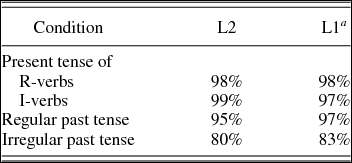
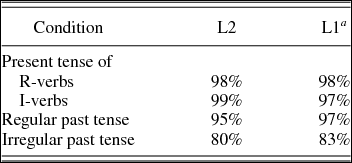
Consider first participants’ behavioral responses to the overt production cue. Table 1 presents mean percentages of correct responses for the four types of stimuli for the L2 group in comparison to the group of L1 speakers tested by Budd et al. (Reference Budd, Paulmann, Barry and Clahsen2013).
Mean percentages of correct spoken responses per condition after the overt production cue for the L1 group and the L2 groups
Note: L1, First language; L2, second language.
aFrom Budd et al. (Reference Budd, Paulmann, Barry and Clahsen2013).
For the L1 data, Budd et al. (Reference Budd, Paulmann, Barry and Clahsen2013) reported significant main effects of verb type and tense as well as a significant Verb Type × Tense interaction, which was due to the fact that adult L1 speakers of English produced regular past-tense forms significantly more accurately than irregular past-tense forms (97% vs. 83%). Table 1 shows the same pattern for the L2 group. A repeated-measures ANOVA on the L2 data revealed main effects of verb type, F (1, 23) = 33.25; p < .001, and of tense, F (1, 23) = 64.03; p < .001, and a significant interaction between verb type and tense, F (1, 23) = 29.59; p < .001. Paired-samples t tests revealed that regular past-tense forms were produced more accurately than were irregular past-tense forms, t (22) = 5.69; p < .001. Irregular past-tense forms were also produced less accurately than the corresponding present-tense forms of the same verbs, t (22) = 7.06; p < .001. These data demonstrate that the L2 learners achieved high overall accuracy scores in their overt production of past-tense and present-tense forms for the verbs tested. The analysis of errors for the L2 learners revealed that most errors occurred when an irregular form had to be produced in the past tense, parallel to what Budd et al. (Reference Budd, Paulmann, Barry and Clahsen2013) found for L1 speakers of English.
Consider next the EEG data for the L2 group. Mean amplitudes were extracted for each participant at each electrode site. The time window of interest was set at 250 ms to 350 ms after the silent production cue onset (i.e., the picture of a dog or dinosaur) based on visual inspection of the data and the timeline analysis. The grand average ERP waveforms for the present-tense conditions are displayed in Figure 1, those for the past-tense conditions are in Figure 2.
Grand average event-related potentials for the present-tense condition at selected electrode sites. The broken line represents the waveform for the present-tense form of irregular past-tense form (I-verbs). The black line represents the waveform for regular past-tense form (R-verbs), that is, verbs that take a regular –ed form in the past tense. The waveform is depicted for 1000 ms starting from the onset of the silent production cue; each tick represents 200 ms.

Grand average event-related potentials for the past-tense condition at selected electrode sites. The broken line represents the waveform for irregular past-tense forms, and the black line the waveform for regular past-tense forms. The waveform is depicted for 1000 ms starting from the onset of the silent production cue; each tick represents 200 ms.
As can be seen from Figure 1, there were no differences between R-verbs and I-verbs for the present-tense condition. For the past-tense condition, however, Figure 2 shows that following the N1/P2 early components, more negative waveforms were observed for the regular past-tense condition compared to the irregular one, in the 250- to 350-ms time window after stimulus onset onward. This contrast was distributed bilaterally across frontal and central electrodes. These findings were also confirmed statistically. A repeated-measures ANOVA revealed main effects of verb type, F (1, 22) = 4.82; MSE = 0.757, p = .039, with overall more negative amplitudes for R-verbs compared to I-verbs, as well as a main effect of tense, F (1, 22) = 21.73; MSE = 0.726; p < .001, with overall more positive amplitudes for the past tense compared to the present tense. More important, there were significant interactions of Tense × Verb Type, F (1, 22) = 3.07; MSE = 1.37; p = .041, and of Verb Type × ROI, F (1, 22) = 4.02; MSE = 1.24; p = .01. Further step-down analysis revealed a significant main effect of verb type for the past-tense, F (1, 22) = 3.50; MSE = 1.62; p = .04, but not for the present-tense condition, as well as significant differences between regular and irregular past-tense forms for the following ROIs: frontal central (t = 2.35; p = .028), central left (t = 2.12; p = .045), central (t = 2.55; p = .018), central right (t = 2.02; p = .049), and posterior right (t = 2.10; p = .047), with a more negative mean amplitude for the regular than the irregular past tense in all conditions. By contrast, comparisons of mean amplitudes per ROI for the present-tense conditions did not reveal any reliable differences between the two verb types.
DISCUSSION
The purpose of the present study was to investigate processes involved in late bilinguals’ production of morphologically complex words using ERPs. Due to their excellent temporal resolution, ERPs provide detailed information about the temporal sequencing of language processing. Our focus was on morphological encoding, a previously overlooked stage of bilingual language production. The linguistic phenomenon under study was the English past tense, specifically the contrast between regular –ed and irregular inflection familiar from many previous psycholinguistic and neurocognitive studies; see Marslen-Wilson (Reference Marslen-Wilson and Gaskel2007) for a review. We employed a new ERP paradigm (Budd et al., Reference Budd, Paulmann, Barry and Clahsen2013) to investigate morphological encoding in production in which participants are visually presented with an infinitive form followed by a tense cue prompting them to silently produce a present-tense or past-tense form, which was followed by a visually presented loudspeaker cue to elicit a delayed overt production of the required inflected word form. We tested a group of fluent late bilinguals (with German as L1) on this task. The behavioral results from their spoken responses indicated that they were highly proficient in producing English past-tense forms, with accuracy scores similar to those of L1 speakers of English. The EEG results revealed a negativity for regular relative to irregular past-tense forms (e.g., asked vs. held), 250 to 350 ms after the silent production prompt, and no difference for the control condition in which the same lexical verbs had to be produced in the third-person present tense (e.g., asks and holds).
As regards the functional interpretation of the enhanced negativity for regular past-tense forms, Budd et al. (Reference Budd, Paulmann, Barry and Clahsen2013) proposed a dual-mechanism account, arguing that this negativity reflects distinct processes of morphological encoding for regular and irregular inflection during language production, specifically the additional computational resources needed to (silently) produce a combinatorial form that consists of a stem plus an affix (e.g., [[walk]–ed]) relative to an irregular form that can be directly retrieved from lexical memory.1 This interpretation is also in line with previous ERP findings, which consistently show increased anterior negativities (sometimes with a left-hemisphere maximum and/or followed by late positivities) for overapplications of regular but not of irregular inflectional processes (e.g., Lück, Hahne, & Clahsen, Reference Lück, Hahne and Clahsen2006; Newman, Ullman, Pancheva, Waligura, & Neville, Reference Newman, Ullman, Pancheva, Waligura and Neville2007; Penke et al., Reference Penke, Weyerts, Gross, Zander, Münte and Clahsen1997).
At the same time, other potential causes for this ERP effect are less likely. First, conceptual and/or semantic encoding processes can be ruled out as the source for the negativity, because the present-tense condition (for which the same lexical items were used as for the past tense) did not yield any ERP difference.
Second, while regular and irregular past-tense forms differ in phonological terms, in that (unlike irregulars) all regular past-tense forms end in a word-final stop, phonological encoding processes in production have been found to occur later, at around 450 ms after stimulus onset (e.g., Sahin et al., Reference Sahin, Pinker, Cash, Schomer and Halgren2009), and are therefore a less likely source for the negativity obtained for regular past-tense forms. This contrast is even more striking for the L2 data presented here, in which the (regular) past-tense negativity occurred earlier, that is, between 250 and 350 ms after stimulus onset. That this negativity had an earlier onset for L2 than for L1 speakers is a rather unusual finding in the face of previous reports of generally slower processing for nonnative than for native speakers (e.g., McDonald, Reference McDonald2006).
Third, the ERP effect we obtained cannot be attributed to frequency differences. The materials we employed were closely matched with respect to frequency, and the verbs and verb forms used in the two critical conditions had similar word (lemma) and word-form frequencies. Yet, the ERPs were different for regular and irregular past-tense forms.
Fourth, recall that to satisfy the various matching criteria, the materials from Budd et al. (Reference Budd, Paulmann, Barry and Clahsen2013) included 12 disyllabic items for the regular past-tense condition, whereas the irregular forms in the past-tense condition were all monosyllabic. To examine the possibility that the negativity was due to these length differences, we reanalyzed the data without these 12 verbs, for the L1 adult control group. The results were parallel to those of the entire data set. In both data sets, the regular past tense yielded a more negative-going waveform than the irregular one, whereas for the present-tense forms, there were no recognizable differences between the lexical items tested. We therefore maintain that the observed ERP effect for regular past-tense forms cannot be attributed to length differences in the materials and conclude that the ERP effect obtained is tapping into morphological encoding processes during production. Together with the findings from Budd et al. (Reference Budd, Paulmann, Barry and Clahsen2013), the current results show that combinatorial processing mechanisms for regular past-tense formation are employed in L2 production in nativelike ways, at least by fluent late bilinguals.
The present study supplements previous research on morphological processing in a nonnative language with new results on morphological encoding in language production. Our finding that advanced L2 learners show an L1-like ERP pattern for past-tense formation in English is in line with Hahne et al.'s (Reference Hahne, Mueller and Clahsen2006) ERP results on participles in L2 German, which revealed nativelike sensitivity to violations of participle inflection in a group of highly proficient L1 Russian speakers. A different picture, however, emerges from studies examining L2 morphological processing during word recognition. Recall, for example, the results of the priming experiments reported above, which found L1/L2 differences in morphological processing during visual word recognition, even in studies with highly fluent late bilinguals. Results from masked priming experiments in English (Clahsen, Balkhair, Schutter, & Cunnings, Reference Clahsen, Balkhair, Schutter and Cunnings2013; Silva & Clahsen, Reference Silva and Clahsen2008), for example, showed that in L1 comprehenders, regularly inflected (–ed) prime words facilitated subsequent recognition of a corresponding morphologically related target form, whereas in late bilinguals, there was no facilitation for in flected word forms. Similar results from masked priming experiments were reported for German (Neubauer & Clahsen, Reference Neubauer and Clahsen2009) and Turkish (Kirkici & Clahsen, Reference Kirkici and Clahsen2013). These findings have been taken to indicate that processing in a late-learned L2 relies less on morphological parsing than in the L1, in contrast to what the current results suggest. How can these differences between word-recognition studies and our findings be explained?
One possibility would be individual differences, for example, with respect to the participants’ proficiency and amount of exposure to the L2. Note, however, that the learners tested in the priming studies mentioned above were all fluent and highly proficient in their L2. The participants in Clahsen et al. (Reference Clahsen, Balkhair, Schutter and Cunnings2013) and in Silva and Clahsen (Reference Silva and Clahsen2008), for example, were living in the United Kingdom to study for university degrees and were “advanced/proficient users” of English according to their mean OPT scores of 79.1 to 85. Hence, they were more exposed to English than the German L2 learners we tested in the present study, who were not living in an English-speaking country. We conclude that the level of L2 proficiency and the amount of L2 exposure are unlikely sources for the contrast between the results of the current production study and those of the priming studies. In addition, differences in the participants’ native language can also be ruled out as a potential source of the contrast between the results of the masked priming studies and those of the current study. The L2 masked priming pattern was found to be parallel across a heterogeneous set of L1 backgrounds and different target languages. For the English past tense, Silva and Clahsen (Reference Silva and Clahsen2008) tested learners with Chinese, Japanese, or German as L1, and Clahsen et al. (Reference Clahsen, Balkhair, Schutter and Cunnings2013) tested learners with Arabic as L1. Despite typological differences between these different L1s, the L2 learners showed the same (nonnative) priming pattern in English. The most direct comparison can be made for German L2 learners of English; these learners performed nativelike in the present ERP-production study, but did not show any facilitation in masked priming (Silva & Clahsen, Reference Silva and Clahsen2008). The learners’ L1 cannot be the reason for this difference.
Alternatively, the results may indicate differences between the two performance systems in a nonnative language. Morphological priming experiments tap into specific processes involved in recognizing and comprehending morphologically complex words. Masked priming effects for inflected words in the L1, for example, engage automatic subconscious processes of morphological parsing during the form-level access stage of visual word recognition (for a review, see Marslen-Wilson, Reference Marslen-Wilson and Gaskel2007). It is conceivable that these mechanisms are not or only partially operative in a late-learned L2, even in fluent learners, while morphological encoding in production still functions in nativelike ways. To explore this possibility, research is needed that directly compares L2 morphological processing in production and comprehension.
Finally, we note that the enhanced negativity for the silent production of regular compared to irregular past-tense forms we found for late bilinguals replicates the ERP pattern Budd et al. (Reference Budd, Paulmann, Barry and Clahsen2013) reported for adult and child L1 speakers of English. While there were no reliable differences for the present-tense control condition, Budd et al. (Reference Budd, Paulmann, Barry and Clahsen2013) found an enhanced negativity for regular past-tense forms compared to irregular ones in both L1 groups, albeit slightly later than in the current study, 300–450 ms after the silent production cue in the adult and 300 to 550 ms in the child group. Although we do not know why the ERP response was delayed in the L1 groups relative to the nonnative speakers, a rather unusual finding, it is worth noting that the silent production plus delayed vocalization paradigm has yielded a reproducible ERP pattern in three participant groups and in different EEG laboratories.
CONCLUSION
We found that a group of L1 German speakers at an advanced level of L2 English showed the same ERP response, that is, an enhanced negativity, as native speakers of English during the (silent) production of regular –ed forms. We interpret the negativity as reflecting combinatorial processing involved in regular (but not irregular) past-tense formation and conclude that late bilinguals and L1 speakers employ the same mechanism for producing inflected words, at least in domains of language in which they are highly proficient. The latency of this negativity (250 to 330 ms) is consistent with previous findings from L1 production studies (Indefrey & Levelt, Reference Indefrey and Levelt2004; Sahin et al., Reference Sahin, Pinker, Cash, Schomer and Halgren2009), which have identified processes of morphological encoding during this time window. Furthermore, we note that EEG recordings during silent production have yielded replicable ERP results for different kinds of morphological phenomena and for both L1 and L2 speakers. Before any wider conclusions from this method can be drawn, it is of course necessary to test it on other linguistic materials, but the initial results presented here together with those of Budd et al. (Reference Budd, Paulmann, Barry and Clahsen2013, in press) suggest that it is a useful tool for future studies of morphological encoding during language production in different populations. In addition, it might be worth exploring the production of inflectional morphology during EEG recording using a more direct immediate (rather than delayed) naming/production paradigm.
ACKNOWLEDGMENTS
The research in this paper was supported by an Alexander-von-Humboldt-Professorship (awarded to H.C.). We are grateful to the adults who participated in the experiment. We thank Mary-Jane Budd and Silke Paulmann for help in analyzing the data and four anonymous reviewers as well as the members of the Potsdam Research Institute for Multilingualism for detailed comments.