Introduction
Strawberries are an important Floridian horticultural crop, valued at $292 million in 2018 (USDA-NASS 2019). Florida strawberries are produced using a drip-irrigated, raised-bed, plasticulture system. Strawberry integrated pest management (IPM) relies primarily on scouting, fumigation, PRE herbicides, and hand weeding to control weeds within the bed. Many fields in Florida have relatively low weed populations, possibly due to the use of plastic mulch, fumigants, and hand weeding. The banning of methyl bromide and the lack of registered fumigants that provide exceptional weed control may lead to increased weed populations over time for some species.
Some broadleaf infestations are already problematic when they emerge from the planting hole in the plastic mulch. They compete with the crop, hinder harvest efficiency, and increase labor required during plastic removal. Two of the most concerning broadleaf species in Florida strawberry production are black medic and Carolina geranium (Webster Reference Webster2014). Black medic has been historically problematic, even when methyl bromide was actively used (WM Stall, personal communication). Clopyralid is registered for POST applications applied atop the crop and is safe on both mature and immature strawberry plants (Boyd and Dittmar Reference Boyd and Dittmar2015; Sharpe et al. Reference Sharpe, Boyd, Dittmar, MacDonald and Darnell2018a). The registered clopyralid dose (140–280 g ae ha−1) does control black medic when directly applied (Sharpe et al. Reference Sharpe, Boyd and Dittmar2016). Black medic escapes clopyralid control in the field due to a combination of factors, including the presence of a larger black medic growth stage during current application timings (Sharpe et al. Reference Sharpe, Boyd, Dittmar, MacDonald, Darnell and Ferrell2018c), its inherent size-based tolerance (Sharpe et al. Reference Sharpe, Boyd and Dittmar2016), crop shielding (Sharpe et al. Reference Sharpe, Boyd, Dittmar, MacDonald, Darnell and Ferrell2018d), and limited clopyralid translocation from treated stems (Sharpe Reference Sharpe2017). Strawberry producers have concerns regarding clopyralid safety on the strawberry crop, as higher air temperature (27 C) both before and after application induced increased clopyralid phytotoxicity, which manifested as increased leaf cupping (Sharpe et al. Reference Sharpe, Boyd, Dittmar, MacDonald and Darnell2018b). Warmer maximum daily air temperatures (>28 C) may be encountered earlier in the production cycle (November to mid-December) (IFAS 2018) when problematic weeds such as black medic have emerged (Sharpe and Boyd Reference Sharpe and Boyd2018). While a warning regarding clopyralid-induced leaf cupping is present on the supplemental label (Anonymous 2011), such damage, although temporary, is a major concern for strawberry producers and a deterrent for clopyralid adoption into IPM strategies. The 7-d postharvest interval and the practice of multi-cropping (double cropping or relay cropping) with cucurbits (Cucurbitaceae) and peppers (Capsicum annuum L.) also inhibits its widespread adoption.
The lack of available POST herbicide options for use atop the crop, the relatively long growing season (October to March) (Whitaker et al. Reference Whitaker, Boyd, Peres, Noling, Renkem, Vallad, Smith, Dittmar and Freeman2017), and concerns for multi-cropping necessitate the need to identify nonchemical alternatives. The lack of POST herbicide options is also a concern for herbicide-resistance management, with reliance on a single mode of action at potentially misaligned application timings (Norsworthy et al. Reference Norsworthy, Ward, Shaw, Llewellyn, Nichols, Webster, Bradley, Frisvold, Powles, Burgos, Witt and Barrett2012). Development of ecological, environmental, and economic alternatives is desirable for both conventional and organic strawberry production. Reducing light access or interception for emerging weeds through cultivar selection and shade cloth applications may be a feasible IPM alternative. However, growers prefer smaller, denser canopies to reduce harvest-related labor costs.
The cultivated strawberry, much like all Fragaria species, demonstrates a low-growing, herbaceous plant habit (Liston et al. Reference Liston, Cronn and Ashman2014). The plant habit is influenced by the presence of the crown, a compressed stem, which gives rise to leaves and inflorescence (Darnell Reference Darnell and Childers2003). The crown and low growth habit localize much of the vegetative growth around the planting hole. Selecting for a strawberry cultivar that rapidly produces both a dense canopy and thick, branching crowns would shade emerging weeds and fill the planting hole in the plastic mulch. One potential candidate is Sensation™ ‘Florida127’, which demonstrates an upright leaf orientation when grown in a plasticulture system (Whitaker et al. Reference Whitaker, Chandler, Peres, Cecilia, Nunes, Florida, Avenue, Pierce and Sims2015). The use of shading structures, either floating row covers or high tunnels, could further reduce available light at the planting hole.
Previous researchers reported that strawberry plants respond positively to shading, with 50% shade covering increasing leaf chlorophyll content, reducing the time to 50% flowering, and increasing yield (Singh et al. Reference Singh, Syndor, Deka, Singh and Patel2012). Floating row covers increased yield for three cultivars within a plasticulture system in North Carolina without affecting crown, leaf, or root dry weight (Fernandez Reference Fernandez2001). In the matted-row system, shading increased yield components for ‘Earliglow’ strawberry (inflorescence, flowers, and berries) and had no effect on crowns (weight or number) or leaves (mass, area, or number) (Gast and Pollard Reference Gast and Pollard1991). The authors speculated that high temperatures during the cool low-growth periods (fall and spring) may have been more influential than shading. Other research demonstrated that either constant shading or shading during stolon production decreased stolon number, and constant shading reduced crown dry weight and leaf dry weight for Earliglow strawberry in the matted-row system (Ferree and Stang Reference Ferree and Stang1988). Shading during the fruiting period did reduce yields and leaf dry weight (Ferree and Stang Reference Ferree and Stang1988). In the matted-row system, row covers reduced the stolon number, root, crown, and leaf dry weights for three strawberry cultivars (‘Allstar’, Earliglow, and ‘Tristar’) but did not affect yield (Chandler et al. Reference Chandler, Miller and Ferree1992).
Success depends on weed sensitivity to shading and executing shading treatments during periods of weed emergence. A Texas population of black medic tolerated shading up to 80%, though the degree of tolerance was variable between years (Interrante et al. Reference Interrante, Muir, Rosiere and Rhykerd2004). Black medic emergence, growth, and development has been studied in Florida strawberry production (Sharpe and Boyd Reference Sharpe and Boyd2018; Sharpe et al. Reference Sharpe, Boyd, Dittmar, MacDonald, Darnell and Ferrell2018c); the patterns for Carolina geranium are unknown but suspected to be similar. The period of field emergence for black medic is during crop establishment before berry harvest (Sharpe and Boyd Reference Sharpe and Boyd2018). This period represents an optimal time for application of shade cloth, as traffic through the field will be minimal. Combining IPM strategies such as cultivar selection and shade cloth could induce high levels of shade at the planting hole and alter light competition dynamics in favor of the strawberry crop. The tolerance for Florida populations of black medic, Carolina geranium, and the commonly planted strawberry cultivar ‘Radiance’ to heavy reductions in available incoming solar radiation ≥80% which may be necessary for suppressing growth is unknown. The study objective was to examine light-limited growth of black medic, Carolina geranium, and Radiance strawberry to assess the feasibility for developing shade-oriented IPM strategies.
Materials and methods
Experiments were conducted at the Gulf Coast Research and Education Center (27.76°N, 82.22°W) in Balm, FL. The experimental design was completely randomized with four replications, and the experiment was repeated. The first experiment began on October 27, 2017, and the second experiment on November 3, 2017, on separate sides of the greenhouse. The greenhouse temperature was set to 25 C. Circular nursery pots (15-cm high and 17-cm diameter) were filled with field soil [Myakka fine sand, (sandy, siliceous, hyperthermic Aeric Alaquods) 6.0 pH, 1.5% organic matter, 1% clay, 4% silt, and 95% sand] and fertilized with Plantacote® pluss (14-9-15) slow-release fertilizer (18 g plot−1) (Plantacote®, Luna Arena, Herikerbergweg 238, 1101 CM Amsterdam Zuidoost, Netherlands). Both black medic and Carolina geranium seeds (25 pot−1) were sown directly into each pot, whereas strawberry plants (Radiance) were transplanted (1 pot−1). Preliminary experimentation demonstrated sufficient seed softening for the experiment, so scarification was not performed. Pots were randomly assigned to experimental treatments immediately after sowing. This was done to simulate the impact of shading from the beginning of their life cycles. Each species was a separate experiment and was grown on the same bench, under the same shade conditions. For both black medic and Carolina geranium, seedlings were thinned to 1 pot−1 at 3 wk after sowing. This corresponded to November 16, 2017, and November 21, 2017, for Experiment 1 and 2, respectively.
Treatments to reduce available incoming solar radiation were produced using knitted shade cloth advertised at 30%, 50%, and 70% shade protection (Riverstone Industries, 40 Richbonton Road, Dover, NJ 07801). Shade cloth was used to make a rectangular tent elevated 1 m above the bench, extending down to cover both the top and all four sides perpendicular to the bench. Light measurements were taken with a Li-190R Quantum Sensor (Li-Cor® Biosciences, 4647 Superior Street, P.O. Box 4425, Lincoln, NE).
On November 17, 2017, and December 8, 2017, instantaneous photosynthetic photon flux density (PPFD) measurements were taken within 2 h of solar noon with no cloud cover both within and outside the shading structures within the greenhouse for both experiments. For each shading structure, five measurements were taken within the greenhouse and five measurements were taken immediately outside the structure. Measurement values were averaged for within and immediately outside each structure for both experiments and for both dates. These values were used to produce a percent reduction for incoming radiation by each structure, then the average reduction for each structure for both measurement dates was calculated. The calculated percent reduction was then used to standardize a designation for available light per treatment. The greenhouse reflected direct incoming solar radiation, so the shade cloth impeded more of the indirect light than anticipated, resulting in 55%, 72%, and 79% shading compared with open placement in the greenhouse (0% shading). The average reduction by each shading structure was then applied to the measured available light in the greenhouse on the last measurement day to estimate the available light for each treatment. The measurements were taken to calculate the percent reduction for incoming radiation by the greenhouse itself and not included for shading-structure calculations.
A second set of instantaneous PPFD measurements was taken on December 8, 2017, both outside and inside the greenhouse. The PPFD values outside and inside the greenhouse were 1,126 µmol m2 s−1 (SE = 14 µmol m2 s−1) and 331 µmol m2 s−1 (SE = 49 µmol m2 s−1), respectively. This corresponding treatments were then labeled as: 69, 94, 149, and 331 µmol m2 s−1. For comparison purposes, the total percent shading compared with sunlight outside the greenhouse was 71%, 86%, 92%, and 94% shading for the 331, 149, 94, and 69 µmol m2 s−1 light treatments, respectively. Both fruiting and nonfruiting strawberry plant leaves saturate photosynthesis at 600 µmol m−2s−1 (Ferree and Stang Reference Ferree and Stang1988), so light levels were approximately half for the highest light-level treatment. Due to the low light levels, strawberry plant mortality was 38% and 25% for the 69 and 94 µmol m2 s−1 light treatments, respectively, across both experiments. Due to this high mortality, two of the four replicates died within a single trial for both the 69 and 94 µmol m2 s−1 treatments, so statistical analysis including those treatments was not performed. Values were pooled across both experiments and presented.
Response variables for all three species include: leaf number, aboveground and belowground biomass, and leaf area. Leaf number measurements occurred at 14 wk after the trial initiation. Leaf area and biomass were taken via destructive harvesting on February 2, 2018, and February 9, 2018, respectively. Leaf area measurements were taken using a LI-3000C leaf area meter (Li-Cor® Biosciences) equipped with a LI-3050C transparent belt conveyer accessory (Li-Cor® Biosciences). Aboveground and belowground dry biomass weights were taken by cutting the plant at the soil surface, washing the soil from the roots, and drying to a consistent weight at 40 C.
ANOVA was performed using PROC GLIMMIX in SAS v. 9.4 (SAS Institute, 100 SAS Campus Drive, Cary, NC). Experimental run and the blocking factor were considered random variables. Model assumptions were verified. Means comparison was conducted using Tukey’s honest significant difference test (α = 0.05).
Results and discussion
Biomass
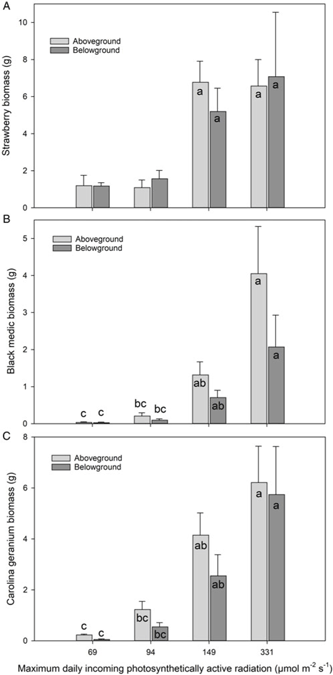
Both aboveground and belowground strawberry biomass when measured at 14 wk after trial initiation were not impacted by restricting available light to 149 or 331 µmol m2 s−1 (Figure 1A). Being exposed to lower levels of available light (69 and 94 µmol m2 s−1) from transplanting onward subsequently resulted in drastic reductions in biomass (<2 g plant−1) as well as plant death. In previous research, ‘Festival’ strawberry plants accumulated 45.5 g plant−1 aboveground and 17.0 g plant−1 belowground when grown in the field using standard Florida practices (Sharpe et al. Reference Sharpe, Boyd, Dittmar, MacDonald and Darnell2018a). This was a dramatic reduction compared with field studies, though expected with the decreased fertility, light, and space for roots. The strawberry cultivar Earliglow demonstrated reduced crown and leaf dry weight but not root dry weight in response to 60% constant shading from direct sunlight (Ferree and Stang Reference Ferree and Stang1988). This indicates cultivar selection may be critical to field trial success. Selective shading during stolon production did not reduce biomass (Ferree and Stang Reference Ferree and Stang1988) and may be a feasible option to reduce the impact on biomass accumulation.
Container-grown (A) strawberry, (B) black medic, and (C) Carolina geranium biomass in response to varying light levels in greenhouse experiments at Balm, FL, in 2018. Biomass was taken at 14 wk after trial initiation. Instantaneous photosynthetic photon flux density was measured on December 8, 2017, at solar noon with no cloud cover inside the greenhouse. The average reduction for incoming radiation within each shading structure was then used to calculate the available photosynthetically active radiation. Vertical bars are raw means, and error bars represent the standard error of the mean. Different letters between treatments (light levels) within either aboveground or belowground biomass indicate a significant difference using Tukey’s honest significant difference test (α = 0.05).

Black medic biomass accumulation was variable at the highest light conditions (331 µmol m2 s−1) (Figure 1B). Reducing available light to 69 or 94 µmol m−2 s−1 did reduce both aboveground and belowground biomass compared with the 331 µmol m−2 s−1 light treatment. In Texas, treatments inducing 80% shade did not reduce black medic biomass (Interrante et al. Reference Interrante, Muir, Rosiere and Rhykerd2004), which was consistent with the current study. The 149 µmol m−2 s−1 treatment provided 86% shade (compared with natural sunlight) and did not reduce biomass, whereas the 92% shading (94 µmol m−2 s−1) and 94% shading (69 µmol m−2 s−1) treatments did reduce biomass. It was expected that black medic allocated resources aboveground at the expense of the root system, given that light was limited but nutrients were not. This may be a consequence of a smaller root system overall, but further study is required.
Carolina geranium demonstrated a trend similar to black medic (Figure 1B and C), although the degree of biomass reduction was less. The Carolina geranium belowground biomass size may make this species a strong nutrient competitor with strawberry, but this depends on its nutrient and water acquisition efficiency, which require further study. If the belowground competition between Carolina geranium and strawberry is substantial, then shade-inducing IPM strategies to reduce belowground biomass may be a viable option.
Leaf area and number
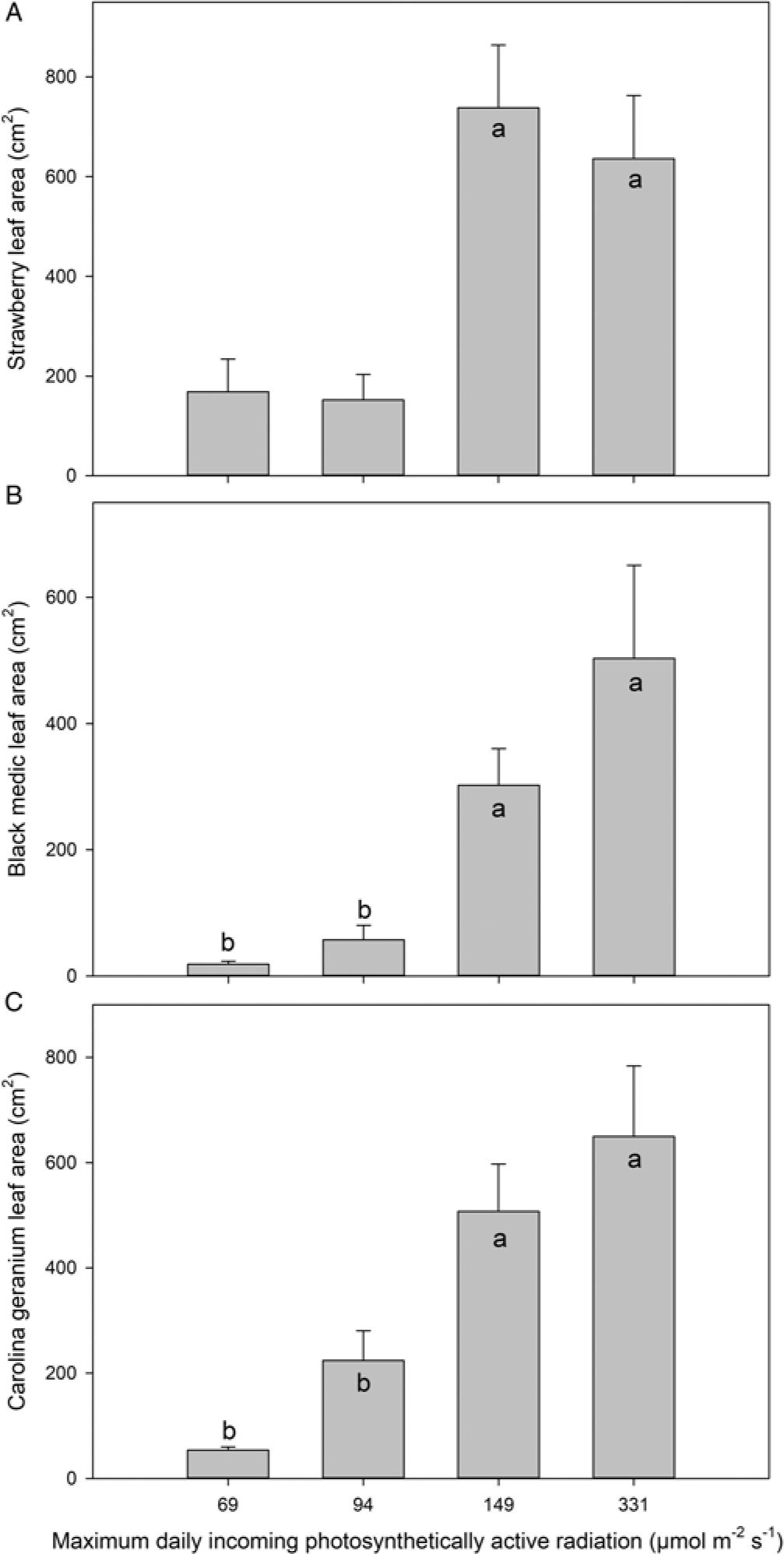
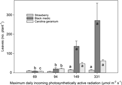
Strawberry maintained its leaf area per plant when available light was reduced from 331 to 149 µmol m−2 s−1 (47.6 cm2 plant−1) (Figure 2A). Further restricting maximal available light to 94 µmol m−2 s−1 was detrimental to the strawberry plant, with a 51% reduction in leaf number (Figure 3) and a 76% reduction in leaf area. At this intensity, strawberry leaves were smaller, at 22 cm2 plant−1.
Container-grown (A) strawberry, (B) black medic, and (C) Carolina geranium leaf area in response to varying light levels in greenhouse experiments at Balm, FL, in 2018. Leaf area was taken at 14 wk after trial initiation. Instantaneous photosynthetic photon flux density was measured on December 8, 2017, at solar noon with no cloud cover inside the greenhouse. The average reduction for incoming radiation within each shading structure was then used to calculate the available photosynthetically active radiation. Vertical bars are raw means, and error bars represent the standard error of the mean. Different letters between treatments (light levels) indicate a significant difference using Tukey’s honest significant difference test (α = 0.05).

Container-grown strawberry, black medic, and Carolina geranium leaf number in response to varying light levels in greenhouse experiments at Balm, FL, in 2018. Leaf number was taken at 14 wk after trial initiation. Instantaneous photosynthetic photon flux density was measured on December 8, 2017, at solar noon with no cloud cover inside the greenhouse. The average reduction for incoming radiation within each shading structure was then used to calculate the available photosynthetically active radiation. Vertical bars are raw means, and error bars represent the standard error of the mean. Different letters between treatments (light levels) within each species indicate a significant difference using Tukey’s honest significant difference test (α = 0.05).

Black medic showed a high degree of sensitivity to shade. Growing black medic under 149 µmol m−2 s−1 maximal light treatment from emergence onward reduced leaf area by 40% (Figure 2B) and leaf number by 49% (Figure 3) compared with the 331 µmol m−2 s−1 light treatment. This difference was not statistically significant, likely due to the high variability for leaf area (Figure 2B) and particularly leaf number (Figure 3). The high variability in black medic growth habit, particularly after 14 wk, has been noted elsewhere (Sharpe et al. Reference Sharpe, Boyd, Dittmar, MacDonald, Darnell and Ferrell2018c). As those authors noted, this was likely a consequence of genetic variability in the plant growth rates as well as production of both primary branches near the point of attachment to the root system and subsequent (secondary and tertiary) branches along the primary stem length. The degree of inherent variability appeared to be more influential than any treatment differences between available light regimes. Increasing sample size would likely help overcome this in future experiments. Under the low light of 94 µmol m−2 s−1, black medic leaf number was reduced by 93% and leaf area by 89% compared with the 331 µmol m2 s−1 treatment. The average leaf area per leaf remained relatively constant as shading increased, between 2 to 3 cm2 leaf−1. Conditions invoking 149 µmol m2 s−1 at emergence may not be sufficient to suppress black medic leaf accumulation and eventual escape from light competition with strawberry in the field due to its prostrate growth habit and development of long stems (Sharpe et al. Reference Sharpe, Boyd, Dittmar, MacDonald, Darnell and Ferrell2018c). Conditions invoking at least 94 µmol m2 s−1 available light in the field, cultivar selection, and the use of shading tents are advised to suppress black medic growth. Black medic has demonstrated exponential accumulation of leaves and stem length (Sharpe et al. Reference Sharpe, Boyd, Dittmar, MacDonald, Darnell and Ferrell2018c) that shading treatments may help suppress.
For Carolina geranium, when the daily maximal available light level was reduced from 331 to 149 µmol m−2 s−1 from emergence onward, leaf area was only reduced by 22% (Figure 2B) and leaf number by 23% (Figure 3), neither of which were statistically different. When Carolina geranium was grown under 94 µmol m−2 s−1, the leaf area and leaf number were both reduced by 66% compared with the 331 µmol m2 s−1 light treatment. A 92% reduction in leaf area and 87% reduction in leaf number was achieved by the 69 µmol m−2 s−1 treatment compared with the 331 µmol m2 s−1 treatment. The average leaf area per leaf was maintained at 11 cm2 leaf−1 between the 94 to 331 µmol m−2 s−1 treatments and was reduced to 7 cm2 leaf−1 for the 69 µmol m−2 s−1 treatment. Carolina geranium appeared to show greater tolerance to reduced available light compared with black medic, as demonstrated by the light treatment, which reduced leaf area and number by 90%. For black medic this was the 94 µmol m−2 s−1 treatment, while for Carolina geranium this was the 69 µmol m−2 s−1 treatment.
Strawberry Radiance plants were tolerant to the 149 µmol m−2 s−1 light levels without reductions in leaf accumulation, leaf area, and biomass. This was consistent with some previous field evaluations (Fernandez Reference Fernandez2001; Ferree and Stang Reference Ferree and Stang1988), though reductions have been noted, largely due to shading duration (Chandler et al. Reference Chandler, Miller and Ferree1992; Ferree and Stang Reference Ferree and Stang1988). Results are promising, as additional benefits from strawberry plant shading include decreases in the time to flowering, increased flower number, reduced stolon number, and increased berry yield (Fernandez Reference Fernandez2001; Ferree and Stang Reference Ferree and Stang1988; Gast and Pollard Reference Gast and Pollard1991; Singh et al. Reference Singh, Syndor, Deka, Singh and Patel2012). Growing strawberries in low tunnels with 75% shade cloth did increase ascorbic acid and anthocyanin content compared with open production (Singh et al. Reference Singh, Syndor, Deka, Singh and Patel2012). Should shading decrease the time to harvest or increase early-season yields, this would benefit growers due to the high demand of the early-season (December) market. One concern is decreased fruit quality due to gray mold (Botrytis cinerea Pers.) infestations under floating row covers, so a strict fungicide program may be necessary (Fernandez Reference Fernandez2001). Selection for cultivars with robust canopies such as Sensation™ Florida 127 and ‘Strawberry Festival’ may decrease light availability at the planting holes and suppress weed growth, though further study is required to determine their tolerance to shade (Chandler et al. Reference Chandler, Legard and Dunigan2000; Whitaker et al. Reference Whitaker, Chandler, Peres, Cecilia, Nunes, Florida, Avenue, Pierce and Sims2015). Given the extent of previous studies on the impact of shading on strawberry yield, it appears shade-oriented IPM strategies for weed management are feasible with regard to crop tolerance, though further study is required to refine techniques.
Black medic growth habit tends to be prostrate, with several long branches extending from the point of emergence in the soil (Sharpe et al. Reference Sharpe, Boyd, Dittmar, MacDonald, Darnell and Ferrell2018c). This type of growth habit results in the plant generally growing below the strawberry plant in a field setting, extending into the areas between strawberry plants on top of the plastic mulch and down into the row middles. Black medic was the most shade susceptible of the three species studied. Low levels of available light (≤94 µmol m−2 s−1) suppressed leaf accumulation over time. Given black medic’s growth habit and susceptibility to shading, the targeted use of shade cloth row covers may be a viable option to suppress its growth during strawberry plant establishment.
Carolina geranium demonstrated a growth habit that was largely similar to the strawberry plant (unpublished data), consisting of a cluster of dense foliage originating from a central location. It was moderately tolerant to the experimental shading treatments for leaf accumulation, leaf area, and biomass. A similar growth habit and a relatively strong shade-tolerance response may limit the effectiveness of shading as a management option. The degree of belowground biomass at the end of the study period was unexpected and may contribute to substantial belowground competition with strawberry roots but requires further study. Shade may still be worth consideration, given it suppressed Carolina geranium root growth, stimulated strawberry leaf production, potentially provided yield benefits noted elsewhere (Fernandez Reference Fernandez2001; Gast and Pollard Reference Gast and Pollard1991; Singh et al. Reference Singh, Syndor, Deka, Singh and Patel2012), and may repress aboveground Carolina geranium growth to enhance clopyralid efficacy when used POST. Shading treatments using cultivar selection and shade cloth require further study within the field to determine whether they will be reliable in repressing Carolina geranium growth during crop establishment.
Shade-induced growth suppression is a promising alternative to chemical control options for conventional and organic Florida strawberry production. While the timing of shading strategies should occur before or at emergence, the duration to which the current study conducted them may not be necessary. Black medic emergence occurs during strawberry crop establishment, approximately mid-November to mid-December (Sharpe and Boyd Reference Sharpe and Boyd2018). Shading treatments may help alter competition dynamics between the strawberry crop and weeds, allowing the crop to mature and establish with minimal interference, though this requires further study. While shade-adaption characteristics have been examined for greenhouse-grown soybean [Glycine max (L.) Merr.], eastern black nightshade (Solanum ptychanthum Dunal), tumble pigweed (Amaranthus albus L.), common lambsquarters (Chenopodium album L.), and velvetleaf (Abutilon theophrasti Medik.) (Stoller and Myers Reference Stoller and Myers1989), using shade cloth in the field to simultaneously suppress weeds and promote crop growth has been largely unstudied. Shade-induced suppression appears to be most feasible for black medic, but may also be useful for Carolina geranium in concert with other IPM control measures. While high tunnels occupy a minority of production, floating row covers or simply placing shade cloth atop the strawberry crop during peak weed emergence timings may have widespread adaptability. The current study evaluates feasibility of limiting light availability for weed suppression under heavy shading scenarios. Further study is required for field evaluation including shade cloth selection and thickness, cultivar selection and responsiveness, shade timing and duration, and yield impacts, including fruit quality and quantity. Because natural cloud shading reduced tomato (Lycopersicon esculentum Mill.) tolerance to metribuzin (Pritchard and Warren Reference Pritchard and Warren1980), the use of shade cloth in conjunction with POST herbicide applications requires further research to determine the impact on strawberry tolerance. The effect of shading in a plasticulture setting on other important weeds such as goosegrass [Eleusine indica (L.) Gaertn.] and purple nutsedge (Cyperus rotundus L.) also requires further study.
Author ORCIDs
Shaun Michael Sharpe https://orcid.org/0000-0002-7683-703X
Acknowledgments
No conflicts of interest have been declared. This research received no specific grant from any funding agency or the commercial or not-for-profit sectors.