Introduction
Alcohol use is a significant public health concern that accounts for approximately three million deaths worldwide each year (World Health Organization, 2022). Alcohol use disorder (AUD) is highly prevalent in US military veterans. For example, in a nationally representative survey of US military veterans, the lifetime and past-year prevalence of AUD were 42.2% and 14.8%, respectively (Fuehrlein et al., Reference Fuehrlein, Mota, Arias, Trevisan, Kachadourian, Krystal and Pietrzak2016), whereas in the general US adult population, were estimated at 29.1% and 13.9%, respectively (Grant et al., Reference Grant, Goldstein, Saha, Chou, Jung, Zhang and Hasin2015).
Historically, examining the association between biological factors and AUD has been critical in understanding the risk, course, and heterogeneity of AUD (Zucker, Reference Zucker, Cicchetti and Cohen2006). It is well known that a family history of AUD is a strong risk factor for AUD (Deak, Miller, & Gizer, Reference Deak, Miller and Gizer2019; Kranzler et al., Reference Kranzler, Zhou, Kember, Vickers Smith, Justice, Damrauer and Gelernter2019). Over the past decade, genome-wide association studies (GWAS) have implicated an array of genetic variants linked to various alcohol use phenotypes (Deak et al., Reference Deak, Miller and Gizer2019; Gelernter et al., Reference Gelernter, Kranzler, Almasy, Koesterer, Smith, Anton and Farrer2014). A considerable body of evidence suggests a significant contribution of genetic factors to alcohol use phenotypes, such as high alcohol consumption (HAC; defined as a score of 4 or higher on the Alcohol Use Disorders Identification Test–Consumption [AUDIT-C]) and AUD (Deak et al., Reference Deak, Miller and Gizer2019; Kranzler et al., Reference Kranzler, Zhou, Kember, Vickers Smith, Justice, Damrauer and Gelernter2019). Previous research has shown that the genetics of alcohol consumption (AC) tend to differ from those indexing problematic alcohol use (PAU) (Kranzler et al., Reference Kranzler, Zhou, Kember, Vickers Smith, Justice, Damrauer and Gelernter2019; Zhou et al., Reference Zhou, Sealock, Sanchez-Roige, Clarke, Levey, Cheng and Gelernter2020). Extant literature suggests a modest correlation between AC and PAU, suggesting overlapping but distinct genetic architecture between the phenotypes (Kranzler et al., Reference Kranzler, Zhou, Kember, Vickers Smith, Justice, Damrauer and Gelernter2019; Zhou et al., Reference Zhou, Sealock, Sanchez-Roige, Clarke, Levey, Cheng and Gelernter2020).
Recently, polygenic risk scores (PRS) derived from large-scale GWAS to describe the association between genetic variance and alcohol-related phenotypes have shown significant effects (Gelernter & Polimanti, Reference Gelernter and Polimanti2021; Kranzler et al., Reference Kranzler, Zhou, Kember, Vickers Smith, Justice, Damrauer and Gelernter2019). However, given the small amount of variance that PRS account for in mental health and alcohol-related phenotypes (Barr et al., Reference Barr, Ksinan, Su, Johnson, Meyers, Wetherill and Dick2020; Murray et al., Reference Murray, Lin, Austin, McGrath, Hickie and Wray2021), there is increasing recognition of the importance of understanding genetic susceptibility in the context of environmental and psychosocial factors (Lutz, Mechawar, & Turecki, Reference Lutz, Mechawar and Turecki2017). A burgeoning body of research examined PRS-by-environmental and psychosocial correlates of psychiatric phenotypes, such as major depressive disorder (Mullins et al., Reference Mullins, Power, Fisher, Hanscombe, Euesden, Iniesta and Lewis2016; Musliner et al., Reference Musliner, Seifuddin, Judy, Pirooznia, Goes and Zandi2015), bipolar disorder (Polimanti et al., Reference Polimanti, Kaufman, Zhao, Kranzler, Ursano, Kessler and Gelernter2018b), and suicidal thoughts (Na et al., Reference Na, De Angelis, Nichter, Wendt, Krystal, Southwick and Pietrzak2022). However, scarce research has examined PRS-by-environmental and psychosocial factors in relation to alcohol use phenotypes (Pasman, Verweij, & Vink, Reference Pasman, Verweij and Vink2019) and to our knowledge, no study has utilized a longitudinal, population-based cohort. Thus, the prospective interactions between polygenic liability of alcohol use and environmental and psychosocial factors in relation to alcohol use phenotypes remain to be elucidated.
Previous research on gene-by-environment interactions in alcohol use phenotypes has disproportionately focused on largely non-modifiable risk factors (e.g. stressful life events, and adverse childhood experiences) (Dick & Kendler, Reference Dick and Kendler2012; Polimanti et al., Reference Polimanti, Kaufman, Zhao, Kranzler, Ursano, Kessler and Stein2018a; Young-Wolff, Enoch, & Prescott, Reference Young-Wolff, Enoch and Prescott2011). In contrast, potentially protective factors such as attachment style, purpose in life, gratitude, optimism, and social support, which have been linked to reduced likelihood of HAC and AUD (Fuehrlein et al., Reference Fuehrlein, Mota, Arias, Trevisan, Kachadourian, Krystal and Pietrzak2016; Krentzman, Reference Krentzman2017; Na et al., Reference Na, Norman, Nichter, Hill, Rosen, Petrakis and Pietrzak2021; Straus et al., Reference Straus, Norman, Haller, Southwick, Hamblen and Pietrzak2019; Straus, Norman, & Pietrzak, Reference Straus, Norman and Pietrzak2020), have received considerably less attention. Characterizing whether such factors may moderate the risk for HAC and AUD determined by PRS will help inform prevention and treatment efforts, especially given that many of them are modifiable (Fava et al., Reference Fava, Ruini, Rafanelli, Finos, Conti and Grandi2004; Hayes, Luoma, Bond, Masuda, & Lillis, Reference Hayes, Luoma, Bond, Masuda and Lillis2006; Krentzman, Reference Krentzman2017; Seligman, Steen, Park, & Peterson, Reference Seligman, Steen, Park and Peterson2005). In our previous studies using the National Health and Resilience in Veterans Study (NHRVS), we found that lower social support, secure attachment style (Fuehrlein et al., Reference Fuehrlein, Mota, Arias, Trevisan, Kachadourian, Krystal and Pietrzak2016; Na et al., Reference Na, Montalvo-Ortiz, Petrakis, Krystal, Polimanti, Gelernter and Pietrzak2023), lower dispositional optimism (Na et al., Reference Na, Norman, Nichter, Hill, Rosen, Petrakis and Pietrzak2021), and personality factors (i.e. agreeableness, conscientiousness) were associated with probable AUD and excessive AC (Na et al., Reference Na, Montalvo-Ortiz, Petrakis, Krystal, Polimanti, Gelernter and Pietrzak2023).
Toward this end, we analyzed data from the NHRVS, a 10-year population-based longitudinal study of US European-American (EUR) veterans to first examine the main effects of PRS derived from a large-scale Million Veteran Program (MVP) GWAS of AUDIT-C scores (Kranzler et al., Reference Kranzler, Zhou, Kember, Vickers Smith, Justice, Damrauer and Gelernter2019) as well as a genome-wide meta-analysis of PAU (Zhou et al., Reference Zhou, Sealock, Sanchez-Roige, Clarke, Levey, Cheng and Gelernter2020). Further, we sought to examine the interactions between AUDIT-C PRS and several psychosocial factors in relation to persistent HAC over a 10-year period. Risk and protective factors examined as potential moderators were selected based on previous work on the correlates of alcohol use phenotypes using the NHRVS, as well as previous genetic and gene-by-environment studies of alcohol-related phenotypes (Dick & Kendler, Reference Dick and Kendler2012; Fuehrlein et al., Reference Fuehrlein, Mota, Arias, Trevisan, Kachadourian, Krystal and Pietrzak2016; Kelsall et al., Reference Kelsall, Wijesinghe, Creamer, McKenzie, Forbes, Page and Sim2015; Krentzman, Reference Krentzman2017; Na et al., Reference Na, Norman, Nichter, Hill, Rosen, Petrakis and Pietrzak2021; Polimanti et al., Reference Polimanti, Kaufman, Zhao, Kranzler, Ursano, Kessler and Stein2018a; Straus et al., Reference Straus, Norman, Haller, Southwick, Hamblen and Pietrzak2019, Reference Straus, Norman and Pietrzak2020; Young-Wolff et al., Reference Young-Wolff, Enoch and Prescott2011). We hypothesized that AUDIT-C PRS would be associated with persistent and new-onset HAC, and that positive psychosocial factors (i.e. dispositional optimism, gratitude, social support, agreeableness and conscientiousness) would moderate this association.
Methods
Participants
Data were analyzed from 1323 EUR veterans who participated in the NHRVS, a 10-year, population-based, longitudinal study of US military veterans. Participants completed a baseline survey and provided a saliva sample for genetic analyses. The baseline assessment was conducted in 2011 and follow-ups were conducted in 2013, 2015, 2018, and 2021 (mean number of completed follow-ups = 2.7, standard deviation [s.d.] = 1.2, range = 1–4). The average age of participants was 63.8 years (s.d. = 13.2: range 24–93); the majority were male (93.1%) and 30.7% were combat veterans. The prevalence of HAC at the baseline assessment did not differ between EUR veterans who did and did not complete follow-up assessments (35.5% v. 35.7%, χ2(1) = 0.01, p = 0.95). Participant recruitment is described in detail in the Supplemental Material. The study protocol was approved by the Human Subjects Subcommittee of the VA Connecticut Healthcare System, and all participants provided informed consent.
Assessments
High alcohol consumption
HAC was assessed using the AUDIT-C (Bush, Kivlahan, & McDonell, Reference Bush, Kivlahan and McDonell1998). The AUDIT-C consists of three questions that assess the frequency of AC and binging, and yields a total score ranging from 0 to 12. Higher scores indicate more severe AC. Details of the AUDIT-C are described in the Supplemental Material.
A score of 4 or higher for men and 3 or higher for women was considered positive screens for HAC based on previous recommendations by the World Health Organization and the Veterans Affairs (VA) (VA Health Care, 2013; World Health Organization, Reference Babor, Higgins-Biddle, Saunders and Monteiro2001). Veterans who consistently screened positive for HAC at the initial assessment and one or more follow-up assessments were classified as having persistent HAC. Those who screened negative for HAC at the initial assessment but screened positive at one or more follow-up assessments were classified as having new-onset HAC. In contrast, those who screened positive on the initial assessment but negative on all completed follow-up assessments were classified as having remitted HAC. Those who consistently screened negative for HAC at initial and all completed follow-up assessments were classified as having no/low AC.
Genotyping
Genotyping was completed at VA Connecticut Healthcare Center (Gelernter lab), as described previously (Na et al., Reference Na, De Angelis, Nichter, Wendt, Krystal, Southwick and Pietrzak2022). As part of genotyping quality control, NHRVS participants with mismatched sex or genotype call rate < 95% were excluded from the analysis. Also, we calculated the degree of cryptic relatedness between each pair of individuals in the sample by estimating their identity by descent coefficients. For each pair of related individuals (pihat > 0.2), the individual with the lowest call rate was removed from the analysis. Next, SNPs with genotype call rate < 95% or minor allele frequency (MAF) < 0.01 were removed before imputation. Quality control was performed on individual genotypic data using PLINK 1.9 (Purcell et al., Reference Purcell, Neele, Todd-Brown, Thomas, Ferreira, Bender and Sham2007). Ancestry assignment was defined via principal component analysis combining NHRVS sample with 1000 Genomes Project reference populations (1000 Genomes Project Consortium, 2015). Since other ancestry groups represented less than 15% of the NHRVS sample, only EUR ancestry was considered for further analyses. Imputation was performed using the genotype imputation software Minimac4 (Fuchsberger, Abecasis, & Hinds, Reference Fuchsberger, Abecasis and Hinds2015) and the Haplotype Reference Consortium (McCarthy et al., Reference McCarthy, Das, Kretzschmar, Delaneau, Wood, Teumer and Durbin2016) as reference panel through the Michigan Imputation Server (Das et al., Reference Das, Forer, Schönherr, Sidore, Locke, Kwong and Fuchsberger2016; Michigan imputation server: Free next-generation genotype imputation service). After imputation, we retained a total of 7 974 742 variants with MAF > 1% and INFO score > 0.6.
Principal components were calculated from LD-independent SNPs using the fast PCA approach implemented in PLINK version 2.0 (Galinsky et al., Reference Galinsky, Bhatia, Loh, Georgiev, Mukherjee, Patterson and Price2016; Purcell et al., Reference Purcell, Neele, Todd-Brown, Thomas, Ferreira, Bender and Sham2007). LD Pruning was performed in PLINK (R 2 < 0.1 for SNPs < 1 Mb apart) using HapMap3 (The International HapMap Consortium, 2003) (U.S. Utah residents with ancestry from northern and western Europe) as reference.
Polygenic risk scoring
We calculated AUDIT-C PRS in the NHRVS sample using PRS-CS and PLINK (Ge, Chen, Ni, Feng, & Smoller, Reference Ge, Chen, Ni, Feng and Smoller2019; Purcell et al., Reference Purcell, Neele, Todd-Brown, Thomas, Ferreira, Bender and Sham2007). We used genome-wide association statistics from a large GWAS of AUDIT-C (as an ordinal trait, as opposed to HAC in the NHRVS sample which used a cutoff to create a binary score based on the same instrument) conducted in EUR participants enrolled in the MVP cohort (n = 200 680) for AUDIT-C PRS (Kranzler et al., Reference Kranzler, Zhou, Kember, Vickers Smith, Justice, Damrauer and Gelernter2019). PRS-CS was used to infer posterior effect sizes of SNPs using AUDIT-C GWAS summary statistics and 1000 Genomes Project reference panel for EUR populations (obtained from https://github.com/getian107/PRScs by the authors). Default settings were used with the sample size of AUDIT-C GWAS as input. We then used PLINK (Purcell et al., Reference Purcell, Neele, Todd-Brown, Thomas, Ferreira, Bender and Sham2007) for polygenic risk scoring in the NHRVS sample using 1000 Genomes Project EUR as reference panel. In addition, we also calculated PAU PRS with the same methods as above using the genome-wide meta-analysis statistics from PAU conducted in EUR participants (n = 435 563) (Zhou et al., Reference Zhou, Sealock, Sanchez-Roige, Clarke, Levey, Cheng and Gelernter2020).
Potential moderating variables
Based on previous work on the correlates of AUD using the NHRVS (Fuehrlein et al., Reference Fuehrlein, Kachadourian, DeVylder, Trevisan, Potenza, Krystal and Pietrzak2018; Na et al., Reference Na, Norman, Nichter, Hill, Rosen, Petrakis and Pietrzak2021, Reference Na, Montalvo-Ortiz, Petrakis, Krystal, Polimanti, Gelernter and Pietrzak2023; Straus et al., Reference Straus, Norman, Haller, Southwick, Hamblen and Pietrzak2019, Reference Straus, Norman and Pietrzak2020) as well as previous genetic and gene-by-environment studies of relevant psychiatric phenotypes (Dick & Kendler, Reference Dick and Kendler2012; Polimanti et al., Reference Polimanti, Kaufman, Zhao, Kranzler, Ursano, Kessler and Gelernter2018b; Young-Wolff et al., Reference Young-Wolff, Enoch and Prescott2011), we evaluated the role of the following variables as potential moderators, that may interact with AUDIT-C PRS in relation to AC outcomes: two of the Big-Five personality factors (i.e. agreeableness, conscientiousness) (Fuehrlein et al., Reference Fuehrlein, Kachadourian, DeVylder, Trevisan, Potenza, Krystal and Pietrzak2018; Na et al., Reference Na, Montalvo-Ortiz, Petrakis, Krystal, Polimanti, Gelernter and Pietrzak2023), attachment style (Fuehrlein et al., Reference Fuehrlein, Kachadourian, DeVylder, Trevisan, Potenza, Krystal and Pietrzak2018; Na et al., Reference Na, Montalvo-Ortiz, Petrakis, Krystal, Polimanti, Gelernter and Pietrzak2023), dispositional gratitude (Krentzman, Reference Krentzman2017), perceived social support (Fuehrlein et al., Reference Fuehrlein, Kachadourian, DeVylder, Trevisan, Potenza, Krystal and Pietrzak2018), dispositional optimism (Na et al., Reference Na, Norman, Nichter, Hill, Rosen, Petrakis and Pietrzak2021), combat veteran status (Na et al., Reference Na, Norman, Nichter, Hill, Rosen, Petrakis and Pietrzak2021), childhood abuse (Dick & Kendler, Reference Dick and Kendler2012; Polimanti et al., Reference Polimanti, Kaufman, Zhao, Kranzler, Ursano, Kessler and Stein2018a; Young-Wolff et al., Reference Young-Wolff, Enoch and Prescott2011), lifetime history of major depressive disorder (Fuehrlein et al., Reference Fuehrlein, Kachadourian, DeVylder, Trevisan, Potenza, Krystal and Pietrzak2018) and/or posttraumatic stress disorder (PTSD) (Palmisano, Norman, Panza, Petrakis, & Pietrzak, Reference Palmisano, Norman, Panza, Petrakis and Pietrzak2022; Straus et al., Reference Straus, Norman and Pietrzak2020). All moderating variables were assessed at the baseline assessment.
Combat veteran status
Combat veteran status was assessed with the following question: ‘Did you ever serve in a combat or war zone?’ and the Combat Exposure Scale (Keane et al., Reference Keane, Fairbank, Caddell, Zimering, Taylor and Mora1989), a 7-item self-report measure that assesses wartime stressors experienced by combatants.
Number of medical conditions
Sum of number of medical conditions endorsed in response to question: ‘Has a doctor or healthcare professional ever told you that you have any of the following medical conditions?’ (e.g. arthritis, cancer, diabetes, heart disease, asthma, kidney disease) Range: 0–24 conditions.
Attachment style
Attachment style was assessed with the following options: (a) I am somewhat uncomfortable being close to others (insecure); (b) I find it relatively easy to get close to others (secure); (c) I find that others are reluctant to get as close as I would like (insecure) (Hazan & Shaver, Reference Hazan and Shaver1990). Secure and insecure attachment styles were dichotomized based on these responses.
Childhood abuse
The Trauma History Screen (Carlson et al., Reference Carlson, Smith, Palmieri, Dalenberg, Ruzek, Kimerling and Spain2011), a 14-item self-report measure, was used to assess exposure to the lifetime occurrence of child physical and sexual abuse.
Lifetime major depressive disorder
Lifetime major depressive disorder was assessed using a modified self-report version of the Mini International Neuropsychiatric Interview for DSM-IV (Sheehan et al., Reference Sheehan, Lecrubier, Sheehan, Amorim, Janavas, Weiller and Dunbar2011).
Lifetime PTSD
Lifetime PTSD was assessed using a lifetime version of the PTSD Checklist-Specific Stressor version, which assessed PTSD symptoms related to veterans' ‘worst’ event on the Trauma History Screen; scores ≥ 50 were indicative of a positive screen (Weathers, Litz, Herman, Huska, & Keane, Reference Weathers, Litz, Herman, Huska and Keane1993).
Agreeableness and conscientiousness
The ‘Big Five’ personality traits were assessed using the Ten-Item Personality Inventory (TIPI) (Gosling, Rentfrow, & Swann, Reference Gosling, Rentfrow and Swann2003), a 10-item self-report brief measure on emotional stability (anxious v. confident and calm), extraversion (outgoing v. reserved), openness to experience (imaginative and inventive v. cautious and routine-like), agreeableness (friendly and cooperative v. detached), and conscientiousness (efficient and organized v. careless). From these five, agreeableness and conscientiousness were selected as possible moderators based on our previous study in the same NHRVS cohort (Na et al., Reference Na, Montalvo-Ortiz, Petrakis, Krystal, Polimanti, Gelernter and Pietrzak2023).
Dispositional gratitude
Score on single-item 7-point Likert scale measure of gratitude from the Gratitude Questionnaire: ‘I have so much in life to be thankful for’ (rating 1 = strongly disagree to 7 = strongly agree) (Scheier, Carver, & Bridges, Reference Scheier, Carver and Bridges1994).
Dispositional optimism
Score on single-item 7-point Likert scale measure of optimism from the Life Orientation Test-Revised (Scheier et al., Reference Scheier, Carver and Bridges1994); ‘In uncertain times, I usually expect the best’ (rating 1 = strongly disagree to 7 = strongly agree).
Perceived social support
Score on an abbreviated 5-item version of the Medical Outcomes Study Social Support Scale (Sherbourne & Stewart, Reference Sherbourne and Stewart1991) was used to assess perceived social support (sample item: ‘How often is each of the following kinds of support available to you if you need it?: Someone to confide in or talk to about your problems’; α = 0.92) (Sherbourne & Stewart, Reference Sherbourne and Stewart1991). Higher scores indicate greater perceived social support.
Data analysis
First, we conducted Bonferroni-corrected chi-square tests and univariate analyses of variance to compare sociodemographic, psychosocial, and psychiatric characteristics by AC group (i.e. remitting HAC, new-onset HAC, persistent HAC, and no/low AC). Second, we conducted correlations of AUDIT-C PRS and potential moderating variables. Third, a multinomial logistic regression analysis was conducted to examine associations between AUDIT-C PRS, risk and protective psychosocial factors, and their interaction in relation to persistent HAC, new-onset HAC, remitted HAC, and no/low AC over the 10-year study period. These analyses were adjusted for age, sex, and the top 10 within-ancestry principal components. A backward elimination estimation approach, which assesses the joint predictive ability and retains only the most important explanatory variables (Chowdhury & Turin, Reference Chowdhury and Turin2020), was employed to identify significant PRS × environment interaction terms. Predicted probabilities of persistent HAC were then computed and plotted to illustrate significant interaction effects. All continuous variables were coded continuously, and were not binarized. To evaluate the specificity of the AUDIT-C PRS in predicting HAC group status over the 10-year study period, we additionally examined the relationship between PAU PRS (Zhou et al., Reference Zhou, Sealock, Sanchez-Roige, Clarke, Levey, Cheng and Gelernter2020) and HAC status. PRS × environment analyses were conducted using IBM SPSS Statistics Version 28 (IBM Corp., 2021).
Results
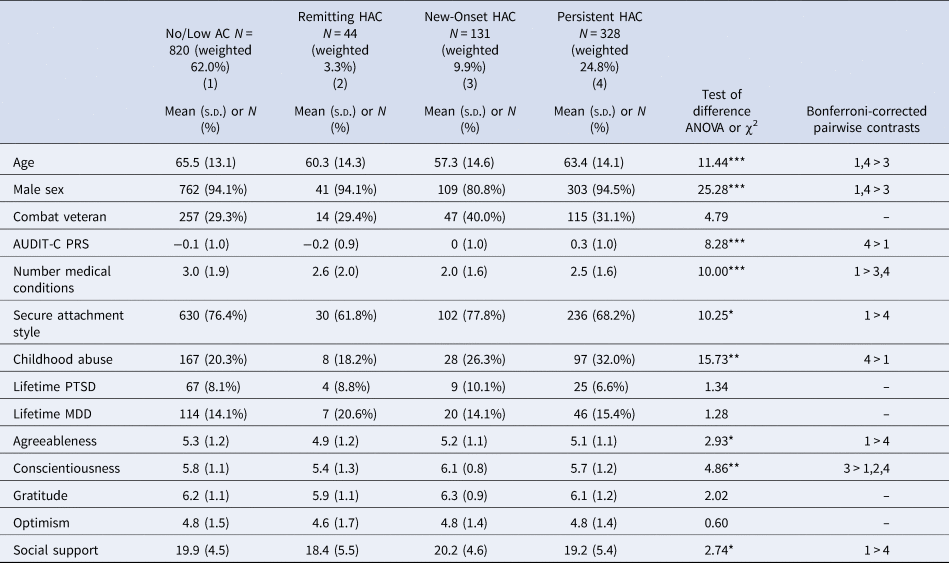
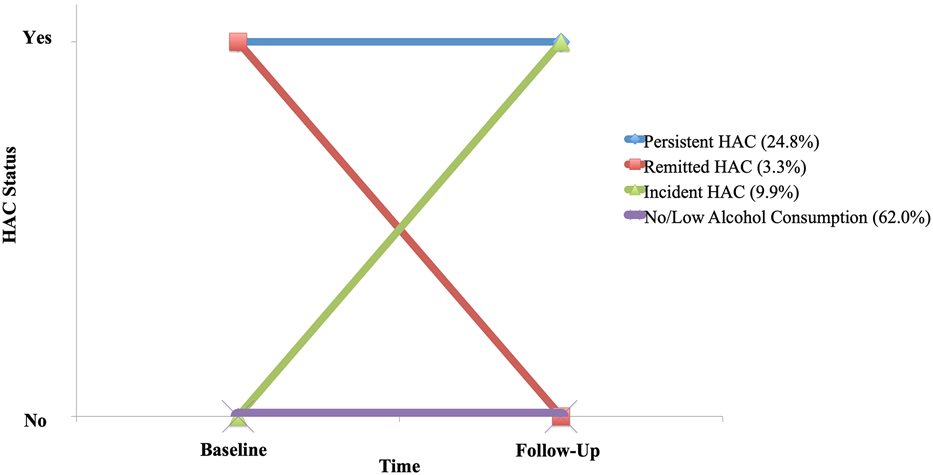
Table 1 presents descriptive statistics of the sample by AC status over the 10-year study period. A total of 328 (weighted 24.8%) veterans had persistent HAC; 131 (weighted 9.9%) had new-onset HAC; 44 (weighted 3.3%) had remitted HAC; and 820 (weighted 62.0%) had no/low AC at all assessments (see Fig. 1). Group differences were observed for all of the study variables (p < 0.05) except combat veteran status, lifetime major depressive disorder/PTSD, dispositional gratitude and dispositional optimism.
Sociodemographic, military, and psychiatric characteristics of veterans by alcohol consumption status

ANOVA, analysis of variance; AUDIT-C, Alcohol use disorders identification test-Consumption; AC, alcohol consumption; HAC, high alcohol consumption; MDD, major depressive disorder; PRS, polygenic risk score; PTSD, posttraumatic stress disorder; s.d., standard deviation; * = p < 0.5, ** = p < 0.01, *** = p < 0.001.
Different subgroups of alcohol consumption over the 10-year study period.
Note: HAC, high alcohol consumption.

AUDIT-C PRS was not associated with attachment style, combat veteran status, childhood abuse, number of medical conditions, agreeableness, conscientiousness, lifetime major depressive disorder/PTSD, dispositional gratitude, dispositional optimism, or perceived social support (r's < |0.05|, p's > 0.05), thus reducing the potential confounding of PRS-by-environment correlations.
Results revealed that PAU PRS was not associated with new-onset v. no/low AC (RRR = 0.94, 95% CI = 0.75–1.17; Wald = 0.33, p = 0.56); persistent v. no/low AC (RRR = 1.11, 95% CI = 0.96–1.29; Wald = 2.01, p = 0.16); or persistent v. remitted HAC (RRR = 1.11, 95% CI = 0.77–1.61; Wald = 0.32, p = 0.57).
Persistent HAC v. no/low AC
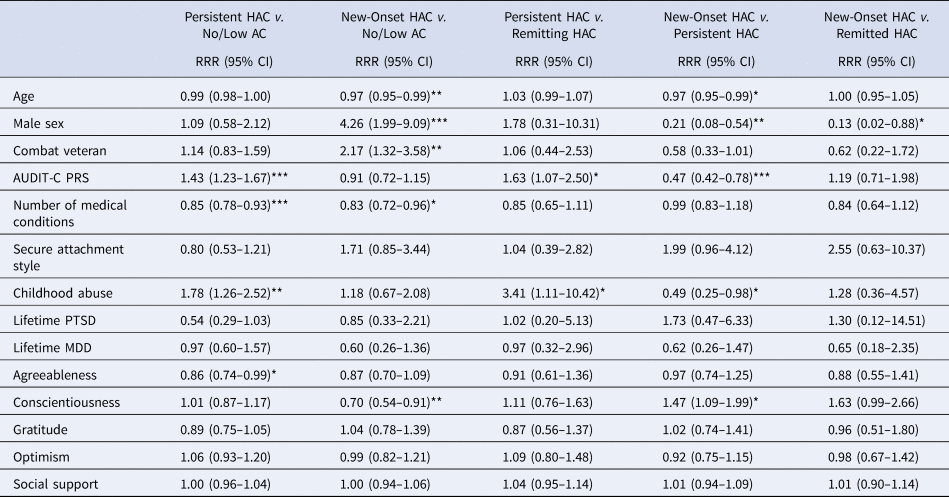
As shown in Table 2, AUDIT-C PRS and childhood abuse were positively associated with persistent v. no/low HAC, while number of medical conditions and agreeableness were negatively associated with this outcome. Significant interactions of AUDIT-C PRS × dispositional gratitude [relative risk ratio (RRR) = 0.77, 95% confidence interval (CI) = 0.64–0.92] and AUDIT-C PRS × agreeableness (RRR = 1.21, 95% CI = 1.05–1.39) were also observed.
Results of multinomial logistic regression analyses predicting drinking groups over 10-year follow-up period

AC, alcohol consumption; AUDIT-C, Alcohol use disorders identification test-Consumption; HAC, high alcohol consumption; MDD, major depressive disorder; PRS, polygenic risk score; PRS, polygenic risk score; PTSD, posttraumatic stress disorder; RRR, relative risk ratio; 95% CI, 95% confidence interval.
Significant association: * = p < 0.5, ** = p < 0.01, *** = p < 0.001.
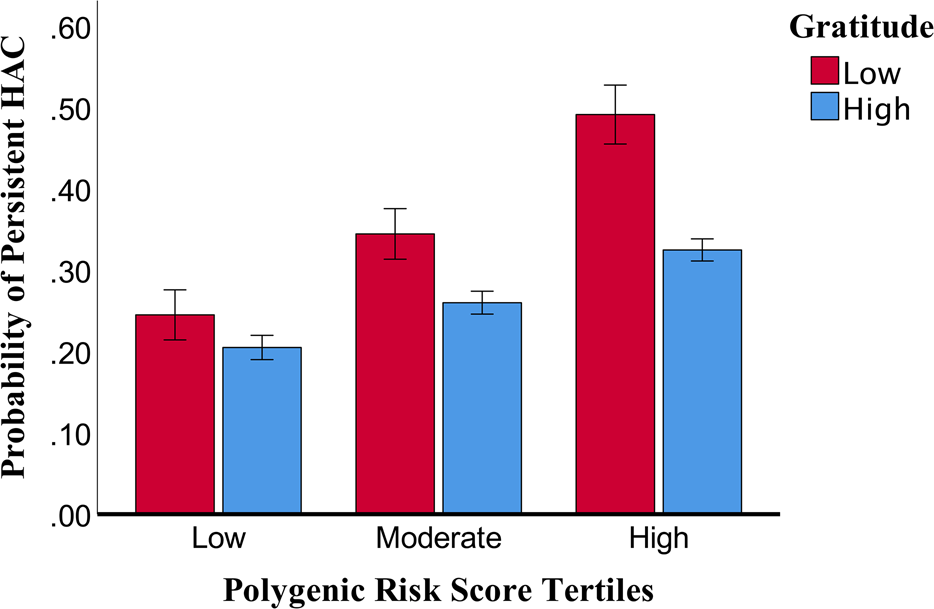
Figure 2 illustrates the interaction between AUDIT-C PRS and dispositional gratitude (Low = Endorsement of Strongly Disagree-to-Slightly Agree v. High = Agree or Strongly Agree on gratitude measure), which indicated the highest probability of persistent HAC among veterans with high AUDIT-C PRS and low dispositional gratitude. Among veterans in this highest tertile of AUDIT-C PRS, those with high gratitude had 34% lower probability of persistent HAC relative to those with low gratitude. Interactions between AUDIT-C PRS and other potential moderator variables, including lifetime major depressive disorder/PTSD, trauma burden, and combat veteran status, were not significant (all p's > 0.05).
Interaction of AUDIT-C PRS and dispositional gratitude in predicting probability of persistent HAC in US military veterans.
Note: HAC, high alcohol consumption. Errors bars represent 95% CIs.
Gratitude scores were negatively skewed and kurtotic and thus low and high scores are plotted: Low = Endorsement of ‘Strongly disagree’ to ‘Slightly agree’ (Mean = 4.3, s.d. = 1.0, range = 1–5, consistent with mean rating of ‘Neither agree nor disagree’) v. High = Agree or Strongly Agree (Mean = 6.6, s.d. = 0.5, range = 6.0–7.0, consistent with mean rating of ‘Agree’ to ‘Strongly agree’).

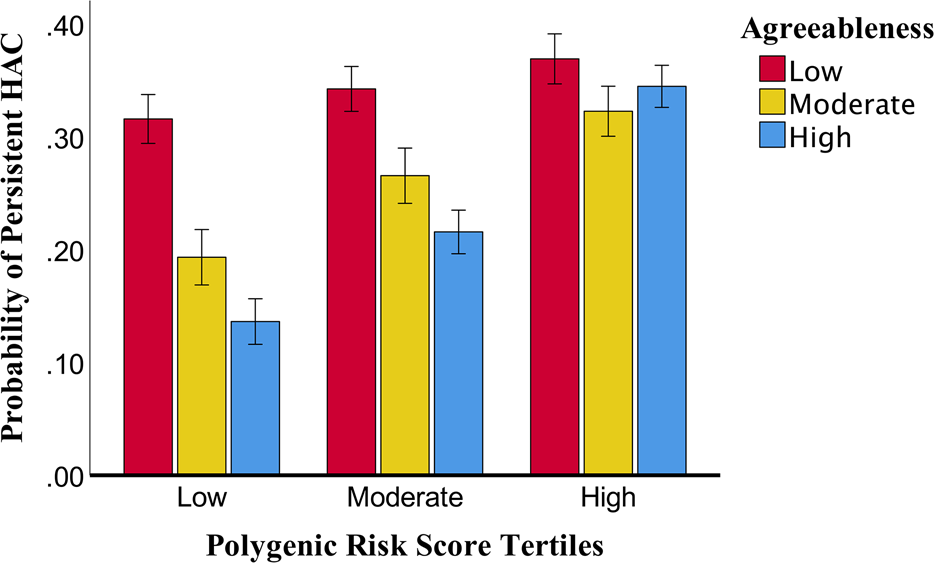
Figure 3 depicts the interaction between AUDIT-C PRS and agreeableness, which indicated the highest probability of persistent HAC among veterans with high AUDIT-C PRS and low agreeableness. The interaction of AUDIT-C PRS × agreeableness was most pronounced at low and moderate AUDIT-C PRS tertiles. Specifically, among veterans with low and moderate AUDIT-C PRS, those with high agreeableness were 57% and 37% less likely, respectively, to have persistent HAC relative to those with low agreeableness. Among veterans with high AUDIT-C PRS, those with moderate agreeableness had 13% lower likelihood of persistent HAC relative to those with low agreeableness.
Interaction of AUDIT-C PRS and agreeableness in predicting probability of persistent HAC in US military veterans.
Note: HAC = high alcohol consumption. Errors bars represent 95% CIs.
Agreeableness scores were stratified into low, moderate, and high levels based on tertiles: Low: Mean = 3.8, s.d. = 0.7, range = 1.0–4.5, consistent with ‘Neither agree nor disagree’ mean rating; Moderate: Mean = 5.2, s.d. = 0.3, range = 5.0–5.5, consistent with ‘Agree a little’ mean rating; High: Mean = 6.3, s.d. = 0.4, range = 6.0–7.0, consistent with ‘Agree moderately’ to ‘Agree strongly’ mean rating.

New-onset HAC v. no/low AC
As shown in Table 2, higher AUDIT-C PRS was not associated with new-onset v. no/low HAC. Male sex and combat veteran status were positively associated with new-onset HAC, whereas greater age, number of medical conditions, and conscientiousness were negatively associated with this outcome.
Persistent HAC v. remitted HAC
As shown in Table 2, higher AUDIT-C PRS and child abuse history were positively associated with persistent v. remitted HAC. Interaction analyses between AUDIT-C PRS and potential moderating variables were not significant (all p's > 0.09).
New-onset HAC v. persistent HAC
As shown in Table 2, relative to veterans with persistent HAC, those with new-onset HAC were younger, had higher AUDIT-C PRS and conscientiousness scores, and were more likely to be female and less likely to have experienced childhood abuse. Interaction analyses between AUDIT-C PRS and potential moderating variables were not significant (all p's > 0.24).
New-onset HAC v. remitted HAC
As shown in Table 2, relative to veterans with remitted HAC, those with new-onset HAC were more likely to be female, but did not differ with respect to any other variables. Interaction analyses between AUDIT-C PRS and potential moderating variables were not significant (all p's > 0.32).
Discussion
In this 10-year longitudinal study of US military veterans, we found that greater AUDIT-C PRS derived from a previous large GWAS (Kranzler et al., Reference Kranzler, Zhou, Kember, Vickers Smith, Justice, Damrauer and Gelernter2019) was positively associated with persistent HAC. Further, among US military veterans with greater AUDIT-C PRS, the likelihood of persistent HAC was lower among those with higher dispositional gratitude and agreeableness. To our knowledge, this is the first longitudinal study of psychosocial moderators of polygenic liability for longitudinal courses of HAC.
The main effect of AUDIT-C PRS in relation to persistent HAC builds upon previous studies suggesting that the cumulative effects of many common genetic polymorphisms (e.g. ADH1B, ADH1C, and SLC39A8) may contribute to increased risk of HAC (Deak et al., Reference Deak, Miller and Gizer2019; Kranzler et al., Reference Kranzler, Zhou, Kember, Vickers Smith, Justice, Damrauer and Gelernter2019). In a previous study using the same MVP genome-wide association statistics, AUDIT-C PRS was associated with alcohol-related disorders in two independent samples (Kranzler et al., Reference Kranzler, Zhou, Kember, Vickers Smith, Justice, Damrauer and Gelernter2019). Our findings expand this previous evidence, highlighting that AUDIT-C PRS was prospectively associated with persistent HAC, and demonstrates potential for further investigation in the application of AUDIT-C PRS in identifying individuals at high risk for persistent HAC (Murray et al., Reference Murray, Lin, Austin, McGrath, Hickie and Wray2021). However, it should also be noted that AUDIT-C scores served as the basis for the GWAS used to generate the PRS; HAC is also derived from AUDIT-C scores. Thus, the GWAS data was a close match for the predicted trait. Of note, PAU PRS was not associated with persistent nor new-onset HAC. This finding aligns with prior work suggesting that PAU and AUD may be genetically different from AC measures (Kranzler et al., Reference Kranzler, Zhou, Kember, Vickers Smith, Justice, Damrauer and Gelernter2019; Zhou et al., Reference Zhou, Sealock, Sanchez-Roige, Clarke, Levey, Cheng and Gelernter2020).
A greater number of medical conditions were inversely associated with persistent HAC relative to no/low AC. One interpretation of this finding is that veterans who had more medical conditions were more likely to refrain from HAC due to actual or perceived negative impact of AC on their physical health (Fuehrlein et al., Reference Fuehrlein, Kachadourian, DeVylder, Trevisan, Potenza, Krystal and Pietrzak2018). Further, greater childhood abuse was positively associated with persistent HAC relative to no/low AC. This finding aligns with previous work showing a robust association between adverse childhood experiences and increased risk of AC (Loudermilk, Loudermilk, Obenauer, & Quinn, Reference Loudermilk, Loudermilk, Obenauer and Quinn2018; Widom, White, Czaja, & Marmorstein, Reference Widom, White, Czaja and Marmorstein2007), as well as substance use disorder (Brems, Johnson, Neal, & Freemon, Reference Brems, Johnson, Neal and Freemon2004; Kim, Kim, Chartier, Wike, & McDonald, Reference Kim, Kim, Chartier, Wike and McDonald2021).
A noteworthy finding of this study was the moderating effect of dispositional gratitude on the relation between AUDIT-C PRS and persistent HAC. Previous work from our and other groups has revealed that gratitude is inversely associated with adverse mental health outcomes, such as current PTSD, major depressive disorder, generalized anxiety disorder, and suicidal thoughts (Emmons & Stern, Reference Emmons and Stern2013; Lambert, Fincham, & Stillman, Reference Lambert, Fincham and Stillman2012; McGuire, Fogle, Tsai, Southwick, & Pietrzak, Reference McGuire, Fogle, Tsai, Southwick and Pietrzak2021). Although not extensively studied, gratitude is a central theme in Alcoholics Anonymous (AA), one of the most commonly utilized behavioral interventions for individuals with alcohol use problems, which defines gratitude as one of the two hallmarks of success within the program (Alcoholics Anonymous, 1953). In the general psychiatric literature, there is considerable evidence suggesting that dispositional gratitude is a modifiable psychological characteristic associated with reduced risk of adverse mental health outcomes (Emmons & Stern, Reference Emmons and Stern2013). A recent meta-analysis of 15 studies examining the effect of psychological interventions designed to increase gratitude documented a moderate effect size relative to an alternative-activity condition such as thought recording, group sessions on daily activities, and best possible self-journaling (d = 0.46, 95% CI = 0.04–0.58; (Davis et al., Reference Davis, Choe, Meyers, Wade, Varjas, Gifford and Worthington2016). To date, however, limited research has examined the effects of interventions targeting gratitude in individuals with substance use disorders. In a randomized controlled trial of 14-day gratitude exercise [i.e. Three Good Things exercise (Seligman et al., Reference Seligman, Steen, Park and Peterson2005)] that involved six open-ended questions (e.g. please describe three good things that happened to you in the past 24 h) administered daily in individuals with AUD demonstrated an increase in positive affect (e.g. calmness, relaxation) and a decrease in negative affect [e.g. irritability, anger; (Krentzman et al., Reference Krentzman, Mannella, Hassett, Barnett, Cranford, Brower and Meyer2015)]. Given the robust moderating effect of gratitude on polygenic risk for persistent HAC observed in the current study, more research is needed to disentangle the association between gratitude and HAC, and evaluate whether interventions to bolster gratitude may help mitigate risk for HAC. However, it should be noted that enhancement of gratitude in the short term through the aforementioned interventions are not equivalent to establishing the ability to feel grateful on a consistent basis (Emmons & Stern, Reference Emmons and Stern2013). Further research is needed to develop psychotherapeutic interventions that foster long-term dispositional gratitude, as well as other positive psychosocial traits.
Greater agreeableness, a personality trait characterized by friendliness and cooperation, was inversely associated with persistent HAC, and moderated the positive association between AUDIT-C PRS and persistent HAC. These findings build upon previous studies that observed strong negative correlations between agreeableness and HAC (Lui, Chmielewski, Trujillo, Morris, & Pigott, Reference Lui, Chmielewski, Trujillo, Morris and Pigott2022). Several mechanisms have been posited for how positive personality traits such as agreeableness may help buffer risk for the development of HAC (Lui et al., Reference Lui, Chmielewski, Trujillo, Morris and Pigott2022). For example, individuals with lower levels of agreeableness may be more likely to become involved in HAC, as they may be less likely to acquire mature roles and responsibilities such as marriage or parenthood (Lee, Ellingson, & Sher, Reference Lee, Ellingson and Sher2015). While agreeableness is largely considered a stable personality trait, there are intensive psychological treatments that may help bolster it (Piedmont, Reference Piedmont2001). For example, in a six-week social skills training program in an outpatient rehabilitation treatment setting for 132 substance users, a significant increase in all ‘Big 5’ personality domains, including agreeableness, was observed (mean Cohen's d = 0.38) up until 15 months of follow-up (Piedmont, Reference Piedmont2001). In light of our finding that veterans with greater AUDIT-C PRS and low agreeableness had the highest risk for persistent HAC, it is possible that veterans with high genetic liability for HAC and low agreeableness may particularly benefit from such interventions. Further research is needed to evaluate this possibility.
Several limitations of this study must be noted. First, PRS was derived from the largest AUDIT-C GWAS available (Kranzler et al., Reference Kranzler, Zhou, Kember, Vickers Smith, Justice, Damrauer and Gelernter2019), while HAC status was dichotomized as a binary outcome from AUDIT-C; nevertheless, latent growth mixture modeling analysis of continuous AUDIT-C scores in this cohort has revealed a similar trajectory of HAC over time (Fuehrlein et al., Reference Fuehrlein, Kachadourian, DeVylder, Trevisan, Potenza, Krystal and Pietrzak2018). Second, although prospective, the relatively small sample size of the NHRVS cohort and low number of persistent and remitted HAC cases may have reduced statistical power in our analyses and limited the ability to detect a broader range of potential moderating effects of AUDIT-C PRS. Third, while the NHRVS cohort is nationally representative, our study sample was comprised entirely of EUR veterans who were predominantly older and male. Given that we could not utilize new analytic tools, such as the PRS-CSx to derive PRS in non-EUR veterans due to the small sample of non-EUR veterans in the NHRVS, it is unclear whether results generalize to more demographically diverse veteran or non-veteran populations. Further large-scale, PRS-by-psychosocial moderator interaction studies are needed to determine whether the findings regarding polygenic risk for AC observed in this study will replicate to more diverse samples. Fourth, the primary outcome used in this study – AUDIT-C scores – does not assess AUD, but rather defines those consuming alcohol above a certain threshold indicative of HAC. Further research using clinical interview-based measures is needed to evaluate the generalizability of the results observed in the current study to AUD diagnoses. Fifth, the self-report of military exposure was not validated, and it is logistically not possible to ascertain whether the veterans who participated in the NHRVS were also included in the MVP cohort. Sixth, although validated in previous studies, the majority of assessments used to measure positive psychosocial traits consisted of brief questionnaires. Nevertheless, there is some evidence to support the use of these brief assessment scales. For example, the TIPI demonstrated high temporal stability, robust correlations with longer measures of personality traits (Gosling et al., Reference Gosling, Rentfrow and Swann2003; Nunes, Limpo, Lima, & Castro, Reference Nunes, Limpo, Lima and Castro2018), and has been replicated in validation studies in different languages and cultures (Nunes et al., Reference Nunes, Limpo, Lima and Castro2018). Seventh, the moderating variables were assessed at baseline and we did not look into the stability of the moderating variables throughout the study period; further research is needed to evaluate the stability of these variables and their association with AC trajectories. Lastly, analyses to maximize the longitudinal nature of the data set, such as latent growth mixture modeling, were not employed as the best-fitting solution yielded a 2-class ‘extreme groups’ solution that was underpowered. Although the prevalence of HAC at the baseline assessment did not differ between veterans who completed follow-up surveys relative to those who did not, it is still possible that heavy drinkers may have been more likely to drop out of the study compared to those who drank less heavily.
Notwithstanding these limitations, results of this 10-year prospective cohort study suggest that polygenic liability for HAC is prospectively associated with increased risk for persistent HAC among US military veterans. Further, it indicates that higher levels of dispositional gratitude and agreeableness may moderate polygenic risk for this outcome. The results suggest the added value of examining polygenic risk along with positive psychosocial factors in building predictive models of HAC. Further research is needed to confirm and extend these results to other, more diverse populations and other alcohol use phenotypes, particularly PAU and AUD; elucidate biopsychosocial mechanisms linking AUDIT-C PRS to alcohol use phenotypes; and evaluate the efficacy of interventions targeting dispositional gratitude and agreeableness in mitigating persistent HAC in veterans with high polygenic risk for alcohol use problems. However, we acknowledge that modifying these positive psychosocial traits may be challenging and thus, early assessments of HAC in veterans will be important in clinical practice.
Supplementary material
The supplementary material for this article can be found at https://doi.org/10.1017/S003329172300199X.
Acknowledgements
We thank the veterans who participated in the National Health and Resilience in Veterans Study.
Financial support
Preparation of this report was supported in part by the U.S. Department of Veterans Affairs via 1IK2CX002095-01A1 (J.L.M.O.) and 1IK1CX002532-01 (P.J.N.).
Competing interest
Dr Na has received royalty from Wolters Kluwer. Drs Zhou, Montalvo-Ortiz, Cabrera-Mendoza and Pietrzak report no competing interests. Dr Petrakis receives in-kind support (medications) for investigator initiated from Alkermes and BioXcel Therapeutics and a grant funded by BioXcel Therapeutics. Dr Krystal is a scientific advisor to Biohaven Pharmaceuticals, BioXcel Therapeutics, Inc., Cadent Therapeutics (Clinical Advisory Board), PsychoGenics, Inc., Stanley Center for Psychiatric research at the Broad Institute of MIT and Harvard, Lohocla Research Corporation. J.K. owns stock and/or stock options in Biohaven Pharmaceuticals, Sage Pharmaceuticals, Spring Care, Inc., BlackThorn Therapeutics, Inc., Terran Biosciences, Inc. J.K. reports income <$ 10 000 per year from: AstraZeneca Pharmaceuticals, Biogen, Idec, MA, Biomedisyn Corporation, Bionomics, Limited (Australia), Boehringer Ingelheim International, Concert Pharmaceuticals, Inc., Epiodyne, Inc., Heptares Therapeutics, Limited (UK), Janssen Research & Development, L.E.K. Consulting, Otsuka America Pharmaceutical, Inc., Perception Neuroscience Holdings, Inc. Spring Care, Inc., Sunovion Pharmaceuticals, Inc., Takeda Industries, Taisho Pharmaceutical Co., Ltd. J.K. reports income >$10 000 per year from Biological Psychiatry (Editor). J.K. received the drug, Saracatinib from AstraZeneca and Mavoglurant from Novartis for research related to NIAAA grant ‘Center for Translational Neuroscience of Alcoholism [CTNA-4] from AstraZeneca Pharmaceuticals. JK holds the following patents: (1) Seibyl JP, Krystal JH, Charney DS. Dopamine and noradrenergic reuptake inhibitors in treatment of schizophrenia. US Patent #:5447948.September 5, 1995; (2) Vladimir, Coric, Krystal, John H, Sanacora, Gerard – Glutamate Modulating Agents in the Treatment of Mental Disorders US Patent No. 8778979 B2 Patent Issue Date: July 15, 2014. US Patent Application No. 15/695164: Filing Date: 09/05/2017; (3) Charney D, Krystal JH, Manji H, Matthew S, Zarate C, – Intranasal Administration of Ketamine to Treat Depression United States Application No. 14/197767 filed on March 5, 2014; United States application or Patent Cooperation Treaty (PCT) International application No. 14/306382 filed on June 17, 2014; (4): Zarate, C, Charney, DS, Manji, HK, Mathew, Sanjay J, Krystal, JH, Department of Veterans Affairs ‘Methods for Treating Suicidal Ideation’, Patent Application No. 14/197.767 filed on March 5, 2014 by Yale University Office of Cooperative Research; (5) Arias A, Petrakis I, Krystal JH. – Composition and methods to treat addiction. Provisional Use Patent Application no. 61/973/961. April 2, 2014. Filed by Yale University Office of Cooperative Research.; (6) Chekroud, A., Gueorguieva, R., Krystal, J.H. ‘Treatment Selection for Major Depressive Disorder’ [filing date June 3, 2016, USPTO docket number Y0087.70116US00]. Provisional patent submission by Yale University; (7) Gihyun, Yoon, Petrakis I., Krystal J.H. – Compounds, Compositions and Methods for Treating or Preventing Depression and Other Diseases. U.S. Provisional Patent Application No. 62/444552, filed on January 10, 2017 by Yale University Office of Cooperative Research OCR 7088 US01; and (8) Abdallah, C., Krystal, J.H., Duman, R., Sanacora, G. Combination Therapy for Treating or Preventing Depression or Other Mood Diseases. U.S. Provisional Patent Application No. 62/719935 filed on August 20, 2018 by Yale University Office of Cooperative Research OCR 7451 US01. Drs Gelernter and Polimanti are paid for their editorial work on the journal Complex Psychiatry. Dr Polimanti received a grant from Alkermes.