Introduction
Orchidaceae are, with more than 700 genera (Geerinck, Reference Geerinck and Bamps1992) and approximately 25,000 species, by far the largest monocotyledon family and perhaps the largest plant family (Chase, Reference Chase2005). On the African mainland, Orchidaceae are represented by 1890 valid taxa (Govaerts et al., Reference Govaerts, Campacci, Baptista, Cribb, George, Kreuz and Wood2008), from which 602 are reported in Atlantic Central Africa which extends from Nigeria to the Republic of Congo (Stévart, Reference Stévart2003). Within this region, the rainforest that covers Cameroon and Equatorial Guinea possesses one of the most diverse floras in Africa. The Mt Cameroon area, for example, is estimated to harbour 3000–4000 species of vascular plants (Mutke & Barthlott, Reference Mutke and Barthlott2005). The orchid family accounts for a large part of this rich diversity.
Several studies on the Orchidaceae from Cameroon have been published over the last 10 years (Cribb, Reference Cribb, Cable and Cheek1998; Cribb et al., Reference Cribb, Zapfack, DeMarco, Cheek, Onana and Pollard2000; Cribb & Pollard, Reference Cribb, Pollard, Cheek, Pollard, Darbyshire, Onana and Wild2004; Pollard et al., Reference Pollard, Roberts, Cribb, Harvey, Pollard, Darbyshire, Onana and Cheek2004; Droissart et al., Reference Droissart, Sonké and Stévart2006), but the most relevant taxonomic accounts on the orchid flora of Cameroon have been published as part of the ‘Flore du Cameroun’ (Szlachetko & Olszewski, Reference Szlachetko, Olszewski, Achoundong and Morat1998, Reference Szlachetko, Olszewski, Achoundong and Morat2001a, Reference Szlachetko, Olszewski, Achoundong and Morat2001b). These list 360 species in 63 genera. These authors also mention 153 species ‘to be found in Cameroon’, showing that this flora still remains incompletely known. Our knowledge of the Orchidaceae from Equatorial Guinea is even poorer and only provisional checklists have been published (Sanford, Reference Sanford1971; Olszewski & Szlachetko, Reference Olszewski and Szlachetko1997; Aedo et al., Reference Aedo, Telleria and Velayos1999).
The data presented here result from a larger project devoted to the study of the biogeography of orchids in Atlantic Central Africa. Since 1997, a project that involves collecting and growing living orchids in shadehouses has been conducted in the area (Stévart, Reference Stévart2003). More than 8000 living orchids have been cultivated in São Tomé and Príncipe, Cameroon, Gabon and Equatorial Guinea. This has allowed us to collect more than 5000 herbarium specimens. Examination of this material resulted in the description of numerous novelties and the discovery of new records from Atlantic Central Africa (Stévart & Geerinck, Reference Stévart and Geerinck2000; Stévart et al., Reference Stévart, Geerinck, Parmentier and Lejoly2003, Reference Stévart, Droissart, Alonso, Lee, Campbell, Pauwels and Dallmeier2006, Reference Stévart and Geerinck2007; Stévart & Cribb, Reference Stévart and Cribb2004a, Reference Stévart and Cribb2004b; Stévart & Nguema, Reference Stévart and Nguema2004; Stévart & Droissart, Reference Stévart, Droissart, Alonso, Lee, Campbell, Pauwels and Dallmeier2006). This paper presents an additional 22 taxa that are new national records.
Methods
Fieldwork location
In Cameroon, botanical inventories were made in East Province (Dja reserve), South West Province (Banyang Mbo Wildlife Sanctuary), South Province (Ngovayang and Akom II forest area) and Centre Province (Mbam Minkom massif area). In Equatorial Guinea (Rio Muni), the field survey mostly targeted Monte Alén National Park and inselbergs of the eastern part of Rio Muni.
Ex situ cultivation in Africa
A shadehouse was built in Yaoundé (Cameroon) in 2004. It now contains more than 2500 living specimens from the various parts of the country where inventories were conducted. Since March 2004, a new collection series (Yaoundé shadehouse series) has been established for all herbarium specimens collected from plants in the Yaoundé shadehouse to avoid confusion with specimens collected in the field. In Equatorial Guinea, a shadehouse was also built in Monte Alén and contains approximately 1750 specimens. From these living collections and field inventories, 2243 specimens were collected in Cameroon and 1207 in Equatorial Guinea (Rio Muni) and are deposited at BRLU. Duplicates will be distributed later.
New national records
Twenty-two orchid taxa are considered to be new national records as they are not recorded from Cameroon or Equatorial Guinea in the ‘Flore du Cameroun’, the World Checklist of Orchidaceae (Govaerts et al., Reference Govaerts, Campacci, Baptista, Cribb, George, Kreuz and Wood2008) and other relevant literature (Sanford, Reference Sanford1971; Olszewski & Szlachetko, Reference Olszewski and Szlachetko1997; Cribb, Reference Cribb, Cable and Cheek1998; Aedo et al., Reference Aedo, Telleria and Velayos1999; Cribb et al., Reference Cribb, Zapfack, DeMarco, Cheek, Onana and Pollard2000; Cribb & Pollard, Reference Cribb, Pollard, Cheek, Pollard, Darbyshire, Onana and Wild2004; Pollard et al., Reference Pollard, Roberts, Cribb, Harvey, Pollard, Darbyshire, Onana and Cheek2004; Droissart et al., Reference Droissart, Sonké and Stévart2006). Almost all type specimens for these taxa have been seen in K, P or WAG herbaria (herbarium acronyms according to Holmgren & Holmgren, Reference Holmgren and Holmgren1998). A specimen which is a new record for Nigeria was also found in WAG herbarium. The distributions of taxa are based on the specimens examined and on the World Checklist of Orchidaceae (Govaerts et al., Reference Govaerts, Campacci, Baptista, Cribb, George, Kreuz and Wood2008). Information on ecology and habitat given under each species entry has been compiled from the BRLU specimen database on Orchidaceae from Atlantic Central Africa. This database includes 8215 digitised specimens.
New National Records from Atlantic Central Africa
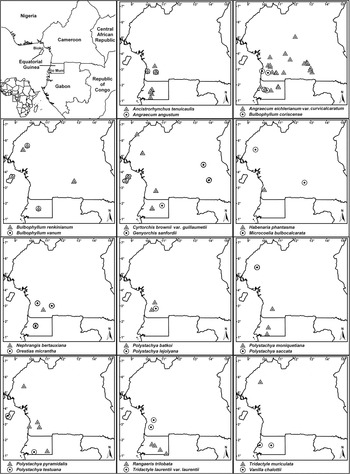
Ancistrorhynchus tenuicaulis Summerh., Kew Bull. 8: 590 (1954 [‘1953’]). – Type: Uganda, Ishasha Gorge, Kigezi, iv 1946, Purseglove 2034 (holo K!; iso EA). Fig. 1.
The study area, Atlantic Central Africa, and maps of taxon distributions in Cameroon and Equatorial Guinea (Rio Muni and Bioko).

Distribution. Cameroon, Equatorial Guinea (Rio Muni), Gabon, Democratic Republic of Congo, Rwanda, Uganda, Tanzania and Malawi. This taxon is recorded from Cameroon and Equatorial Guinea (Rio Muni) for the first time here.
Ecology and habitat. Epiphyte in lowland and submontane primary forest. In Rio Muni, specimens were also collected in the forest fringe of an inselberg. Altitudinal range from 400 to 1200 m. Flowering peaks between May and July.
Note. Ancistrorhynchus tenuicaulis is closely related to A. schumannii (Kraenzl.) Summerh. also known from Cameroon. However, the two species can easily be separated by the shape of the leaf apex (rounded for Ancistrorhynchus schumannii and acute for A. tenuicaulis) and the number of flowers in a single inflorescence (usually two for A. schumannii and up to five for A. tenuicaulis). The apex of the spur is slightly flattened in Ancistrorhynchus tenuicaulis but not in A. schumannii.
Specimens examined. Cameroon. Akom II (Kribi-Ebolowa road), 2°44.795′N, 10°32.819′E, 3 vi 2006, Droissart 114 (BRLU); ibid., 2°44.334′N, 10°31.932′E, 4 vi 2006, Droissart 130 (BRLU); Bidjouka (Ngovayang forest area), 3°09.158′N, 10°28.146′E, 17 vi 2006, Droissart 160 (BRLU); ibid., 17 vi 2006, Droissart 161 (BRLU); Bidou III/Nkolembonda (Kribi-Ebolowa road), 2°47.968′N, 10°00.281′E, 26 v 2007, Droissart & Simo 564 (BRLU); Akom II (Kribi-Ebolowa road), 2°44.813′N, 10°32.810′E, 31 v 2007, Droissart, Stévart & Simo (Yaoundé shadehouse) 528 (BRLU); Bidjouka (Ngovayang forest area), 3°09.158′N, 10°28.146′E, 14 vii 2007, Droissart, Stévart & Simo (Yaoundé shadehouse) 606 (BRLU).
Equatorial Guinea (Rio Muni). Near Miserge, 1°23′N, 10°17′E, 1 vii 1999, Stévart 547 (BRLU); near Esamalan, 1°34′N, 10°12′E, 1 vii 1999, Stévart 550 (BRLU); Engong (Monte Alén Nat. Park), 1°37′N, 10°18′E, 1 vii 1999, Stévart 564 (BRLU); before Esamalan, 1°30′N, 10°12′E, 17 ix 1999, Ndong Bokung & Stévart 75 (BRLU); Mirador (inselberg), 1°40′N, 10°17′E, 24 vi 2000, Ndong Bokung & Stévart 179 (BRLU); before Esamalan, 1°30′N, 10°12′E, 25 vi 2000, Ndong Bokung & Stévart 188 (BRLU); Mitemele, 1°09.438′N, 10°12.137′E, 8 vii 2001, Stévart 965 (BRLU); Engong, 1°37.438′N, 10°17.811′E, 20 vii 2001, Ndong Bokung, Stévart & Obama 373 (BRLU); Monte Alén Nat. Park, 1°39′N, 10°18′E, 20 ix 2002, Ndong Bokung & Stévart 510 (BRLU).
Angraecum angustum (Rolfe) Summerh. in Hutch. & Dalziel, Fl. W. Trop. Afr. 2: 452 (1936). – Type: Nigeria, Cross River, Itu, Old Calabar, 20 v 1897, Holland 27 (holo K!). Figs 1,2A.
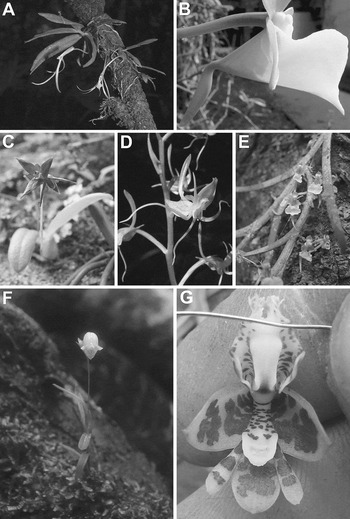
Rare orchid taxa from Atlantic Central Africa. A, Angraecum angustum; B, Angraecum eichlerianum var. curvicalcaratum; C, Bulbophyllum vanum; D, Habenaria phantasma; E, Nephrangis bertauxiana; F, Polystachya batkoi; G, Polystachya lejolyana.

Distribution. Nigeria and Cameroon. This taxon is recorded from Cameroon for the first time here.
Ecology and habitat. Epiphyte usually growing on small mossy branches in submontane forest. Altitudinal range from 450 to 1050 m. Flowering peaks between May and June.
Note. This species was previously only known from the type specimen collected in South Nigeria in 1897. In Cameroon, we collected this species only in submontane forest in two localities in South Province: in the Ngovayang forest area, near Akom II, and at 450 m on the summit of the ‘Mont des Eléphants’.
Specimens examined. Cameroon. Akom II (Kribi-Ebolowa road), 2°44.889′N, 10°32.383′E, 26 vii 2004, Droissart, Stévart, Nguembou & Djuikouo (Yaoundé shadehouse) 57 (BRLU); ibid., 2°44.873′N, 10°31.983′E, 25 x 2004, Droissart, Stévart, Nguembou & Djuikouo (Yaoundé shadehouse) 251 (BRLU); Akom II (Kribi-Ebolowa road), 2°44.667′N, 10°31.827′E, 2 vi 2006, Droissart 104 (BRLU); ibid., 2°44.795′N, 10°32.819′E, 3 vi 2006, Droissart 111 (BRLU); Akom II (Kribi-Ebolowa road), 2°44.889′N, 10°32.383′E, 10 vi 2006, Droissart, Stévart & Simo (Yaoundé shadehouse) 371 (BRLU); Bidjouka (Ngovayang forest area), 16 vi 2006, Droissart 152 (BRLU); Bidou III/Nkolembonda (Kribi-Ebolowa road), 2°47.852′N, 9°59.987′E, 24 v 2007, Droissart & Simo 554 (BRLU); ibid., 24 v 2007, Droissart & Simo 555 (BRLU); Akom II (Kribi-Ebolowa road), 2°44.813′N, 10°32.810′E, 31 v 2007, Droissart, Stévart & Simo (Yaoundé shadehouse) 531 (BRLU); Bidou III/Nkolembonda (Kribi-Ebolowa road), 2°47.991′N, 10°00.171′E, 30 vi 2007, Droissart, Stévart & Simo (Yaoundé shadehouse) 571 (BRLU).
Angraecum eichlerianum Kraenzl. var. curvicalcaratum Szlach. & Olszewski, Fl. Cameroun 36: 898 (2001). – Type: Cameroon, Nanga Eboko, Jacques-Félix 4740 (holo P). Figs 1,2B.
Distribution. Cameroon, Equatorial Guinea (Rio Muni) and Gabon. This taxon is recorded from Equatorial Guinea (Rio Muni) for the first time here.
Ecology and habitat. Epiphyte in lowland and submontane primary forest, but also observed in the forest fringe of inselbergs. Altitudinal range from 100 to 1100 m. Flowering peaks between June and August.
Note. Two varieties of Angraecum eichlerianum are recognised by Szlachetko & Olszewski (Reference Szlachetko, Olszewski, Achoundong and Morat2001b). The type variety possesses a straight spur and its dorsal sepal is more than 40 mm long. The variety curvicalcaratum has a curved spur and its dorsal sepal is usually no more than 40 mm long.
Specimens examined. Cameroon. Mbassakok (Mama), 3°19.023′N, 12°42.403′E, 12 vii 2001, Stévart, Chamba & Pial 105 (BRLU); Schouam (Dja reserve), 3°19.323′N, 12°47.445′E, 12 vii 2001, Stévart, Chamba & Pial 106 (BRLU); ibid., 17 vii 2001, Stévart, Chamba & Pial 123 (BRLU); ibid., 17 vii 2001, Stévart, Chamba & Pial 129 (BRLU); Mbassakok (Mama), 3°19.023′N, 12°42.403′E, 17 vii 2001, Stévart, Chamba & Pial 126 (BRLU); ibid., 7 viii 2001, Stévart, Chamba & Pial 159 (BRLU); Schouam (Dja reserve), 3°19.323′N, 12°47.445′E, 7 viii 2001, Stévart, Chamba & Pial 166 (BRLU); ibid., 7 viii 2001, Stévart, Chamba & Pial 167, 172 (BRLU); ibid., 3°19.323′N, 12°47.445′E, 22 viii 2001, Stévart & Pial 195 (BRLU); Philippe's hill (Dja reserve), 3°17.165′N, 12°47.478′E, 20 vi 2002, Stévart & Pial 387 (BRLU); between Philippe's hill and Schouam (Dja reserve), 3°18.069′N, 12°47.485′E, 21 vi 2002, Stévart & Pial 395 (BRLU); Schouam (Dja reserve), 3°19.307′N, 12°47.467′E, 22 vi 2002, Stévart & Pial 404 (BRLU); Mbolo's falls (S of Dja reserve), 2°52.093′N, 12°57.334′E, 4 vii 2002, Stévart & Pial 420 (BRLU); Bali (S of Dja reserve), 12 km NE Mbolo's falls, 2°59.624′N, 12°59.222′E, 6 vii 2002, Stévart & Pial 425 (BRLU); Mbolo's falls (S of Dja reserve), 2°51.938′N, 12°56.670′E, 10 vii 2002, Stévart & Pial 456 (BRLU); Schouam (Dja reserve), 3°19.323′N, 12°47.445′E, 17 vii 2002, Stévart & Pial 481 (BRLU); ibid., 17 vii 2002, Stévart & Pial 484 (BRLU); Mbassakok (between Mama and Bifos), 3°18.946′N, 12°42.615′E, 28 vii 2002, Stévart & Pial 544 (BRLU); Nguti, (Edjuigang), 5°35.722′N, 9°44.992′E, 14 iii 2004, Stévart, Droissart & Simo P. 2139 (BRLU); Nkolsia (23 km NW of Bipindi), 3°10.5′N, 10°16.5′E, Villiers s.n. (YA); Mbam-Minkom, (Nye-Meyong), 3°55.240′N, 11°22.029′E, 11 v 2006, Droissart 21 (BRLU); ibid., 3°55.544′N, 11°22.210′E, 13 v 2006, Droissart 67 (BRLU); ibid., 3°55.240′N, 11°22.029′E, 15 vii 2006, Droissart, Stévart & Simo (Yaoundé shadehouse) 394 (BRLU); Schouam (Dja reserve), 3°19.323′N, 12°47.445′E, 21 vii 2006, Droissart, Stévart & Simo (Yaoundé shadehouse) 396 (BRLU); Memel II (N of Bipindi), 3°11.107′N, 10°24.544′E, 22 vii 2006, Droissart, Stévart & Simo (Yaoundé shadehouse) 400 (BRLU); Bindem (Messama road), 2°41.701′N, 10°46.623′E, 19 viii 2006, Droissart & Simo 271 (BRLU); ibid., 2°42.423′N, 10°48.320′E, 20 viii 2006, Droissart & Simo 277 (BRLU); Akom II (Kribi-Ebolowa road), 2°45.007′N, 10°32.435′E, 28 vi 2007, Droissart 597 (BRLU); Bindem (Messama road), 2°42.423′N, 10°48.320′E, 16 vii 2007, Droissart & Simo 622 (BRLU); Mbassakok (Mama) et Bifos, 2°44.795′N, 10°32.819′E, 3 viii 2007, Droissart, Stévart & Simo (Yaoundé shadehouse) 633 (BRLU); Bissombo (Dja reserve), 3°17.953′N, 12°34.505′E, 3 viii 2007, Droissart, Stévart & Simo (Yaoundé shadehouse) 634 (BRLU).
Equatorial Guinea (Rio Muni). Bata-Bicomo, 28 xii 1993, Carvalho 5454 (MA); Akuom (inselberg), 1°50′N, 10°55′E, 13 vi 1999, Parmentier & Nguema 336 (BRLU); Bikurga (inselberg), 18 ii 2001, Stévart 763 (BRLU); SW Monte Alén Nat. Park, 20 i 2002, Senterre, Obiang & Ngomo 2009 (BRLU); Akoak Benguan (inselberg), 1°47′N, 10°56′E, 23 viii 2002, Deman, Ndong Bokung & Nguema 11 (BRLU); Bicurga (inselberg), 1°35′N, 10°28′E, ii 2001, Parmentier 1681 (BRLU).
Bulbophyllum coriscense Rchb.f., Otia Bot. Hamburg.: 118 (1881). – Type: Gabon, Corisco Bay, 1862, Mann 1883 (holo K!). Fig. 1.
Distribution. Cameroon, Equatorial Guinea (Rio Muni) and Gabon. This taxon is recorded from Cameroon and Equatorial Guinea (Rio Muni) for the first time here.
Ecology and habitat. Epiphyte in the understorey of coastal primary forest. Altitudinal range from 50 to 600 m. Flowering peaks between September and October.
Note. Until this observation in Monte Alén National Park, the species was only known from the type specimen collected in Gabon in 1862 in Corisco Bay. We have also collected a fertile specimen of this rare species in the Cristal Mountains (Gabon) near Tchimbélé and Andok Foula.
Specimens examined. Cameroon. Bifa (Kribi-Ebolowa road), 2°41.308′N, 10°16.406′E, 5 x 2007, Droissart, Stévart & Simo (Yaoundé shadehouse) 773 (BRLU); Eboundja I (Kribi-Campo road), 2°47.793′N, 9°53.700′E, 30 x 2007, Droissart, Stévart & Simo (Yaoundé shadehouse) 793 (BRLU).
Equatorial Guinea (Rio Muni). Cataratas (big rainfall), 1°37′N, 10°02′E, 1 vii 1999, Stévart 600 (BRLU); Esamalan, 1°34′N, 10°12′E, 3 ix 1999, Ndong Bokung & Stévart 50 (BRLU).
Bulbophyllum renkinianum (Laurent) De Wild., Pl. Bequaert. 1: 95 (1921). – Type: Democratic Republic of Congo, Injolo, Laurent 1772 (lecto BR!, designated by Vermeulen, Reference Vermeulen1987). Fig. 1.
Distribution. Cameroon, Equatorial Guinea (Rio Muni and Bioko Island), Gabon and Democratic Republic of Congo. This taxon is recorded from Equatorial Guinea (Rio Muni and Bioko Island) for the first time here.
Ecology and habitat. Epiphyte in primary and secondary lowland forest. Altitudinal range from 200 to 650 m. Flowering peaks between March and May.
Note. This species is not recorded for Cameroon in the World Checklist of Orchidaceae (Govaerts et al., Reference Govaerts, Campacci, Baptista, Cribb, George, Kreuz and Wood2008). However, it has been recently reported by Cribb & Pollard (Reference Cribb, Pollard, Cheek, Pollard, Darbyshire, Onana and Wild2004) from South West Province of Cameroon. We have also collected this species in East Province (Dja Wildlife Reserve).
Specimens examined. Cameroon. Dja river (Somalomo), 3°22.178′N, 12°44.513′E, 14 v 2001, Stévart, Chamba & Pial 78 (BRLU); ibid., 3°22.178′N, 12°44.513′E, 14 vii 2001, Stévart, Chamba & Pial 142 (BRLU); ibid., 3°22.178′N, 12°44.513′E, 16 iv 2002, Stévart & Pial 323 (BRLU); ibid., 15 iv 2003, Stévart & Pial 766 (BRLU); Mbassakok (Mama), 3°18.946′N, 12°42.403′E, 12 v 2003, Stévart & Pial 779 (BRLU); Mama (Dja reserve), 3°18.946′N, 12°42.403′E, 21 v 2003, Stévart & Pial 783 (BRLU); Dja river (Somalomo), 3°22.178′N, 12°44.513′E, 21 v 2003, Stévart & Pial 786 (BRLU); Nguti (Banyang Mbo Wildlife Sanctuary), 5°20.590′N, 9°29.824′E, 13 iii 2004, Stévart, Droissart & Simo P. 2147 (BRLU); Nguti (Edjuigang), 5°35.165′N, 9°45.085′E, 14 iii 2004, Stévart, Droissart & Simo P. 2130 (BRLU); Nguti (Banyang Mbo Wildlife Sanctuary), 5°20.591′N, 9°29.825′E, 15 iii 2004, Stévart, Droissart & Simo P. 2156 (BRLU); Dja river (Somalomo), 30 iv 2004, Stévart & Pial 1011 (BRLU); Mbassakok (Mama), 3°18.946′N, 12°42.403′E, 15 v 2004, Stévart & Pial 1015 (BRLU); Nguti (Banyang Mbo Wildlife Sanctuary), 5°20.234′N, 9°28.411′E, 23 iii 2007, Droissart, Stévart & Simo (shadehouse) 456 (BRLU).
Equatorial Guinea (Bioko). Bioko Norte, 12 vi 1988, Carvalho 3485 (MA). Equatorial Guinea (Rio Muni). Bikurga (Timber exploitation), 23 v 2002, Stévart, Ndong Bokung & Ndong Maye 1529 (BRLU); ibid., 1°34.966′N, 10°28.252′E, 18 i 2003, Deman 265 (BRLU).
Bulbophyllum vanum J.J.Verm., Bull. Jard. Bot. Natl. Belg. 54: 148 (1984). – Type: Gabon, Ogooué-Ivindo. Bélinga, lower slopes of Babiel Nord, southern exposition, 15 ix 1978, Breteler & de Wilde 642 (holo WAG!). Figs 1,2C.
Distribution. Cameroon, Equatorial Guinea (Rio Muni), Gabon and Democratic Republic of Congo. This taxon is recorded from Cameroon and Equatorial Guinea (Rio Muni) for the first time here.
Ecology and habitat. Epiphyte in rainforest rich in Caesalpinioideae, or lithophytic on rock outcrops in Rio Muni. Altitudinal range from 150 to 900 m.
Note. A specimen collected in South Province of Cameroon (Droissart 380) is probably this taxon but identification cannot be certain as the specimen is sterile.
Specimens examined. Cameroon. Nguti (Timber exploitation), 5°34.810′N, 9°45.240′E, 25 x 2004, Droissart, Stévart, Nguembou & Djuikouo (Yaoundé shadehouse) 165 (BRLU); ibid., 25 x 2004, Droissart, Stévart, Nguembou & Djuikouo (Yaoundé shadehouse) 166 (BRLU); ibid., 31 x 2005, Droissart, Stévart, Nguembou & Djuikouo (Yaoundé shadehouse) 339 (BRLU); ibid.,13 viii 2006, Droissart, Stévart & Simo (Yaoundé shadehouse) 406 (BRLU).
Equatorial Guinea (Rio Muni). Bikurga (inselberg), 1°35′N, 10°28′E, 18 ii 2001, Stévart 777 (BRLU).
Cyrtorchis brownii var. guillaumetii Pérez-Vera, Orchidées Côte D'Ivoire: 250 (2003). – Type: Ivory Coast, Between Buyo and Soubré, right bank of Sassandra, 16 xii 1963, Guillaumet 1767 (holo UCJ; iso ABI). Fig. 1.
Distribution. Ivory Coast, Nigeria, Cameroon and Equatorial Guinea (Rio Muni and Bioko Island). This taxon is recorded from Nigeria, Cameroon and Equatorial Guinea (Rio Muni and Bioko Island) for the first time here.
Ecology and habitat. Epiphyte in evergreen moist forest on mossy branches, and in saxicolous forests around inselbergs. Cyrtorchis brownii var. guillaumetii is restricted to submontane forest. Altitudinal range from 900 to 2300 m. Flowering peaks between May and July.
Note. This variety of Cyrtorchis brownii was recently described from Ivory Coast (Perez-Vera, Reference Perez-Vera2003). It differs from the type variety by its leaf shape and size, by its larger floral bracts, and by small differences in floral morphology. Cyrtorchis brownii (Rolfe) Schltr. is reported by Cribb & Pollard (Reference Cribb, Pollard, Cheek, Pollard, Darbyshire, Onana and Wild2004) from South West Province of Cameroon, without stating which variety. The ecology and altitude given by these authors suggest that the specimen they examined (Cheek 8379) also belongs to Cyrtorchis brownii var. guillaumetii.
Specimens examined. Nigeria. Boshi extension forest reserve, between pillar 12 and 13, 23 v 1971, van Meer 1765 (WAG).
Cameroon. Mucton (9 km SW of Bamgem), 2 vi 1982, Villiers 1397 (YA); Kupe-Manengouba (Ebamut), 29 x 2001, Simo P., Zapfack & Salazar 44 (YA); Akom II (Kribi-Ebolowa road), 2°44.795′N, 10°32.819′E, 31 v 2006, Droissart 112 (BRLU); ibid., 2°44.334′N, 10°31.932′E, 3 vi 2006, Droissart 129 (BRLU); ibid., 2°44.976′N, 10°32.089′E, 4 vi 2006, Droissart 135 (BRLU).
Equatorial Guinea (Bioko). Lago Moka, 30 i 1947, Guinea 2236 (MA); Bioco (pico Basilé), 3 vii 1986, Carvalho, Casas, Regueiro & Tellería 10166 (MA); Bioko (Malabo-Pico Basilé), 2 vii 1989, Carvalho 4004 (MA). Equatorial Guinea (Rio Muni). Monte Alén-Mirador slope, 1°39′N, 10°18′E, 1 viii 1999, Ndong Bokung & Stévart 5 (BRLU); Engong (Monte Alén Nat. Park), 1°37′N, 10°18′E, 25 vi 2000, Ndong Bokung & Stévart 185 (BRLU); ibid., 14 vi 2001, Ndong Bokung & Stévart 273 (BRLU); ibid., 1°37.395′N, 10°17.572′E, 29 v 2002, Stévart 1593 (BRLU).
Genyorchis sanfordii Szlach. & Olszewski, Fl. Cameroun 35: 485 (2001). – Type: Cameroon, Near Dimako, Sanford 5256 (holo P!). Fig. 1.
Distribution. Cameroon, Equatorial Guinea (Rio Muni), Gabon and Republic of Congo. This taxon is recorded from Equatorial Guinea (Rio Muni) for the first time here.
Ecology and habitat. Epiphyte in lowland forest. Altitudinal range from 600 to 750 m. Flowering peaks between August and September.
Specimens examined. Cameroon. Mindourou near Lomie (AC 5), 6 viii 2001, Stévart, Chamba & Pial 151 (BRLU); ibid., 15 viii 2001, Stévart & Pial 181 (BRLU); ibid., 22 viii 2001, Stévart & Pial 188 (BRLU); ibid., 1 ix 2001, Stévart & Pial 201 (BRLU); ibid., 3°24.305′N, 13°55.356′E, 15 viii 2002, Stévart & Pial 583 (BRLU); ibid., 3 ix 2002, Stévart & Pial 602 (BRLU); ibid., 11 viii 2003, Stévart & Pial 844 (BRLU); ibid., 20 ix 2004, Droissart, Stévart, Nguembou & Djuikouo (Yaoundé shadehouse) 118 (BRLU); ibid., 3°23.123′N, 13°54.410′E, 20 viii 2007, Droissart, Stévart & Simo (Yaoundé shadehouse) 655 (BRLU).
Equatorial Guinea (Rio Muni). Akoak Benguan (inselberg), 1°47′N, 10°56′E, 23 viii 2002, Deman, Ndong Bokung & Nguema 7 (BRLU); ibid., 24 viii 2002, Deman, Ndong Bokung & Nguema 14 (BRLU).
Habenaria phantasma la Croix, Kew Bull. 48: 369 (1993). – Type: Republic of Congo, Niari Region, Col de Bamba (Mayombe), 9 xii 1990, La Croix & La Croix 1090 (holo K!). Figs 1,2D.
Distribution. Cameroon and Republic of Congo. This taxon is recorded from Cameroon for the first time here.
Ecology and habitat. Terrestrial in evergreen forest rich in Caesalpinioideae. Several populations of 5–10 individuals growing in mid to deep shade were found in a recently logged area. These populations were observed between 50 and 150 m altitude on the E-SE side of a small hill (summit at 450 m), 30 km from the coast. Flowering occurs in May.
Note. This species was previously known only from the type specimen collected in very deep shade in a forest at Col de Bamba near Foungouti Mountain (SW Republic of Congo) in 1990.
Specimens examined. Cameroon. Bidou III/Nkolembonda (Kribi-Ebolowa road), 2°47.746′N, 10°01.689′E, 13 v 2007, Droissart & Simo 568 (BRLU); ibid., 2°48.136′N, 10°01.544′E, 25 v 2007, Droissart & Simo 560 (BRLU); ibid., 2°48.213′N, 10°01.937′E, 26 v 2007, Droissart & Simo 561 (BRLU).
Microcoelia bulbocalcarata L.Jonss., Symb. Bot. Upsal. 23: 121 (1981). – Type: Uganda, Kigezi, S Kayonza, Impenetrable Forest, near Ihizo R., xi 1977, Meyer 56 (holo K). Fig. 1.
Distribution. Cameroon, Príncipe Island, Gabon, Rwanda, Uganda. This taxon is recorded from Cameroon for the first time here.
Ecology and habitat. Epiphyte in lowland evergreen forest rich in Caesalpinioideae. Altitudinal range from 200 to 700 m.
Specimens examined. Cameroon. Bifos, 3°14.365′N, 12°35.418′E, 15 xi 2002, Stévart & Pial 694 (BRLU); Nguti (Banyang Mbo Wildlife Sanctuary), 5°20.234′N, 9°28.411′E, 13 ix 2004, Droissart, Stévart, Nguembou & Djuikouo (Yaoundé shadehouse) 116 (BRLU).
Nephrangis bertauxiana Szlach. & Olszewski, Fl. Cameroun 36: 696 (2001). – Type: Gabon, Bélinga, aérodrome, Hallé 2847 (holo P). Figs 1,2E.
Distribution. Cameroon and Gabon. This taxon is recorded from Cameroon for the first time here.
Ecology and habitat. Epiphyte in lowland semi-caducifoliate rainforest. Approximately 15 individuals were found growing on branches with a diameter of 20–35 cm, partially covered with lichens and creeping ferns. The only locality where we observed this species was at 600 m altitude. Flowering occurs in August.
Note. The species was previously known only from the type specimen from Gabon.
Specimens examined. Cameroon. Bindem (Messama road), 2°41.139′N, 10°47.059′E, 15 viii 2006, Droissart & Simo 258 (BRLU).
Orestias micrantha Summerh., Bull. Misc. Inform. Kew 1937: 460 (1937). – Type: Cameroon, Bipindi, Zenker 1380 (holo K!). Fig. 1.
Distribution. São Tomé Island, Cameroon, Equatorial Guinea (Rio Muni). This taxon is recorded from Equatorial Guinea (Rio Muni) for the first time here.
Ecology and habitat. Terrestrial in lowland and submontane moist evergreen forest rich in Caesalpinioideae. Altitudinal range from 200 to 1200 m. Flowering peaks between August and September.
Specimens examined. Equatorial Guinea (Rio Muni). Monte Alén Nat. Park, 11 iii 2002, Senterre, Obiang & Esono 756 (BRLU); ibid., 1°37.371′N, 10°17.678′E, 10 v 2002, Stévart, Ndong Bokung & Ndong Maye 1417 (BRLU); ibid., 11 v 2002, Parmentier & Esono 2826 (BRLU).
Polystachya batkoi Szlach. & Olszewski, Fl. Cameroun 35: 586 (2001). – Type: Gabon, Monts de Cristal, Riv. Balakabo, 20 ii 1968, Hallé 5416 (holo P!). Figs 1,2F.
Distribution. Cameroon, Gabon and Democratic Republic of Congo. This taxon is recorded from Cameroon for the first time here.
Ecology and habitat. Epiphyte in primary and secondary forest rich in Caesalpinioideae. Altitudinal range from 100 to 600 m.
Note. This species has been recorded from the Democratic Republic of Congo by Szlachetko et al. (Reference Szlachetko, Sawicka, Kras-Lapinska and Morat2004) but no specimen has been cited for this country.
Specimens examined. Cameroon. Bidjouka (Ngovayang forest area), 3°09.158′N, 10°28.146′E, 17 vi 2006, Droissart 159 (BRLU); Bifa (Kribi-Ebolowa road), 2°41.308′N, 10°16.406′E, 14 iv 2007, Droissart & Simo 391 (BRLU); ibid., 13 ix 2007, Droissart, Stévart & Simo (Yaoundé shadehouse) 727 (BRLU).
Polystachya lejolyana Stévart, Adansonia, III, 26: 219 (2004). – Type: Gabon, Mont Mbilan, 7 iv 2002, Stévart & Kombila 1289 (holo BRLU!). Figs 1,2G.
Distribution. Cameroon and Gabon. This taxon is recorded from Cameroon for the first time here.
Ecology and habitat. Epiphyte in lowland moist evergreen forest rich in Caesalpinioideae. Altitudinal range from 600 to 650 m. Flowering is sequential: the inflorescence produces only one flower at any one time but for a period of more than three months.
Specimens examined. Cameroon. Akom II (Kribi-Ebolowa road), 2°44.889′N, 10°32.383′E, 8 xi 2004, Droissart, Stévart, Nguembou & Djuikouo (Yaoundé shadehouse) 179 (BRLU); ibid., 9 v 2005, Droissart, Stévart, Nguembou & Djuikouo (Yaoundé shadehouse) 263 (BRLU); ibid., 31 x 2005, Droissart, Stévart, Nguembou & Djuikouo (Yaoundé shadehouse) 336 (BRLU); ibid., 18 v 2006, Droissart, Stévart & Simo (Yaoundé shadehouse) 350 (BRLU); ibid., 16 viii 2007, Droissart, Stévart & Simo (Yaoundé shadehouse) 645 (BRLU).
Polystachya moniquetiana Stévart & Geerinck, Syst. Geogr. Pl. 73: 281 (2003). – Type: Equatorial Guinea (Rio Muni), Engong (Monte Alén Park Nat.), 11 ix 2001, Ndong Bokung S. & Stévart 418 (holo BR!; iso K!). Fig. 1.
Distribution. São Tomé Island, Cameroon, Equatorial Guinea (Rio Muni) and Gabon. This taxon is recorded from Cameroon for the first time here.
Ecology and habitat. Epiphyte in lowland moist evergreen forest rich in Caesalpinioideae. Altitudinal range from 650 to 850 m.
Specimens examined. Cameroon. Akom II (Kribi-Ebolowa road), 2°44.650′N, 10°32.406′E, 13 ix 2004, Droissart, Stévart, Nguembou & Djuikouo (Yaoundé shadehouse) 106 (BRLU).
Equatorial Guinea (Rio Muni). Between Engong and Lago, 1°34′N, 10°17′E, 19 ix 2001, Ndong Bokung & Stévart 425 (BRLU).
Polystachya pyramidalis Lindl., J. Proc. Linn. Soc., Bot. 6: 130 (1862). – Type: Nigeria, s.l., Mann 522 (holo K!). Fig. 1.
Distribution. Nigeria, Cameroon, Equatorial Guinea (Rio Muni) and Gabon. This taxon is recorded from Equatorial Guinea (Rio Muni) for the first time here.
Ecology and habitat. Epiphyte in lowland primary and secondary forest. Usually found in wet places on tree trunks. Once found as a terrestrial plant in the herbaceous fringe of an inselberg. Altitudinal range from 50 to 1300 m. Flowering peaks between September and November.
Specimens examined. Cameroon. Akom II (Kribi-Ebolowa road), 2°44.650′N, 10°32.406′E, 5 iii 2004, Stévart & Droissart 2053 (BRLU); ibid., 2°44.953′N, 10°32.143′E, 6 iii 2004, Stévart & Droissart 2094 (BRLU); ibid., 2°44.889′N, 10°32.383′E, 29 xi 2004, Droissart, Stévart, Nguembou & Djuikouo (shadehouse) 204 (BRLU); ibid., 7 xi 2005, Droissart, Stévart, Nguembou & Djuikouo (shadehouse) 341 (BRLU); Bifa (Kribi-Ebolowa road, 5 km SE of Zingui), 2°39.837′N, 10°16.923′E, 14 vi 2007, Droissart 581 (BRLU); Eboundja I (Kribi-Campo road), 2°47.793′N, 9°53.700′E, 26 ix 2007, Droissart, Stévart & Simo (shadehouse) 753 (BRLU); Akom II (Kribi-Ebolowa road), 2°45.260′N, 10°32.484′E, 3 x 2007, Droissart, Stévart & Simo (shadehouse) 767 (BRLU).
Equatorial Guinea (Rio Muni). Akoak Ebanga (inselberg), 31 v 2002, Parmentier & Esono 3507 (BRLU); Nsork (Ngong Mokomo), 1°14′N, 11°02′E, 30 i 2003, Ndong Bokung & Stévart 526 (BRLU).
Polystachya saccata (Finet) Rolfe, Orchid Rev. 26: 107 (1918). – Type: Guinea, Pita, Pobéguin 2304 bis (holo P). Fig. 1.
Distribution. Guinea-Bissau, Guinea, Liberia, Nigeria, Cameroon, Gabon, Democratic Republic of Congo and Zambia. This taxon is recorded from Cameroon for the first time here.
Ecology and habitat. Epiphyte in lowland evergreen forest rich in Caesalpinioideae. Altitudinal range from 250 to 350 m. Flowering period occurs in March.
Specimens examined. Cameroon. Nguti (Banyang Mbo Wildlife Sanctuary), 5°21.390′N, 9°34.475′E, 16 iii 2004, Stévart, Droissart & Simo P. 2162 (BRLU); ibid., 5°21.295′N, 9°33.693′E, 7 iii 2005, Droissart, Stévart, Nguembou & Djuikouo (Yaoundé shadehouse) 225 (BRLU); ibid., 4 iii 2007, Droissart, Stévart & Simo (Yaoundé shadehouse) 438 (BRLU).
Polystachya testuana Summerh., Kew Bull. 14: 136 (1960). – Type: Gabon, Upper Ngounyé River, Etoughi, E of Kembélé, xi 1925, Le testu 5706 (holo P!). Fig. 1.
Distribution. Equatorial Guinea (Rio Muni) and Gabon. This taxon is recorded from Equatorial Guinea (Rio Muni) for the first time here.
Ecology and habitat. Epiphyte in lowland primary forest. Also collected on roadsides. This species was collected at 500 m altitude.
Specimens examined. Equatorial Guinea (Rio Muni). Mitemele (Schimmer site), 1°09.445′N, 10°12.114′E, 17 vii 2001, Ndong Bokung & Stévart 300 (BRLU); ibid., 26 v 2002, Ndong Bokung & Stévart 462 (BRLU).
Rangaeris trilobata Summerh., Bull. Misc. Inform. Kew 1936: 229 (1936). – Type: Nigeria, Eket district, 1912–13, Talbot 3299 (holo BM!; iso FHI, K!). Fig. 1.
Distribution. Nigeria, São Tomé Island, Cameroon, Equatorial Guinea (Rio Muni) and Gabon. This taxon is recorded from Equatorial Guinea (Rio Muni) for the first time here.
Ecology and habitat. Epiphyte in lowland and submontane forest. Also observed in herbaceous, shrubby and forest fringes of inselbergs. Altitudinal range from 100 to 1200 m. Flowering peaks in May.
Note. May also be present on Príncipe Island (Gulf of Guinea) but only sterile specimens have been collected on this island.
Specimens examined. Equatorial Guinea (Rio Muni). Sine loc., inselberg, 21 vi 1999, Parmentier & Nguema 1128 (BRLU); Mirador (inselberg), 1°40′N, 10°17′E, 1 vii 1999, Stévart 589 (BRLU); ibid., 5 ii 2001, Stévart 755 (BRLU); Monte Alén Nat. Park, 1°35′N, 10°28′E, 11 v 2002, Parmentier & Esono 2794 (BRLU); Mungum (inselberg), 1°19.072′N, 10°48.936′E, 24 v 2002, Stévart, Ndong Bokung & Ndong Maye 1537 (BRLU); Akoak Ebanga (inselberg), 1°04′N, 11°12′E, 31 v 2002, Parmentier & Esono 3521 (BRLU).
Tridactyle laurentii (De Wild.) Schltr. var. laurentii, Beih. Bot. Centralbl. 36(2): 145 (1918). – Type: Democratic Republic of Congo, Eala, 1903, Laurent 28 (holo BR!; iso K!). Fig. 1.
Distribution. Cameroon, Gabon and Democratic Republic of Congo. This taxon is recorded from Cameroon for the first time here.
Ecology and habitat. Epiphyte in lowland evergreen forest rich in Caesalpinioideae. We found several groups of this taxon on large horizontal branches of an old Bikinia letestui (Pellegr.) Wieringa (Caesalpinioideae) in a recently logged area. Altitudinal range from 0 to 100 m.
Note. This variety can be differentiated from Tridactyle laurentii var. kabareensis Geerinck (Reference Geerinck1990) mainly by the leaf shape and size. Leaves of the type variety are shorter (2–4 cm vs. 5–8.5 cm), narrower (1–3 mm vs. 15–20 mm) and linear (vs. oblong to narrowly elliptic). However, the leaves of the specimens reported here are even shorter than usual for the type variety (< 1 cm vs. 2–4 cm).
Specimens examined. Cameroon. Bipindi (Memel II village), 3°10.820′N, 10°24.059′E, 1 iii 2004, Stévart & Droissart 2018 (BRLU); Bifa (Kribi-Ebolowa road), 2°43.675′N, 10°13.974′E, 3 x 2007, Droissart, Stévart & Simo (Yaoundé shadehouse) 769 (BRLU).
Tridactyle muriculata (Rendle) Schltr., Beih. Bot. Centralbl. 36(2): 146 (1918). – Type: Nigeria, Oban, 1911, Talbot 904 (holo K!; iso BM!). Fig. 1.
Distribution. Nigeria and Cameroon. This taxon is recorded from Cameroon for the first time here.
Ecology and habitat. The only specimen we observed was an epiphyte on an isolated tree in a village at 700 m altitude.
Note. The species was previously known only from the type specimen collected in South Nigeria in 1911.
Specimens examined. Cameroon. Komba Tida road, 5°37.238′N, 9°46.664′E, 4 vii 2005, Droissart, Stévart, Nguembou & Djuikouo (Yaoundé shadehouse) 303 (BRLU).
Vanilla chalotii Finet, Bull. Soc. Bot. France 56: 102 (1909). – Type: Gabon, Environs de Libreville, Chalot 4027 (holo P!). Fig. 1.
Distribution. Equatorial Guinea (Rio Muni) and Gabon. This taxon is recorded from Equatorial Guinea (Rio Muni) for the first time here.
Ecology and habitat. Terrestrial and epiphytic in lowland moist forest. Also found in the Clappertonia polyandra Bech. shrubby fringe of inselbergs. Altitudinal range from 400 to 1200 m.
Note. The species was previously known only from the type specimen. The three specimens cited from Rio Muni are sterile but the unusual leaf shape, elongated and linear, is very characteristic. Moreover, the type locality is very close. We also collected fertile specimens in Gabon (Mont Mbilan, Stévart 1658).
Specimens examined. Equatorial Guinea (Rio Muni). Bata-Senge, 27 iii 1997, Carvalho 6262 (MA); N Monte Alén Nat. Park, 14 xi 2002, Senterre & Ngomo 3415 (BRLU); Bikurga (inselberg), 1°35′N, 10°28′E, ii 2001, Stévart 759 (BRLU).
Acknowledgements
The authors should like to acknowledge Professor Jean Lejoly (Université Libre de Bruxelles) for his support and hospitality in his laboratory, and Dr Steven Dessein (National Botanic Garden of Belgium), two anonymous referees and David Middleton for helpful comments. We are grateful to people who collected specimens in the shadehouses of Monte Alèn, Yaoundé and Somalomo and to Raphael Govaerts (Kew Garden) for providing data from the Kew database. Fieldwork in Africa was funded by the ECOFAC Program (EC-DG8), DIVEAC (CUD-ULB) and the CUREF Project, the Leopold III Funds, the Communauté française de Belgique, the Wildlife Conservation Society (WCS), the Fonds National de la Recherche Scientifique (FNRS) and the Central Africa Regional Program of the Environment (CARPE). We should also like to acknowledge the ‘Sud Expert Plantes’ project, under the French Ministry of Foreign Affairs, for providing financial support for the fieldwork. The herbarium visits of V. Droissart to Kew, Paris and Wageningen were funded by the European Commission's Research Infrastructure action via the SYNTHESYS Project (applications FR-TAF-2418 & NL-TAF-1611) and by the FNRS.