


A range of theoretical work suggests that policymakers will generate temporary economic expansions before elections.Footnote 1 Yet empirical studies of Organisation for Economic Co-operation and Development (OECD) countries generally fail to uncover expansions in preelection periods, particularly with respect to real macroeconomic outcomes. Indeed, study after study has suggested that such cycles may not exist in OECD countries. As Keech (Reference Keech1995, 61) surmises, “empirical support for the electoral-cycle idea is generally weak.” Similarly, Drazen (Reference Drazen, Bernanke and Rogoff2000, 76) concludes, “at least for the opportunistic model in developed countries, there is much less hard evidence than both the theoretical models and the conventional wisdom about the prevalence of ‘election-year economics’ would suggest.”Footnote 2
We argue that under specified conditions, elections will induce lower growth in a substantial portion of the economy. Specifically, we suggest that businesses and households have incentives to postpone investments with high costs of reversal immediately before elections that are associated with a good deal of policy uncertainty. This incentive for delay causes a preelection decline that directly contrasts with the opportunistic cycle, a phenomenon we term a reverse electoral business cycle (REC). These ideas are formalized in a simple model, which shows that reverse electoral business cycles depend on electoral competitiveness and sufficient polarization between the major parties.
To test the theory, we examine quarterly data on nongovernment gross fixed capital formation (GFCF) from 10 OECD countries across three decades. GFCF has been a subject of prior work (e.g., Boix Reference Boix1997) and encompasses costly-to-undo investments such as machinery, equipment, or construction. Quarterly data of the flow of nongovernment GFCF exist for 10 member countries: Australia, Canada, Finland, France, Germany, the Netherlands, New Zealand, Norway, the United Kingdom, and the United States. This analysis reveals that nongovernment GFCF will decline in the preelection period if polarization between major parties is high or the race is competitive.
To assess whether the results could be an artifact of the specifications or sample, we analyze whether growth in total gross domestic product (GDP) follows the patterns that previous research has established. After finding that it does, we proceed to consider the possibility that most of the economy experiences an opportunistic cycle, but that this phenomenon is obscured by the downturn in sectors associated with costly-to-undo investments such as fixed capital. Private GFCF in and of itself composes 18% of GDP in the data. We therefore conduct a final set of tests on real growth in “noninvestment GDP,” which equals GDP minus private fixed investment. These results provide greater support for the existence of opportunistic political business cycles than earlier work has uncovered.
The article is divided into six sections: a theoretical development that begins with motivating examples; a comparison of the REC theory with existing theories of electoral business cycles; a description of the data and main specifications; tests of the reverse electoral business cycle predictions; a reexamination of opportunistic political business cycles; and a concluding discussion.
MOTIVATING EXAMPLES AND THEORY
In various OECD countries, local business organizations have observed that the policy uncertainty associated with elections hampers investment. For instance, in Australia in 1996, the head of the Australian Chamber of Manufactures, Allan Handberg, maintained that companies were withholding investments because the election created uncertainty about the “terms and conditions” under which businesses would be operating in the future. Footnote 3 His viewpoint was shared at the time by the chief executive of the Australian Chamber of Commerce and Industry, the executive director of the Retailers Council of Australia, and the executive director of the Business Council of Australia.Footnote 4 More recently, Peter Thompson, the Managing Director of New Zealand's largest real estate company, made a similar assertion with respect to New Zealand's property market. He maintained, “Every three years we see the uncertainty surrounding the pending election flow through into the property market. Vendors tend to want to hold off until post-election when the outcome is known.”Footnote 5 These assertions echo ones associated with capital investment in the United States during the 2004 presidential campaign. As the St. Paul Pioneer Press reported, U.S. companies were postponing capital investments because of a “rat's nest” of uncertainties that included “the outcome of the country's tight presidential race, future tax policies,” and concerns about the economy.Footnote 6
Notably, the claims do not appear to be driven simply by fears of left-wing governments. In the 1996 Australian case, a right-leaning coalition defeated the incumbent Labor Party. Likewise, the quotation from the New Zealand executive suggests that elections dampen real estate activity in every election, not simply when left-wing coalitions are winning. Thus the examples cannot be explained by theories about the structural dependence of the state on capital, which predict a decline in investment given expectations of a leftward shift in government (e.g., Przeworski and Wallerstein Reference Przeworski and Wallerstein1988). Nor do the claims fit with opportunistic political business cycle theories, which predict an expansion in the preelection period.
The claims are consistent, however, with research that suggests that economic uncertainty causes businesses and households to delay investments with high costs of reversal. Scholars have long referred to such items as “irreversible” (e.g., Arrow Reference Arrow and Wolfe1968; Arrow and Fisher Reference Arrow and Fisher1974). The purchase of machinery, the development of a forest, or the construction of a plant qualifies as irreversible, whereas investments that are liquid or could be sold readily at market value, such as stocks, do not. A variety of formal models predict that irreversible investment declines in the face of economic uncertainty (e.g., Bernanke Reference Bernanke1983; Cukierman Reference Cukierman1980; Dixit and Pindyck Reference Dixit and Pindyck1994). Because these models will be unfamiliar to many political scientists and have not focused on elections, we formally develop arguments about the preelection period, electoral competitiveness, and polarization within the framework of Cukierman (Reference Cukierman1980). The text reviews key assumptions and conclusions, and Appendix A provides more detailed proofs.
Two-period Formalization
Consider first a simple two-period model in which a private actor must choose whether to make an investment in the first period, when he or she does not know the results of an upcoming election, versus the second period, when these results are known. The utility that the actor receives from the investment depends on the electoral results, which correspond to the policy platforms that the victors will pass. Say that one party will enact new trade restrictions if elected, whereas the other major party will not. The actor wants to choose the level of investment that is optimal for the party that will hold office.
Formally, assume that the actor's chosen level of investment is d > 0 and that the electoral results are represented by the parameter W, which is normally distributed with mean μ and precision τ, where τ is the reciprocal of the variance. The utility received from the investment, y(W, d), equals

The actor is risk-neutral and therefore wants to select the level of investment that maximizes y(W, d). If he or she knew W with certainty, the actor would clearly choose d=W.
In the first period, the actor knows the distribution of W but not its value. In the second period, the election has occurred and the actor knows W. Of course, this assumption could be adjusted so that the election is merely a signal of the state of the world, and indeed, in Cukierman (Reference Cukierman1980), W is never fully revealed; here, in order to conserve space for the empirics, we maintain the admittedly crude simplification. The actor can only choose d once. That is, he or she cannot choose one level of investment in the first period and then a different level in the second period. This assumption captures that the investment is irreversible. The tension is consequently over whether to choose d in the first period, where the actor knows the distribution but not the value of W, versus the second period, when the actor knows the value of W.
Were there no cost to delaying the investment, the optimal action would be to choose d in the second period. However, delaying an investment postpones profits and/or utilization. If the investment is made in the second period, the actor incurs a cost of c. The actor's maximization problem is therefore

where E y(W, d) equals the expected utility from the investment and n represents the number of delayed periods.
As reviewed in Appendix A, the actor will invest in the preelection period if and only if

In other words, the incentive for delay depends on the precision with which the electoral results can be predicted (where, again, τ is the reciprocal of the variance); the degree to which the optimal investment is affected by the electoral results, as represented by b; and the cost of delay, c. As τ increases, the incentive for delay diminishes because the actor can forecast the results with greater accuracy. Likewise, the incentive decreases as the costs of postponing the investment rise. Indeed, in some circumstances, the benefits of learning the results are outweighed by the losses associated with postponing the investment.
It is worth emphasizing that the actor is risk-neutral. Thus any incentive he or she has for delay does not derive from risk aversion. Instead, the incentive derives from the irreversibility of the choice of d and the uncertainty about W. The irreversibility of d is also worth emphasizing because if d could be changed without penalty, the actor would have no incentive for delay. Accordingly, the theory does not imply that reverse electoral business cycles should exist for all types of investments, only for irreversible ones.
Three-period Formalization
We now extend the framework to incorporate a preelection “campaign” period in which the private actor receives a signal about the upcoming election. In this campaign period, which occurs in period two, the actor observes the realization of a random variable x that reflects the expected results of the election. Throughout the game the actor knows that x is normally distributed with mean W and precision p, where the variance is the reciprocal of the precision.
In the first period, the actor knows the distributions of W and x but not their realizations. In the final period, the actor learns the value of W, just as in the two-period version. Also, as before, delay is not free. If the actor postpones the investment until period two, he or she incurs a cost of γc, where γ>0. If the actor waits until period three, the cost is (1+γ)c. Thus, in deciding when to invest d, the actor must choose among waiting to learn W and incurring the cost (1+γ)c, observing the signal x and incurring the cost c, or receiving no information about W or x other than their initial distributions but avoiding any costs of delay.
Formally, he or she will invest in the preelection period if and only if
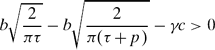
and
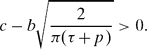
Equation (4) represents the difference in expected utility between choosing d in period two, after observing x, and choosing d in period one. Equation (5) reflects the difference between choosing d in period two and choosing d in period three. (Again, Appendix A proves all results.)
Recall that p equals the reciprocal of the variance of the signal x. Each of Equations (4) and (5) suggests that as p decreases, so that the variance of the signal increases, the likelihood of the actor investing in d in the preelection period (period two) diminishes. In other words, as the preelection period offers a less precise signal about the electoral outcome, the actor becomes more likely to choose d before that period or simply wait until the electoral results become known.
What measurable factors should affect p, the precision of the campaign signal x? Perhaps most naturally, the competitiveness of the race should affect the accuracy of the signal. As a race becomes less competitive, the campaign will offer a more precise forecast of the party and policy platform that are likely to emerge victorious. At the extreme, if the outcome is highly predictable, the cost of delaying the investment will outweigh the benefits. Accordingly, reverse electoral business cycles depend on a sufficient level of electoral competitiveness. Equations (4) and (5) do not offer a specific numerical estimate of this level, and assessing it is an empirical question we address in the subsequent testing.
Less obviously, party polarization can also affect the precision of the campaign signal. For a given mean of x, higher polarization between the major candidates/parties will produce higher variance. The campaign period will consequently offer a less precise estimate of the winning policy platform. By comparison, lower polarization will produce a more precise estimate of the winning platform, reducing the incentive to delay irreversible investments until after the election. If the parties hold relatively similar positions, even a small cost of postponement will offset the benefit from learning the electoral results. Reverse electoral business cycles therefore require sufficiently high polarization between the major parties. As with competitiveness, the theory does not specify a numerical estimate regarding the minimum level of polarization, and the empirical analysis will estimate how extreme polarization must be for an election to be associated with a decline in irreversible investment.
The literature encompasses a range of models of irreversible investment that are more complex than the examples developed here. Some of these models explicitly incorporate competition among firms (e.g., Dixit and Pindyck Reference Dixit and Pindyck1994), alternative distributional assumptions regarding uncertainty (e.g., Cukierman Reference Cukierman1980, 471–73), and stochastic processes (e.g., Bernanke Reference Bernanke1983), among other assumptions. Importantly, the most general result—that uncertainty induces a decline in costly-to-reverse investment—survives these extensions.Footnote 7 In fact, in many cases, the results become stronger with more “realistic” settings. For instance, Dixit and Pindyck (Reference Dixit and Pindyck1994, 247–81) show that in a competitive equilibrium, where the uncertainty is not specific to any given firm but extends across all firms in an industry, the incentive for delay is even stronger than in cases with firm-specific uncertainty. Yet these theories have not been applied to the electoral context, and the REC model offers predictions quite different from those of existing political business cycle theories.
COMPARISON WITH OTHER ELECTORAL BUSINESS CYCLE THEORIES
According to the REC theory, growth in irreversible investment declines in the preelection period when the benefits from learning the electoral outcome outweigh the costs from postponement. Also according to the theory, these benefits are more likely to outweigh the costs when the election is competitive and polarization is high than when the election is not competitive or the major parties’ positions are similar. In other words, the theory suggests that reverse electoral business cycles depend on the race being competitive, which we label the Electoral Competitiveness Prediction. Similarly, the theory suggests that reverse electoral business cycles depend on sufficiently high polarization between the major parties, which we dub the Polarization Prediction.
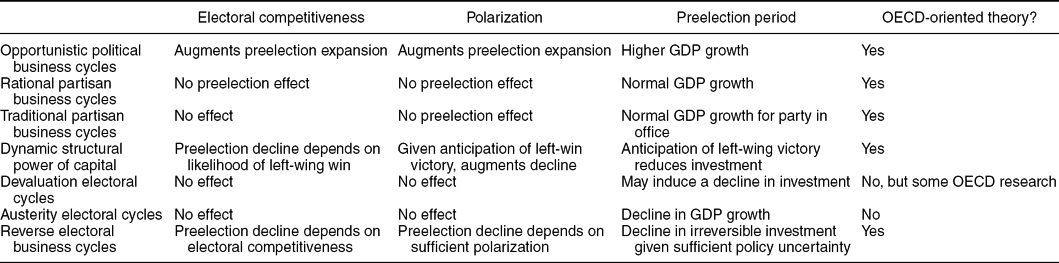
Table 1 summarizes how the predictions compare with other perspectives. Notably, neither the Polarization nor the Electoral Competitiveness Prediction can be derived from other theories of electoral business cycles. As Table 1 reviews, the opportunistic political business cycle perspective predicts expansions during the preelection period (e.g., Nordhaus Reference Nordhaus1975; Persson and Tabellini Reference Persson and Tabellini1990; Rogoff Reference Rogoff1990). In fact, some studies suggest that these expansions should be greatest when competitiveness and polarization are high. Specifically, research on fiscal policy finds that government manipulation of the economy depends on sufficient polarization between parties (Alt and Lassen Reference Alt and Lassen2006) and electoral competitiveness (Price Reference Price1998; Schultz Reference Schultz1995). Thus according to the opportunistic business cycle perspective, polarization and competitiveness have, if anything, an effect opposite to that predicted by the REC theory.
Comparison of Electoral Business Cycle Theories
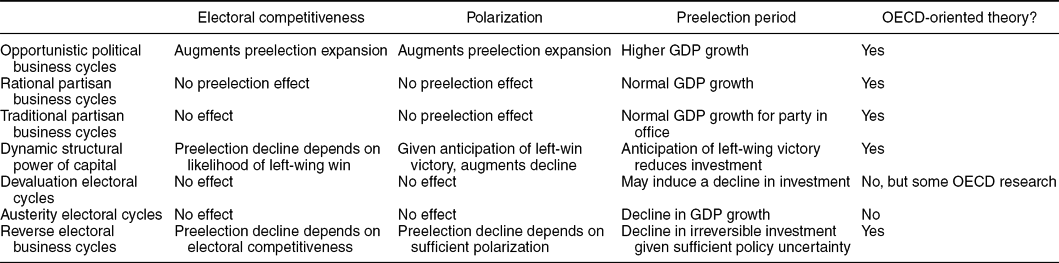
The predictions of the REC theory also diverge from those of partisan business cycle theories, given that the latter predict normal levels of growth in the preelection period regardless of the level of polarization or competitiveness. More specifically, the partisan theories assume a tradeoff between high-inflation policies, which stimulate higher growth and lower unemployment, and low-inflation policies, which induce lower growth and higher unemployment. Left-wing coalitions enact the high-inflation, high-growth policies, whereas right-wing coalitions prefer low-inflation, low-growth policies (e.g., Bartels Reference Bartels2008; Hibbs Reference Hibbs1977).Footnote 8 In the traditional partisan cycle, these patterns hold across the term, whereas in the rational partisan theory, the effects are limited to the postelection period. In particular, the rational partisan theory assumes that voters do not know which party will win an upcoming election and expect inflation between what the two parties would enact. If a left-wing (right-wing) party wins, inflation is higher (lower) than anticipated, producing a short-term increase (decline) in growth. In the second half of the term, growth reverts to “normal” independent of which party is in office (e.g., Alesina, Londregan, and Rosenthal Reference Alesina, Londregan and Rosenthal1993, 14).Footnote 9 This normal growth occurs regardless of electoral competitiveness or the level of polarization between the parties.Footnote 10
A different perspective on the impact of ideology emerges from theories of the structural dependence of the state on capital. According to the “dynamic structural power of capital” perspective, investment declines in the preelection period when capital owners anticipate that a left-wing party/coalition will take office (e.g., Przeworksi and Wallerstein Reference Przeworski and Wallerstein1988, 22). A shift in the probability of a right-wing victory from low to moderate accordingly increases investment in the preelection period. By comparison, the Electoral Competitiveness Prediction suggests that such a shift in competitiveness should induce a decline in irreversible investment. It is worth highlighting that the structural power of capital theory encompasses all investments, not just irreversible ones, so it is possible for this perspective to explain patterns in mobile capital even if the REC theory better explains irreversible investment.
Table 1 reviews not only major OECD-oriented perspectives, but also two theories that are oriented toward developing nations. First, several studies suggest that devaluations are less likely in the preelection period (e.g., Frieden, Gezzi, and Stein Reference Frieden, Ghezzi, Stein, Frieden and Stein2001; Leblang Reference Leblang2003; Stein and Streb Reference Stein and Streb2004). Stein and Streb develop a formal model, based on Rogoff (Reference Rogoff1990), where an incumbent government signals its competence by postponing devaluations until after elections. One could extrapolate from this theory that expectations of postelection devaluations induce preelection declines in investment.Footnote 11 Even given such an extrapolation, however, the devaluation perspective does not correspond to the Polarization and Electoral Competitiveness predictions. In the devaluation perspective, incumbents have an incentive to delay devaluations until after the election even when the parties hold identical positions. Accordingly, the decline in investment occurs regardless of the level of polarization. Nor does the theory establish that the delay in devaluations depends on electoral competitiveness.
The second perspective on developing countries, the austerity electoral cycle, originates in recent work by Kaplan (Reference Kaplan2010). According to Kaplan, incumbents in Latin American countries with decentralized financing of debt have an incentive to demonstrate a commitment to creditors’ interests in the preelection period. Consequently, incumbents pursue low-inflation policies that impair short-term growth.Footnote 12 Kaplan does not, however, predict that this austerity cycle depends on polarization between parties or electoral competitiveness. Furthermore, the cycle involves growth in the total economy, not simply sectors of irreversible investment.
In sum, the Polarization and Electoral Competitiveness Predictions are distinct from those of existing political business cycle theories. No other perspective predicts a preelection decline that depends on sufficient levels of polarization and competitiveness. Moreover, unlike most of the theories, the REC theory is limited by design, in that it does not concern all parts of the economy. Instead, it allows that growth in parts not dominated by irreversible investment, and even in total GDP, may exhibit patterns consistent with other perspectives. The empirical analysis exploits this feature of the theory.
DATA, SPECIFICATIONS, AND METHODS
To test the predictions of the REC theory, we need data on costly-to-undo investments made by private sector entities. There are a range of potential data and tests, and because this article is both developing and analyzing arguments, we subject readily available data to a variety of established specifications. In particular, the testing utilizes OECD quarterly data on nongovernment GFCF, which exist for 10 member countries. GFCF equals acquisition minus disposal of new or existing fixed assets. Examples include machinery, buildings, or equipment. The potential time, effort, and difficulty in converting these assets to cash makes them costly to undo. Because the predictions of the theory apply to the actions of businesses and households, we analyze nongovernment GFCF rather than total GFCF, which includes government GFCF.Footnote 13
Specifically, we make use of quarterly, seasonally adjusted nongovernment GFCF from the OECD database OECD.Stat. We examine the three decades 1975–2006, although the data extend back to 1975 for only four countries. The time span in the data for each country is as follows: Australia (1975Q1–2006Q4), Canada (1975Q1–2006Q4), Finland (1990Q1–2006Q4), France (1975Q1–2006Q4), Germany (1991Q1–2006Q4), the Netherlands (1987Q1–2006Q4), New Zealand (1987Q2–2006Q4), Norway (1978Q1–2006Q4), the United Kingdom (1986Q1–2006Q4), and the United States (1975Q1–2006Q4). In the sample, nongovernment GFCF comprises an average of 18% of GDP. At the extremes, it is as high as 30% of GDP in Norway in the second quarter of 1978, and as low as 12% of GDP in New Zealand in the second quarter of 1991.
Because we are interested in the absolute performance of GFCF, rather than in how this performance relates to GDP, the dependent variable is based on real growth in nongovernment GFCF. The data are transformed from nominal to real values using the “all items/total” consumer price index of each country from the OECD database of economic indicators.Footnote 14 As in earlier work on political business cycles, the dependent variable is based on year-over-year real quarterly growth (e.g., Alesina, Roubini, and Cohen Reference Alesina, Roubini and Cohen1997; Krause Reference Krause2005). Thus for country i in quarter t, the dependent variable equals

This variable, for which we have 963 observations, is termed Private Fixed Investment Growth. It has a mean of 2 ½% and a standard deviation of 9%.Footnote 15 Only in Germany is the average negative, and even then it is close to zero at −0.5%. Appendix B provides descriptive statistics on this and other variables. For each analysis we use as many of the 963 observations as possible.
Many of the independent variables depend on specifying a set of comparable elections. In the parliamentary systems, we consider national parliamentary elections, and for the United States, we analyze presidential ones.Footnote 16 Our purpose in focusing on these major elections is not to suggest that other types of elections are outside the purview of the theory, but instead to focus on those that previous work on electoral business cycles has commonly studied (e.g., Alesina, Roubini, and Cohen Reference Alesina, Roubini and Cohen1997; Nordhaus Reference Nordhaus1975).
Key independent variables measure the polarization between major coalitions and electoral competitiveness. Polarization is based on the manifesto scaling of Lowe et al. (Reference Lowe, Benoit, Mikhaylov and Laver2011). For almost all elections in the data, Lowe et al. provide estimates of the parties’ positions on a variety of policy dimensions, including “state involvement in the economy.” We utilize their estimates of the parties’ positions on this dimension, taking the absolute difference between the major left and right parties that might lead a coalition following the election.Footnote 17 This variable Polarization ranges from less than 0.01, in Germany in 1992, to greater than 5, in Australia in 1976. The Lowe et al. estimates do not change except by election, and therefore for periods between elections we employ the polarization estimate closest in time to the observation.
Appendix B provides descriptive statistics on the 936 observations for which polarization estimates are available. The mean level is 1.65 and the median is 1.63. To minimize collinearity among interactions involving polarization and the preelection quarter, we create indicators that reflect high versus low levels of polarization. Above Average Polarization equals one if Polarization is greater than its median and zero otherwise. Analogously, Below Average Polarization equals one if Polarization is less than its median and zero otherwise. (We use the term “above average” rather than “above the median” for simplicity of language; utilizing the mean rather than the median for the cutpoint only strengthens the findings.) We have investigated how using alternative thresholds alters the results. The evidence suggests that reverse electoral business cycles do not occur for lower levels of polarization, and that the magnitude and significance of the effect increases for the top quartile of polarization estimates.Footnote 18
Measuring electoral competitiveness is more challenging than measuring polarization, given the lack of comparable public opinion for all countries. However, the Mannheim Eurobarometer survey data offer comparable estimates of vote intentions in the European countries. Until 2002 the standard spring and fall Eurobarometers, as well as some special ones, asked about a respondent's vote intention if a general election were soon held in the respondent's country.Footnote 19 The typical question wording was, “If there were a general election tomorrow, which party would you support?” Many researchers have relied on this question as a measure of vote intention (e.g., Elff Reference Elff2009; Sinnott Reference Sinnott1998). Because the number of parties varies across countries, we compare support for the parties in the current government with support for other parties. Specifically, Electoral Competitiveness equals the absolute difference between the percentage of respondents who would vote for a party in the ruling coalition and the percentage who would vote for another party. In total, we have 266 observations from the survey data. The median difference is 14 percentage points, and the mean is 16 percentage points. Appendix B provides further descriptive statistics.
As with polarization, we create indicators that distinguish high versus low competitiveness. Competitive equals one if Electoral Competitiveness is less than 15 percentage points and zero otherwise, and Not Competitive equals one in the opposite circumstances. Examining lower thresholds is difficult given the relatively small number of observations, but we have still investigated the issue. If a cutpoint of 10 percentage points is used, then in the subsequently described specifications, the size of the coefficient on competitive elections is consistently larger than with a threshold of 15 percentage points, but the significance of the effect is not robust to specification.Footnote 20 Thus there is some preliminary indication that the size of reverse electoral business cycles increases with more restrictive thresholds on competitiveness, but more definitive analysis would require additional data. Also, although the results are robust to increasing the threshold to up to 20 percentage points, additional analyses suggest that such findings are driven by the more competitive elections.Footnote 21
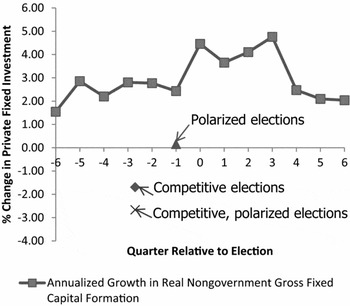
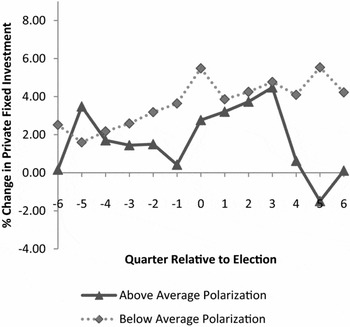
Figures 1, 2, and 3 provide an initial look at how private fixed investment growth relates to the electoral cycle, polarization, and electoral competitiveness. Figure 1 shows the overall average of private fixed investment growth for a window of six quarters surrounding the election. For the preelection quarter, the figure also identifies the averages according to whether the election is competitive, whether the parties are more polarized than usual, and whether both electoral competitiveness and above average polarization are present. These descriptive data suggest that private fixed investment growth is lower before the election than in the election quarter and subsequent ones. More tellingly, however, a preelection decline is apparent for elections with above average polarization or competitiveness. The overall average in the preelection quarter is 2.46 percentage points, and this average drops to 0.15 if the election is competitive, −1.69 if it is associated with above average polarization, and −2.67 if both above average polarization and competitiveness are present.
Growth in Private Fixed Investment

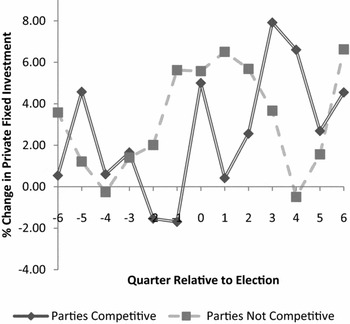
Competitiveness and Private Fixed Investment Growth

Polarization and Private Fixed Investment Growth

Figures 2 and 3 illustrate the effects of competitiveness and polarization in more detail. In Figure 2, which depicts private fixed investment growth according to whether the major coalitions are within 15 percentage points, the patterns diverge starkly. When one coalition has a decisive lead in an election year, private fixed investment actually grows. By contrast, when the parties are competitive, a decline occurs in the couple of quarters prior to the election, with the nadir occurring in the preelection quarter. Polarization also appears to matter substantially. Figure 3 shows that when polarization is below average, the preelection quarters are not associated with lower-than-average growth in private fixed investment. In contrast, when polarization is above average, there is low growth in the quarter before the election and higher growth in the quarters following it.
The theory does not specify whether the preelection period should last a quarter, two quarters, a year, or a month. We might expect the length of the preelection decline to depend on the type of fixed capital. Certain types, such as construction, are planned far in advance, whereas other types, such as machinery or computer software, can more readily be adjusted in the couple of months before an election. Separately, one might expect a more prolonged preelection decline in countries with long campaign periods and/or relatively fixed elections than in countries where elections can occur soon after an expected dissolution of parliament. One could envision a series of analyses—of different countries and types of fixed capital—associated with a range of expectations about the length of the preelection decline. Here, we do not have the space to develop this wide range of analyses, and we focus in the text on two main types of specification that relate to works discussed in the previous section.
The first type adopts the traditional practice of defining one preelection period—in this case, the quarter before the election—and comparing it with the remainder of the term (e.g., Alesina, Roubini, and Cohen Reference Alesina, Londregan and Rosenthal1993, 93–94; Nordhaus Reference Nordhaus1975; Schultz Reference Schultz1995). Schultz also focuses on the preelection quarter, whereas Alesina, Roubini, and Cohen's analysis of opportunistic business cycles follows Nordhaus in specifying the preelection period as the three quarters before the election. Appendix C shows the results with the Nordhaus–Alesina–Roubini–Cohen approach. The second main specification accounts for each of the two quarters before the election and each of the two after it. This approach is similar to that in Stein and Streb (Reference Stein and Streb2004), with the exception that we include an additional variable for the second quarter after the election. The variables Preelection Quarter, Quarter (−2), Quarter (+1), and Quarter (+2) represent, respectively, the quarter before the election, the quarter that occurs two quarters before the election, the quarter after the election, and the quarter that occurs two quarters after the election. Each equals one if the observation involves that quarter of the electoral cycle and zero otherwise. Even if an election takes place at the end of a given quarter, the preelection quarter is not coded as the same one in which the election occurred. This procedure helps ensure that any evidence in favor of the theory is not an artifact of postelection activity. The other electoral cycle indicators are coded similarly.
Because the Polarization and Electoral Competitiveness Predictions suggest the preelection decline depends on high polarization and competitiveness, we include a series of interaction terms and main effects. For the sample of observations on polarization, the first, simpler type of specification for country i and quarter t is

Equation (6) allows the impact of the preelection quarter to vary according to whether polarization is above or below average. Also, the main effect of polarization is included, to account for the possibility that polarization affects irreversible investment regardless of whether an election is near. The second specification is similar except it includes variables for additional quarters:

The inclusion of Quarter (−2) enables assessing whether reverse electoral business cycles extend to two quarters before the election. The postelection terms help control for postelection effects. For the analysis of the competitiveness prediction, Competitive and Not Competitive substitute for Above Average Polarization and Below Average Polarization, respectively.
Each of the tests controls for a variety of factors that the literature suggests may influence growth and/or investment. As in Alesina, Roubini, and Cohen (Reference Alesina, Roubini and Cohen1997), we account for the health of the OECD economy using the weighted mean of growth in real GDP in the seven largest OECD economies. These countries include ones such as Japan for which quarterly data on nongovernment GFCF are not available.Footnote 22 OECD Economic Growth is measured similarly to the dependent variable, with annualized growth in real, seasonally adjusted GDP.
The traditional partisan theory (e.g., Hibbs Reference Hibbs1977) predicts that left-wing governments will produce higher growth, and we control for the ideology of the current government. Keefer's (Reference Keefer2007) database of political institutions identifies whether a government is left-wing, right-wing, or moderate and we utilize his coding. Conservatism of Current Government is a trichotomous categorical variable coded so that right-wing governments have the highest value and left-wing governments the lowest. The number of liberal versus conservative governments is evenly distributed, with each occurring a little over 48% of the time. Moderate governments compose the remaining small percentage. Within this sample Finland is the only country with a moderate government in any year.
The rational partisan business cycle theory suggests that left-wing policies will abet growth in the period directly following an election; in the latter part of the term growth will revert to a normal level regardless of which party holds office. Although that theory explicitly abstracts away from investigating the role of “physical capital” (e.g., Alesina, Roubini, and Cohen Reference Alesina, Roubini and Cohen1997, 52), we still control for the possibility that left-wing victories engender early-term expansions. Rational Partisan Theory is based on the coding decisions documented in Alesina, Roubini, and Cohen (Reference Alesina, Roubini and Cohen1997, 177–84). It equals one from the second to the fifth quarter following a switch in regime from conservative left-wing to right-wing government, negative one for the same period following a switch from liberal right-wing to left-wing government, and zero otherwise.
The tests also account for country-specific differences. Each country is represented by an indicator that equals one for observations of that country and zero otherwise.Footnote 23 Additionally, we include a set of year dummies to control for annual shocks that may affect all OECD countries.
Finally, in the analysis of private fixed investment, we control for interest rates given that investment should decline as the cost of raising capital goes up. Interest Rate equals the quarterly long-term rate on the given country's government bonds as documented in the OECD.stat database. The variable is dropped in analyses of total GDP, given that it is not a standard control and, correspondingly, is potentially endogenous. One could argue that the REC theory indicates that politicians should have particularly strong incentives to pressure central banks to reduce interest rates before elections. A large literature exists on the relationship between central bank independence and political monetary cycles (e.g., Alpanda and Honig Reference Alpanda and Honig2009; Beck Reference Beck1987), and a full analysis of monetary implications is beyond the scope of this article. We have, however, examined whether the effects of reverse electoral business cycles lessen when interest rates are lower, and found evidence to this effect.Footnote 24 Also, the results are robust to the inclusion or exclusion of the control for interest rates.
Before we proceed to the analysis, a few methodological issues require attention. First and foremost is autocorrelation. The use of annualized quarterly growth is conventional (e.g., Alesina, Roubini, and Cohen Reference Alesina, Roubini and Cohen1997; Heckelman and Berument Reference Heckelman and Berument1998; Krause Reference Krause2005), but presumably contributes to autocorrelation, given that it involves four quarters of growth. In a basic regression of Equation (6) or (7), the Wooldridge (Reference Wooldridge2002, 282–83) test for panel data rejects the null of no first-order autocorrelation (p < .01, two-tailed). At the same time, specification testing fails to uncover unit roots.Footnote 25 Some research includes a lagged dependent variable to reduce autocorrelation. In this case, however, significant autocorrelation remains even when a lagged dependent variable is included.Footnote 26 Consequently, we adjust for autocorrelation directly. A typical means of analyzing time-series cross-section data is panel-corrected standard errors, and we correct for autocorrelation within the context of this approach (Beck and Katz Reference Beck and Katz1995).Footnote 27 In particular, the errors are corrected for first-degree autocorrelation, and following Beck and Katz, a common coefficient of correlation is estimated across the panels. As is standard with panel corrected standard errors, the disturbances are assumed to be heteroskedastic within countries and contemporaneously correlated across them.
Wilson and Butler (Reference Wilson and Butler2007) recommend analyzing time-series cross-section data with multiple approaches to assess robustness, and they discuss the value of the first-differenced estimator. We have utilized this alternative method, and present these results in Appendix D. As the table shows, all of the results from the first-differenced analyses support those in the text.
TESTS OF THE REVERSE ELECTORAL BUSINESS CYCLE PREDICTIONS
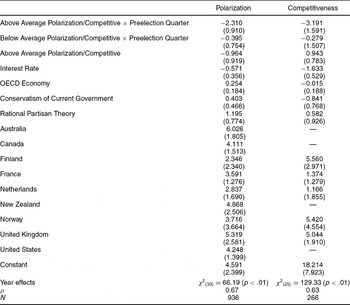
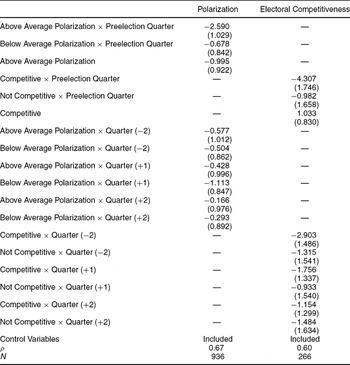
Tables 2 and 3 show the results from testing the Polarization and Electoral Competitiveness predictions. Table 2 depicts the findings from the Schultz specification of electoral periods, Equation (6), and Table 3 from the Stein–Streb specification, Equation (7).
Tests of the Polarization and Electoral Competitiveness Predictions, Schultz Specification of Electoral Periods

Notes: Dependent variable equals Private Fixed Investment Growth. Standard errors are in parentheses beneath coefficients. All analyses use panel-corrected standard errors with an AR(1) correction. The omitted country indicator is Germany.
Tests of the Polarization and Electoral Competitiveness Predictions, Stein–Streb Specification of Electoral Periods

Notes: Dependent variable equals Private Fixed Investment Growth. Standard errors beneath coefficients. Tests use panel-corrected standard errors with an AR(1) correction. Controls include Interest Rate, OECD Economy, Conservatism of Current Government, Rational Partisan Theory, and country and year effects.
Consider first the results regarding the Polarization Prediction. Regardless of the specification, the coefficient on the interaction between the preelection quarter and above average polarization is significantly negative (p < .05, two-tailed). If polarization is higher than average, private fixed investment growth drops between two and three percentage points in the quarter before the election. In comparison, the coefficient on the interaction between below-average polarization and the preelection quarter is not significant at any conventional level. As expected, a preelection decline in irreversible investment exists but only when the parties hold sufficiently disparate positions.
Tables 2 and 3 also indicate that a preelection decline depends on the election being competitive. In both tables, the coefficient on the interaction between competitiveness and the preelection quarter is significant at conventional levels (p < .05, two-tailed), suggesting that a preelection decline in private fixed investment occurs when the parties are within 15 percentage points of each other. In Table 2, the magnitude of this decline in the preelection quarter is three percentage points, whereas in Table 3, the decline is over four percentage points. At the same time, and consistent with the Electoral Competitiveness Prediction, uncompetitive elections have no effect on irreversible investment. All of the findings are robust to accounting for the autocorrelation with first differencing. As Appendix D shows, the Polarization and Competitiveness predictions receive support in a first-differenced analysis of either the Schultz or Stein–Streb specifications of electoral periods.
Table 3 and Appendix D provide mixed evidence about the importance of Quarter (−2). The Electoral Competitiveness tests suggest a decline in irreversible investment by approximately three percentage points in this period. The Polarization tests do not uncover a significant effect of Quarter (−2), however. If instead we group together the two or three quarters before the election quarter to estimate a single preelection effect, it is negative and significant: p < .10, two-tailed, in the case of two quarters and p < .05 in the case of three quarters. This sort of approach has been used by well-known studies (e.g., Alesina, Roubini, and Cohen Reference Alesina, Roubini and Cohen1997; Alt and Lassen Reference Alt and Lassen2006; Nordhaus Reference Nordhaus1975), and Appendix C shows tests of the Polarization and Competitiveness predictions with these alternative specifications of the pre- and postelection periods. The first two columns follow Alesina, Roubini, and Cohen's (Reference Alesina, Roubini and Cohen1997) analysis of opportunistic business cycles, which is based on Nordhaus (Reference Nordhaus1975). The third and fourth columns use the Alt and Lassen (Reference Alt and Lassen2006) approach of three three-quarter groupings: one for the main period in question, one preceding that period, and one succeeding it. The Polarization and Competitiveness predictions receive support in all of these specifications of electoral periods.
In Table 3, Appendix C, and Appendix D the effects of the postelection periods are generally not significant at any conventional level. The main exception is the test of the Polarization Prediction with the Alt–Lassen specification, where the interaction between the postelection period and above average polarization is significantly positive. This result suggests that in addition to a preelection decline, a postelection boom may occur. In the conclusion we discuss issues associated with investigating the possibility of postelection effects. Here these variables are primarily included as controls.
The results on the other control variables present few surprises. Table 2 describes these findings for the Schultz specification of electoral periods; for the analysis of Table 3, the results on the control variables are similar and are available upon request. The country effects suggest that most countries had higher growth in private fixed investment than did Germany. This difference may be related to the low growth Germany experienced in the 1990s following reunification (recall that the German data begin in 1991Q1). Separately, Pianta (Reference Pianta1995) argues that OECD economies have tended to focus either on capital formation or on research and development, and that Germany has prioritized research and development. The estimates on the country indicators are also consistent with Pianta's (Reference Pianta1995) evidence that Australia, Canada, and the United Kingdom have prioritized capital formation.
The year effects are highly significant (p < .01 in a joint significance test), and additional tests suggest these indicators reduce the impact of other controls. As just one example, if the year effects are removed in the analysis of polarization with the Schultz specification, the effect of interest rates becomes significant at p < .05, two-tailed. Notably, the Polarization and Competitiveness Predictions continue to receive support if the year indicators are excluded. We have also analyzed the data without any of the control variables, and these results further substantiate the Polarization and Competitiveness Predictions.
A potential concern is that the findings might depend primarily on one country. This concern seems particularly relevant to Norway, given the dependence of the Norwegian economy on the capital-intensive oil and gas industries and given that Norway has affected the results of other studies of growth (e.g., Jackman Reference Jackman1987; Lange and Garrett Reference Lange and Garrett1987). We have therefore conducted the tests of Tables 2 and 3 excluding Norway, and all of the main findings hold. In addition, we have dropped every country individually, and in each case the Polarization and Competitiveness Predictions receive support.
Separately, we have made efforts to assess whether the results regarding competitiveness are driven by other causes, including the popularity of the left or poor economic conditions. For the first analysis, we created the variables Left Favored and Right Favored. Left Favored equals one if the majority of respondents favored the coalition aligned with the major left-wing party and zero otherwise, whereas Right Favored equals 1 - Left Favored. We then substituted Left Favored for Competitive and Right Favored for Not Competitive. If the results supporting the Electoral Competitiveness Prediction were driven by cases where the left was likely to win office, as the structural power of capital theory would predict, then the coefficients on the interactions between the preelection periods and the left being favored should be higher than those for when the right is favored. In fact, the effects are, if anything, greater when the right is favored, in either the Schultz or Stein–Streb specification; these results are available upon request. We also compared the impact of Preelection Quarter for cases where the left actually went on to win with that for other cases. Again, the results suggest that reverse electoral business cycles are not caused by capital flight in the face of a left-wing victory.
To investigate whether the findings on competitiveness are an artifact of negative economic conditions, we calculated the median of national GDP growth for the observations for which we have data on competitiveness, found that it was 3.06 percentage points, and analyzed whether the results held when GDP growth was above this level. These results suggest that even when the economy is sound, competitive elections are associated with a significant decline in irreversible investment in the quarter before the election (p < .05, two-tailed).Footnote 28
Finally, we conducted a number of general robustness checks. These included dropping the four highest and lowest observations of private fixed capital growth, dropping each year, conducting a series of quasi-placebo tests, and investigating whether specification testing recommends an instrumental variables model. For the analyses that drop outlying observations or individual years, we subjected each regression in Tables 2 and 3 to the possibility that a particular year or set of outlying observations was driving the results. The hypothesized effect of the preelection quarter was almost always significant at p < .05, two-tailed, and in all cases at p ≤ .10, two-tailed.
For the quasi-placebo analyses, we estimated Equation (6) by substituting other quarters for the preelection quarter. We use the term “quasi-placebo” because other elections or events that affect irreversible investment may regularly occur. For instance, in Norway, the local elections regularly occur two years after the parliamentary elections, and these results may cause a vote of confidence and/or otherwise shift the balance of power in the national parliament, the Storting.Footnote 29 In the interest of transparency, we examine all quarters, with the knowledge that some will be closer to placebos than others. In the tests of the Competitiveness Prediction, it is never the case that the interaction between competitive elections and the quasi-placebo quarter is negative and significant at p ≤ .10, two-tailed. In the analogous tests for the Polarization Prediction, a few of the key interactions are significant (Quarter (+7), Quarter (+4), and Quarter (−6)), but this significance goes away entirely if Norway is left out. What is happening with Norway? First, Quarter(+7) is the quarter before the local elections. Second, recent work suggests that when both year and country effects are included, the results rely more heavily on intercountry comparisons than when country effects are combined with time-varying controls (Imai and Kim Reference Imai and Kim2011). If we replace the year dummies with a national-level economic control, so that the analysis relies less heavily on comparisons between Norway and other countries, the impact of Quarter (+4) and Quarter (−6) goes away even with Norway included.Footnote 30 Notably, however, the Polarization Prediction continues to receive support when the year dummies are replaced with the national-level economic control. Also, as mentioned previously, the results in Tables 2 and 3 do not depend on including Norway.
We also investigated whether specification testing suggests that a two-stage least squares model may be more appropriate. This could be the case for parliamentary systems, in particular, if the calling of elections were endogenous to private fixed capital growth. We analyzed the data from the parliamentary systems with an instrumental variables model that included a single effect for the preelection quarter, an instrument for this variable, and all controls from the Schultz specification. With the first-differenced estimator, such an instrumental variables specification is straightforward. In the few studies of political business cycles that account for endogenous election timing, instruments are commonly based on the fact that elections must be called within a specified period (e.g., Heckelman and Berument Reference Heckelman and Berument1998; Ito Reference Ito1990). We follow this tradition with the instrument Term Expires, a binary indicator for whether the term must end in the next quarter.Footnote 31 Clearly the expiration of the term should be correlated with the calling of an election; at the same time, if the term's expiration did not allow for a potential change in government, then we would not expect any effect on private fixed investment. The instrument has the expected effect and is significant at p < .05, two-tailed. However, the Durbin–Wu–Hausman test recommends against an instrumental variables approach; the null that the preelection quarter is exogenous to private fixed investment growth cannot be rejected (p = .44). Further details of this analysis are available upon request.
In sum, the empirical analysis provides a great deal of support for the REC theory. Irreversible investment declines in the preelection period when polarization is high and/or the election is competitive, but not otherwise. These results hold in a variety of specifications based on established works of electoral business cycles. At the same time, no other theory is consistent with these findings. The analysis thus indicates that a previously unidentified electoral business cycle explains an important portion of economic activity.
REVISITING OPPORTUNISTIC ELECTORAL BUSINESS CYCLES
The findings on private fixed investment provoke several questions. First, might the sample or specifications be prone to showing preelection declines in growth? That is, would even an analysis of total GDP support the Polarization and Competitiveness Predictions? Second, might reverse electoral business cycles in private fixed investment obscure the existence of opportunistic cycles in other portions of the economy? To investigate these questions, we conduct two types of tests, each of which replaces Private Fixed Investment Growth with a different dependent variable. In the first type, the dependent variable is GDP Growth, which equals year-over-year quarterly growth in real, seasonally adjusted GDP. In the second type, the dependent variable is based on subtracting private fixed investment from total GDP. Noninvestment GDP Growth equals annualized quarterly real growth of seasonally adjusted GDP minus seasonally adjusted nongovernment GFCF.
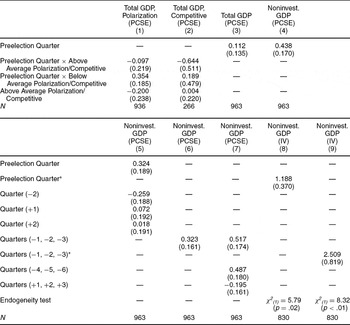
If the sample or specifications are prone to finding preelection declines in growth, then these declines should emerge even when we substitute total GDP for private fixed investment. Table 4 shows the results from such a substitution, using the Schultz specification of electoral periods as in Equation (6). For space reasons, only the estimates of key variables are presented; results for control variables are available upon request. All controls from Equation (6) are included with the exception of interest rates. As mentioned in the description of the variables, interest rates are not a standard control in analyses of GDP, but if we do include them, all substantive results hold.
Revisiting Opportunistic Electoral Business Cycles

Notes: Standard errors beneath coefficients. Controls include OECD Economy, Conservatism of Current Government, Rational Partisan Theory, and country and year effects. PCSE refers to the panel-corrected standard errors model and IV to the first-differenced instrumental variables model. Preelection Quarter* and Quarters (–1, –2, –3)* each equal the predicted values from the first-stage equation described in the text. The instrument Term Expires is significant at p < .05; full results of the first-stage equation are available upon request.
Column (1) presents the results for the analysis of polarization, and column (2) for competitiveness. In neither case is the coefficient on a term involving the preelection quarter significant and negative. In fact, the effect of the preelection period in elections associated with low polarization is significantly positive at p < .10, two-tailed. If we examine the effect of the electoral cycle with the Stein–Streb specification of electoral periods, the results are similar, except that the positive effect for low-polarization elections becomes far less significant. (These results are available upon request.) We have also analyzed the preelection quarter in isolation, i.e., without interacting it with polarization or competitiveness, in an effort to ensure that the interaction terms are not somehow diminishing a significant, negative effect. As shown in column (3), there is again no significant effect of the preelection quarter on total GDP.
These results on GDP conform to standard findings in the literature (e.g., Franzese Reference Franzese2002; Keech Reference Keech1995). Notably, even the work that indicates that competitiveness and polarization are associated with political budget cycles does not claim that total GDP growth increases under these conditions (e.g., Alt and Lassen Reference Alt and Lassen2006; Schultz Reference Schultz1995). Moreover, the findings on private fixed investment suggest that irreversible investment declines precisely when polarization and competitiveness are high. It therefore seems plausible that reverse electoral business cycles obscure opportunistic cycles in other parts of the economy. To assess this possibility, we analyze a number of established specifications with Noninvestment GDP as the dependent variable. Of course, a complete reevaluation of the opportunistic model would require an article or book unto itself. Our goal here is to investigate plausibility.
Columns (4) through (9) of Table 4 present the key results from six specifications. As with the analysis of total GDP, all controls from Tables 2 and 3 are included except for interest rates, the results are robust to controlling for interest rates, and the estimates on controls are available upon request. Column (4) shows the effect of the preelection quarter relative to all other quarters, whereas Column (5) is based on the Stein–Streb specification of electoral periods. According to these columns, growth excluding private fixed investment increases between three- and four-tenths of a percentage point in the quarter before an election. The effect in column (4) is significant at p < .05, two-tailed, and that in column (5) at p < .10, two-tailed. Columns (6) and (7) report the results from the Nordhaus–Alesina–Roubini–Cohen and Alt–Lassen approaches that formed the basis of Appendix C, and these tests also uncover evidence of a preelection increase in noninvestment GDP (p < .05, two-tailed). Indeed, the Alt–Lassen test suggests that this increase is as high as one-half of a percentage point, and extends back into the fourth, fifth, and sixth quarters when analyzed as a group.
Columns (8) and (9) show the results from the first-differenced instrumental variables model in which, as in the previous section, Term Expires is the excluded instrument.Footnote 32 Recall that the instrumental variables analysis attempts to account for the potential endogeneity of elections in parliamentary systems, and that specification testing did not recommend an instrumental variables approach in the analysis of private fixed investment. In this case, with Noninvestment GDP as the dependent variable, specification testing recommends the instrumental variables model over a one-equation model, as detailed in the table. Also, the instrument, Term Expires, is highly significant (p < .05, two-tailed). Even with the instrumental variables model, however, we find substantial support for a preelection expansion. In fact, the expansion is not only statistically significant at p < .05, two-tailed, but considerably higher in magnitude than in the one-equation models. This is the case either if we examine the preelection quarter relative to all other quarters (column [8]) or, following the Nordhaus–Alesina–Roubini–Cohen approach, the three quarters before the election as a group (column [9]). Further results of the instrumental variables models are available upon request.
In sum, simply by removing private fixed investment from GDP, a result that is quite different from the conventional wisdom emerges. Rather than finding little to no indication of opportunistic cycles in real macroeconomic outcomes, we uncover evidence of a real expansion in the over 80% of GDP that is not private fixed investment. These results suggest that the REC theory may not only provide insight into how elections affect irreversible investment but also facilitate greater understanding of how elections influence the economy more broadly.
DISCUSSION AND CONCLUSION
A prominent feature of the literature on electoral business cycles has been the lack of consistent evidence that OECD governments are able to expand the economy before an election. Franzese (Reference Franzese2002, 378) surmises, “the empirical literature uncovers some possible, but inconsistent and weak, evidence for electoral cycles in macroeconomic outcomes, with evidence for cycles in real variables generally weakest. . . .” Research on developing nations, in comparison, has found greater substantiation of opportunistic political business cycles (e.g., Brender and Drazen Reference Brender and Drazen2005; Treisman and Gimpelson Reference Treisman and Gimpelson2001). This contrast has led to speculation that governments in OECD countries may lack sufficient capacity to influence the economy (e.g., Remmer Reference Remmer1993, 393) or that their electorates would disapprove of such manipulation (e.g., Alesina, Roubini, and Cohen Reference Alesina, Roubini and Cohen1997, 254).
We have developed a theory, the reverse electoral business cycle theory, that suggests that sectors dominated by irreversible investment experience a decline in the preelection period when the policy uncertainty associated with the election is sufficiently high. Because the policy uncertainty is low if the race is uncompetitive or the parties hold similar positions, the preelection decline depends on the race being competitive and on an adequate level of polarization between the major left and right parties. To test these arguments, we analyzed quarterly data on private gross fixed capital formation from 10 OECD countries. The tests found that growth in private fixed investment decreased significantly in the preelection period when the elections were competitive and polarization was above average. At the same time, and consistent with the theory, no decline occurred for noncompetitive elections or when polarization was low. Further testing indicated that the findings are not a function of investors preferring right-wing governments, but instead are related to the level of electoral uncertainty. In addition, the results do not appear to be an artifact of the sample or specifications, as analysis of total GDP produced findings consistent with the conventional wisdom. We proceeded to assess whether simply removing private fixed capital formation from GDP would reveal evidence of opportunistic political business cycles, and found that this was the case. This final set of findings establishes plausibility that reverse electoral business cycles obscure preelection expansions occurring elsewhere in the economy.
At a broader level, the article relates to the vast literature on the causes and consequences of policy uncertainty. A longstanding concern is whether specific legal and political institutions engender greater policy uncertainty and thereby hamper growth. For instance, Stasavage (Reference Stasavage2002) suggests that veto points promote higher capital investment by limiting policy uncertainty, and he supports this claim with an analysis of developing countries. Other research on development highlights the importance of minimizing policy uncertainty (e.g., Frye Reference Frye2002; Rodrik Reference Rodrik1991). This article, by showing that political uncertainty routinely affects investment even in OECD countries, contributes to the body of evidence that indicates that the factor is an important determinant of economic outcomes.
This article also raises a number of questions for future research. For example, what are the postelection implications of reverse electoral business cycles? If incumbents have been defeated, might any postelection expansions be delayed until greater certainty emerges about the new government's policies? And in parliamentary systems, how does postelection uncertainty about coalition formation affect irreversible investment? The theoretical framework and empirics could be extended to examine these and other issues related to the postelection period. Separately, the analysis motivates the question of whether developing nations experience reverse electoral business cycles in investment. Theoretically, there is no reason to expect that these cycles are limited to OECD countries.
APPENDIX A: PROOF OF FORMAL EXAMPLES
Two-period Formalization
This Appendix details the mathematics linking the actor's utility function to her optimal investment decision. In the two-period formalization, the actor's maximization problem is

where n equals one if d is chosen in period two and zero if d is chosen in period one. Recall that y(W, d)=aW−b|W−d|, a > 0, b > 0. Because the term aW does not depend on d, the actor chooses d to maximize the expression −b|W−d|. When W is known, the optimal level of investment d* clearly equals W. Thus if the actor waits until the second period, when W is known, he or she chooses d=W and his or her utility is aW−c.
In the first period, the actor only knows the distribution of W~N(μ, τ), where τ is the reciprocal of the variance. Therefore if the actor chooses d in the first period, the optimal choice is based on the distribution of W. Following Cukierman (Reference Cukierman1980) and the more fundamental mathematical proofs of DeGroot (Reference DeGroot1970), the expression −b|W−d| is maximized if the actor chooses d equal to the median of the distribution of W, which is the mean μ given that W is normally distributed. As shown in DeGroot (Reference DeGroot1970), the expected value of |W−d| then equals  . Thus if the actor invests in the first period, his or her expected utility is
 . Comparing the expected utility from investing in the first versus second period simplifies to comparing
 to −c given that the utility associated with aW is independent of d. Accordingly, the actor will invest in the preelection period (the second period) if and only if
 .
Three-period Formalization
In the three-period case the actor must choose between waiting until period three and learning W, investing in period two when he or she has received the signal x but does not know the value of W, and investing in the first period when he or she knows only the distributions of W and x. The first period works as in the two-period version. The actor chooses d equal to the median of the distribution of W, which is the mean μ, given that W is normally distributed, and his or her expected utility is  . Also as before, if the actor waits until the final period, he or she chooses d=W and his or her utility is aW minus the costs of delay. Thus in period one, the expected utility from waiting to choose d until the third period is aμ−(1+γ)c.
In the “campaign” or second period, the investor's optimal choice of d is based not only on the distribution of W but also the distribution of the signal x~N(W, p), where p represents the reciprocal of the variance. Following Cukierman (Reference Cukierman1980) and DeGroot's (Reference DeGroot1970) first theorem, the posterior distribution of W given the signal x is  . The actor's optimal investment is the median of this posterior distribution, which is the mean
 given the normality of the distribution. Again following DeGroot's first theorem (Reference DeGroot1970), the expected value of |W − d| is
 . Thus the expected utility from investing in the second period is
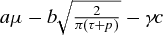 . This expression is greater than the expected utility from investing in the first period iff
 , which simplifies to
 . Likewise, the expected utility from investing in the second period is greater than that from choosing d in the third period if and only if
 , which simplifies to
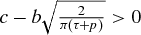 .
APPENDIX B: DESCRIPTIVE STATISTICS

APPENDIX C: ALTERNATIVE SPECIFICATIONS OF ELECTORAL PERIODS

Notes: Dependent variable equals Private Fixed Investment Growth. Standard errors are in parentheses beneath coefficients. All analyses use panel-corrected standard errors with an AR(1) correction. Control variables include OECD Economy, Conservatism of Current Government, Rational Partisan Theory, and country and year effects.
APPENDIX D: FIRST-DIFFERENCED ESTIMATOR

Notes: Dependent variable equals Private Fixed Investment Growth. Standard errors are in parentheses beneath coefficients. The numbers of observations differ from Tables 2 and 3 because the first differencing removes the first quarter of data. In the competitiveness analyses, this procedure removes more than 10 observations, given the gaps in the Eurobarometer poll over time.



Comments
No Comments have been published for this article.