I. INTRODUCTION
Shape memory polymers (SMPs) are considered as one major class of smart materials.Reference Lai, Wu and Wang1 An SMP is able to memorize its original shape, to acquire a metastable temporary shape upon deformation, and to recover back to its permanent shape upon exposition to a proper stimulus such as temperature, water, light, and electrical or magnetic fields.Reference Cai, Sun, Ren and Naguib2–Reference Xie, He, Deng, Du, Fan, Yang and Wang6 Generally, a rigid phase and a switching phase are consisted in SMPs and the rigid one defines the permanent shape and is able to store energy during deformation, while the switching one contains molecular switches, which responds to external stimuli. These switches establish additional reversible cross-links within the polymer networks (denominated as temporary net points) to enable the fixation of a programmed temporary shape.Reference Lai, Wu and Wang1,Reference Kim7 Compared with shape memory alloys, SMPs hold its significant advantage in chemical stability and modification, easy processing, low manufacturing cost, light weight, and high recoverable strain within a wide range of stimuli. These unique properties make it more applicable in deployable space structures, 3D-print, 4D-print, clothing manufacturing, and commercial sectors for applications such as paint protection films, actuators, adaptive fracture fixator, and shape memory stents.Reference Xu, Wu, Balamurugan, Thompson, Brandys and Nielsen8–Reference Carroll, Lancaster, Turro, Koberstein and Mammana13
Recently, poly(lactide acid) (PLA), a kind of biodegradable SMPs, attracted great interests in both academia and industry.Reference Tsuji14,Reference Yakacki, Shandas R, Lanning, Rech, Eckstein and Gall15 Due to its high biocompatibility, nontoxicity, and biodegradability, PLA is expected to be a potential polymer in biomedical fields, such as tissue engineering, drug delivery systems, resorbable sutures, and implant materials.Reference Gremare, Guduric, Bareille, Heroguez, Latour, L’Heureux, Fricain, Catros and Le Nihouannen16–Reference Wei, Peng, Qu, Pei and Fang18 Furthermore, several published reviews have reported the excellent shape memory properties of PLA.Reference Tanzi, Bozzini, Candiani, Cigada, De Nardo, Fare, Ganazzoli, Gastaldi, Levi, Metrangolo, Migliavacca, Osellame, Petrini, Raffaini, Resnati, Vena, Vesentini and Zunino19–Reference Zhang, Chen and Zhang21 Dogan et al. has reported that the shape memory effect (SME) of PLA comes from the presence of crystalline and amorphous phases. The crystalline phase acts as the rigid phase that is responsible for energy storage during the temporary shape and the amorphous phase acts as the switching phase, which can be triggered above glass transition temperature (T g).Reference Dogan, Boyacioglu, Kodal, Gokce and Ozkoc22 Despite the great range of advantages, internal brittleness and relatively high T g (about 60 °C) are the major drawbacks of PLA as SMP which limit its applications in biomedical fields.Reference Navarro-Baena, Sessini, Dominici, Torre, Kenny and Peponi23
To overcome these difficulties, several strategies have been considered to improve the performance of PLA based SMPs. These measures include copolymerization, blending, and surface modification.Reference Rasal, Janorkar and Hirt24 One of the most popular and practical measures is blending plasticizers with PLA. Compared with copolymerization, blending is more economic and environmental friendly.Reference Karger-Kocsis9 Plasticizers were used to improve its processability, flexibility, and ductility of PLA through delaying tearing and cracking.Reference Pillin, Montrelay and Grohens25
The most common plasticizer used for PLA was PEG which is biodegradable and non-toxic.Reference Pillin, Montrelay and Grohens25 PEG has a great contribution to improving the mechanical properties of PLA. Choi et al.Reference Choi, Lim, Choi, Han and Ha26 showed that the elongation at break of PLA blended with 9 wt% PEG increased about 17 times compared with pure PLA. Chieng et al.Reference Chieng, Ibrahim, Wan and Hussein27 investigated the way of fabricating PLA/PEG polymer blends and reported that the tensile elongation increased from 5.37 to 413.3% with 10 wt% PEG. Put another way, plasticizers can also decrease the glass transition temperature (T g) of SMPs. Cai et al.Reference Cai, Sun, Ren and Naguib2 carried out a detailed research to trigger the SME under body temperature as desired for use in biomedical applications by introducing the plasticizer PEG into PLA. Chieng et al.Reference Chieng, Ibrahim, Wan and Hussein27 also suggested that the T g of PLA/PEG polymer blends can be decreased from 62 °C to 51 °C with 10 wt% PEG. Bijarimi et al.Reference Bijarimi, Ahmad, Rasid, Khushairi and Zakir28 pointed out that the plasticizer added to the polymer was acting as a spacer at the molecular level so that less energy is required to allow substantial rotation about the C–C bonds, which leads to the improvement of mechanical properties and the decrease in T g. As to the SME of PLA/PEG blends, the change in T g apparently affected the SME. There are series of research on the SMEs of PLA/PEG blend systems. Cai et al.Reference Cai, Sun, Ren and Naguib2 investigated the overall shape memory process within the dynamic mechanical analysis (DMA) chamber shown in a three-dimensional diagram. He found that the plasticizer PEG can not only improve the recovery speed, but also lead to an overall improvement of the fixing ratio under room temperature due to the altering polymer chain interactions. In brief, with the improvement of mechanical properties and decrease in T g, the participation of the plasticizer PEG widens its adoption and application in biomedical fields.Reference Barmouz and Hossein Behravesh29
Despite the significant achievements in research related to different PLA/PEG blending systems, less attention has been paid to the SME of PLA/PEG blends prepared by the solution evaporation method. Compared with the melting blending method, the solvent evaporation method can better mix the PLA and PEG components and get more homogeneous blends which may improve the mechanical properties and SME effectively.Reference Pillin, Montrelay and Grohens25 For example, PillinReference Pillin, Montrelay and Grohens25 found that melting blend PLA can only reach 3% elongation at break, while the solution evaporation PLA films can achieve to 18%. What is more, introducing a proper content of ethyl alcohol (EtOH) into the solution can significantly improve the mechanical properties of blends because EtOH is able to enhance the polar interactions in polymer chains.Reference Liu, Zhang, Huang, Dong, Xu, Ray and Zhu30 Shen and his co-workers investigated the effects of cross-linkers on the SME of PLA/PEG blends; they prepared the PLA/PEG film samples with the solvent evaporation method and tested the SME of the PLA/PEG film by using the heat-bending test in a water bath.Reference Shen, Lu, Zhou and Liang31 However, there is still a lack of shape memory cycle test data of PLA/PEG blends with the solvent evaporation method, which can provide the basis for both constitutive studies and applications. In our work, the mechanical properties and shape memory behaviors of PLA/PEG blends prepared by using the solution evaporation method were investigated comprehensively. Shape memory cycle procedures with the DMA tensile setup are adopted to measure the SME of PLA/PEG blends more accurately. Several aspects are focused on (i) the influence of PEG contents on the thermal properties of PLA/PEG blends including glass transition temperature and crystallization conditions; (ii) the improvement of the mechanical properties of PLA/PEG blends influenced by different PEG contents; (iii) the shape memory behaviors of PLA/PEG blends under different loading conditions in the shape memory cycle such as recovery temperature, tensile strain, tensile strain rate, and deformation temperature.
II. EXPERIMENTAL
A. Materials
Poly(lactic acid) (PLA, 4302D, pellet) was purchased from Natureworks Co. (Minnetonka, Minnesota) with a melting temperature (T m) of 167 °C and the glass transition temperature (T g) of 60 °C. Poly(ethylene glycol) (PEG) with a molecular weight of 2000 g/mol was supplied by Sigma Aldrich (Shanghai, China) The melting temperature of PEG is approximately 50 °C. Both dichloromethane (DCM) and absolute ethyl alcohol (EtOH) were purchased from Kemiou Co (Tianjin, China).
B. Samples manufacturing
The solvent evaporation film was used to manufacture the samples according to the following steps: The materials were dried at 40 °C for 12 h in a vacuum oven before mixing. PLA and PEG were blended and the plasticizer PEG content varied as 0, 5, 10, 15, 20, 30, and 40 wt%. The mixtures were effectively dissolved in a co-solvent of DCM and EtOH (V:V = 4:1) to form 10 wt% solution on a magnetic stirrer at room temperature for 12 h, by contrast, PLA without PEG was dissolved in DCM. Subsequently, the well stirred solution was cast onto polytetrafluoroethylene (PTFE) molds to generate films at room temperature for 12 h to make the solvent fully volatilized. Finally, the films were obtained with the thickness of 0.15 ± 0.03 mm. To distinguish samples with different PEG contents, the samples were named by the content of PEG, for example, PEG20 means that there is 20% PEG in the PLA/PEG blends. By contrast, the samples without PEG and EtOH were named PLA100.
C. Characterization
1. DSC
To explore the thermal properties including glass transition temperature (T g), cold crystallization temperature (T c), melting temperature (T m), and the crystallinity conditions of PLA/PEG samples, the differential scanning calorimetry (DSC) analysis was conducted on a differential scanning calorimeter (DSC, Q100, TA Instrument). Standard aluminum pans were used, and the mass of each sample was approximately 5 mg. To achieve good sensitivity, three cycles were performed: first a heating scan, from 10 to 200 °C, to erase the thermal history of the samples, second a cooling scan from 200 to 10 °C, and finally, another heating scan from 10 to 200 °C to explore the aforementioned thermal properties. All of the three scans were performed with a heating rate of 10 °C/min.
2. SEM
The surface morphology of the PLA/PEG samples was analyzed by using a scanning electron microscope (SEM, QUANTE FEG 250 ESEM, FEI, Hillboro, Oregon). The samples were subjected to 1 min of platinum sputter coating for 10 times with a voltage of 10 KV prior to imaging to ensure suitable electrical conductivity.
3. Tensile test
Tensile tests were carried out on a universal testing machine (Liangong Technology Co., Jinan, China) at room temperature. The strain rate was 5 mm/min, and the samples were cut into rectangular sample sheets (40 × 10 × 0.15 mm) for test specimens. In each case, at least eight measurements were taken.
4. Shape memory and water bath shape recovery test
The shape memory tests were conducted in a tensile machine with a temperature control box purchased from Liangong Technology Co. (Jinan, China). Two main indexes, R f and R r, were used to characterize the shape memory behaviors. The shape fixing ratio R f describes the ability to fix the deformation during the programming process in the temporary shape. The shape recovery ratio R r represents the extent to get back to the original shape.Reference Bijarimi, Ahmad, Rasid, Khushairi and Zakir28 The shape fixing ratio (R f) and shape recovery ratio (R r) are defined by the following equationsReference Cai, Sun, Ren and Naguib2:
 $${R_{\rm{f}}} = {{{\varepsilon _{\rm{u}}}} \over {{\varepsilon _{\rm{m}}}}}\quad ,$$
 $${R_{\rm{r}}} = {{{\varepsilon _{\rm{m}}} - {\varepsilon _{\rm{p}}}} \over {{\varepsilon _{\rm{m}}}}}\quad ,$$
where, εm is the stretch strain, εp is the strain of temperature shape, and εu is the strain after recovery.
To investigate the shape memory properties, two different tests schemes were conducted. In Test 1, the influence of tensile strain on the shape fixing ratio (R f) and shape recovery ratio (R r) of samples with different PEG contents was investigated according to the following steps: (i) heating the samples to 60 °C (above T g) and holding it for 1 min; (ii) stretching the samples to a temporary shape of 50%, 100%, 150%, 200%, and 250% strain at a rate of 5 mm/min, respectively; (iii) cooling the samples by using an ice pack for 5 min and maintaining at room temperature for 12 h to record the shape fixing ratio (R f); (iv) placing the samples into the water bath at 70 °C for 60 s to determine the shape recovery ratio (R r). As for PLA/PEG shape memory blends, the recovery temperature was not a definite value but a temperature interval. In Test 2, the influence of the PEG content on the recovery temperature interval of PLA/PEG blends was investigated. (i) Heating the samples to 60 °C (above Trans) and holding it for 1 min; (ii) stretching the samples to a temporary shape of 100% strain at a rate of 10 mm/min; (iii) cooling the samples by using an ice pack for 5 min and maintaining at room temperature for 12 h to record the shape fixing ratio (R f); and (d) placing the samples into the water bath at 70 °C for 60 s to determine the shape recovery ratio (R r). All the size of samples was the same as used in the mechanical test. Five samples of each PEG content were measured to achieve the average R f and R r.
5. DMA
Dynamic mechanical analysis (DMA TA Q800, TA Instruments, New Castle, Delaware) with a thin film setup was used for verifying the storage modulus E′, loss modulus E″, and tan δ, which can also reflect the change in T g of the PLA/PEG blends with different PEG contents. Besides, shape memory cycle tests were also carried out by DMA to visually reflect the process of shape fixing and shape recovery. In the first DMA test, the samples were cooled to −40 °C and equilibrated for 5 min and then the samples were loaded with a 20 μm–1 Hz load with temperature increasing from −40 to 90 °C and the storage modulus E′, loss modulus E″, and tan δ of the blends are recorded. In the second DMA test, a set of customized procedures are used to exhibit the shape memory cycle in temperature–stress–strain space. At first, the thin film samples were stretched under a specific temperature T def to 100% strain. Here the temperature T def can be named the deformation temperature. After the deformation, the temperature was lowered from T def to −40 °C with a rate of 10 °C/s for shape fixing with stress removed. Then, the temperature was increased from −40 to 90 °C, and the recovery strain was monitored.
6. WCA
Samples of different proportions were tested on a contact angle meter purchased from Shanghai Technology Apparatus Co. (Shanghai, China). The surface of samples was dropped by deionized water (3 μL) to measure the water contact angle (WCA) at room temperature to determine the hydrophilicity of each PLA/PEG sample.
III. RESULTS AND DISCUSSION
A. Thermal behavior
To investigate the shape memory behavior of the PEG/PLA blends, the plasticizing effect of different PEG contents on thermal behavior was studied. The DSC curves of blends with different PEG contents are given in Fig. 1. As a temperature sensitive SMP, the recovery temperature of PLA/PEG blends is usually around its glass transition temperature (T g). As we know, the T g value is an indication of chain flexibility, and the lower the T g, the higher the flexibility.Reference Shen, Lu, Zhou and Liang31 The shape memory properties of PLA/PEG blends are greatly affected by the flexibility of the molecular chain. Therefore, investigating the T g value influenced by PEG is necessary for exploring the shape memory properties of PLA/PEG blends. As shown in Fig. 1, for pure PLA (both PLA100 and PEG0), the T g of pure PLA was 59.5 °C and the melting temperature (T m) was 167 °C. The T g value decreased to 50 °C with additional 5 wt% PEG which had a flexibility effect on the polymer chains, and a lower T g value was obtained with less require of energy in phase transition. It was worth noting that when the content of PEG increased above 10%, the T g of PLA/PEG blends became difficult to be identified from the endothermic curves, and this phenomenon is similar to previous reports.Reference Choi, Lim, Choi, Han and Ha26 Another significant phenomenon which could be found was the change in crystallinity conditions of blend systems. Pure PLA shows a typical semi-crystalline characteristic with low crystallinity, the cold crystallization temperature (T c) of pure PLA is about 135 °C. With 5 wt% of PEG, the blend showed an increasing and narrow crystallization peak and the T c also shifted from 135 to 108 °C. As the content of PEG increased to 10 wt%, the cold crystallization peak decreased during the cooling process and lowered to 80 °C. When the content of PEG increased above 15 wt%, the crystallization peak disappeared. Overall, a conclusion can be drawn that the T g value and crystallinity conditions can be changed by the different contents of PEG, and consequently, the PEG will have a noteworthy impact on the shape memory performance of the blends.
DSC thermograms for PLA/PEG blends.

In addition, as the content of PEG increased above 20 wt%, an obvious phase separation could be observed from the DSC curves. The phase separation could be speculated by the increasing endothermic peaks at 50 °C, which was constant with the melting temperature of PEG. Besides, the DSC curve of PEG0 was almost the same as that of PLA100, which indicates that the EtOH has no influence on the thermal properties of blend systems.
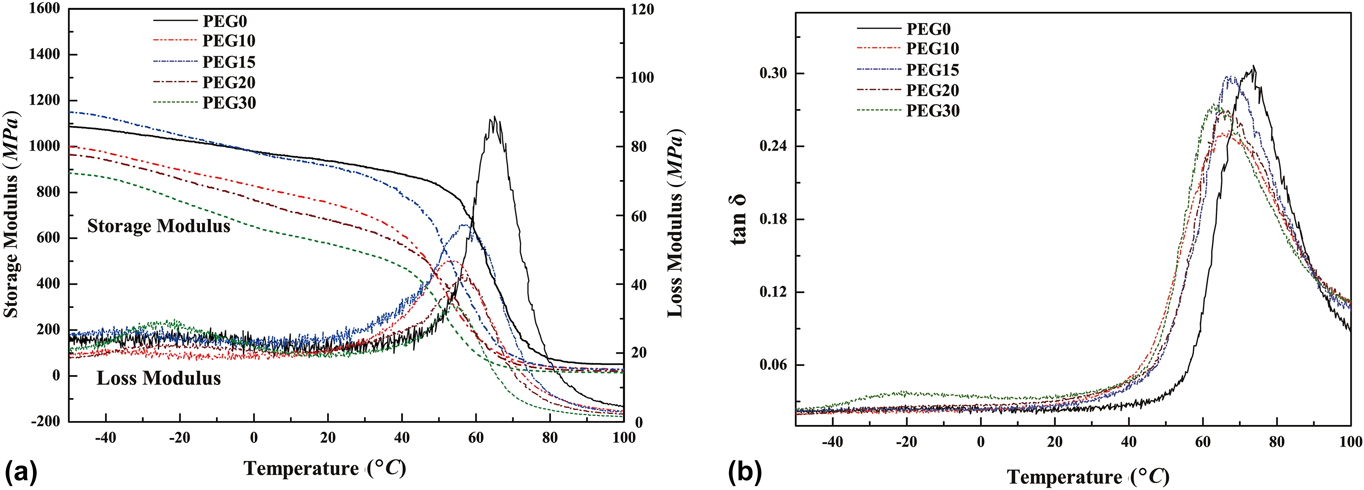
The dynamic mechanical properties of the PLA/PEG blends were presented by the storage modulus E′, loss modulus E″, and tan δ from DMA tests, as shown in Fig. 2. Compared with DSC, the glass-transition temperatures T g of blends can be identified from tan δ curves which were analyzed by DMA. The specimens have a transition temperature range where tan δ sharply changes with increasing temperature. The peaks of tan δ–temperature curves of PEG0, PEG10, PEG15, PEG20, and PEG30 are 73.7 °C, 67.4 °C, 66.7 °C, 65.0 °C, and 62.9 °C, respectively. The downtrend with increasing PEG contents coincides with the results of DSC. What is more, with the addition of PEG, both the slope of E′-temperature curves and the peaks of E″-temperature curves were shifted significantly to a lower temperature. It indicates that the plasticization effect of PEG can effectively enhance the motion capacity of the molecular chains of PLA/PEG blends.
The dynamic mechanical properties of the PLA/PEG blends by using the DMA test: (a) storage modulus E′ and loss modulus E″ and (b) tan δ.

B. Morphological observation
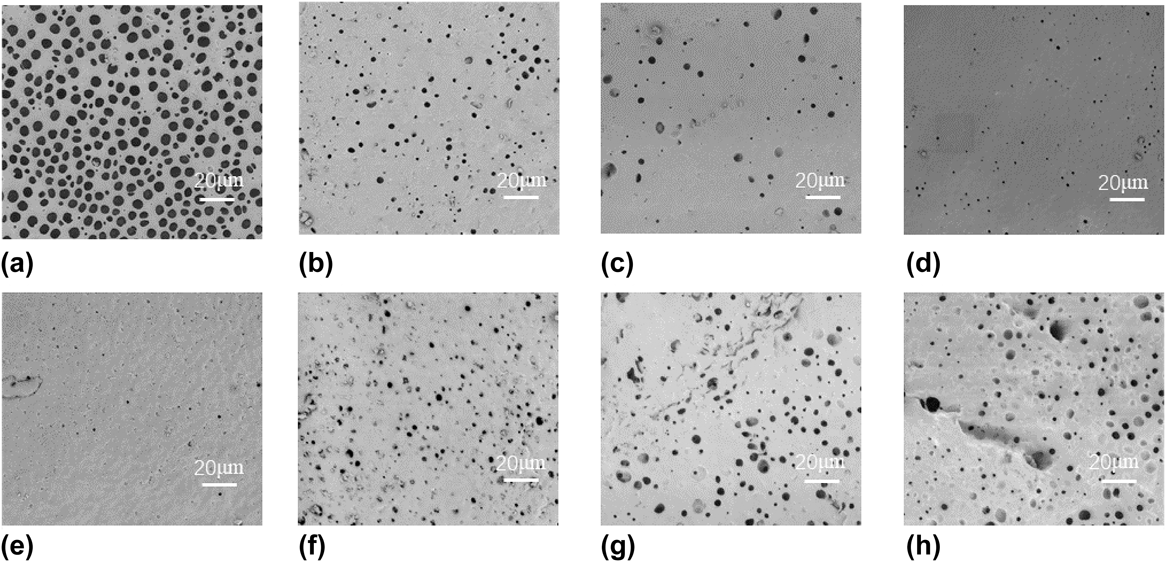
The morphology of PLA/PEG blends has a significant influence on the mechanical properties and the shape memory behaviors.Reference Goryczka and Szaraniec32 To understand the impact of PEG on the morphology of PLA/PEG blends, the SEM tests were performed and the results are showed in Fig. 3. Several phenomena could be observed from the SEM images. Firstly, fast solution evaporation generated plenty of pores on the surfaces of PLA100 films [Fig. 3(a)] which may have negative effects on the mechanical properties. Secondly, introducing 20% EtOH into the solution dramatically reduces the size and number of pores on the surfaces, because the material can be uniformly mixed in strong polar dispersion solvents such as EtOH. Furthermore, PLA is soluble in most organic solvents such as THF and DCM, but insoluble in EtOH, and the pore formation mechanism in PLA/PEG films can be related to the non-solvent inducing a phase separation.Reference Phaechamud and Chitrattha33 Thirdly, the presence of the plasticizer PEG greatly impacted the morphology of PLA/PEG blends. The PEG0 film exhibited a porous structure. However, with 5 wt% PEG, the number of pores decreased obviously. When the contents of PEG were 10 wt% and 15 wt%, the situations were even better, fewer pores could be seen in both PEG10 and PEG15 samples. This phenomenon reveals a better compatibility between PLA and PEG. However, as the content of PEG increased further, a bigger size and an increased number of pores could be seen on the surface of PEG20, PEG30, and PEG40 samples. Moreover, it was almost certain that a slight white bump on the surface of PEG30 sample is PEG. This suggests that an obvious phase separation occurs, which confirms the analysis result of DSC. A conclusion can be obtained that the morphology of PLA/PEG blends can be improved with a suitable content of PEG. As previously reported by Baiardo,Reference Baiardo, Frisoni, Scandola, Rimelen, Lips, Ruffieux and Wintermantel34 the compatibility of the PLA/PEG system was limited up to a given concentration, where the plasticizer reached its solubility limit in the polymer. The solubility limit of PEG was 15–30 wt% depending on molecular weight. In our work, both the results of DSC and SEM indicate that the solubility limit of PEG with a molecular weight of 2000 is 20 wt% within the PLA/PEG systems.
The surface topography of the PLA/PEG blends by using SEM micrographs: (a) PLA100, (b) PEG0, (c) PEG5, (d) PEG10, (e) PEG15, (f) PEG20, (g) PEG30, and (h) PEG40.

C. Mechanical properties
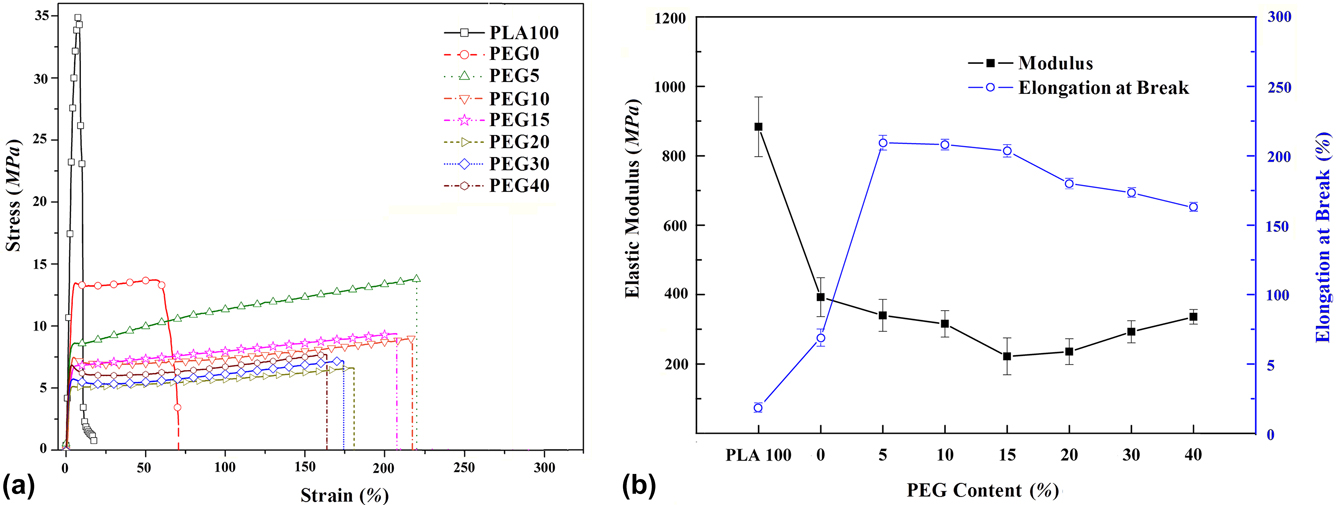
The mechanical properties of the PLA/PEG samples were studied, and the representative stress–strain curves are presented in Fig. 4(a). The curves of modulus and elongation at break are summarized in Fig. 4(b). As can be seen, the PLA100 samples exhibited a high initial modulus of 883.3 ± 86 MPa but relatively low elongation at break which abruptly broke at an ultimate strain of 18%. So PLA100 is unsuitable for the shape memory performance because of its brittleness. Compared with PLA100, PEG0 samples exhibited a lower modulus of 392.3 ± 56 MPa and a higher elongation at break of 69.0%. The addition of EtOH enhances the polar interactions in polymer chains and results in the decrease in modulus.Reference Liu, Zhang, Huang, Dong, Xu, Ray and Zhu30 This is also one of the most important reasons why the modulus of PLA100 is higher than that of the PLA/PEG blends with 20% EtOH. It is a good proof that introducing EtOH can improve the mechanical properties of PLA significantly. Compared with the melting blending method, the solution evaporation method can mix the blends more homogeneously, which results in the improvement of mechanical properties.
The mechanical properties of the PLA/PEG blends by using the tensile test: (a) stress–strain curve and (b) modulus and elongation at break.

Two opposite effects are considered on the blend systems with PEG as the plasticization. On the one hand, with the increasing contents of PEG, the elongation at break of blends increased obviously. Without phase separation, the observed elongations at break for PEG5, PEG10, and PEG15 were 209%, 208%, and 203%, respectively. As the contents of PEG increased further, the phase separation occurred and resulted in the decrease of the elongation at break of the blends. The elongations at break for PEG20, PEG30, and PEG40 were 180%, 173%, and 162%, respectively. As shown in Fig. 4(b), contrary to the tendency of elongation at break, the modulus increased gradually with the PEG content increasing and then decreased when the PEG content reached above 15%. It indicates that a proper content of PEG exists which is able to apparently improve the ductility of the PLA/PEG system. On the other hand, the increase in PEG contents has caused the slightly decrease in the tensile strength of blends. It is known that high crystallinity can improve the tensile strength.Reference Liu, Zhang, Huang, Dong, Xu, Ray and Zhu30 The higher tensile strength of PEG0 and PEG5 compared with the other plasticized blends can be explained by the higher crystallinity, which can be determined by the DSC results.
D. Investigation of the shape memory behaviors
More attention has been paid to the exploration of shape memory behaviors. Several key influence factors of SME including the recovery temperature, stretch strain, deformed temperature, and tensile rate were systematically explored. Furthermore, the shape memory cycle behaviors were investigated with DMA tests and described in strain–stress–temperature 3D spaces.
1. Shape memory behavior under different tensile strain
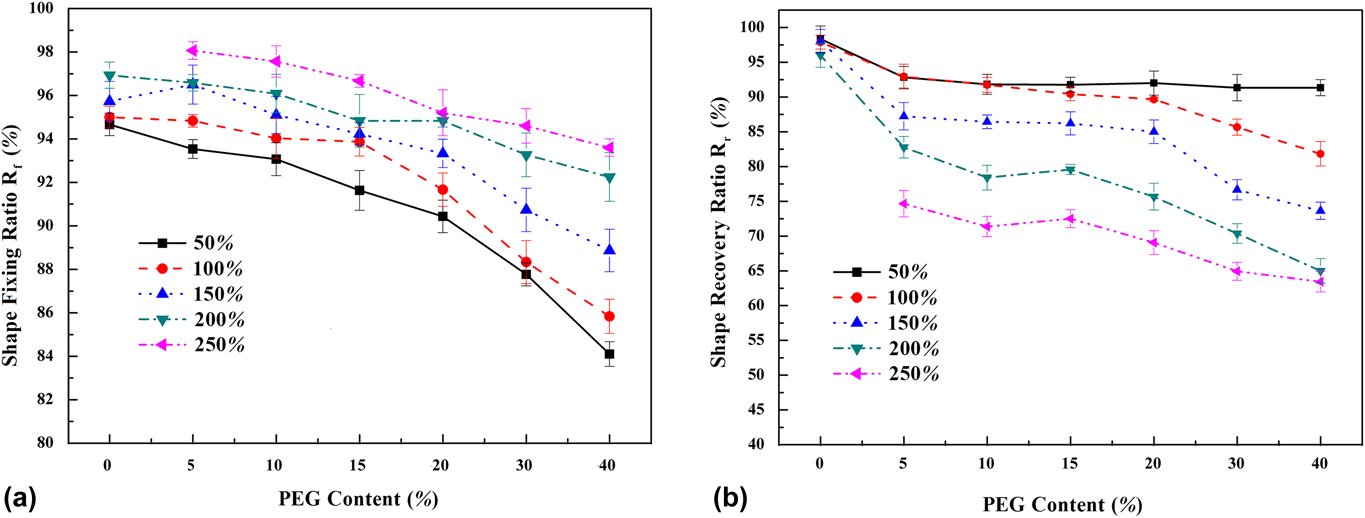
The influence of PEG contents on the shape fixing ratio (R f) and shape recovery ratio (R r) of samples under different tensile strain was investigated, and the results are plotted in Fig. 5. The samples were stretched to different strain 50%, 100%, 150%, 200%, and 250% at 60 °C, and the fixing ratio (R f) is recorded and plotted in Fig. 5(a). Apparently, with the increased PEG contents, the fixing ratio decreased accordingly. This behavior suggests that the PEG acts as spacers at the chain alignment and has a chain flexibility effect, which results in an increase in the recoverable part of the deformation.Reference Bijarimi, Ahmad, Rasid, Khushairi and Zakir28
Shape memory properties of PLA/PEG blends in different strain conditions: (a) shape fixing ratio R f and (b) shape recovery ratio R r.

As another important aspect of the SME, the recovery ratio R r is recorded and plotted in Fig. 5(b). The following phenomena were observed from recovery behavior: (i) The shape recovery ratio of PEG0 was approximately 97% which was the highest one. This reveals that the amorphous segment of PLA has great contribution to the shape memory behavior of PLA/PEG blends. However, without PEG, a relatively low tensile strain of PEG0 limits its application as SMP. (ii) It can be observed that the decrease in the shape recovery ratio was accompanied by the introduction of PEG. For instance, with PEG content 5 wt%, the shape recovery ratio (R r) decreased to 92.7% and 87.5% under 50% and 150% tensile strain, respectively. It can be concluded that introducing PEG which is a plastic material causes irreversible deformation in PLA/PEG blends which leads to the decrease in R r. Although the tendency of the shape recovery ratio was declining, the PLA/PEG blends with proper PEG contents still maintained a relatively high shape recovery ratio. For example, the recovery ratios of PEG5 and PEG10 at 50% strain were at 92.5% and 92.3%, respectively. This suggests that PLA/PEG blends are great candidates for shape memory materials with proper contents of PEG. (iii) The shape recovery ratio remained steady with the plasticizer content of 5 wt%, 10 wt%, and 15 wt% and then descended quickly when the content of PEG was above 20 wt%. This can be accounted for the phase separation that occurred when the PEG content increased to 20 wt%. This is well related to the result merged from the SEM and DSC analysis. (iv) As can be seen in Fig. 5, when the tensile strain increased, both the recovery ratio and fixing ratio of PLA/PEG blends decreased gradually with the content of PEG increased. This phenomenon can be attributed to an increase in irrecoverable deformation under greater tensile strain. In addition, for each PLA/PEG blend, the fixing ability was enhanced, while the ability of shape recovery decreased, with the increase in tensile strain. It is known that R r and R f values depend on each other, and a higher R f value usually implies a lower R r, in agreement with previous reports.Reference Cai, Sun, Ren and Naguib2
2. Shape recovery under different water bath temperatures
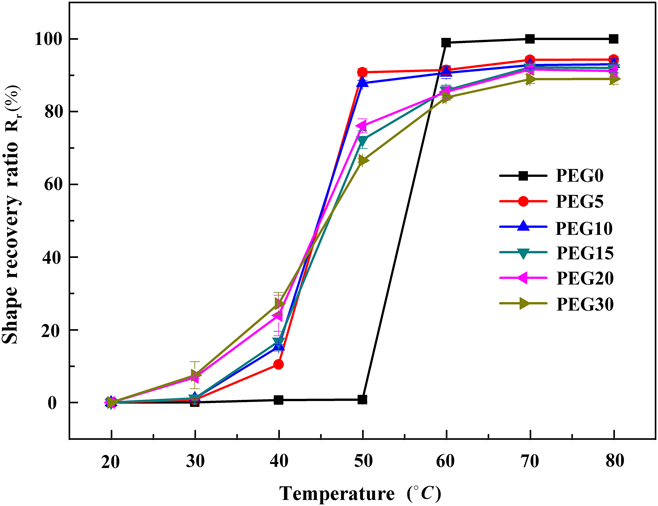
The shape memory properties of PLA/PEG blends were examined at a series of water bath temperatures from 20 to 80 °C, and the shape recovery curves are shown in Fig. 6. The shape recovery of the prepared PLA/PEG blends occured when the water bath temperature was changed above their T g.Reference Karger-Kocsis9 The Rr-temperature curves were S-shaped. It shows that the shape recovery behavior can be affected by both the water bath temperature and the content of PEG. The following interesting phenomena were observed during the shape recovery process: (i) In the water bath, the shape recovery of each sample was quite fast. Most of the shape recovery happened in the first 5 s (ii) It could be seen that PEG0 kept the temporary shape at 50 °C and recovered entirely at 60 °C. The recovery temperature of PEG0 was most likely a determined value. The recovery temperature value was consistent with the T g of PEG0 which was 59.5 °C as measured by DSC analysis. (iii) With the addition of PEG, the recovery temperature decreased and turned into a temperature range. The PEG5 began to recover at 40 °C and almost completed recovery at 50 °C, while the T g of PEG5 was 50 °C. In addition, with the increase of plasticizer content, the recovery temperature range expanded gradually. The recovery behaviors of PEG10 and PEG15 were similar with PEG5, while PEG15 did not recover completely at 50 °C. In addition, PEG20 and PEG30 began to recover at 30 and finished at 70 °C. This suggests that the plasticized PLA is more sensitive to the change in the recovery temperature, which is beneficial for its fast response. (iv) It could be seen that PLA/PEG blends could recover at lower temperature. It has long been known that the sensitivity of macromolecular chain movement has a strong relationship with the plasticizing effect.Reference Cai, Sun, Ren and Naguib2 By increasing PEG, the movement of the macromolecular chain gets easier, which leads to the recovery at lower temperature in contrast to pure PLA. The results indicate that a higher operation temperature is advantageous to the completed recover of prepared PLA/PEG blends. In general, it can be concluded that the prepared PLA/PEG blends with amorphous switching segments have a broad switching temperature. In this sense, the prepared PLA/PEG blends may be suitable for special applications as shape memory biomedical fields.
Shape recovery ratio R r of PLA/PEG blends under different recovery temperatures by using the water bath test.

3. Shape memory behaviors under different stretch strain rates
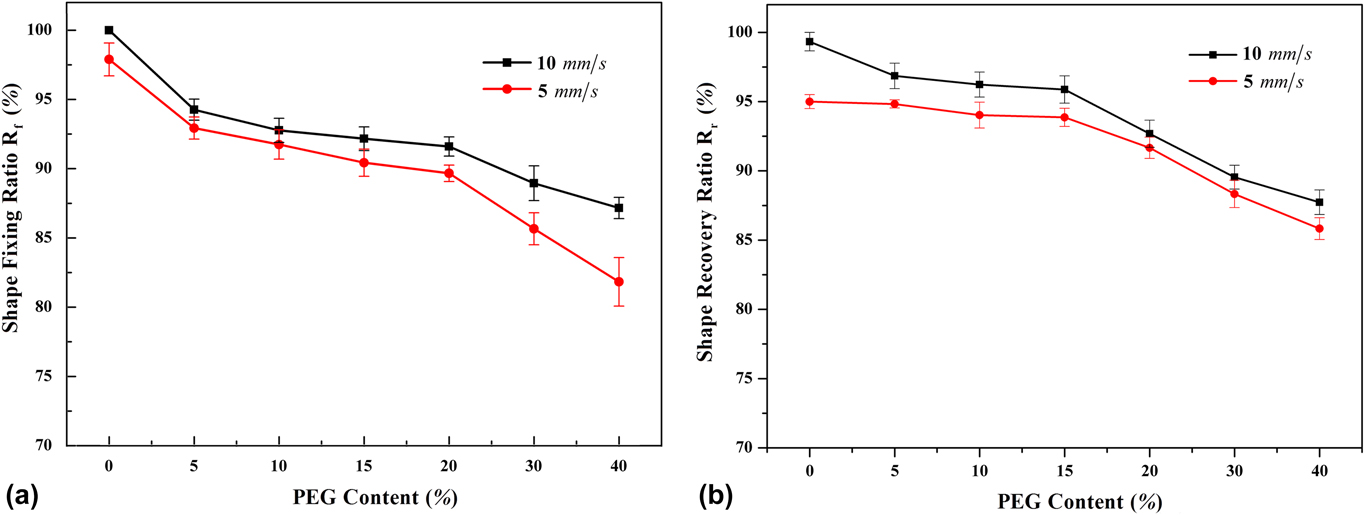
The shape fixing and shape recovery values were recorded and compared at different stretch strain rates and are shown in Figs. 7(a) and 7(b), respectively. All the samples were stretched under 60 °C with different stretch rates to 100% strain and then recovered in a 70 °C water bath. It could be obviously seen that with higher strain rate, higher fixing rate R f and recovery rate R r were obtained. The appearance of this phenomenon can be interpreted as the low processing strain rate allows molecular chain relaxation. Therefore, to obtain a higher recovery ratio and fixing ratio, increasing the stretch rate can be a practical way.
Shape memory properties of PLA/PEG blends with different stretch strain rates: (a) shape fixing ratio R f and (b) shape fixing ratio R r.

4. Shape memory behaviors of different deformation temperatures
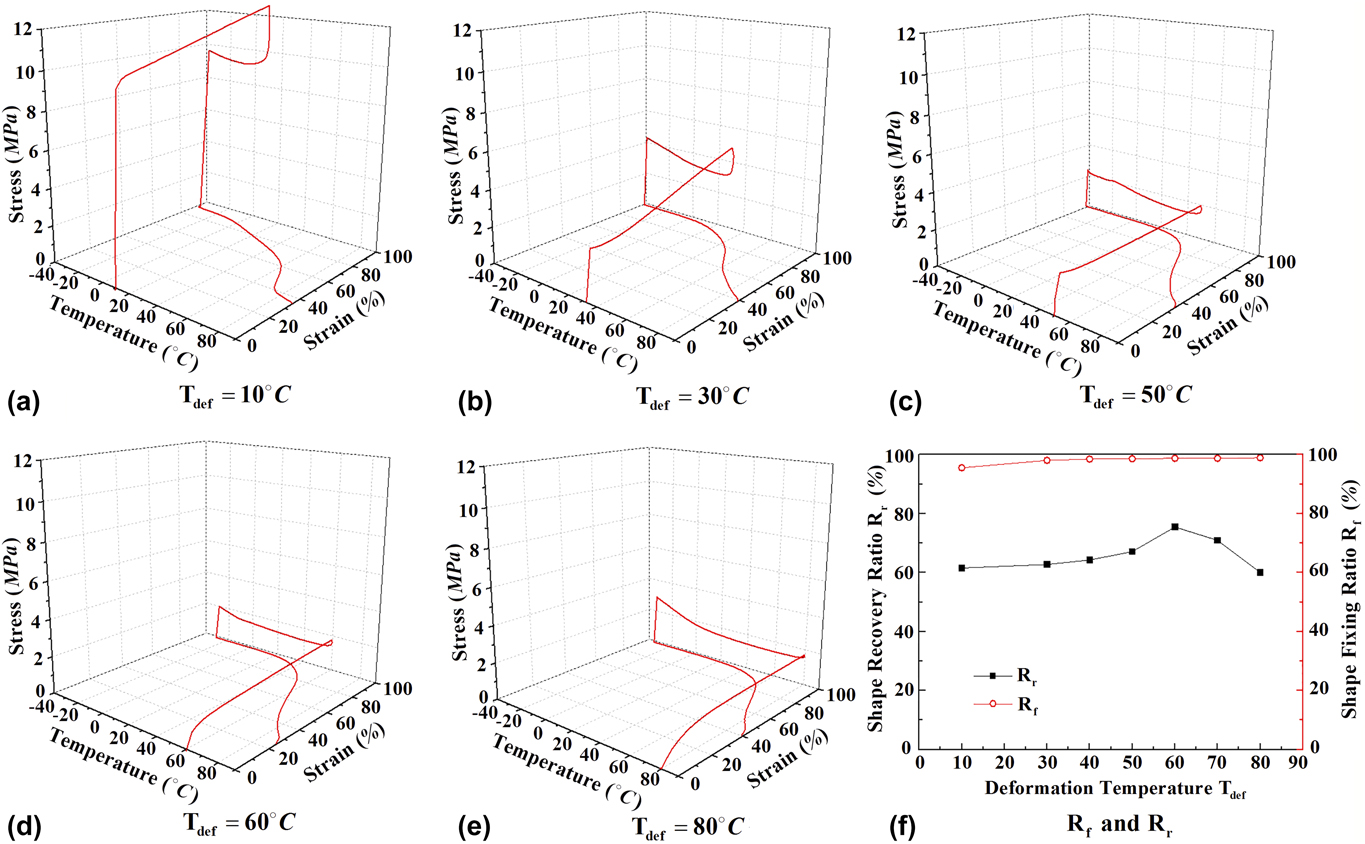
The shape memory cycle behaviors curves in strain–stress–temperature 3D space were investigated by using the DMA test. Two schemes were investigated in this test: at the first scheme, we investigated the influence of deformation temperature T def on the shape memory cycle. As shown in Fig. 8, the PEG20 samples were stretched under different T def before the cooling step. The shape memory cycle curves, R f, and R r are plotted in Fig. 8(f). It can be seen that T def had a clear influence on the recovery ability of the samples. Both R f and R r reached the maximum values when T def was 60 °C which is a temperature slightly lower than the T g of PEG20. But as T def increased above T g, the recovery ability declined rapidly.
The shape memory cycle of PEG20 by using the DMA test with different deformation demperatures T def. (a) T def = 10 °C, (b) T def = 30 °C, (c) T def = 50 °C, (d) T def = 60 °C, (e) T def = 80 °C, and (f) shape fixing ratio R f and shape fixing ratio R r.

5. Shape memory behaviors with different PEG contents
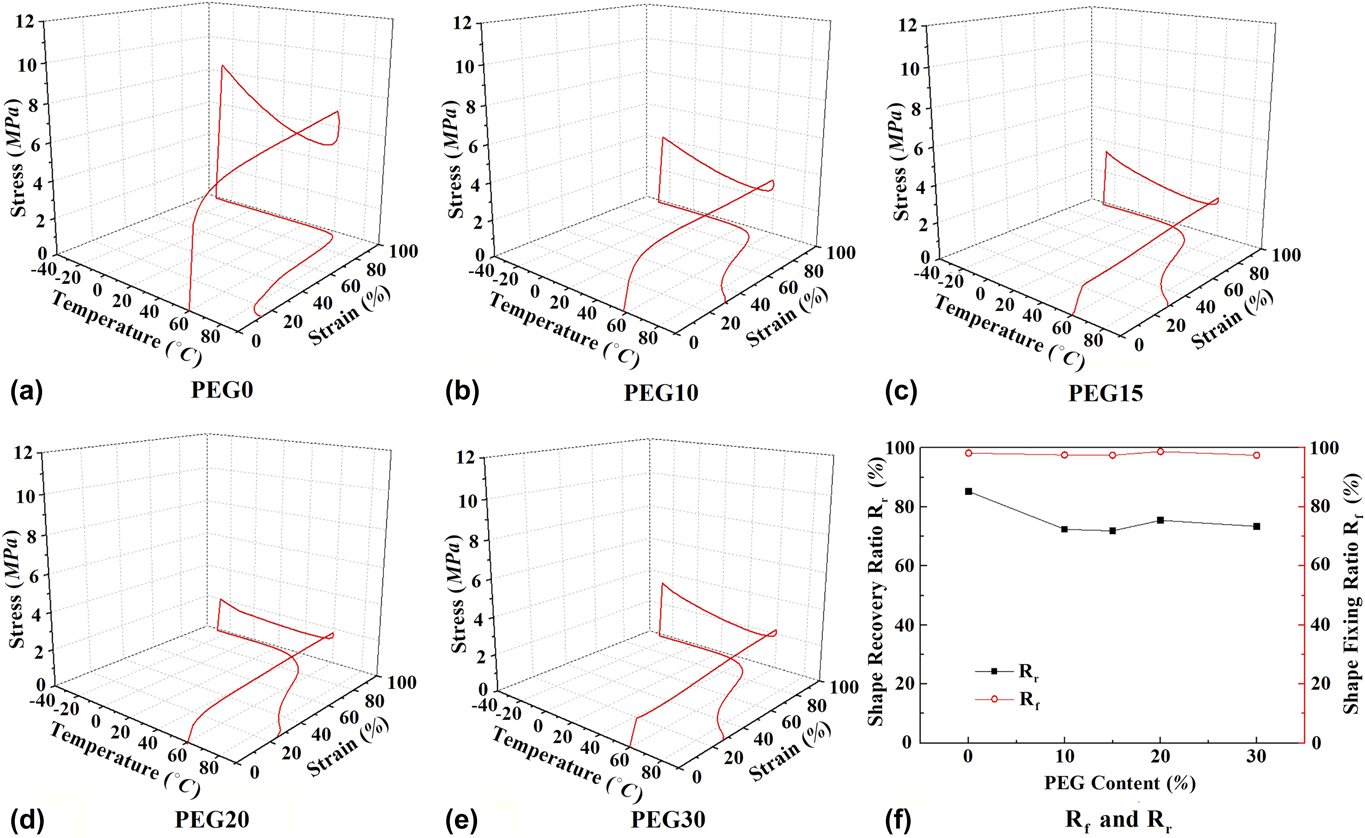
At the second test scheme by using the DMA test, we investigated the influence of PEG contents on the shape memory cycle of the blends. The same shape memory cycle procedures were performed on PEG0, PEG10, PEG15, PEG20, and PEG30, and the deformation temperature T def was selected as 60 °C. All the results are plotted in Fig. 9. Several conclusions can be drawn from the results: (i) The strain–temperature curve of pure PLA (PEG0) was much steeper than that of other samples, and the recovery temperature became lower with increasing PEG content. It indicates that with increasing PEG content, the decline of T g decreases the recovery temperature of blends. (ii) The value of R r decreased with increasing PEG contents slightly. It indicates that the addition of PEG declines the recovery ability of PLA/PEG blends. (iii) Comparing the shape memory test results with the tensile machine, the R f of each sample was higher in DMA tests because a much lower temperature better fixed the temporary shape. However, in the heating process, a significantly higher recovery temperature was monitored than that in water bath tests, and the recovery ratio R r of all the samples became lower than that in water bath tests. It could be explained that in DMA tests, the samples were heated by the air and the heating effect was not as good as in the water bath. The real temperature of the sample lagged behind the environment temperature, and thus the shape could not recover sufficiently in the heating process.
The shape memory cycles of the PLA/PEG blends by using the DMA test with different PEG contents. (a) PEG0, (b) PEG10, (c) PEG15, (d) PEG20, (e) PEG30, and (f) shape fixing ratio R f and shape fixing ratio R r.

E. Water contact angle and hydrophilicity
To achieve potential applications, the effect of PEG on the hydrophilicity of PLA/PEG blends was explored. Figure 10 shows the results of the WCA measurements. With the increase in the PEG content, the hydrophilicity gradually increased even if there was a phase separation. However, WCA almost unchanged when the PEG content attained 20%. PEG is known as a water-soluble polymer which results in increasing hydrophilicity.Reference Cai, Dai, Wang, Luo, Xue and Yu35 Moreover, the addition of EtOH significantly increased the hydrophilicity and the average contact angle decreased from 88.5° to 79.5°. It is speculated that this phenomenon may be related to the decrease in pores on the surface. Wettability of the material surface, which determines its hydrophobic or hydrophilic character, plays an important role in medical applications.Reference Goryczka and Szaraniec32 The plasticized PLA by PEG with better hydrophilicity will often be used more widely in biomedical fields.
WCA of the PLA/PEG blends with different PEG contents.

IV. CONCLUSION
A series of biodegradable shape memory PLA/PEG blends were manufactured by using the solvent evaporation method. Suitable solutions were selected as a co-solution of DCM and EtOH to facilitate performance of blends in this work. PEG was introduced as a plasticizer in the blend systems and its influence on the properties of the PLA/PEG blends were investigated comprehensively. Several conclusions can be derived from the experimental results: (i) Neat PLA has a good SME but its brittleness and relatively low elongation at break limits its applications as SMP. (ii) Introduction of appropriate contents of the plasticizer PEG into the PLA/PEG systems results in the significant improvement of morphology, hydrophilicity, and mechanical properties while the high shape memory properties were still retained. (iii) An optimal mass fraction of the plasticizer exists, further increasing the PEG content to more than that leads to the phase separation which has negative effects on both the mechanical properties and shape memory properties of the blends. (iv) Several key factors such as stretch strain rate, deformation temperature, and tensile strain have evidential influence on the shape memory behaviors of PLA/PEG blends. (v) The method of solvent evaporation film in our work is a convenient and novel method which is better for getting more homogeneous blends and improve the mechanical properties and SME effectively. These PLA/PEG blends prepared by using the solvent evaporation method, which show excellent mechanical and shape memory ability, can be prepared and designed for more potential in biomedical areas.
ACKNOWLEDGMENT
The authors would like to sincerely thank the financial support from the National Natural Science Foundation of China (11502238 and 11372287), the International Science & Technology Cooperation Program of China (Grant No. 2015DFA30550), the China Postdoctoral Science Foundation (Grant Nos. 2016M592307 and 2017M610460), the Opening Fund of National Center for International Research of Micro-nano Molding Technology (MMT2017-05), and the International Science & Technology Cooperation Program of Henan (172102410076 and 173102410062).