INTRODUCTION
Soybean is produced mainly for protein and oil (seed composition). Information on the effects of charcoal rot disease on soybean seed composition under the Early Soybean Production System (ESPS; Heatherly et al. Reference Heatherly, Blaine, Hodges, Wesley, Buehring, Heatherly and Hodges1998) in mid-southern USA, including Mississippi, Louisiana, Alabama, Tennessee, and Kentucky, is limited. Charcoal rot is caused by the fungus Macrophomina phaseolina. The pathogen can be found worldwide and is most severe between 35°N and 35°S (Wyllie Reference Wyllie and Hill1976) under warm temperatures and drought (Smith & Wyllie Reference Smith, Wyllie, Hartmann, Sinclair and Rupe1999), with an optimum temperature range 30–35°C for disease expression (Meyer et al. Reference Meyer, Sinclair and Khare1974). The pathogen affects soybean plants by reducing root volume and weight and also plant height, leading to a significant negative effect on yield (Wrather et al. Reference Wrather, Kendig, Anand, Niblack and Smith1995) and seed quality (Gangopadhyay et al. Reference Gangopadhyay, Wyllie and Luedders1970).
Although tremendous efforts are being made to identify charcoal rot resistance in soybean, no claims have been made for soybean charcoal rot resistance in commercial cultivars. Although it has been reported that irrigation is recommended to help alleviate stress, recent work (Kendig et al. Reference Kendig, Rupe and Scott2000) showed that water management limits, but does not prevent root infection. A moderately resistant germplasm line, DT97-4290, was field evaluated and released (Paris et al. Reference Paris, Mengistu, Tyler and Smith2006) at Stoneville, MS, USA. Host tissue colonization by M. phaseolina was assessed (Mengistu et al. Reference Mengistu, Ray, Smith and Paris2007). Colony forming units (Smith & Carvil Reference Smith and Carvil1997) of M. phaseolina were also used as a measure of resistance.
Since the use of ESPS in the midsouth, especially in Mississippi, has exposed ESPS cultivars to new environmental stress factors during seed fill and since there is limited information on the effects of charcoal rot infection on seed composition, the objective of the present experiment was to investigate the concentration of protein, oil and fatty acids as influenced by cultivar susceptibility to charcoal rot grown under charcoal rot infestation and under irrigated and non-irrigated conditions. To study the relationship between protein concentration and nitrogen fixation under those conditions, nitrogen fixation using nitrogen isotope 14N/15N was also assessed.
MATERIALS AND METHODS
Selected soybean cultivars of maturity group (MG) IV were planted in sandy loam soil in 2004 and 2005 at Delta Research and Extension Center Stoneville, MS (33°26′N). Cultivars were selected based on their susceptibility to charcoal rot disease as follows: (a) moderately resistant germplasm line DT97-4290 and (b) susceptible cultivars Egyptian and Pharaoh. Seeds were treated with mefenoxam ((R)-2-{2, 6-(dimethylphenyl)-methoxyacetylamino}-propionic acid methyl ester) fungicide prior to planting as a precaution against stand loss due to Pythium spp. Two weeks prior to planting, individual plots were fumigated using a mix of Methyl Bromide in combination with chloropicrin in the proportions 0·895 and 0·105, respectively, at a depth of 254 mm at a broadcast rate of 504 kg/ha. The plots were then either infested with charcoal rot inoculum, or not (non-infested). Row spacing was 0·5 m and seeding rate was 16–20 seeds/m of row. Plots were 23 m long. In all years plots were 4 m (eight rows) wide. Planting was complete by the end of April in 2004 and 2005 and plants were harvested in mid-September. Throughout the present study, C=control or non-infested; I=irrigated; N=non-irrigated; and D=infested or diseased. Therefore, the treatments were irrigated/non-infested (IC) as a control for irrigated/diseased (ID); non-irrigated/non-infested (NC) as a control for the non-irrigated/infested (ND). We used infestation/infested or infection/infected based on the definition of Holliday (Reference Holliday1989). Therefore, the term ‘infestation/infested’ has been used whenever charcoal rot conditions in soil or charcoal rot treatment are referred to; ‘infection/infected’ has been used whenever the reference is to charcoal rot in relation to plant, cultivar, or seed. Irrigation was applied via furrows whenever water potential reached −50 KPa at 300 mm depth and soil water potential was monitored using tensiometers according to Heatherly et al. (Reference Heatherly, Elmore, Wesley and Spurlock2001), Ray et al. (Reference Ray, Heatherly and Fritschi2006) and Bellaloui & Mengistu (Reference Bellaloui and Mengistu2008). Irrigation was applied to designated plots beginning from emergence (VC) to the end of seed fill (R6) growth stage (Fehr et al. Reference Fehr, Caviness, Burmood and Pennington1971). Inoculum increase, inoculation and disease assessments were based on the method developed by Mengistu et al. (Reference Mengistu, Ray, Smith and Paris2007). Infected millet seeds were used to inoculate plots at the rate of 3 g/m of a row at planting. Disease was measured by the intensity of discolouration on a scale of 1–5, where 1=no discolouration and 5=highly discoloured. The scale for root and stem severity (RSS) was divided into four classifications (Paris et al. Reference Paris, Mengistu, Tyler and Smith2006): resistant (values of 1), moderately resistant (values >1 and ⩽2), moderately susceptible (values >2 and <3) and susceptible (values 3–5). Host tissue colonization by M. phaseolina was assessed in three replications by destructively sampling 10 plants at the R7 growth stage. Soybean was harvested from each treatment and grain yield was adjusted to 130 g moisture/kg.
Analysis of protein, oil and fatty acids in seed
Seeds (approximately 25 g of whole grain) from each replicate were analysed for oil, fatty acids and protein using near infrared (NIR; Wilcox & Shibles Reference Wilcox and Shibles2001; Dardanelli et al. Reference Dardanelli, Balzarini, Martinez, Cuniberti, Resnik, Ramunda, Herrero and Baigorri2006) reflectance (Diode array feed analyser, Perten). The results were expressed as a concentration on a dry matter basis (Wilcox & Shibles Reference Wilcox and Shibles2001).
Delta 15N natural abundance analysis
Delta 15N abundance was evaluated from nitrogen isotope 15N/14N ratio (Shearer & Kohl Reference Shearer and Kohl1986) as described by Bellaloui et al. (Reference Bellaloui, Zablotowicz, Reddy and Abel2008).
Experimental design and statistical analysis
The experimental design was a split plot with irrigation as the main plot, infestation as subplot, and cultivar as sub-subplot. Three replicates were used. Differences in means were considered significant at P⩽0·05. Results were analysed by SAS, using Proc Mixed procedure (SAS 2001).
RESULTS
Effects of charcoal rot infection on seed oil, fatty acids and protein
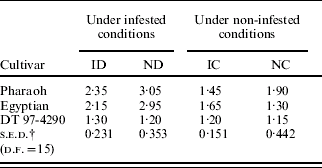
Table 1 shows the score of mean severity of charcoal rot across 2 years on the three cultivars tested. In the control plants, there were no significant (P⩽0·05) differences between the varieties for charcoal rot score. Under infested conditions, Pharaoh and Egyptian had a significantly higher (P⩽0·05) score than DT97-4290. Analysis of variance across years showed significant (P⩽0·01) effects of year, irrigation and cultivar for protein, oil and fatty acid oleic. There were significant year×cultivar and year×infestation interactions for oleic (P⩽0·01) and linolenic (P⩽0·05) acids, as well as significant cultivar×infestation interactions for protein (P⩽0·001) and fatty acids (P⩽0·001). Since there were year×cultivar and year×infestation interactions for some seed composition components (protein and fatty acids), the results are presented separately for each year.
of mean severity of charcoal rot infection across years in cultivars under irrigated-infested/diseased (ID), non-irrigated-infested/diseased (ND), irrigated-non-infetsed/control (IC), and non-irrigated-non-infested/control (NC) conditionsFootnote *
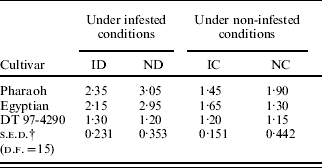
* The severity of internal discolouration for stem and root was measured on a scale of 1–5 (where 1=resistant and 5=susceptible) according to Paris et al. (Reference Paris, Mengistu, Tyler and Smith2006). A rating value of 1=resistant, >1 and ⩽2=moderately resistant, >2 and <3=moderately susceptible, and 3–5=susceptible.
† s.e.d.=Standard error of differences.
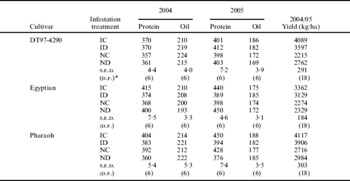
Protein and oil content in 2004 and 2005 are presented in Table 2. In 2004 and 2005, no significant differences in protein or oil levels in DT97-4290 were observed. However, in the cultivar Egyptian, protein was significantly higher under IC than under ID conditions for 2 years. The opposite was observed when Egyptian was grown under non-irrigated conditions, where protein was consistently higher under ND than NC in both years. Pharaoh showed a different pattern in that an increase in protein concentration was observed under non-infested conditions (IC and NC). Oil (Table 2) and saturated fatty acids (palmitic and stearic, data not shown) did not show a consistent pattern.
Mean values of protein and oil concentrations (g/kg DM) in soybean as influenced by charcoal rot infection in 2004 and 2005

* s.e.d.=Standard error of difference; d.f.=degrees of freedom.
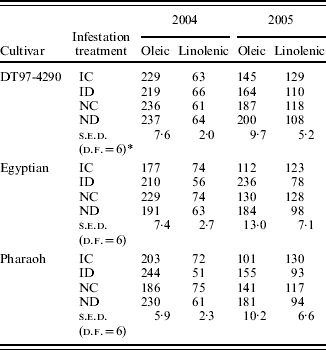
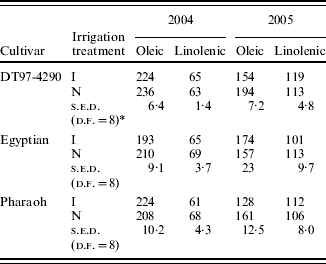
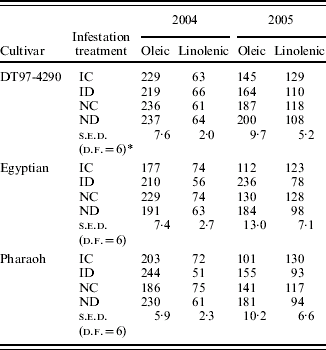
No effects of infestation on oleic and linolenic acid concentrations in DT97-4290 were observed. In the susceptible cultivars, however, oleic acid was significantly (P⩽0·0001) higher in Egyptian under ID than IC for 2 years (Table 3). For Pharaoh, oleic acid was significantly higher under infested (ID and ND) conditions for 2 years (Table 3). It is interesting to note that oleic acid was consistently higher under infested conditions than non-infested conditions in Pharaoh.
Mean values of oleic and linolenic acids concentrations (g/kg DM) in soybean as influenced by charcoal rot infection in 2004 and 2005
* s.e.d.=Standard error of difference; d.f.=degrees of freedom.
Linolenic acid had the opposite trend to oleic acid and was significantly lower under infested conditions in both years in both susceptible cultivars (Table 3).
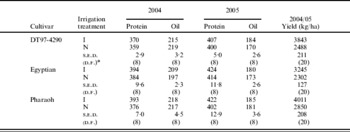
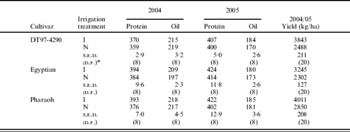
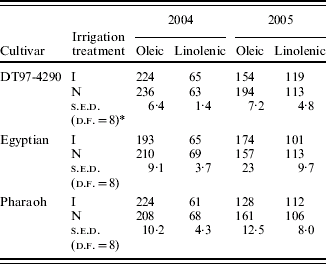
The effect of irrigation type (irrigated and non-irrigated) on protein, oil and oleic and linolenic acids was inconsistent across years (Tables 4 and 5). Yield was consistently higher under irrigated than under non-irrigated conditions in all cultivars (Table 4). However, no significant differences in yield were observed between infested and non-infested plots for each cultivar (Table 2).
Mean values of protein and oil concentrations (g/kg DM) in soybean as influenced by irrigated (I) and non-irrigated (NI) conditions in 2004 and 2005
* s.e.d.=Standard error of difference; d.f.=degrees of freedom.
Mean values of oleic and linolenic acids concentrations (g/kg DM) in soybean irrigated (I) and non-irrigated (NI) conditions in 2004 and 2005
* s.e.d.=Standard error of difference; d.f.=degrees of freedom.
Nitrogen fixation as influenced by charcoal rot
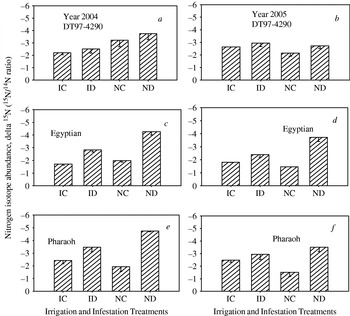
In both years there was a consistent significant (P⩽0·05) enrichment of Delta 15N in susceptible varieties Egyptian and Pharaoh, especially under ND (P⩽0·0001; Fig. 1 c–f). The lower enrichment of Delta 15N in plants in non-infested plots of DT97-4290 indicated that atmospheric nitrogen (N2) was the main source of nitrogen for nodules.
The effect of irrigation and charcoal rot infection on nitrogen isotope abundance Delta 15N as expressed by 15N/14N ratio in DT97-4290, Egyptian, and Pharaoh. Treatments are: IC=irrigated/non-infested; ID=irrigated/infested or irrigated/diseased; NC=non-irrigated/non-infested; ND=non-irrigated/infested or non-irrigated/diseased. Delta 15N in 2004 (a, c and e); in 2005 (b, d and f). Values are mean of three replicates. Bars are mean±standard error of the mean values (s.e.m.).

DISCUSSION
Source of variability
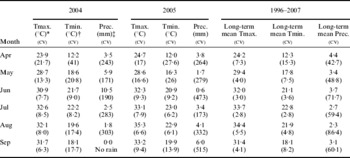
The main effect of year, irrigation, cultivar and infestation was the main source of seed composition variability. Interactions between these factors for some seed composition components indicate seasonal environmental factors of rainfall and temperature cannot be excluded as source of variability. It was observed that temperatures in 2004 were slightly higher than those in 2005 and precipitation during June was higher (10·5 mm in 2004 compared to 0·6 mm in 2005). The effect of environmental factors on soybean for seed yield, protein and oil has been reported to be significant (Wilcox & Shibles Reference Wilcox and Shibles2001). The weather data on rainfall and air temperature (Table 6) (MSUCares 2008) showed that the period from June to August is important, as it coincides with the reproductive period: initial bloom to full bloom (R1–R2) in June; beginning pod to full pod to beginning seed (R3–R4–R5) in July; and full seed to beginning maturity to full maturity (R6–R7–R8) in August. In mid-southern USA, the critical stages of development can occur during greatest drought stress in normal years (Heatherly et al. Reference Heatherly, Blaine, Hodges, Wesley, Buehring, Heatherly and Hodges1998). Therefore, environmental factors cannot be excluded as an additional possible source of seed composition variability. The effect of environmental factors on seed composition is beyond the scope of the present study.
Air temperature (°C), rainfall (mm) at Delta Research and Extension Center, Stoneville, MS, USA in 2004, 2005, and their long-term monthly means and coefficient of variation (CV)

* Tmax.=maximum temperature.
† Tmin.=minimum temperature.
‡ Prec.=precipitation. CV was large because precipitation can range from 0 to170 mm in a month with only 1–3 times of rain per month; this is not unusual for mid-southern USA.
Protein, oil and fatty acids
The stability of protein and oil contents in DT97-4290 and the change in protein and oil contents in susceptible cultivars may indicate that seed composition responds differently, depending on the susceptibility of the cultivar to charcoal rot infection. Although protein and oil levels in DT97-4290 did not decrease under charcoal rot infection, a significant (P⩽0·05) decrease in isoflavones was observed in all cultivars under infection, regardless of the level of susceptibility to charcoal rot (data not shown). This indicates isoflavones in DT97-4290 are more sensitive to charcoal rot infection than protein and oil. The nature of this selective response is not known and requires further investigation.
The consistent decrease in protein and linolenic acid accumulation in Pharaoh under infection could be due to charcoal rot infection, leading to a reduction in seed quality (Gangopadhyay et al. Reference Gangopadhyay, Wyllie and Luedders1970). Since there was a significant decrease in protein in Pharaoh under ND, non-irrigated conditions in combination with the infection may further decrease protein accumulation in this cultivar. This observation is supported by Kendig et al. (Reference Kendig, Rupe and Scott2000), who found that the severity of charcoal rot increased with drought conditions.
Charcoal rot infection did not always lead to a decrease in seed protein concentration as seen in Pharaoh under ID and ND. Egyptian showed a higher protein concentration under ND; this could be due to water stress and charcoal rot infection. Therefore, the trend of decrease or increase in seed protein in susceptible cultivars may depend on cultivar and irrigation management. This explanation is supported by other workers like Hoffman et al. (Reference Hoffman, Hartman, Mueller, Leitz, Nickell and Pedersen1998), who showed that increasing infection with S. sclerotiorum led to increased seed protein content in cultivar A3304, but not in the other four cultivars. Ziems et al. (Reference Ziems, Giesler, Graef, Redinbaugh, Vacha, Berry, Madden and Dorrance2007) found that infected soybean with bean pod mottle virus had increased seed protein and decreased oil. It has also been reported that the increase of protein concentration often reduces oil concentration (Brim & Burton Reference Brim and Burton1979; Burton Reference Burton and Shibles1985; Wilson Reference Wilson, Boerma and Specht2004) and often, but not always, lower yield (Brim & Burton Reference Brim and Burton1979). The present results are in agreement with the above research for the protein increase in Egyptian in ND, for protein decrease in Pharaoh in ID and ND and for the inverse relationship between protein and oil concentrations (when protein and oil concentration in 2004 and 2005 are compared). Although the inverse relationship between protein and oil was thought to be genetically controlled, associated with environment and gene interactions and related to energy cost partitioning between protein and oil syntheses (Egli & Bruening Reference Egli and Bruening2007), the mechanism controlling this relationship is still unknown. It must be noted that the response of these cultivars to the infection and their impact on seed composition cannot be generalized for other susceptible or resistant cultivars. In addition, a combination of charcoal rot infection, genotype, environmental factors of rainfall and temperature could be another possible source of seed composition variability.
Other data from the present 2-year field experiment (not shown) suggested that the concentrations of calcium (Ca), zinc (Zn), and boron (B) in the seeds were significantly higher under irrigated and infected condition in DT97-4290 than in Egyptian and Pharaoh for the 2 years. Although the effect of mineral nutrition on fungal disease control has been reported extensively (Corden Reference Corden1965; Ollagnier & Renard Reference Ollagnier and Renard1976; Graham & Webb Reference Graham, Webb, Mortvedt, Cox, Shuman and Welch1991), the roles of Ca, B and Zn in the charcoal rot resistance and its influence on soybean seed composition is still not well known. One possible explanation is that Ca and B are taken up at higher rates in DT97-4290 than in Egyptian and Pharaoh as a response to disease infection for cell-wall stability and integrity. The roles of Ca and B in the cell wall has been reported by several authors (Konno et al. (Reference Konno, Yamaya, Yamasaki and Matsumoto1984) for Ca, and Brown & Hu (Reference Brown and Hu1996) and Hu et al. (Reference Hu, Brown and Labavitch1996) for B). The lower levels of Ca and B in seed may be due to infected root in susceptible cultivars.
The consistent increase of oleic fatty acid in Pharaoh under infested conditions and in Egyptian under infested and irrigated conditions may suggest that oleic fatty acid may play a role under charcoal rot infection, or its increase may be a result of charcoal rot stress. The different trend between oleic and linolenic acid may be due to a reciprocal change in polyunsaturated fatty acids, which is related to changes in the activity of the desaturase enzyme (Bennett et al. Reference Bennett, Yu, Heatherly and Krishnan2004).
The effect of irrigation and non-irrigation on protein, oil, and oleic and linolenic acids was inconsistent across years. Kendig et al. (Reference Kendig, Rupe and Scott2000) showed that when irrigation was terminated in well-watered plots at growth stage R2, Macrophomina phaseolina microsclerotial densities in the roots increased, indicating increased root colonization. Matheny & Hunt (Reference Matheny and Hunt1981) and Sweeney et al. (Reference Sweeney, Long and Kirkham2003) reported that protein and oil accumulation did not respond to irrigation, but Bellaloui & Mengistu (Reference Bellaloui and Mengistu2008) found that irrigation type influenced significantly seed protein, oil, and oleic and linolenic acids in soybean. However, this influence depended on the cultivar. The inconsistency of the effect of irrigation on seed composition may be due to the variability in environmental factors such as rainfall and temperature during the growing season, and cultivar/genotype differences.
The significantly higher yield under irrigated than non-irrigated conditions in all the cultivars is in agreement with reports by Heatherly et al. (Reference Heatherly, Blaine, Hodges, Wesley, Buehring, Heatherly and Hodges1999). In spite of the effect of charcoal rot infestation in soil on seed composition, no significant differences in yield between infested and non-infested plots were found for all cultivars within each irrigation treatment. It is clear that under infestation Egyptian and Pharaoh had a higher infection score than DT92-4290, but under non-infestation the endogenous pathogen was still present at lower levels. Therefore, a greater differential in charcoal rot pressure between the treatments may have been required to see an effect on yield. The authors of this paper suggest that alteration in seed composition occurred in susceptible cultivars without yield differences. Although the alteration of seed composition can be explained as a stress response resulting from the charcoal rot infection, genotypic differences between cultivars and environmental factors of rainfall and temperature could be other possible sources for seed composition differences. The observation that seed composition changed without yield differences under stressed and non-stressed conditions was observed in soybean in an another study (Bellaloui et al. Reference Bellaloui, Zablotowicz, Reddy and Abel2008). Bellaloui et al. (Reference Bellaloui, Zablotowicz, Reddy and Abel2008) found that the application of high dose of glyphosate to glyphosate-resistant soybean resulted in a significant increase in oleic acid and protein contents and decrease in linolenic acid in seed without yield differences between treated and non-treated soybean.
Nitrogen fixation using delta 15N natural abundance analysis
The present results are in agreement with those reported by Sprent et al. (Reference Sprent, Geoghegan, Whitty and James1996) in that plants which fix part or entire nitrogen content for their needs will have lower 15N than plants which obtain entire nitrogen for their needs from the soil. The enrichment of 15N under infested conditions in susceptible cultivars suggested charcoal rot may have negatively affected nodules' growth and nitrogen fixation capacity. One possible explanation is that when nitrogen fixation decreases, soil nitrate may be used to compensate for nitrogen fixation reduction caused by possible nodule damage in susceptible varieties. The higher 15N/14N ratio in the susceptible cultivars under infested conditions, especially under non-irrigated conditions indicates that both cultivars took up more 15N (soil nitrogen) and less 14N (atmospheric nitrogen), suggesting that nitrogen fixation was substantially lower under infested conditions and source of nitrogen used in nitrogen metabolism (assimilation and fixation) was altered. This suggestion is supported by the observation that the susceptible cultivars showed a significant alteration in 15N/14N ratio compared with the moderately resistant line. It appears that nitrogen fixation is more sensitive to infection than nitrogen assimilation. This may be one of the mechanisms used in maintaining nitrogen level in seeds under biological and environmental stresses (Bellaloui & Mengistu Reference Bellaloui and Mengistu2008), where nitrate uptake by roots and root nodules is inhibited. This observation may have a significant agricultural application for yield increase and higher seed quality through maintaining an optimum Rhizobium level under charcoal rot infection. The agricultural implication of this observation needs further investigation before a recommendation is made.
In conclusion, the increase or decrease of protein in susceptible cultivars in response to charcoal rot infection may depend on the cultivar and irrigation management. Maintaining protein concentrations in the moderately resistant line may be due to less infection by charcoal rot and healthy root system. The alteration in seed composition in susceptible cultivars could be due to the infection of the disease and root damage. The higher level of oleic acid under infected conditions is interesting and needs further investigation. Variability of seasonal factors of rainfall and temperature, and genotype differences between cultivars could be another possible source of seed compositional differences. The higher 15N/14N ratio in the susceptible cultivars under infected conditions may indicate the possible negative impact of charcoal infection on growth and function of nodule, and nitrogen fixation capacity. In spite of current management strategies to reduce the impact of charcoal rot on yield and seed quality, the most effective approach is the use of resistant or tolerant soybean cultivars. Since there are no commercial resistant cultivars available, and water management can have a significant effect on root colonization by M. phaseolina (Kendig et al. Reference Kendig, Rupe and Scott2000), tolerant cultivars with appropriate water management may provide soybean producers with an alternative approach for charcoal rot management. The current information is valuable for soybean breeding programmes for seed composition improvement.
We are highly grateful to Dr Anne M. Gillen for reviewing the manuscript; Sandra Mosley, Gary Shelton, Will Marlow, Avis Clark, and Annie Johnson for field and laboratory technical assistance. Also, we are thankful to Dr Craig A. Abel and Leslie Price for their technical assistance in nitrogen isotope measurement.