Introduction
Early life adversity (ELA) refers to a broad set of negative experiences in childhood that are likely to require psychological or neurobiological adaptation and that represent a deviation from the expected early environment (McLaughlin, Reference McLaughlin2016). Exposure to ELA is associated with increased risk for psychopathology across the life-course both in the US (Green et al., Reference Green, McLaughlin, Berglund, Gruber, Sampson, Zaslavsky and Kessler2010; McLaughlin et al., Reference McLaughlin, Green, Alegría, Costello, Gruber, Sampson and Kessler2012a, Reference McLaughlin, Green, Gruber, Sampson, Zaslavsku and Kessler2012b) and cross-nationally (Kessler et al., Reference Kessler, McLaughlin, Green, Gruber, Sampson, Zaslavsky, Aguilar-Gaxiola, Alhamzawi, Alonso, Angermeyer, Benjet, Bromet, Chatterji, de Girolamo, Demyttenaere, Fayyad, Florescu, Gal, Gureje, Haro, Hu, Karam, Kawakami, Lee, Lepine, Ormel, Posada-Villa, Sagar, Tsang, Bedirhan, Vassilev, Viana and Williams2010). Despite the robust link between ELA and psychopathology, mechanisms linking ELA to the onset of psychopathology remain poorly understood. One potential mechanism is accelerated pubertal timing (one's stage of pubertal development relative to age-matched peers), given that exposure to ELA is associated with earlier pubertal onset (Graber et al., Reference Graber, Brooks-Gunn and Warren1995; Ellis and Garber, Reference Ellis and Garber2000), especially in girls (Mendle et al., Reference Mendle, Harden, Brooks-Gunn and Graber2010; Joinson et al., Reference Joinson, Heron, Lewis, Croudace and Araya2011). Although accelerated pubertal timing is associated with risk for a diverse set of mental disorders (Ullsperger and Nikolas, Reference Ullsperger and Nikolas2017), little research has directly examined whether early onset of puberty is a mechanism explaining elevated risk for psychopathology in youth who have experienced ELA (see Mendle et al., Reference Mendle, Leve, Van Ryzin and Natsuaki2014; Belsky et al., Reference Belsky, Ruttle, Boyce, Armstrong and Essex2015; Negriff et al., Reference Negriff, Saxbe and Trickett2015 for work that has explored this idea). Accordingly, this study empirically examines variation in pubertal timing as a mechanism through which ELA exposure confers risk for the onset of psychopathology during adolescence.
Extensions of life history theory to humans have posited that certain types of ELA may accelerate pubertal timing, in order to maximize reproduction prior to mortality (Belsky et al., Reference Belsky, Steinberg and Draper1991; Ellis et al., Reference Ellis, Figueredo, Brumbach and Schlomer2009). Specifically, ELA characterized by environmental harshness (e.g. trauma, violence exposure) is thought to accelerate pubertal timing (Ellis et al., Reference Ellis, Figueredo, Brumbach and Schlomer2009; Belsky, Reference Belsky2012a). Recent conceptual models have highlighted the importance of distinguishing between ELA experiences characterized by threat (i.e. experiences involving trauma/threat of harm to the child, such as abuse and exposure to violence) v. deprivation (i.e. experiences involving an absence of expected environmental inputs, such as physical and psychosocial neglect and food insecurity) (McLaughlin et al., Reference McLaughlin, Sheridan and Lambert2014; Sheridan and McLaughlin, Reference Sheridan and McLaughlin2014; Humphreys and Zeanah, Reference Humphreys and Zeanah2015; McLaughlin and Sheridan, Reference McLaughlin and Sheridan2016). Experiences involving threat and deprivation have increasingly been shown to have unique consequences in the domains of emotion, cognition, and neural development (Busso et al., Reference Busso, McLaughlin and Sheridan2016; Everaerd et al., Reference Everaerd, Klumpers, Zwiers, Guadalupe, Franke, van Oostrom, Schene, Fernandez and Tendolkar2016; Dennison et al., Reference Dennison, Rosen, Sambrook, Jenness, Sheridan and McLaughlin2017; Lambert et al., Reference Lambert, King, Monahan and McLaughlin2017; Sheridan et al., Reference Sheridan, Peverill, Finn and McLaughlin2017; Rosen et al., Reference Rosen, Sheridan, Sambrook, Meltzoff and McLaughlin2018), although it is unknown whether they have differential associations with pubertal timing. Harshness maps on well to the threat dimension of ELA, suggesting that experiences of threat may accelerate pubertal timing (Sung et al., Reference Sung, Simpson, Griskevicius, I-Chun Kuo, Schlomer and Belsky2016). However, it is unclear how experiences of deprivation align with life history theory; whereas nutritional deprivation/food insecurity and famine are thought to delay pubertal timing to ensure maximal bioenergetic resources should reproduction occur (van Noord and Kaaks, Reference van Noord and Kaaks1991; Prebeg and Bralic, Reference Prebeg and Bralic2000; Rogol et al., Reference Rogol, Clark and Roemmich2000), specific predictions about psychosocial neglect are lacking. Determining whether accelerated pubertal timing is associated with exposure to ELA generally or with particular dimensions of ELA may help to elucidate specific psychobiological mechanisms underlying these associations (McLaughlin, Reference McLaughlin2016).
To date, few studies have empirically examined whether different dimensions of ELA have distinct associations with pubertal timing. Prior work examining the effects of specific types of adversity suggests that child abuse and family composition (such as absence of a biological father/presence of a step-father) are associated with earlier pubertal timing, particularly in females (i.e. Ellis and Garber, Reference Ellis and Garber2000; Belsky et al., Reference Belsky, Steinberg, Houts, Friedman, DeHart, Cauffman, Roisman, Halpern-Felsher and Susman2007; Ryan et al., Reference Ryan, Mendle and Markowitz2015; Noll et al., Reference Noll, Trickett, Long, Negriff, Susman, Shalev, Li and Putnam2017). Less work has examined deprivation and pubertal timing (Ellis, Reference Ellis2004; Belsky, Reference Belsky2012b). Existing work typically finds no association between psychosocial neglect and pubertal timing (Mendle et al., Reference Mendle, Leve, Van Ryzin, Natsuaki and Ge2011; Ryan, Mendle and Markowitz, Reference Ryan, Mendle and Markowitz2015; Reid et al., Reference Reid, Miller, Dorn, Desjardins, Donzella and Gunnar2017), although two studies found an association between material deprivation as measured by socioeconomic status (SES) and accelerated pubertal timing (James-Todd et al., Reference James-Todd, Tehranifar, Rich-Edwards, Titievsky and Terry2010; Sun et al., Reference Sun, Mensaw, Azzopardi, Patton and Wake2017). In contrast, studies of war and famine suggest that severe deprivation can delay pubertal development (van Noord and Kaaks, Reference van Noord and Kaaks1991; Prebeg and Bralic, Reference Prebeg and Bralic2000). A central issue in most prior work on this topic is a failure to assess and adjust for co-occurring forms of ELA. Such an approach is critical when evaluating potential specificity in associations with pubertal timing because experiences of ELA are highly co-occurring (Kessler et al., Reference Kessler, McLaughlin, Green, Gruber, Sampson, Zaslavsky, Aguilar-Gaxiola, Alhamzawi, Alonso, Angermeyer, Benjet, Bromet, Chatterji, de Girolamo, Demyttenaere, Fayyad, Florescu, Gal, Gureje, Haro, Hu, Karam, Kawakami, Lee, Lepine, Ormel, Posada-Villa, Sagar, Tsang, Bedirhan, Vassilev, Viana and Williams2010; McLaughlin et al., Reference McLaughlin, Green, Alegría, Costello, Gruber, Sampson and Kessler2012a, Reference McLaughlin, Green, Gruber, Sampson, Zaslavsku and Kessler2012b). In a smaller community sample, we found that whereas exposure to threat-related ELA was associated with the advanced pubertal stage, exposure to deprivation was associated with the delayed pubertal stage, after controlling for experiences of threat (Sumner et al., Reference Sumner, Colich, Uddin, Armstrong and McLaughlin2018). Inconsistencies in the prior literature exploring associations between ELA and pubertal timing may be due, in part, to lack of consideration of how different dimensions of environmental experience uniquely influence these associations.
Here we evaluate whether distinct dimensions of ELA – specifically, experiences of threat and deprivation – have differential associations with pubertal timing and whether accelerated pubertal timing is a mechanism linking ELA with the onset of psychopathology during adolescence. We examine these questions among a nationally representative sample of females, using age at menarche (AAM) as our marker of pubertal timing. We hypothesized that exposure to threat would be associated with earlier AAM, even after controlling for co-occurring exposure to deprivation. Given mixed findings regarding associations between deprivation and pubertal development, we did not expect to find associations between deprivation and AAM. Building on prior work demonstrating that ELA and accelerated pubertal timing are associated with adolescent psychopathology (McLaughlin et al., Reference McLaughlin, Green, Alegría, Costello, Gruber, Sampson and Kessler2012a, Reference McLaughlin, Green, Gruber, Sampson, Zaslavsku and Kessler2012b; Platt et al., Reference Platt, Colich, McLaughlin, Gary and Keyes2017), we expected that the association between exposure to threat, controlling for co-occurring exposure to deprivation, and adolescent-onset mental disorders would be mediated by earlier AAM.
Methods
Sample
Data were from the National Comorbidity Survey Adolescence Supplement (NCS-A). As described elsewhere (Kessler et al., Reference Kessler, Avenevoli, Costello, Green, Gruber, Heeringa, Merikangas, Pennell, Sampson and Zaslavsky2009a, Reference Kessler, Avenevoli, Costello, Green, Gruber, Heeringa, Merikangas, Pennell, Sampson and Zaslavsku2009b, Reference Kessler, Avenevoli, Green, Gruber, Guyer, He, Jin, Kaufman, Sampson, Zaslavsky and Merikangas2009c) the NCS-A data were collected from 2001–2004. Adolescents aged 13–18 were interviewed face-to-face in dual-frame household and school samples. See online Supplementary Materials for more detail on sample selection.
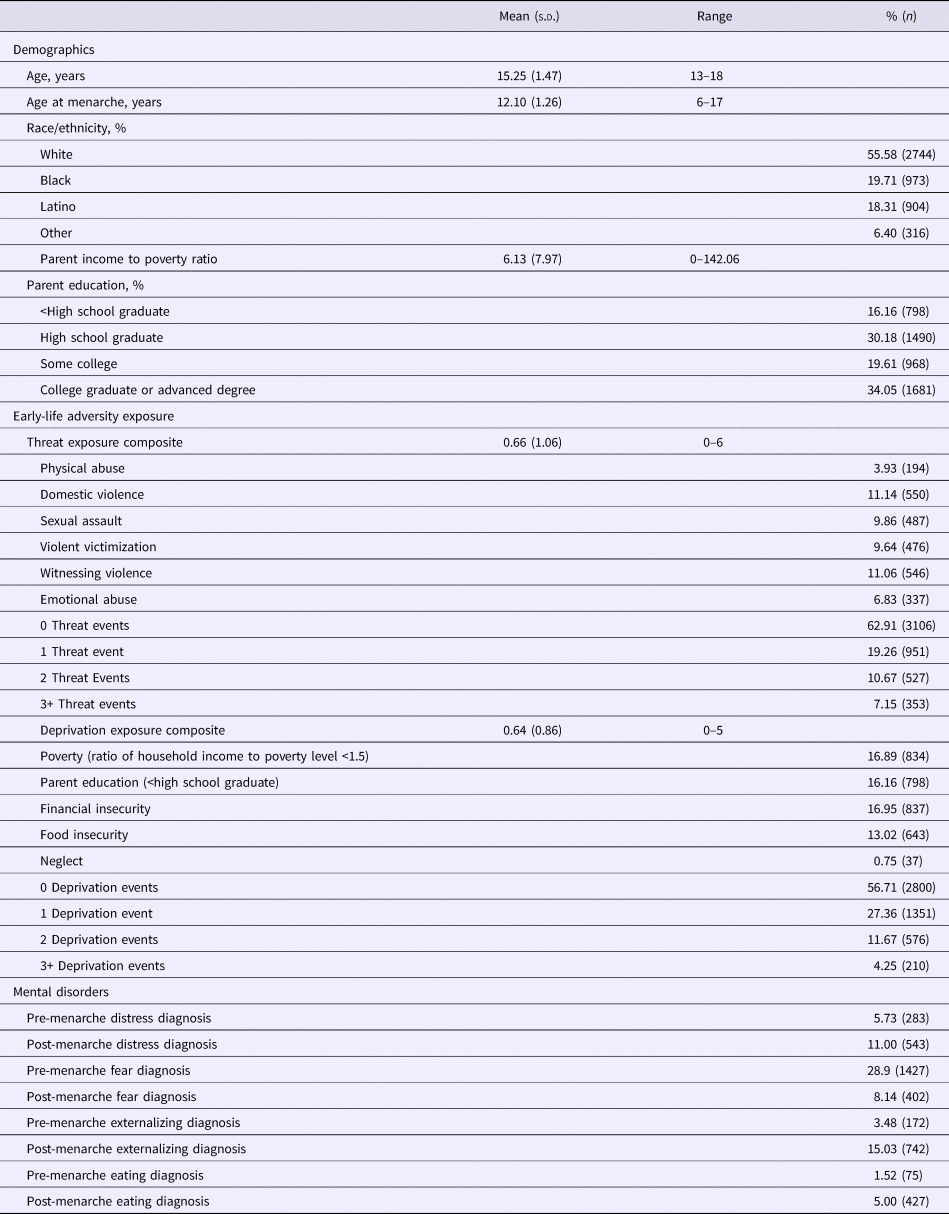
The NCS-A sample includes 10 148 participants and 5183 females (51.1%). We focus here only on girls given the literature suggesting that the association between ELA and pubertal timing is stronger in girls, and because pubertal timing was measured only by AAM and no similar measure was available for males. Females with missing responses for AAM (n = 83; 1.6%) and those who had not begun menstruating (n = 163; 3.1%) were excluded from the analyses. The final sample size included is 4937 participants. See Table 1 for sample demographics.
Participant characteristics

s.d., standard deviation.
Measures
Early life adversity
Exposure to ELA was assessed using both child interviews and parent self-administered questionnaires of 11 types of childhood adversity. Following prior work in this sample (McLaughlin et al., Reference McLaughlin, Green, Alegría, Costello, Gruber, Sampson and Kessler2012a, Reference McLaughlin, Green, Gruber, Sampson, Zaslavsku and Kessler2012b; Platt et al., Reference Platt, McLaughlin, Luedtke, Ahern, Kaufman and Keyes2018), threat-related adversities included six specific adversities including physical abuse, witnessing domestic violence, sexual assault, witnessing or being the victim of violence in the community, and emotional abuse. Deprivation-related adversities included five specific adversities including physical and psychosocial neglect, financial insecurity (i.e. family received money from a government assistant program), food insecurity, low parental education attainment (less than a high school degree), and household poverty (ratio of household income to poverty level <1.5). All adversities were coded dichotomously. We created a composite score for each dimension of adversity (threat and deprivation) by summing across all child- or parent-reports for each type of adversity. See online Supplementary Materials for more information about the measurement of ELA. We included poverty and low parental education as indicators of deprivation in our models, consistent with earlier work in this sample (Platt et al., Reference Platt, McLaughlin, Luedtke, Ahern, Kaufman and Keyes2018) and based on extensive evidence demonstrating that children from families with low parental education and/or income experience reductions in cognitive and social stimulation than children from higher-SES families (Bradley et al., Reference Bradley, Corwyn, Burchinal, McAdoo and Coll2001; Duncan and Magnuson, Reference Duncan and Magnuson2012). However, poverty has also been conceptualized as a risk factor for, rather than a direct marker of, deprivation (McLaughlin et al., Reference McLaughlin, Sheridan and Lambert2014; Sheridan and McLaughlin, Reference Sheridan and McLaughlin2014). Results were consistent when we removed poverty and parental education from our deprivation composite, and we retain them in final models.
We evaluated whether associations of ELA with AAM and mental disorders were due to experiencing any threat or deprivation experience, and whether the effects were due to cumulative exposure to ELAs, measured by a count of the number of threat and deprivation experiencesFootnote 1.
Age at menarche
AAM was assessed via self-report. Girls were asked the age at which they had their first period, in whole year increments. Responses ranged from 6–17 years of age (mean = 12.10 years of age, median = 12.0 years of age)Footnote 2. AAM was modeled as a continuous variable. Interview-based assessments of AAM in adolescence have been shown to be acceptably reliable (Dorn et al., Reference Dorn, Sontag-Padilla, Pabst, Tissot and Susman2013).
Mental disorders
Adolescents were administered a modified version of the CIDI, a fully structured, valid and reliable interview administered by trained interviewers that assesses both lifetime and past-year DSM-IV disorders (Kessler and Üstün, Reference Kessler and Üstün2004; Kessler et al., Reference Kessler, Avenevoli, Costello, Green, Gruber, Heeringa, Merikangas, Pennell, Sampson and Zaslavsky2009a, Reference Kessler, Avenevoli, Costello, Green, Gruber, Heeringa, Merikangas, Pennell, Sampson and Zaslavsku2009b, Reference Kessler, Avenevoli, Green, Gruber, Guyer, He, Jin, Kaufman, Sampson, Zaslavsky and Merikangas2009c). Age-of-onset of each disorder was assessed using procedures shown experimentally to improve the accuracy of these reports (Knäuper et al., Reference Knäuper, Cannell, Schwarz, Bruce and Kessler1999). We used this information to determine whether a disorder onset was pre- or post-menarche. We examined fifteen adolescent disorders, and conducted a confirmatory factor analysis to reduce the data to four disorder groups based on prior work in this sample: fear disorders (panic disorder with/without agoraphobia, agoraphobia without panic disorder, social phobia, specific phobia), distress disorders (major depressive disorder/dysthymia, generalized anxiety disorder, post-traumatic stress disorder), externalizing disorders [oppositional defiant disorder, conduct disorder, alcohol abuse, drug abuse, tobacco abuse (with or without dependence)], and eating disorders (anorexia, bulimia, binge eating; McLaughlin et al., Reference McLaughlin, Green, Alegría, Costello, Gruber, Sampson and Kessler2012a, Reference McLaughlin, Green, Gruber, Sampson, Zaslavsku and Kessler2012b; Platt et al., Reference Platt, Colich, McLaughlin, Gary and Keyes2017). This model fit the data well (CFI = 0.94; RMSEA = 0.029; Hu and Bentler, Reference Hu and Bentler1999).
Each disorder onset was classified as having occurred pre- or post-menarche. Participants could have experienced both a pre-menarche and post-menarche disorder in the same disorder group [e.g. a participant could have experienced specific phobia at age 4 (pre-menarche) and social phobia at age 14 (post-menarche)].
Covariates
Models were adjusted for age, race/ethnicity, body mass index (BMI), and pre-menarche onset disorders and SES (for models that did not include deprivation). See online Supplementary Materials for more details.
Data analysis
We first used linear regression to estimate associations between ELAs (independent variables; threat and deprivation adversities) and menarche age (dependent variable). Second, we used logistic regression to estimate the associations of ELAs (independent variables: threat and deprivation adversities) with post-menarche disorder onset, separately for fear, distress, externalizing, and eating disorders (dependent variables). Third, we used logistic regression to estimate the associations between menarche age (independent variable) and post-menarche disorder onset for each disorder group (dependent variables). We tested a mediation model only when there was a significant association between ELA and AAM, and AAM and a disorder group. We implemented the mediation analysis by fitting linear regression models to estimate the distribution of the mediator given the observed exposure and covariate values, and logistic regression models to estimate the distribution of the outcome given the observed exposure, mediator, and covariate values. These fitted models were used to estimate the indirect pathway parameters, interpreted as the log odds of developing a post-menarche disorder for each ELA a participant experienced, mediated by a 1-year change in AAM (see online Supplementary Materials for details). Robust standard errors were computed to estimate 95% confidence intervals, using quasi-Bayesian Monte Carlo methods based on normal approximation (Imai et al., Reference Imai, Keele and Tingley2010).
Sensitivity analyses
Timing of exposure was assessed for most threat-related adversities, but none of the deprivation-related adversities. We did not incorporate information on timing of exposure into our main analyses because we did not want to introduce a systematic difference between how threat and deprivation-related adversities were assessed. However, in order to ensure findings do not reflect reverse causality, we ran sensitivity analyses excluding instances of sexual assault, physical abuse, witnessing domestic violence and witnessing or being the victim of violence in the community that occurred post-menarche. The direction and significance of our results were unchanged in these models, which are reported in the online Supplementary Materials.
Finally, given that the threat composite included six indicators and the deprivation composite included only five, we wanted to ensure that the reduced range in the deprivation composite was not responsible for our results. To do so, we created a standardized score (M = 0, s.d. = 1) of each composite, consistent with prior work (Sumner et al., Reference Sumner, Colich, Uddin, Armstrong and McLaughlin2018). Using these composites did not change the direction or significance of our results (see online Supplementary Materials).
Results
Early life adversity and age at menarche
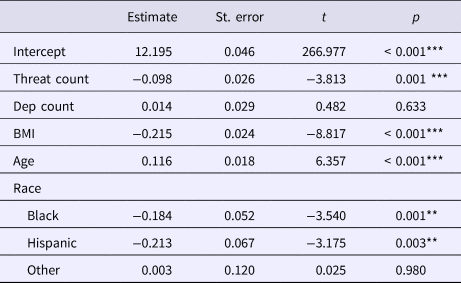
We first examined whether the number of threat or deprivation experiences was associated with AAM (Table 2). Here, a greater number of threat-related exposures was associated with earlier AAM (B = −0.1, s.e. = 0.03, p = 0.001; Fig. 1a). The number of deprivation exposures was not associated with AAM (B = 0.01, s.e. = 0.03, p = 0.63; Fig. 1b). See online Supplementary Table S2 for estimates for all individual indicators of threat and deprivation.
Regression parameters for associations of childhood adversity and age at menarche

*p < 0.05, **p < 0.01, ***p < 0.001.
(a) Adjusted age at menarche for individuals who experienced 0, 1, 2, or 3+ threat-related early life adversity experiences. Model adjusted for age, race/ethnicity, and deprivation-related ELA. Error bars represent standard errors. (b) Adjusted age at menarche for individuals who experienced 0, 1, 2, or 3+ threat-related early life deprivation experiences. Model adjusted for age, race/ethnicity, and threat-related ELA. Error bars represent standard errors.

Early life adversity and post-menarche mental disorders
We next examined how the number of threat-related or deprivation-related experiences predicted post-menarche disorder onset (online Supplementary Table S3; Model 1). Experiencing a greater number of threat-related ELAs was associated with elevated odds of post-menarche distress (OR 1.71, 95% CI 1.49–1.97, p < 0.001), fear (OR 1.35, 95% CI 1.19–1.52, p < 0.001), externalizing (OR 1.82, 95% CI 1.61–2.05, p < 0.001), and eating disorders (OR 1.49, 95% CI 1.27–1.75, p < 0.001). Exposure to a greater number of deprivation-related adversities was associated with elevated odds of post-menarche externalizing disorders (OR 1.2, 95% CI 1.04–1.39, p < 0.05). See online Supplementary Table S2 (Model 2) for ORs for all individual indicators of threat and deprivation-related forms of adversity.
Age at menarche and post-menarche mental disorders
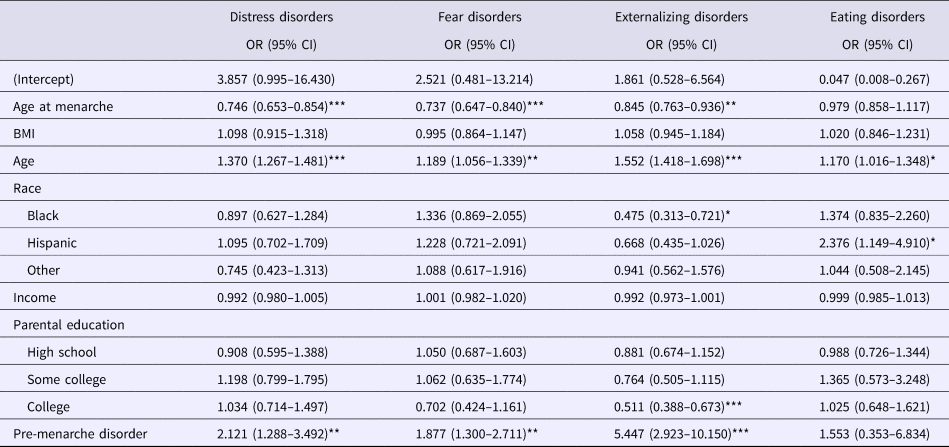
We conducted four separate logistic regressions to evaluate whether AAM was associated with the post-menarche onset of each disorder group. Later AAM was associated with reduced odds of experiencing post-menarche distress (OR 0.75, 95% CI 0.65–0.85, p < 0.001), fear (OR 0.74, 95% CI 0.65–0.84, p < 0.001), and externalizing disorders (OR 0.85, 95% CI 0.76–0.94, p < 0.01), but not eating disorders (OR 0.98, 95% CI 0.86–1.12, p = 0.70; Table 3). These results indicate that earlier age of menarche is associated with elevated odds of post-menarche distress, fear, and externalizing disorders.
Odds ratios for associations of age at menarche and post-menarche mental disorders

*p < 0.05, **p < 0.01, ***p < 0.001.
Mediation results
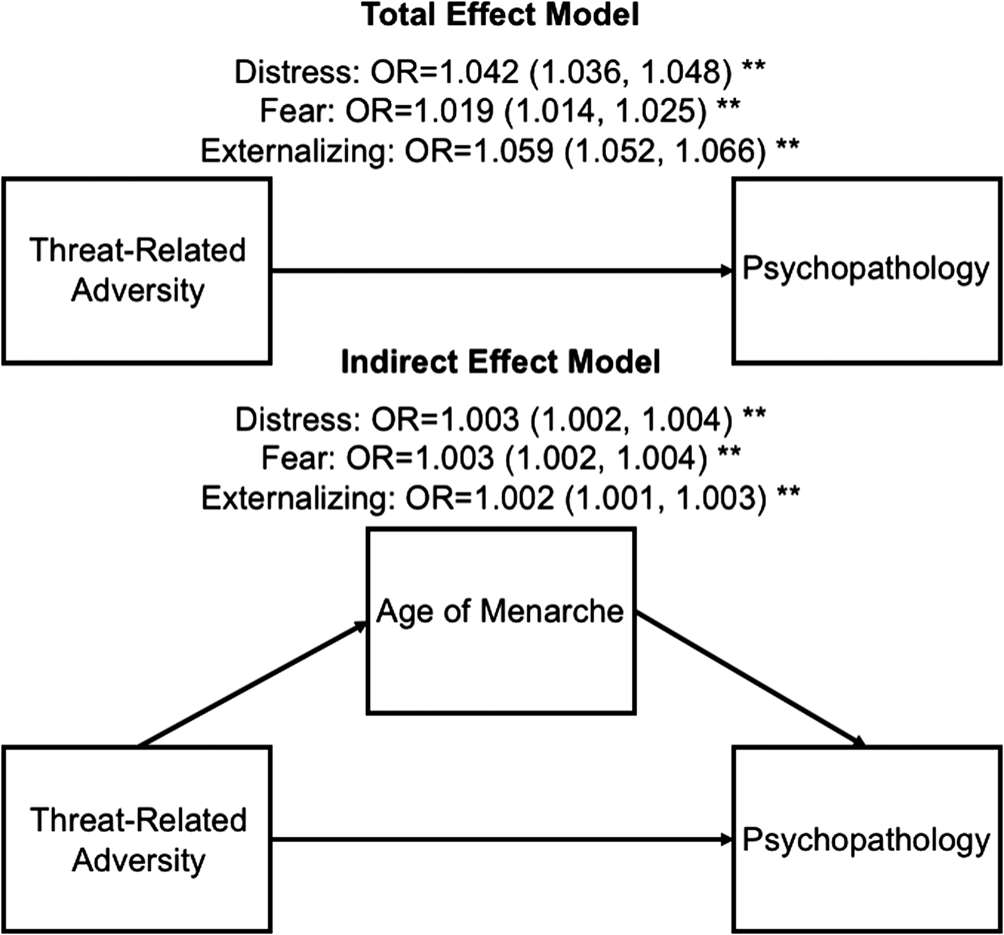
We tested whether AAM mediated the association between threat-related ELA and post-menarche disorder onset (Fig. 2; online Supplementary Table S4). We observed a significant indirect effect of cumulative threat-related ELAs on distress (B = 0.003, OR 1.003, 95% CI 1.002–1.004; proportion mediated = 6.2%), fear (B = 0.003, OR 1.003, CI 1.002–1.004; proportion mediated = 16.3%), and externalizing disorders (B = 0.002, OR 1.002, CI 1.001–1.003; proportion mediated = 2.9%) through earlier AAM. These results can be interpreted as the increased log odds of each disorder group for each experience of threat-related ELA, mediated by a 1-year decrease in menarche onset, and indicate that accelerated pubertal timing is a mediator of the association between threat-related ELA and adolescent-onset mental disorders.
Total and indirect effect of threat-related ELA exposure on the onset of mental disorder (separate models for distress, fear, and externalizing disorders) through age at menarche. Model adjusted for age, race/ethnicity, SES, and pre-menarche disorder.

Discussion
We provide novel evidence that a specific dimension of ELA (i.e. threat but not deprivation) is associated with earlier AAM in females, and that this accelerated pubertal timing is a transdiagnostic mechanism contributing – in part – to the association between ELA and onset of mental disorders in adolescence. Specifically, experiences of threat, but not deprivation, were associated with earlier AAM. Earlier AAM, in turn, was associated with increased odds of experiencing an onset of distress, fear, and externalizing disorders post-menarche. Critically, we demonstrate that earlier AAM partially mediates the association between threat-exposure in childhood and the onset of post-menarche distress, fear, and externalizing disorders. These findings suggest that accelerated pubertal development may be one potential pathway through which trauma exposure confers risk for psychiatric disorders in adolescent females.
Extensions of life history theory to humans has posited that exposure to environmental harshness (i.e. threat) in childhood accelerates maturation, in order to increase the likelihood of reproduction prior to potential mortality (Rickard et al., Reference Rickard, Frankenhuis and Nettle2014). Our evidence is consistent with this theory, as a greater number of threat-related experiences in childhood was associated with earlier AAM. They also replicate recent findings from our lab demonstrating that threat-related adversities are associated with accelerated pubertal development, whereas deprivation-related adversities are associated with delayed pubertal development (Sumner et al., Reference Sumner, Colich, Uddin, Armstrong and McLaughlin2018). The mechanisms through which ELA influences pubertal timing remain unknown. One possibility is that ELA provides an early signal to the organisms about the type of environment they are likely to experience, which allows the development of an appropriate phenotype for that environment; the neurobiological mechanisms that could mediate this type of early forecasting remain unknown, but most likely involve the hypothalamic-pituitary-adrenal (HPA) axis (Saxbe et al., Reference Saxbe, Margolin, Spies Shapiro, Ramos, Rodriguez and Iturraide2014; Negriff et al., Reference Negriff, Saxbe and Trickett2015). Alternatively, increasing evidence suggests that ELA – particularly experiences of threat – are associated with accelerated cellular and epigenetic aging (Wolf et al., Reference Wolf, Maniates, Nugent, Maihofer, Armstrong, Ratanatharathorn, Ashley-Koch, Garrett, Kimbrel, Lori, Aiello, Baker, Beckham, Boks, Galea, Geuze, Hauser, Kessler, Koenen, Miller, Kessler, Risbrough, Rutten, Stein, Ursano, Vermetten, Vinkers, Uddin, Smith, Nievergelt and Logue2017; Sumner et al., Reference Sumner, Colich, Uddin, Armstrong and McLaughlin2018). Recent models argue that internal markers of aging provide a signal to the reproductive system that accelerates sexual maturation in response to advanced biological aging (Nettle et al., Reference Nettle, Frankenhuis and Rickard2013; Rickard et al., Reference Rickard, Frankenhuis and Nettle2014). Finally, evidence from animal models suggests that ELA influences epigenetic programing which in turn, signals the onset of pubertal development (Cameron et al., Reference Cameron, Del Corpo, Diorio, McAllister, Sharma and Meaney2008; Cameron, Reference Cameron2011). Future research is needed to directly evaluate these mechanisms.
In contrast, we found no evidence for an association between deprivation and altered pubertal timing. Life history theory posits that deprivation of bioenergetics resources could result in delayed maturation and later AAM (Ellis et al., Reference Ellis, Figueredo, Brumbach and Schlomer2009). It is likely that deprivation in our modern context is not the same as deprivation in our evolutionary past. Although food insecurity is common in the U.S. and associated with youth psychopathology (McLaughlin et al., Reference McLaughlin, Green, Alegría, Costello, Gruber, Sampson and Kessler2012a, Reference McLaughlin, Green, Gruber, Sampson, Zaslavsku and Kessler2012b), caloric intake may be sufficient to support metabolic processes even in individuals who experience food insecurity and nutrient deficiency in the US (Barrett, Reference Barrett2010). It is possible that more extreme forms of deprivation in contexts where food scarcity is associated with significantly decreased caloric intake may be more strongly associated with pubertal timing, particularly delayed the onset of puberty, consistent with prior studies of war-related famine (van Noord and Kaaks, Reference van Noord and Kaaks1991; Prebeg and Bralic, Reference Prebeg and Bralic2000). These findings highlight the importance of considering the nature of the exposure when exploring the developmental consequences of ELA. Future research should carefully distinguish between the effects of threat- and deprivation-related adversities on pubertal timing.
Accelerated life history strategies stemming from early environmental circumstances may be adaptive in terms of reproductive fitness but appear to have deleterious consequences for mental health. We provide novel evidence that accelerated pubertal timing is a mechanism contributing to the strong association between threat-related ELA and post-menarche onset of fear, distress, and externalizing disorders, after controlling for important confounders such as race/ethnicity, BMI, SES, and pre-menarche mental disorders. These findings suggest that accelerated pubertal timing may be one pathway through which exposure to trauma increases the risk for mental disorders in girls. Although prior work has shown that certain types of adversity are associated with pubertal timing (Natsuaki et al., Reference Natsuaki, Leve and Mendle2011; Mendle et al., Reference Mendle, Ryan and McKone2016) and that adversity is associated with onset of mental disorders in adolescence and adulthood (Green et al., Reference Green, McLaughlin, Berglund, Gruber, Sampson, Zaslavsky and Kessler2010; Kessler et al., Reference Kessler, McLaughlin, Green, Gruber, Sampson, Zaslavsky, Aguilar-Gaxiola, Alhamzawi, Alonso, Angermeyer, Benjet, Bromet, Chatterji, de Girolamo, Demyttenaere, Fayyad, Florescu, Gal, Gureje, Haro, Hu, Karam, Kawakami, Lee, Lepine, Ormel, Posada-Villa, Sagar, Tsang, Bedirhan, Vassilev, Viana and Williams2010; McLaughlin et al., Reference McLaughlin, Green, Alegría, Costello, Gruber, Sampson and Kessler2012a, Reference McLaughlin, Green, Gruber, Sampson, Zaslavsku and Kessler2012b), prior literature exploring pubertal timing as a mediator of the effect of adversity on mental health has been limited and results are mixed (Mendle et al., Reference Mendle, Leve, Van Ryzin and Natsuaki2014; Belsky et al., Reference Belsky, Ruttle, Boyce, Armstrong and Essex2015; Negriff et al., Reference Negriff, Saxbe and Trickett2015). This may reflect that prior studies have examined single types of adversity (sexual abuse; Mendle et al., Reference Mendle, Leve, Van Ryzin and Natsuaki2014) or a composite measure of adversity that includes both experiences of threat and deprivation (Belsky et al., Reference Belsky, Ruttle, Boyce, Armstrong and Essex2015; Negriff et al., Reference Negriff, Saxbe and Trickett2015). We demonstrate that accelerated pubertal timing explains a significant proportion of the association only between trauma-related adversities and post-menarche mental disorder onsets, particularly fear (16.3%) and distress (6.2%) disorders. The association between early puberty and psychopathology is often attributed to discrepancies between physical and cognitive development (Ge and Natsuaki, Reference Ge and Natsuaki2009; Mendle, Reference Mendle2014). Accelerated physical maturation may place females in a social context that they are not prepared to handle in terms of their social-cognitive development, either presenting opportunities for engagement in age-inappropriate risk-taking behaviors or creating psychological distress. Accelerated pubertal timing is also associated with heightened stress reactivity in adolescents (Natsuaki et al., Reference Natsuaki, Klimes-Dougan, Ge, Shirtcliff, Hastings and Zahn-Waxler2009) and altered neural responses to emotional stimuli (Whittle et al., Reference Whittle, Simmons, Byrnes, Strikwerda-Brown, Kerestes, Seal, Olsson, Dudgeon, Mundy, Patton and Allen2015). However, understanding of the neurobiological mechanisms linking accelerated pubertal timing to psychopathology remains limited (Byrne et al., Reference Byrne, Whittle, Vijayakumar, Dennison, Simmons and Allen2017) and represents a critical direction for future research.
Several limitations of this study highlight key directions for future research. First, we focused solely on AAM as a metric of pubertal timing. Menarche occurs relatively late in the pubertal process and does not provide information on the tempo or pace of pubertal progression (Marceau et al., Reference Marceau, Ram, Houts, Grimm and Susman2011). Similarly, the use of cross-sectional data precludes us from making causal claims about the associations among ELA, pubertal timing and psychopathology. Future research should explore these findings in a longitudinal dataset. Use of AAM as a metric of pubertal timing also prevented us from studying males. Furthermore, we used race/ethnicity as a covariate rather than exploring how adversity might interact with race/ethnicity to predict AAM. Future research should explore potential sex differences and differences across race/ethnicity in these associations. Additionally, we assessed AAM in whole-year increments, which may limit the precision of our estimates. Second, the timing of ELA could influence pubertal timing (Parent et al., Reference Parent, Franssen, Fudvoye, Gerard and Bourguignon2015). Information on timing of exposure was unavailable for all deprivation-related adversities in the NCS-A, precluding us from examining timing of exposure as a predictor of AAM and limiting our ability to establish clear temporal sequencing of ELA occurring prior to AAM. However, timing of exposure was available for most threat-related adversities. In a sensitivity analysis, we demonstrate that threat-related adversities occurring prior to menarche predict both AAM and post-menarche onset of mental disorders with no change in the direction or significance of our results (see online Supplementary Materials). This bolsters our confidence in the finding that pre-menarche trauma is associated with earlier AAM and increased risk of post-menarche mental disorders. It will be important to replicate these patterns in longitudinal studies with greater information on timing of adversity exposure. Third, ELAs were coded dichotomously and we did not take into account the severity of specific adversities. Given the nature of the survey data collected from this large, nationally-representative sample, this was not feasible. Future research should explore how the severity and timing of ELAs influence pubertal timing and AAM. An alternative explanation for the association of ELA with pubertal timing is the heritability/intergenerational transmission of pubertal timing (de Vries et al., Reference de Vries, Kauschansky, Shohat and Phillip2004; Towne et al., Reference Towne, Czerwinski, Demerath, Blangero, Roche and Siervogel2005). It is plausible that mothers who experience an earlier onset of puberty reproduce at an earlier age and/or expose their offspring to a more adverse environment. Future research should explore how maternal age at menarche influences the associations of ELA, child age at menarche, and psychopathology. Finally, self-reports of age of onset (of ELA, age at menarche, and psychopathology) are subject to recall bias. Because these biases are likely to be non-systematic, this would make our findings conservative estimates of the true associations.
Finally, we note that associations between AAM and psychiatric disorders are complicated by the fact that both the exposure and the outcomes have a natural course that is developmentally linked. By defining the outcome in our analyses as post-menarche disorders, which is necessary to establish temporality, we are also introducing some selection processes. Such selection will be minimal for disorders with later average ages of onset [e.g. MDD (mean age = 12.35), alcohol/drug/tobacco abuse (14.60/14.55/14.50), eating disorders (13.19)], but caution should be applied for disorders with earlier ages of average onset. For example, the average onset age of specific phobia in these data is 6.13 (s.d. = 2.51). Those girls with the onset of specific phobia after menarche (mean age 12) may be different in terms of etiology and phenomenology of disorder than girls with the onset of specific phobia pre-menarche. However, we addressed the potential for selection to explain our results by controlling for pre-menarche disorders.
We demonstrate that earlier age at menarche may be one pathway through which ELA, particularly threat-related experiences, leads to later psychopathology in a population-representative sample of females. These findings have relevance for pediatric health practice. Specifically, early menarche is an easily assessed marker that can be measured non-intrusively that can identify females who may be at risk for later psychopathology. Both medical and mental health professionals can use these findings to guide preventative and early interventions in trauma-exposed youth who may be showing signs of early pubertal onset (such as AAM ⩽ 10 years of age), in order to mitigate the subsequent development of psychopathology.
Supplementary material
The supplementary material for this article can be found at https://doi.org/10.1017/S0033291719000953.
Author ORCIDs
Natalie L. Colich, 0000-0002-7878-4250.
Acknowledgements
We thank the participants and their families for their contributions to this project.
Financial support
This research was supported by the National Institutes of Health (F32-MH114317 to NLC; T32-MH1304346 to JMP; K01-HL130650 to JAS; R01-MH103291; R01-MH103291- S2 to KAM).
Conflict of interest
The authors report no conflicts of interest.