Introduction
Bovine herpes virus 1 (BHV-1) is a latent viral infection of bovines (Nandi et al., Reference Nandi, Kumar, Manohar and Chauhan2009). It is the causative agent of infectious bovine rhinotracheitis (IBR), which has been linked to infertility and production losses in cattle (Biuk-Rudan et al., Reference Biuk-Rudan, Cvetnić, Madic and Rudan1999; Raaperi et al., Reference Raaperi, Bougeard, Aleksejev, Orro and Viltrop2012). Infection with BHV-1 prior to breeding can result in an animal undergoing irregular oestrus cycles (Givens, Reference Givens2006), while abortifacient effects are a direct result of naïve contraction in mid-to-late gestation of cattle (Muylkens et al., Reference Muylkens, Thiry, Kirten, Schynts and Thiry2007). The virus has also been shown to impact upon the production of viable offspring for sale as a result of immunosuppression and the onset of subsequent secondary bacterial infections (Fairbanks et al., Reference Fairbanks, Campbell and Chase2004; Sharon et al., Reference Sharon, Duff, Paterson, Dailey, Carroll and Marceau2013).
Previous research has examined the prevalence of pathogens such as BHV-1 (Cowley et al., Reference Cowley, Clegg, Doherty and More2011); however, none has investigated the implications of the pathogen on whole-farm economics. An understanding of the economic consequences of this pathogen is imperative for the development of herd health control programmes. Furthermore, government policy needs to be informed of the likely implications for national herd health. In this respect, many EU countries are currently engaged in, or have already implemented, national control programmes aimed at acquiring BHV-1-free status (Czech Republic, Germany, Italy, Denmark, Sweden, Norway, Finland, Austria, Switzerland; Cowley et al., Reference Cowley, Graham, Guelbenzu, Doherty and More2014). There is currently no such programme in Ireland; thus, the economic implications of exposure to BHV-1 in Irish cattle herds is of considerable interest.
Given the multifactorial nature of farm systems economics, an appropriately parameterized whole-farm model is required to establish the economic implications of an infectious disease outbreak. Mathematical models simulating farm dynamics are essential in examining how farm systems adapt to environmental changes such as the introduction of a pathogen. A number of epidemiological models have previously been developed to evaluate the economic implications of various control strategies for bovine viral diarrhoea virus (BVDv) and BHV-1 at both farm (van Schaik et al., Reference van Schaik, Nielen and Dijkhuizen2001) and national levels (Noordegraaf et al., Reference Noordegraaf, Buijtels, Dijkhuizen, Franken, Stegeman and Verhoeff1998; Gunn et al., Reference Gunn, Stott and Humphry2004). Although these models provide important information in the evaluation of a BHV-1 infection, they lack the ability to examine its effect on whole-farm economics, due to the absence of a whole-farm modelling approach.
Furthermore, a paucity of performance data with respect to pasture-based suckler beef systems, to validate such models, may undermine their effectiveness. Previous studies such as those conducted by Noordegraaf et al. (Reference Noordegraaf, Buijtels, Dijkhuizen, Franken, Stegeman and Verhoeff1998) used a combination of expert opinion and experimental data to parameterize a state transition model for a BHV-1 infection. Where studies have used performance data, they focussed on the likely implications of a BHV-1 outbreak on dairy production systems (van Schaik et al., Reference van Schaik, Shoukri, Martin, Schukken, Nielen, Hage and Dijkhuizen1999).
Therefore, a whole-farm bio-economic model incorporating the effects of BHV-1 within a beef cow herd and parameterized using novel data from a national-level animal disease study, is required. The objectives of the current paper were to:
(1) Evaluate the impact of BHV-1 seropositivity within pasture-based suckler beef cow herds, on key economically important animal production traits.
(2) Quantify the impact of a BHV-1 infection on whole-farm technical and economic performance using literature-sourced risk factors for this pathogen.
Materials and methods
Epidemiological study
A comprehensive epidemiological study (full title, An integrated multi-disciplinary approach to improving the reproductive efficiency of seasonal calving beef cow herds in Ireland; short title, BeefCow) was carried out to identify the key factors affecting the reproductive efficiency of commercial Irish beef cow herds, with particular emphasis on the prevalence and impact of infectious diseases (Barrett et al., Reference Barrett, Parr, Fagan, Johnson, Tratalos, Lively, Diskin and Kenny2018). Information regarding seroprevalence to BHV-1, BVDv, leptospirosis and Neospora caninum were collected on a large cohort of breeding females. This consisted of 161 spring calving suckler beef herds, containing 6049 suckler cows. During the breeding season (May to July) in 2014 and 2015, calved cows from these farms were blood sampled to measure their seroprevalence (antibodies) to each of the pathogens using commercially available antibody test kits (BHV-1 gE, gB X3 antibody kit; Idexx Laboratories, Inc. One IDEXX Drive, Westbrook, Maine, USA). Additionally, trans-rectal uterine ultrasonography was carried out approximately 1 month after the end of the breeding season to obtain a pregnancy diagnosis. For the purposes of the current study, a sample set of beef cows from herds within the Republic of Ireland were extracted for analysis from this larger group. The sample set consisted of 134 spring calving suckler beef herds in the Republic of Ireland, containing 4240 suckler cows.
Animal-level performance data
To permit the investigation of the effects of BHV-1 seropositivity on animal performance, it was necessary to combine serology data with animal-level performance data. The animal-level performance data were retrieved from the database of the Irish Cattle Breeding Federation (ICBF), which collates data from all bovine animals in Ireland (Wickham et al., Reference Wickham, Amer, Berry, Burke, Coughlan, Cromie, Kearney, McHugh, McParland and O'Connell2012). Individual records were obtained for each cow serologically tested, together with performance and health-related records of their immediate progeny.
Mortality and live-weight performance traits
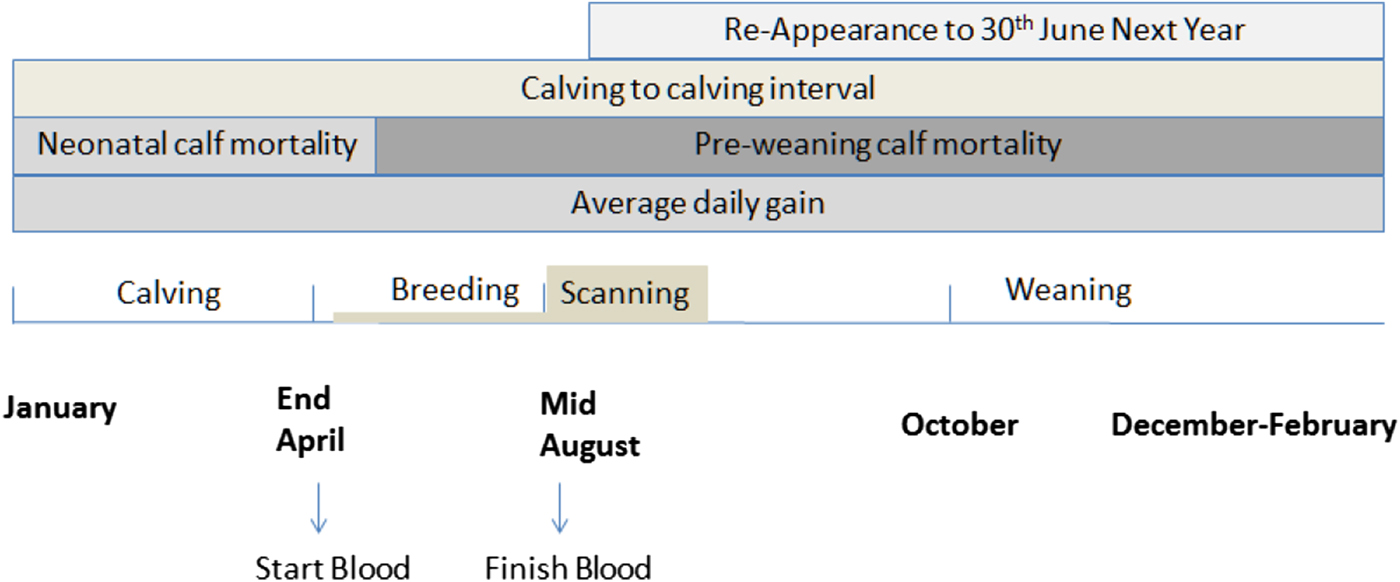
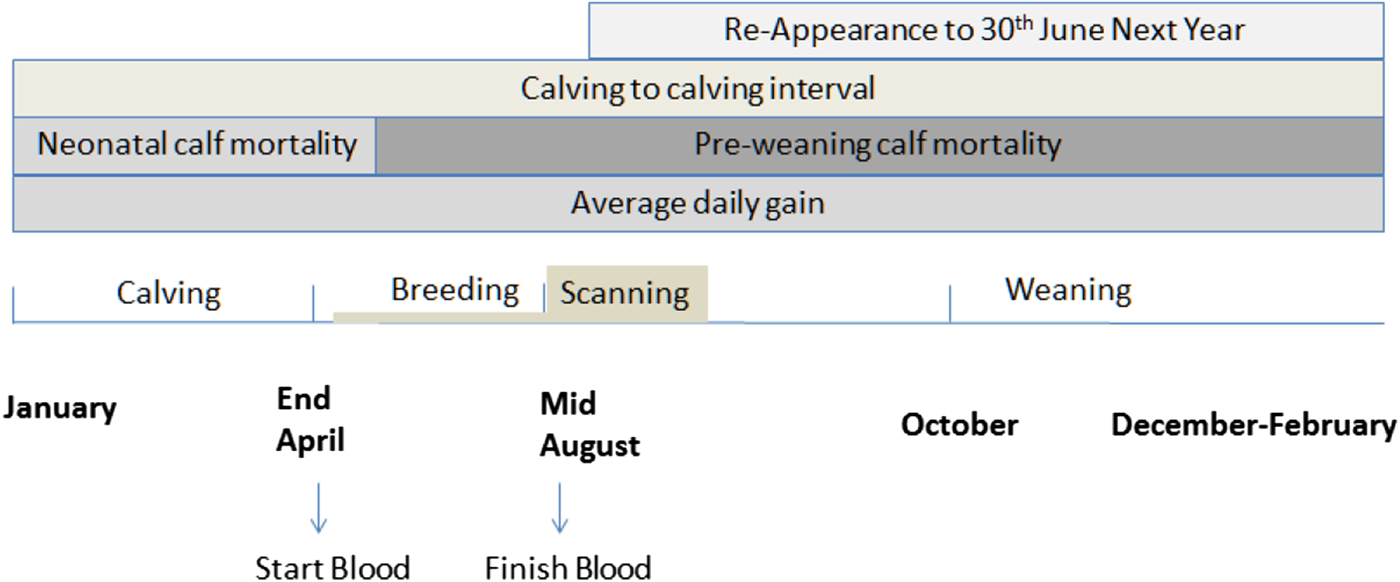
Mortality data from the ICBF database are categorized as mortality in the neonatal period (0–28 days of age) and mortality of older, pre-weaned calves (29–225 days of age). For the current study, these data were analysed based on the year the cow was blood tested to account for both the potential for placental–foetal transfer of the virus and potential of the calf suckling the dam contracting the virus (Fig. 1). Also, within the year of blood sampling, average daily live-weight gain was measured, up to a maximum of 225 days, which is consistent with the weaning protocol typical of Irish spring calving herds (McGee et al., Reference McGee, Drennan and Caffrey2005). Live-weight gain data were obtained from livestock marts as well as on-farm weight recordings and were adjusted to account for gender and age.
Schematic representation illustrating the chronology of the BHV-1 epidemiological study and duration of measurement of each of the key performance traits. Reappearance is indicative of pregnant cows at scanning that successfully calve and thus reappear on national records, before 30 June the following year.
Reproductive performance traits
Two parameters were used to examine the possible effects of BHV-1 on the reproductive output of beef cows (Fig. 1). Firstly, calving interval (CIV), defined as the interval in days between successive calvings, was used as an indicator of reproductive irregularities such as delayed oestrus or failure to conceive. Secondly, reappearance percentage was used to indicate the culling of non-pregnant cows due to mid- to late-term abortion and/or an extended CIV. Animals were assumed to have aborted and thus require replacement if they had a positive pregnancy diagnosis but did not reappear in the calving records of the ICBF database before 30 June of the following year. Thus, reappearance percentage was calculated as the number of cows which had a positive pregnancy scan and subsequently carried gestation successfully through to full term.
Statistical analysis
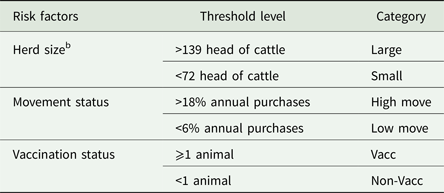
Statistical significances were obtained for the effects of seropositivity within the pre-determined risk factor groupings based on the thresholds in Table 1. Analysis was carried out using the software package Statistical Analysis Systems (SAS version 9.1.2 SAS Institute Inc., Cary NC, USA, 2004). PROC UNIVARIATE was used to confirm that all data adhered to a normal distribution, while PROC GLM was used to analyse the outcome variables of interest; CIV, reappearance percentage, live-weight gain, calf mortality and weanling mortality. Independent variables such as sero status for all other respective pathogens and body condition score of cows were included in the statistical model, along with controls for cow breed, number of cow movements, parity, herd, year, calf sire and calf sex. Significance levels were initially set at a level of P ⩾ 0.20 in order to eliminate non-significant effects using a stepwise approach; however, the final significance threshold was set at a level of P ⩽ 0.05.
Threshold levels used to define scenarios for a whole-farm bio-economic model of BHV-1 pathogenicitya

a See supplementary material for threshold definitions.
b Based on entire herd.
Risk factors for BHV-1 pathogenicity
Statistical analysis was conducted for a range of scenarios with respect to the performance traits mentioned. Firstly, overall effects of seropositivity on performance traits were defined. Risk factors were then identified to quantify the effects on performance traits of herd seropositivity in the context of specific herd characteristics that were measurable in the present study. Van Wuijckhuise et al. (Reference van Wuijckhuise, Bosch, Franken, Frankena and Elbers1998) identified herd size as an important risk factor for herd seropositivity to BHV-1 in Dutch dairy herds. The level of biosecurity has also shown to be an important management-related risk factor that could increase the pathogenicity of a BHV-1 infection (van Schaik et al., Reference van Schaik, Dijkhuizen, Huirne, Schukken, Nielen and Hage1998; O'Grady et al., Reference O'Grady, O'Neill, Collins, Clegg and More2008). In this respect, percentage of inter-herd movements was used as a measure of biosecurity within the herds sampled in the present study. Vaccination was also included as a risk factor in the current study, given its effect on the pathogenicity of the virus (Ackermann and Engels, Reference Ackermann and Engels2006). Scenarios for each risk factor were derived from thresholds representative of the study data itself (Table 1 and Supplementary Table 1, available online at https://multimediafluids.uam.elogim.com/core/journals/journal-of-agricultural-science).
Bio-economic model
General framework
The Grange Beef Systems Model (Crosson et al., Reference Crosson, O'Kiely, O'Mara and Wallace2006) is a whole-farm budgetary simulation model of Irish suckler cow-based production systems. It is a single-year, static model with a monthly time step. The model is configured by specifying the farm area, proportion of the cow herd calving in each month, breeding policy (natural mating or artificial insemination (AI)), replacement rate, cattle trading strategy (month/age at sale and feed management practices) and feeding system, along with various price variables.
The feed management criteria for animal groups are based on a combination of grazing, grass silage, concentrate feeds and alternative forages (e.g. maize or whole crop cereal silage). All feeding activities are specified on a monthly basis to incorporate the seasonal variation in animal diets during the year. Forage production (herbage produced monthly expressed as kg dry matter (DM)/ha) is calculated based on conservation strategy and rate of fertilizer application. Animal feed requirements are determined according to the net energy system (Jarrige, Reference Jarrige1989) which was modified for Irish conditions by O'Mara et al. (Reference O'Mara, Caffrey and Drennan1997) and Crowley et al. (Reference Crowley, Keane, Agabriel and O'Mara2002).
Costings for animal, forage and fixed items are formulated and specified within output reports. This allows for a detailed evaluation of economic performance of the farm system. Technical performance such as average animal numbers, stocking rates, live weight at key periods (e.g. weaning) and feed consumption is outlined in a summary report. Financial performance in the form of net margin includes all revenues accrued, direct and overhead costs but does not account for non-market-based subsidies (e.g. support payments made according the European Union Common Agricultural Policy) or costs associated with the farmers own family labour or land ownership.
Parameterization of the Grange Beef Systems Model
The approach taken in the present study was to incorporate the epidemiological data from the BeefCow project into the Grange Beef Systems Model. The model was configured to represent a 40 ha spring calving suckler herd selling weanlings in the autumn. In the case of the herd size risk factor scenario, farm size was maintained at 40 ha to remove the potential confounding caused by economics of scale. Although there was no charge for owned land, where a change in farm system required additional land, this land was rented using a prevailing rental charge.
The baseline herd was assumed to be seronegative and non-vaccinating for BHV-1 and to meet industry targets for reproductive (Diskin and Kenny, Reference Diskin and Kenny2014) and live-weight (Drennan and McGee, Reference Drennan and McGee2009) performance. Stocking rate was set at 2.2 livestock units (LU) per ha; accordingly, economic performance was commensurate with the top third of Irish suckler beef herds (Teagasc, 2016). Default animal management assumptions were as follows: the calving profile modelled was 0.3, 0.4 and 0.3 of the herd calving in February, March and April, respectively, with a mean calving date of 15 March. Suckler progeny were assumed to be weaned at 225 days of age and sold as weanlings at 235 days of age. Heifers calved for the first time at 24 months of age with all females bred using AI.
The values of the performance traits in the baseline scenario were: CIV, 365 days; replacement rate, 18%; average daily live-weight gain pre-weaning for male calves, 1200 g/day and female calves 1100 g/day; neonatal mortality, 5%; and pre-weaning (excluding the neonatal period) mortality, 1%.
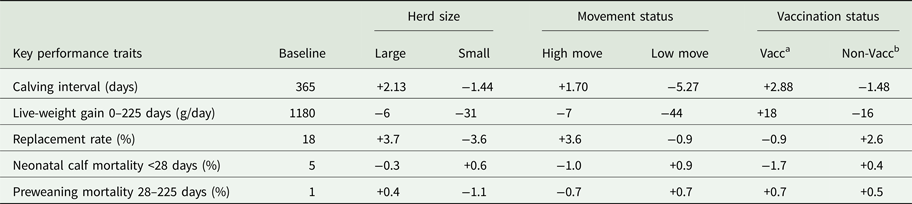
The effect of seropositivity within each scenario was observed as the cumulative difference between seronegative and seropositive animals for each of the performance traits, as presented in Table 2. The impact of seropositivity was thus modelled as a change in the corresponding performance traits within the baseline scenario. All animals within modelled seropositive herds were assumed to be seropositive and therefore impacted by BHV-1 seropositivity.
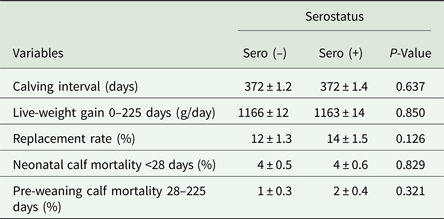
Implications of BHV-1 seropositivity on mean values, s.e.m. (±) and P-values of key performance traits in pasture-based suckler beef cow herds

CIV changes were modelled as changes to the calving profile such that each additional day increase in CIV moved the calving season to later in the spring. Since reappearance percentage due to BHV-1 infection is a component of the overall herd replacement rate, its effect was modelled as an increase to the baseline replacement rate of 18%. In the case of the live-weight gain and mortality performance traits, these were modelled as increases or decreases to the values used in the baseline scenario.
Results
Effects of seropositivity
BHV-1 seropositivity analysis
A grand scenario was developed comparing seronegative and seropositive herd scenarios. When compared with animals which were seronegative to BHV-1, there was no significant effect of seropositivity for any of the key performance variables measured (Table 2). The greatest numerical differences were for replacement rate and pre-weaning calf mortality, which showed differences of 1.9 and 0.5%, respectively.
Technical and economic performance
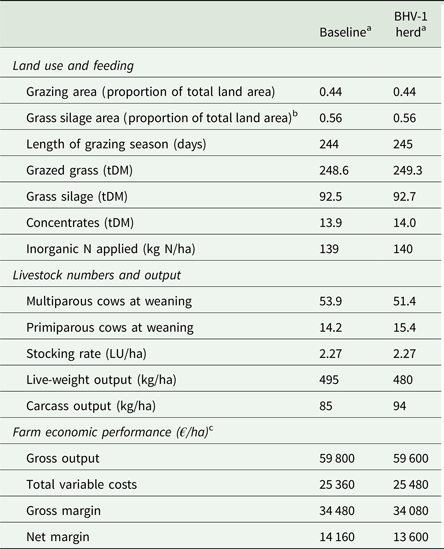
When modelled at whole-farm level, the effects of seropositivity to BHV-1 were modest (Table 3). Land use and feed budgets remained broadly similar across both scenarios with no change in the quantities of grazed grass, grass silage or concentrates. Differences in replacement rates resulted in different mature and primiparous cow numbers, with corresponding effects observed in carcass and live-weight output.
Impact of herd seropositivity to BHV-1 against the baseline (high performing herd, seronegative to BHV-1) on the technical and economic performance of a suckler cow herd, as modelled using the Grange Beef Systems Model (Crosson et al., Reference Crosson, O'Kiely, O'Mara and Wallace2006)

a Baseline and BHV-1 herds used the respective performance traits as follows: CIV 365, 365; ADG 1.18, 1.18; replacement rate 18.0, 19.9%; neonatal calf mortality 5.0, 4.9%; pre-weaning mortality 1.0, 1.5%.
b Grass silage area is also available for early spring grazing and aftermath grazing following silage harvest.
c Prices used were as follows: weanling price, €2.50 kg; beef carcass, €3.35 kg; concentrate feedstuffs, €299 tDM, inorganic fertilizer; urea, €360 t; CAN, €320 t.
Similarly, only marginal effects were found in farm financial performance, with net margin for the seronegative scenario being 4% greater than the seropositive scenario.
Effects of seropositivity within risk factor scenarios
Risk factor analysis
Further statistical analysis evaluated the effect of a change due to seropositivity in key performance traits within each of the chosen risk factors (Supplementary Table S1). When compared with animals seronegative for BHV-1, seropositivity resulted in a small increase in CIV under ‘Vacc’, ‘large’ and ‘high move’ scenarios; however, a decline in CIV was observed for all others, most noticeably in the ‘low move’ scenario (Table 4). Average daily live-weight gain was not impacted by seropositivity. In contrast, seropositivity had a large effect on replacement rate for all scenarios, with the effect particularly noticeable, and opposite in its impact, for the ‘large’ and ‘small’ scenarios. The ‘low move’ scenario had the greatest increase in neonatal calf mortality, while the ‘Vacc’ and ‘high move’ scenarios displayed the greatest decreases. Pre-weaning mortality was reduced to a large degree in the ‘small’ herd scenario.
Effect of seropositivity to BHV-1 on key performance traits for spring calving suckler beef herds within each of the risk factors for BHV-1 pathogenicity

a Vaccinating herd.
b Non-vaccinating herd.
Technical performance
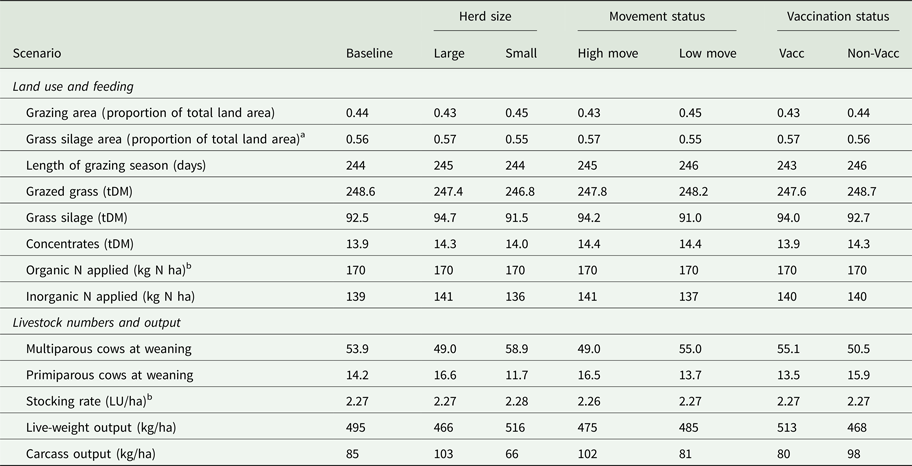
Whole-farm modelling showed that land use was similar across all scenarios, with a modest change in land usage seen within the ‘small’ herd scenario, where a larger grazing area was needed as a result of a decrease in the CIV (Table 5). The effect of a shorter CIV is to advance the mean calving date. Since cows are assumed to be turned out to pasture post-calving, the effect of this was to increase and decrease grazed grass and grass silage demand, respectively, in the composition of the entire diet. The length of the grazing season was similar across all scenarios except vaccination status, wherein ‘Vacc’ scenarios were 3 days shorter when compared with ‘non-Vacc’. Again, this was mostly attributable to the increase in the CIV variable seen for vaccinating herds within the study data.
Effect of seropositivity to BHV-1 on the technical performance of suckler cow systems for herds differing in size, movement status and vaccination status when compared with the baseline herd (high performing, seronegative to BHV-1)

a Grass silage area is also available for early spring grazing and aftermath grazing following silage harvest.
b Both stocking rate and organic N/ha were kept at approximate equilibrium throughout all scenarios.
There were differences in the ratio of multiparous v. primiparous cows across all scenarios. This was due to differences in replacement rates between scenarios. Increased replacement rate had the effect of reducing and increasing the number of multiparous and primiparous cows, respectively, at weaning. Scenarios with the highest amount of weanling sales, hence the greatest live-weight outputs, were observed for the ‘small’ and ‘Vacc’ herd scenarios at 516 and 513 kg/ha, respectively.
Economic performance
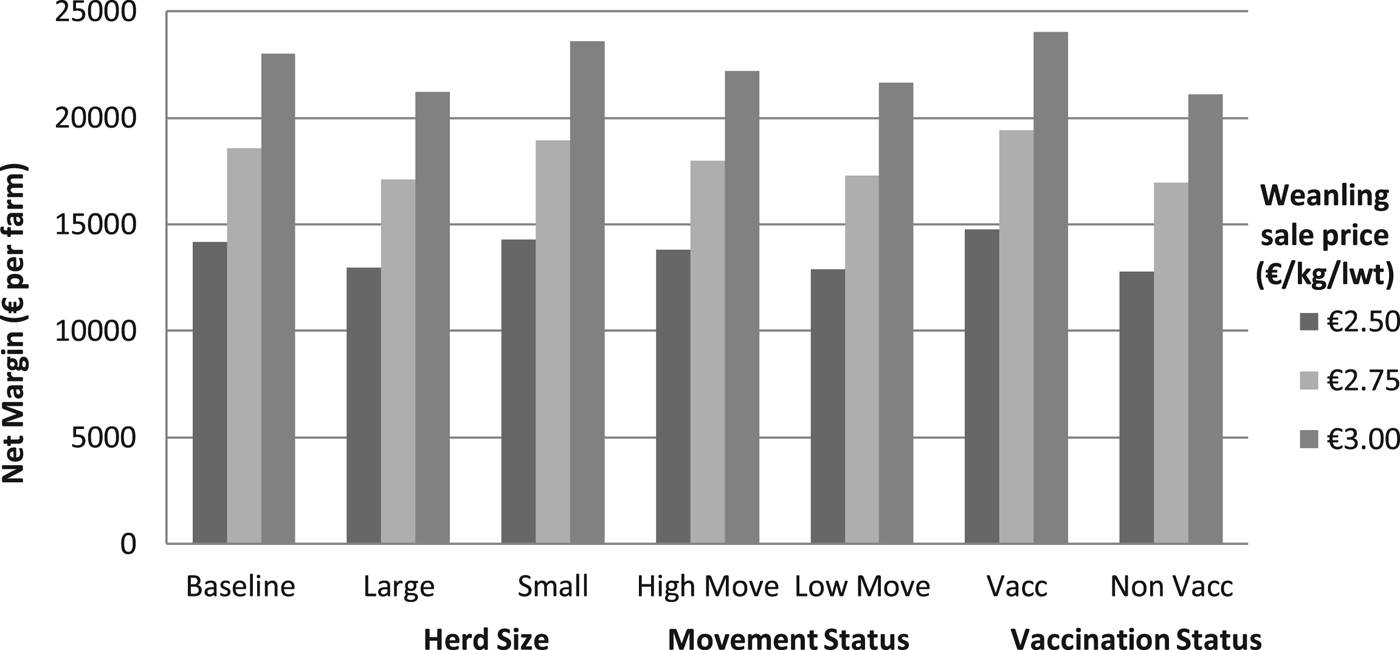
The effect of seropositivity to BHV-1 in each scenario against the baseline differed according to differences in beef price (Fig. 2). Overall, effects were minor across all the price variables (<5% deviation from the baseline), with the exception of ‘low move’ and ‘non-Vacc’ scenarios.
Effect of weanling sale value on farm net margin for scenarios investigating the impact of seropositivity to BHV-1 within herds categorized according to the following risk factors: herd size (large and small), movement status (high move and low move) and vaccination status (Vacc and non-vacc). The baseline scenario represents a herd that is a seronegative to BHV-1 and is meeting industry targets for reproductive and live-weight performance.

The lowest net margin was recorded in the ‘non-Vacc’ scenario with seropositivity resulting in a c. 10% reduction in net margin from the baseline scenario (€12 800 v. €14 160 per farm), when taken at a weanling price of €2.50 per kg live weight. All other scenarios, with the exception of ‘small’ and ‘Vacc’ herds, showed reduced profit due to herd seropositivity across all of the price ranges. The two highest net margins were seen in the ‘small’ and ‘Vacc’ herd scenarios at €23 588 and €24 040 per farm, respectively, when taken at a weanling price of €3.00 per kg live weight. This represented a €588 and €1040, respectively, farm net margin differential when compared with the baseline scenarios performance at a similar weanling price.
Discussion
Within pastoral-based suckler beef cow herds, cow fertility is critical to herd economic performance (Diskin and Kenny, Reference Diskin and Kenny2014) since (1) it underpins the level of output attained with respect to the progeny produced per breeding female, and (2) it determines the capacity of the system to take advantage of grazed grass by synchronizing calving with the onset of grass availability. Further to this, healthy progeny with good live weight for day of age is essential to the economic sustainability of a calf to weanling production system. Any factor that impacts upon animal health and subsequent productivity is likely to have considerable economic implications. The primary objective of the current paper was to evaluate the effects of BHV-1 seropositivity, an infection known to have both reproductive and live-weight effects, within a pasture-based suckler beef farm. A further aim was to quantify the impact of risk factors associated with the pathogenicity of a BHV-1 infection on the technical and economic performance of a spring calving beef cow herd.
Effects of seropositivity
Within the current study, the effects of seropositivity to BHV-1 on beef cow reproduction were considered using CIV (to represent delays in rebreeding) and replacement rate (to represent potential abortifacient effects). Progeny effects considered were mortality from 0 to 28 days (neonatal) and up to 225 days (pre-weaning), in addition to live-weight gain. Overall, there was little effect of seropositivity to BHV-1 on these variables, which resulted in a negligible difference in net margin. Only a minor change was noted in CIV; however, there was an increase, albeit statistically non-significant, of c. 2% on replacement rate within seropositive herds. As replacement rate was determined from the rate of cow reappearance after successful conception, this is assumed to be attributed to abortion in mid-to-late gestation. Indeed, Lassen et al. (Reference Lassen, Orro, Aleksejev, Raaperi, Järvis and Viltrop2012) observed similar effects, whereby herd seroprevalence of BHV-1 increased the odds ratio of abortion and still births.
No economically significant reduction in calf live-weight gain or neonatal mortality rate was associated with seropositivity. However, an increase in pre-weaning mortality further reduced profitability to an aggregated difference in farm net margin of €560 between seropositive and seronegative herds. This concurs with studies by Sharon et al. (Reference Sharon, Duff, Paterson, Dailey, Carroll and Marceau2013) and Yates et al. (Reference Yates, Babiuk and Jericho1983) that showed the ability of the virus to cause increased mortality in older animals. Such a response may be indicative of the level of exposure to environmental stressors that older stock may have endured, which generally serves to reactivate a latent virus.
Risk factor analysis
Three risk factors, which were previously identified in the scientific literature as influencing the pathogenicity of BHV-1 for seropositive herds, herd size, proportion of inter-herd movements and the herd vaccination status, were evaluated.
Herd size and herd movements
In the previous Irish work, O'Grady et al. (Reference O'Grady, O'Neill, Collins, Clegg and More2008) indicated that herd size was a significant factor in BHV-1 seroprevalence. In a separate large-scale Estonian study by Lassen et al. (Reference Lassen, Orro, Aleksejev, Raaperi, Järvis and Viltrop2012), the authors came to a similar conclusion. The current study adds more precedence by indicating a possible link between animals which had previous exposure to BHV-1 within larger herds, and the amplification of its detrimental effects on the economics of pasture-based suckler beef farms. This would tend to support the hypothesis that more horizontal spread occurred through animal-to-animal interactions within larger enterprises and therefore served to amplify the negative implications of BHV-1 seropositivity. Subsequently, this translated into a reduction in farm profitability in larger herds.
Most other related studies have focussed on the level of herd movement as an indicator for a change in herd seroprevalence (van Wuijckhuise et al., Reference van Wuijckhuise, Bosch, Franken, Frankena and Elbers1998; Van Schaik et al., Reference van Schaik, Schukken, Nielen, Dijkhuizen, Barkema and Benedictus2002). The current study did not examine the change in seroprevalence directly, but rather focussed on the magnitude of the effects of the BHV-1 virus on key performance traits of interest within herds with two different levels of animal movement. ‘Low move’ herds had a larger reduction in net margin in comparison with ‘high move’ herds, mainly due to the increase in both neonatal and pre-weaning mortality.
Vaccination status
In a review by Ackermann and Engels (Reference Ackermann and Engels2006), the authors indicated how vaccination can prevent the economic losses attributable to IBR. The availability of sufficient cohorts of both vaccinating and non-vaccinating herds within the current study allowed for the testing of a scenario based on the efficacy of vaccination at reducing the pathogenicity of BHV-1.
Net margin was not reduced within a seropositive herd with an active vaccination programme. This indicates that seropositivity for BHV-1 within herds with an active vaccination programme had less of an impact on the key performance traits, and subsequent net margin, than seropositivity within herds not practicing vaccination. The current study found there was an almost 16% difference in net margin in favour of vaccinating herds compared with non-vaccinating, after accounting for the cost associated with vaccine administration. This is largely due to the combination of a lower replacement rate and lower neonatal calf mortality and indicates clearly that herds practising vaccination observed a greater positive impact on the offspring rather than on the cow itself.
It is worth noting that most of the calf performance trait results indicate low levels of mortality and good live-weight gains, albeit with no statistical difference in most instances. However, the numerical differences seen may explain the positive net margins in small and vaccinating herds when compared with the baseline, as these data were incorporated into the model. There is a possibility that the decrease seen in ‘large’ and ‘high move’ herds with respect to calf mortality may be due to the fact that large herds or those which purchase a high number of animals annually may have a more robust overall herd health programme in place on their farm. This was further reinforced by the fact that there was a difference, by way of a reduction in calf mortality, between vaccinating and non-vaccinating herds in the current study. Another major point to note is that calf mortality pre-weaning may not have allowed for the expected effect of BHV-1 contraction to become manifest, as this excludes possible post-weaning mortality.
Strengths and limitations
The model coefficients for the current study were derived from a robust data set which originated from a comprehensive national epidemiological study carried out on BHV-1 seroprevalence within Irish suckler beef farms. The matching of these results with a range of definitive on-farm metrics from a well-established national breeding database (ICBF) allowed for a novel approach to investigating this issue.
Earlier studies have developed mathematical models to simulate the epidemiology of the onset of an endemic infection in cattle populations (Hage et al., Reference Hage, Schukken, Dijkstra, Barkema, van Valkengoed and Wentink1998; Keeling, Reference Keeling2005). Few studies, however, have incorporated an economic framework around such infections. Where they have (Noordegraaf et al., Reference Noordegraaf, Buijtels, Dijkhuizen, Franken, Stegeman and Verhoeff1998; van Schaik et al., Reference van Schaik, Shoukri, Martin, Schukken, Nielen, Hage and Dijkhuizen1999, Reference van Schaik, Nielen and Dijkhuizen2001), studies extended their analysis to farm-level effects such as milk yield, or risk factors for pathogenicity, independently. Furthermore, there has been no previous study of the economic effects of a BHV-1 infection in pasture-based suckler beef cow systems, using a whole-farm model. The current findings, therefore, are the first to focus on the effects of BHV-1 infection and synthesize these into a whole-farm economic modelling framework.
The major strength of this whole-farm bio-economic modelling approach is that it can account for a change in a multitude of variables on farm output simultaneously. Within the model used in the current study, adjustments to farm system variables such as calving date impact upon the feed resource allocation, while also altering the replacement rate. Subsequently, any effect on replacement rate alters the number of heifer progeny available for sale and hence farm live-weight output. Conversely, culling rates alter carcass output as was seen within ‘large’, ‘high move’ and ‘Vacc’ scenarios in the current study. Calf growth and mortality also impact upon the system as a whole by both decreasing the live-weight output and increasing the costs per cow calf unit, which ultimately reduces net margin.
The counterintuitive outcomes which resulted from the risk factor analysis complicated the farm-level assessment of the risk factors for BHV-1 pathogenicity. The objective of the whole-farm modelling analysis was to replicate the farm-level data as faithfully as possible – thus, the data pertaining to each scenario were used to parameterize the Grange Beef Systems Model. The very modest differences in many of the outcome variables were reflected in the negligible differences in net farm margin between scenarios.
This model provides additional information to aid the design and implementation of BHV-1 control programmes. Suckler beef herd owners will be more informed with respect to the cost-effectiveness of BHV-1 vaccination programmes based on the risk factors identified. Overall, BHV-1 has little impact on key performance traits specific to pasture-based suckler beef cow herds; however, within large herds, producers may need to be more vigilant regarding biosecurity measures on farm, one of which may be vaccination for BHV-1.
Supplementary material
The supplementary material for this article can be found at https://doi.org/10.1017/S0021859618000576.
Financial support
The lead author gratefully acknowledges the financial support of the Department of Agriculture, Food and the Marine under the Research Stimulus Fund (Project 13/S/515; short title, ‘BeefCow’).
Conflict of interest
None.
Ethical standards
Not applicable.