Introduction
Delegation is a defining feature of modern liberal democracy. Facing seemingly ever-more complex policy issues with limited resources, legislative and executive institutions increasingly turn to delegating key parts of the policy-making process to “agents” like legislative committees and bureaucratic agencies (e.g., Epstein and O’Halloran Reference Epstein1996; Huber and McCarty Reference Huber2004; Callander and Krehbiel Reference Callander2014). While such delegation can leverage the expertise of a legislature’s members or the specialization of entities within the administrative state, it comes with risks. For one, an agent who does not share the preferences of the delegating institution—the “principal”—may craft policies that diverge from what the principal would have otherwise set (e.g., Moe Reference Moe1990; Schnakenberg Reference Schnakenberg2015). For another, agents may base their policy decisions on different concerns than those of the principal, even when they share a policy preference (e.g., Gailmard and Patty Reference Gailmard2007; Turner Reference Turner2017). As a result, the decision of when and how to delegate poses a central question for policy makers (e.g., Bawn Reference Bawn1995; Bendor, Glazer, and Hammond Reference Bendor2001).
In this article, we extend the logic of delegation to a court’s use of panels containing a subset of their judges (also known as “chambers”) in the judicial decision-making process. While some courts such as the US Supreme Court conduct judicial review en banc, many high courts and courts of appeal have the option of delegating decision-making authority to panels consisting of a subset of judges. Much like delegation in the legislative and executive contexts, these decisions have implications for both the effective functioning of judicial institutions and the content of judicial decisions. Using the context of the Court of Justice of the European Union (CJEU) and its panel system to develop our account and test its empirical implications,Footnote 1 we contend that the decision to delegate cases to smaller panels is in part a function of the strategic environment surrounding a case.
While extant studies of panel systems at courts such as the US Courts of Appeals and the Canadian Supreme Court have largely followed the classic principal-agent theory’s focus on ideological divergence between actors (e.g., Hausegger and Haynie Reference Hausegger2003; Giles, Walker, and Zorn Reference Giles2006; Giles et al. Reference Giles2007; Clark Reference Clark2008), we build on the judicial politics literature on strategic judicial decision making to argue that delegation to panels becomes less likely as the risk of government resistance to an adverse judicial decision increases. Our analysis of preliminary reference cases filed at the CJEU supports this expectation, as the CJEU was less likely to delegate cases to a panel when confronted with an incentive to behave strategically so as to avoid potential noncompliance or legislative override. Additional analyses of our theory’s implications for case disposition provide further support for a strategic account of delegating cases to panels.
The remainder of the article is organized as follows. The next section develops our theoretical account by placing the use of panels within the larger role of delegation in judicial politics. We then describe the setting for our empirical analysis, the CJEU, and the data used to test our argument’s empirical implications. After that, we present the results of our analyses. We conclude with a discussion of the article’s implications for the functioning of courts generally and the CJEU in particular.
Panel Systems and Delegation in the Judiciary
Courts’ delegation of cases to subsets of their full plenum of judges is commonplace in many judiciaries around the world. Whether it is through random assignment—as is assumed to be done on many US circuit courts—or intentional assignment to panels, courts’ processes of allocating cases to their judges are consequential.Footnote 2 When discussing delegation in the judiciary more broadly, the extant principal-agent models of judicial decision making focus on the judicial hierarchy. This scholarship addresses, among other topics, the probability that a higher court will correct a lower court’s decisions, how lower courts operate in this strategic environment, and the probability that a circuit court will engage in en banc review (e.g., Tiller and Spiller Reference Tiller1999; Cameron, Segal, and Songer Reference Cameron2000; Giles et al. Reference Giles2006; Westerland et al. Reference Westerland2010; Kastellec Reference Kastellec2011; Carrubba and Clark Reference Carrubba2012; Beim, Hirsch, and Kastellec Reference Beim2014).
Although these models primarily analyze the American judiciary, they are informative to our discussion of panel systems in other judiciaries. Instead of courts using en banc review to monitor ideologically distant panels of judges ex post (e.g., Giles et al. Reference Giles2007; Clark Reference Clark2008)—that is, a larger panel of judges reviewing the decision already made by a smaller panel of judges—some courts with panel systems make these decisions ex ante. A court may be less likely to delegate a case to a specific panel of judges knowing that the judges are ideologically distant from the rest of the court. It may instead delegate a case to a panel of judges who are more ideologically comparable to the court or elect to not hear the case in panels to prevent an ideologically extreme panel from having a disproportionate influence on the court’s judgment in a given case.
Similar to en banc review for higher courts reviewing the decisions of lower courts, hearing a case outside of panels is costly for a court.Footnote 3 For instance, many courts have large caseloads and a backlog of cases for which they have yet to issue a judgment (e.g., Kenney Reference Kenney2000; Tridimas and Tridimas Reference Tridimas2004; Mitsopoulos and Pelagidis Reference Mitsopoulos2007; Dimitrova-Grajzl et al. Reference Dimitrova-Grajzl2012; Epstein, Landes, and Posner Reference Epstein2013; Bielen et al. Reference Bielen2018; Roussey and Soubeyran Reference Roussey2018). Hearing cases outside of panels adds cases to the workload of each judge and subsequently slows down courts’ processing of cases. Furthermore, in addition to the material costs, as more judges are involved in a given case, the process becomes more cumbersome. As George (Reference George1999, 218) describes, “Seeking one voice can produce the opposite effect by causing intracourt acrimony, ideological polarization, and lost collegiality.”Footnote 4 Consequently, courts hear considerably fewer cases outside of panels than in panels.
Accounting for the aforementioned costs, then, what are the conditions under which we should expect a court to hear a case outside of panels? Extant theories of ex post review emphasize the role of judges on ideologically distant panels strategically using the power to dissent to signal to their circuits or higher courts that they should review the panel’s decision on a given case (e.g., Beim et al. Reference Beim2014, Reference Beim2016; Beim and Kastellec Reference Beim2014). Writing a dissent is understood in these accounts as a costly and informative signal to judges in the judicial hierarchy. Since we are interested in settings in which the decision to hear a case in panels is made ex ante, theoretical and empirical questions remain of what factors inform a court’s decision to send a case to a panel early in the adjudication process.
While ideological accounts provide compelling explanations for the role and function of panels, they necessarily cannot fully address the multifaceted nature of judicial decision making, particularly the potential influence of strategic concerns resulting from separation-of-powers dynamics. That is, the focus of such accounts on intracourt and intercourt dynamics leaves unanswered how a court’s relationship with other actors in the political system, especially the legislative and executive branches responsible for implementing court decisions, might contribute to the use of panels. With a substantial literature highlighting the impact of interinstitutional dynamics on other key facets of the decision-making process at major high courts (e.g., Vanberg Reference Vanberg2005; Staton Reference Staton2006; Krehbiel Reference Krehbiel2016), it may similarly be the case that the crucial decision of determining which and how many judges will adjudicate a case is at least partly influenced by a court’s concern for the political reaction to its decision.
We argue that courts, or those who ultimately set a court’s agenda, are sensitive to the risk of noncompliance when deciding whether to delegate a case to panels.Footnote 5 Scholars contend that threats of noncompliance affect courts’ decision making in a variety of contexts (e.g., Rosenberg Reference Rosenberg1991; Helmke Reference Helmke2005; Vanberg Reference Vanberg2005; Staton Reference Staton2010; Clark Reference Clark2011; Carrubba and Gabel Reference Carrubba2015). When facing potential opposition, courts are strategic in their decision making in order to help build and maintain their institutional prestige (e.g., Gibson, Caldeira, and Baird Reference Gibson1998; Staton and Vanberg Reference Staton2008; Carrubba Reference Carrubba2009) and take actions to try to minimize the threat of noncompliance (e.g., Staton Reference Staton2006; Krehbiel Reference Krehbiel2016). Given the significance of panel systems for the process and outcome of cases, it is plausible, if not likely, that courts similarly view panels in terms of their strategic significance.Footnote 6
We posit that the threat of noncompliance, along with its implications for courts’ institutional capacity, influences courts’ willingness to delegate decisions to panels. When the risk of noncompliance is high, so too is the potential cost incurred by institution-focused judges if a panel fails to act strategically. That is, delegating a strategically significant case raises the possibility that a panel of judges will place considerations such as ideology, legal philosophy, or career aspirations ahead of concern for the court’s long-term institutional position. Retaining such cases provides a clear strategy for avoiding that risk. Consequently, as long as those who determine the use of panels have a particularly strong concern for their court’s institutional position and power,Footnote 7 they should be less likely to delegate a case to panels as the threat to those concerns increases.Footnote 8 Such institution-focused judges, nonetheless, are also balancing their preferences for policy. Indeed, inherent in this choice to delegate is perhaps a trade-off between a panel that will push policy in the direction a judge prefers and a court’s full plenum that is likely to protect the court’s institutional integrity. When making such a trade-off, judges may be willing to sacrifice their preferences for a particular policy in the short term for their court having the benefits of high institutional legitimacy capable of compelling a government’s compliance with its decisions in the long term (e.g., Gibson et al. Reference Gibson1998). Such strategic institution-focused decision making allows a court to build the institutional legitimacy necessary to compel government compliance with its decisions (e.g., Carrubba Reference Carrubba2009). Similarly, we expect that the utility a judge receives from policy is conditional on the court’s ability to compel a government to comply with such a policy and, therefore, affects a judge’s decision to delegate. This theorizing leads us to the following hypothesis:
Hypothesis 1. A case is less likely to be decided by a panel as the probability of noncompliance increases.
Two empirical implications follow from this argument. First, if the risk of noncompliance is a factor in the use of panels, then it should likewise affect case disposition. Specifically, the delegation of a case to panels should correspond to the likelihood of a ruling against the interests of the government. The reason for this implication is how separation-of-powers constraints generally influence judicial decision making. When faced with potential threats to their institution, courts defer to the interests of governments (e.g., Vanberg Reference Vanberg2005; Staton Reference Staton2006; Carrubba et al. Reference Carrubba2008).Footnote 9 That is, empirical manifestations of strategic decision making are typically viewed as limited to decisions that conform with a government’s wishes. Consequently, if a court is more likely to send cases to panels when the need for such strategic behavior is low, then those panels should be more likely to engage in sincere rather than strategic decision making. As a result, we should observe panels ruling against the interests of the government more frequently than the strategically focused larger compositions of a court. This theorizing leads to our second hypothesis:
Hypothesis 2. A panel is more likely to rule against a government’s interests.
A second, related implication of our argument regards the likelihood of a court ruling contrary to the legal merits in a case. As noted above, strategic decision making is often viewed as issuing decisions that conform with a government’s interests. Implicit in this conceptualization of strategic behavior is that the court would have ruled otherwise had the threat of noncompliance or other institutional harm not been present. If our account is correct that courts delegate less strategically constrained cases to panels, then we might expect the decisions in those cases to be more likely to correspond to nonstrategic factors than those not delegated. One such factor is the objective legal merits of the case brought before a court.Footnote 10 When the legal merits line up against a government’s interest in a less strategically important case, the court may be freer to follow the facts and rule accordingly. However, a constrained court may be incentivized to act strategically by ruling in the government’s favor despite the legal merits opposing such a holding. Considering we propose that panels are given the less strategically significant cases, we therefore anticipate that panels will be less likely than the full court to go against the legal merits by ruling in favor of the government’s interests. From this logic, our third hypothesis follows:
Hypothesis 3. A panel is less likely to rule contrary to legal merits that are opposed to a government’s position.
Application: The CJEU
To test our hypotheses, we examine the use of panels at the European Union’s highest court, the Court of Justice. We choose to analyze the CJEU for several reasons. First, the CJEU’s panel system shares key traits with the systems used at many prominent courts such as the Spanish supreme court (e.g., Garoupa, Gili, and Gómez-Pomar Reference Garoupa2012), the German constitutional court (e.g., Vanberg Reference Vanberg2005), and the Italian constitutional court (e.g., Pellegrina and Garoupa Reference Pellegrina2013), among others, making our analysis relevant for scholars of other judiciaries. Second, the CJEU at times faces a meaningful threat of noncompliance or override that scholars have empirically identified and measured (e.g., Carrubba et al. Reference Carrubba2008; Larsson and Naurin Reference Larsson2016). Third, the CJEU’s use of Advocates General (AG) in cases provides a reasonably objective approximation of the legal merits. Lastly, specifically regarding the extensive literature on the CJEU, while scholars argue panel assignment is an indicator of the importance of a case (e.g., Kelemen Reference Kelemen2012; Larsson and Naurin Reference Larsson2016; Larsson et al. Reference Larsson2017), they refrain from making a direct argument about how the court’s assignment of a case to a panel is a strategic action related to affecting a case’s outcome. We address this gap in the literature by positing a strategic account of the CJEU’s use of panels.
One of the key steps in the adjudication process at the CJEU is the determination of how many judges will decide a case. When a case arrives at the CJEU, the president handles the case before any of the other judges. The president, then, assigns the case to a judge-rapporteur who is responsible for writing a preliminary report on the case. The judge-rapporteur in consultation with the AG (if an AG is presiding over the case) makes a recommendation to the General Assembly of the CJEU (consisting of all judges and AGs) as to which formation of the CJEU should hear the case. The General Assembly then takes a vote on whether a case should be heard in panels, known as “chambers” at the CJEU, or a larger formation of the CJEU. Hermansen (Reference Hermansen2020) argues and provides empirical evidence that the president is strategic in allocating cases to judges-rapporteur, especially in cases in which member states have expressed conflicting positions through the observations they send to the court. We may expect, thus, that the president is likely to assign such a case to a judge-rapporteur who is likely to recommend that a larger formation of the CJEU hears the case. Furthermore, according to Kenney (Reference Kenney1998, 108), the president “chairs the administrative meeting [General Assembly] which determines the formation of the case—that is, how many judges will hear and decide the case.” Although the president has only a single vote in the General Assembly, it is reasonable to expect that the president has a disproportionate informal influence in determining which formation of the CJEU will hear a case.Footnote 11 Drawing from interviews with référendaires (clerks) at the CJEU, Zhang (Reference Zhang2016, 112) states, “To be sure, judges face peer pressure when working at the Court…. This is especially true at the Court of Justice, where the President has exercised discretion in assigning cases according to the competence and expertise of the judges. This works as both a carrot and a stick. It incentivizes the judges to perform, because otherwise they risk being marginalized—assigned to small and unimportant cases and excluded from the Grand Chamber.” Since the president determines the allocation of cases, judges are incentivized to defer to the president in order to ensure that the president assigns them desirable cases in the future. Because of their formal power to determine the allocation of cases to judges and the resulting informal influence over the General Assembly, the president fills the role of principal in our theoretical framework.
While the CJEU has made increasingly frequent use of panels, it is not required to do so.Footnote 12 Rather, the CJEU largely retains the option of having cases decided by a large number of judges presided over by the CJEU’s president. The precise size and composition of this option has varied over the course of the CJEU’s development and expanded size. Before the 2003 Treaty of Nice, this entailed cases either going to the full court or a petit-plenum consisting of nine judges. After the treaty entered into force, a newly defined Grand Chamber of 13 judges became the primary alternative venue for cases not delegated to a smaller panel.Footnote 13 In both instances of these larger compositions, the presidents of the smaller panels serve as judges, while the president of the CJEU presides over proceedings. As CJEU president Koen Lenaerts explained in an interview with the Wall Street Journal, “The president and the vice-president are the only two permanent members of the Grand Chamber for the three-year period of their mandate…. Conducting the hearing and then the deliberations with the fifteen judges is the main task of president” (Pop Reference Pop2015). Unlike in cases assigned to panels, the CJEU’s president can directly influence the outcome of nonpanel cases.
Although the CJEU’s hearing all cases outside of panels would prevent the agency costs associated with delegation, its hearing cases outside of panels is costly. One of the reasons it is costly is that the caseload of the CJEU is large and is increasing substantially. The caseload is a substantial cost for a couple reasons. First, the enlargement of the EU has increased its number of member states. The enlargement has, thus, subsequently increased the number of courts that can refer cases to the CJEU through the preliminary reference procedure and the number of cases the European Commission brings to the CJEU against member states in the infringement procedure. Second, the CJEU does not control its docket and therefore cannot refuse to hear cases that the European Commission or other member-state courts bring to it. Outside of the caseload burden, it is also costly to put a case before the Grand Chamber because of its impact on judges’ collegiality. As former CJEU judge Sir David Edward explained in a 2005 interview, “As has been proved in practice, it’s extremely difficult to have a working court system in which 25 judges sit together…. To some extent this creates a problem because the decisions of the Court of Justice are no longer the decisions of all the judges sitting together and discussing together.”Footnote 14
Given the CJEU’s potential costs, we turn to factors affecting the assignment of cases to panels. A simple answer offered by the literature is that a case’s importance is a determinant of the CJEU’s decision of whether to assign a case to panels (e.g., Kelemen Reference Kelemen2012; Larsson and Naurin Reference Larsson2016). Judge Edward mentions that judges-rapporteur in their preliminary reports will refer to a case’s importance when suggesting to the president which formation of the CJEU should hear the case. Judges-rapporteur, as per an example by Judge Edward, may state, “I think this is a pretty straight forward case. I think it could easily be handled by a [panel] of three judges.” Or, alternatively, “this is a case of enormous significance” and “should go to the plenary.”Footnote 15 Black boxed in extant explanations, however, are the factors determining a case’s importance.
We argue that member states’ probability of noncompliance with an adverse ruling is one such factor determining a case’s importance. If the CJEU is responsive to member-state preferences in its judgments, as many scholars contend (e.g., Garrett, Kelemen, and Schulz Reference Garrett1998; Carrubba et al. Reference Carrubba2008, Reference Carrubba2012; Gabel et al. Reference Gabel2012; Larsson and Naurin Reference Larsson2016; Castro-Montero et al. Reference Castro-Montero2018; Peritz Reference Peritz2018), and the CJEU’s president is more responsive to threats of noncompliance than any individual judge in panels, as we argue, then the president should also consider a member state’s probability of noncompliance with an adverse ruling when assigning a case’s judge-rapporteur and deciding whether to advocate for the Grand Chamber to hear a case before the General Assembly. In particular, consistent with the extant literature, we assume that in cases that come before the CJEU, member states prefer to retain their sovereignty over policy making as opposed to transferring authority to the European Union (EU); the CJEU, conversely, prefers to rule in a direction that transfers more authority to the EU (e.g., Koremenos, Lipson, and Snidal Reference Koremenos2001; Rosendorff and Milner Reference Rosendorff2001; Carrubba Reference Carrubba2005; Rosendorff Reference Rosendorff2005; Carrubba and Gabel Reference Carrubba2015; Krehbiel and Cheruvu Reference Krehbiel2022). A strategic decision by the CJEU, then, can be understood as one in which it decides in favor of the member states, even when the legal merits favor ruling in a pro-EU direction.
In line with our hypotheses, with regards to the CJEU, we expect that as the probability of noncompliance increases, the less likely the president assigns a case to panels. Similarly, we argue that panels are less sensitive to concerns of the CJEU’s institutional prestige than the CJEU’s president and therefore, on average, are more likely to rule against a government’s interest than the larger compositions like the Grand Chamber and petit-plenum. Lastly, since strategic decision making by the CJEU involves ruling in an anti-EU direction even when the legal merits favor a pro-EU decision, we argue that panels are less likely to side with a government’s position when the legal merits favor a pro-EU decision.
The CJEU’s behavior in the case T-Mobile Austria GmbH v. Republic of Austria (C-284/04) highlights these potential dynamics. The case dealt with the interpretation of an EU directive related to the taxation of mobile telecommunications services. Consistent with our account, the CJEU decided to resolve the case in the Grand Chamber after the case drew briefs from nine member-state governments opposing a prointegration interpretation of the directive that would have categorized national authorities’ auctions of frequencies in the electromagnetic spectrum as economic activity and thus made them subject to the value-added tax. In contrast, the AG argued that the legal merits of the case meant that the CJEU should adopt such a prointegration opinion. Again consistent with our account, the Grand Chamber sided with the member-state governments and rejected the AG’s opinion, issuing a ruling that restricted the extent of EU law with the conclusion that the actions in question do “not fall within the scope of that directive.”
Data, Measures, and Empirical Approach
To test our hypotheses, we use data on the CJEU’s most common proceeding type, references for preliminary ruling. These cases are sent to the CJEU by the judiciaries of the member states when they face an issue involving EU law. By bringing the CJEU into direct contact with domestic legal systems and allowing national courts to enforce EU law, scholars describe the preliminary reference procedure as the driving force behind the transformation of the EU legal order (e.g., Stein Reference Stein1981; Weiler Reference Weiler1994; Alter Reference Alter2001). Consequently, a substantial literature focuses on the various facets of the preliminary reference procedure (e.g., Stone Sweet and Brunell Reference Stone Sweet1998; Carrubba Reference Carrubba2005; Gabel et al. Reference Gabel2012; Krehbiel and Cheruvu Reference Krehbiel2022). We focus our analysis on preliminary reference cases filed at the CJEU from 1999 to 2008, with judgment-level data drawn from Cheruvu (Reference Cheruvu2019) and Fjelstul (Reference Fjelstul2019) and data from Larsson and Naurin (Reference Larsson2016) used to incorporate information on the specific legal issues raised in each case. In total, our data have 1,326 judgments addressing 3,286 legal issues.
Hypothesis 1
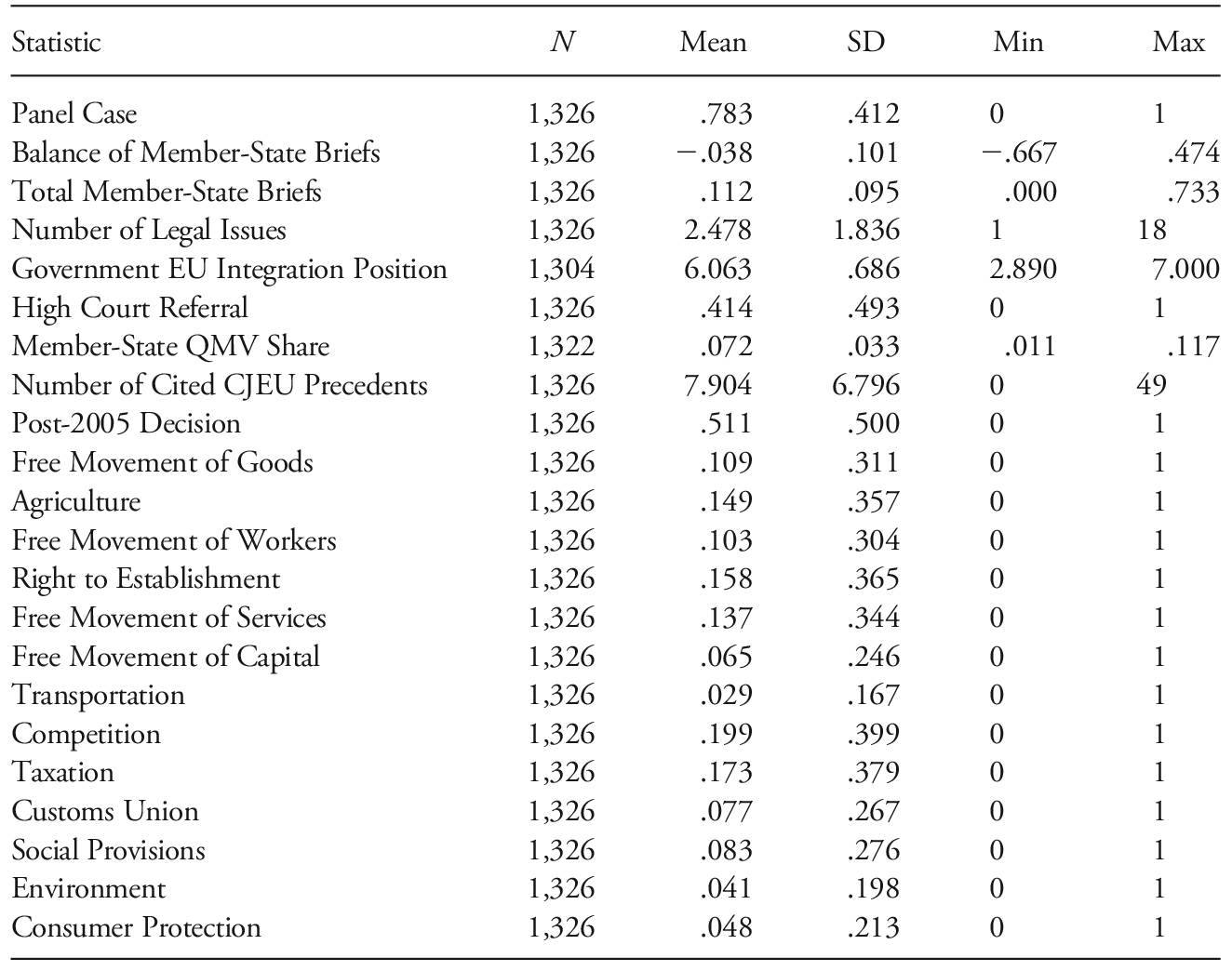
For our first hypothesis, the outcome of interest is whether the CJEU delegated a case to a panel or instead decided it in its larger composition like the Grand Chamber or petit-plenum. Accordingly, the variable Panel Case is coded 1 if a case is decided by a three- or five-judge panel and 0 if decided by the larger compositions of the CJEU. As the decision of panel assignment is made at the judgment level, this serves as the unit of analysis for the statistical models (see table 1).Footnote 16
Descriptive Statistics of Judgment Data

As our first hypothesis predicts a relationship between the use of panels and the risk of noncompliance, we follow the example of recent scholarship (e.g., Carrubba et al. Reference Carrubba2008; Carrubba and Gabel Reference Carrubba2015; Larsson and Naurin Reference Larsson2016) by relying on the content of briefs filed by member-state governments in each case. As the revealed preferences of member-state governments, these briefs convey information to the CJEU about the likelihood that they will pressure or otherwise compel compliance from the member state involved in a case (Larsson and Naurin Reference Larsson2016). Consequently, we anticipate the likelihood of delegating a case to a panel to decrease, as the balance of such briefs skews toward opposing further European integration. To calculate this measure, we use the data provided by Larsson and Naurin (Reference Larsson2016) on the balance between pro- and anti-EU integration briefs weighted by member states’ voting power in the Council of Ministers.Footnote 17 As their data are collected at the legal-issue level rather than the judgment level, we calculate the average of this balance across all legal issues addressed in a judgment. The resulting variable, Balance of Member-State Briefs, takes positive values when the weighted number of briefs favoring more EU integration is greater than the number opposing such a decision and negative values for the inverse. Therefore, we expect this variable to have a positive relationship with Panel Case, indicating that the likelihood of delegation to a panel increases the more the balance of briefs favors greater EU integration.
We include a series of control variables to address alternative explanations for the CJEU’s use of panels. Consider the standard account of panels focused on the salience or legal novelty of a case. As such cases may similarly be politically sensitive ones, we need measures of a case’s importance to avoid confounding our key variables. To this end, we control for the total number of briefs filed by member-state governments with the variable Total Member-State Briefs, which is weighted by a member state’s voting weight in the Council of Ministers. Second, the variable Number of Legal Issues is the total number of legal issues in a judgment identified by Larsson and Naurin (Reference Larsson2016). Similarly, we account for the legal novelty of a case by including the variable Number of Cited CJEU Precedents, which is a count of the number of CJEU precedents cited in a given case. Additionally, we include a dummy variable for whether the AG, whose role we discuss in greater detail in our empirical approach for the third hypothesis, provided the CJEU with a pro-EU integration opinion on any of the legal issues in a case.
Turning to the source and subject matter of the cases, the variable High Court Referral is coded 1 if a case was referred by a member state’s high court and 0 otherwise. We further control for the relative size of the member state in which a case originated by including the variable Member-State QMV Share, which is the voting power of the originating member state in the qualified majority voting procedure. We also include both member-state fixed effects and a series of dummy variables for the following policy areas: free movement of goods, agriculture, free movement of workers, right to establishment, free movement of service, free movement of capital, transportation, competition, taxation, customs union, social provisions, environment, and consumer protection. As a judgment can address multiple policy areas, each policy area is coded as a separate variable.
We additionally control for political and institutional factors surrounding each judgment. To account for the position of the government of the member state from which a case originated, the variable Government EU Integration Position uses the Chapel Hill Expert Survey’s question on the “overall orientation of the party leadership towards European integration.” On a scale from 1 (strongly opposed) to 7 (strongly in favor), we assign each judgment the value given to the head of the government’s party in the survey fielded closest to the government’s election or reelection to office.Footnote 18 To account for revisions to the CJEU’s procedure that came into effect in 2005, we include the dichotomous variable Post-2005 Decision that takes a value of 1 for decisions issued after 2005.
Hypothesis 2
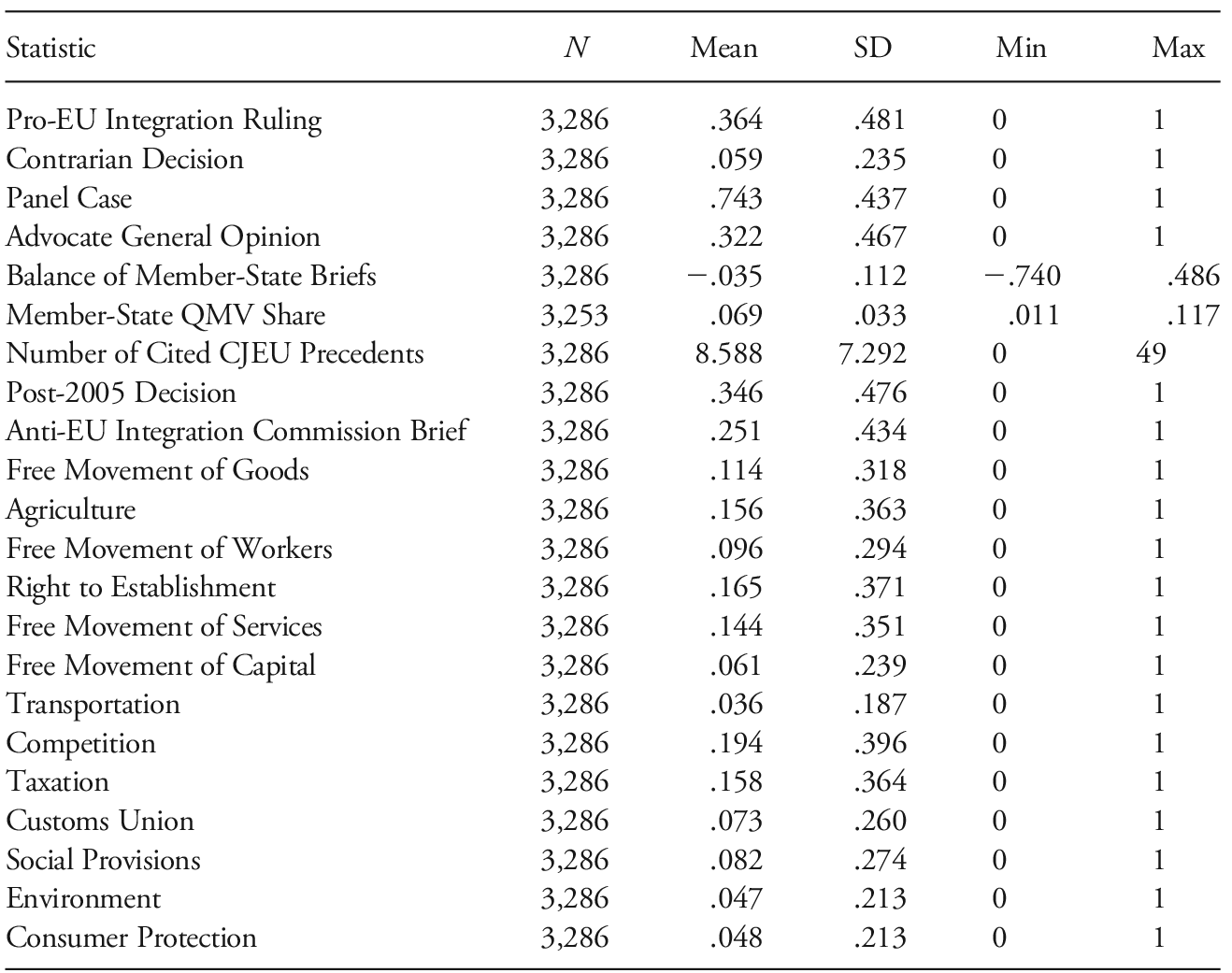
Turning to the second and, in the next section, third hypotheses, which focus on the CJEU’s judgments, we use the data provided by Larsson and Naurin (Reference Larsson2016) on the CJEU’s disposition in legal issues raised in preliminary references.Footnote 19 Consider the second hypothesis, which predicts that cases delegated to panels will be more likely to result in a ruling counter to the government’s interests. Following our earlier discussion on the EU integration–national sovereignty dimension largely defining CJEU decisions, the outcome of interest for each legal issue is whether the CJEU ruled in a manner that expands or otherwise favors increased European integration. The variable Pro-EU Integration Ruling is thus coded 1 if the CJEU ruled in a prointegration direction on a legal issue and 0 otherwise.
The independent variable of theoretical interest for the second hypothesis is Panel Case, as our argument posits that cases delegated to smaller panels are more likely to result in a ruling contrary to the government’s preferred outcome. Accordingly, we expect Panel Case to have a positive relationship with Pro-EU Integration Ruling. We then include a series of control variables to account for alternative explanations and address potential omitted-variable bias. We include Balance of Member-State Briefs, as we expect it to correspond with Panel Case and previous work has shown a relationship between such briefs and case disposition (Carrubba et al. Reference Carrubba2008; Larsson and Naurin Reference Larsson2016). To address potential confounding by member-state government preferences regarding EU integration, we include Government EU Integration Position. Similarly, we include Advocate General Opinion as a control for the legal merits supporting a pro-EU integration ruling and the case-level variable Number of Cited CJEU Precedents to control for legal novelty. The variable Member-State QMV Share accounts for the possibility that the CJEU considers the relative size of member states when engaged in decision making. We again account for the CJEU’s 2005 procedural change by including the variable Post-2005 Decision. Finally, we include the policy-area controls described in our empirical approach for the first hypothesis.
Hypothesis 3
Finally, we turn to our empirical approach for the third hypothesis. Recall that this hypothesis predicts that one implication of the strategic behavior we propose is that a full court (or comparable composition) is more likely than panels to rule in favor of a government’s preferred position despite legal merits to the contrary. As such, we need a variable capturing instances of the CJEU’s deciding to not issue a pro-EU integration ruling even though the legal merits of the case support such a ruling. We accomplish this by leveraging information on both the CJEU’s disposition of legal issues and the AG’s opinion on those same legal issues.
Although appointed by member states, AGs do not serve as judges at the CJEU but rather as a form of “legal expert helping the [CJEU] make good law” (Carrubba and Gabel Reference Carrubba2015, 93). This role has led scholars to use the AG’s opinion on legal issues as a proxy measure for the legal merits independent of the political context surrounding a case (e.g., Carrubba et al. Reference Carrubba2008; Carrubba and Gabel Reference Carrubba2015; Larsson and Naurin Reference Larsson2016). Similar to previous studies, we argue that the AG’s position is a reasonable approximation for a case’s legal merits. The AG does not represent a litigant in a case but rather is an institutional member of the CJEU who has the responsibility of reviewing case materials and writing an opinion to answer a case’s legal questions. The AG writes an opinion independently of the judge-rapporteur and delivers it at the end of the oral procedure. Importantly, the AG does not participate in the judges’ deliberations. As Dashwood (Reference Dashwood1982, 211) describes, “Once the [AG’s] opinion has been read the case disappears behind the wall of secrecy that surrounds the Judges’ deliberations.” Although AGs at the CJEU are subject to 6-year renewable terms and therefore may be susceptible to political pressure from the member states, Carrubba and Gabel (Reference Carrubba2015, chap. 4) provide evidence that AGs are generally not responsive to the preferences of the member state that appointed them when their member state sends a brief to the CJEU supporting a particular outcome in the case. They further provide evidence that member states send briefs to the AGs they appointed to the CJEU in only 6% of the legal issues in their data set spanning cases from 1960 to 1999. Given the descriptive and empirical evidence, we argue that our presumption that AGs’ opinions are reflective of a case’s legal merits is well substantiated by the existing literature. Thus, we consider a pro-EU integration opinion from the AG to be indicative of an issue for which the legal merits are in opposition to a member-state government’s preferences. The strategic behavior of interest in the third hypothesis, therefore, is instances of the CJEU not issuing a prointegration ruling on an issue despite the presence of a prointegration AG opinion. The variable Contrarian Decision is coded 1 in such instances and 0 otherwise.
The key independent variable for the analysis of the third hypothesis is Panel Case, which we anticipate having a negative relationship with Contrarian Decision. With respect to control variables, we seek to address the possibility that a relationship between panels and decisions contrary to AG opinions is a consequence of the AG simply getting a case “wrong” in the particularly complex or otherwise difficult cases handled by the CJEU’s larger compositions. We do so by including two variables that might explain instances of the CJEU ruling contrary to the AG’s opinion. First, the variable Anti-EU Integration Commission Brief is coded 1 if the European Commission files a brief arguing against greater EU integration ruling on an issue. Second, we include Balance of Member-State Briefs since the CJEU may be more likely to ignore the AG’s opinion when the balance of briefs opposes more EU integration. In addition to these controls, we include member-state and policy-area controls, Member-State QMV Share, Government EU Integration Position, Number of Cited CJEU Precedents and Post-2005 Decision to again address the CJEU’s procedural development. Table 2 provides descriptive statistics for the legal-issue-level variables used in the analyses of hypotheses 2 and 3.
Descriptive Statistics of Legal Issue Data

Empirical Approach
For ease of interpretation, we estimate a series of linear probability models. As Angrist and Pischke (Reference Angrist2009) demonstrate, OLS provides results similar to logit when using a binary dependent variable. For robustness, we include logit results for our models of interest in the appendix. For each of the hypotheses, we first estimate a bivariate model with issue-area and member-state fixed effects, and then we include the relevant control variables. As the data for the second and third hypotheses are structured by legal issue, we estimate models with standard errors clustered by judgment.
Results
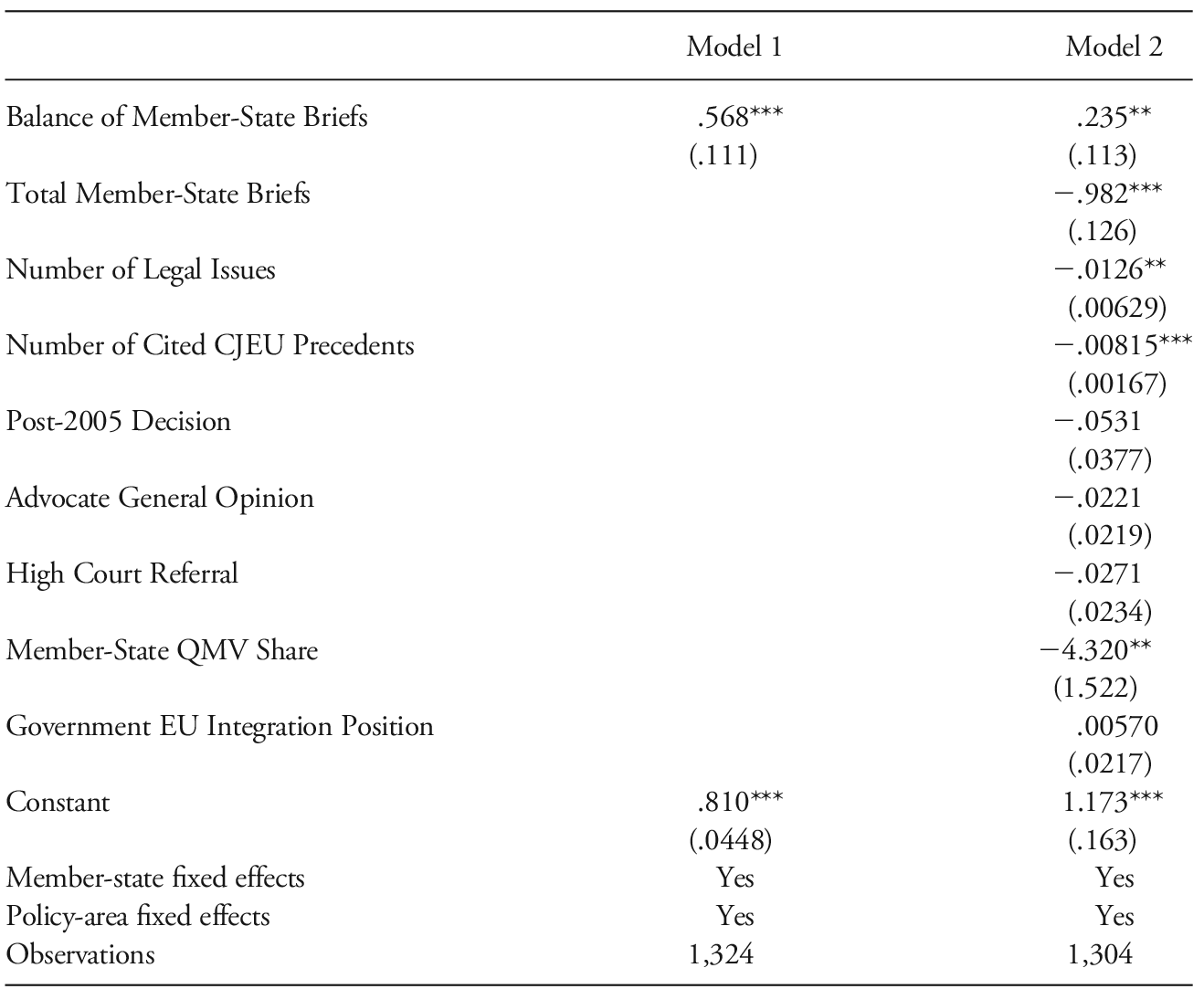
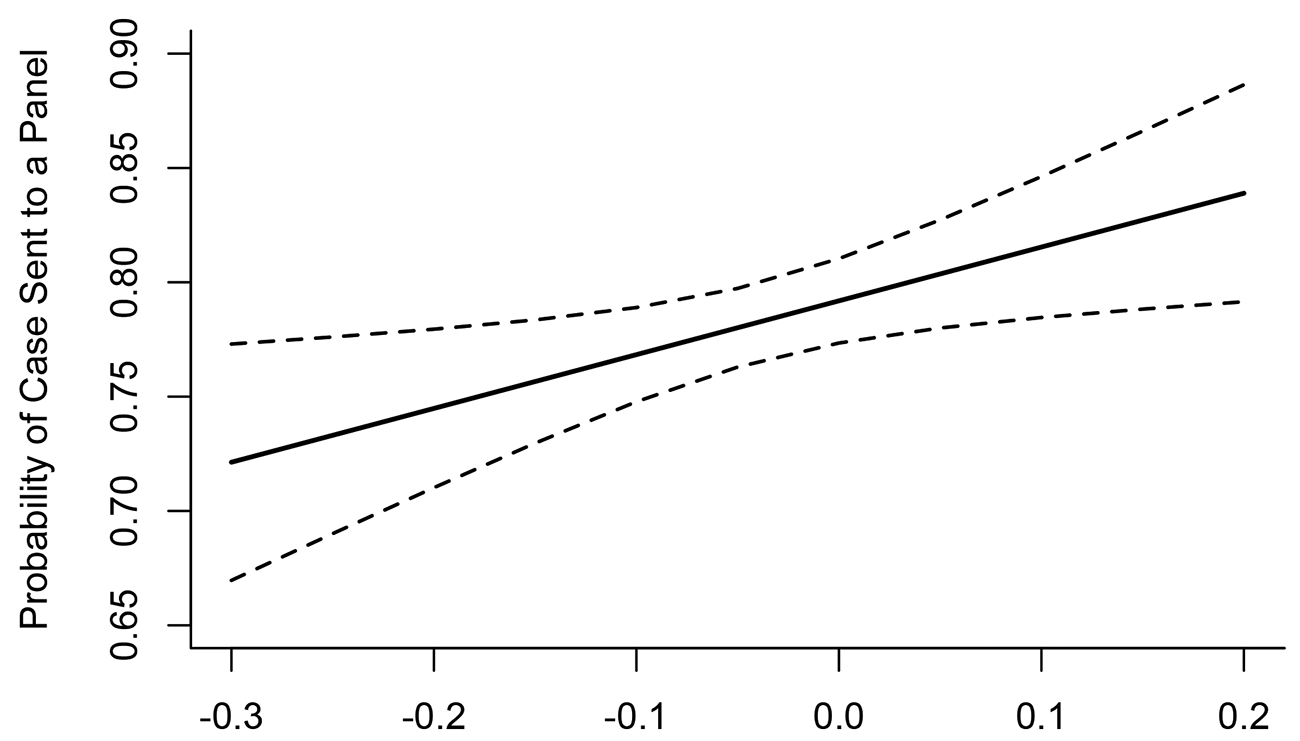
Table 3 presents the results of our analysis of the first hypothesis. As expected, the results indicate that the likelihood of a case being delegated to one of the CJEU’s panels increases as the risk of noncompliance decreases. Importantly, this result is robust to the inclusion of a series of control variables accounting for case aspects like the total number of member-state briefs and the number of legal issues raised in each judgment.Footnote 20 As the results of model 2 demonstrate, Balance of Member-State Briefs exerts a substantively significant influence on the CJEU’s decision to assign a case to panels even after accounting for the total number of briefs and legal issues in a case.Footnote 21 As the coefficient indicates, a shift in Balance of Member-State Briefs from −0.5 to 0.5, which covers nearly the full range of the variable, corresponds to a 23.5% increase in the probability of a case being assigned to panels. Or, to give a concrete example, a shift in Balance of Member-State Briefs from 2 standard deviations below to 2 standard deviations above the mean, which is roughly equivalent to comparing a case in which Germany and France oppose greater EU integration with one in which those major member states do favor such a ruling, increases the likelihood of a case going to a panel by nearly 11%. Although such a comparison is one between two extremes with one case generating unusually strong pro-EU integration sentiment from the member states and one that instead generates strong anti-EU integration views from EU governments, it provides a sense of the upper bound of the potential impact the threat of noncompliance may have on the CJEU’s procedural choice. As figure 1 shows, though, the substantive significance of this relationship is not limited to such extreme outlier cases and shifts in member-state government briefs. The figure presents the predicted probability of the CJEU delegating a case to a panel based on the balance of member-state government briefs, with negative values on the x-axis indicating member-state opposition to a pro-EU integration ruling and positive values indicating support for such a decision. A modest shift of 1 standard deviation—the rough equivalent of a brief filed by one of the EU’s smaller member states like Hungary or the Netherlands—increases the likelihood of a case being heard by a panel by nearly 3%. Given that the vast majority (74%) of cases go to panels, even this modest shift represents a nontrival impact on the CJEU’s behavior and highlights the sensitivity of the CJEU to member-state interests and reflects similar findings regarding the CJEU’s decision making (Carrubba et al. Reference Carrubba2008; Carrubba and Gabel Reference Carrubba2015; Larsson and Naurin Reference Larsson2016).
OLS Analysis of Panel Use at the CJEU (Hypothesis 1)

Note.—Standard errors in parentheses.
* p < .10.
** p < .05.
*** p < .01.
Predicted probability of the CJEU delegating a case to a panel. Based on results of model 2. Dashed lines, 90% confidence intervals.

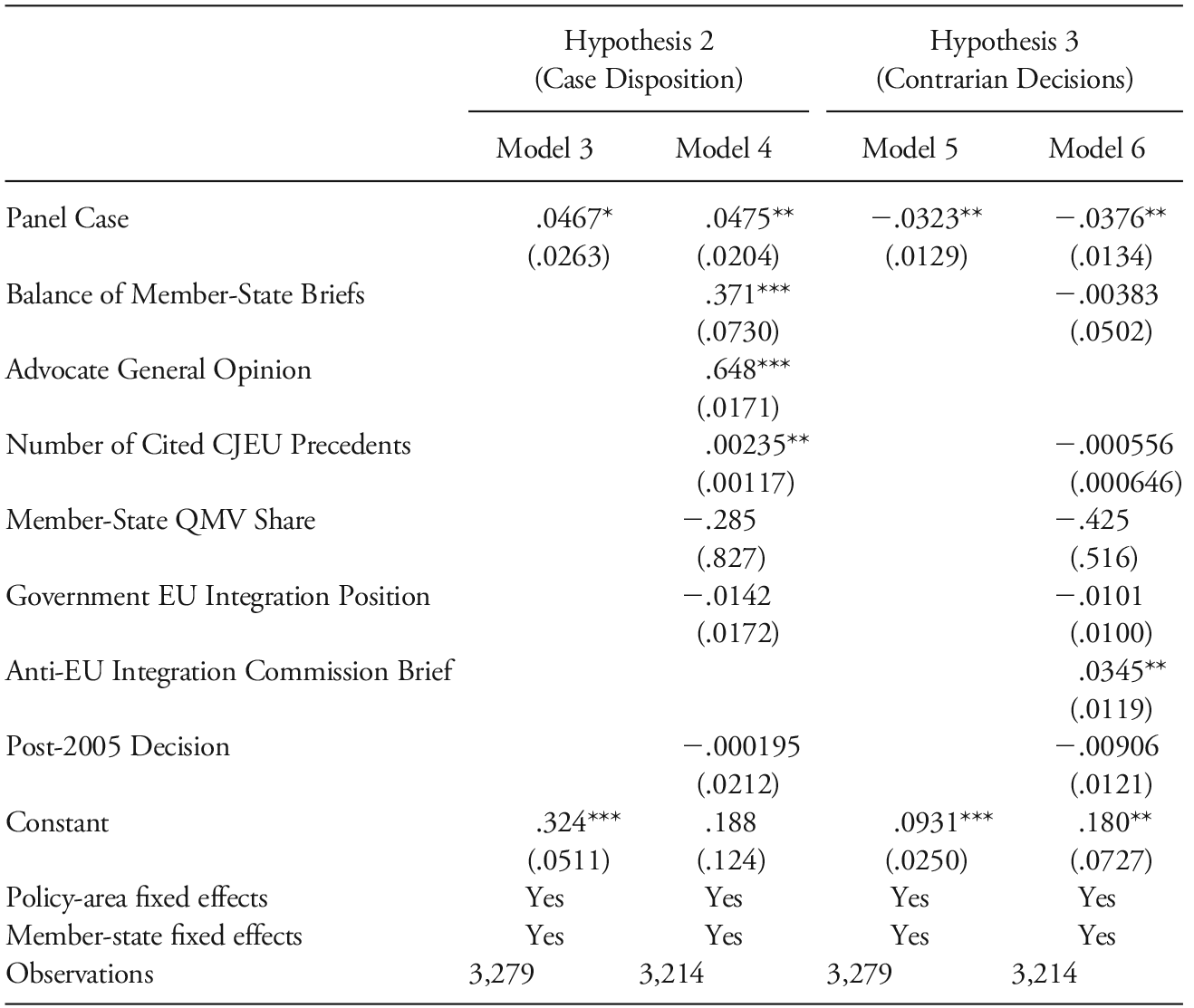
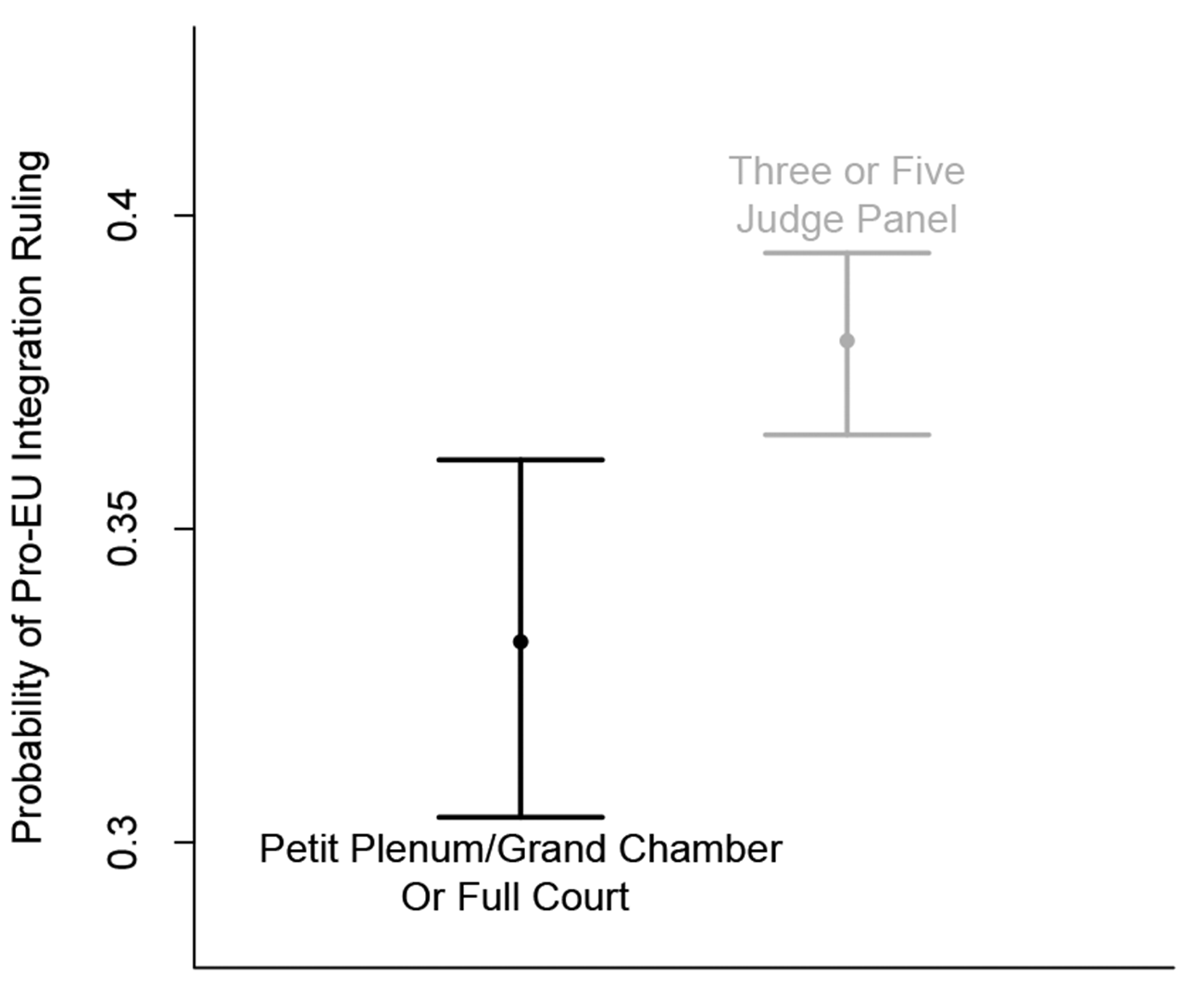
The results of the analysis for the second hypothesis are presented by models 3 and 4 in table 4. As predicted by the theory, legal issues decided by the CJEU’s smaller three- and five-judge panels were more likely to result in a pro-EU integration decision than those handled by the CJEU’s larger compositions. Notably, this empirical relationship holds even after accounting for factors like the legal merits, positions of member-state governments, and policy area.Footnote 22 As the predicted probabilities presented in figure 2 demonstrate, the substantive magnitude of this relationship is not trivial.Footnote 23 Whereas the probability of legal issues handled by panels resulting in a pro-EU integration direction is 39%, this drops to 34% for those disposed of by the CJEU’s larger compositions. Although smaller than the impact of the AG’s opinion or large shifts in the balance of member-state briefs, this change in the likelihood of a pro-EU integration decision corresponds roughly in magnitude to that of adding a large member state like Germany or France to the balance of member-state briefs.
Panels and CJEU Decisions (Hypotheses 2 and 3)

Note.—Standard errors clustered by case. Outcome variable is measured at the level of legal issue.
* p < .10.
** p < .05.
*** p < .01.
Likelihood of pro-EU integration decision. Based on results of model 4. Bars, 90% confidence intervals.

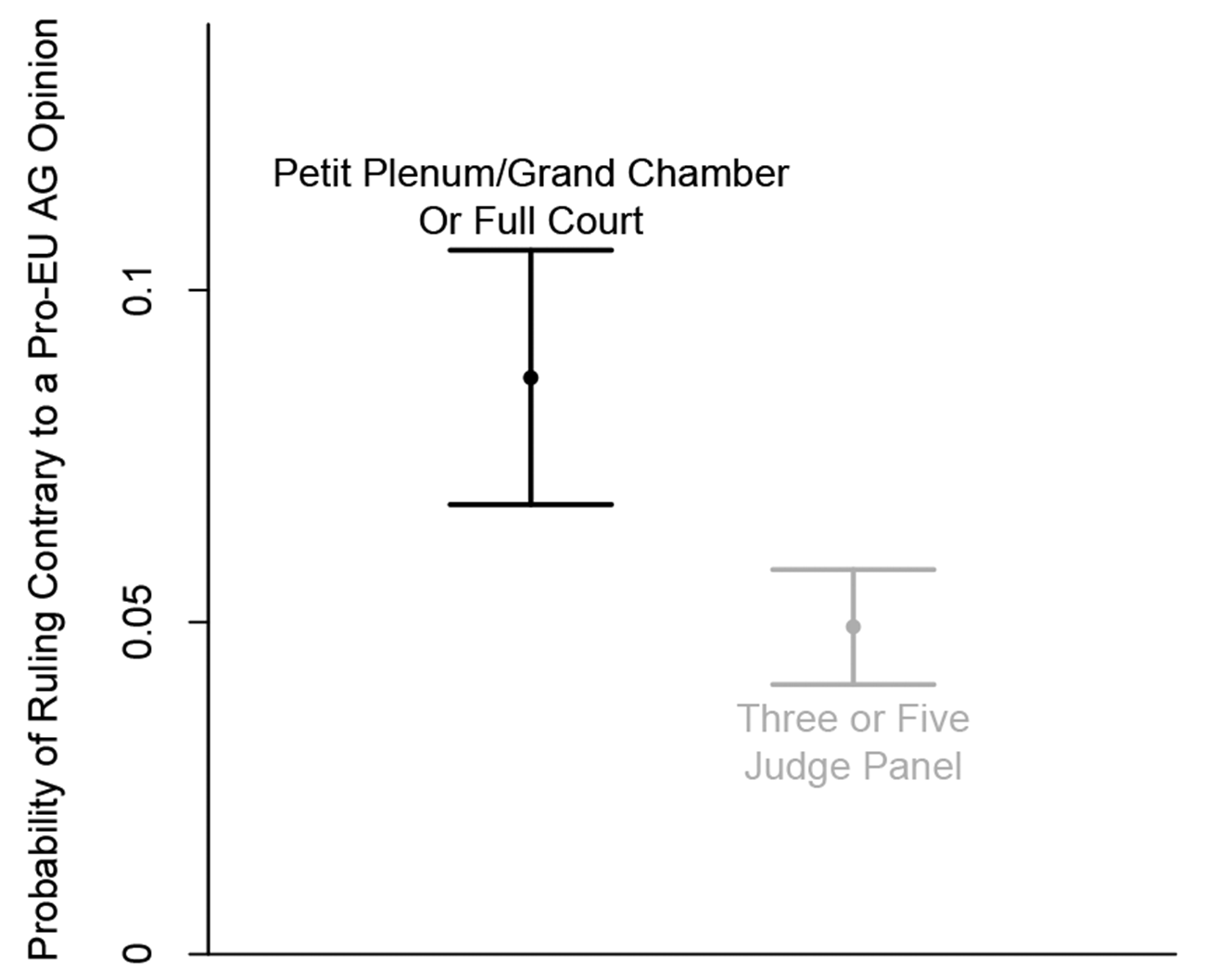
Finally, we turn to the results of models 5 and 6 in table 4, which test our third hypothesis. Recall that this hypothesis predicts that panels are less likely than a full court to rule against a government’s interests when the legal merits favor such a decision. Empirically, we expect, therefore, that issues decided by panels are more likely to conform with an opinion by the AG recommending a pro-EU integration decision. The results of models 5 and 6 support this expectation.Footnote 24 Issues decided by panels are more likely to conform with an AG’s opinion promoting a pro-EU integration. In contrast, the larger compositions were more likely to disregard such a prointegration opinion from the AG by ruling instead in a manner preserving national sovereignty.Footnote 25 While, as figure 3 shows, the likelihood of such decisions is low, the difference between panels and the larger compositions of the CJEU is substantial. Whereas the probability of a panel decision against a pro-EU integration AG opinion is only roughly 5%, the probability of a larger composition of the CJEU making such a decision is nearly double at 9%. To the extent that such decisions reflect strategic behavior, these results further support our argument linking the delegation of decision making to panels with the political environment surrounding a case.
Probability of panel decision against pro-EU integration. Based on results of model 6. Bars, 90% confidence intervals.

Conclusion
Just as examples of delegation abound in the context of legislative and executive institutions, courts regularly delegate tasks to individual or small subsets of judges. While a substantial American politics literature has addressed instances of such delegation like opinion assignment at the Supreme Court (Maltzman and Wahlbeck Reference Maltzman2004; Lax and Cameron Reference Lax2007) and the use of en banc review at the Courts of Appeals (Giles et al. Reference Giles2006; Clark Reference Clark2008; Kastellec Reference Kastellec2011), less is known about why and how courts delegate from a comparative perspective. With many of the world’s high courts using panel systems by which the court delegates cases to subsets of judges, this limitation of the extant literature leaves a number of empirical and theoretical questions unanswered. Building on standard delegation accounts, we argue that institutional concerns raised by the threat of noncompliance present one factor influencing the use of panels. From our expectation that cases with a greater risk for noncompliance will not be sent to panels, we then derive empirical implications for case disposition and the willingness of a court to rule contrary to the legal merits in a case. An empirical analysis of panel use in preliminary reference cases at the CJEU provides evidence supporting our account.
These results have a number of implications for the functioning and operation of courts in general and the CJEU in particular. First, we contribute to an extensive literature analyzing how courts leverage institutional tools when facing threats of noncompliance (e.g., Vanberg Reference Vanberg2005; Staton Reference Staton2010; Krehbiel Reference Krehbiel2016). Second, our theory and results are consistent with other studies that demonstrate the effectiveness and pitfalls of panel decision making at courts (e.g., Farhang and Wawro Reference Farhang2004; Malecki Reference Malecki2012; Kastellec Reference Kastellec2013, Reference Kastellec2016; Glynn and Sen Reference Glynn2015; Grossman et al. Reference Grossman2016). Third, with regards to the CJEU, an extensive debate exists regarding whether, and to what extent, the CJEU is responsive to the preferences of member states (e.g., Stone Sweet and Brunell Reference Stone Sweet1998, Reference Stone Sweet2012; Carrubba et al. Reference Carrubba2008, Reference Carrubba2012; Larsson and Naurin Reference Larsson2016; Larsson et al. Reference Larsson2017). In addition to analyzing the disposition of cases, we theorize over and provide empirical evidence that the probability of member-state noncompliance affects the president’s decision over panel assignment. Our argument goes beyond the previous scholarship in asserting that the probability of member-state noncompliance affects a case well before the CJEU writes its judgment.
Our theoretical account and empirical findings also point to potential avenues for future research on both the use of panels specifically and procedural aspects of the judicial process more generally. While we have identified one potential influence on the assignment of cases to panels, a number of other factors likely exist whose influence remains an open empirical question. For example, the role of ideology or the internal politics of a court could well inform which cases are sent to a panel and which are not. Moreover, such factors could interact with concern for compliance. Although we see our theory and empirical analysis as not being specific to the context of the CJEU, the substantial variation in panel systems when viewed from a comparative perspective remains a largely untapped source of leverage for theory development and empirical analysis. Future research may consider other examples of delegation in the judicial context. At the CJEU, for example, the president’s assignment of the judge-rapporteur for each case presents a clear instance of delegation. In other courts, such as the German Constitutional Court, the distribution of specific issue areas to subsets of the court or individual judges similarly provide potential examples of delegation taking place within the judiciary.