According to Norpoth,Footnote 1 ‘war and economics have few rivals when it comes to making or breaking governments’. Research on economic voting has largely arrived at a consensus concerning the positive effects of favorable economic conditions on governing parties’ electoral fortunes.Footnote 2 Yet research on the effect of interstate conflict involvement on election outcomes reveals a diversity of findings. Some scholars argue that conflict is a costly gamble for governments because of the societal costs,Footnote 3 while others suggest that conflict involvement may enhance voter support for the government.Footnote 4 Still others find that conflict has no effect on the fate of governments.Footnote 5 To further complicate matters, the effect of conflict may be conditioned by the clarity of government responsibility,Footnote 6 the issues that governing parties emphasizeFootnote 7 or the salience of foreign policy among voters.Footnote 8
We argue that the myriad possible effects of conflict pose problems for traditional economic voting models. Specifically, a government's participation in international conflict is likely to increase the error variance around our predictions of electoral outcomes – heteroskedasticity. As a consequence, inferences drawn from such models are likely to be misleading.Footnote 9 Rather than treat such non-constant error variance as a nuisance to be corrected, we advocate explicitly modeling the stochastic component of voting models as a function of conflict involvement.Footnote 10 This modeling approach – which we label ‘heteroskedastic economic voting models’ – not only corrects for the consequences of heteroskedasticity, but also facilitates a more accurate depiction of the influence of economic conditions on electoral support.
Examining government parties’ vote shares among twenty-four established democracies from 1965–2000, we employ heteroskedastic regression to model the non-constant error variance associated with conflict. Our results provide robust evidence that participation in international conflict increases the variance of electoral predictions. The findings suggest that conflict involvement introduces added uncertainty into traditional economic voting models.
Foundation
Conflict is frequently thought to be costly for democratic leaders. Involvement in conflict typically produces casualties, which tend to reduce support for the war effort and decrease the leader's popularity.Footnote 11 Indeed, as Bueno de Mesquita and LalmanFootnote 12 assert, ‘[t]he very need to resort to force suggests a political failure by the national leadership…’. Thus conflict involvement can be characterized as a costly gamble that is likely to erode the domestic political position of democratic leaders. However the provision of public goods to a domestic audience associated with conflict involvement can be expected to enhance the leader's chances of political survival.Footnote 13 Indeed, in the cases of the United States and Great Britain, leader popularity has been shown to rise in response to participation in international crises.Footnote 14 Conflict also affords democratic leaders many other opportunities that would otherwise be unavailable. For example, conflict may facilitate a leader's efforts to outmaneuver the domestic opposition by changing the national agenda.Footnote 15 Dispute involvement may also divert public attention away from poor economic conditions,Footnote 16 solidify support for the leader among the ruling coalitionFootnote 17 or allow the leader to demonstrate his or her leadership competence.Footnote 18 These possibilities suggest that conflict may provide opportunities for democratic leaders to enhance their prospects for political survival.
Other research suggests that there is a conditional relationship between conflict and elections. An examination of American cases suggests that support for military operations – and, hence, the leadership – does not decline inexorably as casualties mount.Footnote 19 Instead, voters may be ‘defeat phobic’ and evaluate the wisdom of military operations on the basis of expected success. Another view privileges the role of an operation's policy objectives, finding that the type of goals a conflict aims to achieve influences public support.Footnote 20 Still othersFootnote 21 find evidence favoring a calculating public that weighs the costs (casualties) and benefits (goals) of conflict.Footnote 22 If popular policy successes that are achieved at sufficiently low costs bode well for incumbent leaders, conditions that increase public support for military operations are likely to translate into electoral benefits as well. Indeed, democratic leaders appear to be aware of this possibility. Democracies tend to win the wars they fight, and to do so at a relatively lower cost than their autocratic counterparts.Footnote 23 Democratic leaders also appear to view the public as casualty phobic and seek to minimize battlefield casualties.
Despite such efforts to maximize favorable conditions, voters are likely to evaluate the conditions of a conflict, much like the economic conditions, subjectively. Regardless of the oft-mentioned ‘objective facts on the ground’, voters’ perceptions of conflict conditions are likely to be important. If voters believe that their leader is a competent manager of issues such as international conflict, the leader is likely to be rewarded. Indeed, such rewards may complicate the usual judgements of voters, which are characterized by the relationship between economic performance and electoral outcomes. In contrast, voter perceptions of incompetence (that is, foreign policy failure) may lead to electoral punishment, and may even outweigh the rewards associated with good economic performance. In other words, conflict participation confuses voter judgements concerning leader competence.
The sources of such confusion are rooted in the conflict itself. Leaders have incentives to obfuscate the goals, expected costs and likelihood of success in order to build and maintain broad support for military operations, while outmaneuvering critics. For instance, leaders tend to identify multiple goals or rationales for engaging in conflict. While some goals may resonate with a given voter, others may not. The accomplishment of any goal can be characterized as success by the leadership, but if a realized goal does not resonate with a voter, s/he is unlikely to credit the leadership with success. Moreover, the opposition may be able to realistically depict the conflict as too costly or unnecessary.Footnote 24 However if the opposition fails to offer a popular alternative to the conflict, the leadership may win the ‘least worst choice’ vote.
Overall, conflict participation provides confusing information to voters about the leadership's abilities. The conduct of a conflict, as well as how it is interpreted subsequently, is likely to contribute to noise around voters’ perceptions. To put it another way, voters may be more (or less) likely to accurately evaluate the leadership's abilities when interstate conflict is introduced into the calculation. Additional uncertainty arises when those preferences, in combination with parties’ platforms, are translated into actual vote choices. Do individuals choose to use their votes as sanctioning devices (consistent with retrospective voting), or as a way of influencing future policy direction (prospective voting)? How do ideological orientations or perceptions of issue ownership determine which parties voters support? Thus the influence of traditional measures of aggregate levels of vote support (for example, economic conditions) may wane when compared to salient foreign policy outcomes.Footnote 25 For these reasons, we hypothesize that our ability to predict vote shares using traditional economic voting models will vary with the presence of international dispute involvement.
Hypothesis: dispute involvement increases the error variance of the predicted vote share of governing parties.
The Problem of Heteroskedasticity
Suppose that we incorporate a measure of conflict into a traditional economic voting model. Such a model, which specifies only the non-stochastic influences on the average expected vote share, assumes that the voting public responds to all conflicts in the same way and to the same degree (on average). However the discussion of the research above indicates that the effect of conflict is likely to influence the average expected vote share differently, depending on a variety of influences. Indeed, in order to facilitate more precise explanations of electoral outcomes using our heteroskedastic economic voting model, we should adopt a statistical approach that accounts for the variance around electoral outcomes.
First, consider a traditional economic voting model Y = Xβ + ε, where Y is a random variable of vote share, X β is a matrix of explanatory variables (such as previous vote share, GDP growth, etc) and their effects, and ε is a stochastic component with mean 0 and variance σ 2. Y is called a random variable because it varies randomly across the hypothetical replications of this dataset.Footnote 26 Unfortunately, we only observe the realized variable, y, which complicates our goal of making inferences about the systematic components of the random variable, Y. While most scholarly attention is focused on the systematic component of y (X β), we suggest that it is also important to determine the variation in the dependent variable when the systematic components do not change; this represents the size of the stochastic component (σ 2). If our goal is to use the realized variable y to make inferences about the random variable Y, then we want our estimates to be correct on average (unbiasedness) and we want more confidence in the precision of our estimate (efficiency).Footnote 27 Unfortunately, in studies of comparative voting, political scientists typically do not have an infinite number of samples of the random variable to allow us to obtain the correct estimate, on average. Without an infinite number of samples (Y), how can we be sure that the one realized variable (y) we have is close to the true population value?
Our proposed solution for heteroskedasticity is to estimate a heteroskedastic regression, in which we can explicitly model the stochastic component (ε) as a function of explanatory variables. This is certainly not a recent development, as there are excellent examples of scholars who theorize and explicitly model the sources of non-constant error variance in voting models.Footnote 28 In this case, we theorize that the variance of our stochastic component (σ 2) is positively related to involvement in international disputes.
The contribution of the heteroskedastic economic voting model is that traditional economic voting models risk making misleading inferences if they ignore the salience of conflict. First, while the βs will be unbiased, they will be more inefficient; the variation of β around its mean will be greater, therefore increasing the potential that the one estimate that we produce is vastly different from the true estimate.Footnote 29 Secondly, ignoring heteroskedasticity in the context of ordinary least square (OLS) produces biased estimates of the standard errors, invalidating confidence intervals and the traditionally used F and t tests.Footnote 30 In the Results section, we demonstrate that failing to model the role of exogenous shocks such as conflict produces non-spherical errors, which causes us to underestimate our uncertainty regarding our predictions. Finally, by studying the ‘variance-altering causes’ of vote share, we gain considerable leverage on a novel hypothesis, which allows us to produce a ‘more accurate and thorough discussion’ of electoral outcomes.Footnote 31 In the next section we discuss the data collection and estimation procedures.
Research Design
To test our hypothesis, we examine government parties’ vote shares in twenty-four established democracies from 1965–2000.Footnote 32 The unit of analysis is the government party/election.Footnote 33 Our dependent variable is each government party's Vote Share at election t. We follow Powell and WhittenFootnote 34 and include each party's vote share in the previous election (Vote Share (Vt −1 )). We expect that this coefficient will be positive, which will demonstrate ‘the fairly stable base of party support from election to election’.Footnote 35 By including the lagged dependent variable, the substantive interpretation of our model becomes one of predicting gains or losses, controlling for previous bases of support.Footnote 36
Our key theoretical variable is the number of hostile militarized interstate disputes (MID) that occurred in the election cycle. We focus our analysis on hostile disputes (uses of force and war) because they tend to be more salient for voters than more minor disputes (threats or displays of force).Footnote 37 These data are drawn from the Correlates of War Militarized Interstate Dispute (MID) dataset.Footnote 38 We expect that Hostile MIDs will positively affect the variance of vote change (since they will increase the unpredictability of election outcomes). As a control variable, we also include Hostile MIDs in the mean equation. Yet one should be cautious about inferring too much from those results, given that the variable is included additively and therefore does not begin to honor the conditional expectations discussed above.
While a variety of variables reflect a country's economic performance, we include the Change in Real GDP Per Capita from the Penn World Tables Version 6.2.Footnote 39 If the election occurs in the first six months of the year, we use the previous year's value. To ensure that we produce a complete model specification, we also include the annual unemployment rate and the first-differenced annual inflation series from the World Bank's World Development Indicators. The expectation is that worsening economic conditions will reduce governing parties’ vote shares.
To control for the possibility that voters hold government parties accountable differently based on the features of the system or the characteristics of the government, we also include the following variables: Majority is coded 1 if the government parties collectively hold a majority of seats in parliament, Coalition is coded 1 if more than one party controls a cabinet portfolio and Executive is coded 1 if the government party controls the prime minister. The expectation is that having a minority or coalition government may moderate the common occurrence of government parties losing votes in subsequent elections, while holding the executive portfolio may exacerbate such a loss.Footnote 40 We created these variables based on the government data provided by Woldendorp, Keman and Budge.Footnote 41 Finally, to take into account the potential electoral advantage that government parties have in determining the timing of elections,Footnote 42 we created the Percentage of Time Left in the Constitutional Inter-election Period (CIEP). This variable calculates the percentage of time left in the election cycle when the election occurred; values closer to 100 indicate elections early in the election cycle.Footnote 43 We then interact this variable with Executive to control for the electoral benefits that an executive's party may receive by opportunistically calling for early elections.Footnote 44
Results
To test our hypothesis that involvement in hostile disputes increases the error variance of vote shares, we estimate heteroskedastic regressions. In addition to estimating vote share directly (that is, in the manner of OLS), it also estimates the predicted variance of the stochastic component of vote share (σ 2) using the following equationFootnote 45 :
 $${{\hat{\sigma }}^2} \, = \, {{e}^{({{{\hat{\gamma }}}_1}\: + \, {{{\hat{\gamma }}}_2}Z)}}, $$
where
 $$$ {{\hat{\gamma }}_1} $$$
is a constant and
 $$$ {{\hat{\gamma }}_2} $$$
is a coefficient representing the effects of the number of hostile disputes (Z) on the error variance of vote share.Footnote
46
This estimation technique relaxes the assumption of constant error variance across observations and lets one predict the error variance of governing party vote share as a function of the presence of conflict.
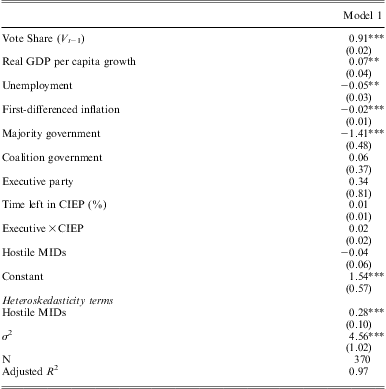
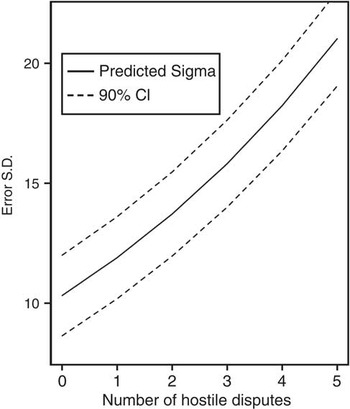
Table 1 shows the heteroskedastic regression estimates for the effects of involvement in Hostile MIDs on vote share. The effect of international conflict on the error variance of vote share is positive and statistically significant at the 99 per cent confidence level. This suggests that becoming involved in international conflict limits our ability to accurately predict vote shares using traditional economic voting models. See Figure 1 for a better understanding of the consequences of ignoring the role of salient foreign policy issues.
Heteroskedastic Regression Results for the Effects of Involvement in Hostile Disputes in the Election Cycle on Government Parties’ Vote Shares (Vt)

Note: robust standard errors in parentheses; *** = p < 0.05, ** = p < 0.1 (two-tailed). Country-specific fixed effects coefficients in the variance equation have been omitted for presentation purposes. CIEP = Constitutional Inter-election Period.
Predicted error standard deviation (σ) across the sample range of hostile dispute involvement in the election cycle

We plot the predicted error standard deviation (σ) and 90 per cent confidence intervals across the number of Hostile MIDs. The figure clearly shows that involvement in hostile disputes produces statistically significant increases in the standard deviation of predictive errors. Each additional conflict increases the risk that scholars will make misleading inferences in voting models due to the assumption of constant error variance.
We also see evidence that supports the use of votes as a sanctioning device for economic policy performance. The coefficients for Real GDP Per Capita Growth, Unemployment and Inflation are in the expected direction and statistically significant, indicating that government parties benefit from strong economic conditions and are punished for poor conditions. The positive and statistically significant coefficient for Vote Share (Vt −1 ) suggests that parties maintain their bases of support from the previous election. While the number of government parties (Coalition) has no effect on vote share, the level of parliamentary support (Majority) results in losses. Executive and Time Left in CIEP are part of an interaction (Executive × CIEP), so it is best to evaluate their substantive effects through marginal effects. At no point in the election cycle does Executive have a statistically significant marginal effect on Vote Share. However, there is a distinct advantage for the executive's party in influencing when elections are called. The marginal effect of Time Left in CIEP is 0.009 (95 per cent confidence interval of [−0.01, 0.03]) for junior parties and 0.034 (95 per cent confidence interval of [0.01, 0.06]) for the party controlling the executive. In other words, for every 1 per cent of the election cycle earlier the election occurs, the executive gains an extra 0.034.Footnote 47
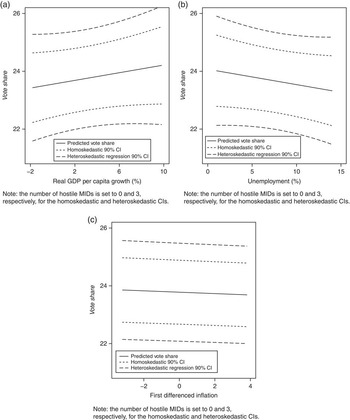
The results from Figure 1 suggest that the variance of the error – representing our ability to accurately predict vote share – increases as a function of international conflict. We now turn our attention to assessing how our inferences of the effects of specific variables – in this case, economic conditions – become more uncertain following conflict. Figure 2 shows the predicted vote share across Real GDP Per Capita Growth, Unemployment and First-differenced Inflation.Footnote 48 In each case we show the 90 per cent confidence intervals for the periods of no hostile disputes (that is, assuming homoskedasticity) compared to three hostile disputes.
Predicted vote share across economic conditions for election cycles with no hostile MIDs versus three hostile MIDs

As the number of hostile disputes increases from 0 to 3, our ability to accurately infer the effects of economic variables drastically decreases (that is, the confidence intervals widen). Indeed, the heteroskedastic confidence intervals when there are no disputes are nearly twice as large as the homoskedastic confidence intervals when there are three disputes. More substantively, it demonstrates that traditional economic voting models miss part of the picture, and risk developing potentially misleading inferences based on overestimating the accuracy of their predictions.
Discussion and Conclusion
We argue that it is difficult to accurately predict election results using traditional economic voting models because various elements make foreign policy issues salient for some voters and parties, but not others. We propose a heteroskedastic economic voting model that is easily estimated with most statistical packages. More importantly, evaluating the role of international dispute involvement with heteroskedastic regressions allows us to effectively model these impacts. We demonstrate that international dispute involvement increases the variance around those election results. Contrary to early research on public opinion about foreign policy,Footnote 49 leaders are not ‘waltzing before a blind audience’.Footnote 50 Indeed, voters pay attention to these events to such an extent that our models based on accountability for economic performance become much less accurate.
We agree with Braumoeller'sFootnote 51 sentiment that variance is the forgotten moment, which has unfortunate implications for the adequacy of voting models. During elections following conflict, we will, on average, get the correct estimate (if our estimator is unbiased), but our variability will be much larger (more inefficient) which is problematic because we want to be correct more often and ensure that our realized variable is closer to the true random variable. By ignoring the role of foreign policy outcomes, we risk making misleading inferences about the effects of economic growth, unemployment and inflation on electoral support. Indeed, ignoring the variance-altering effects of international conflict is one possible explanation for the often uneven findings regarding economic conditions.Footnote 52
Elections following international conflict incorporate additional layers of uncertainty. These are the toughest elections to predict for a reason: we know little about how voters respond to conflict, which is precisely why our error variance increases. It is possible that the salience of other issues (for example, the economy) decreases as a result of costly disputes. Moreover, we currently lack cross-national theories that specify how voters respond to disputes in terms of which parties they support: do voters refrain from changing horses mid-race, or do they throw the bastards out? If voters decide to sanction government parties and shift their support, which other parties then see boosts? Are these shifts in support moderated by ideological orientations (of voters or parties), or by clarity of responsibility?Footnote 53 We provide aggregate evidence that is consistent with the patterns SingerFootnote 54 observes at the individual level regarding the ability of foreign policy issues to disrupt the list of issues that voters traditionally consider to be important.
If producing accurate empirical models is a priority, then for all of these reasons, it is imperative to recognize the effects of international disputes on the variance of vote shares. While we propose a methodological solution to non-constant error variance, it would be foolish to underemphasize the importance of producing theoretically grounded, well-specified models of voting behavior. Ultimately, scholars should be motivated to make these variance coefficients statistically insignificant by producing a better model specification of the mean, with the goal of getting the residuals to be white noise. We cannot stress the importance of model specification enough, as data can appear to be heteroskedastic due to omitted variable bias, incorrect functional form, the presence of outliers, etc.Footnote 55 Until we have stronger theories that produce models with more accurate specifications, we will continue to observe larger error variances due to conflict.
A particularly fruitful source of theory regarding the effects of conflict is the literature on critical events. Critical events are exogenous shocks that have the potential to destabilize governments,Footnote 56 due to changes in the parties’ positions on key issues, the salience of those issues or the distribution of seats.Footnote 57 Hostile international disputes can influence all three of these factors, which suggests that the domestic consequences of international conflict are vastly understated. We present preliminary evidence that indicates that disputes – as potentially critical events – can upset the salience of domestic issues as well as the distribution of seats (that is, votes). Additional research can explore whether involvement in international disputes influences the types of issues that parties emphasize in campaigns, the stability of certain governing arrangements or individual-level responses to these events.