Implications
The commercial poultry-specific dim-to-blue light-emitting diode (LED) light and typical compact fluorescent light (CFL) tested in this study yielded comparable growing performance and well-being as reflected by feather and comb conditions of non-beak-trimmed W-36 pullets during 14-week rearing period. The LED light shows more stimulating effect on the pullet activity levels, which may be beneficial from the standpoint of enhancing a stronger bone development in the birds for subsequent egg production.
Introduction
Light is a crucial environmental factor that affects bird’s behaviors, development, production performance, health, well-being and possibly product quality of modern egg production (Lewis and Morris, Reference Lewis and Morris1998). Extensive research on poultry lighting has been conducted over the past eight decades, which has contributed to understanding of poultry responses to lighting, improved energy efficiency in lighting and general management practices of modern egg production. Today, more energy-efficient, readily dimmable, long-lasting and more affordable LED lights are increasingly finding applications in poultry production facilities (Parvin et al., Reference Parvin, Mushtaq, Kim and Choi2014). There have been some anecdotal claims about the benefits of such lighting on bird performance and behavior; however, data from controlled research were lacking.
Many lighting effects on poultry have been well understood by both scientific and industrial communities. For example, activity levels of birds are known to be positively correlated to light intensity (Boshouwers and Nicaise, Reference Boshouwers and Nicaise1993; Deep et al., Reference Deep, Schwean-Lardner, Crowe, Fancher and Classen2012). Sexual development and maturity of pullets are known to be associated with changes in day length and red light spectrum (Morris and Fox, 1960; Smith and Noles, Reference Smith and Noles1963; Min et al., Reference Min, Hossan, Nazma, Jae, Han, Hwan, Dong, Hyum, Hee and Ok2012; Baxter et al., Reference Baxter, Joseph, Osborne and Bedecarrats2014). However, certain aspects remain to be fully investigated and understood. For instance, a few studies reported that blue lights were associated with improving broiler growth, calming the birds (e.g. reducing aggressive interaction and locomotion) and enhancing immune response (Prayitno et al., Reference Prayitno, Phillips and Omed1997; Rozenboim et al., Reference Rozenboim, Biran, Chaiseha, Yahav, Rosenstrauch, Sklan and Halevy2004; Cao et al., Reference Cao, Liu, Wang, Xie, Jia and Chen2008; Xie et al., Reference Xie, Wang, Dong, Cao, Wang, Chen and Chen2008; Sultana et al., Reference Sultana, Hassan, Choe and Ryu2013). However, the underlying mechanisms were not clearly delineated in these studies. In contrast, some studies reported no effects of different light sources on growth performance of pullets and broilers (Schumaier et al., Reference Schumaier, Harrison and McGinnis1968; Pyrzak et al., Reference Pyrzak, Snapir, Goodman, Arnon and Perek1986; Baxter et al., Reference Baxter, Joseph, Osborne and Bedecarrats2014; Huth and Archer, Reference Huth and Archer2015; Olanrewaju et al., Reference Olanrewaju, Miller, Maslin, Collier, Purswell and Branton2016). A long-term field study with commercial aviary hen houses revealed no differences in egg weight, egg production, feed use and mortality rate of DeKalb white hens between a commercial LED light and CFL light (Long et al., Reference Long, Zhao, Wang, Ning and Xin2016). In addition, studies found that different genetic breeds of birds responded differently to lights. For example, W-36 laying hens were reported to have the highest feed intake at 5 lux but lowest at 100 lux (Ma et al., Reference Ma, Xin, Zhao, Li, Shepherd and Alvarez2016), whereas ISA Brown hens showed most feeding in the brightest (200 lux) and least in the dimmest light (<1 lux) (Prescott and Wathes, Reference Prescott and Wathes2002). Thus further investigation of poultry lighting is warranted.
Poultry and humans have different light spectral sensitivities (Prescott et al., Reference Prescott, Wathes and Jarvis2003; Saunders et al., Reference Saunders, Jarvis and Wathes2008) in that humans have three types of retinal cone photoreceptors, but poultry have five that are sensitive to UV, short-, medium- and long-wavelength lights (Osorio and Vorobyev, Reference Osorio and Vorobyev2008). Compared with humans, poultry can perceive light not only through their retinal cone photoreceptors in the eyes, but via extra retinal photoreceptors in the brain (e.g. pineal and hypothalamic glands) (Mobarkey et al., Reference Mobarkey, Avital, Heiblum and Rozenboim2010). Retinal cone photoreceptors produce the perception of light colors by receiving lights at the peak sensitivities of about 415, 450, 550 and 700 nm, and are more related to poultry activities (e.g. feeding, drinking and locomotion) and growth (Lewis and Morris, Reference Lewis and Morris2000). In contrast, the extra retinal photoreceptors can only be activated by long-wavelength lights (e.g. red) that can penetrate the skull and deep tissue of poultry, and are more related to sexual development and maturity (Lewis and Morris, Reference Lewis and Morris2000). It has been demonstrated that red lights can pass through hypothalamic extra retinal photoreceptors, thus stimulate reproductive axis by controlling the secretion of gonadotrophin receptor hormone and stimulating the release of Luteinising hormone and Follicle-stimulating hormone (Lewis and Morris, Reference Lewis and Morris2000). As different light sources (e.g. incandescent, high pressure sodium, fluorescent and LED lights) usually have different spectral characteristics, retinal and extra retinal photoreceptors of poultry may be stimulated differently when exposed to different light sources, thus causing different impacts on birds.
Despite the increasing LED light applications in egg production facilities, current lighting guidelines or recommendations (e.g. Hy-Line Commercial Layers Management Guideline) were established based on conventional incandescent and/or CFL lights and measured based on human vision. As a result, existing guidelines may not accurately reflect the operational characteristics and impact of the LED lights, hence the need for more research regarding the impact of LED lights on poultry and the corresponding lighting strategy. Meanwhile, concerns over animal welfare have led to increasing adoption of alternative housing systems such as enriched colony and cage-free aviary housing. However, there exist a number of challenges in such alternative housing systems, such as incidences of floor eggs, aggressive pecking and cannibalism, and resultant high mortality rate. With the important role that light plays in controlling hen behaviors, fine-tuning of lighting conditions and management strategies is expected to have a profound impact on alleviating some of these challenges.
Lighting experience during rearing period is very important for pullets as it can have profound impact on their growth and development (e.g. BW, BW uniformity (BWU), mortality rate and skeleton health), behaviors (e.g. aggressive pecking and cannibalism), subsequent lay performance (e.g. egg production rate and egg quality) and well-being (Lanson and Sturkie, Reference Lanson and Sturkie1961; Zappia and Rogers, Reference Zappia and Rogers1983; Nicol et al., Reference Nicol, Bestman, Gilani, De Haas, De Jong, Lambton and Rodenburg2013; Hy-Line International, 2016). With the emergence of various LED lights intended for poultry production, science-based information is necessary to optimize lighting characteristics. Just as CFL lamps have been replacing incandescent lamps, LED lights are expected to replace CFL lamps and become the predominant lighting source in the foreseeable future. Thus, it is of socioeconomic as well as scientific importance to quantify and compare the growing performance and behavioral responses of pullets to LED v. CFL lighting conditions.
The objective of this study was to evaluate the effects of a commercial poultry-specific dim-to-blue LED light (dim-to-blue, controllable correlated color temperature or CCT from 4500 to 5300 K) v. a typical CFL light (soft white, CCT=2700 K) with regards to growing performance (BW, BWU, BW gain (BWG), cumulative mortality rate (CMR)), activity levels, and feather and comb conditions of pullets. The results will contribute to the scientific basis of improving lighting guidelines for pullet rearing and egg production.
Material and methods
This study was conducted at the Hy-Line International Research Farm Facility located in Dallas Center, IA, USA. The experimental protocol was approved by the Iowa State University Institutional Animal Care and Use Committee (Log no: 3-15-7982-G).
Experimental pullets and husbandry
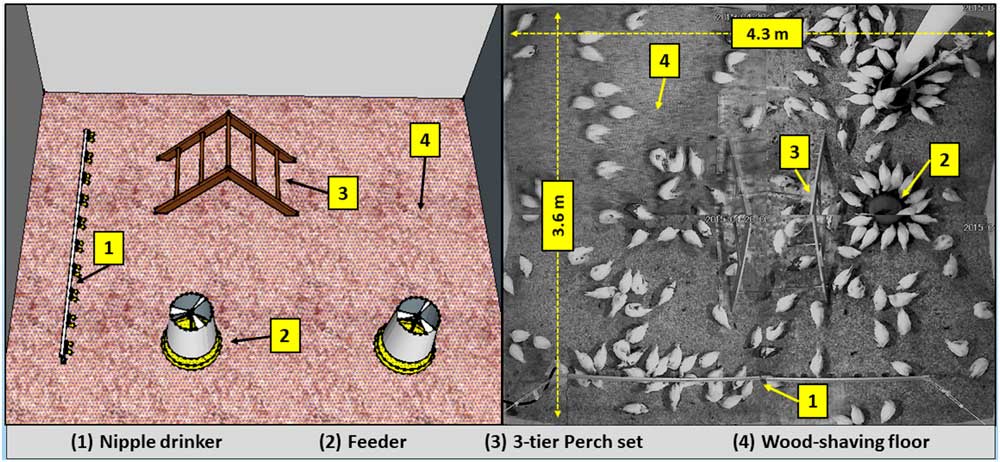
A total of 1280 Hy-Line W-36 non-beak-trimmed pullets in two successive batches were used in the study. For each batch, 640 pullets were individually identified with wing-bands, randomly assigned to four identical litter-floor rooms, 160 pullets per room at stocking density of 10 birds/m2 (967 cm2/bird). The pullet-rearing rooms (Figure 1), each measuring 4.3×3.6×2.4 m (L×W×H), had a concrete floor covered with wood shavings (4 to 5 cm in depth), two round auto-fill feeders (51 cm in diameter), 14 nipple drinkers (adjustable height) and a wooden gable perch set (90 cm L×140 cm W×67 cm H) that had five parallel perches (90 cm in length and 1.6 cm in diameter) in three tiers. Four cameras were installed on the ceiling of each room, evenly distributed, covering the entire floor area with top views (Figure 1). The rooms were equipped with mechanical ventilation (one variable speed fan per room, up to 1495 m3/h airflow rate) and supplemental heating to ensure thermal comfort conditions throughout the rearing period. Room temperature and relative humidity (RH) were set according to the Hy-Line Commercial Layers Management Guideline (Hy-Line International, 2016), that is 33°C to 35°C from placement to day 3, decreased to 31°C to 33°C from day 4 to day 7 and then gradually reduced by 2°C per week until 21°C by day 36; 40% to 60% RH. The pullets had ad libitum access to feed and water. Corn and soy diets were formulated to meet the nutritional recommendations based on BW (Hy-Line International, 2016), that is, starter-1 diet (20.00% CP, 2977 to 3087 kcal/kg metabolizable energy (ME), 1.00% Ca and 0.50% available phosphorus) for BW below 176 to 184 g, starter-2 diet (18.25% CP, 2977 to 3087 kcal/kg ME, 1.0% Ca and 0.49% available phosphorus) for BW below 413 to 427 g, grower diet (17.50% CP, 2977 to 3087 kcal/kg ME, 1.0% Ca and 0.47% available phosphorus) for BW below 947 to 973 g and developer diet (16.00% CP, 2977 to 3131 kcal/kg ME, 1.0% Ca and 0.45% available phosphorus) for BW below 1154 to 1186 g (Hy-Line International, 2016). Standard vaccination program (e.g. Marek’s disease, Newcastle disease, infectious bronchitis, infectious bursal disease, avian encephalomyelitis and fowl pox) recommended for pullet production was also followed (Hy-Line International, 2016).
Schematic (left) and top photographic view (right) of the pullet-rearing room.

Lighting regimens
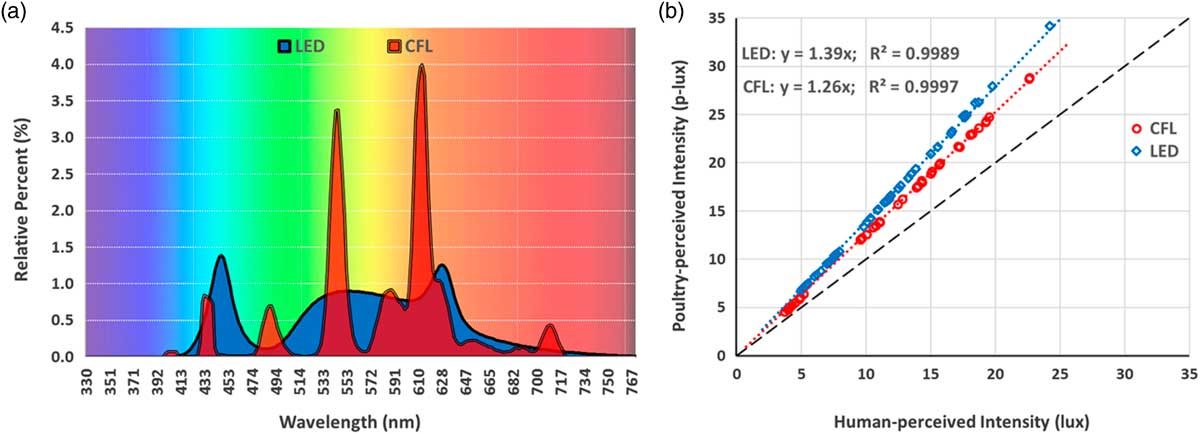
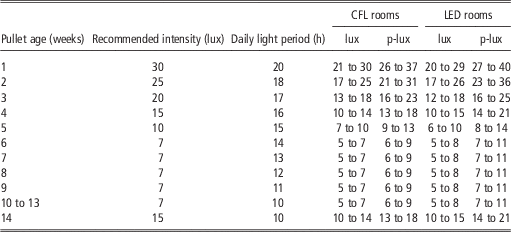
Artificial light was the only light source in the rearing rooms. Two rooms used a commercial poultry-specific dim-to-blue LED light (Agrishift MLB LED, 12 W, dim-to-blue, controllable CCT from 4500 to 5300 K; Once, Inc., Plymouth, MN, USA). ‘Dim-to-blue’ is achieved by lowering power input to other color components, yielding higher proportion of blue light. The other two rooms used a typical CFL light (EcoSmart CFL, 9 W, soft white, CCT=2700 K; Eco Smart Lighting Australia Pty Ltd, Sydney, Australia). Two light bulbs installed on the ceiling per room. The spectral profiles of both lights (Figure 2a) were determined using a spectral meter (SpectraShift 2.0, Once, Inc.). Specifically, the LED light had a relatively even spectral profile as compared with the CFL light. The relatively elevated spectral peaks for the LED light occurred at 450 and 630 nm, whereas spectral spikes for the CFL light occurred at 545 and 610 nm. Light intensity and photoperiod (Table 1) used in the study, varying with bird age, followed the Hy-Line Commercial Layers Management Guideline (Hy-Line International, 2016). Actual light intensities (Table 1), in both lux and p-lux (poultry-perceived light intensity) (Prescott et al., Reference Prescott, Wathes and Jarvis2003), were measured using the spectral meter at the bird head level at five different spots within the rearing rooms (center and four quadrants below the cameras). Light intensities in p-lux for the LED and CFL lights were shown to be, respectively, 1.39 and 1.26 times the values measured in lux (Figure 2b). Light intensities (lux) were comparable between the LED and CFL rooms at each intensity level.
Spectral profiles (a) and relationship between poultry-perceived intensity and human-perceived intensity (b) for the light-emitting diode (LED) light (dim-to-blue, controllable correlated color temperature (CCT) from 4500 to 5300 K) and compact fluorescent light (CFL) (soft white, CCT=2700 K) used in this study.

Lighting program and measured light intensities in the pullet-rearing rooms with the light-emitting diode (LED) light (dim-to-blue, controllable correlated color temperature (CCT) from 4500 to 5300 K) and compact fluorescent light (CFL) (soft white, CCT=2700 K)

lux=human-perceived light intensity; p-lux=poultry-perceived light intensity.
Data collection and processing
Growing performance
Individual BW of pullets was measured every 2 weeks from day-old to 14 weeks of age (WOA) by the farm staff. Mortality was recorded daily and postmortem examination was conducted to determine the cause of death (e.g. injury, disease, etc.). Pullets with apparent injuries in each group were culled by the farm staff and were counted as mortality as well. Body weight uniformity, BWG and CMR were then calculated based on the farm records. Body weight uniformity is expressed as the percent of individual weights that fall within 10% of the flock average (Hy-Line International, 2016). Body weight gain is the difference between two successive BW values. Cumulative mortality rate is measured as the percent of total dead and culled birds relative to the initial number of birds placed. Feed intake was not recorded in the study because all the rooms shared the same automated feeder conveyor which could not discern feed use for each individual room.
Activity levels and Movement Index
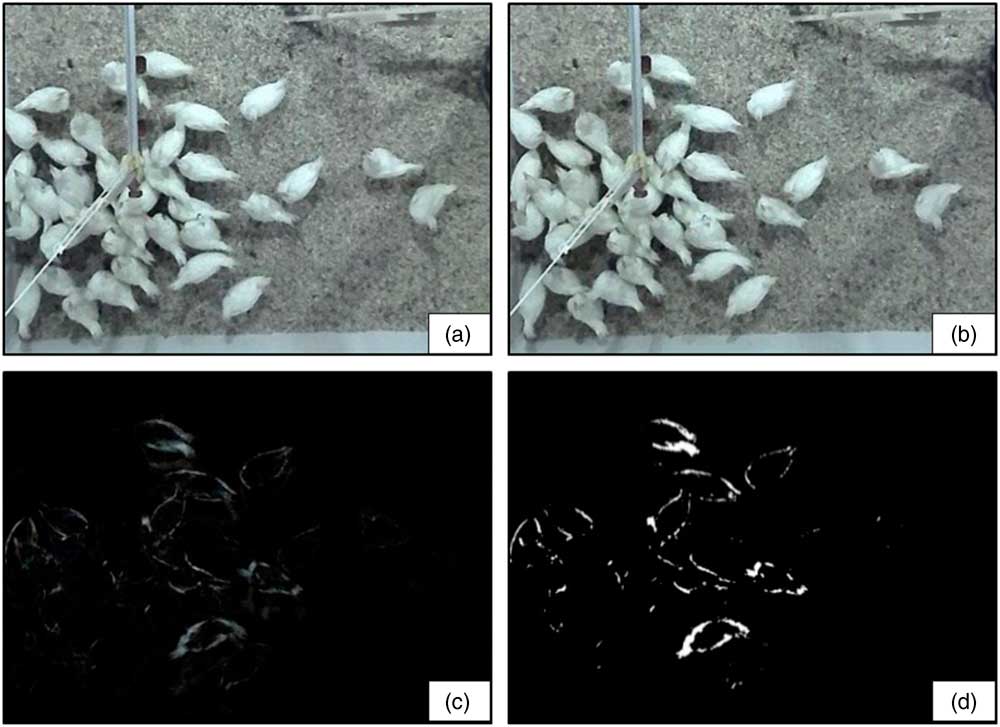
Movement Index (MI) was used as the behavioral parameter for quantifying activity levels of the pullets in this study. Movement Index was defined as the ratio of cumulative displacement area caused by moving pullets to the entire floor area at 1-s intervals. Although not identical definition, the principle and calculation procedure of MI was analogous to activity index described in two other studies (Aydin et al., Reference Aydin, Cangar, Ozcan, Bahr and Berckmans2010; Costa et al., Reference Costa, Ismayilova, Borgonovo, Viazzi, Berckmans and Guarino2014). During 5 to 14 WOA, locomotion behaviors of pullets in each rearing room were intermittently recorded (1 day/WOA) using four digital cameras (720P HD, night vision; Backstreet Surveillance Inc., Salt Lake City, UT, USA) at 5 frames/s (missing video data due to system failure for the earlier part of the second batch, i.e., 5 to 8 WOA). Video analysis was implemented to calculate time-series MI of the pullets using automated image processing programs developed in MATLAB (MATLAB R2014b; The MathWorks, Inc., Natick, MA, USA). Implementation of the image processing procedure is illustrated in Figure 3. I(f) and I(f−1) are two consecutive image frames captured at 0.2-s intervals. Subtracting the current frame I(f) (Figure 3a) by the previous frame I(f−1) (Figure 3b) yields the difference (Figure 3c) between the two frames. The difference image is then converted to a binary image (Figure 3d), where the white pixels correspond to movements of pullets. To minimize the noises and random errors derived from video recording procedures, MI values over 1-min interval was averaged to obtain mean MI (MMI); three different parts of the day, that is, early (the first hour of light-on), middle (1000 to 1100 h) and late part (the last hour of light-on), were chosen for comparing activity levels between the lighting regimens, covering 60 time-series MMI measures per part of the day.
(a) Current image frame I(t), (b) previous image frame I(t−1), (c) gray-scale differential between I(t) and I(t−1), (d) binary differential.

Feather and comb conditions
Feather and comb conditions of pullets were visually examined every 2 weeks by the farm staff during the weighing procedures to observe any feather damage or comb wound. At the end of the rearing period (16 WOA), 60 pullets from each rearing room were randomly selected and transferred to our animal laboratory at Iowa State University (farm visit was restricted due to the high pathogenic avian influenza risk), where feather and comb conditions of the pullets were assessed according to the Welfare Quality Assessment Protocols (Welfare Quality, 2009). Per this protocol, feather conditions were scored independently on a three-point scale (i.e. a=no or slight wear; b=moderate wear, featherless area <5 cm in diameter at the largest extent; c=featherless area ⩾5 cm) on three body parts, including neck/head, back/rump and belly. An overall score (0, 1 or 2) for each pullet was then determined based on the scores of the three individual body parts (i.e. 0=all body parts scored ‘a’; 1=at least one part scored ‘b’ but no ‘c’ score; 2=at least one part scored ‘c’). Comb conditions were scored on a three-point scale as well (i.e. 0=no evidence of pecking wounds; 1=less than three pecking wounds; 2=three or more pecking wounds).
Statistical analysis
All statistical analyses were performed using SAS Studio 3.5 (SAS Institute, Inc., Cary, NC, USA) with the MIXED procedure. As the experiment followed the split-plot experimental design, the rearing room was treated as the experimental unit although some observations (i.e. BW and BWG) were made on individual pullets, thus leading to four replicates per light regimen. Body weight, BWU, BWG and CMR were analyzed separately for each bird age (week 0, 2, 4, … , 14) using a linear mixed model expressed as follows:
 $$Y_{{ijk}} {\,\equals\,}\mu {\plus}L_{i} {\plus}B_{j} {\plus}R(B)_{{jk}} {\plus}e_{{ijk}} $$
Where Y ijk denotes the independent observation for light regiment i in room k of batch j; µ is the overall mean; L i the fixed light effect; B j the fixed batch effect; R(B) jk the random effect of room within batch, R(B) jk ~N (0, σ R 2); and e ijk the random error, e ijk ~N (0, σ 2). Likewise, MMI of pullets was also analyzed separately for each bird age (week 5, 6, 7, … , 14) using a linear mixed model expressed as follows:
 $$Y_{{ijkd}} {\,\equals\,}\mu {\plus}L_{i} {\plus}B_{j} {\plus}R(B)_{{jk}} {\plus}P_{d} {\plus}(LP)_{{id}} {\plus}e_{{ijkd}} $$
Where Y ijkd denotes the independent observation for light regiment i in room k of batch j at part d of the day; µ the overall mean; L i the fixed light effect; B j the fixed batch effect; R(B) jk the random effect of room within batch, R(B) jk ~N (0, σ R 2); P d the fixed effect of part of the day; (LP) id the fixed interaction effect of light and part of the day; and e ijkd the random error, e ijkd ~N (0, σ 2). For all models, Tukey–Kramer tests were used for pairwise comparisons as applicable. Normality and homogeneity of variance of data were examined by residual diagnostics. Effects were considered significant at P<0.05. Unless otherwise specified, data were presented as least squares means along with SEM.
Results
Growing performance of pullets
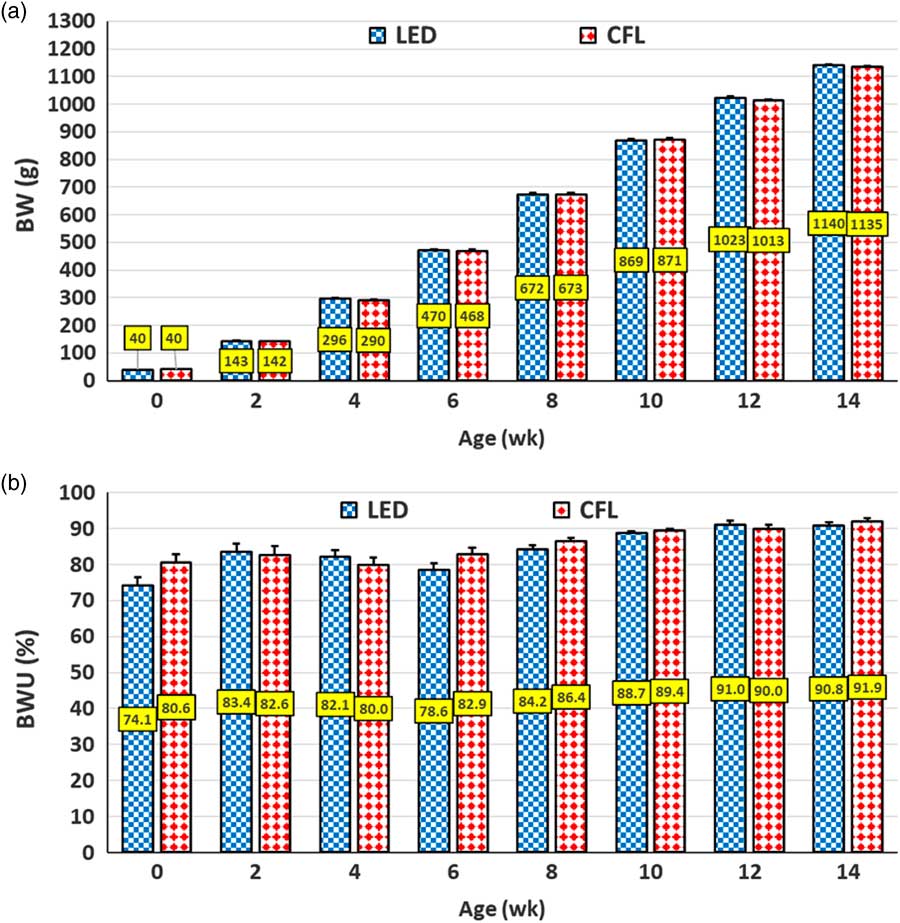
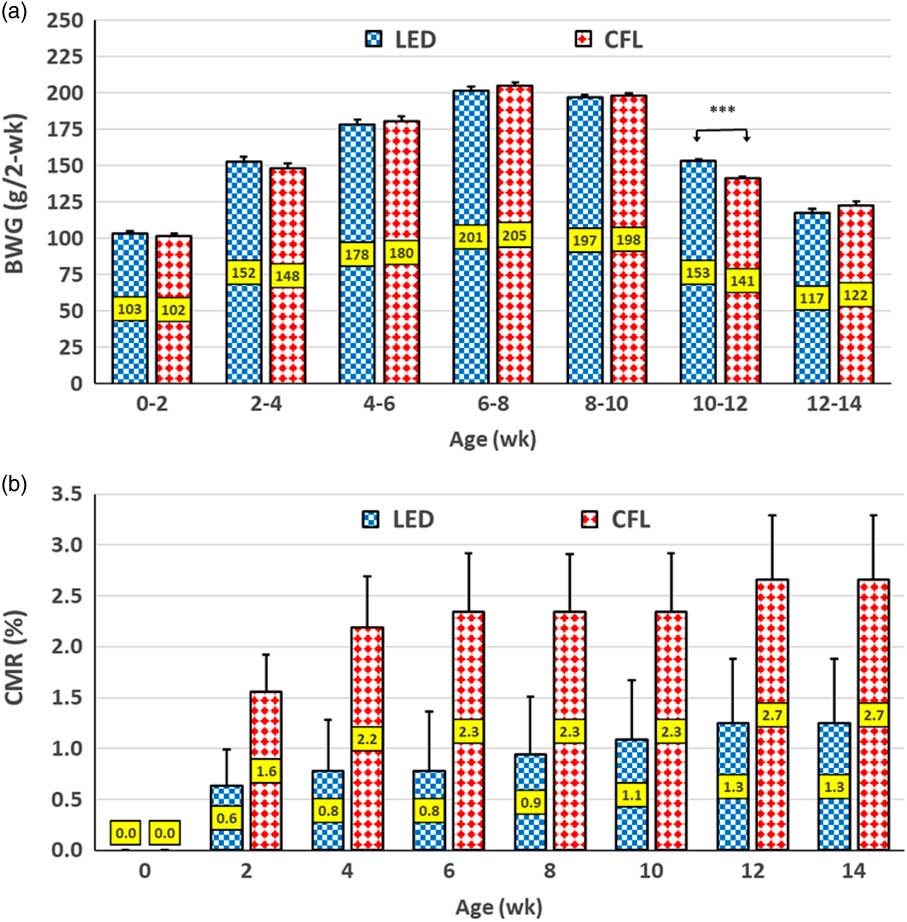
As illustrated in Figures 4 and 5, all the growing performance parameters (BW, BWU, BWG and CMR) were highly comparable between the two light regimens at any age throughout the 14-week rearing period (P>0.05), with the exception that pullets under the LED light had higher BWG than pullets under the CFL light at 10 to 12 WOA (153±1 v. 141±1 g, P<0.001). At 14 WOA, pullets under the LED light had BW of 1140±5 g, BWU of 90.8±1.0% and CMR of 1.3±0.6% compared with 1135±5 g, 91.9±1.0% and 2.7±0.6%, respectively, for pullets under the CFL light (P=0.41, 0.48 and 0.18 for BW, BWU and CMR, respectively).
(a) Body weight and (b) BW uniformity (BWU) of W-36 pullets under the light-emitting diode (LED) light v. the compact fluorescent light (CFL). Body weight uniformity is expressed as the percent of individual weights that fall within 10% of the flock average. Values are given as least squares means±SEM; n=4 per light regimen. No treatment effect was detected for all ages (P>0.05).

(a) BW gain (BWG) and (b) cumulative mortality rate (CMR) of W-36 pullets under the light-emitting diode (LED) light v. the compact fluorescent light (CFL). Values are given as least squares means±SEM; n=4 per light regimen. Means marked with *** are significantly different at P<0.001.

Activity levels of pullets
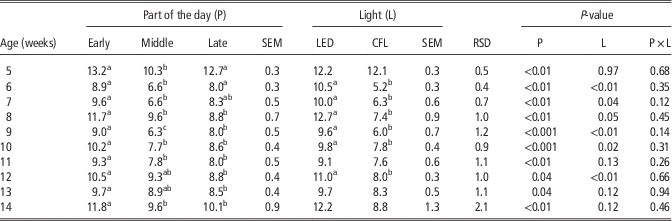
In general, the light regimens had significant impacts on activity levels of the pullets (Table 2). Specifically, pullets had significantly larger MMI under the LED light than under the CFL light at 6 (P<0.01), 7 (P=0.04), 8 (P=0.05), 9 (P<0.01), 10 (P=0.02) and 12 (P<0.01) WOA. No significant difference was detected in MMI for pullets under the LED light v. CFL light at any other age (P>0.05). Part or time of the day showed consistently considerable influence on activity levels of pullets (Table 2), in that MMI was significantly greater during the early part of the day than during the middle and/or late parts of the day (P<0.05). No interaction effect was detected between light regimen and the part of the day (P>0.05).
Mean Movement Index of W-36 pullets as affected by light regimen (light-emitting diode (LED) light and compact fluorescent light (CFL)) and part of the day

Values are given as least squares means; n=2 for 5 to 8 weeks of age (WOA), n=4 for 9 to 14 WOA.
a,bDifferences between lights or parts of the day were considered significantly at P<0.05. Row means among three parts of the day or between two lights with different superscript letters were significantly different at P<0.05.
Feather and comb conditions of pullets
Very limited detectable feather damages or comb wounds were observed among the pullets during the weighing process (reported by the farm staff). The exceptions were the eight pullets that were culled due to apparent pecking injuries on the rump or back. Among these eight culled pullets, three pullets were culled from the LED rooms and the reaming five were from the CFL rooms. For the randomly selected pullets at 16 WOA (60 pullets per room, 480 pullets in total), both feather and comb conditions were scored 0 for all pullets according to the previously described protocol. Therefore, feather and comb conditions were not further compared between the light regimens.
Discussion
To the best of our knowledge, this is the first study to compare the effects of a poultry-specific dim-to-blue LED light with a typical CFL light on growing performance, activity levels, and feather and comb conditions of non-beak-trimmed W-36 pullets. The primary interest was to investigate whether the dim-to-blue LED light could improve growing performance, calm the birds, and/or enhance feather and comb conditions of pullets as compared with the typical CFL light.
Effects of light sources on growing performance of pullets
The dim-to-blue LED and the CFL lights used in the study had distinctly different spectral characteristics. However, pullets under these two light regimens had comparable BW and BWU throughout the rearing period. These results, to some extent, implied that the impact of spectral characteristics of the light sources might be secondary or negligible on the growth performance of pullets. This inference seems to be supported by results of earlier studies. Schumaier et al. (Reference Schumaier, Harrison and McGinnis1968) found that pullets reared under red, green and white fluorescent lights had comparable BW at 20 WOA, regardless of their beak conditions (debeaked or intact beak). Pyrzak et al. (Reference Pyrzak, Snapir, Goodman, Arnon and Perek1986) reported that pullets reared under cool white fluorescent light, sunlight-simulating fluorescent light and narrow-band blue, green and red fluorescent lights had comparable BW at 16 and 20 WOA. Likewise, Baxter et al. (Reference Baxter, Joseph, Osborne and Bedecarrats2014) reported that pullets reared under red, green or white LED light had comparable BW until the sexual maturity at 23 WOA. Coincidently, consistent results have also been reported from lighting studies on broilers. Huth and Archer (Reference Huth and Archer2015) reported no effects of light sources on broiler growth in a study comparing broiler performance among a dim-to-blue LED light (same LED light as in the current study), a ‘NextGen’ poultry-specific LED light (3500 K) and a dimmable CFL light (2700 K). Olanrewaju et al. (Reference Olanrewaju, Miller, Maslin, Collier, Purswell and Branton2016) assessed effects of a cool poultry-specific filtered LED light (5000 K), a neutral LED light (3500 K), a typical CFL light (2700 K) and an incandescent light (2010 K) on broiler growth and reported no light effects either. In addition, Yang et al. (Reference Yang, Jiang, Wang, Liu, Yu, Pan and Ying2016) investigated the effects of monochromatic LED lights (e.g. white, yellow, green, red and blue LED lights) on broiler growth and found broilers under yellow, green and blue LED lights had similar growth performance. In contrast, a couple of studies reported opposite results that blue lights were found to improve growth of broilers as compared with white and red lights (Rozenboim et al., Reference Rozenboim, Biran, Chaiseha, Yahav, Rosenstrauch, Sklan and Halevy2004; Cao et al., Reference Cao, Liu, Wang, Xie, Jia and Chen2008). Although the authors attributed this difference in growth to the difference in perceived light intensities by broilers, the underlying mechanisms were not clearly delineated in these studies. It should be noted that broilers have been genetically selected for faster growth, whereas pullets are selected for lighter BW and improved skeleton integrity (Bessei, Reference Bessei2006). As such, pullets and broilers may have different growth responses to light regimens.
Pullets under the LED and CFL lights had comparable CMR throughout the rearing period in the current study (culled pullets were counted as mortality). Similar finding was reported by an earlier study in that mortality of pullets till 20 WOA was not affected by light treatments when reared under red, green or white fluorescent light, regardless of their beak conditions (intact beak or debeaked) (Schumaier et al., Reference Schumaier, Harrison and McGinnis1968). A long-term field study with commercial aviary hen houses revealed no difference in mortality rate of DeKalb white hens between a commercial LED light and a CFL light (Long et al., Reference Long, Zhao, Wang, Ning and Xin2016). Mortality of broilers was also not influenced by white incandescent, blue, green, yellow or red fluorescent light (Wabeck and Skoglund, Reference Wabeck and Skoglund1974). However, mortality of both laying hens and broilers were greatly influenced by photoperiod (Lewis et al., Reference Lewis, Morris and Perry1996). As a result, it is reasonable to infer that light sources would have slight or unnoticeable impact on the mortality of pullets. It should be cautioned that the current study involved rather small flock size (160 pullets/flock) and as such the outcome may change in large commercial flocks.
Effects of light sources on activity levels of pullets
No existing literature was found regarding the activity levels of pullets under different light sources. As a result, activity levels of pullets in the present study were mainly discussed and compared with research findings from broilers. Prayitno et al. (Reference Prayitno, Phillips and Omed1997) investigated the effects of red, blue, green and white lights on the behavior of broilers and found that broilers in red light spent more time in aggressive interaction, pecking at the floor and wing stretching as compared with birds in green and blue lights. Broilers were also found to have the greatest walking activity in white light but the least walking activity in green light (Prayitno et al., Reference Prayitno, Phillips and Omed1997). Sultana et al. (Reference Sultana, Hassan, Choe and Ryu2013) found that broilers decreased movement and increased sitting under short-wavelength light (e.g. blue, green-blue) and performed more physical movement and fear responses under long-wavelength light (e.g. red). In addition, broilers were found to be more active when exposed to fluorescent light and red LED light than exposed to blue LED light (Eich et al., 2016). For all those cited studies, the underlying mechanisms were not clearly delineated, except that the authors once again attributed the differences in the bird behaviors or activity levels to differences in perceived light intensities. Activity levels of birds are known to be positively correlated to light intensity (Boshouwers and Nicaise, Reference Boshouwers and Nicaise1993; Deep et al., Reference Deep, Schwean-Lardner, Crowe, Fancher and Classen2012). Birds have been demonstrated to have much higher spectral sensitivity for long-wavelength light (e.g. yellow, red–yellow) than for short-wavelength light (e.g. blue, green-blue) (Prescott et al., Reference Prescott, Wathes and Jarvis2003; Saunders et al., Reference Saunders, Jarvis and Wathes2008). Thus the light intensity perceived by broilers under the pure red or white lights would be higher than those under the pure blue or green lights in these cited studies. However, results from the current study did not parallel the findings of the cited studies on broilers. In the current study, pullets under the dim-to-blue LED light had significantly higher activity levels compared with their counterparts under the CFL light. Light intensities for both LED and CFL rooms in the study were set according to Hy-Line Commercial Layers Management Guideline, adjusted based on human-perceived light intensity (lux). Although both the dim-to-blue LED light and the CFL light had full-spectral wavelength outputs, the LED light and the CFL light had distinct spectral profiles as described earlier. Consequently, the light intensities perceived by the pullets (p-lux) presumably differed between the LED and CFL regimens (8 to 14 v. 7 to 13 p-lux at 5 WOA, 7 to 11 v. 6 to 9 p-lux at 6 to 13 WOA and 14 to 21 v. 13 to 18 p-lux at 14 WOA). Although being considerably low in magnitude, the difference (1 to 3 p-lux) in light intensities between the two light regimens might have been enough to cause behavioral difference (e.g. higher activity levels under the LED) as found in those broiler studies. This different result, as compared those with broilers, might also have arisen from physiological differences (e.g. BW, skeleton development and bone strength) between pullets and broilers (Bessei, Reference Bessei2006) in that broilers have a high incidence of skeletal disorders due to the selection for fast early growth rate and consequently a low locomotor activity.
Effects of lights sources on feather and comb conditions of pullets
Schumaier et al. (Reference Schumaier, Harrison and McGinnis1968) found that pullets reared under green and white lights lost most of their tail feathers during the rearing period, whereas pullets reared under red lights showed no apparent signs of feather damage. The authors reported that feather picking occurred spontaneously among the pullets reared under green and white lights at 12 WOA without apparent causes. de Haas et al. (Reference De Haas, Bolhuis, de Jong, Kemp, Janczak and Rodenburg2014) assessed risk factors for feather damage during laying period and found that the prevalence of severe feather pecking during the rearing period averaged 60% (between 37% and 66%) in commercial flocks. In the current study, very limited detectable feather damages or comb wounds were observed among the pullets under both light regimens, even though the pullets were not beak trimmed. This result was in agreement with the conclusion from a recently published review on the development of feather pecking in commercial systems (Nicol et al., Reference Nicol, Bestman, Gilani, De Haas, De Jong, Lambton and Rodenburg2013), namely, feather damage does not usually occur during the rearing period although gentle feather pecking is commonly observed and could start from as early as day-old. However, Nicol et al. (Reference Nicol, Bestman, Gilani, De Haas, De Jong, Lambton and Rodenburg2013) also pointed out that low rates of feather pecking or slight feather damage during rearing present a significant risk for late feather pecking during laying period. In the current study, eight pullets were culled from the rearing rooms due to apparent pecking injures, indicating potential risk of severe feather pecking among the pullets. In addition, all the injuries on the culled pullets occurred at the rump or back, which is consistent with the finding by de Haas et al. (Reference De Haas, Bolhuis, de Jong, Kemp, Janczak and Rodenburg2014) who reported that the feather damage during rearing was limited to damage to the back of pullets.
During feather assessment in the current study, slight feather wears or damages were observed among the pullets. However, feather condition was scored 0 for all pullets per the protocol (Welfare Quality, 2009), as it has limitation in assessing slight feather damages (established for assessing laying hens). This limitation made it impossible to further compare feather conditions of pullets between the two light regimens. de Haas et al. (Reference De Haas, Bolhuis, de Jong, Kemp, Janczak and Rodenburg2014) improved the compatibility of this protocol by including cuts in the wings and tails as an indication of early feather damage (a and b scores), thus successfully quantified slight feather damages for pullets at 5, 10 and 15 WOA. Advanced sensing technologies are increasingly developed and adopted in modern animal production systems. New techniques, such as IR thermography (Zhao et al., Reference Zhao, Xin and Dong2013), can help improving the sensitivity of feather condition assessment because surface temperature and distribution of birds are closely related to their feather thickness and feather coverage.
Conclusions
Effects of a commercial poultry-specific dim-to-blue LED light v. a typical CFL light on non-beak-trimmed W-36 pullets were evaluated with regards to growing performance (BW, BWU, BWG and CMR), activity levels, and feather and comb conditions. Both the LED and CFL lights led to comparable pullet performance of BW, BWU and CMR by the end of 14-week rearing period, although varying BWG occurred during the intermediate period. Overall, the LED light showed an effect of stimulating locomotion activities of the pullets as compared with the CFL light, which might have stemmed from differences in spectrum and/or intensity between the two lights. In general, both lights had similar effects on feather and comb conditions of the pullets during the rearing period.
Acknowledgments
Funding for the study was provided in part by the Center for Industrial Research and Service (CIRAS) at Iowa State University and Hy-Line International and is acknowledged. Our special gratitude goes to Hy-Line International Research Farm staff for the immense support and superb collaboration throughout the study. The authors also thank Once, Inc. for providing the LED lights and the controller used in the study, and the Agriculture Experiment Station (AES) Consulting Group at Iowa State University for the consistent assistance in statistical consulting for the study. K. L. thank China Scholarship Council for providing part of the financial support for his PhD study at Iowa State University.