Introduction
The poultry meat industry is the largest in Greece in terms of meat production and it entails the participation of many large enterprises. Poultry meat has shown a remarkable development over the last few decades. The production volume increased from 67.404 to 175,793 tonnes between 1970 and 2007. During the last decade, poultry meat production has fluctuated. In 2008, poultry meat production reached 181,254 tones. The largest amount was chicken followed by turkey, duck-guinea fowl and other poultry such as quail and dove. In 2006, the average per capita consumption of poultry meat in Greece reached 19.3 kg which is considered low, compared with other European countries (Spain, Denmark, Portugal, France, Hungary and Ireland) and the USA (ICAP, Reference ICAP2007). The degree of self-sufficiency in consumption of poultry meat until 1992 exceeded 90%, but then followed a downward trend, reaching 78% in 2006 (ICAP, Reference ICAP2007).
Greece has a negative trade balance for poultry meat. The share of poultry meat in total meat imports decreased from 13% to 7% between 2001 and 2006. A major supplier is Italy followed by Holland, France and Germany. The share of poultry meat as total meat exports decreased from 39% to 26% between 2001 and 2006. A significant portion of Greek exports is directed toward external-EU trade (ICAP, Reference ICAP2007).
Greece has a deficit in other kinds of meat, especially beef for which self-sufficiency is only 33% (2006). Beef is the most significant imported agricultural product, and a substitution away from it would also benefit the balance of payments (Alogoskoufis and Baltas, Reference ALOGOSKOUFIS and BALTAS1991, ICAP, Reference ICAP2007).
Research design and data collection
The research was conducted in two stages. The first was the qualitative and the second was the quantitative research.
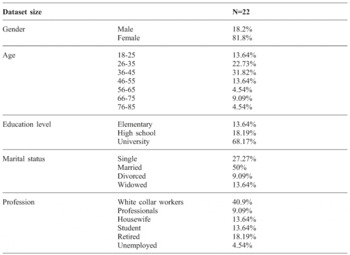
The qualitative research was undertaken in December 2009 and covered the wider area of Thessaloniki. The qualitative research was conducted using in- depth interviews, devoting more time to each respondent in order to draw detailed information on each question. The total number of consumers was 22. Age, education level, income and other demographic characteristics were varied among the sample. All interviews were tape-recorded and transcribed. Results obtained from the qualitative research were very helpful in understanding people's first impressions of poultry meat. Table 1 shows socio-demographic properties on the respondents, who participated in the qualitative research.
Structure of the sample in qualitative research.

The next stage was the quantitative research. The collection of the information about consumers’ perceptions of poultry meat was conducted with the use of a questionnaire. The questionnaire was based mainly on qualitative research and the relevant literature.
The questionnaire consisted of two main parts: the first part was related to general consumer behaviour and attitudes toward poultry meat; it included four sections (1) frequency, purchasing ways and place, (2) consumer perception of meat safety and price, (3) consumer attitudes to poultry meat, and (4) consumer perception of poultry meat attributes. The second part consisted of eight socio-demographic questions.
The consumer perception of meat safety and price was measured by means of 5-point Likert scale, where 1 is the least safe and expensive meat and 5 represents the safest and the most expensive meat respectively.
The research took place in the region of Thessaloniki from April to May 2010. In total, 240 consumers were interviewed. The data was collected by personal interviews. The total sample can be characterized as representative with an error of 2%. The sampling method used was simple random sampling because it guarantees that every member of the population has a known and equal chance of being selected, with the resulting sample, no matter what the size, being a valid representation of the population (Schmidt and Hollensen, Reference SCHMIDT and HOLLENSEN2006).
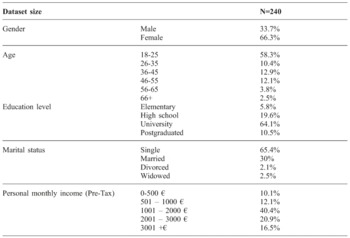
Considering the sample population, the majority of the consumers were women, single and approximately two thirds were under 45 years old. Most of the consumers had monthly income 1000-2000 euro and had graduated from high school and university. Table 2. Socio-demographic properties on the respondents, who participated in the qualitative research.
Structure of the sample in quantitative research.

Purchasing patterns
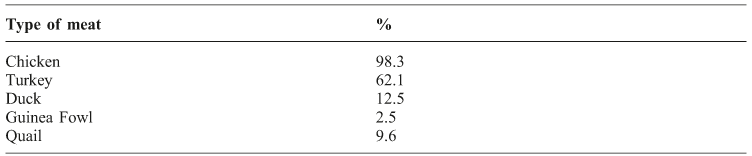
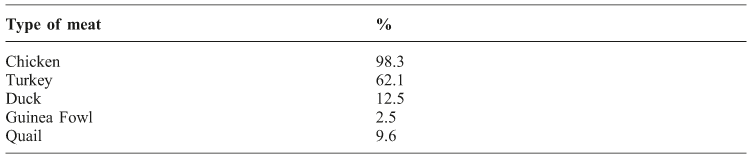
Consumers consume mainly chicken (98.3%) and turkey (62.1%) and secondarily duck (12.5%), quail (9.6%) and guinea fowl (2.9%) (Table 3).
Percentage of respondents consuming different meat types (n=240).
Consumers buy poultry (especially chicken), because it is a healthy and nutritious food (it has low cholesterol and is healthier than red meat), it is easy to cook, it fits in many dishes, can be cooked in many ways and is suitable for dieting.
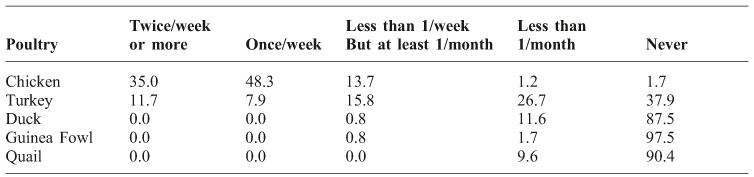
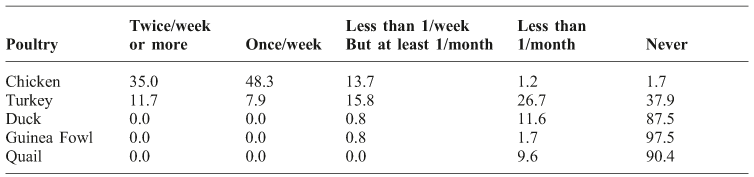
As shown in Table 4, 48% of consumers eat chicken once a week, while 35% consume it at least twice a week, i.e. 83% of consumers are frequent consumers of this product. Most consumers eat turkey, duck, quail and guinea fowl less than once a month.
Poultry meat purchasing and consumption frequency (%, n=240).
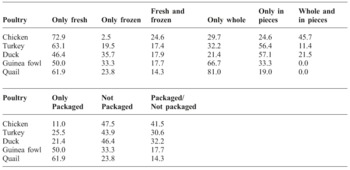
Consumers purchase chicken in mainly a fresh form, both as a whole and in portions, and not packaged. A significant percentage of consumers buy chicken both packaged and unpackaged. Consumers purchase mainly fresh turkey, only as portions and preferably not packaged. Duck is mainly purchased fresh, only in portions and never packaged. Consumers purchase guinea fowl and quail in a mainly fresh form, only as whole carcasses that are packaged (Table 5).
Purchasing ways of poultry meat (%).

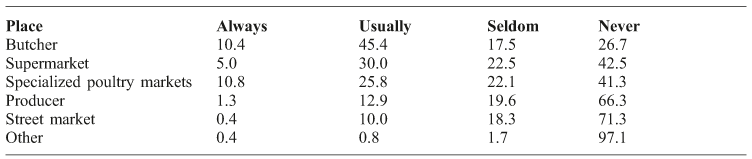
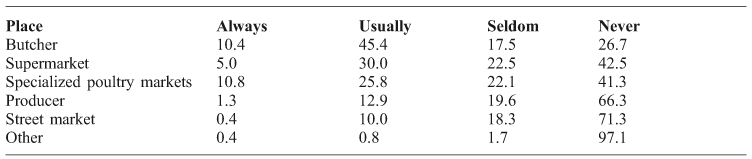
Consumers usually buy poultry from butchers (45.4%), the supermarket, (30%), specialised poultry markets (25.8%), directly from the producer (12.9%) and on street markets (10%). It is worth noting that approximately 10% of the consumers buy poultry meat either from the butcher shop or from specialised poultry markets exclusively. It seems that the butcher is the principal place of purchase of poultry followed by supermarkets and specialised poultry shops (Table 6). Consumers trust the poultry from the butcher more due to perceived security/hygiene, reliability, high quality, variety and a personal relationship with the vendor.
Place of purchasing poultry meat (%, n=240).
Consumer perceptions of poultry meat
Consumers perceive poultry meat as a tasty (eating enjoyment), high quality, healthy, cheap and protein-rich food source. Since it is easy to prepare and suitable for picnics and social gatherings, it also represents a very popular type of meat (McCarthy et al., Reference MCCARTHY, O’ REILLY, COTTER and DE BOER2004; Yildirim and Ceylan, Reference YILDIRIM and CEYLAN2008; Vukasovič, Reference VUKASOVIC2009; Reference VUKASOVIC2010).
Published literature has focused on the impact of country of origin on consumer behaviour (Bolliger and Reviron, Reference BOLLIGER and REVIRON2008; Vukasovič, Reference VUKASOVIC2009; Reference VUKASOVIC2010; Strašek, Reference STRAŠEK2010). A series of food scares, such as avian influenza, chicken meat contaminated with Salmonella, Campylobacter, and overuse of antibiotics in chicken has increased consumer concerns about the consumption of chicken. Amongst these food risks in chicken meat, microbiological risk causes consumers most concern (Yeung and Morris, Reference YEUNG and MORRIS2001; Yeung and Yee, Reference YEUNG and YEE2002; Gstraunthaler and Day, Reference GSTRAUNTHALER and DAY2008; Hsu et al., Reference HSU, LIU, HUANG and LEE2008; Leppin and Aro, Reference LEPPIN and ARO2009; Voeten et al., Reference VOETEN, DE ZWART, VELDHUIJZEN, YUEN, JIANG, ELAM, ABRAHAM and BRUG2009).
When respondents buy poultry they are mainly concerned about issues such as Salmonella, hormones, antibiotics, feed, time of rearing and fresh. Most respondents reported that avian influenza outbreaks and reports did not affect their consumption of poultry, and only a small percentage of consumers reduced or stopped the consumption of chicken at this time.
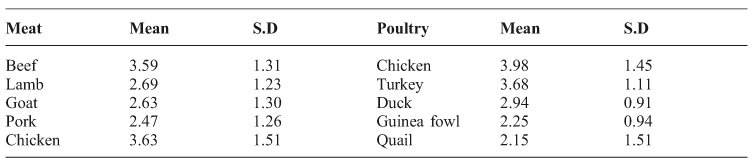
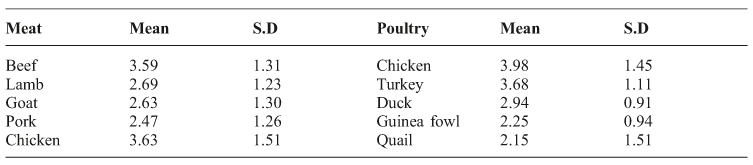
According to Table 7, consumers perceive chicken and beef as the safest choice amongst other meat types. They consider lamb, goat and pork as less safe. Among poultry meat types, chicken, turkey and duck are considered as a safe choice, whereas guinea fowl and quail are considered as less safe.
Consumer perception of meat safety (n=240).
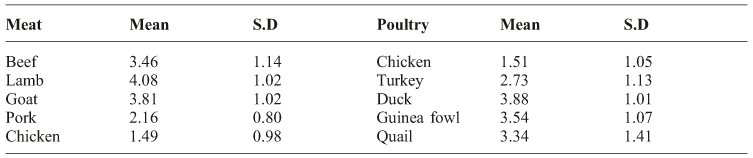
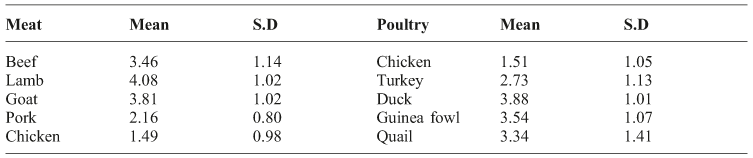
Consumers perceive lamb meat, goat and beef as more expensive, while pork and chicken are perceived to be cheaper (Table 8). The chicken is regarded by consumers as cheaper poultry, followed by turkey. On the other hand duck, guinea fowl and quail are considered to be expensive poultry.
Most respondents believe that the price reflects the nutritional value of poultry they buy and especially that of chicken. If the price of chicken increases, to some extent, consumers will continue to buy it.
Consumer perception of price (n=240).
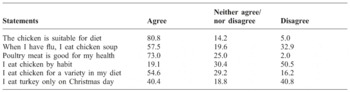
Consumers agree that chicken is suitable for a good diet and is a healthy meat. Consumers disagree that they eat chicken by habit, as previously suggested by Yildirim and Ceylan (Reference YILDIRIM and CEYLAN2008). Greek consumers appreciate the nutritive value of chicken more than the Turkish urban consumers. Only 40% of consumers agree that they eat turkey only on Christmas day (Table 9).
Consumer perceptions about poultry meat (%, n=240).

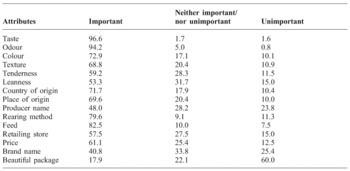
From the attributes regarding sensory quality, taste, odour, colour, texture, tenderness and leanness are considered important by consumers. From the attributes indicating production quality, feed, rearing method, country of origin and place of origin are considered important. The producer name is relevant for 48% of consumers, which can be considered a significant percentage. Finally, from the point of marketing quality attributes of poultry meat, price and the retailing store are considered important by consumers. The brand name is perceived as important for nearly 41% of the consumers, which again can be considered as a significant level. On the other hand, attractive packaging is considered unimportant (Table 10).
Consumer perceptions about poultry quality attributes (%, n=240).

Recommendations
The basic recommendations at the strategic marketing level are:
• The implementation of strategies for product differentiation to create a sustainable competitive advantage based on product quality (taste, rearing method and feed, place of origin and country of origin).
• The orientation of production to the needs of the consumer, i.e. production of high quality, safe and reasonably priced products.
• It is very important is to connect the product with the name of the producer. Therefore marketers should implement the strategy of family branding (all products bearing the same brand name). In this case, the cost of introducing new brands is reduced.
• Small poultry companies should pay attention to marketing strategies, such as personal selling, in order to encourage retailing stores to promote their products to consumers. Large poultry companies should focus on strategies such as advertising in the media.
• Advertisements should show a clear competitive advantage by focusing on 1-2 quality benefits of the product to the consumer.
• Poultry retailers should respect basic requirements of consumers such as cleanliness, reliability, fresh products, proper food storage conditions, high quality and great variety. These rules form the basis for creating a trusting relationship with the client with a view to maintaining this relationship and hence purchasing decisions.
The basic recommendations in the public policy level are:
• Promotion of the demand for poultry by informing the consumers of its nutritional value.
• Creation of an effective system of preserving the quality of the products from production to the consumption (‘field to fork’).
• Creation of programs for the education for everyone who participates in the production and the marketing of poultry in matters of security, quality and marketing.
• Participation of the government in the organization of the supply chain of the agricultural products and especially those who are destined for exports.