Introduction
A large majority of studies on visual word recognition in bilinguals conducted in the last decade have provided evidence that the word identification system is ‘thoroughly language non-selective’ (Brysbaert, Van Dijck and Van De Poel, Reference Brysbaert, Van Dijck and Van De Poel1999; De Groot, Delmaar and Lupker, Reference De Groot, Delmaar and Lupker2000; Dijkstra and van Heuven, Reference Dijkstra and van Heuven2002; Dijkstra, Van Jaarsveld and Ten Brinke, Reference Dijkstra, Van Jaarsveld and Ten Brinke1998; Jared and Kroll, Reference Jared and Kroll2001; Kim and Davis, Reference Kim and Davis2003). The expression is meant to convey that in bilingual word reading, lexical candidates from different languages are activated under a large variety of experimental circumstances. Apparently, language membership is not an early criterion for selecting lexical candidates in bilingual word recognition. In languages with alphabetic scripts, the initial activation of word candidates on the basis of the input letter string proceeds analogously for items of different languages and is based on the similarity of the input letter string to stored lexical representations in an integrated bilingual mental lexicon. Differences in the activation of lexical representations from different languages appear to be quantitative (e.g., due to frequency of usage or orthotactics) rather than qualitative (e.g., due to separate or different word recognition procedures).
The goal of the present article is to test the limits of this position by considering to what extent a monolingual account on masked lexical priming and repetition (Grainger and Jacobs, Reference Grainger and Jacobs1999) can be generalized to the bilingual domain. If lexical access to the bilingual word recognition system is really profoundly non-selective and automatic, there should be no qualitative differences in how even late and unbalanced bilinguals process words from the first (L1) and a second (L2) language, leaving aside strategic factors and differences inherent in the organization of the two lexicons. We will first collect data on the effects of target item repetition and masked orthographic priming within the native language of Dutch–English participants (Experiment 1). Next, we consider between-language effects for this participant group by combining English (L2) word and nonword primes with Dutch (L1) word and nonword targets (Experiment 2). Finally, because the Bilingual Interactive Activation Plus (BIA+) model (Dijkstra and van Heuven, Reference Dijkstra and van Heuven2002) is directly compatible with the generalized priming account, we will summarize its simulations of the data patterns, which are available as Supplementary Material.Footnote 1
Extending the masked priming account by Grainger and Jacobs (Reference Grainger and Jacobs1999) to bilinguals
Grainger and Jacobs (Reference Grainger and Jacobs1999) have formulated a set of six localist–connectionist principles that serve as a basis for a theoretical account of monolingual masked priming and repetition of words. In this section, we will consider their principles and extend them to bilingual processing. The first and basic principle (principle 1) is that word recognition involves a hierarchical, cascaded and non-linear activation flow between various sublexical and lexical representations. For instance, orthographic representations are part of a network that has facilitatory connections between associated units of different levels (e.g., the letter A in the first-letter pool is connected to the word ABLE at the word level) and inhibitory connections between units at the same level (e.g., different words like HOME and DOME compete by way of lateral inhibition). Activation builds up over time in letter representations and continuously feeds forward to orthographic word representations. Word unit activation strength is a function of the degree of orthographic overlap with the stimulus (principle 2). Activated letter units excite compatible words and inhibit incompatible words. Furthermore, all positively activated words send top-down activation back to their letters (principle 3) and send inhibition to all other activated words (principle 4). Furthermore, all words have resting level activations that are proportional to their frequency of occurrence (principle 5).
These five principles can be assumed to hold directly for bilingual word recognition as well, if it is assumed that orthographic representations of different languages are all part of one integrated network (as in the BIA+ model; Dijkstra and van Heuven, Reference Dijkstra and van Heuven2002). Of course, L2 words will have been encountered by the bilingual less often than L1 words because of differences in L1 and L2 proficiency, so L2 words on average have substantially lower subjective frequencies of usage than L1 words. This subjective frequency difference may affect the relative speed of lexical activation and identification of L1 and L2 words. As a consequence, cross-linguistic effects of L2 on L1 will be less strong than in the other direction. However, if L2 proficiency is strong enough, it should be possible to obtain effects from L2 on L1, because mechanisms like lexical activation and lexical competition should operate similarly in the bilingual and monolingual word processing system.
Finally, Grainger and Jacobs (Reference Grainger and Jacobs1999) formulated a sixth principle to account for repetition effects, i.e., observed faster reaction times (RTs) to items that are repeated at long lags. They propose that identification of a given word results in a rise in the resting-level activation of the corresponding whole-word representation (p. 482). In addition, under particular conditions there may be an inhibitory reset of active lexical alternatives to the target. Principle 6 holds that the degree of inhibition generated by the reset mechanism is a function of the activation level of a given representation at the moment of reset. If this mechanism is active, repeating a target would lead to an increased suppression of neighbor primes after target recognition and therefore to smaller competition effects due to those neighbors.
Grainger and Jacobs hold that the first five principles are already sufficient to understand monolingual orthographic priming effects. From principles 1 and 2 it follows that in masked priming with visual lexical decision, nonword primes that are neighbors of the target words should lead to facilitation of target word responses, because the orthographic overlap between prime and target would preactivate the target, whereas there would be no lexical inhibition from the primes because they are nonwords. Related word primes, in contrast, would compete with the target word, causing inhibitory effects that might override the facilitation effects due to stimulus overlap.
According to a language non-selective view of lexical access, this argumentation should also hold if the prime is from another language than the target word, such as a second language, as long as the participants’ level of L2 proficiency (and therefore the subjective frequency of the L2 word) is high enough. If that is the case, the recognition of an L1 target word should be similarly affected by related primes from L1 and L2, even when the L2 prime is masked and presented for only 60 ms and even when the participants are not aware of the relevance of L2 to the experimental situation. We will refer to this account as the ‘generalized masked priming account’. In the present study, we have tested this theoretical position by comparing the effects of within- and between-language masked priming (Experiments 1 and 2, to be reported, respectively). In addition, we have simulated all findings with the Bilingual Interactive Activation Plus model (Dijkstra and van Heuven, Reference Dijkstra and van Heuven2002), which itself is a direct extension of a monolingual model of word recognition, the Interactive Activation model (McClelland and Rumelhart, Reference McClelland and Rumelhart1981).
Empirical study of L2 to L1 lexical effects
Some empirical evidence about cross-linguistic effects in bilingual masked priming has already been collected by Bijeljac-Babic, Biardeau and Grainger (Reference Bijeljac-Babic, Biardeau and Grainger1997). We will first discuss this study and then describe our own.
Bijeljac-Babic et al. (Reference Bijeljac-Babic, Biardeau and Grainger1997, Experiment 2) investigated the orthographic effects of a briefly presented L1 or L2 prime word on L1 processing using a masked priming paradigm. Three groups of French-speaking students were tested, varying in their proficiency of English: French monolinguals, beginning French–English bilinguals and proficient French–English bilinguals. In this experiment, the prime words were interlingual neighbors of the targets (e.g., soil [English] – SOIF [French, meaning “thirst”]). The participants made a French lexical decision on the target word. An inhibitory effect was found for orthographically related prime–target pairs. This cross-language effect depended on the relative L2 proficiency of the participants, increasing from a non-significant 4 ms for the monolinguals and 17 ms for the beginning bilinguals, to a significant effect of 43 ms for the proficient bilinguals. Because the performance of French monolinguals showed no influence of English word primes (null-effect), the authors concluded that the effects that were observed in the beginning and proficient bilinguals cannot have been prelexical in origin. Instead, they argued that the inhibitory effects of different-language primes were likely to be due to the prime word's lexical representation in some way interfering with target word recognition.
Bijeljac-Babic et al. argued that the cross-language effects they observed are compatible with current language non-selective access accounts of bilingual word recognition. In fact, they proposed that the basic mechanism underlying the inhibition effects was that of lateral inhibition at word level (principle 4): active word candidates of both languages mutually inhibit each other to a degree that directly depends on their degree of activation.
As mentioned above, Bijeljac-Babic et al. reported a non-significant effect of 4 ms of cross-linguistic priming in their French monolinguals. However, if the English primes were unknown, i.e., not included in the French–English lexicon as words (Dijkstra, van Heuven and Grainger, Reference Dijkstra, van Heuven and Grainger1998), no lexical competition between prime and target (principle 4) should have been present and facilitatory effects due to prime–target form overlap should have arisen, not null-results (principle 2). So how can these null-effects be interpreted? If we assume that the French monolingual participants were familiar with a few of the English primes, the observed null-results can be accounted for. Those few familiar items would result in inhibition effects (principle 4), and the mix of known and unknown English primes would result in a canceling out of sublexical facilitatory and lexical inhibitory effects. The assumption that some primes were known by the monolingual participants appears to be reasonable, because the experiment included high frequency words like post and fire. In addition, several target words in the stimulus set were interlingual homographs between French and English (e.g., CAGE, PLATE, PORT, RITE). The assumption that some L2 words were already known can be tested indirectly by considering the effects of related nonword primes on word targets. Finding facilitatory effects of such nonword primes make this explanation more likely, because we can be sure that such nonwords were never treated as words by the bilinguals.
The present study
To assess the contribution of lexical and sublexical factors to priming effects within and between languages, the present study tested the effects of word and nonword masked primes on repeated word and nonword targets from the same language (L1 to L1 effects; Experiment 1) or from another language (L2 to L1 effects; Experiment 2). In addition, repetition was manipulated as a factor of interest to the principles of Grainger and Jacobs’ account (described above). In our study, we used a different language combination (Dutch–English) than Bijeljac-Babic et al. (Reference Bijeljac-Babic, Biardeau and Grainger1997) did (French–English). According to our generalization of Grainger and Jacobs’ (Reference Grainger and Jacobs1999, p. 471) orthographic priming account, two important independent variables that will affect orthographic priming are Prime Lexicality, i.e., the lexical status of the prime (word or nonword) and (if it is a word) its frequency; and Relatedness, i.e., the presence or absence of orthographic overlap between prime and target. In addition, the resting level activation should be affected by the recent use of an item (cf. principle 5). These considerations led us to using an empirical approach that differed from that by Bijeljac-Babic et al. in the following respects.
Extending the principles to the bilingual domain, related nonword primes should result in facilitatory effects on target word recognition in a masked priming paradigm, whereas related word primes should induce inhibition. These predictions are made irrespective of whether prime and target are items from the same or another language. By including both word and nonword primes, we should be able to disentangle sublexical overlap (facilitatory) effects and lexical competition (inhibition) effects. Following the generalized masked priming account, we expected facilitation effects to arise for nonword primes and inhibitory effects for word primes. The observed patterns of results for within-language and between-language priming situations should provide more solid evidence that both L2 and L1 prime words are indeed competing with the L1 target words. Second, we improved upon the design of the earlier study by using a one-by-one match of the frequency of the primes in related and unrelated conditions, rather than a Latin square rotation procedure combining primes and targets. Third, repeating the target word a number of times should allow us to test if the masked priming account can account for both masked priming and repetition priming effects within and between languages.
In the present experiments, we tested a further prediction that directly follows from a monolingual account of orthographic priming. Suppose a target item is repeated several times in a session. If such target repetition leads to a relatively increased resting level activation for the target (following principle 5 of the orthographic priming account by Grainger and Jacobs, Reference Grainger and Jacobs1999) and/or to a relatively decreased resting level activation for its competitors, this should give it more inhibitory force relative to other items (principle 6). Thus, target repetition should reduce the inhibitory effects of lexical competitors, one of which is the prime. Indeed, if the suppression of other word candidates becomes maximal, the presentation of an overlapping prime word should have the same effect as a related nonword prime: it should be facilitatory (compared to unrelated prime–target combinations).
Given these considerations, we conducted both a within-language masked priming experiment (Experiment 1) and a between-language masked priming experiment (Experiment 2). We manipulated the following experimental factors. First, we varied the lexical status of prime (Dutch or English word, or Dutch-derived or English-derived nonword) and target (Dutch word or nonword). Second, we manipulated the relatedness between prime and target (with or without orthographic overlap). According to the generalized masked priming account, both related L1 (Dutch) and L2 (English) word primes should induce inhibitory effects on L1 (Dutch) target word identification, whereas related nonword primes should induce facilitation. Finally, in a Latin square design we presented the target items four times, each time preceded by a different type of prime (related or non-related, and word or nonword). This manipulation allowed us to examine the effect of target repetition on the priming effect. Repeated presentation of the target word should increase its resting level activation, making its recognition less sensitive to the presented primes, because those are suppressed more quickly via lateral inhibition than without target repetition. This account should hold, by and large, for both within- and between-language priming.
Experiment 1: masked orthographic priming from L1 to L1
Method
Participants
Forty-two students (30 female and 12 male, mean age: 22 years) at the Radboud University Nijmegen participated in the experiment for course credit or payment. All participants were native speakers of Dutch with normal or corrected to normal vision.
Stimulus materials
Twenty Dutch monolingual 5-letter target words (mean frequency: 22 occurrences per million (opm)) were selected from the CELEX database (Baayen, Piepenbrock and Van Rijn, Reference Baayen, Piepenbrock and Van Rijn1993). No Dutch–English cognates or homographs were included in this selection. The average number of neighbors across targets was 2.2. For each Dutch target word, the Dutch neighbor with the highest frequency (mean: 216 opm) was also selected. Following the definition by Coltheart, Davelaar, Jonasson and Besner (Reference Coltheart, Davelaar, Jonasson, Besner and Dornic1977), a neighbor is a word that differs in only one letter position from the target. Thus, DEUGD (English “virtue”) is a neighbor of JEUGD (English “youth”). The highest-frequency neighbor words were used as the Dutch related word primes. Also, 20 Dutch control word primes (mean opm: 180) that had no orthographic or other relationship with the target words were selected. These unrelated Dutch word primes were matched in frequency with the related word primes.
Twenty nonword primes were constructed by changing one letter of each Dutch target word, making sure that Dutch orthotactics and phonotactics were obeyed. The letter that was changed was in a different position than that of the word neighbor prime for the same target. In this way, indirect priming of a target word's neighbor by a nonword prime in the course of the experiment was avoided. These prime–target pairs were used in the related nonword prime condition. In addition, 20 unrelated control nonword primes were constructed from the unrelated Dutch word primes in line with Dutch orthotactics (see Table 1 for examples of prime–target pairs and an overview of the experimental conditions). Finally, sixteen practice prime–target pairs were also constructed, representing all eight priming conditions.
Examples of prime–target pairs for word and nonword targets in Experiment 1 (L1 to L1 priming).

Design and procedure
The experimental design had as within-subject factors Target Lexicality (word/nonword), Prime Lexicality (word/nonword), Relatedness (related/unrelated prime), and as between-subject factor Block (1–4, reflecting the order of item presentation).
The total stimulus set consisted of 160 prime–target pairs, of which 80 items were word targets (preceded by 20 related word primes, 20 unrelated word primes, 20 related nonword primes, and 20 unrelated nonword primes) and 80 were nonword targets (preceded by related and unrelated word and nonword primes, 20 of each).
The 160 prime–target pairs were divided in four blocks of 40 pairs, such that in each block each of the 20 word targets and each of the 20 nonword targets occurred exactly once. Furthermore, in a block, five different word targets occurred in each of the four prime conditions. The blocks systematically rotated the priming conditions and the targets, so that after four blocks each target had occurred in all four conditions. For each block a separate randomization was used. Finally, the order of presentation of the resulting four blocks was determined via a Latin square procedure such that across participants, each block occurred equally often as the first, second, third and fourth block of the experiment. In this way, it is possible to analyze each quarter of the experiment separately, in order to test whether and how the relevant priming effects change in the course of the experiment.
Each participant was tested individually. The experiment was conducted on a Macintosh G3 computer. The presentation of the visual stimuli and the recording of the RTs were controlled by a computer program and a dedicated button box developed by the technical group of the Donders Centre for Cognition. The participants performed a visual lexical decision task seated at a table with the computer monitor at a 60 cm distance. They first read a Dutch instruction, telling them that they would see hashes and then a letter string to which they were supposed to react by deciding whether it was a Dutch word or not. They were asked to indicate their decision by pressing one of the two buttons on the button box in front of them. The participants were told to react as quickly as possible without making too many errors.
The trial started with a 500 ms presentation of a visual mask consisting of five hash marks. Next, the prime was presented for 60 ms in lowercase letters and in an Arial font on a 15-inch computer monitor in black on a white background. The visual target was presented next in capital letters in Arial size 24. The target letter string appeared in the middle of the screen and stayed there until the participant responded or to a maximum of 2000 ms. When the button was pressed, the visual target stimulus disappeared and a new trial was triggered immediately. The experiment was divided into four blocks of equal length, with a short break in between. The first part was preceded by 16 practice trials. After the practice set, the participant could ask questions about the task. All communication between participant and experimenter was conducted in Dutch. After the experiment, the participants were asked if they noticed anything special in the experiment, and, if so, what it was. None of the participants remarked that they had noticed the presentation of the prime. In total, the experimental session lasted about 30 minutes.
Results
The data of three participants with error rates larger than 10% were excluded from further analyses. This left us with the data of 39 participants. RTs greater than 1200 ms were discarded, as were RTs outside the range of two standard deviations from both the participant and item mean in a particular condition (2.1% of all valid data). Also, incorrect responses (3.7% of all data) were removed from the data.
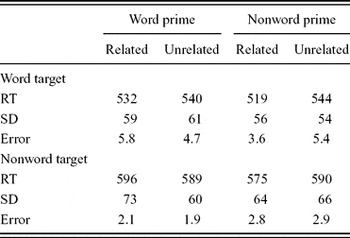
The resulting mean RTs for all conditions across blocks are presented in Table 2. Word targets were reacted to 54 ms faster than nonword targets (533 ms and 587 ms, respectively), while the two types of item had error percentages of 4.9% and 2.4%, respectively. Because the error rates were quite small and generally followed RTs, no error analyses are presented. In general, only RT analyses or comparisons will be reported with a p < .10.
Mean RTs, SDs and error percentages for word and nonword targets in related and unrelated prime conditions for Experiment 1 (L1 to L1 priming).

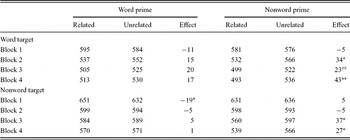
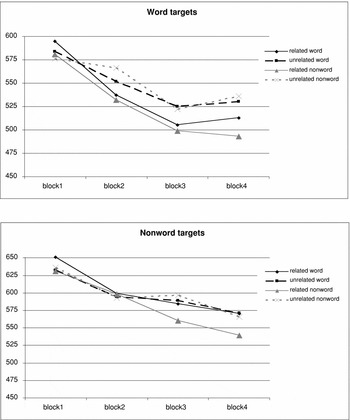
Table 3 and Figure 1 present the mean RTs for all conditions for each block separately. The RTs for word and nonword targets were analyzed separately by means of an ANOVA with the within-subject factors Prime Lexicality (word vs. nonword prime) and Relatedness (related or unrelated), and the between-subject factor Block. In addition, List was included as a between-subject factor to remove additional variance, as advised by Pollatsek and Well (Reference Pollatsek and Well1995). We will first report the overall analyses for word targets and nonword targets, and then consider the results for block 1 and blocks 2–4 separately.
Mean RTs for word and nonword targets in related and unrelated word and nonword prime conditions across presentation blocks for Experiment 1 (L1 to L1 priming).

## p = .061; * p < .05; ** p < .001.
Experiment 1: mean RTs for L1 word and nonword targets in the related and unrelated L1 word and nonword prime conditions across blocks (graphical representation of empirical data in Table 3).

Overall analysis of word targets
The overall analysis for the word-targets showed significant main effects of Block [F 1(3,140) = 9.26, p < .001; F 2(3,256) = 25.37, p < .001] and Relatedness [F 1(1,140) = 23.38, p < .001; F 2(1,256) = 5.31, p < .05]. These effects reflect that RTs became generally faster with repetition and were faster when the prime was form-related to the target rather than unrelated. The effect of Prime Lexicality was not significant [F 1(1,140) = 1.79, p = .18; F 2(1,256) = 1, p = .32]. Pairwise comparisons of Blocks showed that Block 1 (583 ms) was significantly slower than Block 2 (546 ms), Block 3 (513 ms) and Block 4 (518 ms). The difference between Block 1 and Block 2 was only marginally significant (p = .092). Mean latencies were 532 ms for related prime conditions and 548 ms for unrelated prime conditions.
There was also a significant interaction between Relatedness and Block [F 1(3,140) = 5.88, p < .01; F 2(3,256) = 1.78, n.s.], which was, however, only significant in the participant analysis. Thus, effects of relatedness tended to change across blocks irrespective of the lexicality of the prime, i.e., the first block showed no relatedness effect, whereas in later blocks facilitation was found due to relatedness.
Overall analysis of nonword targets
The analysis for the nonword targets showed a significant main effect of Block [F 1(3,140) = 6.58, p < .001; F 2(3,260) = 31.80, p < .001]. Furthermore, there was a significant main effect of Prime Lexicality by participants [F 1(1,140) = 6.45, p < .05; F 2(1,260) = 2.17, n.s.] and a marginal effect of Relatedness by participants [F 1(1,140) = 3.32, p = .071; F 2(1,260) < 1]. These effects reflect that RTs were generally slower when the prime was a word compared to a nonword and were faster when the prime was form-related to the target rather than unrelated. Pairwise comparisons showed that Block 1 (637 ms) was significantly slower than Block 3 (583 ms) and Block 4 (561 ms), but not slower than Block 2 (597 ms).
There was also a significant interaction between Relatedness and Block [F 1(3,140) = 4.99, p < .01; F 2(3,260) = 1.56, n.s.], which was, however, only significant in the participant analysis. Thus, as for the word targets, effects of relatedness tended to change across blocks. Irrespective of the lexicality of the prime, the relatedness effect was only present in Block 4 (18 ms) compared to the first three Blocks (respectively, 9 ms, 1 ms, and 7 ms).
There was also a significant interaction of Prime Lexicality and Relatedness [F 1(1,140) = 11.56, p < .01; F 2(1,260) = 3.16, p = .077]. Overall, for all four blocks combined, the effect of relatedness was influenced by whether the prime was a nonword or a word, i.e., stronger relatedness effects arose for the nonword prime conditions.
Separate analysis of block 1
We next conducted analyses for word targets and nonword targets in each block separately. The mean RTs for all conditions in this block are represented in Table 3. The analysis of the first block for the word targets, i.e., the block in which each target item occurred for the first time, showed no significant main effects or interactions of Prime Lexicality or Relatedness.
The nonword targets only showed a significant interaction of Prime Lexicality and Relatedness in the participant analysis [F 1(1,35) = 4.71, p < .05; F 2(1,64) < 1]. This reflects a slower response following word primes relative to nonword primes in related vs. unrelated prime–target conditions. A separate ANOVA for the word prime conditions indeed showed only a significant effect of Relatedness (651 vs. 632) in the participant analysis [F 1(1,35) = 4.30, p < .05; F 2(1,64) < 1].
Separate analysis of blocks 2–4
Blocks 2–4 were analyzed in the same way as the first block. Mean RTs for the words in the second and later blocks are shown in Table 3, which also shows the effects for Relatedness. The analysis for the second block showed a significant main facilitatory effect of Relatedness for the word targets in the participant analysis [F 1(1,35) = 9.06, p < .01; F 2(1,64) = 2.63, n.s.]. The related prime condition (534 ms for both the related word and nonword primes together) was significantly faster than the unrelated prime condition (568 ms, also word and nonword primes together). Bonferroni pairwise comparison showed a significant effect for the nonword primes (34 ms). The nonword targets showed no significant main effect or interactions of either Prime Lexicality or Relatedness.
For the third block alone, the analysis of the word targets revealed a significant main effect of Relatedness [F 1(1,35) = 14.78, p < .001; F 2(1,64) = 3.29, p = .074]. The related prime conditions (having both word and nonword primes) were faster than the unrelated prime conditions (also word and nonword primes), namely 502 ms and 524 ms, respectively. Bonferroni pairwise comparison showed a marginally (p = .061) significant effect for the nonword primes (23 ms). The nonword targets showed a significant main effect of Relatedness [F 1(1,35) = 12.70, p < .01; F 2(1,64) = 2.49, n.s.] and a significant interaction between Prime Lexicality and Relatedness, both effects significant across participants only [F 1(1,35) = 8.93, p < .01; F 2(1,64) = 1.60, n.s.]. This interaction can be explained by the absence of a significant Relatedness effect for the word primes (5 ms). For the nonword primes, a Bonferroni pairwise comparison did reveal a significant Relatedness effect (37 ms).
In the fourth block, there was a significant main effect of Relatedness [F 1(1,35) = 15.82, p < .001; F 2(1,64) = 5.38, p < .05] for word targets. Mean RTs were faster for related prime conditions (503 ms) than for unrelated prime conditions (532 ms), not considering lexical status of the prime. Bonferroni pairwise comparison showed that the effect for the nonword primes (43 ms) was significant. The nonword targets analysis showed a significant main effect of Prime Lexicality [F 1(1,35) = 8.03, p < .01; F 2(1,64) = 3.56, p = .064] and a trend for a main effect of Relatedness [F 1(1,35) = 3.99, p = .053; F 2(1,64) = 1.54, n.s.]. The word primes (570 ms) were significantly slower than the nonword primes (552 ms). The trend showed that the related conditions led to faster RTs compared to the unrelated conditions, 555 ms versus 567 ms, respectively. Again, Bonferroni pairwise comparison revealed a significant effect for the nonword primes (27 ms).
Discussion
Experiment 1 investigated within-language priming for Dutch (L1) target words. On their first presentation, target words preceded by related prime words were processed non-significantly slower than those preceded by unrelated prime words. When they were repeated, the effects of relatedness became facilitatory, especially when the primes were nonwords. According to Grainger and Jacobs’ account of masked priming, these results for word targets can be interpreted as follows. Upon the first presentation of the target word, lexical competition between the target word and its related neighbor prime causes an inhibition effect, whereas the overlap of three out of four letters between prime and target results in a sublexical facilitation effect; the combination of both then results in an overall null-effect on the target (apparently with some tendency towards inhibition). Because nonword primes are not words, they will not lexically compete with the target words; thus, the observed relatedness effects for word targets will generally be more facilitatory for nonword primes than for word primes. On subsequent presentations, repetition of the target word will result in facilitation for related versus unrelated prime conditions under the assumption that the recognition of the target word leads to a temporarily larger resting level activation for the target word relative to non-targets.
The within-language inhibitory word priming results for target words in the first block of the present experiment are smaller than those obtained by Bijeljac-Babic et al. (Reference Bijeljac-Babic, Biardeau and Grainger1997). These researchers observed a significant inhibition effect for word targets preceded by related words from both the same and another language for their proficient bilinguals. Several other studies have also observed within-language inhibition for form-related word primes (Brysbaert, Lange and Van Wijnendaele, Reference Brysbaert, Lange and Van Wijnendaele2000; De Moor and Brysbaert, Reference De Moor and Brysbaert2000; Davis and Lupker, Reference Davis and Lupker2006; Drews and Zwitserlood, Reference Drews and Zwitserlood1995; Grainger, Colé and Segui, Reference Grainger, Colé and Segui1991; Grainger and Ferrand, Reference Grainger and Ferrand1994; Segui and Grainger, Reference Segui and Grainger1990).
Nevertheless, in comparison to other available studies, the trend towards inhibition we observed is not exceptional. In a backward-masked priming study (involving the so-called ‘three-field technique’), Perea (Reference Perea1998) found inhibitory effects on target identification percentages only when target and neighbor differed in terms of their middle letters, not when they differed in their initial or final letters. With respect to target decision latencies, Janack, Pastizzo and Feldman (Reference Janack, Pastizzo and Feldman2004, Experiments 1a and 1b) found a tendency towards inhibition for word primes regardless of position or amount of overlap between prime and target in a forward-masked priming study like ours. The priming effects for primes with bold or regular masks varied between 12 ms inhibition (non-significant) and 30 ms inhibition (significant). In our experiment, the first presentation of target words preceded by related vs. unrelated primes led to an inhibition effect of 11 ms (see Table 3). In contrast, Forster and Veres (Reference Forster and Veres1998) reported a set of lexical decision experiments in which word primes produced either a null-effect or a facilitatory effect. Forster (Reference Forster and Coltheart1987) even found a 38 ms facilitation effect for word targets primed by word primes. In all, the differences in within-language priming results between Bijeljac-Babic et al. and ours might be ascribed, at least in part, to differences in the positions of letter overlap in the prime–target word pairs used.
The facilitation effects for word targets preceded by related vs. unrelated nonword primes in our study are in line with most of the monolingual priming literature (Davis and Lupker, Reference Davis and Lupker2006; Forster and Davis, Reference Forster and Davis1984; Forster, Reference Forster and Coltheart1987; Forster, Davis, Schoknecht and Carter, Reference Forster, Davis, Schoknecht and Carter1987; Forster, Mohan and Hector, Reference Forster, Mohan, Hector, Kinoshita and Lupker2003; Forster and Veres, Reference Forster and Veres1998; Humphreys, Evett and Quinlan, Reference Humphreys, Evett and Quinlan1990; Perea and Lupker, Reference Perea, Lupker, Kinoshita and Lupker2003; Perea and Rosa, Reference Perea and Rosa2000; Sereno, Reference Sereno1991). Janack et al. (Reference Janack, Pastizzo and Feldman2004, Experiments 2a and 2b) also observed facilitation effects due to nonword priming, but their effects were non-significant.
The nonword targets, derived from Dutch words, were processed non-significantly slower when preceded by related vs. unrelated Dutch words, and somewhat faster upon their third and fourth presentation when preceded by related vs. unrelated nonword primes. This result suggests that there may have been some effect of whether target and prime had the same lexical status or not. Such a speculative effect could be accounted for by assuming that words and nonwords are bound to different responses (see Dijkstra and van Heuven, Reference Dijkstra and van Heuven2002; Dijkstra, Reference Dijkstra, Kroll and Groot2005).
Experiment 2: masked orthographic priming from L2 to L1
Method
Participants
Forty-one students (25 female and 16 male, mean age: 22.9 years) at Radboud University Nijmegen participated in the experiment for course credit or payment. All participants were native speakers of Dutch with normal or corrected to normal vision. They were all of the same population as the participants in Experiment 1. In a questionnaire following the experiment, the participants assessed their English language proficiency. They had an average of ten years of experience with the English language, making them highly proficient though “late” L2 users. They all used English regularly in their study.
Stimulus materials
Twenty Dutch monolingual 5-letter target words (mean frequency: 22 opm), all non-cognates, were selected from the CELEX database. For each of these Dutch targets, the English neighbor with the highest frequency (mean: 249 opm) was also selected (cf. Segui and Grainger, Reference Segui and Grainger1990). The mean number of neighbors was 3.0. These words were used as the English related word primes. Also, 20 English control word primes (mean: 254 opm) that had no orthographic or other relationship with the target words were selected. These unrelated English word primes were matched in frequency with the related word primes.
Twenty nonword primes were constructed by changing one letter of each Dutch target word. The resulting prime–target pairs were used in the related nonword prime condition. In addition, 20 unrelated control nonword primes were made from the unrelated Dutch words in line with English orthotactics (see Table 4 for an overview). Finally, sixteen practice prime–target pairs were constructed, representing all eight priming conditions.
Examples of prime–target pairs for word and nonword targets in Experiment 2 (L2 to L1 priming).

Design and procedure
All aspects of experimental design and procedure were identical to those in Experiment 1, except that the experiment was conducted on a Macintosh Quadra 660 AV computer.
Results
The data of one participant with error rates larger than 10% was excluded from further analyses. This left us with the data of 40 participants. There were no RTs above 1200 ms. RTs that were outside the range of two standard deviations from both the participant and item mean in a particular condition were considered as outliers (2.1% of all valid data) and were discarded. Also, incorrect responses (3.5% of all data) were removed from the data.
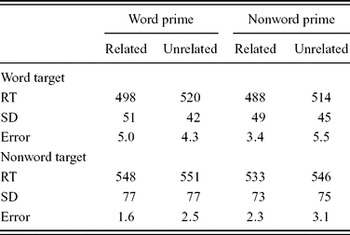
The resulting mean RTs for all conditions across blocks are presented in Table 5. Word targets were reacted to 33 ms faster than nonword targets (506 ms and 539 ms, respectively), while the two types of item had error percentages of 4.5% and 2.4%, respectively.
Mean RTs, SDs and error percentages for word and nonword targets in related and unrelated prime conditions in Experiment 2 (L2 to L1 priming).

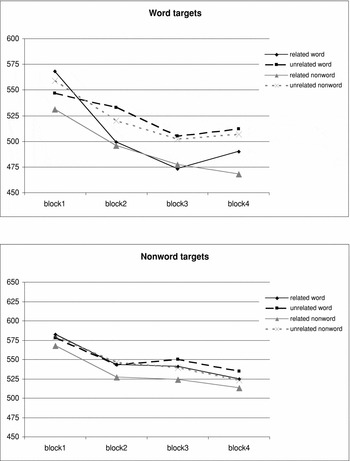
Table 6 and Figure 2 present the mean RTs for all conditions for each block separately. As before, we will first report the overall ANOVAs for word and nonword targets, and then consider the results for block 1 and blocks 2–4 separately.
Mean RTs for word and nonword targets in the related and unrelated word and nonword prime conditions across presentation blocks in Experiment 2 (L2 to L1 priming).

# p = .08; ## p = .066; * p < .05; ** p < .001.
Experiment 2: mean RTs for L1 word and nonword targets in the related and unrelated L2 word and nonword prime conditions across blocks (graphical representation of empirical data in Table 6).

Overall analysis of word targets
The analysis for the word targets showed a significant main effect of Block [F 1(3,144) = 11.74, p < .001; F 2(3,256) = 35.29, p < .001]. Furthermore, there were significant main effects of Prime Lexicality [F 1(1,144) = 8.40, p < .01; F 2(1,256) = 4.87, p < .05] and Relatedness [F 1(1,144) = 50.04, p < .001; F 2(1,256) = 27.25, p < .001]. These effects reflect that RTs became generally faster with repetition, were slower when the prime was a word rather than a nonword, and were faster when the prime was form-related to the target rather than unrelated. Pairwise comparisons of Blocks showed that Block 1 (551 ms) was significantly slower than Block 2 (512 ms), Block 3 (489 ms) and Block 4 (494 ms). Mean latencies across blocks for the word and nonword prime conditions were 509 ms and 501 ms, respectively. Mean latencies were 493 ms for related prime conditions and 517 ms for unrelated prime conditions.
More importantly, there was a significant three-way interaction of Prime Lexicality, Relatedness and Block in the participant analysis [F 1(3,144) = 4.45, p < .01; F 2(3,256) = 1.79, n.s.], as well as a significant interaction between Relatedness and Block [F 1(3,144) = 4.22. p < .01; F 2(3,256) = 3.75, p < .05]. Thus, effects of relatedness tended to change across blocks and depended on whether the primes were words or nonwords.
Overall analysis of nonword targets
The analysis for the nonword targets showed a significant main effect of Block [F 1(3,144) = 5.43, p < .01; F 2(3,256) = 22.85, p < .001]. There were also significant main effects of Prime Lexicality [F 1(1,144) = 10.68, p < .01; F 2(1,256) = 2.58, n.s.] and of Relatedness [F 1(1,144) = 8.23, p < .05; F 2(1,256) = 2.22, n.s.], although both were only significant by participant. Reaction times generally became faster with repetition, were slower when the prime was a word than a nonword, and were faster when the prime was form-related to the target rather than unrelated. Pairwise comparisons of Blocks showed that Block 1 (570 ms) was significantly slower than Block 2 (535 ms), Block 3 (533 ms) and Block 4 (518 ms). Block 4 was also significantly faster than all three other blocks. Mean latencies across blocks for the word and nonword prime conditions were 549 ms and 540 ms, respectively. Mean latencies were 540 ms for related prime conditions and 549 ms for unrelated prime conditions, irrespective of lexicality of the prime.
Separate analysis of block 1
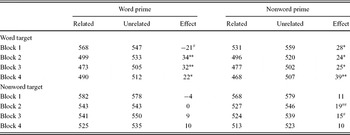
The mean RTs for all conditions in block 1 are represented in Table 6. The separate analysis of the first block for the word targets showed neither significant main effects for Prime Lexicality nor for Relatedness. However, the analysis led to a significant interaction between Prime Lexicality and Relatedness in the participant analysis [F 1(1,36) = 8.72, p < .05; F 2(1,64) < 1]. This interaction arose because the related condition had faster RTs than the unrelated condition when the primes were nonwords, but slower RTs when the primes were words. Bonferroni pairwise comparisons supported and clarified the interaction. First, they showed a trend (p = .08) towards a inhibitory Relatedness effect of 21 ms between the related and the unrelated word prime conditions (568 ms and 547 ms, respectively). Thus, form-overlap of a word prime and word target tended to induce inhibition relative to unrelated prime–target combinations. In contrast, a significant facilitatory Relatedness effect of 28 ms arose between the related and unrelated nonword prime conditions (531 ms and 559 ms, respectively). Thus, for nonword primes, form overlap between nonword prime and word target led to facilitation. Finally, in the first block, the related word prime condition was significantly slower than the related nonword prime condition (568 ms and 531 ms, respectively). Note that this effect, which could be considered as a combination of the inhibitory relatedness effect for word primes and the facilitatory relatedness effect for nonword primes, was predicted in the ‘Introduction’ in relation to the study by Bijeljac-Babic et al. (Reference Bijeljac-Babic, Biardeau and Grainger1997).
The analysis of nonword targets showed no significant main effects or interactions of Prime Lexicality or Relatedness.
As can be seen in Figure 2, there was a considerable change in the RTs for word prime conditions but not for nonword prime conditions from the first to the second presentation of the target word. In fact, a separate analysis of the first two blocks for the word prime conditions revealed no significant effect of Relatedness, but led to a significant interaction of Relatedness by Block [F 1(1,72) = 17.27, p < .001; F 2(1,64) = 7.68, p < .01]. In contrast, the same analysis for the nonword prime conditions showed a significant main effect of Relatedness [F 1(1,72) = 13.07, p < .001; F 2(1,64) = 5.43, p < .05], but no significant interaction of Relatedness with Block.
Separate analysis of blocks 2–4
To obtain an indication of the change in effects with repetition of targets, the next three blocks were analyzed in the same way. Mean RTs for the words and nonwords in the second and later blocks are shown in Table 6. The analysis of the second block for the word targets revealed a significant main effect of Relatedness [F 1(1,36) = 25.38, p < .001; F 2(1,64) = 12.72, p < .001]. The related prime condition (497 ms for both the related word and nonword primes together) was significantly faster than the unrelated prime condition (527 ms, also word and nonword primes together). Bonferroni pairwise comparison for both the word and the nonword primes showed a significant effect of Relatedness (34 ms and 24 ms, respectively). The analysis for the nonword targets in the second block showed no significant main effects or interactions and only a marginally significant (p = .066) Relatedness effect (19 ms) for the nonword primes.
For the third block alone, the analysis for the word targets revealed a significant main effect of Relatedness [F 1(1,36) = 37.69, p < .001; F 2(1,64) = 12.78, p < .001]. The related prime conditions (having both word and nonword primes) were faster than the unrelated prime conditions (also word and nonword primes), namely 475 ms and 504 ms, respectively. Again, Bonferroni pairwise comparison revealed a significant effect of Relatedness for both the word primes (32 ms) and the nonword primes (25 ms). The nonword target analysis revealed a significant main effect of Prime Lexicality in the analysis by participant [F 1(1,36) = 5.38, p < .05; F 2(1,64) = 1.77, n.s.]. The word prime conditions (having both related and unrelated primes) were slower than the nonword prime conditions (also related and unrelated primes), namely 545 ms and 532 ms, respectively. The effect for the nonword primes (15 ms) was only marginally (p = .08) significant, as for Block 2.
In the fourth block, the word targets showed a significant main effect of Relatedness [F 1(1,36) = 20.84, p < .001; F 2(1,64) = 24.32, p < .001] and a significant main effect of Prime Lexicality [F 1(1,36) = 7.74, p < .01; F 2(1,64) = 3.95, p = .051]. Mean RTs were faster for related prime conditions (479 ms) than for unrelated prime conditions (509 ms), not considering lexical status of the prime. Also, mean RTs were significantly slower for the word prime conditions (501 ms) than for the nonword prime conditions (487 ms), not considering Relatedness. Bonferroni pairwise comparison showed a significant facilitation effect for the word primes (22 ms) and for the nonword primes (39 ms). The nonword targets revealed trends towards a significant main effect of Relatedness [F 1(1,36) = 3.95, p = .055; F 2(1,64) = 1.24, n.s.] and Prime Lexicality [F 1(1,36) = 3.66, p = .064; F 2(1,64) < 1], for both in the participant analysis only. Mean RTs were faster for related prime conditions (519 ms) than for unrelated prime conditions (529 ms), not considering lexical status of the prime. Also, mean RTs were significantly slower for the word prime conditions (530 ms) than for the nonword prime conditions (518 ms), collapsing across levels of Relatedness.
Discussion
Experiment 2 investigated between-language priming from L2 (English) to L1 (Dutch). With respect to the Dutch word targets, targets in the first block were responded to 21 ms slower when preceded by related English word primes instead of unrelated word primes (p = .08), but they were responded to 28 ms faster when preceded by related nonword primes instead of unrelated nonword primes (p < .05). In the next three blocks, related word primes continued to significantly facilitate the repeated target words relative to unrelated word primes. Similarly, related nonword primes produced faster responses than unrelated nonword primes in all blocks.
Note that, relative to our study, Bijeljac-Babic et al. (Reference Bijeljac-Babic, Biardeau and Grainger1997) observed a larger and significant inhibition effect for word targets preceded by related vs. unrelated words from another language for their proficient bilinguals than we did. One explanation for this difference could be sought in the relative L2 proficiency of their and our participants. The proficient participants in their study were bilinguals who had been exposed to both languages from early childhood and continued to use them daily at work and/or at home, whereas ours were Psychology students who had acquired their second language at a later age and used it especially at work. Indeed, our results are more similar to those by Bijeljac-Babic et al. for their beginning bilinguals, who were French University students of English. As Bijeljac-Babic et al. argued, increased L2 competition and associated cross-linguistic interference would be expected when the L2 proficiency of participants increases. However, this explanation cannot account for the similar difference between their within-language results and ours in Experiment 1. Thus, additional or different explanations in terms of experimental design and stimulus materials cannot be excluded.
In our Experiment 2, Relatedness initially did not significantly affect the processing of nonword targets. Only upon repetition, nonword targets preceded by nonword primes showed a tendency towards a facilitatory relatedness effect.
Although Experiment 2 showed relatively large relatedness effects for word targets preceded by word primes relative to Experiment 1, the overall data patterns of the two experiments appear to be similar. Such a conclusion would support the generalized masked priming account discussed in the ‘Introduction’. In order to substantiate this claim statistically, we performed an analysis incorporating both Experiment 1 and Experiment 2. In addition, we sought to confirm this conclusion by simulating the result patterns of both experiments using the implemented, orthographic part of the BIA+ model (Dijkstra and van Heuven, Reference Dijkstra and van Heuven2002). This implementation is fully compatible with the principles of the generalized masked priming account and is equivalent to the BIA model without language nodes (Dijkstra and van Heuven, Reference Dijkstra, van Heuven, Grainger and Jacobs1998; van Heuven et al., Reference van Heuven, Dijkstra and Grainger1998).
Comparison of Experiments 1 and 2
Overall analysis of word targets
The results of the two experiments were compared in an overall analysis with the between-subject factors Experiment and Block and the within-subject factors Prime Lexicality (word vs. nonword prime) and Relatedness (related or unrelated).
The analysis revealed a significant main effect of Experiment [F 1(1,284) = 17.99, p < .001; F 2(1,512) = 86.79, p < .001]. Overall, the participants of the L1-to-L1 Experiment 1 were slower (540 ms) to react than the participants of the L2-to-L1 Experiment 2 (512 ms). This could simply be due to the participant sample in the two experiments; however, given the number of participants in the two experiments, an interesting theoretical possibility is that primes from the strongly represented mother tongue induce slower responses than primes of the weaker second language.
Most importantly, there were no interactions of the factor Experiment with the other factors that were significant both by participant and by item. The only noteworthy interaction was a four-way interaction that was significant by participants only between Experiment, Block, Prime Lexicality and Relatedness [F 1(3,284) = 2.78, p < .05; F 2(3,512) < 1]. Inspection of the data patterns in Tables 3 and 6 suggests that this complex interaction is due to the different patterns found across the two experiments for Prime Lexicality and Relatedness in the word prime conditions of Blocks 2–4. Relatedness effects were somewhat larger in these conditions in Experiment 2 (L2-to-L1 priming). We will come back to this point in the General Discussion.
The analysis further revealed important similarities in the result patterns of the two experiments with respect to the other factors. A significant main effect of Block was found [F 1(3,284) = 20.36, p < .001; F 2(3,512) = 55.23, p < .001], indicating that, across experiments, the first block was reacted to slower (567 ms) then all three other blocks (529 ms, 501 ms and 506 ms, respectively). A significant main effect also arose for Prime Lexicality [F 1(1,284) = 8.71, p < .01; F 2(1,512) = 4.14, p < .05]. Word prime conditions were generally reacted to slower (529 ms) than nonword prime conditions (523 ms). In addition, a significant main effect of Relatedness was found across all factors [F 1(1,284) = 69.92, p < .001; F 2(1,512) = 22.61, p < .001]. Overall, targets were processed faster when preceded by related primes (516 ms) than by unrelated primes (536 ms).
The analysis further showed a significant interaction of Prime Lexicality and Relatedness by participants [F 1(1,284) = 7.10, p < .01; F 2(1,512) = 3.46, p = .064]. Across the two experiments, the facilitatory Relatedness effect tended to be smaller for the word prime conditions (14 ms) than for the nonword prime conditions (26 ms). A significant interaction of Relatedness and Block was also found [F 1(3,284) = 10.04, p < .001; F 2(3,512) = 4.64, p < .01], caused by the deviant Block 1. Upon first presentation of the target word, no overall effect of Relatedness was found, but the following blocks showed a facilitation effect for related vs. unrelated prime conditions.
Overall analysis of nonword targets
A similar analysis was conducted across experiments for the nonword targets. This analysis also revealed a significant main effect of Experiment [F 1(1,284) = 39.83, p < .001; F 2(1,512) = 239.92, p < .001]. As for the words, the participants of Experiment 1 (594 ms) were overall much slower in reacting to nonwords than the participants of Experiment 2 (545 ms). There were no interactions of Experiment with the other factors, indicating that the nonword target conditions behaved the same in the two experiments.
As for the word targets, the nonword targets showed a significant main effect of Block [F 1(3,284) = 11.92, p < .001; F 2(3,512) = 54.23, p < .001]. The first block was reacted to the slowest (607 ms) compared to all three other blocks (568 ms, 561 ms and 543 ms, respectively) across the two experiments. There was also a significant main effect of Prime Lexicality [F 1(1,284) = 16.49, p < .001; F 2(1,512) = 4,65, p < .05]. Nonword targets preceded by word primes, irrespective of Relatedness, Block or Experiment, were reacted to slower (574 ms) than preceded by nonword primes (565 ms). A significant main effect of Relatedness was found [F 1(1,284) = 10.93, p < .01; F 2(1,512) = 2.89, p = .09], which was only significant by participants. Overall, related prime conditions were faster (566 ms) than unrelated prime conditions (573 ms).
The analysis showed a significant by-participant interaction of Relatedness and Block [F 1(3,284) = 3.80, p < .05; F 2(3,512) = 1.14, n.s.]. The first two blocks showed no effect of Relatedness, whereas the latter two blocks showed a small facilitation effect. Furthermore, a significant interaction was found of Prime Lexicality and Relatedness [F 1(1,284) = 12.75, p < .001; F 2(1,512) = 4.21, p < .05]. There was no overall Relatedness effect for the word prime conditions (0 ms), but a facilitation effect of Relatedness for the nonword prime conditions (15 ms).
In all, the general lack of significant interactions for word and nonword targets by participant and item with the factor Experiment, suggests that, in all major respects, the results for the word targets in the two experiments were analogous. Repetition of the target (Block), lexical status of the prime (Prime Lexicality) and orthographic overlap of prime and target (Relatedness) clearly and consistently affected target processing both in the within- and in the across-language priming conditions.
Simulation study with BIA+
Next, we simulated the result patterns of the two experiments by means of the BIA+ model (Dijkstra and van Heuven, Reference Dijkstra and van Heuven2002). Here we present the key findings of the simulations; for details, one can consult the on-line Supplementary Material. The same parameter set was used for both experiments. Parameters were set as in the original Interactive Activation (IA) model, except for adjustments to account for 5-letter words rather than the usual 4-letter words (letter to word excitation: .056; letter to word inhibition: .05). To simulate the data from the second and later blocks, the resting level activation of target and/or prime words was adapted as proposed in the ‘Introduction’ (principle 6). For each experiment, we conducted simulations of three types: simulations in which target word repetition: (a) affected only the resting level activation of the target word; (b) affected only the resting level activation of the prime, which is the most active neighbor of the target; and (c) affected the resting level activations of both target and prime. For both experiments, the correlations between experimental data and model data were found to correlate increasingly well going from simulation types (a) to (c), ranging from a smaller Pearson r = .59 for simulation (a) up to a large r = .97 for simulation (c). Simulations (c) led to the best overall fit to the data, both for the within-language priming effects of Experiment 1 (r = .85, p < .001) and for the between-language priming effects of Experiment 2 (r = .97, p < .001). We can therefore conclude that both the elevation of the resting level activation for the word target after recognition and the reduction of resting level activation for competing word neighbors contributed to the fit between model data and empirical data. In all, the BIA+ simulations provide a good fit with the empirical data and support the generalized masked priming account.
General discussion
In two orthographic forward-masked priming experiments, we observed both within- and between-language priming effects. Both L1 and L2 related word primes resulted in non-significant inhibitory effects on L1 target word processing, while nonword primes derived from L1 and L2 words led to facilitation effects. When the L1 target word was repeated, generally facilitatory effects of related primes were found. In the following, we will first discuss the results for the target's first presentation, then the observed repetition effects. In both cases, a comparison of our results to those from the empirical literature will precede an interpretation in terms of the generalized masked priming account.
Priming effects on the target word's first presentation
By and large, the within-language (L1 to L1) priming effects in block 1 were in line with results obtained in earlier studies. This holds for the tendency towards inhibition for word primes (Perea, Reference Perea1998; Janack et al. (Reference Janack, Pastizzo and Feldman2004, Experiments 1a and 1b) and towards facilitation for nonword primes (Forster et al., Reference Forster, Davis, Schoknecht and Carter1987; Humphreys et al., Reference Humphreys, Evett and Quinlan1990; Janack et al., Reference Janack, Pastizzo and Feldman2004, Experiments 2a and 2b).
The between-language (L2 to L1) priming effects we observed can be compared to those by Bijeljac-Babic et al. (Reference Bijeljac-Babic, Biardeau and Grainger1997). The cross-linguistic conditions in their Experiment 2 most resemble the conditions for block 1 in our Experiment 2. In their study, monolinguals and two groups of bilinguals processed L1 (French) target words with related and unrelated L2 (English) words as primes. An inhibitory effect was found when the prime words were neighbors of the target words (e.g., the prime-target combination soil–SOIF was responded to more slowly than gray–SOIF). The inhibitory effect was 43 ms for their most proficient bilingual group, who used both French and English daily at work and/or at home. As mentioned earlier, the size of this inhibitory between-language relatedness effect is larger than in our study, where it was 21 ms. Two reasons for the difference in results may be that our bilinguals may have been somewhat less proficient in their L2 and that they may have focused relatively more on accuracy than on speed. De Moor, Verguts and Brysbaert (Reference De Moor, Verguts and Brysbaert2005) showed that in monolingual forward masking, stressing accuracy of responding leads to stronger inhibition effects for related vs. non-related prime conditions, whereas stressing response speed leads to more facilitation. Given that RTs in our study were about 150–200 ms faster than in Bijeljac-Babic et al., whereas their proficient bilingual participants were at least as proficient as ours, it appears that our participants did indeed focus more on speed and theirs on accuracy.
For the monolingual participants of Bijeljac-Babic et al., a non-significant difference arose between the related and unrelated word prime conditions. The authors assumed that for these French monolinguals the English primes were in fact comparable to nonwords (because the participants did not know these words, they should have no lexical representations). In our study we tested this assumption by using “real” nonwords as primes. For such items, one is certain that the bilinguals do not consider them as words. According to the results from Bijeljac-Babic et al., we should have found no significant RT differences between related and unrelated prime conditions with such nonword primes. However, instead a related nonword prime–word target pair led to a large facilitation effect of 28 ms compared to an unrelated nonword prime–word target pair. Thus, the English word materials in the study by Bijeljac-Babic et al. were apparently not functioning as nonwords for their monolingual participants. Thus, their participants may not have been as monolingual as they were thought to be.
Next, we will consider the interpretation of prime lexicality and relatedness effects in the two experiments in terms of the generalized masked priming account. Following this account, slower RTs were expected for target words preceded by related prime words when the target words were first presented. Such an inhibition effect would be a consequence of lexical competition (lateral inhibition; principle 4) between the major word candidates activated by the prime and by the target in the related condition. For instance, in a monolingual situation where the prime is jeugd (meaning “youth” in English) and the target is deugd (meaning “virtue” in English), the words jeugd and deugd compete for recognition. Relative to the prime–target combination kerel (Dutch for “bloke”) and deugd, the related condition therefore leads to slower RTs. For our bilingual results, a similar reasoning holds, except that the prime is now from a different language than the target. Thus, the prime–target combination spoon–SPION (spion means “spy” in English) leads to slower RTs than mouse–SPION, because of lexical competition between orthographically overlapping word candidates from different languages.
The empirical data we collected in both Experiment 1 (monolingual situation) and Experiment 2 (bilingual situation) did indeed show slower responses to related word prime–word target conditions, but, in contrast to these predictions, the RT differences with the unrelated conditions (11 ms in the L1-to-L1 situation, and 21 ms, p = .08, in the L2-to-L1 situation) were statistically non-significant, in spite of considerable numbers of participants (40 and 39, respectively). The finding of a non-significant inhibition effect in the related conditions could be understood as the consequence of a simultaneously operating facilitatory effect due to orthographic prime–target overlap (principle 2). This facilitatory effect of sublexical overlap would counter the inhibitory effect of word–word competition.
Repetition of the target
The observed between-language (L2 to L1) priming effects in our study occurred across blocks even though the masked L2 prime was presented for only 60 ms and the participants were not aware of the relevance of L2 in the experimental situation. As such, this provides additional evidence supporting the few available studies that examined effects from the second language of a bilingual on first language processing (Bijeljac-Babic et al., Reference Bijeljac-Babic, Biardeau and Grainger1997; Van Hell and Dijkstra, Reference Van Hell and Dijkstra2002; van Heuven, Dijkstra and Grainger, Reference van Heuven, Dijkstra and Grainger1998; Van Wijnendaele and Brysbaert, Reference Van Wijnendaele and Brysbaert2002). These studies, mostly involving isolated words, indicated that L2 on L1 effects do occur if the L2 proficiency of the bilinguals involved is high enough.
One of the few other masked priming studies examining L2 to L1 effects was done by Van Wijnendaele and Brysbaert (Reference Van Wijnendaele and Brysbaert2002). Using a backward priming technique, they had French–Dutch bilinguals identify French words that were preceded by briefly presented (42 ms) nonword primes that sometimes overlapped phonologically according to Dutch spelling rules (e.g., fain–FAIM). A larger percentage of correct identification arose for target words than for controls (e.g., faic–FAIM). Thus, activation of L2 phonological rules occurred in these relatively proficient bilinguals and was able to affect L1 word recognition, providing evidence in favor of language non-selective lexical access.
The repetition data also appear to be fully compatible with the generalized masked priming account. A comparison of Experiment 1 (L1 to L1 priming) and Experiment 2 (L2 to L1 priming) indicates that the effects of L1 and L2 primes on target word processing were similar in terms of the effects of Block, Prime Lexicality and Relatedness. However, in the word prime–word target conditions, the observed facilitation effects in blocks 2–4 were larger for L2 to L1 priming than for L1 to L1 priming (as indicated by a significant four-way interaction, see above). An explanation for this finding is that, on average, L2 words have subjectively lower word frequencies than L1 words. As a consequence, the inhibitory force of L2 word primes on L1 word targets will be smaller than that of L1 word primes, even after repetition of the target. Therefore, the facilitatory effects of orthographic overlap were more prominent in L2 to L1 word priming than in L1 to L1 word priming.
In the generalized masked priming account, the resting level activation of a target word is increased relative to other active word candidates after the target has been recognized (principle 5). When the target is then repeated, it has a “head start” during recognition relative to other candidates. As a consequence, the competing strength of those other word candidates will be less than on the first target presentation, and over time they will have a decreased inhibitory effect on target activation. This account can directly be applied to our bilinguals if it is assumed that the bilingual lexicon is integrated and that cross-linguistic competition operates according to the same competition mechanism as within-language competition.
To conclude, the masked orthographic priming effects across languages that we obtained appear to be predicted directly by a theoretical account of priming that was originally proposed for data in the monolingual domain but extended here to the bilingual domain. In the first block of trials, a related word prime activates a direct competitor of the target word, leading to lateral inhibition and relatively slow RTs to the target word. The generalized account simply proposes that the same holds when prime and target originate from different languages. Thus, the fact that the experimental situation and the pre-experiment experience of the bilinguals was totally oriented towards their native language, Dutch, did not exert any influence on cross-linguistic masked priming. Furthermore, the model assumes that in later blocks of trials, the “competitive force” of the prime will be countered by a higher resting activation level for the target word due to repetition. A facilitatory effect of the prime will remain, however, if it overlaps in form (a number of letters) with the target word.
To account for our empirical results, it is not necessary to refer to mechanisms that go beyond those proposed for the monolingual domain (such as top-down inhibition effects from the language nodes). Monolingual mechanisms such as lateral inhibition and facilitation due to form-overlap are sufficient to explain the results in bilingual masked orthographic priming as well. This conclusion is in agreement with the theoretical view that bilinguals possess a mental lexicon that is integrated across languages, and to which lexical access is not dependent on the language membership of the words involved in the recognition process.