Implications
Opinions of those directly connected with livestock industries focused on disease and long-term husbandry procedures as major welfare issues, whereas animal welfare advocates focused on painful, invasive procedures. Better communication between the various interest groups is therefore advocated. Regular identification of the major welfare concerns is also important to enable education to be provided within each sector. As some of the opinions were not supported by the extant scientific research, further exploration of the reasons for the opinions expressed is warranted. Balancing short-term pain-related issues and long-term issues of greater economic impact is a communication challenge for cross-respondent group dialogue.
Introduction
Livestock industries share responsibility with a number of groups of industry service providers for the welfare of their animals (e.g., livestock transporters/veterinarians), but they are also indirectly responsible to the general public and consumers. The Australian livestock industry incorporates many extensive farms, which present a wide variety of welfare issues, including long distance transport for sale, slaughter, live export or to feedlots, where cattle and sometimes sheep are fattened before further transport to slaughter (Petherick, Reference Petherick2005). A preliminary analysis of expert opinion of welfare issues in the Australian sheep industry (Cronin et al., Reference Cronin, Barnett, Edge and Hemsworth2002) indicated that stockmanship, land transport, contingency planning for emergency situations during live export, mortality and mulesing were considered extremely important. Experts came from industry, government, university and community sectors.
A heightened interest in animal welfare issues by consumers has been observed in some countries in recent years, supported by an increased amount of information that has become available in relation to animal husbandry, housing conditions, transportation and slaughter (Eastwood, Reference Eastwood1995; Blokhuis et al., Reference Blokhuis, Jones, Geers, Miele and Veissier2003). It is possible that concerns for animal welfare may influence the products that consumers choose to purchase and consequently, markets demand. Consumers in some markets are becoming increasingly willing to make purchases based partly on the animal’s perceived welfare, regardless of whether the information is accurate, and are choosing products that they consider to be of the highest quality in terms of the welfare of the animal from which they were derived (Blokhuis et al., Reference Blokhuis, Jones, Geers, Miele and Veissier2003).
The focus of this study was to survey opinion on animal welfare issues in cattle, sheep and goat management using a web-based questionnaire. The principle objectives were first to determine opinions regarding the welfare of livestock in the Australian cattle, sheep and goat industries, and second, to establish a baseline of opinions which could be used for future comparison. We used a novel survey technique traditionally reserved for market research, adaptive conjoint analysis (ACA), which has recently been demonstrated to be a more effective market research survey method than conventional questionnaires (Abernethy et al., Reference Abernethy, Evgeniou and Toubia2008). It was anticipated that this study would inform understanding of welfare issues and indicate possible future directions for research.
Material and methods
Adaptive conjoint analysis
ACA is a research technique that has traditionally been used in marketing to collect information about respondents’ preferences for different products (Hamilton, Reference Hamilton2006; Abernethy et al., Reference Abernethy, Evgeniou and Toubia2008). The technique can also be adapted and used within the field of scientific research (e.g., Pines et al., Reference Pines, Petherick, Gaughan and Phillips2007). The web-based, interactive questionnaire employed in this study was constructed using Sawtooth software® (Sawtooth Software Inc., Sequim, WA, USA). ACA questionnaires use a series of questions asking respondents to make choices between different scenarios (e.g., different animal management practices in the livestock industry). They have an advantage over traditional survey techniques in that they can be customized according to the respondent’s answers, and in particular focusing on issues where the respondent has previously indicated similar responses. It can also be programmed to place more emphasis on topics that are important to the respondent, and together these two factors facilitate a rapid and accurate definition of respondents’ preferences and opinions (Sawtooth Software, 2003).
The survey technique has a number of other potential advantages over traditional paper-based, or personal interviews. First, the questionnaire can be easily tailored to the researcher’s requirements for each topic investigated. Use of computer software means that the content can be altered if required and the automatic transmission statistical software reduces transcription errors. The software also automatically recognizes respondent data that is illogical (i.e., if the respondent did not provide consistent answers when completing the survey, this is highlighted to the researcher). Second, as the survey is completed on the Internet, the results are not influenced by the behaviour of the interviewer, and the computer interface provides respondents with a large degree of anonymity. However, because of the requirement for respondents to be familiar with use of the Internet, response rates are often only about 20% (Hamilton, Reference Hamilton2006; Kongsved et al., Reference Kongsved, Basnov and Holm-Christensen2007), and have been recorded as 11% less than conventional questionnaire techniques (Manfreda et al., Reference Manfreda, Bosnjak, Berzelak, Haas and Vehovar2008). This is at least partially offset by increased completeness in the data provided (Kongsved et al., Reference Kongsved, Basnov and Holm-Christensen2007). Established guidelines for questionnaire development were followed in this survey (Sudman and Bradburn, Reference Sudman and Bradburn1982; Salant and Dillman, Reference Salant and Dillman1994).
Sections within the questionnaires
Two surveys were devised concerning welfare issues in the beef cattle and sheep/goat industries. Attributes (different animal management practices in the livestock industry) that were considered relevant to the welfare of beef cattle or sheep/goats in Australia were identified from a review of relevant farm animal welfare literature. This included the current Australian codes of practice pertaining to the management of beef cattle: SCA (1992), SCARM (1997), SCA (1999), SCARM (2001), PISC (2004); and sheep/goats: SCARM (2001), SCA (1991a and 1991b), as well as relevant scientific publications, in particular reviews (e.g., Stafford and Mellor, Reference Stafford and Mellor1993; Hogan et al., Reference Hogan, Petherick and Phillips2007; Phillips, Reference Phillips2009).
Attributes identified for cattle were castration, confinement conditions, dehorning, food supply, food and water deprivation before transport (locally termed a curfew), health status, heifer spaying, identification, mixing during transport, mustering, parasite control, pre-slaughter stunning, protection from climatic extremes, live ground (road and rail) transport, sea transport, journey duration and stockmanship.
Attributes identified for sheep were tail docking, mulesing, castration, identification, disbudding/dehorning, pizzle dropping, teeth grinding, foot trimming, confinement conditions, protection from climatic extremes, protection from predation, pre-slaughter stunning, food supply, stockmanship, mustering, live road transport, food and water deprivation before transport, journey duration, sea transport, mixing during transport and health status. Attributes, such as castration, mulesing and tail docking, that had any possible interpretation difficulties were defined in pop-up boxes, see Appendix.
This list provided the initial basis for the content of the questionnaires. Following identification of the list, it was refined at a meeting of industry leaders and animal welfare scientists associated with the project, including representatives of stakeholder groups concerned with livestock production, transport and animal welfare. The meeting had the aim of reducing the number of attributes in each survey to 13, thereby allowing the number of questions to respondents to be kept to a level that would help to ensure that an adequate number of potential respondents would complete the survey. Attributes in the beef cattle survey identified for entry into the questionnaire following the meeting were castration, dehorning method, identification, spaying, mustering, stockmanship, shelter (simplified from protection from climatic extremes), food supply, confinement, pre-slaughter stunning, ground and sea transport and curfew (pretransport food and water deprivation). For the sheep survey, attributes retained were castration, curfew (from pretransport food and water deprivation), parasite control (from health status), feeding, mulesing, mustering, ground transport, predation, shelter, sea transport, stockmanship, stunning and tail docking.
Each of these attributes was described by two to five levels, or standards, of provision according to the perceived welfare impact (Table 4), which were also proposed by the research team and discussed at the meeting. In the questionnaires, respondents were asked to indicate their preferences (in terms of the perceived level of welfare for the animal) between both the different attributes and different levels within these attributes. The survey design was dynamic and tailored combinations of attributes and levels according to the respondents’ previous responses.
The questionnaire consisted of four separate sections, each preceded by a brief introduction explaining the nature and purpose of the section:
Section A. Demographic questions
This section obtained descriptive information about the respondents, including details of their age, gender, residence and education.
Section B. ACA rating questions
Respondents were asked to rate the different levels within each attribute in relation to their perceived acceptability of the animal welfare outcome (on a 7-point scale with 1 being ‘not acceptable’ and 7 being ‘extremely acceptable’).
Section C. ACA importance questions
This section asked the respondents how much importance they would place on the difference between the perceived best and worst levels within each attribute, in terms of the animal’s welfare. The importance of these differences was rated on a 7-point scale, and these results were used to construct initial utility estimates, described under Statistical Analysis below. Respondents were given the following introductory text before presentation of the perceived best and worst levels for each attribute:
‘In this next section, we will present you with two levels of a particular livestock management practice and ask you to decide how important the difference between the two practices is in terms of the animal’s welfare, assuming that all other aspects of the animal’s management are acceptable. The following is an example of such a question.
Self-mustering v. mustering using helicopter or light aircraft
With this question you must first decide whether the procedures are different in terms of their impact on the animal’s welfare. If you think their impact on the animal’s welfare is not different, choose ‘not important’. If you think there is a difference between the two procedures, then use the scale to decide how important that difference is. Please keep in mind that if a time frame is not implied, we would like you to consider the immediate impact of each procedure on the animal’s welfare.’
Section D. Customized paired comparison tradeoff questions
The 10 most important attributes for each individual respondent were determined from Section C and the three least important attributes were eliminated from further consideration for this respondent. Progressive refinement of respondents’ preferences for different attributes was achieved by presenting a series of customized paired comparison questions, consisting of combinations of two or three attributes, each with different levels. Respondents were asked to decide which scenario represented a higher degree of animal welfare and to indicate the strength of their preference for one scenario over the other on a 9-point scale. Due to the demanding nature of these questions, their number was limited to 25.
The text of the preliminary information and a sample question were as follows:
‘Based on your previous responses, we will now present you with different scenarios for you to consider. In each question you’ll be presented with two combinations of management practices, with one combination presented on the LEFT side of the screen and the other on the RIGHT side. You’ll be asked which combination is more favourable in terms of the animal’s welfare.
Of these two combinations, which represents the BETTER welfare scenario?’
When answering the questions, respondents were asked to consider the short-term impact of the practices or procedures on an individual animal’s welfare (within a 48-h time frame). This time frame was chosen in response to the recommendations of Duncan and Fraser (Reference Duncan and Fraser1997), who outlined the importance of defining a time frame when assessing the impact of various procedures on the welfare of a focal animal. Some of the terms in the surveys were linked to pop-up boxes that contained simple and objective descriptions of the procedure/practice in question in order to clarify any ambiguous terms and to ensure that all respondents understood all practices and procedures in the same way (see Appendix). For example, in one of these, animal welfare was defined as ‘the animal’s physical and mental health, as well as the extent to which the animal is allowed to behave naturally and instinctively’ (Gregory, Reference Gregory2004). Respondents were also instructed to think strictly about the animals’ welfare, regardless of the practical and economic factors associated with the procedure in question. At the end of the questionnaire, respondents were asked to identify any issues they felt uncomfortable addressing during the survey because of limited knowledge or experience and were also encouraged to comment on the study if they wished. The purpose of this was to evaluate respondents’ comprehension and to obtain feedback about any difficulties that they might have had with the survey.
Study population and recruitment
To identify which of the selected animal management practices were believed to be of most importance to those with experience and/or interest in the cattle sheep/goat industries in Australia, seven groups were identified to participate in the survey. These groups were (1) cattle or sheep/goat farmers, who were obtained from the industry body, Meat and Livestock Australia membership lists, (2) livestock transport representatives, who were members or employees of the relevant trade organizations (Livecorp, Liveship, Queensland Rail, Australian Land Transport Association, and Australian Live Export Council), (3) government representatives, who were animal health, livestock or extension officers employed by state/territory government agencies, (4) animal welfare scientists in Australia, identified using web searches and discussion with leading animal welfare scientists in Australia, (5) animal welfare advocacy group representatives, who were officers and/or members from the organizations RSPCA (Royal Society for the Prevention of Cruelty to Animals) or Animals Australia, (6) veterinarians, from the Australian National Cattle Pregnancy Diagnosis Scheme veterinary members list and (7) meat processors, who were members of the Australian Meat Industry Council.
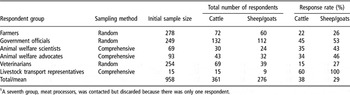
Respondents were recruited to take part in the survey using either random or comprehensive (all available respondents) sampling methods (Table 1). As some respondent groups had a limited number of people that were available within Australia, the sampling method used was dependent on the number of participants available. A single instance of convenience sampling occurred, when a meat processor voluntarily contacted the research team and asked to complete the survey. Invitations were subsequently sent to others in this category. All eligible individuals were required to have basic computer literacy and access to a computer and the Internet in order to participate in the study.
Sampling frames and method of participant selection for the sixFootnote 1 respondent groups for the beef cattle and sheep/goats surveys

1 A seventh group, meat processors, was contacted but discarded because there was only one respondent.
All targeted participants were contacted by e-mail or fax, in an invitation that included a brief description of the study and information to allow the respondent to access the web surveys. Participants were assigned a unique username and password in order to access the survey and restrictions were set in the ACA software that would allow each participant to complete the survey once only.
Statistical analysis
Utility and Importance values
Utility and Importance values (representing the mean respondents’ preference within and between attributes, respectively, calculated from individual respondents’ returns) were estimated using a hierarchical Bayes estimation provided by the Sawtooth software. They were analysed statistically using the Minitab® analytical software package (State College, PA, USA). Utility values were interval data and the ACA software normalized the data for each respondent by zero-centering the values within each indicator, so that the sum of the utilities for each level within each indicator was equal to zero (Orme, Reference Orme2002). Positive and negative Utility values represent levels preferred or not preferred by the respondents, respectively. The larger the Utility value, the stronger the preference for or against that particular level. Utility values can only be legitimately compared within attributes.
The relative Importance values were calculated for each attribute from the difference that each one made to the total of all the Utility values for each respondent. This difference is the range in each attribute’s Utility values, converted to a percentage, producing a set of Importance values that add up to 100. These are ratios, so an attribute with a value of 20% is rated as twice as important as one with a value of 10%. Taking mean Importance values from all the respondents, attributes were ranked in order from highest importance to the lowest (Sawtooth Software, 2003).
Univariate analyses were performed to test the significance of relationships between respondent groups and attribute Importance values. For those showing significance, multiple comparisons were then performed using Bonferroni’s correction in order to determine which respondent groups differed with respect to mean relative Importance values. Probability values were considered significant at <0.05.
Cluster analysis
Cluster analysis assessed the similarities and differences between different respondent groups. A divisive (‘top-down’) algorithm was used, beginning with the whole set and then dividing it into successively smaller clusters. Two, three, four and five centroid linkage clusters were derived using the Importance values for each respondent group, in order to assess the distances (reflecting similarities and differences in opinions) between clusters, using Euclidean distance measures. Similarities in the perceptions of the different groups were obtained by assessing the distribution of the clusters, with the assumption that those respondent groups assigned to the same cluster group share similar perceptions, and that the greater the distance between the clusters, the greater the dissimilarities in perception between the respondent groups.
All statistical analyses were performed with Minitab® statistical software.
Results
Response rate
A total of 361 (beef cattle) and 276 (sheep/goats) of the 958 people invited completed the survey (Table 1). Twenty-one respondents (2 beef cattle survey, 19 sheep/goat survey) started the survey but failed to complete it. This represents a total response rate to this survey of 38% for beef cattle and 28% for sheep/goats. Although the Australian Meat Industry Council was initially proposed as a stakeholder group, it had only three potential participants who could be contacted and only one of these responded to the survey. This stakeholder group was therefore eliminated from the study. Responses were also examined for unusual patterns, e.g., numbers only at the extremes of the scale, and also for any unusual patterns indicating that the respondent was not concentrating while answering the survey. One respondent from the veterinarians’ group gave many unusual patterns in his answers, and the data set from this participant was removed from the analysis. This did not affect the significance of any of the results. The median completion times were 27 (beef cattle survey) and 26 min (sheep/goats survey).
Demographic results
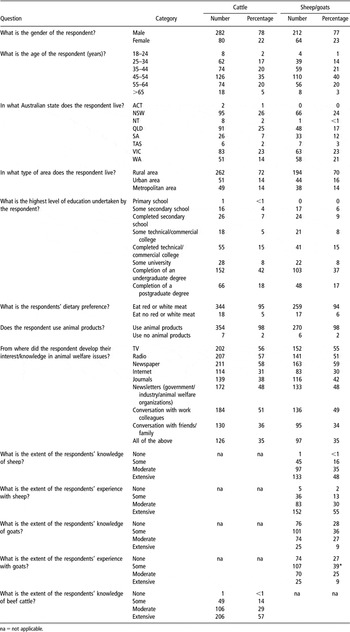
Results are described for beef cattle and sheep/goat surveys (Table 2). The ratios of male to female respondents were 78 : 22 and 77 : 23 for the two surveys, respectively. Most respondents were between 45 and 54 years of age (35% and 40%, respectively). Respondents resided in all Australian states, with the majority responding from New South Wales (26% and 24%), Victoria (25% and 23%) and Western Australia (23% and 21%). Most (72% and 70%) of the respondents indicated that they lived in a rural area and most (60% and 54%) also indicated that they had completed an undergraduate and/or postgraduate degree. Nearly all of the respondents ate meat (94% and 96%) and used animal products (98% and 98%).
Demographic information received from respondents to the beef cattle and sheep/goats surveys

na = not applicable.
Respondents had gained their knowledge of animal welfare issues from multiple sources, the three main ones being newspapers (58% and 59%), the television (57% and 55%) and the radio (56% and 51%). A total of 35% of respondents in each survey stated that they had gained their knowledge in animal welfare from all given information sources. In the beef cattle survey, the majority of respondents believed they had extensive knowledge (57%) of, and experience (66%) within, the industry. In the sheep/goat survey, about one-half of respondents believed they had extensive knowledge (48%) and experience (55%) of sheep, and considerably fewer than this indicated extensive knowledge or experience (9%) of goats. In response to the question ‘How would you describe your interest in issues related to animal welfare?’, most (80% and 78%) were ‘very interested’ or ‘extremely interested’.
Mean Importance values for attributes
Beef cattle survey
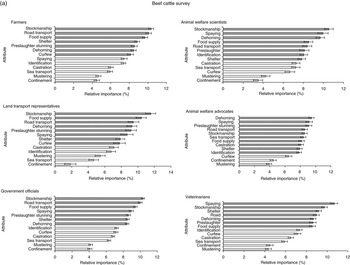
The highest Importance value was attributed to stockmanship (10.2%). Also rated highly, in order of diminishing importance, were ground transport (9.2%), spaying (9.1%), food supply (9.1%), dehorning (9.0%) and pre-slaughter stunning (8.6%). Of below average importance were identification (7.4%), curfew (7.2%) and castration (7.0%). Even lower importance ratings were attributed to sea transport (6.4%) and mustering (4.5%), and the lowest rating was attributed to confinement (3.8%). A significant proportion of respondents (32%) indicated that they were uncomfortable answering questions on spaying, either because of limited knowledge or experience, or because they considered the question to be too simplistic, and a smaller proportion (13%) indicated similar problems with pre-slaughter stunning.
Sheep/goat survey
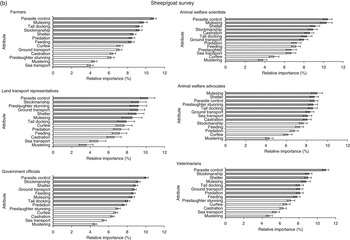
The highest mean Importance value was attributed to parasite control (10.2%). Also rated highly, in order of diminishing importance, were mulesing (9.1%), shelter (8.9%), stockmanship (8.9%), tail docking (8.4%) and ground transport (8.2%). Of below average importance was feeding (7.7%), predation (7.6%), pre-slaughter stunning (7.5%) and castration (7.0%). Even lower Importance values were attributed to curfews (6.6%) and sea transport (5.8%), and the lowest value was attributed to mustering (4.2%). A significant proportion of respondents (13%) indicated that they were uncomfortable answering questions on pre-slaughter stunning, either because of limited knowledge or experience, or because they considered the question to be too simplistic.
The Importance values of attributes given by the different respondent groups
Beef cattle survey
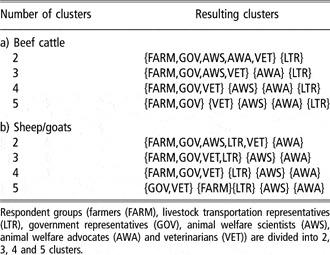
The initial clustering demonstrated that the land transport group had the most different responses to the other five groups examined (Table 3). They rated ground transport as less important than other respondents and food supply as more important (Figure 1). Spaying and confinement were also rated as less important than overall responses by this group. However, the sample size was small, which may reduce the significance of this result.
Relative importance values (and standard errors) for the different respondent groups (farmers, land transport representatives, government officials, animal welfare scientists, animal welfare advocates and veterinarians) for (a) the beef cattle survey and (b) the sheep/goat survey. The empty bars shown in each figure indicate those attributes having an importance level below that of the mean importance level.


Identification of clusters of respondent groups according to the Importance values of the attributes for a) beef cattle and b) sheep/goats

Respondent groups (farmers (FARM), livestock transportation representatives (LTR), government representatives (GOV), animal welfare scientists (AWS), animal welfare advocates (AWA) and veterinarians (VET)) are divided into 2, 3, 4 and 5 clusters.
The second cluster detected was the animal welfare advocates group, who rated injurious procedures highly, in particular dehorning, spaying and pre-slaughter stunning. The other groups all had stockmanship as their number one or two priorities; whereas for the animal welfare advocates this was lower at fifth place. Sea transport was rated much higher by this group than the other stakeholder groups, for whom it was always in the bottom four attributes.
The next cluster was the animal welfare scientists, in which the principle difference was that they rated dehorning higher than food supply, whereas these two attributes received similar ratings from other groups. The final cluster was the veterinarians, who were unusual in rating spaying as the highest concern, and by a considerable margin. Otherwise, their concerns were similar to the majority of respondents.
Concerning the remaining groups, farmers gave stockmanship and ground transport similar high Importance values, whereas other groups gave stockmanship a higher rating than ground transport (Figure 1). Spaying, which was third overall in the survey, was rated of below average importance by the farmers. Government officials had very similar responses to the mean ranking of all groups.
Sheep/goat survey
The initial clustering demonstrated that the animal welfare advocates had fundamentally different responses from the other five groups examined in this survey. They were the only group that did not rate parasite control highest (Figure 1). Instead, they selected mulesing first. Stockmanship, which was one of the highest priorities for the other groups, was ranked ninth by the animal welfare activists. Sea transport was ranked as the seventh most important attribute, whereas in the other groups it was always in the bottom three attributes. Curfews were rated as less important than other groups (Figure 1).
Division into three clusters determined that the animal welfare scientists were also different. They rated castration higher and curfews lower than other stakeholder groups (Figure 1). Division into four clusters indicated that the land transport representatives had differing views to the other groups (Table 4). They rated parasite control, pre-slaughter stunning and ground transport relatively high, whereas mulesing tended to be low in this group (Figure 1).
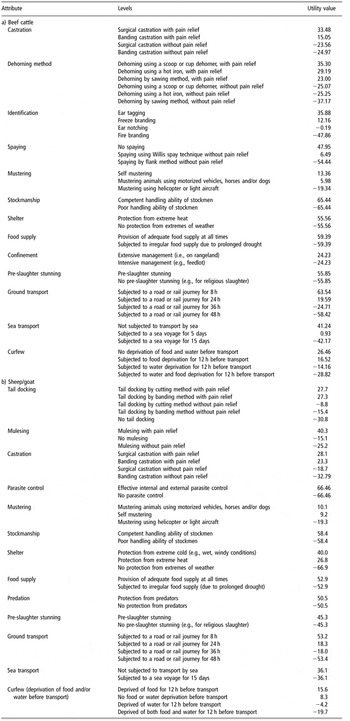
The thirteen attributes, together with Utility values (mean respondents’ preference within attributes) for the different methods (levels) used to perform husbandry procedures in a) beef cattle and b) sheep/goats (− value indicates not preferred)

The final cluster to be identified was the farmers, who chose parasite control first, then mulesing, tail docking and stockmanship (Figure 1). Shelter, predation and feeding were next, and then curfew, ground transport, castration and stunning. Mustering and sea transport received the lowest ratings. This final clustering also isolated the government officials (Figure 1) and veterinarians (Figure 1), which were different only because they rated stockmanship higher than the average of all groups.
Preferences for levels of the attributes
Beef cattle survey
Mean utilities for each level of each attribute are presented in Table 4. Pain relief was considered most important during the process of castration, rather than whether a surgical or banding technique was used, although the former was slightly preferred (Table 4). For dehorning, pain relief was also seen as more important than the method used, although there was a marginal welfare preference for the scooping cup method and to a lesser extent the hot iron, compared with the sawing method.
The preferred method of identification, in respect to welfare, was ear tagging, then freeze branding and ear notching, with a much lower score given to fire branding. Spaying by the flank method without pain relief was given a very low score compared to the dropped ovary technique without pain relief. There was only a marginal preference for self-mustering or mustering with ground-based methods, compared with mustering using helicopters or aircraft, which was given a low rating for welfare impact.
A strong preference was given for stockmen that had a competent handling ability, compared with poor handling ability, and also for the provision of shelter in extreme weather, adequate food at all times and pre-slaughter stunning. A less strong preference was observed for extensive management, compared with intensive. Regarding curfews (deprivation of food and/or water before transport), the highest rating was given to no food and water deprivation, then food-only deprivation, then water-only deprivation and finally both food and water deprivation. Utility values decreased with journey length for road/rail transport or sea transport and in both cases this was an approximately linear response across levels.
Sheep/goat survey
In relation to tail docking, the provision of pain relief was rated as more important than the technique, and the cutting and banding methods achieving similar Utility values when conducted with pain relief. When no pain relief was provided, respondents tended to prefer the banding method to cutting. The lowest value was attributed to no tail docking. Pain relief was also seen as more important than the method of castration, but where no pain relief was provided there was evidence that banding castration was preferred to surgical castration. In relation to mulesing, the highest Utility value was attributed to mulesing with pain relief, compared with no mulesing or mulesing without pain relief.
A lower Utility value was observed for mustering using helicopter or aircraft, compared to self-mustering or mustering using animals or vehicles, which were viewed as having similar welfare impact. Protection from the cold was viewed as more important than protection from heat. The Utility value for ground transport increased approximately linearly with duration of the voyage. Regarding curfews, the most favoured option was food deprivation before transport and, to a lesser extent, no food or water deprivation, with the worst option being both food and water deprivation. Water deprivation was therefore seen as having a greater welfare impact than food deprivation. Parasite control, stockmanship, a regular supply of food, protection from predators, pre-slaughter stunning and no sea transport were all viewed as preferable to the alternative level in the attribute.
Respondents’ comments
Only two adverse comments were received, and many respondents indicated satisfaction with the questionnaire. Of these two comments, one noted concern that some procedures that may cause adverse welfare impact to animals in short term may actually be beneficial to the animal in the long term, which had been considered in planning the surveys. The other stated that other factors, not considered within this survey, may influence the choices.
Discussion
Differences between respondent groups
The most consistent difference across surveys between respondent groups was emergence of the animal welfare advocate group as different from the rest. Higher ratings were given by this group to the practices of dehorning, spaying and pre-slaughter stunning in beef cattle, and tail docking, castration and mulesing in sheep/goats. This focus on injurious practices could be because their direct experience of the production systems is likely to be less than other groups, and these procedures represent direct injury to animals, whereas issues such as adequate nutrition and stockmanship are less likely to be appreciated from a remote perspective. These are the attributes that affect animal survival and productivity and are therefore economically important to farmers and industry-associated parties. In addition, for those that are unfamiliar with the production systems, there may be an anthropomorphic element which sees injurious procedures as akin to the trauma associated with human surgery, compared with irregular food supply and stockmanship, which do not affect humans in developed countries. An alternative hypothesis concerning the disparity between the views of the animal welfare advocates and those more closely connected with industry is that the latter have become desensitized or inured to the injurious procedures through repeated exposure, and therefore respondents may have concentrated more on the perceived long-term welfare impacts for the animal.
In the beef cattle survey, the group that was most different to all the others was the land transport group, which was because they rated spaying less important and food supply more important than the mean ranking given by respondents. This may be because spaying is entirely an on-farm issue, whereas on-farm food supply can influence the suitability of animals for transport. In the sheep and goat survey, land transport representatives were only shown to be different to the other respondents when four clusters were identified, and this difference was primarily because they rated ground-based transport more highly. This demonstrates the tendency for groups that have more contact with a practice to rate it as more important.
Validity of the results in relation to scientific studies and the industry profile in Australia
Many of the practices compared have not been subjected to scientific evaluation; however, where possible, the expert opinions are compared to experimental results.
Beef cattle
Examination of the husbandry procedures that different stakeholder groups considered to be most influential in determining the welfare of the animal showed that stockmanship was indicated to be the most important procedure by the majority of respondents. The focus on stockmanship by industry personnel may reflect the learning over time that the ability of the stockperson has a major effect on welfare in varied systems that are difficult to manage well. Stockmanship includes several leant elements, including knowledge, skills, motivation and animal handling (Cronin et al., Reference Cronin, Barnett, Edge and Hemsworth2002). Recognition of its importance reinforces the need to have skilled employees working within each field in the industry, which may be challenged by declining attendance at training colleges, low financial rewards and increasing job mobility. This should be a major area of concern to the industry, given the declining attractiveness of work as a stockperson to young people in many developed countries and increasing levels of public concern for the welfare of livestock.
The high importance placed on ground transport of beef cattle may be, in part, due to the fact that transportation is a common procedure within all areas of the beef cattle industry, therefore, the majority of personnel involved in the industry will have knowledge of this procedure, and will be familiar with conditions experienced by cattle during transportation. They may, therefore, be likely to express their concerns with the procedure in a survey of this type. Under Australian conditions, cattle transport has been demonstrated to result in stress mainly in the early period of travel (Pettitford et al., Reference Pettitford, Ferguson, Lea, Lee, Paul, Reid, Hinch and Fisher2008).
The preference for the Willis spay technique over surgical spaying is in accordance with Department of Agriculture Forestry and Fisheries (DAFF) policy in Australia (DAFF, 2006). No scientific research has been reported that directly compares different methods. Unlike other attributes, such as mulesing of sheep, there was agreement that not performing the technique was best for welfare, even though DAFF suggests that not spaying is likely to be detrimental to welfare, presumably because of the generation of pregnancies in cows that do not have adequate feed supplies (DAFF, 2006).
In relation to the dehorning practices investigated, there was a marginal preference for the scooping cup method over the hot iron method. This is contrary to the assessment by Gregory (Reference Gregory2004), who believed that the duration of pain inflicted by the hot iron method is shorter than that produced by the scoop, irrespective of whether or not a local anaesthetic is used. He did, however, advocate the use of a local anaesthetic to control pain produced at the time the wound is inflicted. The preference of respondents for freeze- over fire-branding concurs with experiments that have demonstrated a greater increase in heart rate and plasma cortisol for the latter method (Lay et al., Reference Lay, Friend, Bowers, Grissom and Jenkins1992).
The view of the land transport group that confinement was not a serious welfare issue, may be due to the fact that for them land transport represents the major period of close confinement for most beef cattle. However, confinement in feedlots is common practice for the final stages of rearing beef cattle, and space limitations have been shown to adversely affect some indicators of welfare, such as growth rate (González et al., Reference González, Ferret, Manteca, Rúiz-de-la-Torre, Calsamiglia, Devant and Bach2008). The land transport group’s higher rating for food supply than other groups may be a reflection of its importance to transportation.
The limited difference between the perceived welfare impacts of various mustering methods probably reflects the low Importance value of this attribute and the short and infrequent nature of the practice. However, the lower values for mustering by helicopter or aircraft than other methods demonstrate that it is widely believed that there would be greater disturbance using aerial methods, probably because of increased noise and faster speed. Mustering speed should ideally be determined by the slowest animal, moving without force or coercion (Garson, Reference Garson2006).
The preference of respondents for no curfew was expected, given the likelihood of significant welfare problems with this practice (Hogan et al., Reference Hogan, Petherick and Phillips2007). The preference for food rather than water restrictions as being better for welfare does not accord with the review of Hogan et al. (Reference Hogan, Petherick and Phillips2007), which concluded that livestock could cope with water restrictions better than food restrictions. The latter might first allow pathogens to colonize the gastrointestinal tract if longer than 24 h, second, could have a prolonged effect on live weight and third, could provide a risk of inadequate glycogen reserves at slaughter. Nevertheless, as Hogan et al. (Reference Hogan, Petherick and Phillips2007) noted, any restriction in water intake will quickly reduce dry food intake as the animals seek to maintain normal rumen osmotic conditions.
Sheep/goats
The highest ranking, given to parasite control, reflects the major challenge to health presented with declining efficacy of antiparasiticides due to emerging resistance (Phillips, Reference Phillips2005), and the economic significance of effective parasite control. The emphasis by respondents on stockmanship confirms the importance of this topic recognized at an expert forum convened to consider sheep welfare priorities (Cronin et al., Reference Cronin, Barnett, Edge and Hemsworth2002). As with beef cattle, there was a low Importance value given to mustering, probably reflecting the limited impact on the animal’s health. The adverse perceived effects of mustering with helicopter or light aircraft were also evident, compared with self-mustering or mustering with motorized vehicles, horses or dogs. Mustering by air is less common for sheep than for cattle, but is still potentially too fast and potentially disturbing and exhausting to the sheep before entering a handling system. The low importance attributed to sea transport in this survey contrasts with its very high importance attributed by experts in the survey of Cronin et al. (Reference Cronin, Barnett, Edge and Hemsworth2002). However, Cronin’s sample included university students and others, who may be more sensitive to media focus on this practice.
Within the tail-docking attribute, the choice of no tail docking as the worst option for animal welfare suggests that many respondents were considering the long-term impact of the procedure, rather than the subsequent 48 h as instructed. The choice of impact within 48 h was considered necessary to enable welfare impact to be effectively compared. Comparing welfare impact over an undefined, longer period was considered to present too difficult a challenge to most connected with the industry, especially since most scientific welfare studies have been conducted over short periods. However, it should be remembered that respondents’ order of Importance could have been quite different if welfare had been able to be evaluated over a longer period, and that this may be more meaningful for certain practices, e.g., undernutrition and thermal challenges. The greater concern for the effects of cold than heat reflect the susceptibility of the newborn lamb to hypothermia, whereas fully fleeced ewes have good resistance to both heat and cold stress.
Similarly the choice of banding castration as worse than surgical castration, in animal welfare terms, also suggests that considerations of welfare impact extended beyond 48 h. In relation to the husbandry method of tail docking, the preference of respondents for banding as opposed to the cutting of lambs’ tails when no pain relief was provided is supported by research that demonstrates longer-lasting cortisol responses when the cutting method is used (Henderson, Reference Henderson1990). In relation to castration, the preference for banding over surgical castration is not supported by the experimental comparisons of different castration techniques, which demonstrate that all methods result in a rapid rise in plasma cortisol for 40 to 60 min, and return to normal within 2 to 3 h (see review by Gregory (Reference Gregory2004)). If both tail docking and castration are performed simultaneously, rubber rings appear to be the least painful method, with surgical techniques causing longer-lasting distress (about 8 h). However, some authors disagree and Henderson (Reference Henderson1990) is of the opinion that surgical castration is the least painful method, causing a shorter lasting pain than banding, provided it is done by experienced operators.
The importance of pain relief, evident in relation to tail docking and castration, was also seen in responses to Utility levels provided for mulesing, in which case mulesing with pain relief was seen as preferable to no mulesing. This was further evidence that some respondents viewed welfare impacts over a longer period than 48 h. The recent scientific evidence for this is convincing, with combined application of non-steroidal anti-inflammatory drugs and anaesthesia reducing pain responses significantly (Paull et al., Reference Paull, Colditz, Lee, Atkinson and Fisher2008; Phillips, Reference Phillips2009).
Effectiveness of the survey technique
The length of time taken for the questionnaire was in accord with recommendations for survey design (Duncan and Fraser, Reference Duncan and Fraser1997) and was considered to reasonably approximate with the length of time required to provide the maximum amount of information to be collected, whilst not impacting to any major extent on respondents for whom time to complete the survey was a major consideration. This helped to ensure that the number of respondents completing the survey was as high as possible. The response rate was calculated separately for each survey and when considered together indicate an adequate return, suggesting minimum bias in results.
Respondents completing the survey had a wide a range of backgrounds, experience and age and were from varied residential locations. The fact that almost three-quarters were from rural areas and over three-quarters were male reflected the rural base of the industry but at a higher educational level than Australian farmers generally. There was little dissatisfaction expressed with the survey and only one apparent incidence of inadequate attention to providing answers. In the sheep/goat survey there was evidence that respondents did not fully take into account that we were asking about the welfare impact within 48 h. Some issues, such as tail docking or mulesing were rated as having a more severe impact when no practice was undertaken, compared with when a welfare-impacting procedure was undertaken, suggesting that some respondents were considering the long-term impact. There was no evidence of this in the beef cattle survey. ‘No spaying’ was rated as having the least adverse impact on welfare and ‘no sea transport’ or ‘no curfew’ were also rated as best options, compared with these practices that would be expected to impact on animal welfare. This is evidence that the beef cattle survey was completed with short-term impact on welfare as the major consideration.
Conclusions
The greatest concerns for the welfare of beef cattle were first, stockmanship and secondly, ground transport, and the greatest concerns for the welfare of sheep/goats were first, parasite control and then mulesing. The method of performing invasive procedures was perceived as less important than the provision of pain relief. Preferences were exhibited for methods of conducting invasive procedures, but these were less definite than the need for pain relief. Different responses were observed from those directly connected with the industry and the animal welfare advocate group. Better communication between the various interest groups is, therefore, advocated. Regular identification of the major welfare concerns is also important to enable education to be provided within each separate sector of the industry. Animal welfare advocates tended to focus on injurious practices that have an obvious short-term adverse effect on welfare. As not all opinions were supported by the extant scientific research, further exploration of the reasons for the opinions expressed is warranted, as well as further research to examine the discrepancies between opinion and research results. Balancing of short-term (pain-related) welfare issues and long-term issues of greater economic impact is a communication challenge for cross respondent group dialogue.
Adaptive conjoint analysis questionnaires successfully extracted opinions of stakeholder groups on the welfare impact of practices with which they were familiar, although response rates were low from some groups. It is not believed that this caused significant bias in the results. The number of questions that could be posed within the normal time taken to complete the survey was adequate to obtain reliable data on the respondent’s opinions.
Acknowledgements
This research was funded by Meat and Livestock Australia and was approved by the Human Ethics review process of the University. We are grateful to A. Lisle for help with the statistical design and analysis of this research.
Appendix: Definitions of terms provided to respondents
Banding castration: Involves the application of a thick rubber band/ring (also referred to as an elastrator ring) to the neck of the scrotum, which restricts blood flow to the testicles.
Dehorning by sawing method (cattle only): Usually done in older cattle (older than 6 months) and involves removing the horns by sawing them off with a cutting wire or electric saw.
Dehorning using a hot iron (cattle only): An instrument (hot iron) is heated and then is directly applied to the tissue (i.e., horn buds) to be killed; there is no blood loss involved.
Dehorning using a scoop or cup dehorner (cattle only): These specialized instruments have sharp cutting edges, and when applied to the base of the horn, they slice off the horn tissue.
Fire branding (cattle only): Involves using a hot iron to put a mark on the animal’s skin as a mean of identification.
Freeze branding (cattle only): Involves applying a super-cooled instrument to the animal’s skin for 25 to 60 s; the hair where the brand was applied grows back white, as a result of depigmentation.
Management (cattle only): Extensive management: Cattle are allowed to graze on rangeland or pasture with minimal supervision by humans. Intensive management: Cattle are confined to a feedlot or small paddocks and have regular supervision by humans.
Mulesing (sheep only): The surgical or chemical removal of wool-bearing skin from the breach area of sheep as a means of preventing fly-strike.
Mustering: Moving animals in a desired direction, generally into yards.
Pre-slaughter stunning: The process of rendering an animal unconscious before killing it by means of bleeding; the animal remains unconscious until death results from blood loss. Stunning is currently achieved through mechanical or electrical methods.
No pre-slaughter stunning: The animal is not rendered unconscious before it is bled to death.
Self-mustering: The animal voluntarily enters a yard through a gate to access water or a supplement. The gate is adjusted so that it only allows the cattle to enter, but not to leave.
Spaying (cattle only): The surgical removal of a cow/heifer’s ovaries. This procedure may be done in extensively managed beef cattle as a means of preventing unwanted pregnancies.
Spaying by flank method (cattle only): Involves a cut being made in the cow/heifer’s left flank, through which ovaries are removed.
Spaying by dropped ovary method (cattle only): Involves the insertion of a small stainless steel rod into the abdomen via the vagina to snip the ovaries, which then drop into the abdominal cavity for absorption by the body.
Surgical castration: The animal’s testicles are removed using a clean, sharp instrument such as a knife.
Tail docking (sheep only): Amputation of the tail.
Tail docking by banding method: Amputation of the tail by applying a thick rubber band/ring (i.e., elastrator ring) to the tail, which restricts blood flow to the tail causing tissue death.
Tail docking by cutting method: Amputation of the tail by using a clean sharp knife.