1. Introduction
The aim of this review is to provide a critical analysis of language teacher research engagement. The term ‘research engagement’ here covers both engagement in research (i.e. by doing it) as well as engagement with research (i.e. by reading and using it). My goal here is to examine our current understandings of both these issues in the field of second and foreign language teaching. Two assumptions underpin my interest in this topic. The first is that research engagement has the potential to be a powerful transformative force in the work and professional development of language teachers. The second is that such engagement remains a minority activity in our field. The motivation for this review stems from the tension between these two assertions, and one of my specific interests here is to explore the gap between what is theoretically possible and the contemporary status of language teacher research engagement.
It is not my intention here to be prescriptive in arguing language teachers should be required to do and read research; as this review will highlight, in many contexts, such engagement will be neither a priority nor feasible. My position, rather, is that if we can understand why research engagement is not a widespread activity in language teaching, we will then be in a stronger position to promote and support teacher research engagement, if that is considered to be a desirable activity. This review will, I believe, have significant practical and theoretical implications for the planning, conduct and evaluation of initiatives which aim to promote research engagement among prospective and practising language teachers. The rationale for this paper also stems from the lack of any existing comparable review of the material I cover here.
1.1 Scope and organization
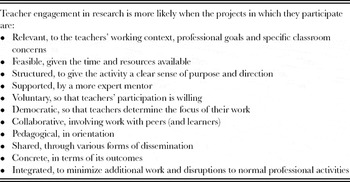
Throughout this paper, the term language teaching (LT) is used to refer to the field of second and foreign language teaching, while language teacher refers to classroom practitioners in this field. The literature relevant to teacher research engagement is substantial, and to delimit the scope of this work I have paid particular attention to material pertinent to the following central issues:
• definitions and perspectives – ways in which teacher research engagement has been defined and conceptualized;
• benefits – claims in the literature for the positive impact of teacher research engagement;
• critical perspectives – critiques of teacher research engagement and of efforts to promote it;
• theory–practice interface – analyses of the relationship between published research and its use by teachers;
• teacher perspectives – research on teachers’ perspectives on doing and reading research;
• facilitators and barriers – evidence of factors which support or impede teacher research engagement;
• promoting teacher research engagement – strategies and initiatives which aim to support teachers’ efforts to engage in and with research.
The literature I draw on for this review is limited to work published in English. I draw widely on relevant work in education generally, as well as on material from the field of LT, most of which relates to the teaching of English as a second or foreign language.
Following this Introduction, I will first present an analysis of language teacher engagement in research, after which I will review the relevant literature on teachers’ engagement with research. This will be followed by an analysis of the conditions which support language teacher research engagement. I will conclude this article with a brief comment on the key themes that emerge here and on the implications of this review.
2. Engagement in research
My focus here is on engagement in research by language teachers for the purposes of understanding their own professional contexts. Language teachers who are doing academic research as part of a Master's or doctoral programme are not a key concern here. Also excluded are language teachers (particularly university foreign language teachers) who do research into areas (e.g. literature, stylistics) which are not central to their own teaching. These omissions reflect my assessment of what will be of most interest to my target audience and of what I can realistically achieve in this review, given the space available and the volume of literature relevant to my primary focus.
2.1 Definitions
Various labels have been applied to the research that teachers do in classrooms and schools. Roulston et al. (Reference Roulston, Legette, DeLoach and Pittman2005), for example, list the following: action research, practitioner research, collaborative inquiry, critical inquiry, self study, and teacher research. It is the last of these that I will use here in discussing teacher engagement in research.
The work on teacher research of Cochran-Smith and Lytle has been very influential, particularly in North America (Cochran-Smith & Lytle Reference Cochran-Smith and Lytle1990, Reference Cochran-Smith and Lytle1993, Reference Cochran-Smith and Lytle2009; Lytle & Cochran-Smith Reference Lytle and Cochran-Smith1990, Reference Lytle, Cochran-Smith, Hollingsworth and Sockett1994). They define teacher research
in the broadest possible sense to encompass all forms of practitioner inquiry that involve systematic, intentional, and self-critical inquiry about one's work in K-12, higher education, or continuing education classrooms, schools, programs, and other formal educational settings. This definition . . . does not necessarily include reflection or other terms that refer to being thoughtful about one's educational work in ways that are not necessarily systematic or intentional. (Cochran-Smith & Lytle Reference Cochran-Smith and Lytle1999: 22)
In the UK, and writing in the context of school improvement, Carter and Halsall (Reference Carter, Halsall and Halsall1998: 73–74) suggest the following ‘essential characteristics’ of teacher research:
• it is grounded in data which has been systematically collected and analysed for a clearly defined purpose;
• it is undertaken by teachers, though sometimes with the support of external critical friends;
• it focuses on professional activity, usually in the workplace itself;
• its purpose is to clarify aspects of that activity, with a view to bringing about beneficial change – ultimately, to improve student progress, achievement and development, this being precisely the purpose of school improvement itself.
One final definition we can consider here comes from Lankshear and Knobel (Reference Lankshear and Knobel2004: 9), who define teacher researchers as
classroom practitioners at any level, from preschool to tertiary, who are involved individually or collaboratively in self-motivated and self-generated systematic and informed inquiry undertaken with a view to enhancing their vocation as professional educators.
What these and other definitions of teacher research have in common is that they refer to inquiry conducted by teachers in their own professional contexts; and, influenced by the work of Stenhouse (Reference Stenhouse1975), these definitions also typically characterize such inquiry as being systematic. Lankshear and Knobel's definition stresses the self-initiated nature of teacher research (i.e. teachers themselves must want to do it and must have some control over its focus and conduct) and suggests it may be collaborative, while, in the definition cited earlier, Cochran-Smith and Lytle distinguish, helpfully I feel, between reflection and teacher research: while teacher research is necessarily reflective, reflecting on one's practice does not automatically constitute teacher research.
Returning to terms commonly associated with teacher research, practitioner research is similar in purpose and conduct to teacher research (and is often used as a synonym for it); it refers to systematic inquiry by professionals in any discipline who are investigating their own practices (so the practitioners may be, for example, nurses). Action research is a form of practitioner research which is characterized by particular procedures, which broadly involve the introduction and evaluation of new practices, typically through a number of investigative cycles (in LT, see Wallace Reference Wallace1998; Burns Reference Burns2005b, Reference Burns2010). Some definitions of action research (e.g. Kemmis & McTaggart Reference Kemmis and McTaggart1988) also stipulate that it should be collective or collaborative, though this is not a condition covered in all definitions of the term. Teacher research is thus a broader term than action research – while action research (when conducted by teachers) is also teacher research, not all teacher research follows the procedures which define action research. Classroom research, a third term often mentioned in the context of teacher research, is simply systematic inquiry which is conducted in classrooms; much teacher research is classroom research, but not all classroom research is teacher research (e.g. academics may visit schools to collect data for their research). In her analysis of the relationship between teacher research, action research and classroom research, Bailey (Reference Bailey and Celce-Murcia2001: 491) concludes that ‘the term classroom research refers to the location and focus of the study. Teacher research refers to the agents who conduct the study. Action research denotes a particular approach’. These broad distinctions are helpful, though incomplete as the basis of a precise definition of what teacher research is (I formulate such a definition at the end of this section).
Another definitional issue to consider here relates to whether teacher research needs to be made public. One argument for doing so is that dissemination is a basic characteristic of all research. Stenhouse's definition of research – ‘systematic inquiry made public’ (Reference Stenhouse1975: 142) makes this position clear; he also notes that ‘private research for our purpose does not count as research’ (Reference Stenhouse1981: 111). Support for this position is also evident in LT: Brumfit and Mitchell (Reference Brumfit and Mitchell1989: 7) argue that all research, including teacher research, should be ‘public because it needs to be distinguished from simply improving one's own private understanding: it is not another name for personal study’, while Crookes (Reference Crookes1993: 137, drawing on Stern Reference Stern1983) says that ‘research is not research unless communicated’.
From a different perspective, Allwright and Hanks (Reference Allwright and Hanks2009) focus on the benefits of making teacher research public; for example, they note that findings which are public can inform educational decision-making. More generally, I would add that the dissemination of teacher research creates greater potential for the knowledge teachers generate through their inquiries to have influence beyond the contexts in which this knowledge is generated. Conversely, as Barkhuizen (Reference Barkhuizen2009: 124) explains, a failure to make teacher research public ‘would mean missing the opportunity and ignoring the responsibility to contribute to discussions and debates in the field of language education’. Freeman (Reference Freeman, Bailey and Nunan1996: 105) similarly expresses concerns that if teacher research is not made public, the knowledge it generates will ‘dissipate in the recesses of private conversations, staff rooms, or schools’. The need for teacher research to be made public does not imply that private inquiry is not beneficial. Given its private nature, though, such inquiry need not appropriate the term ‘research’.
The view that teacher research cannot remain a private activity is not motivated by a desire to see it as an approximation of academic research. Bartels (Reference Bartels2003) suggests that imposing academic notions of dissemination on teacher research in this way would be ‘colonialist’. Bartels’ concerns are justified if formal research reports are seen as the only acceptable way of making teacher research public. My position is to promote a broad view of dissemination which directs teachers to the many varied formats, oral and written, formal and less formal, formative and summative, through which they can make their work available for public scrutiny. This stance, I believe, is in no way colonialist, and it is illustrated in the many excellent suggestions for sharing teacher research contained in texts such as Burns (Reference Burns1999) and Altrichter et al. (Reference Altrichter, Feldman, Posch and Somekh2008).
One final element to consider briefly in defining teacher research is the data collection strategies it utilizes. Teacher research is more commonly associated with qualitative forms of inquiry and investigative strategies which are accessible to teachers, though in theory there are no limitations on the strategies that teacher researchers can deploy (and quantitative techniques are sometimes used). The many different data collection methods available to teacher researchers are illustrated in, for example, Freeman (Reference Freeman1998), Burns (Reference Burns1999), Edwards (Reference Edwards, Edwards and Willis2005) and McKernan (Reference McKernan1996).
On the basis of the above analysis, I thus define teacher research as systematic inquiry, qualitative and/or quantitative, conducted by teachers in their own professional contexts, individually or collaboratively (with other teachers and/or external collaborators), which aims to enhance teachers’ understandings of some aspect of their work, is made public, has the potential to contribute to better quality teaching and learning in individual classrooms, and which may also inform institutional improvement and educational policy more broadly.
2.2 Origins of teacher research
The history of teacher research has been well-documented (e.g. Olson Reference Olson and Olson1990; Elliott Reference Elliott1991; Crookes Reference Crookes1993; Hollingsworth & Sockett Reference Hollingsworth, Sockett, Hollingsworth and Sockett1994; McKernan Reference McKernan1996; Burns Reference Burns1999; Zeichner & Noffke Reference Zeichner, Noffke and Richardson2001; McNiff & Whitehead Reference McNiff and Whitehead2002; Noffke Reference Noffke, Day, Elliott, Somekh and Winter2002; Hammersley Reference Hammersley2004a). Action research is seen as its ancestor and accounts of the origins of teacher research thus typically begin with reference to the work of Kurt Lewin in the USA in 1940s. Another early source was Corey (Reference Corey1953), though despite this work, action research virtually disappeared from the educational landscape in the USA in the 1950s and 1960s. The more recent emergence of teacher research is traced to parallel efforts in the UK and the USA which took place in the 1970s. These efforts shared a concern for educational reform, in particular for democratizing education and making it a more participatory process. In the UK, the teacher research movement emerged in the context of curriculum reform initiatives and is most closely associated with the work of Stenhouse (Reference Stenhouse1975) and Elliott (see Elliott (Reference Elliott1990) for brief history). In the USA, it is Schön's (Reference Schön1983) work on reflective practice which is seen as critical to a renewed interest in teacher research; his argument that professionals were not unthinking technicians but reflective practitioners provided impetus for initiatives which placed teachers in the rôle of autonomous investigators of their work. Teacher research with a strong reflective element was thus seen as an ideal way for professionals to explore and develop their own understandings of their practices.
In LT, attention to teacher research dates back to as recently as the late 1980s, stimulated in part, as Allwright and Bailey (Reference Allwright and Bailey1991) explain, by the inconclusive results of large-scale studies aiming to identify the best way to promote language learning. These results created an awareness in the field that the search for global pedagogical prescriptions was unlikely to be productive; local, classroom-based research thus emerged as an alternative. Of course, much of the early classroom research in LT was not teacher research (see, for example, the review of academic classroom research in Chaudron Reference Chaudron1988); however, the emergence of classroom research did provide the basis for the next logical step in the evolution of LT research – that classroom studies would start to be conducted by teachers themselves. Distinctions between teachers and researchers, between practice and theory, would thus, it was believed, be narrowed, and teaching would no longer be seen as ‘something which certain people do and others research’ (Freeman Reference Freeman, Bailey and Nunan1996: 106).
Allwright and Bailey (Reference Allwright and Bailey1991) was an early attempt to promote teacher inquiry, though Allwright (Reference Allwright2003: 116) later reflected with regret that that text ‘had unintentionally made classroom research so demanding that teachers would not be able to do it unless they had extra time and extra support’. Nunan's work (Reference Nunan1989a, Reference Nunan1989b, Reference Nunan, Edge and Richards1993) was also influential in giving teacher research prominence in LT. In the last twenty years there have been a number of texts whose aim is to enable language teachers to engage in research, often from an explicitly teacher research (or action research) perspective (McDonough & McDonough Reference McDonough and McDonough1997; Freeman Reference Freeman1998; Wallace Reference Wallace1998; Burns Reference Burns1999; O'Brien & Beaumont Reference O'Brien and Beaumont2000; Burns Reference Burns2010).
2.3 Conceptualizations of teacher research
Given its diverse historical roots, it is not surprising that contemporary forms of teacher research reflect different underlying conceptualizations of its goals. Hammersley (Reference Hammersley2004a), for example, talks about three views of action research: as a way of solving practical classroom problems, as a movement for social change, and as a form of personal professional development. In a related though not identical scheme, Cochran-Smith and Lytle (Reference Cochran-Smith and Lytle1999) also discuss three conceptualizations of teacher research: teacher research as social inquiry, as ways of knowing within communities and as practical inquiry. The first sees teacher research – particularly in the form of action research – as a way of promoting social change. Teacher research with a social orientation is often described as emancipatory (drawing on Carr and Kemmis Reference Carr and Kemmis1986). This perspective on teacher research is also referred to as critical praxis (Hollingsworth & Sockett Reference Hollingsworth, Sockett, Hollingsworth and Sockett1994). It adopts a socio-political stance to the study of education which aims to disrupt and change existing inequitable social conditions.
The second view of teacher research noted above (ways of knowing within communities) sees it as a form of collaborative enquiry through which teachers improve classrooms and schools. As already noted, collaboration is core to some definitions of teacher research (in LT, see Burns Reference Burns1999), and the idea that teacher research can contribute not just to individual teacher development but to broader improvements to schools and classrooms is also a common one. This perspective can be seen, for example, in the papers in Halsall (Reference Halsall1998), where teacher research is positioned as a key mechanism for school improvement. A concern for improving schools also underlies much recent state-funded teacher research in the UK, with references to research-engaged schools a common feature of the discourse in this context (e.g. CUREE 2003; Handscomb & Macbeath Reference Handscomb and Macbeath2003; Sharp et al. Reference Sharp, Eames, Sanders and Tomlinson2005, Reference Sharp, Eames, Sanders and Tomlinson2006).
In the third conceptualization of teacher research noted above (as practical inquiry), it is seen as a vehicle for making explicit and developing teachers’ practical knowledge. Here there is an often individual (and, Hammersley Reference Hammersley2004a suggests, instrumental) focus on solving practical classroom problems. Edge (Reference Edge2001: 5) describes this view of action research as being ‘means oriented’ (he does also list a number of other possible orientations, some of which – e.g. society oriented – relate to the various conceptualizations of teacher research outlined above).
In the context of LT, a particular conceptualization of teacher research that merits attention here is exploratory practice (EP) (Allwright Reference Allwright2003, Reference Allwright2005). Motivated by the view that ‘practitioner-research, at its worst, seems to constitute a way of getting research done badly and making the process so demanding that it is patently unsustainable and therefore soon abandoned’ (Allwright Reference Allwright1997: 368), EP was developed as a form of teacher research which can be integrated into teachers’ everyday practices and which aims to improve the quality of classroom life for teachers and learners. EP is contrasted with action research as follows:
Practitioner research involves two conceptually distinct processes: taking action for understanding, and taking action for change. Taking action for change . . . is more the realm of Action Research. EP's is action for understanding . . . why insist on two distinct processes, taking action for understanding and taking action for change? The answer lies in the ‘for’. It is a matter of intentions. AR [action research] starts out with an intention to change in order to solve a problem, or at least to introduce an innovation. (Allwright & Hanks Reference Allwright and Hanks2009: 172)
Given this position, proponents of EP might disagree with it being described as ‘a more teacher-friendly version of action research’ (Dörnyei Reference Dörnyei2007: 193). That apart, though, some justification for EP's stance to action research is found in the way that the latter is often defined as a problem-solving activity (which thus implies an intention is to promote change): Richards and Farrell (Reference Richards and Farrell2005: 171), for example, define action research as ‘teacher-conducted classroom research that seeks to clarify and resolve practical teaching issues and problems’. There is evidence, too, that teachers often see action research as a problem-solving activity (Rainey Reference Rainey2000). However, I consider this explicit emphasis on problem-solving unnecessary, as action research can be stimulated by an interest in understanding current practice even when there is no immediate problem to solve. Altrichter et al. (Reference Altrichter, Feldman, Posch and Somekh2008: i) acknowledge this in writing that ‘Action research is a method used by teachers and other professionals to improve their understanding of their practice situations, and as a way to generate knowledge about practice’. This conception of action research aligns quite well with EP's focus on understanding; thus, while I fully support EP's goal of making teacher research a more feasible and productive activity for teachers and learners, I do not feel the oppositions it sets up with action research are wholly necessary.
2.4 Evidence-based practice
A further perspective on teacher research is offered by evidence-based practice (EBP). Stimulated by critiques of the quality and impact of educational research in the UK (e.g. Tooley & Darby Reference Tooley and Darby1998), significant government funding has been invested in making teaching an evidence-based profession (i.e. one where teachers engage in and with research). Similar concerns have been raised in the USA and Australia: see Department of Education Training and Youth Affairs (2000) and Shavelson and Towne (Reference Shavelson and Towne2002). The thinking behind EBP in the UK has been extensively described and debated in the literature (Hammersley Reference Hammersley2007 is a compilation of key relevant papers); one of its major premises is that when teachers engage with and in research and make pedagogical decisions based on, or informed by, sound research evidence, this will have a beneficial effect on both teaching and learning (Davies Reference Davies1999). While the validity of the EBP metaphor (adopted from the field of medicine) for education has been challenged (e.g. Hammersley Reference Hammersley, Thomas and Pring2004b), it is generally accepted that more informed use of and involvement in research by teachers can have a positive impact on their work. I return to some of these ideas in Section 3, where I consider more closely the relationship between reading research and teachers’ classroom practices.
Numerous funded opportunities have been set up in the UK to encourage teachers to become research-engaged. These have been summarized in various publications (e.g. CERI/OECD 2002) and have also been reviewed extensively (e.g. Foster Reference Foster1999; Bartlett Reference Bartlett2002; Simons, Kushner & James Reference Simons, Kushner and James2003). Such initiatives have included The National Teacher Research Panel, Teacher Training Agency (TTA) school-based research consortia (funded collaborations between universities and schools), the Teacher Research Grant Scheme and Best Practice Research Scholarships, and The National College of School Leadership. According to Cordingley (Reference Cordingley, Thomas and Pring2004), such initiatives have involved over 10,000 teachers. There have also been initiatives aimed at making published research more accessible to teachers and I discuss these in Section 3 below.
2.5 Language teacher research
Having covered a range of foundational issues, I would now like to focus in more specific detail on LT, where a number of publications evidencing teacher research are available. Early examples came from the ‘Teachers Develop Teachers Research’ series of conferences organized by IATEFL (e.g. Edge & Richards Reference Edge and Richards1993; Field et al. Reference Field, Graham, Griffiths and Head1997). Recent years, in addition to continued publications by IATEFL (e.g. Mitchell-Schuitevoerder & Mourão Reference Mitchell-Schuitevoerder and Mourão2006), have seen the publication of the ‘Language Teacher Research’ series by TESOL, with volumes covering the Americas, Asia, the Middle East, Europe, Australia and New Zealand, and Africa (Borg Reference Borg2006d; Farrell Reference Farrell2006; Burns & Burton Reference Burns and Burton2007; Coombe & Barlow Reference Coombe and Barlow2007; McGarrell Reference McGarrell2007; Makalela Reference Makalela2009). There have been special issues of the journals TESOL Journal (Volume 4, Issue 1) and The Canadian Modern Language Review (Volume 54, Issue 1) dedicated to teacher research. From Australia we have eight volumes in the ‘Teachers’ Voices’ series (e.g. Burns & Hood Reference Burns and Hood1995; Burns & Hood Reference Burns and Hood1997; de Silva Joyce Reference de Silva Joyce2000) and the LIPT [Languages Inservice Program for Teachers] project in South Australia (for examples of work from this project, see Freeman Reference Freeman1998, Appendix E). Relevant collections of papers have come out of Asia (Tinker Sachs Reference Tinker Sachs2002; Hadley Reference Hadley2003) and more recently the Middle East, in Dubai (Warne et al. Reference Warne, O'Brien, Syed and Zuriek2006; Gallagher & Bashir-Ali Reference Gallagher and Bashir-Ali2007) and the Sultanate of Oman (Borg Reference Borg2006c, Reference Borg2008b, Reference Borg2009c, Reference Borgd). Edge (Reference Edge2001) has also showcased action research in a range of ELT settings internationally, Edwards and Willis (Reference Edwards and Willis2005) is a collection of reports by language teachers researching the use of tasks in their classrooms, while Johnson and Golombek (Reference Johnson and Golombek2002) includes narratives written by teachers exploring their own work. There are also regional publications which have a particular focus on teacher research, such as the journal PROFILE, published in Colombia. The journal Language Teaching Research devotes regular space to exploratory practice (further examples of EP are available in Allwright and Hanks Reference Allwright and Hanks2009). Teacher research has also appeared in journals such as English Teaching Forum and ELT Journal; Kiely's (Reference Kiely and Pawlak2008) analysis indicates that there were 28 teacher research articles in ELT Journal Volume 57 and 27 in Volume 60 – significant numbers (but see my critique of this analysis in 2.7). The recently revived TESOL Journal (now in electronic form only) also dedicates a regular section to teacher research.
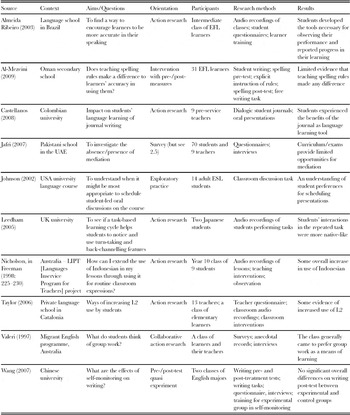
Whilst maintaining my position here that, globally speaking, language teacher engagement in research remains limited, the publications listed above do amount to a considerable body of inquiry in a range of international language teaching contexts (see Burns, this volume, for a comparative book review including some of this material). Table 1 presents an analysis of ten illustrative teacher research papers from the above sources and a number of observations about this work can be made in relation to issues covered so far:
• With one exception, all the papers meet the basic criteria for teacher research discussed in 2.1. Jafri (Reference Jafri, Coombe and Barlow2007), though, represents research done on others and, coupled with its academic orientation, is not in my view an example of teacher research (despite the title of the collection in which it appears).
• A wide range of investigative strategies have been utilized, reflecting the point I made earlier about the inclusiveness of teacher research in this respect.
• In several studies there is little explicit concern to frame findings (e.g. via a literature review) in a way that might connect with contexts outside those studied.
• The dominant (and largely implicit) conceptualization of teacher research in these papers is one that involves individual teachers addressing problems, exploring puzzles or assessing the impact of interventions in their individual classrooms.
• In many cases the research element of teachers’ work was integrated into their routine teaching practices. This is one of the goals of EP (see Johnson (Reference Johnson, Johnson and Golombek2002) in Table 1), but it is clear that such integration may also be possible in action research projects; Valeri (Reference Valeri, Burns and Hood1997: 38), for example, notes that ‘the data collection soon became a part of the teaching/learning process whenever group work was done, rather than simply for the purposes of the research project’. This perhaps supports my earlier point that the differences between EP and action research need not be overstated.
Ten examples of language teacher research.

One issue to emerge from this analysis – one which I will comment on in more detail – relates to the range of discourse conventions adopted in these different reports. At one end of the spectrum, Wang (Reference Wang2007) adopts a very academic stance in terms of content, structure, style and technical sophistication (e.g. use and reporting of statistics). In sharp contrast, Valeri (Reference Valeri, Burns and Hood1997) is a three-page summary of her investigation which provides hardly any methodological details and narrates the procedures in a more conversational manner. This contrast raises interesting issues about the nature of the boundaries, in representational terms, between teacher research and academic research; whilst reading Wang (Reference Wang2007), I did not intuitively feel it is in keeping with the ‘spirit’ of teacher research – and it is certainly not a paper that many classroom teachers would be able to engage with easily – yet the research was conducted by a language teacher interested in exploring the impact of a pedagogical intervention on his learners. Valeri's paper, on the other hand, while much more accessible to a readership of fellow professionals, does not allow readers to assess the extent to which her conclusions are sound.
The Language Teacher Research series and the collections from Oman also follow the conventional structure of a research paper. It might be felt that doing so demonstrates the rigour of teacher research and hence addresses common criticisms about its quality (see 2.7). A formal discourse in reports of teacher research may also encourage academics to read such reports; teachers though, at the same time, may be discouraged. Burns (Reference Burns1999) suggests that academic forms of writing may not be appropriate for disseminating teacher research, but the exclusive application of this strategy may work against improving communication between teachers and academics. In Section 3 I discuss the need for academics to make their work accessible to teachers; I see no reason why teachers should not at least be given the option of doing the same and telling their stories in terms academics can relate to more readily. The crucial issue is that reports of research – teacher research or otherwise – assume a form that is appropriate for the intended audience.
2.6 Benefits of teacher research
An extensive list of potential benefits of teacher research is proposed in the literature (e.g. Goswami & Stillman Reference Goswami and Stillman1987; Kemmis & McTaggart Reference Kemmis and McTaggart1988; Elliott & Sarland Reference Elliott and Sarland1995; Burns Reference Burns1999; Henson Reference Henson2001; Kincheloe Reference Kincheloe2003). For example, it has been claimed that teacher research:
• develops teachers’ capacity for autonomous professional judgements (Lankshear & Knobel Reference Lankshear and Knobel2004);
• reduces teachers’ feelings of frustration and isolation (Roberts Reference Roberts1993);
• allows teachers to move out of a submissive position and be curriculum innovators (Gurney Reference Gurney and Lomax1989);
• allows teachers to become more reflective, critical, and analytical about their teaching behaviours in the classroom (Atay Reference Atay2006);
• makes teachers less vulnerable to and less dependent on external answers to the challenges they face (Donato Reference Donato2003);
• fosters connections between teachers and researchers (Crookes Reference Crookes1993).
Olson's (Reference Olson and Olson1990: 17–18) list of six benefits enhances the prospective value of teacher research even further. According to her, it
• reduces the gap between research findings and classroom practice;
• creates a problem-solving mindset that helps teachers when they consider other classroom dilemmas;
• improves teachers’ instructional decision-making processes;
• increases the professional status of teachers;
• helps empower teachers to influence their own profession at classroom, district, state and national levels;
• offers the overriding and ultimate advantage of providing the potential for improving the educational process.
Some of these claims do have a somewhat idealistic or lofty ring to them, particularly when seen against the unfavourable conditions, vis-à-vis teacher research, that characterize many LT contexts worldwide. Nonetheless, broader analyses of teacher research initiatives in the USA and UK have reported positive findings. In the USA, Zeichner's review concluded that:
Here we have seen evidence that the experience of engaging in self-study research helps teachers to become more confident about their ability to promote student learning, to become more proactive in dealing with difficult situations that arise in their teaching . . . We have also seen evidence of direct links between conducting teacher research under particular conditions and improvements in students’ attitudes, behavior and learning. (Zeichner Reference Zeichner2003: 317)
In the UK, the papers in Halsall (Reference Halsall1998) examine the benefits of teacher research for school improvement, while in her review of the work of a number of research-engaged schools in the UK, Sharp (Reference Sharp2007: 22) offered the similarly positive conclusion that
teacher research has the potential to make a real difference to pupils and staff, the whole school and the wider community. It is also a particularly engaging means of enabling schools to drive their own agenda for innovation and improvement.
In LT, Nunan (Reference Nunan1989b: 3–4) cites (from Beasley & Riordan Reference Beasley and Riordan1981) a list of nine benefits of teacher-initiated research, ranging from the relatively concrete ‘it sharpens teachers’ critical awareness through observation, recording and analysis of classroom events and thus acts as a consciousness-raising exercise’ to the more fuzzy ‘it matches the subtle, organic process of classroom life’. More specific examples of the benefits of teacher research are reported in Edwards (Reference Edwards, Edwards and Willis2005: 261), who cites one teacher researcher's feelings of
excitement about what I've learned; satisfaction at the depth of understanding and clarity of articulation I've achieved; confidence that I can approach professional challenges in a principled way and eventually overcome them; awareness about what I'm doing.
The examples of language teacher research in Table 1 also refer to a range of benefits. These include enhanced teacher awareness (e.g. of learners’ views), improvements in their practices and new understandings of the impact (or lack thereof) of particular instructional strategies. Al-Mezeini (Reference Al-Mezeini and Borg2009), for example, became aware that explicitly teaching spelling rules did not necessarily improve learners’ spelling, while Taylor (Reference Taylor, Mitchell-Schuitevoerder and Mourão2006: 94) said that the study ‘helped me to relax about the students’ use of L1 and to see it as a useful diagnostic tool rather than as something detrimental to the students’ acquisition of English’. Almeida Ribeiro (Reference Almeida Ribeiro and Hadley2003) also suggests there were benefits for her learners, though evidence of these is limited in her report.
The benefits of teacher research have also been discussed in the context of teacher education. In initial teacher education in the USA, reviews of research have not found strong evidence of such benefits (e.g. Darling-Hammond et al. Reference Darling-Hammond, Hammerness, Grossman, Rust, Shulman, Darling-Hammond and Bransford2005; Grossman Reference Grossman, Cochran-Smith and Zeichner2005). The latter, for example, states that ‘although many teacher educators proclaim the value of various forms of practitioner research in preservice teacher education, we are still at the early stages of being able to bolster these claims with empirical evidence’ (p. 447). In LT, Burns (Reference Burns, Burns and Richards2009) provides a review of the use of action research in teacher education, while reports of specific initiatives and their impact are provided in a number of other sources (e.g. Brindley Reference Brindley and Sadtono1991; Thorne & Qiang Reference Thorne and Qiang1996; Crookes & Chandler Reference Crookes and Chandler2001; Beaven & Borg Reference Beaven and Borg2003; McDonough Reference McDonough2006; Reis-Jorge Reference Reis-Jorge2007; Atay Reference Atay2008; Kiely & Davis Reference Kiely and Davis2010). Collectively, this work points to ways in which a teacher research component can support language teacher growth and identifies the challenges this process raises, though these are issues where our empirical understandings remain emergent.
2.7 Critiques of teacher research
Despite the volume of claims presented above, a number of critiques of teacher research have been put forward. In education generally, Lieberman and Miller (Reference Lieberman, Miller, Hollingsworth and Sockett1994: 204) note that ‘there is a romantic and naïve quality . . . to the entire ambiance that surrounds teacher research’, while Huberman's (Reference Huberman1996) analysis questions the reliability of the investigative methods often utilized in teacher research, such as narratives. He also describes some claims about the benefits of teacher research as ‘legitimate arguments intermeshed with spleen’ (p. 127). Elliot and Sarland (Reference Elliott and Sarland1995: 373) list numerous criticisms of teacher research in relation to, for example, ‘the dominance of description over analysis in many accounts [and] the tendency in many accounts to adopt a narrowly technicist stance to the problems of pedagogical change’.
More recently, Brown's (Reference Brown2005: 399) discussion of initiatives in the UK to promote teacher research concludes that ‘a healthy scepticism has to be maintained about . . . some of its wilder claims for the effective resolution of educational problems’. Specific evaluations of some of the UK initiatives mentioned earlier also raise concerns about the quality of the research being conducted. Foster (Reference Foster1999), for example, analysed the reports produced by teachers involved in the Teacher Research Grant Pilot Scheme and concluded that some of the reports did not actually constitute research, but rather ‘personal descriptions of, or justifications for, their own practice; or accounts of their efforts to improve pupil achievement, or of their involvement in staff development activities’ (p. 383). He also expressed serious reservations about the validity of the findings in much of this research (but see Bartlett & Burton (Reference Bartlett and Burton2006) for a contrasting view).
Examining teacher research in LT more specifically, Dörnyei's (Reference Dörnyei2007: 191) view is that ‘there is one big problem with action research: there is too little of it’. I agree that, globally-speaking, engagement in research by language teachers is limited, but I have identified through this review numerous examples of teacher (and action) research and I would therefore challenge Dörnyei's somewhat dismissive summation. In relation to quality, Ellis (Reference Ellis2010: 189) says that ‘the methodological limitations that are evident in much teacher-research may make its findings of little value to the academe’, while another sceptical view within LT comes from Block (Reference Block2000: 138), who, with reference to action research, notes that ‘the entire enterprise is strong in theory but very difficult to carry out in practice’. The reasons for this, he suggests, are that in most teaching contexts teachers receive no compensation for the extra work that engaging in research involves. Additionally, he feels that the lack of impact on the field of the results of action research discourages teachers from engaging in it.
All criticisms of teacher research, of course, reflect particular views about the nature of research. Embedded in Block's critique is the assumption that action research should have findings that are more generally relevant for the field, but this is at odds with the view of teacher research as, primarily, a powerful strategy for local inquiry. The common criticism of teacher research that it is of poor quality, methodologically-speaking, is also often underpinned by conventional scientific notions of research (e.g. large-scale, replicable, quantitative).
Debates about the criteria which should be used to assess the quality of research highlight two general positions (Seale Reference Seale1999). One is a foundationalist position – that there should be one set of criteria for judging the quality of all types of research – the second is nonfoundationalist, arguing that different types of research require different criteria. Huberman (Reference Huberman1996), for example, argues that conventional criteria – e.g. to do with the provision of evidence and freedom from obvious bias – should apply to teacher research too. In LT, Nunan (Reference Nunan1997: 367) argues that the ‘key distinction should be not whether an activity is practitioner research or regular research but whether it is good research or poor research’, while Brumfit and Mitchell (Reference Brumfit and Mitchell1989b: 9) write that
if obtaining a clearer understanding of teaching processes requires care and rigour in other modes of research, there is no good argument for action research producing less care and rigour unless it is less concerned with clear understanding, which it is not.
Alternative criteria for assessing teacher research have been proposed. Bartlett and Burton (Reference Bartlett and Burton2006), for example, suggest that professional relevance is one criterion that enhances the validity of teacher research; I agree, but on its own this does not provide sufficient reassurance that an inquiry has been conducted in a trustworthy manner. Anderson and Herr (Reference Anderson and Herr1999: 15) describe several other types of validity which can be referred to in evaluating the quality of teacher research: outcome validity, process validity, democratic validity, catalytic validity, and dialogic validity. The third of these, for example, refers to ‘the extent to which research is done in collaboration with all parties who have a stake in the problem under investigation’. Again, this is valuable, but collaboration in itself does not a guarantee that an inquiry has been conducted systematically. A basic level of (not necessarily ‘scientific’) rigour must apply to the collection and analysis of data if teacher research is to generate understandings we can have confidence in. Burns’ comments (Reference Burns and Hinkel2005a: 250) on the quality of action research seem to acknowledge this and she argues that
one of the strongest features of action research that can contribute to enhancing rigor is its iterative, or cyclical, nature . . . The iterative aspect becomes particularly powerful when research is conducted collaboratively, as findings and outcomes can be cross-referenced across multiple activities.
Language teacher research can also be critiqued for its lack of a critical perspective (Crookes Reference Crookes1993): for having ‘goals that are more or less instrumental and/or that lack clear connections to larger social and political agendas’ (Cochran-Smith & Lytle Reference Cochran-Smith and Lytle1999: 20). In LT, despite claims that teacher research can function as a critical enterprise in which ‘localized teachers’ research can be conceptualized as knowledge that other teachers can draw from to understand and promote social change in their own schools and communities’ (Stewart Reference Stewart2006: 427), there has been scarce evidence of such critical practices. For example, based on his analysis of teacher research articles in ELT Journal, Kiely (Reference Kiely and Pawlak2008: 26) concludes that
The studies are very narrowly teacher-based, with little reference to the wider programme or institutional policy . . . Teachers may, without engagement with school culture, reinforce a view in our field that teachers work in isolation in their classrooms, rather than as part of teams at programme and institutional levels.
The analysis in Table 1 above also highlighted the prevalence of a largely individualist and technicist orientation to teacher research which I would argue is representative in the field of LT.
A closer examination of the range of collections of LT research discussed in 2.5 leads to further critical observations. Firstly, many examples of teacher research (e.g. Borg Reference Borg2006c, Reference Borg2008b; Edwards & Willis Reference Edwards and Willis2005; Warne et al. Reference Warne, O'Brien, Syed and Zuriek2006) are dissertations produced for undergraduate or Master's degree programmes. Questions arise here, therefore, about potential tensions between academic requirements and the principles of teacher research. Reis-Jorge's (Reference Reis-Jorge2007: 415) experience of such tensions led him to conclude that if our goal is to promote teacher research ‘a formally designed research project produced to meet the criteria imposed by academic regulations may not be the most appropriate kind of project’ (see also Elliott & Sarland Reference Elliott and Sarland1995). The result of such tensions, too, may be inquiry where academic concerns override a focus on the meaningful and thoughtful exploration of classroom life. This is perhaps one criticism that could be levelled at some of the work from Oman (additionally, this work, through examples of methodologically-limited attempts to demonstrate causal links between teaching and learning, highlights difficulties which teachers often have in adapting an orientation to teacher research which focuses on understanding rather than proof). I am not suggesting that teacher research is wholly incompatible with academic study; we must, however, be mindful of the potential of the latter to transform teacher research into an exercise driven by largely instrumental goals. It is clear, too, that teacher research conducted as part of a university degree entails the kind of close supervision that practising teachers doing teacher research would not normally receive. This is actually one advantage of the academic model of teacher research, and highlights the central role that expert mentors can play in enabling teachers to sustain their engagement in teacher research.
There is also evidence to suggest that teacher research is often conducted by university language teachers rather than school teachers. For example, the ‘Language Teacher Research’ series published by TESOL consists of six volumes consisting of a total of 67 chapters (not counting the editors’ introductions); fifty-two of these are written by university language teachers or academics. And to return to the analysis of ELT Journal articles by Kiely (Reference Kiely and Pawlak2008) mentioned earlier, of the first ten authors in Kiely's list, all from Volume 57 (2003), six had a Ph.D., one was a Ph.D. candidate, one was a university lecturer with an MA, and one further paper was co-authored by a senior lecturer and a Ph.D. candidate. The final paper was written by a teacher recently graduated from a MA programme. I am not suggesting that higher formal qualifications disqualify one from doing and reporting teacher research. But one of my arguments in this review is that teacher research remains a minority activity for the bulk of the population of language teachers in schools. These are clearly not the individuals who are submitting papers to ELT Journal (they are actually more likely to be teachers such as those in Rainey (Reference Rainey2000), who found that over 75% of the 228 teachers she surveyed said they had never heard of action research). In the same vein, most contributions in Field et al. (Reference Field, Graham, Griffiths and Head1997) are by experts writing about teacher research rather than by teachers who are doing it. In reviewing the text Voices from the language classroom (Bailey & Nunan Reference Bailey and Nunan1996), Rubdy (Reference Rubdy, Bailey and Nunan1997: 277) makes the similar point that
it appears somewhat ironical that some of these stories should still happen to come from the pens of well-known specialists/researchers in the field . . . rather than grass roots teachers.This raises questions as to the credibility of the claim that it is the teachers’ perspectives and interpretations that are being presented.
Overall, then, an analysis of the relevant literature highlights a wide range of sometimes substantial criticisms of teacher research (see also Hammersley (Reference Hammersley1993) for a critical analysis of the arguments through which teacher research is sometimes justified). In LT, my analysis suggests that many of the teachers who engage in teacher research are university language teachers or are doing teacher research as part of a qualification. The work available also tends to be individualist and technicist (oriented to practical problem-solving) in nature. This picture presents a contrast to the rhetoric celebrating teacher research's many goals and potential benefits affecting all levels of the educational system from individuals to broader communities and educational policy; over 25 years on, Peeke's (Reference Peeke1984: 24) question remains relevant to our field: ‘If good reasons exist for teacher involvement in research, why is it not more common?’ This is, of course, a key question that underpins this review, particularly in relation to the many language teachers who remain unaware of and/or uninvolved in teacher research.
2.8 Teachers' and managers' perspectives on engagement in research
In education, a number of studies highlight teachers’ often negative attitudes to research and suggest that such attitudes can exert a powerful influence on the extent to which teachers are research-engaged (Shkedi Reference Shkedi1998; Everton, Galton & Pell Reference Everton, Galton and Pell2000, Reference Everton, Galton and Pell2002; McNamara Reference McNamara and McNamara2002; Ratcliffe et al. Reference Ratcliffe, Bartholomew, Hames, Hind, Leach, Millar and Osborne2004).
A growing body of research into language teachers’ conceptions of research is now also available (in addition to the work I discuss below, see Rainey Reference Rainey2000; Edwards Reference Edwards, Edwards and Willis2005; Reis-Jorge Reference Reis-Jorge2007; Barkhuizen Reference Barkhuizen2009). Early studies by McDonough and McDonough (Reference McDonough and McDonough1990) (a survey of 34 EFL teachers) and Brown et al. (Reference Brown, Knowles, Murray, Neu and Violand-Sanchez1992) (a survey of 607 ELT professionals, not all teachers) reported notions of research closely tied to quantitative and statistical methods and a general ambivalence (and in some cases cynicism) about the role of educational research in teachers’ professional lives. More recent work by Allison and Carey (Reference Allison and Carey2007: 70) examined the views about research of language teachers at a university in Canada; lack of encouragement and motivation to do research were commonly cited challenges to teachers’ efforts to engage in research, and one teacher was quoted as saying they were explicitly discouraged by ‘high ranking members of the university’ from ‘acting like professors and publishing research’. Borg (Reference Borg2006b, Reference Borg2007a, Reference Borgb, Reference Borgc, Reference Borg2009a) has also examined teachers’ conceptions of research through a series of studies involving over 2,900 language teaching professionals worldwide. Borg (Reference Borg2009a), for example, drew on the views of over 500 teachers in 13 countries and concluded that
limitations in [teachers’] attitudes, knowledge, and skills (particularly when combined with unsupportive institutional conditions) shed light on why for so many teachers reading and (to a greater degree) doing research are not seen to be feasible or even desirable activities.
This study also indicates that, where teachers said they were engaged in research, this was primarily for personal and professional reasons rather than due to external forces such as promotion or employer pressure.
While in the UK there has been substantial interest in the way school leaders can promote research engagement (e.g. Sharp et al. Reference Sharp, Eames, Sanders and Tomlinson2006), internationally there has been little research of this kind (Saha, Biddle and Anderson Reference Saha, Biddle and Anderson1995 is an exception here). Yet school leaders can exert a significant influence on the extent to which teachers engage in research and thus ‘an important aspect of many practitioner-research programmes is to also engage the senior management of organisations in the programme’ (Davies, Hamilton & James Reference Davies, Hamilton and James2007: 6). Borg's programme of research provides some insights into the conceptions of research held by language school leaders. One study of 208 directors of accredited English language schools in the UK highlighted a clear ambiguity among these individuals about the distinction between research on the one hand and reflective pedagogical practice or professional development on the other. For example, research was often seen to constitute activities such as reading practical teaching magazines, evaluating new coursebooks, attending workshops, and observing colleagues and talking about the lesson afterwards (Borg Reference Borg2007b). In another study, Borg (Reference Borg2008a) compared the views about research of directors and teachers working in 33 private language schools in 18 countries. Both groups saw research as a more academic activity; they also shared the view that their institutions did not constitute environments which were supportive of teacher research. The conclusion to this study was that respondents wanted to be more research-engaged, but that ‘existing structures, strategies and attitudes work against the development in centres [i.e. schools] of environments in which research can be a more central part of what teachers – and managers – do’ (p. 29).
2.9 Barriers to engagement in research
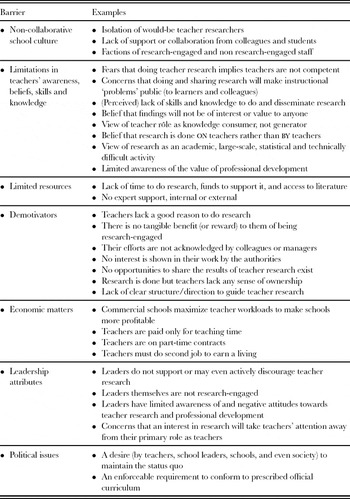
Various obstacles to teacher engagement in research have been alluded to so far. Table 2 summarizes a wide range of such barriers noted in the literature (Elliott Reference Elliott1991; Burton & Mickan Reference Burton, Mickan, Edge and Richards1993; McKernan Reference McKernan1993; Roberts Reference Roberts1993; Henson Reference Henson, Sikula, Buttery and Guyton1996; Burns Reference Burns1999; Rainey Reference Rainey2000; Hancock Reference Hancock, Soler, Craft and Burgess2001; McNamara Reference McNamara and McNamara2002; Borg Reference Borg, Beaven and Borg2003a, Reference Borgc, Reference Borg2006a, Reference Borg2008a, Reference Borg2009a; Worrall Reference Worrall2004; Barker Reference Barker2005; Denny Reference Denny2005; Edwards Reference Edwards, Edwards and Willis2005; Sharp et al. Reference Sharp, Eames, Sanders and Tomlinson2005; Atay Reference Atay2006; Rust & Meyers Reference Rust and Meyers2006; Allison & Carey Reference Allison and Carey2007; Barkhuizen Reference Barkhuizen2009; McKay Reference McKay, Burns and Richards2009).
Barriers to teacher research.
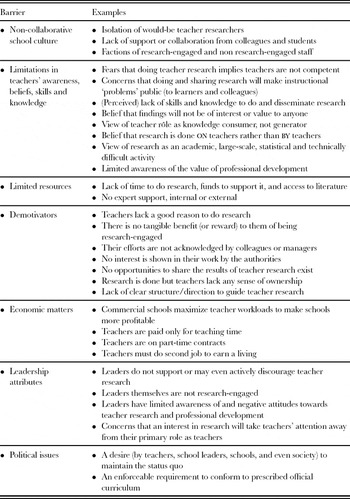
Taken collectively, this analysis makes a powerful statement about why – especially in contexts where many of these factors co-exist – teacher engagement in research is not a feasible activity for so many language teachers. Although a lack of time is the most commonly cited reason by teachers for their lack of engagement in research, a wider range of interactive factors may clearly contribute (to different degrees across varying contexts) to this situation.
3. Engagement with research
I now move on to review literature relevant to the theme of teachers as readers and users of research.
3.1 Teachers as consumers
A key argument in EBP is that teachers should be critical consumers of educational research, using it to inform their instructional decisions. In education generally, Shank and Brown (Reference Shank and Brown2007: 6) advise teachers that ‘educational research is for the benefit of the field as a whole, not just for a handful of specialists. That is why it is important for you to improve your skills as a consumer of research’. McMillan and Wergin (Reference McMillan and Wergin2010: v) also have as their focus engagement with research, and their rationale is that teachers ‘should not have to depend on others’ assessments of the credibility or usefulness of research; they should be able to read, critique, and evaluate research information themselves’.
In LT, Perry (Reference Perry2005: xi) argues that teachers ‘and others on whom research in applied linguistics has an impact need to be able to understand it to the point where they are able to evaluate recommendations based on such research’, while Brown (Reference Brown1988) and Porte (Reference Porte2002) both focus on developing language teachers’ ability to engage with quantitative research. Porte's book, for example, ‘seeks to answer a current need in the literature for a set of procedures that can be applied to the reading of quantitative research’ (back jacket).
One orientation shared by the texts mentioned so far is that they conceive of the process of reading research as a largely technical one. Thus they seek to facilitate engagement with research by promoting the knowledge and skills that teachers require in order to be critical consumers. However, while certain core competencies are clearly required when reading research, conceptualizing engagement with research in largely technical terms makes four erroneous assumptions. These are (1) teachers have access to published research; (2) teachers want to read published research; (3) teachers need to read published research; and (4) teachers have the time to read such material. All four apply to teachers engaged in formal study (and this is the audience the texts above will appeal to) but they do not hold true for the majority of language teachers in schools around the world. I discuss reasons why teachers do not read research below (3.3.2), but attitudinal barriers will constitute a major obstacle. And where this is the case, books which give teachers technical solutions to becoming better consumers of research (without addressing the attitudinal barriers) are not likely to make much difference. Even in supportive, collegial and structured contexts where teachers are committed to professional development, fostering dispositions in teachers that enable them to engage with research in ways that they find meaningful and of value presents significant challenges (see Kiely & Davis Reference Kiely and Davis2010).
3.2 Research knowledge and classroom practice
Critiques of EBP have claimed that it assumes that when teachers read research it will have a direct impact on their teaching. Hammersley (Reference Hammersley, Thomas and Pring2004b: 138), for example, argues that ‘there are substantial limitations on what research can offer to policy-making and practice’, and develops his position with reference to three points (see also Pachler (Reference Pachler2003) for critique from LT). Firstly, he argues that research knowledge is always fallible; second, that research knowledge usually takes the form of generalizations (but teachers need to make decisions in specific contexts); and third, that factual knowledge is never a sufficient determinant of good practice. He concludes that ‘professional practice cannot for the most part be governed by research findings – because it necessarily relies on multiple values, tacit judgement, local knowledge, and skills’ (p. 138). Cordingley (Reference Cordingley, Thomas and Pring2004: 83) also notes that, given the context-specific nature of instructional decision-making, ‘there will always be a skilled professional job to do in interpreting the relevance of and implications of evidence for a practitioner's own setting’. In response to such critiques, the term evidence-informed practice is often preferred to evidence-based; it still allows for a contribution of research knowledge to classroom practice without implying that this contribution is an unmediated one.
In LT, the work of Freeman (e.g. Freeman Reference Freeman, Bailey and Nunan1996; Freeman & Johnson Reference Freeman and Johnson1998) is often cited (see, for example, Rankin & Becker (Reference Rankin and Becker2006); Stewart (Reference Stewart2006)) in support of claims that second language acquisition (SLA) research has little to offer teachers; Freeman and Johnson (Reference Freeman and Johnson1998: 411) did write that ‘much current knowledge in SLA may be of limited use and applicability to practicing teachers’; however, interpretations of this statement have, I feel, been exaggerated (and made out of context). Freeman and Johnson themselves have since explained that ‘we do indeed value research in SLA and have always held that such knowledge needs to inform the work of language teachers' (Freeman & Johnson Reference Freeman, Johnson and Tedick2005: 30). SLA research is clearly a foundational area of knowledge for LT professionals, and this is not a point I want to contest here. My specific concern is with the dissemination and use of this knowledge in LT.
There is clearly an awareness in our field of the complex relationship between research knowledge and teaching (whether this is evident in practice, such as in the design of teacher education programmes, is another matter). Lightbown (Reference Lightbown2000: 454), for example, has noted that ‘SLA research findings do not constitute the only or even the principal source of information to guide teachers in their daily practice’, while more recently Ellis (Reference Ellis2010: 197) suggests that ‘SLA is best viewed as a body of technical knowledge that can illuminate pedagogically inspired questions’. There is no implication in the views expressed by these authoritative figures in SLA research that it should (or even can) be a major determinant of teachers’ practice (as Crookes (Reference Crookes1998) suggests, the impact of research on teaching is likely to be mediated rather than direct); indeed there is even some degree of consensus with the view that ‘simple prescriptions from researchers and theorists are not sufficient. Teachers need to evaluate such recommendations in light of their own situations and to determine what exactly they will be able to use in their classrooms’ (Clarke Reference Clarke1994: 21). This is an important shift in attitude from one which assumes that published research should directly inform practice to one which reflects more sophisticated understandings of teacher knowledge. Such a shift on its own, however, will have no impact on language teachers’ willingness to engage with research. That is, if academics agree that teachers should critically engage with research knowledge, but then fail to take steps to facilitate this engagement, we will have not really moved away from the historically prevalent academic view that ‘it is primarily the obligation of the recipients of our work . . . to understand the importance of, and to apply correctly, the findings we have so meticulously generated’ (Barone Reference Barone1995: 1). What is then also required is a commitment by academics to make their work more accessible to teachers. This is an issue I discuss further below (3.4).
3.3 Teachers' practices in engaging with research
There has been limited empirical work on language teachers’ practices in engaging with research and I discuss this here, together with relevant work in education more generally.
3.3.1 The extent and nature of teacher engagement with research
In my programme of research I have received answers to the question ‘How frequently do you read published language teaching research?’ from an international sample of 1,160 teachers of English. The responses suggest that almost 75% of these teachers read research at least ‘sometimes’, but this seemingly positive figure must be treated with caution, for two reasons. Firstly, teachers vary significantly in the meaning they assign to ‘sometimes’ (see Borg Reference Borg2009a for a discussion) and it may imply a very infrequent and incidental level of engagement with research. Secondly, teachers also vary in their understanding of what counts as research, and thus some who claim to be reading research may in fact be reading about practical teaching ideas. There is clearly scope for more research into what precisely teachers read, in addition to how they read and interpret the material.
Outside LT, there have been some studies of teachers’ sources of research information. Williams and Coles (Reference Williams and Coles2007), in a survey of 312 teachers in the UK, found that the three most common sources were informal discussions with colleagues, professional magazines and newspapers, and in-service teacher education. In Everton, Galton and Pell (Reference Everton, Galton and Pell2000), also in the UK, the three most popular sources of research for teachers were in-service courses, accredited courses, and official publications. Shkedi (Reference Shkedi1998), in a survey of 47 teachers in Israel, found that most teachers read ‘practical’ educational literature. Unsurprisingly, academic books and journals do not figure prominently in the results of these studies.
3.3.2 Reasons for not reading research
Research has highlighted a number of barriers to teachers’ engagement with research. A lack of time was the key obstacle cited by the teachers in Borg (Reference Borg2009a). The review by Hemsley-Brown and Sharp (Reference Hemsley-Brown and Sharp2003) also highlighted problems of physical and conceptual accessibility (i.e. teachers did not understand what they read), two barriers also noted in McDonough and McDonough's (Reference McDonough and McDonough1990) study of language teachers. Macaro's (Reference Macaro2003) work with heads of modern foreign language departments in the UK also found that the inaccessibility of published language teaching research was a key barrier to engagement with it. Teachers’ negative attitudes to research constitute another significant barrier. Williams and Coles (Reference Williams and Coles2007: 202), for example, note that while a lack of access to research was a real problem for teachers, even where access existed attitudinal factors limited the extent to which teachers engaged with research (‘so access alone is not the whole story’). Shkedi (Reference Shkedi1998) found that teachers were suspicious of and lacked trust in published research, while numerous respondents in my work have explained their lack of engagement with research in terms of a perceived lack of relevance to their work (‘research/articles are often (usually?) completely unengaging and of no practical value in the classroom’ (Borg Reference Borg2008a: 18)). A mismatch between teachers’ narrative experience of classroom life and the portrayal of learning and teaching they encounter in research papers is another barrier to teachers’ engagement with research (see 3.4.1); as one teacher reflecting on their experience of engaging with research during formal study put it, ‘course reading didn't bear much resemblance to reality’ (see also Lo Reference Lo and Bartels2005).
3.3.3 Case studies of teachers' engagement with research
A small number of studies shed light on teachers’ practices in engaging with research. Zeuli (Reference Zeuli1994) examined how 13 teachers on a teacher education course read research articles and found that they were concerned mainly with what ideas they could find to take back to the classroom. As one teacher explained, ‘I don't need to know about the research. I go for the steps that I need to know. What are the things that I can take back to the classroom that are going to work for me?’ (p. 42). Zeuli's conclusion was that in reading research many teachers ‘were more interested in products . . . like consumers interested in making decisions about what goods to procure without understanding further why the decision is warranted’ (for a related paper, see Tiezzi & Zeuli Reference Tiezzi and Zeuli1994).
In LT, Bartels (Reference Bartels2003: 748) found differences in the ways teachers and researchers read academic articles and noted in particular that teachers, even when they had an academic background, showed ‘little acceptance or understanding of the researcher Discourse’ (after Gee Reference Gee1990). The converse was true of academics in relation to the Discourse of teacher research; the reaction of one academic to a teacher-oriented article is not, I hope, representative, but does highlight the challenges we face in developing productive relationships between academics and teachers: ‘this is a woefully way (sic) from doing an actual study . . . I mean who cares? I mean it's just terrible. This kind of really, really reminds me of why I'd rather do research than teach. It's just not good enough’ (p. 745).
Another case study of a language teacher's experience of reading research is Lo (Reference Lo and Bartels2005), which was conducted in the context of a Master's level SLA course. This study highlights frustrating tensions between the practical insights the teacher hoped to obtain through engaging with research and her view that ‘most research-oriented papers were simply different experiments that had little to do with the real classroom situations’ (p. 139). Clear differences are evident in this study between the teacher's expectations of reading SLA research and the goals the tutor had in assigning such reading (see also Kerekes Reference Kerekes, Johnston and Irujo2001; MacDonald, Badger & White Reference MacDonald, Badger and White2001; Busch Reference Busch2010 for broader discussions of the impact of SLA courses on teachers).
In contrast to the negative conclusions of the above studies, Rankin and Becker's (Reference Rankin and Becker2006) case study of the engagement of a teacher of German with the SLA literature on corrective feedback found that such engagement supported the development of the teacher's pedagogical growth; in particular, it enriched his reflections on his teaching by providing new ways of describing and analysing his own corrective feedback strategies in the classroom. The study suggests that connecting reading to the analysis of classroom events made the teacher's engagement with research more purposeful. Important insights into the way research knowledge becomes part of teachers’ knowledge also emerged:
the knowledge embedded in published research . . . is not simply accumulated and then put into action. It is processed and filtered through layers of experience and belief, rendering the outcome far less predictable than a simple transmission model would suggest. Knowledge about teaching and the classroom becomes instantiated only after it has been integrated into the teacher's personal framework – contextualized, as it were, into a matrix of classroom experience and other sources of pedagogical input. (p. 366)
This conclusion illustrates the complex relationship between research knowledge and teaching discussed earlier. It also suggests that enhancing the impact of published research on teachers is not simply a matter of making it more accessible to them; teachers also need opportunities to reconcile and meld (to use terms from Thomas Reference Thomas, Thomas and Pring2004) research knowledge with their own practical knowledge.
3.4 Enhancing teacher's engagement with research
Keeping in mind the provisos covered in 3.2, engagement with research can be of value to teachers in several ways. For example, it can help teachers:
• make deeper sense of their work (new ways of seeing);
• identify ideas to experiment with in their classroom (new ways of doing);
• extend their discourse for discussing teaching (new ways of talking);
• validate with a theoretical rationale what they already do (new ways of knowing);
• examine their planning and decision-making processes (new ways of thinking).
These are substantial potential benefits. Our challenge, then, to give teachers a chance to experience such benefits, is to find ways of addressing the physical, practical, conceptual, linguistic and attitudinal barriers already noted to teacher engagement with research. We also need to develop a deeper understanding of the ways in which practical knowledge and research knowledge can be productively integrated.
One response to this challenge, educating teachers to be consumers of research, was discussed earlier (see 3.1). A second strategy for making research more accessible to teachers is the ‘implications’ section commonly found at the end of research papers (see Chapelle Reference Chapelle2007; Han Reference Han2007 for contrasting views on the value of such sections). I do not see this as a productive way of enhancing teacher engagement with research; most language teachers do not read research journals and the presence of ‘implications’ is not going to change that. More substantial measures are needed to support teacher engagement with research. To consider the forms these might take, I will now first review research on the features of research reports to which teachers seem to respond positively, then comment on examples of initiatives whose goal has been to increase teacher engagement with research.
3.4.1 Positive teacher response to research reports
Considerable work has been undertaken in the UK to understand what features of published research facilitate teachers’ access to and use of it. Hemsley-Brown and Sharp (Reference Hemsley-Brown and Sharp2003) (a literature review) and Ratcliffe et al. (Reference Ratcliffe, Bartholomew, Hames, Hind, Leach, Millar and Osborne2004) (a study of science educators) are two relevant sources here. Collectively, they suggest that teacher engagement with research is enhanced when reports:
• are relevant to teachers’ context, concerns, interests and priorities;
• provide detailed descriptions of classroom activities which teachers can relate to their own work;
• build on what teachers already know;
• are congruent with teachers’ beliefs and values;
• make clear and feasible recommended changes to practice.
In a further study, Cordingley and the National Teacher Research Panel (Reference Cordingley2000) identified four key characteristics of research which teachers felt were important in facilitating their engagement with it: interest, credibility, usability and accessibility. For example, teachers reported being interested in research which presented authentic teacher and learner perspectives. Teachers found credible research that was conducted in real classroom settings. In terms of usability, ‘research reports that suggest practical teaching and learning approaches to enable other teachers to try out or test new approaches in their own setting were welcomed’ (p. 4). In relation to accessibility, this study found a preference among teachers ‘for light referencing, bullet point summaries of arguments, lists of further reading and a brief summary of the literature, preferably in an appendix’ (p. 3). What is described as a ‘stepping stones’ approach to reporting research outcomes was also preferred by the teachers in this study:
Very brief (4 sides of A4) summaries with key findings, a short explanation of supporting evidence and of methods were thought to help teachers decide quickly whether they want to know more. Longer summaries which explain and illustrate approaches and evidence in a little more detail could help teachers to start to identify implications for their own practice, subject, classes or communities. Fuller reports were thought important in providing helpful reference for further study or to support interpretation and application. (p. 4)
In LT, the idea of producing tailored summaries of research of this kind to enhance its accessibility for teachers has been met with some caution; Ranta (Reference Ranta2002), for example, (although she does argue for the need for more teacher-friendly research) seems against the idea that research should be presented in ‘“pablum” form (i.e. easy to digest)’ on the basis that ‘research presented in this way does more harm than good because it makes it look all so simple’ (see also the negative views of Jarvis (Reference Jarvis2002: 2) on ‘dumbing-down our research to make it more accessible to a less-informed audience’). Ellis (Reference Ellis2010), though, argues for the use of summaries as a strategy for increasing language teachers’ access to research (and suggests some principles which might govern the construction of such summaries). Arguably, many of the methodology handbooks written for language teachers do include summaries of research; however, their emphasis is often on the implications of practice for teachers rather than on better enabling teachers to engage with research themselves.
Overall, particularly on the basis of the mainstream evidence from the UK, summaries of research written especially for teachers seem central to the goal of enabling them to be more research-engaged (see 3.4.2). Similar points about the need for summaries of research are made, for example, in Bevan (Reference Bevan2006) and McNamara (Reference McNamara and McNamara2002), while a major review of literature on models of research impact (Nutley, Percy-Smith & Solesbury Reference Nutley, Percy-Smith and Solesbury2003: 41) also concluded that
research must be translated: to have an impact, research findings need to be adapted to, or reconstructed within, practice and policy contexts. This can involve tailoring findings to a target group.
The need for research to be ‘translated’ – reported in forms that teachers can access quickly – has obvious implications for the manner in which reports are written and organized. In LT, Pachler (Reference Pachler2003: 13) suggests that teacher research engagement can be supported where researchers ‘write the findings up in a way that engages with the discourse conventions used by practitioners and disseminate them in forums practitioners readily access’. The need for researchers to consider alternatives to conventional expository modes of reporting research is also discussed by Ellis (Reference Ellis2010), who (echoing arguments put forward by, for example, Clarke (Reference Clarke1994)) refers in particular to the use of narrative as a device for sharing research. ‘Teachers’ experience is storied, typified by detailed, dynamic, social interactions taking place in specific contexts’ (Borg Reference Borg, Beaven and Borg2003a: 42) and research in the form, for example, of detailed case studies of aspects of classroom life, may represent language learning and teaching phenomena to teachers in ways which they can relate more immediately to their own experience. In addition to reporting research in different formats, researchers should also consider, as the second part of the Pachler quote above suggests, disseminating research in a wider range of outlets which teachers read. Academics, understandably, may not always feel they can do this as such publications may not be recognized by their institutions as legitimate research outputs.
3.4.2 Initiatives to facilitate engagement with research
Here I will focus briefly on three examples of initiatives in the UK which, responding to research of the kind highlighted in 3.4.1, aim to enhance teacher engagement with research (for a more detailed account of these and related resources see CERI/OECD (2002)). The three initiatives (all of which are accessible free) are The National Teacher Research Panel (NTRP) (www.standards.dfes.gov.uk/ntrp), ‘Research for Teachers’ (www.gtce.org.uk/teachers/rft) and The Evidence for Policy and Practice Information and Co-ordinating Centre (EPPI-Centre: http://eppi.ioe.ac.uk/cms). One of the goals of the NTRP is to ‘to ensure that all research in education takes account of the teacher perspective’; they thus provide ‘a resource to researchers . . . who require input from teachers with research expertise at all stages . . . from identifying priorities to making published research accessible to teachers’. The notion of researchers seeking input from teachers on the focus, design, conduct and dissemination of their studies would be an interesting one to explore in LT.
‘Research for Teachers’ provides downloadable summaries of research appearing in peer-reviewed journals. The summaries are produced by the Centre for the Use of Research and Evidence in Education (CUREE: www.curee-paccts.com), which selects articles felt to have potential for stimulating teacher engagement with research. One key feature of the summaries is a ‘case studies’ section where the issues dealt with in the research are illustrated with practical examples.
The focus of the EPPI-Centre's work is systematic reviews of research. The results of these reviews can be accessed either via the ‘knowledge library’, which provides a summary of key messages about specific subjects, or downloaded in more detailed summaries and reports. For example, under the ‘Foreign Languages’ heading there are four reviews available (one, for example, from 2004, is entitled, ‘A systematic review of the characteristics of effective foreign language teaching to pupils between the ages 7 and 11’). The scope of the EPPI-Centre's work is impressive; as a mechanism for providing practitioners and policy makers with accounts of ‘what works’ in education, though, it has been the subject of criticism. Similar criticisms have been directed at a comparable initiative in the USA, the What Works Clearinghouse (http://ies.ed.gov/ncee/wwc). Very briefly, the criticisms are based on the view that the criteria used in deciding which research to include in systematic reviews tend to favour ‘scientific’ research and to exclude research conducted by teachers, in addition to qualitative research generally. It has thus been argued that such criteria imply that the ‘“research” deemed to be of value to practitioners in schools is of a specific kind, responds to certain questions – namely, causal questions of the formulation “x causes y”, and uses experimental methods’ (Roulston et al. Reference Roulston, Legette, DeLoach and Pittman2005: 173). For further perspectives on this debate, see Hammersley (Reference Hammersley2001, Reference Hammersley, Thomas and Pring2004b), Davies (Reference Davies2000), Maxwell (Reference Maxwell2004), Morrison (Reference Morrison2001) and Feuer, Towne & Shavelson (Reference Feuer, Towne and Shavelson2002).
I am not aware of initiatives in LT comparable to those above, though some resources which may support teachers’ engagement with research do exist. In the USA, the Center for Applied Linguistics provides evidence-based briefs on various issues in language learning: www.cal.org/resources/Digest/, while the International Research Foundation for English Language Education (TIRF: www.tirfonline.org) is developing ‘a series of reports that addresses key, unanswered questions regarding policies and practices in English language education worldwide’ (the first of these, entitled The Impact of English and Plurilingualism in Global Corporations, was published in 2009 and is available for download). In the UK, the National Research and Development Centre for Adult Literacy and Numeracy (NRDC: www.nrdc.org.uk) supports practitioner research and makes its publications freely available, including some relevant to ESOL, while research reports are also available through the National Centre for Languages website (www.cilt.org.uk/secondary.aspx). At the European level, research reports can be accessed via the European Centre for Modern Languages in Graz (www.ecml.at/doccentre/doccentre.asp?t=DRC#fond). While the above initiatives all make research freely available to language teachers, the emphasis remains on disseminating research without any systematic approach to maximizing teachers’ engagement with it. These are clearly largely unexplored issues in our field.
4. Conditions for teacher research engagement
In concluding my analysis, I will now draw on the literature discussed above (and some additional sources: Tinker Sachs Reference Tinker Sachs2000; Gutteridge Reference Gutteridge2002; Westwell Reference Westwell2006; Borg Reference Borg and Borg2009b) to identify conditions which facilitate teacher research engagement. An awareness of these is central to the success of initiatives which seek to promote teacher research and/or to encourage teachers to engage more productively with published research.
4.1 Epistemological conditions
A commitment to teacher research engagement implies a particular epistemological stance (i.e. a view of what counts as knowledge, its origins and use). Such a stance is, thus, in a sense, a condition for teacher research engagement, and will be reflected in a general, if not unquestioning, acceptance of many of the following propositions:
• naturally-occurring classroom events are a legitimate source of research knowledge about teaching and learning;
• teachers are uniquely positioned to conduct systematic inquiry into teaching and learning;
• as professionals, teachers must assume the role of generators of knowledge, not just consumers;
• academic research cannot provide incontrovertible evidence on which teachers can reliably base their actions;
• received knowledge is mediated by teachers’ cognitions and the socio-cultural contexts in which teaching and learning take place;
• collaborations among teachers, and among academics and teachers create productive mutually-beneficial social spaces for knowledge creation;
• knowledge generation by teachers, individually or collaboratively, has the potential to impact positively on learners, teachers and schools.
These assertions provide a powerful rationale for teacher research engagement; without denying the contribution that academic research can make in shaping what teachers know and what they do, teacher research is based on the belief that the kinds of insights which are likely to be most attuned to shaping teachers’ practices are those which derive from teachers’ own investigations of their work. The epistemological positions outlined above are reflected in the goals of long-established teacher research groups such as the Collaborative Action Research Network (CARN: see www.esri.mmu.ac.uk/carnnew and Somekh (Reference Somekh2010)).
4.2 Conditions for engagement in research
At a much more concrete level, three main domains influencing teacher engagement in research can be identified: the workplace, the teacher, and the project. These are summarized in Tables 3, 4 and 5. The prevalence of engagement in research by language teachers, then, is shaped by the multiple interactions (in ways that linear tables cannot represent) of factors across all three domains. These lists of conditions can be expressed as questions and used as the basis of a research engagement readiness audit – a strategy for examining the extent to which an environment conducive to teacher research engagement exists. I would argue that an audit of this kind might be an essential early stage in the design of initiatives aiming to promote language teacher research engagement.
Workplace conditions.

Teacher conditions.

Project conditions.

4.3 Conditions for engagement with research
The conditions for engagement in research were discussed in detail in Section 3 of this review. To recap, teachers are more likely to be willing to engage with research and use it to explore and inform their practice when it is accessible – physically, conceptually, linguistically and practically – credible, useable, and interesting. In addition, teacher engagement with research is likely to impact more positively on teachers’ work where they
• view published research as a source of enhanced understanding of their work, not as a direct solution to their problems;
• are driven to seek out relevant research by an interest in exploring classroom issues of personal pedagogical relevance;
• have assisted opportunities over time to integrate insights from reading with their existing pedagogical practices and theories.
The attitudinal dispositions which can facilitate teacher engagement in research (see Table 4) are of course also fundamental in shaping teachers’ engagement with it.
5. Conclusion
The material I have reviewed here provides, in both LT and education more generally, a range of theoretical and practical perspectives (including those of teachers) on teacher research engagement. The potential value of such engagement to teachers, learners and schools is undeniable (its potential to contribute to theory and policy-making is less well illustrated). The evidence I have considered, though, suggests that our field's level of commitment (practically, not rhetorically) to teacher research engagement is not high. Many inspiring examples of language teachers engaging in research are available (together, of course, with methodologically-flawed examples and instances of pseudo-academic inquiry masquerading as teacher research); overall, though, there are whole populations of language teachers worldwide whose understandings of teacher research, at best, are that it is something that might be done to them by others. It is likely, too, that there are many other teachers who, despite a genuine interest in becoming research-engaged, find it difficult to translate this interest into practical and sustainable action. There are, as I have shown, very many reasons for this situation, and by highlighting here the many barriers which exist to teacher engagement in research I have been keen to disavow simplistic assumptions that the problem lies exclusively with teachers. Powerful social, cultural, political and institutional factors do also contribute.
In terms of our understandings of language teachers’ engagement with research, the levels of practical and empirical interest in this issue are minimal. There is a growing awareness that the contribution of SLA research to what teachers do is at best facilitative rather than determinative. However, there has been hardly any work aimed at better understanding language teachers’ practices in engaging with research – if they read, what they read, why they read, how they read, what use they make of this reading, and, crucially, how their engagement with research can be facilitated. There are clear messages available in relation to such questions in the educational literature, and one important aspect of this review has been to highlight these messages; they do provide valuable starting points in our efforts as a field to facilitate teacher engagement with research. For example, it is clear that academics need to extend conventional practices for disseminating research knowledge to include formats and forums which teachers can readily engage with. Mediating activities such as in-service teacher education would also seem to have an important role to play.
I have also noted here common criticisms of teacher research, particularly those directed at its methodological rigour. These will not go away, and neither should they. If teachers’ inquiries are to be called ‘research’, then it is wholly reasonable to expect them to be trustworthy, and to be able to demonstrate this publicly. What is required, of course, is that the demands made on teachers to illustrate the quality of their work are reasonable, and this is where greater dialogue among academics and teacher researchers would be valuable: unilateral decision-making by the former about what the criteria for judging teacher research is not satisfactory. Collaboration between academics and teachers is in fact commonly seen as a productive strategy in enhancing teacher research engagement; I have not unduly stressed this here, and would not want to overstate its importance, but it is clear from many of the points I have made that closer relationships – ones which both parties contribute to and can benefit from – can further the goal of enhancing teacher research engagement (see also Borg Reference Borg2003b).
Finally, I have identified here an extensive list of conditions which, on the basis of the literature reviewed here, can enhance teacher research engagement. These constitute in very obvious terms a diagnostic device through which the feasibility of initiatives intending to promote teacher research engagement can be judged.
The observation that language teacher research engagement is a minority activity is not a new one. This review, though, grounds this observation in data from an extensive volume of international literature and provides detailed insights into the processes which characterize and regulate the extent to which teachers carry out, read and use research. I hope this analysis will stimulate not just debate but, in time, forms of concrete action which are so obviously required if teacher research engagement is to fulfil its potential in our field. And in this respect, influential organizations such as IATEFL, TESOL, ECML, ACTFL, CILT and the British Council, to name but some, have a very important role to play.
Simon Borg is Reader in TESOL at the School of Education, University of Leeds, UK. He has been involved in TESOL for over twenty years, working as a teacher, teacher educator, lecturer, examiner and researcher in a range of international contexts. He specializes in language teacher cognition, teacher education, research methods, teacher research and grammar teaching and has published widely on these topics. Full details of his work are available at www.education.leeds.ac.uk/people/staff.php?staff=29.