Implications
It has been previously highlighted that nutrient restriction during early gestation causes reduced foetal growth and development. Mid-gestation nutrient restriction has now been shown to cause the same damaging effects to the same extent, even when no nutritional stress is incurred during early gestation. This could explain why experiments on mid gestation nutrient restriction can find many of the same results as early gestation nutrient restriction.
Introduction
Because most beef cattle are maintained in pastoral production systems, they are subject to seasonal changes in nutrient availability that correspond to changes in forage quantity and quality. Beef cattle experiencing nutritional stress in utero can have reduced skeletal growth, which can affect carcass merit and meat production (Long et al., Reference Long, Tousley, Underwood, Paisley, Means, Hess, Du and Ford2012b). This could be especially problematic in heifers used as breeding stock as it has been shown that nutrient restriction during early gestation leads to reduced antral follicle counts in heifer offspring at 12 months of age (Mossa et al., Reference Mossa, Carter, Walsh, Kenny, Smith, Ireland, Hildebrandt, Lonergan, Ireland and Evans2013). Any stimulus or insult that alters foetal growth during gestation can lead to permanent negative effects on the offspring’s physiology and development (Baker et al., Reference Baker, Becker, Norton, Sasse, Jensen and Harmon1969). Even minor events like transportation of the dam can lead to alteration of the hypothalamic-pituitary axis development in the foetus, inhibiting correct regulation of growth and reproduction in the postnatal animal (Lay et al., Reference Lay, Randel, Friend, Carroll, Welsh, Jenkins, Neuendorff, Bushong and Kapp1997). Foetuses that undergo intrauterine growth retardation (IUGR) often exhibit asymmetrical growth patterns, which suggests that the foetus compartmentalizes nutrients and blood flow to the organs and structures that are most pertinent to development (Anthony et al., Reference Anthony, Scheaffer, Wright and Regnault2003). Early gestation is a critical period for foetal organ and tissue development (Ford, Reference Ford, Hess, Schwope, Nijland, Gilbert, Vonnahme, Means, Han and Nathanielsz1995). It has been shown that young cows respond differently than older cows when exposed to nutrient restriction and this leads to differences in foetal growth and development (Long et al., Reference Long, Vonnahme, Hess, Nathanielsz and Ford2009). It has also been shown that nutrient restriction during early gestation will result in calves that are similar in BW at birth but have organs and tissues that are functionally compromised (Long et al., Reference Long, Vonnahme, Hess, Nathanielsz and Ford2009). The objective of this study was to determine the severity of asymmetrical foetal growth and changes in maternal and foetal metabolites caused by maternal nutrient restriction during early or mid-gestation and to what extent, if any, the effects of foetal growth restriction could be alleviated by feeding the dam slightly over maintenance requirements during the second trimester of gestation in young cows. Our hypothesis is that mid-gestation nutritional stress will alter foetal development similar to early gestation nutrient restriction.
Material and methods
Animals and sample collection
All animal procedures were approved by Clemson University Animal Care and Use Committee (AUP no. 2013-062). Primiparous Angus-cross cows (2.5 to 3.5 years of age) were initially synchronized. On day 0, cows received an easy breed (CIDR) (Zoetis Animal Health, New York, NY, USA) and gonadotropin releasing hormone (100 µg (i.m.); Zoetis Animal Health). On day 7, CIDRs were removed and cows received prostaglandin F2α (25 mg (i.m.); Zoetis Animal Health). Cows were observed for oestrus twice daily for 30 min and inseminated by one technician with male sexed (day 190 foetuses) or conventional (day 110 foetuses) semen from one Angus sire 12 h after observed oestrus. From the start of synchronization to day 30 of gestation, cattle were group fed in excess of requirements (National Research Council (NRC), 1996). At 30 days post breeding, singleton pregnancy was determined via transrectal ultrasonography (Aloka 500-V with 7.5-MHz probe; Corometrics Medical Systems, Wallingford, CT, USA). Blood samples were collected from pregnant animals via caudal venipuncture into 9 ml Lithium-Heparin vacutainers (Becton, Dickinson and Company, Franklin Lakes, NJ, USA) and placed immediately on ice. Samples were centrifuged within 2 h of collection at 2000×g for 20 min at 4°C. After centrifuging, the plasma was collected and stored at −20°C until analysis.
Animals were blocked by body condition score (BCS) (Wagner et al., Reference Wagner, Lusby, Oltjen, Rakestraw, Wettemann and Walters1988) into treatment groups. Throughout the experiment, all animals were fed a total mixed ration (30% soya bean hulls, 20% cottonseed hulls, 17.5% peanut hulls, 17% corn screening, 12.5% corn gluten feed, 1.5% salt, 0.5% calcium, 0.5% trace mineral, 0.5% vitamin premix: 1.72 Mcal net energy of maintenance (NEm)/kg, 8.9% CP, 1.4% ether extract on a DM basis, 94.1% DM) at one of two levels. Diets were control (CON), fed to gain 1 kg of BW/week and exceed CP requirements or nutrient restricted (NR) fed 0.55% of maintenance energy and CP recommendations based on BW (NRC, 1996). A subset of animals was fed either NR (n=8) or CON (n=8) from days 30 to 110 of gestation. The remaining animals were fed CON (n=8) days 30 to 190; NR (n=7) days 30 to 110 followed by CON days 110 to 190; or CON (n=7) days 30 to 110 followed by NR days 110 to 190.
Cattle were maintained together on a dry lot with free access to water and were fed individually once daily. Animal BW was collected weekly and used to adjust feed allowances throughout the experiment; BCS and blood samples were collected every 2 weeks. All blood samples were collected and processed as previously described.
Final maternal BW, BCS and blood samples were collected before transport to commercial abattoir. Blood samples were collected as previously described into 9 ml sodium heparin, serum and Ethylenediaminetetraacetic acid (EDTA) vacutainers. The plasma tubes were processed as previously described. Serum samples were allowed to clot for ~60 min at room temperature and then refrigerated overnight before centrifuging and stored the same way as plasma samples. All animals were harvested at the same commercial abattoir. Cows were harvested and the gravid uterus was removed. At harvest, foetal gender was determined. Within the day 110 dams there were two female and six male foetuses per treatment and within the day 190 dams only male foetuses were recovered and used for this study. Foetal blood samples were collected from the umbilical cord into 10 ml sodium heparin, serum and EDTA vacutainers, handled as previously described, and stored at −80°C. Foetal weight, crown rump length, abdominal circumference and thoracic circumference were recorded. Foetal brain, heart, liver, lungs, kidneys, adrenals, perirenal adipose, viscera and longissimus dorsi (LD) muscles were collected and weights were recorded. The foetal heart was dissected into right and left atria, right and left ventricle, and septum; each component was individually weighed. Thickness was measured in three locations and averaged. The eviscerated foetus was weighed to obtain an empty foetal weight (EFW).
Histology
Two samples of foetal perirenal adipose tissue were collected and stored in 10% formalin for histology. All samples were embedded in paraffin and stored at room temperature. Four, 5 µm, sections, five sections apart were collected for evaluation. Tissues were deparaffinized then stained using standard haematoxylin–eosin Y staining procedures. Two randomly chosen fields were captured digitally at 10× magnification per section for a total of eight fields per animal. Cell diameter was evaluated on fifty randomly chosen cells per field for a total of 400 adipocytes per animal. The histological measure of cell diameter has been previously validated (Long et al., Reference Long, Tousley, Underwood, Paisley, Means, Hess, Du and Ford2012b). Only adipocyte diameters for day 190 foetuses are reported due to finding preadipocytes and no filled adipocytes for day 110 foetuses.
Hormone and metabolite quantification
Animals were blocked by treatment and gestation group into assay plates. All day 190 samples (n=22) were run separately from day 110 samples (n=16). Within each gestation group, all treatments were represented on an assay block. All colorimetric reagents and standards were obtained from Pointe Scientific (Canton, MI, USA). Plasma glucose concentrations were determined by colorimetric assay previously validated in our lab (Long and Schafer, Reference Long and Schafer2013) on both maternal and foetal plasma for all animals. Intra-assay and inter-assay CV of the glucose assays were 3.5% and 3.1%, respectively. Serum triglyceride concentrations were determined by colorimetric assay previously validated in our lab (Long et al., Reference Long, Burns, Duckett and Schafer2014) on all samples. Intra-assay and inter-assay CV were 2.4% and 3.1%, respectively. Serum cholesterol concentrations were determined by colorimetric assay previously validated in our lab (Long et al., Reference Long, Burns, Duckett and Schafer2014) for all samples. Intra-assay and inter-assay CV were 2.7% and 3.7%, respectively. All assays were read at their respective wavelengths on a Synergy HT 96 well plate Spectrophotometers (BioTek Instruments, Winooski, VT, USA). Maternal serum cortisol concentrations were quantified in duplicate in a single assay via a previously validated RIA (Long and Schafer, Reference Long and Schafer2013) with a sensitivity of 0.25 ug/dl (Coat-A-Count cortisol RIA; Siemens Medical Solutions Diagnostics, Los Angeles, CA, USA) with an intraassay CV of 5.3%.
Statistics
All data were tested for normality using the Shapiro–Wilk test using the UNIVARIATE procedure of SAS and was found to be normally distributed (P>0.17). All data for days 110 and 190 cows, initial BW and BCS along with changes in each, were analysed as an ANOVA analysis using the GLM procedure of SAS. Maternal plasma glucose concentrations for days 110 and 190 animals was analysed separately as a repeated measures analysis using the MIXED procedure of SAS with treatment, day and their interaction in the model statement. For all maternal day 110 date, foetal gender was initially included in the model but was found to be non-significant (P>0.67) and was therefore removed from the final model. For day 110 animals, foetal weights and measurements, plasma glucose, serum triglycerides and serum cholesterol in dams and foetuses and maternal serum cortisol at harvest were analysed using the MIXED procedure of SAS with treatment, gender and their interaction in the model statement. For day 190 animals, foetal weights and measurements, plasma glucose, serum triglycerides, serum cholesterol in dams and foetuses and maternal serum cortisol at harvest, and adipocyte diameter were analysed as an ANOVA analysis using the GLM procedure of SAS with treatment in the model. A tendency was defined as P⩽0.10 and a significant difference was defined as P⩽0.05
Results
Maternal BW, BCS, metabolites and foetal metabolites
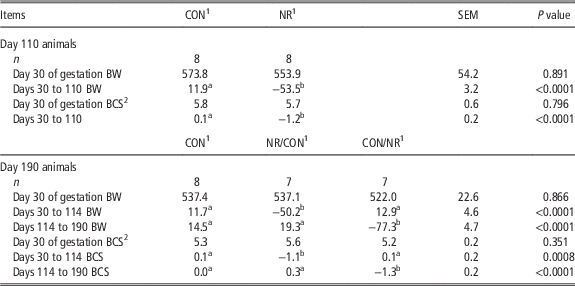
Maternal BW and BCS changes are shown in Table 1. At day 30 of gestation cow BW and BCS were similar (P>0.35) for all cows. At day 110, NR cattle had a decrease in both BW (P<0.0001) and BCS (P<0.0001) from days 30 to 110 when compared with day 110 CON cattle. In day 190 cows, NR/CON cattle had a decrease in both BW (P<0.0001) and BCS (P=0.0008) from days 30 to 114 when compared with CON/NR and CON cattle. A decrease in BW (P<0.0001) and BCS (P<0.0001) occurred in CON/NR cows from days 114 to 190 when compared with NR/CON and CON cattle.
Maternal BW (kg) and body condition score (BCS) changes throughout gestation for days 110 and 190 animalsFootnote 1

a,bMeans differ P⩽0.05.
1 CON=control cows fed to gain 1 kg of BW/week and exceed CP recommendations. NR=nutrient restricted cows fed 0.55× of NRC NEm and CP recommendations, NR/CON and CON/NR cows were fed respective treatments from days 30 to 110 of gestation and the other treatment from days 110 to 190 of gestation.
2 Wagner et al. (Reference Wagner, Lusby, Oltjen, Rakestraw, Wettemann and Walters1988).
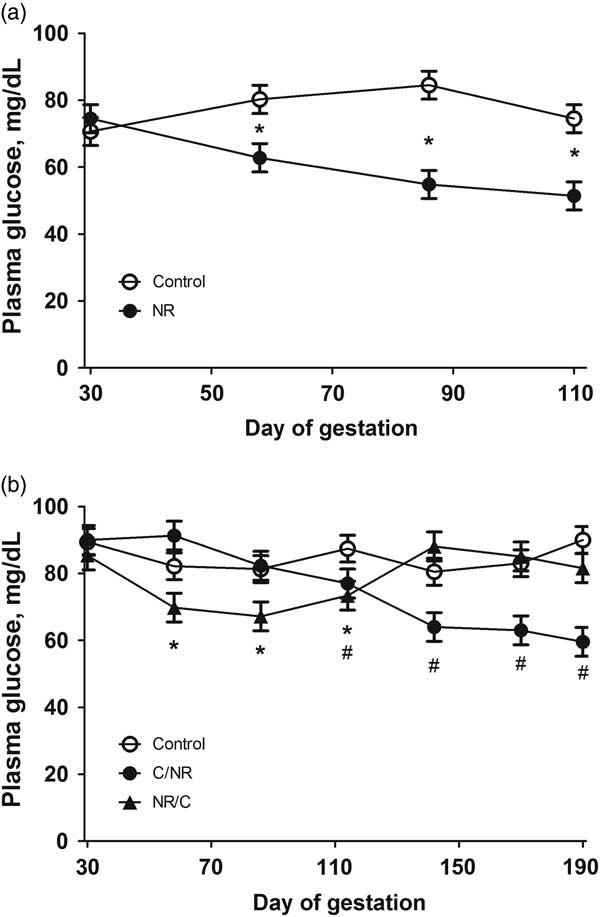
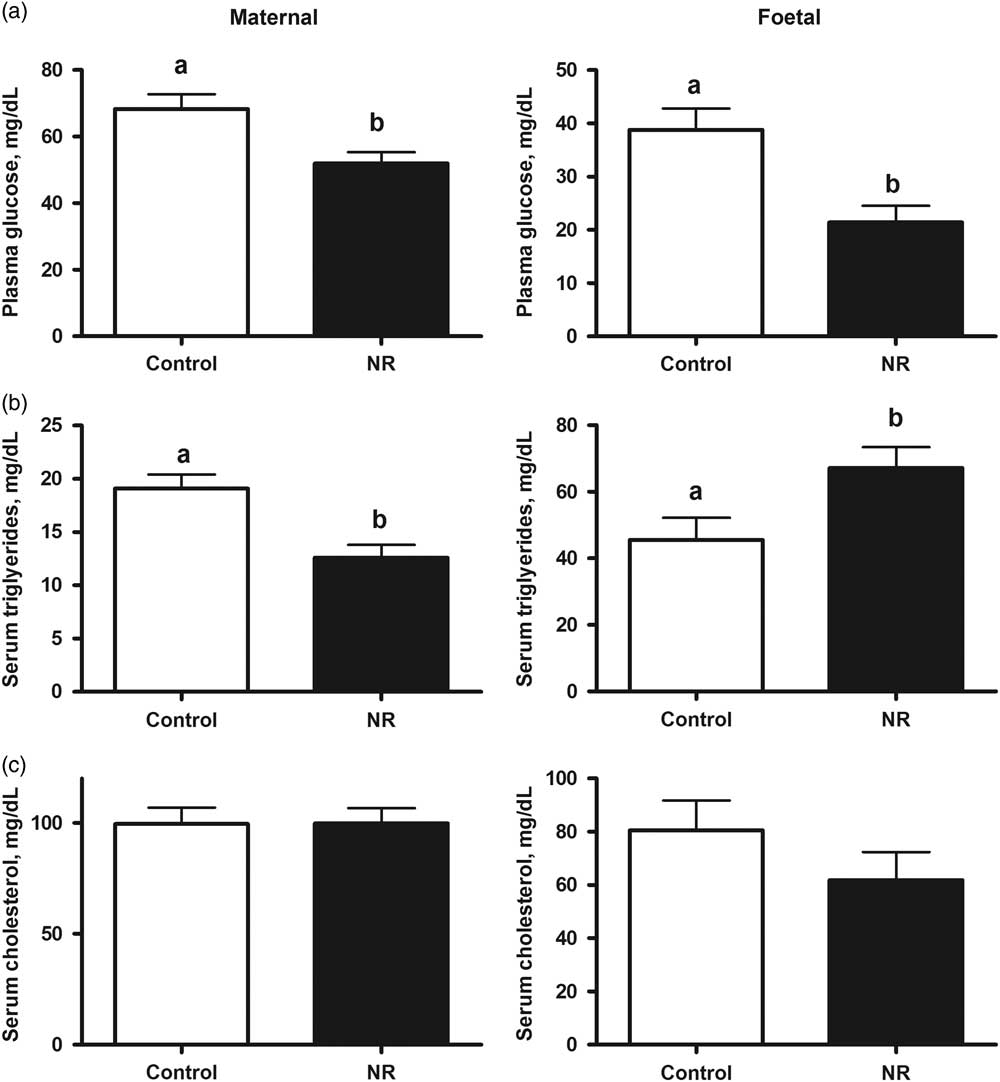
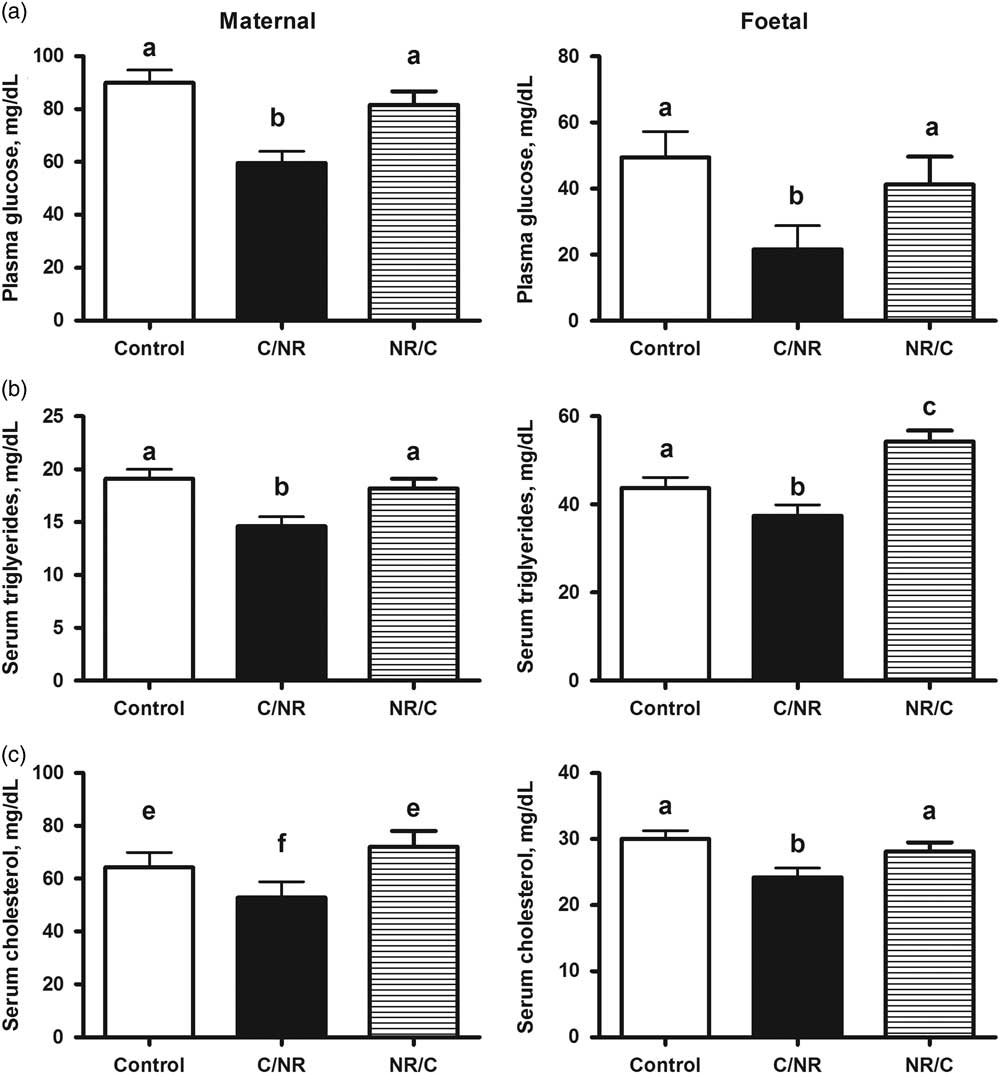
Monthly plasma glucose concentrations of day 110 cows (Figure 1a) exhibited a treatment×day effect (P=0.002), with the plasma concentration of NR group decreased (P<0.05) compared with CON cows at day 56 that was maintained until harvest. Maternal plasma glucose concentrations at harvest of day 110 cows (Figure 2a) were decreased (P=0.027) in dams on the NR diet compared with dams on the CON diet. Foetal plasma glucose concentrations at harvest on day 110 (Figure 2a) were decreased (P=0.014) in foetuses from dams on NR diet v. foetuses from dams on CON diet. Monthly plasma glucose concentrations of day 190 cows (Figure 1b) exhibited a treatment×day effect (P=0.0001). Cows that were nutritionally restricted on days 30 to 110 had decreased (P<0.05) plasma glucose compared with animals on the CON diet during early gestation. On day 114, both NR treatments had decreased (P<0.05) plasma glucose compared with CON cows. Cows that were NR during mid-gestation had decreased (P<0.05) plasma glucose compared with CON treatments during the same time period. Maternal plasma glucose concentrations at harvest for day 190 cows (Figure 3a) were decreased (P<0.001) in NR dams, whereas plasma glucose concentrations were similar between animals on the CON diet before harvest. Foetal plasma glucose concentrations at harvest on day 190 of gestation (Figure 3a) were decreased (P=0.049) in foetuses from NR dams, whereas plasma glucose concentrations were similar between foetuses from dams on CON diets before harvest.
Plasma glucose concentrations of control cows (fed to gain 1 kg of BW/week and exceed CP recommendations, CON) and nutrient restricted (NR) cows (fed 0.55× of NRC NEm and CP recommendations, NR) cows either harvested at day 110 of gestation (a, treatment×day, P=0.002, *means differ within a time point P<0.05) or day 190 of gestation (b, treatment×day, P=0.0001, *means differ between CON and NR/CON; P<0.05. #Means differ between CON and CON/NR; P<0.05). Data are presented as least square means±SEM.

Plasma glucose (a), serum triglycerides (b), and serum cholesterol (c) concentrations from control (cows fed to gain 1 kg of BW/week and exceed CP recommendations, n=8) and nutrient restricted NR (NR cows fed 0.55× of NRC NEm and CP recommendations, n=8) foetuses and dams at day 110 of gestation. Data are presented as least square means±SEM. a,bMeans differ P<0.05.

Plasma glucose (a), serum triglycerides (b) and serum cholesterol (c) concentrations from control (cows fed to gain 1 kg of BW/week and exceed CP recommendations) and nutrient restricted (NR cows fed 0.55× of NRC NEm and CP recommendations) foetuses and dams at day 190 of gestation. n=8, 7 and 7 for CON, NR/CON and CON/NR treatments, respectively. Data are presented as least square means±SEM. a,b,cMeans differ P<0.05 and e,fmeans differ P<0.10.

Maternal serum triglyceride concentrations of day 110 cows of gestation (Figure 2b) were decreased (P=0.003) in NR dams compared with CON dams. Foetal serum triglyceride concentrations at day 110 of gestation (Figure 2b) were decreased (P=0.033) in foetuses from CON dams compared with NR dams. Maternal serum triglyceride concentrations at day 190 of gestation (Figure 3b) were decreased (P=0.008) in NR dams compared with CON dams. Foetal serum triglyceride concentrations at day 190 of gestation (Figure 3b) were decreased (P<0.001) in CON/NR v. CON foetuses, however NR/CON foetuses had increased (P<0.05) serum triglyceride concentrations.
Maternal and foetal serum cholesterol concentrations at day 110 of gestation (Figure 2c) were similar among experimental groups (P=0.984 and 0.285, respectively). Maternal serum cholesterol concentrations at day 190 of gestation (Figure 3c) tended to be decreased (P=0.098) in NR dams compared with dams on CON. Foetal serum concentrations at day 190 of gestation (Figure 3c) were decreased (P=0.019) in foetuses from NR dams compared with foetuses from dams on CON.
Maternal serum cortisol concentrations at day 110 of gestation was increased in NR cows compared with CON cows (1.13±0.27 v. 0.56±0.27, least square means (LSM) and SEM, respectively P=0.04). At day 190 of gestation maternal serum cortisol concentration were greater (P=0.003) in CON/NR cows compared with CON and NR/CON cows (2.13±0.24, 0.86±0.26 and 0.89±0.26 LSM and SEM, respectively).
Foetal measures at day 110 of gestation
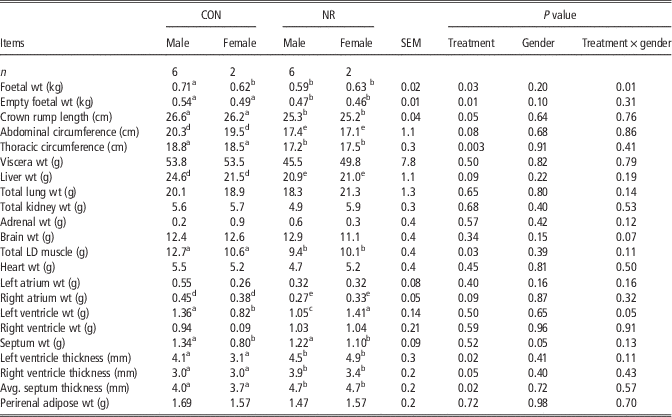
Foetal size and weights at day 110 of gestation are shown in Table 2. Foetal weights showed a treatment by gender interaction (P=0.01) with NR male foetuses having a reduced foetal weight compared with the other foetal groups. Empty foetal weights and crown rump length and thoracic circumference was reduced (P=0.01, P=0.05 and P=0.003, respectively) in NR foetuses compared with CON foetuses. Abdominal circumference tended to be reduced (P=0.08) in NR compared with CON foetuses. Liver weights tended to be decreased (P=0.09) in NR foetuses v. CON foetuses. Total LD muscle weights was decreased (P=0.03) in NR foetuses v. CON foetuses. Brain weight had a tendency (P=0.07) to be decreased in NR female foetuses v. male NR and CON foetuses and female CON foetuses. Total heart, left atrium, right ventricle and septum weight were unaffected by treatment, whereas the right atrium weight had a tendency (P=0.09) to be reduced in NR v. CON foetuses. Left ventricle weight was decreased (P=0.05) in female CON foetuses v. female NR foetuses and male CON and NR foetuses. Both ventricles wall and septum wall thickness was increased (P⩽0.05) in NR foetuses compared with CON foetuses. Total weight of kidneys, lungs and adrenal glands (P=0.68, P=0.14, P=0.12, respectively) were unaffected by maternal treatment.
Foetal measurements and selected organ weights (wt) of male and female foetuses on day 110 of gestation from control (CON) and nutrient restricted (NR) cattleFootnote 1

LD=longissimus dorsi.
a,b,c,d,eMeans differ P⩽0.05.
1 CON cows fed to gain 1 kg of BW/week and exceed CP recommendations. NR cows fed 0.55× of NRC NEm and CP recommendations.
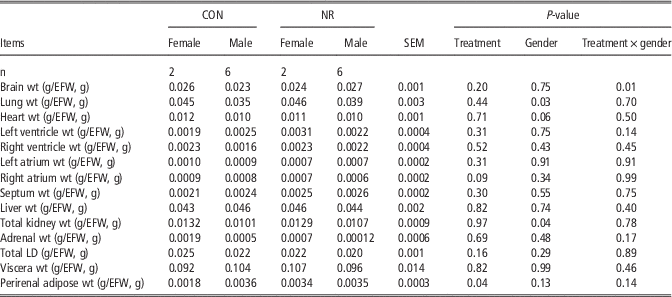
Foetal organ weights as a percentage of EFW at day 110 of gestation are shown in Table 3. Brain weight as a percentage of EFW was increased (treatment×gender interaction P=0.01) in NR male foetuses v. CON male foetuses, with no differences in female foetuses. Total lung weight as a percentage of EFW was increased (P=0.03) in female foetuses v. male foetuses. Foetal heart weight as a percentage of EFW tended (P=0.06) to be increased in female v. male foetuses. Right atrium weight as a percentage of EFW had a tendency (P=0.09) to be increased in CON foetuses v. NR foetuses. Total kidney weight as a percentage of EFW were increased (P=0.04) in female foetuses v. male foetuses. Perirenal adipose tissue weight as a percentage of EFW was increased (P=0.04) in NR foetuses compared with CON foetuses. Foetal left and right ventricles, left atrium, septum, liver, adrenal, LD muscles and viscera, as a percentage of EFW were unaffected by either maternal diet or foetal gender.
Foetal organ weights (wt) as a percentage of empty foetal weight (EFW) at day 110 of gestation from control (CON) and nutrient restricted (NR) cattleFootnote 1

LD=longissimus dorsi.
1 CON cows fed to gain 1 kg of BW/week and exceed CP recommendations. NR cows fed 0.55× of NRC NEm and CP recommendations.
Foetal measures at day 190 of gestation
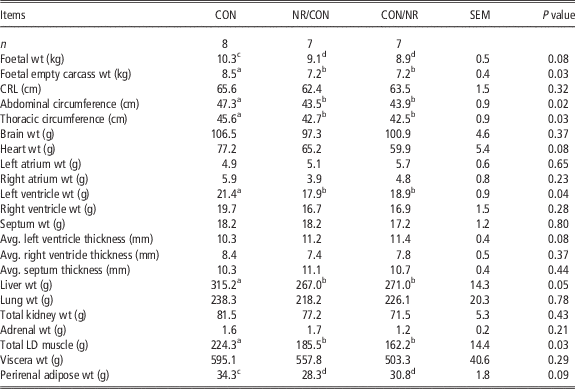
Foetal measurements and foetal organ weights at day 190 of gestation are shown in Table 4. Foetal weights tended to be reduced (P=0.08) in NR/CON and CON/NR v. CON/CON foetuses and EFWs were reduced (P=0.03) in NR/CON and CON/NR v. CON/CON foetuses. Abdominal and thoracic circumference were reduced (P=0.02 and P=0.03, respectively) in NR/CON and CON/NR foetuses v. CON/CON foetuses, however crown rump length was unaffected (P=0.32). Foetal liver weight was reduced (P=0.05) in NR/CON and CON/NR v. CON/CON foetuses. Total LD muscle weight was decreased (P=0.03) in NR/CON and CON/NR v. CON/CON foetuses. Perirenal adipose weight tended to be reduced (P=0.09) in NR/CON and CON/NR compared with CON/CON foetuses. Total heart weight tended to be reduced (P=0.08) in NR/CON and CON/NR v. CON/CON foetuses. Left ventricular weights were reduced (P=0.04) in NR/CON and CON/NR v. CON/CON foetuses. Atria, right ventricle and septum weights were similar between foetal groups. Left ventricle thickness tended to be increased (P=0.08) in NR/CON and CON/NR v. CON/CON foetuses. Right ventricles and septum thickness were both unaffected (P=0.37 and P=0.44, respectively) by maternal treatments.
Foetal measurements and selected organ weights (wt) on day 190 of gestation from control (CON), nutrient restricted (NR)/CON and CON/NR cowsFootnote 1

CRL=crown rump length; LD= longissimus dorsi.
a,bMeans differ P⩽0.05, c,dmeans differ P<0.1.
1 CON cows fed to gain 1 kg of BW/week and exceed CP recommendations. NR cows fed 0.55× of NRC NEm and CP recommendations.
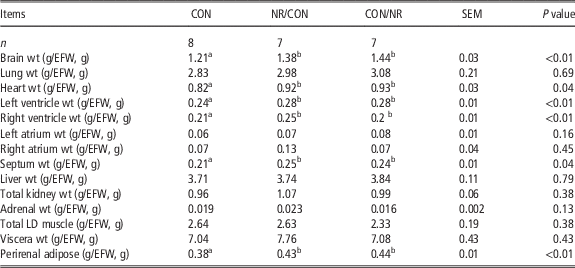
Foetal organ weights as a percentage of EFW at day 190 of gestation are shown in Table 5. Brain weight as a percentage of EFW was increased (P=0.01) in NR/CON and CON/NR v. CON/CON foetuses. Total heart weight as a percentage of EFW was increased (P=0.04) in NR/CON and CON/NR v. CON/CON foetuses. Left and right ventricle weight as a percentage of EFW was increased (P<0.01) in NR/CON and CON/NR v. CON/CON foetuses. Septum weight as a percentage of EFW was also increased (P=0.04) in NR/CON and CON/NR v. CON/CON foetuses. Foetal perirenal adipose as a percentage of EFW was increased (P<0.01) in NR/CON and CON/NR v. CON/CON foetuses. Adipocyte diameter of perirenal adipose tissue at d 190 of gestation were similar (P=0.86) regardless of treatment (CON=23.9±0.6; CON/NR= 24.4±0.7; NR/CON 24.3±0.7 µm).
Foetal organ weights (wt) as a percentage of empty foetal weight (EFW) on day 190 of gestation from control (CON), nutrient restricted (NR)/CON and CON/NR cowsFootnote 1

LD=longissimus dorsi.
a,bMeans differ P⩽0.05.
1 CON cows fed to gain 1 kg of BW/week and exceed CP recommendations. NR cows fed 0.55× of NRC NEm and CP recommendations
Discussion
To the authors’ knowledge, this is the first study with maternal nutrient restriction during early or mid-gestation in young cattle without realimentation with foetal endpoints. Previous studies have shown in multiple mammal species that maternal nutrient restriction during early or mid-gestation can lead to IUGR exhibited by asynchronous organ growth (i.e. enlarged hearts and brains) (McMillen et al., Reference McMillen, Adams, Ross, Coulter, Simonetta, Owens, Robinson and Edwards2001; Vonnahme et al., Reference Vonnahme, Hess, Hansen, McCormick, Rule, Moss, Murdoch, Nijland, Skinner, Nathanielsz and Ford2003; Platz and Newman Reference Platz and Newman2008; Long et al., Reference Long, Vonnahme, Hess, Nathanielsz and Ford2009). However, there have been little comparisons of early versed mid-gestation IUGR in the same experimental conditions in cattle. This study revealed asynchronous organ growth in foetuses from NR dams regardless of which trimester the restriction took place. Other studies have utilized a bovine maternal nutrient restriction (Long et al., Reference Long, Vonnahme, Hess, Nathanielsz and Ford2009 and Reference Long, Prado-Cooper, Krehbiel, DeSilva and Wettemann2010; Camacho et al., Reference Camacho, Lemley, Van Emon, Caton, Swanson and Vonnahme2014; Prezotto et al., Reference Prezotto, Camacho, Lemley, Keomanivong, Caton, Vonnahme and Swanson2016), however the BW and BCS loss of dams in this study was more significant than these other early gestation maternal nutrient restriction, despite similar restriction levels because our maintenance energy and CP recommendations calculations did not incorporate nutrition requirements for pregnancy and were instead based on the requirements of a non-pregnant, non-lactating cow. This was done to get back to absolute maintenance energy and protein basis that other researched have neglected as most have fed their control animals over requirements. This allowed us to get both an early and mid-gestation IUGR that others were not able to obtain (Prezotto et al., Reference Prezotto, Camacho, Lemley, Keomanivong, Caton, Vonnahme and Swanson2016). This was probably due to both our level of NR and also our use of young cows as young cows are more susceptible to producing IUGR compared with older cows (Long et al., Reference Long, Vonnahme, Hess, Nathanielsz and Ford2009).
Plasma glucose concentration was decreased in NR dams and foetuses at both days 110 and 190 of gestation. This data are consistent with that of sheep that has shown that NR (50% of requirements) or overfeeding (150% of requirements) altered plasma glucose concentrations in ewes and their foetuses during nutritional treatments (Ford et al., Reference Ford2007; Tuersunjiang et al., Reference Tuersunjiang, Odhiambo, Long, Shasa, Nathanielsz and Ford2013). In contrast to sheep, Long et al. (Reference Long, Vonnahme, Hess, Nathanielsz and Ford2009) showed that not all NR cattle and foetuses would exhibit decreased plasma glucose concentrations. Older cows have been shown to have an increased ability to partition nutrients to maintain normal foetal growth during a period of NR. This study also helps to support the fact that younger cows do not partition nutrients to their foetus (Long et al., Reference Long, Vonnahme, Hess, Nathanielsz and Ford2009). We would have expected at least some increased foetal growth in the NR/CON dams after they were placed on the control ration but there appeared to be no compensatory foetal growth even while maternal plasma glucose was similar to the CON/CON cows during mid-gestation.
Serum triglycerides were decreased in NR dams and foetuses at days 110 and 190 of gestation. Similar decreases in maternal and foetal serum triglycerides have been shown in ewes that were NR during early gestation (Ma et al., Reference Ma, Zhu, Uthlaut, Nijland, Nathanielsz, Hess and Ford2011). However, of interest is that foetuses that were exposed to NR during the first trimester and then returned to the control diet had increased serum triglyceride compared with foetuses that had been on the control diet. This could indicate possible selected nutrient partitioning in these NR/CON foetuses. In obese ewes and their foetuses increased triglyceride concentrations have been reported relative to their control counterparts and this through as a reflection of their increased nutritional status (Zhu et al., Reference Zhu, Ma, Long, Du and Ford2010). However, in this present study, this increased serum triglyceride concentration in the NR/CON did not result in any changes in foetal measurements. It should be noted that increased lipid transport into foetus may not be beneficial, as it has been shown that increased lipid transport into ovine foetuses leads to increased development and altered function of adipose tissue (Zhu et al., Reference Zhu, Ma, Long, Du and Ford2010; Long et al., Reference Long, Rule, Zhu, Nathanielsz and Ford2012a).
Although the foetus can synthesize cholesterol on its own, there is still placental transport of maternal cholesterol to the foetal environment (Woollett, Reference Woollett2011). During early gestation, when demand for growth is lower, cholesterol is not as compulsory as is indicated by the similarities in serum cholesterol concentration at harvest in either maternal or foetal serum at day 110 of gestation. This effect of similar cholesterol has been noted in foetuses from an early gestation maternal NR sheep study (Ma et al., Reference Ma, Zhu, Uthlaut, Nijland, Nathanielsz, Hess and Ford2011). By mid-gestation (days 110 to 190), as demand for cholesterol increases in the foetus, NR animals were not able to meet the demand, resulting in the decreased serum cholesterol in NR day 190 dams and foetuses. In other species this reduced cholesterol concentrations is associated with reduced foetal growth rates (McConihay et al., Reference McConihay, Honkomp, Granholm and Woollett2000; Edison et al., Reference Edison, Berg, Remaley, Kelley, Rotimi, Stevenson and Muenke2007).
In day 110 foetuses there were multiple measures that exhibited a treatment×gender effect, in which foetuses that were male and NR showed increased evidence of growth restriction. Typically, male foetuses grow quicker and heavier than female foetuses (Pedersen, Reference Pedersen1980) and are therefore more susceptible to nutrient restriction. The mechanism for this gender-specific response in unknown, but it has been shown that protein restriction during early gestation leads to gender-specific changes in foetal-placental hemodynamic (Hernandez-Medrano et al., Reference Hernandez-Medrano, Copping, Hoare, Wapanaar, Grivell, Kuchel, Miguel-Pacheco, McMillen, Rodgers and Perry2015). Another possible mechanism is a gender-specific response to the elevated cortisol detected in out NR cows, it has been shown that gender affects the response to glucocorticoids in ovine foetuses (Miller et al., Reference Miller, Sutherland, Supramaniam, Walker, Jenkin and Wallace2012).
Increased percentage of perirenal adipose tissue in NR foetuses has been shown in other species. Increased perirenal adipose tissue depots have been reported in twin bearing ewes on a 70% restricted diet during gestation (Edwards et al., Reference Edwards, McFarlane, Kauter and McMillen2005). Twin foetuses from restricted ewes were potentially more severely restricted than singleton foetuses from restricted ewes because of increased nutrient partitioning in utero. This increase in adipose percentage may alter appetite regulation in the postnatal animal, caused by changes in endocrine secretions from the adipose tissue (Wang et al., Reference Wang, Mariman, Renes and Keijer2008). This alteration of appetite and increased adiposity leads to further metabolic disorders such as insulin and glucose dysregulation, also observed in sheep that were restricted during early (days 28 to 78) gestation (George et al., Reference George, Zhange, Tuersunjiang, Ma, Long, Uthlaut, Smith, Nathanielsz and Ford2012).
In conclusion, whereas it has been previously highlighted that nutrient restriction during early gestation causes IUGR and decreased foetal development, mid-gestation nutrient restriction has now been shown to cause the same damaging effects to the same extent, even with no nutritional stress during early gestation. Realimentation of animals after a period of nutrient restriction alleviates some of the damaging results of nutrient restriction (Long et al., Reference Long, Vonnahme, Hess, Nathanielsz and Ford2009), but without realimentation this study shows that the effects of nutrient restriction cannot be overcome even though many maternal metabolites return to control levels, indicating a partitioning of nutrients for the maternal system and not for the foetus in these young cows.