INTRODUCTION
The ‘sandy ray’ Leucoraja circularis (Couch, 1838) is one of the sixteen rajid species currently known in the Mediterranean Sea (Notarbartolo di Sciara & Bianchi, Reference Notarbartolo di Sciara and Bianchi1998). The species is distributed in the eastern Atlantic from Morocco to Iceland and in the North Sea where it is mainly found in offshore waters between −70 and −900 m (Fischer et al., Reference Fischer, Bauchot and Schneider1987). In the Mediterranean Sea, L. circularis is mainly found in the western basin (Stehmann & Burkel, Reference Stehmann, Burkel and Whitehead1984); concerning the Italian waters, occurrences of L. circularis have been reported from the Ionian Sea (Sion et al., Reference Sion, D'onghia, Tursi and Matarrese2003), Strait of Sicily (Ragonese et al., Reference Ragonese, Cigala Fulgosi, Bianchini, Norrito and Sinacori2003), Sardinian Sea (Follesa et al., Reference Follesa, Addis, Murenu, Saba and Sabatini2003), south-western Adriatic Sea (Ungaro et al., Reference Ungaro, Marano, Rizzi and Marzano2001) and the northern Tyrrhenian Sea (Serena et al., Reference Serena, Mancusi and Auteri2003). The only information on its presence in the central Tyrrhenian Sea is given by Bonaparte (Reference Bonaparte1840) who describes a specimen of L. circularis collected from a fishmonger in Rome under the name of Raja falsavela (Bini, Reference Bini and Sommerso1967) and by Clark (Reference Clark1926) who examined a young specimen purchased from the Marine Station of Naples (SZN). Since both of these records are lacking precise data and locality of capture, the specimen of L. circularis reported in the present paper represents the first circumstantiated occurrence of the species in the central Tyrrhenian Sea. The principal biometric and meristic characters of the Anzio specimen of L. circularis are presented herein.
MATERIALS AND METHODS
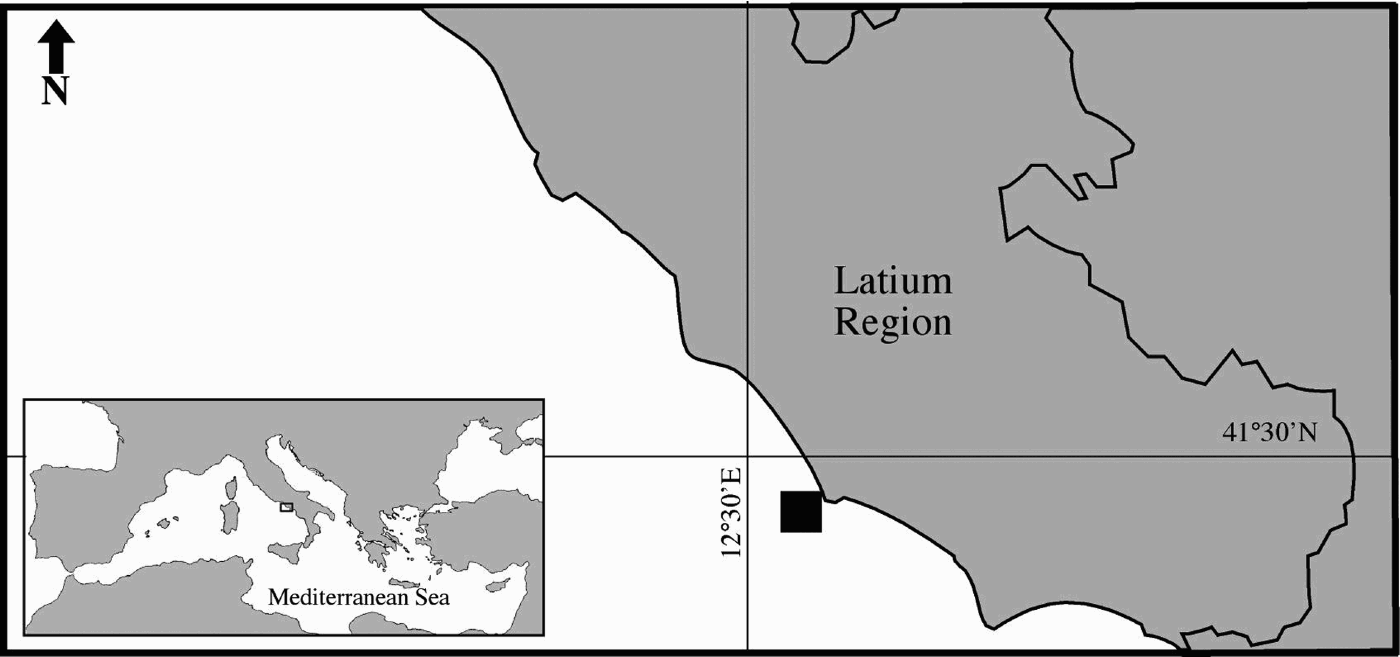
In January 2005, one specimen of Leucoraja circularis was captured by a bottom trawler operating 15 nautical miles south-east off the Anzio coast (central Tyrrhenian Sea) (Figure 1) at a depth of 500 m. The skate was taken to the laboratory and morphometric and meristic data were recorded according to Stehmann & Burkel (Reference Stehmann, Burkel and Whitehead1984). Specific diagnosis was performed by means of dichotomous keys (Fischer et al., Reference Fischer, Bauchot and Schneider1987). The specimen of L. circularis has been deposited in the Zoological Museum University of Naples ‘Federico II’ (MZN), catalogue no. Z6832. Sexual maturity was defined in accordance with maturity stage scale for oviparous cartilaginous fish given by Stehmann (Reference Stehmann2002).
Map of central Tyrrhenian Sea showing the locality (▪) where the specimen of Leucoraja circularis was caught.

RESULTS
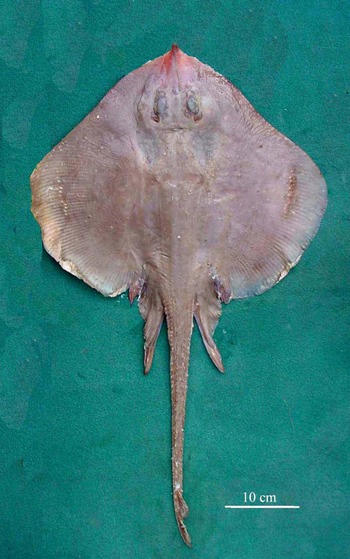
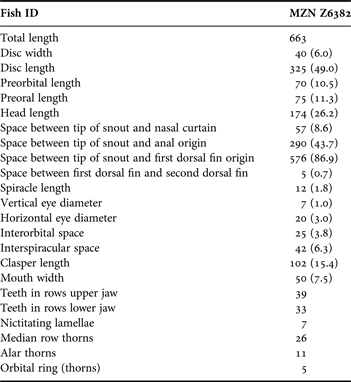
Morphometric and meristic data of Leucoraja circularis are summarized in Table 1. The specimen (Figure 2), measuring 66.3 cm total length (TL) and weighing 1329 g total weight (TW), is described as follows. Upper surface entirely spinoluse with five thorns in a complete row around inner margin of eye. Prickles along anterior margin of disc, no thorns on nape (nuchals and scapulars absent); two parallel rows of prominent thorns on anterior half of tail, no thorns between dorsal fins. Ventral surface entirely smooth. Colour, red-brown with five white spots on the ‘dorsal’ disc (in contrast with uniform dorsal livery of Leucoraja fullonica), underside white; eye-spots absent on the disc (in contrast with Leucoraja melitensis and Leucoraja naevus). The Anzio specimen was classified as an adult male.
The specimen of Leucoraja circularis caught off the coast of Anzio, central Tyrrhenian Sea. Scale bar: 10 cm.

Morphometric and meristic characteristics of Leucoraja circularis from Anzio, central Tyrrhenian Sea. Measurements are given as absolute (mm) and as percentage (in parentheses) value of TL (%).
DISCUSSION
Although the presence of the sandy ray in some sectors of the Tyrrhenian Sea has already been reported, this is the first documented capture of the species in this area. Besides Bonaparte's (1840) description of Raja falsavela (=Leucoraja circularis), based on a single specimen collected from a fishmonger in Rome, the only information regarding the presence of this species in the central Tyrrhenian Sea is given by Clark (Reference Clark1926) who describes a young female from Naples, but no mention of date of capture is made. We suspect that the latter author examined a preserved specimen without a label, as is the case of other old samples housed in the SZN systematic collections. On these grounds, Bini (Reference Bini and Sommerso1967) included the central Tyrrhenian Sea among the distributional area of the sandy ray L. circularis in the Italian seas. The rarity of the species in this sector of the Tyrrhenian Sea is confirmed by the results of the many scientific trawl fishing surveys conducted by the Italian Group for Demersal Resources (GRUND) during the past 20 years. In fact, with the exception of a few samples obtained from the northern and southern sectors, no other captures of the species have been reported from the many research teams operating in the Tyrrhenian basin (Relini et al., Reference Relini, Biagi, Serena, Belluscio, Spedicato, Rinelli, Follesa, Picinetti, Ungaro, Sion and Levi2000). In the Mediterranean as a whole, the sandy ray seems to be more abundant in the Ionian Sea of Italy where it has also been collected by the researchers working within the Mediterranean International Trawl Survey (MEDITS) (Bertrand et al., Reference Bertrand, Gil De Sola and Papakonstantinou2000).
ACKNOWLEDGEMENTS
The authors wish to thank D. Accardo, captain of the trawler ‘Angelo Padre II’ who made the catch and P. Sorrentino (Coop Isole Pelagie, Anzio) for his help in storing the specimen.