Introduction
In October of 2015, the White House (Washington, DC USA) launched its “Stop the Bleed” initiative to address the concerns for the disturbing number of mass shooting incidents plaguing the United States. 1 The Federal Bureau of Investigation (FBI; Washington, DC USA), in cooperation with Texas State University (San Marcos, Texas USA), published a report in 2013 on the study of active shooter events in the United States demonstrating a concerning rise from the years 2000 to 2013.Reference Blair and Schweit 2 The report clearly illustrated the increasing threat to the public and prompted a meeting of medical experts within the trauma community; the resulting Harford Consensus called for new protective and response measures within the community to respond to this rising threat.Reference Jacobs, McSwain and Rotondo 3
These studies suggest that active shooter incidents generally end prior to the arrival of any police or medical first responders. Additionally, the majority of these crime scenes are not deemed to be safe for medical responder entry until long after the violence has occurred. This phenomenon delays victims from receiving medical attention. This conceivably has contributed to loss of life that may have been saved by expedient medical care. The Hartford Consensus concluded that it is unreasonable to believe medical first responders can arrive in a timely enough fashion to respond. Therefore, bystanders need to be capable of rendering emergency first aid in order to save lives.
Bystander first aid has the potential to save lives in numerous situations. Ashour, et al identified that appropriate bystander actions at the scene of motor vehicle collisions would have resulted in 4.5% increased survival based on deaths from preventable causes.Reference Ashour, Cameron, Bernard, Fitzgerald, Smith and Walker 4 According to the Fatal Injury Reports from the Centers for Disease Control’s (CDC; Atlanta, Georgia USA) Web-based Injury Statistics Query and Reporting System (WISQARS), the death rate for motor vehicle collisions in the United States in 2014 was 10.58 per 100,000 (33,736 individuals). 5 Bystander action in these scenarios may translate into over 1,500 lives saved annually in the United States alone.
This study examines laypersons’ ability and willingness to respond to medical emergencies and the perceived barriers to action. It also examines the impact of a brief educational intervention on hemorrhage control with the goal to identify sources for improved community education and public messaging to increase laypersons’ sense of self-efficacy and improve the capacity within the community to respond to traumatic emergencies.
Methods
Design, Setting, and Participants
The University of Texas Health Science Center San Antonio Institutional Review Board (San Antonio, Texas USA) approved this study and was found to meet criteria for Non-Regulated Research, as a community outreach project (Protocol Number: HSC20160321N).
Investigators recruited participants through the University of Texas San Antonio student interest groups, the Southwest Regional Trauma Advisory Council (San Antonio, Texas USA) community education committee, and through personal connections within the San Antonio community. There were 236 participants who voluntarily applied for the class at multiple venues within Bexar County and Frio County, Texas. Venues included a community health fair, two elementary schools, community group meetings, the University of Texas at San Antonio student interest groups, San Antonio Airport Personnel public safety training, and a local musicians group rehearsal session.
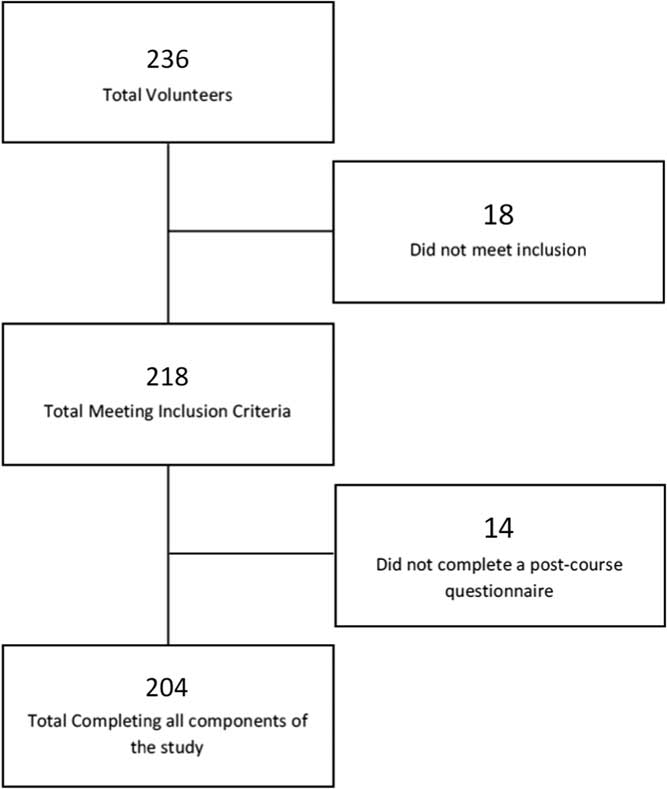
Data collection occurred from September 2016 to March 2017. Individuals with a medical certification were excluded from analysis (Figure 1).
Participants in the Study.

Volunteers completed a pre-event questionnaire (Appendix 1; available online only). Data regarding subject comfort levels, knowledge, and attitudes about tourniquets were collected with the pre-study questionnaire. Each training course included individual evaluation of tourniquet placement followed by 20 minutes of didactic instruction on hemorrhage recognition and control techniques (Appendix 2; available online only). The focus was on recognition of serious hemorrhage, the importance of direct pressure, and indications and techniques for tourniquet placement. Each session included time for hands-on instruction and practice of tourniquet application on both adult and child size mannequins. Following the completion of the event, all volunteers were asked to complete a post-event questionnaire with similar questions and the same knowledge assessment as in the pre-event questionnaire.
Questionnaire
A simple questionnaire was used to capture participant demographics, medical experience and training, history of military service, self-assessed confidence with tourniquet placement and perceived safety, willingness to respond to a medical emergency involving hemorrhage, and perceived barriers to action. It also included a brief knowledge assessment on tourniquets. The questionnaire was completed prior to the start of the course and again at the completion.
Individual Assessment of Tourniquet Placement
Trainers asked all participants to place a tourniquet on a mannequin before beginning the course. Each participant was randomized, using online randomization generator, into one of 12 possible study arms. They included tourniquet type (Combat Action Tourniquet [CAT; North American Rescue, LLC; Greer, South Carolina USA], Ratcheting Medical Tourniquet [RMT; M2 Inc.; Winooski, Vermont USA], or Stretch Wrap and Tuck Tourniquet [SWAT-T; TEMS Solutions, LLC; Salida, Colorado USA]); mannequin type (adult or child); and location (upper extremity or lower extremity). Each participant was asked to place a tourniquet on the bleeding extremity to which they were randomly assigned. They were provided the following scenario: “This person has an injury that has continued to bleed despite direct pressure on the wound. It has been determined they need a tourniquet. A tourniquet has been pulled from the public access bleeding control kit, and someone hands it to you. Please place the tourniquet so that it will stop the bleeding. Please let me know when you believe your placement is complete.” The instructor would then hand the participant their designated tourniquet and start a timer. The timer would be stopped once the participant reported being done placing the tourniquet. The tourniquet placement would then be assessed for correct position, placement technique, and adequate tightness. Each mannequin was marked with a simple piece of moulage to identify the bleeding area. Correct position included any location on the injured limb proximal to the wound. Correct placement technique was observed if the participant used the device in a reasonable manner as compared to manufacturer provided instruction. Adequate tightness was present if the researcher was unable to slide a finger under the tourniquet. No instructions were provided to the participant, and no feedback was provided until after the exercise was complete. Following the exercise, the instructor would provide feedback on the correct placement and technique.
Statistical Analysis
Microsoft Excel (Microsoft Corp.; Redmond, Washington USA) was used to manage the data and SAS JMP (SAS Institute Inc.; Cary, North Carolina USA) for statistical analyses. Descriptive statistics were produced for analysis of demographics, and chi-square (or Fisher’s exact) tests and t-tests were conducted to determine differences between the groups. Patient self-efficacy ratings were compared prior to and following the educational intervention using non-parametric Wilcoxon Signed-Rank paired test for location. The McNemar-Bowker test of symmetry was used for comparing opinions about tourniquet safety and willingness to use in real life prior to and following the educational intervention. Baseline and post-educational intervention knowledge questionnaire scores were compared using paired t-tests. Statistical significance was defined as P<.05, and 95% confidence intervals were obtained, when appropriate.
Results
The Questionnaire
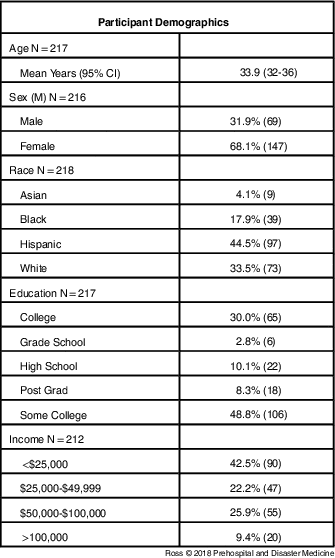
Of 236 participants, 218 met the eligibility criteria (Figure 2). The participants were 68.1% female (147/216), with most reporting having completed some college or were currently attending college. Most participants were Hispanic (44.5%), under age 21 (29.8%), and reported earning <$25,000 per year (42.5%; Table 1).
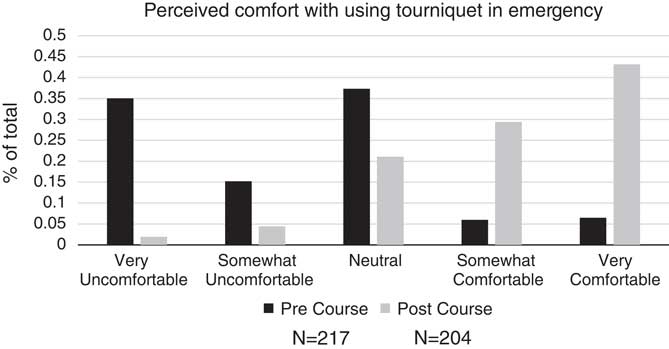
Perceived Comfort of Tourniquet Use.

Participant Demographics

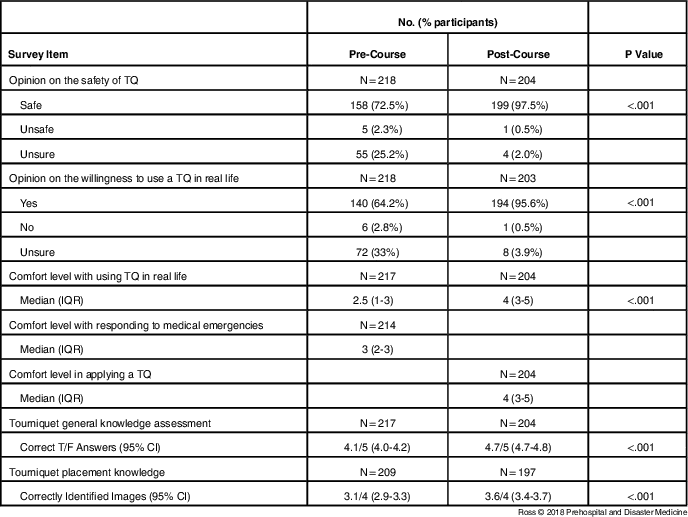
When initially asked if they felt tourniquets were safe, 72.5% (158/215) said “Yes,” and 2.3% (5/218) felt they were unsafe. Following training, 97.5% (199/204) felt tourniquets were safe, and only 0.5% (1/202) felt they were unsafe. Of those who initially felt tourniquets were unsafe, all felt they were safe following training. The one individual who felt tourniquets were unsafe following training previously reported feeling that they were unsure about the safety.
When initially asked if they would use a tourniquet in real life, 64.2% (140/218) responded “Yes.” Following training, 95.6% (194/203) of participants responded that they would use a tourniquet in real life. Of the participants who initially responded “No” (2.8%; 6/218), all responded “Yes” following training. Before training, men were statistically more likely to respond “Yes” to using tourniquets than women (80.9% versus 57.1%; P=.003), but that difference resolved following training.
Prior to the training, participant overall comfort level with responding to an emergency was 3/5 (2-3 median IQR). Following training, the comfort level in applying a tourniquet was 4/5 (3-5 median IQR; Table 2). There was a statistically significant difference between men and women’s post-training comfort with applying a tourniquet (4.35 versus 3.97; P=.004). When participants were asked about their comfort level with using a tourniquet in real life, there was a statistically significant difference between their initial response and their post-training response (2.5 versus 4.0; P<.001; Figure 2).
Participant Questionnaire and Knowledge Assessment

Abbreviation: TQ, tourniquet.
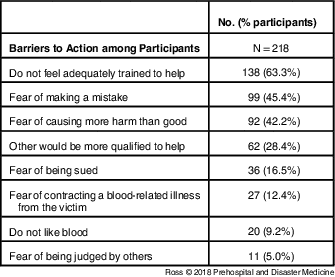
Barriers to responding during an emergency with tourniquets included:
-
1. Do not feel adequately trained to help (63.3%), more common in women than men (69.4% versus 50.7%; P=.008), and more common in those making <$25,000 (75.6%; P=.005);
-
2. Fear of making a mistake (45.4%), more common in women than men (55.8% versus 23.2%; P<.001);
-
3. Fear of causing more harm than good (42.2%), more common in women than men (46.9% versus 31.9%; P=.037), and more common amongst Asian participants (66.7%) and least common amongst Hispanic participants (33.0%);
-
4. Someone else would be more qualified to help (28.4%);
-
5. Fear of being sued (16.5%);
-
6. Fear of contracting a blood-related illness from the victim (12.4%);
-
7. Do not like blood (9.2%), more common in college grads (21.5%; P<.001), those making >$100,000 (25.0%; P=.001), and those ages 31-40 (25.0%; P=.006); and
-
8. Fear of being judged by others (5.0%), more common in those earning >$100,000 (20.0%; P=.012; Table 3).
Participant Identified Barriers to Act

Participants had a statistically significant improvement in basic tourniquet knowledge with an initial score of 4.1/5 increasing to 4.7/5 (P<.001) post training. There was also a statistically significant improvement in knowledge on where to place tourniquets with participants correctly identifying 3.1/4 correct placements at baseline and 3.6/4 (P<.001) following training.
Tourniquet Placements
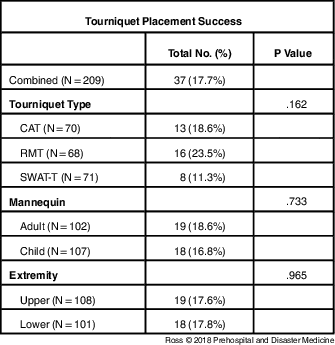
The overall success rate for tourniquet placement was 17.7%. The rates of successful tourniquet application for the RMT, SWAT-T, and CAT were 23.5%, 11.3%, and 18.6%, respectively (P=.162). Participants with reported military service were statistically more likely to be successful (57.1%; P=.005). No other differences were noted based on demographics or reported prior tourniquet training. There were no statistically significant differences based on the extremity applied or mannequin type (adult versus child; Table 4).
Successful Tourniquet Placements

Abbreviations: CAT, Combat Action Tourniquet; RMT, Ratcheting Medical Tourniquet; SWAT-T, Stretch Wrap and Tuck Tourniquet.
Discussion
This study is one of the first to examine barriers to act for traumatic medical emergencies. It is also the first to document the outcomes from a “Stop the Bleed” campaign-focused educational program. The study found that most laypersons are not comfortable responding to a traumatic medical emergency. Multiple barriers to act were identified, with the most common being feeling inadequately trained. Other significant barriers included fear of making a mistake and fear of causing more harm than good. The participants demonstrated a 30.0% increase in their willingness to use a tourniquet in real life following a short educational intervention. Additionally, of those participants who believed tourniquets were harmful before the class, all reported they thought they were safe following the class.
There were some significant demographic differences among the barriers to acting. Women were more likely to report fear of making a mistake, fear of causing more harm than good, and feeling inadequately trained to help. Women were also less likely to feel comfortable responding to a medical emergency and less likely to use a tourniquet in real life. Finally, women were less likely to be comfortable with their ability to apply a tourniquet, even after training. The actual ability of women to successfully place a tourniquet was no different than the men. Multiple previous studies evaluating bystander response and helping behavior have demonstrated significant gender differences.Reference Swor, Khan, Domeier, Honeycutt, Chu and Compton 6 - Reference Shotland and Heinold 8
One unexpected finding was that those earning $25,000-$50,000 were much more likely to act than those earning >$100,000. Previous bystander response data for out-of-hospital cardiac arrest has found that lower socioeconomic status is associated with lower rates of bystander response.Reference Vaillancourt, Lui, De Maio, Wells and Stiell 9 - Reference Chiang, Ko and Chang 11 The >$100,000 group did report higher rates of not liking blood and fear of being judged by others as barriers to action. These findings may account for the observed difference.
Other studies have shown educational interventions can significantly improve willingness to respond in an emergency. A 2009 study by Hamasu, et al looking at college students’ willingness to perform cardiopulmonary resuscitation (CPR) showed that initially, individuals cited “knowledge of how to work an automated external defibrillator (AED) device” as a major limiting factor. In this study, training improved perceived willingness to respond from 13.0% prior to Basic Life Support training to 77.0% following training.Reference Hamasu, Morimoto and Kuramoto 12 This study had similar findings with inadequate knowledge/training as the major limiting factor and noted significant improvement in perceived comfort following training.
The only major ethnic difference identified in this study was individuals that identified as Asian were far more likely to report fear of causing more harm than good. Additionally, those who identified as Hispanic were the least likely to report this as a barrier. This finding is consistent with prior findings by Shibata, et al when looking at a Japanese population.Reference Shibata, Taniguchi, Yoshida and Yamamoto 13
This study demonstrates that short educational interventions are adequate to improve laypersons’ sense of self-efficacy and reported willingness to act. The longer commercial courses that are currently available are not necessary to achieve the public health goal of improved layperson preparedness and willingness to act. 1 This study also revealed an unacceptably high rate of failure of commercially available tourniquet application in the hands of untrained laypersons. Based on this study, and previous studies looking at layperson use of tourniquets,Reference Goolsby, Branting, Chen, Mack and Olsen 14 , Reference Goolsby, Chen and Branting 15 it may be necessary to re-evaluate how commercially available tourniquets are manufactured and packaged in order to improve a tourniquet’s usability by the lay public before the widespread dissemination of tourniquets will have a significant public health effect.
Future prospective studies are needed to assess the duration of the brief educational intervention impact. Military studies looking at recent recruits have demonstrated rapid skill degradation on tourniquet placement as soon as one week after the initial training.Reference Baruch, Benov and Shina 16 Incorporating hemorrhage control training into public schools as part of a larger health education program may enable retention of these skills. A similar concept has already been implemented for CPR in some areas of the United States.Reference Eisenburger and Safar 17 At least one county in Texas has adopted this approach to hemorrhage control training by including this instruction with every American Heart Association (AHA; Dallas, Texas USA) Basic Life Support and CPR course they teach.Reference Bolleter 18
Limitations
This study has limitations. First, this study was part of a larger study specifically looking at different commercial tourniquets and the ability for laypersons to apply them in the absence of training. Although this study found no statistically significant differences between the different type of tourniquet used, the extremity, or type of mannequin with regards to successful tourniquet placement, differences existed in the tourniquet application assessments based on the participant’s randomization.
Second, this study was focused on adults. Several high school and middle school students attend the classes, but they were excluded from the testing. A significant body of research has shown that teaching younger students may have a much larger impact than adults on community preparedness.Reference Lorem, Steen and Wik 19 , Reference Kanstad, Nilsen and Fredriksen 20 Future efforts should explore hemorrhage control education in teenagers as well.
Third, this study was a convenience sample from the community that volunteered to attend a class on controlling hemorrhage. The study found that overall less than 10.0% found blood as a barrier to act and only 12.4% were concerned about contracting a blood-related infection from the victim. Previous studies looking at bystander CPR and barriers to action found that around 16.0% of individuals voiced concerns over transmission of infection.Reference Hamasu, Morimoto and Kuramoto 12 , Reference Lu, Jin and Meng 21 Additionally, these volunteers may be more enthusiastic about tourniquet use and more likely to respond to an emergency. This convenience sample may not have been an adequate representative sample of the entire community.
Finally, this study tested individuals in multiple different environments and venues. The various testing sites may have influenced the success of the participants and impact of the educational intervention. Every effort was made to ensure the educational content was standardized, but due to the multiple venues, the material was presented by large laminated slides, large screen projectors, and even handheld tablet computers.
Conclusion
In this hemorrhage control education study, it was found that a short educational intervention can improve laypersons’ self-efficacy and reported willingness to use a tourniquet in an emergency. Identified barriers to act should be addressed when designing future hemorrhage control public health education campaigns. Community education should continue to be a priority of the “Stop the Bleed” campaign.
Acknowledgements
The authors would like to thank the San Antonio Fire Department, the Office of the Medical Director for the San Antonio Fire Department, and all the “Stop the Bleed” trainers for their contribution to this community outreach effort. They would also like to thank the Centre for Emergency Health Sciences (Spring Branch, Texas USA) and Scotty Bolleter for sharing his educational materials and expertise in the development of this project.
Supplementary Material
To view supplementary material for this article, please visit https://doi.org/10.1017/S1049023X18000055