Introduction
Open cavity mastoidectomy, also known as canal wall down mastoidectomy, is one of the main techniques in cholesteatoma surgery. Its perceived advantages are lower rates of recurrent and residual cholesteatoma, compared with intact canal wall mastoidectomy.Reference Roden, Honrubia and Wiet1 Its perceived disadvantages are cerumen accumulation in the open mastoid cavity, the need for regular cleaning, and intolerance of the cavity to water.Reference Khalil and Windle-Taylor2 The surgical outcome of open cavity mastoidectomy is often influenced by the extent of the cholesteatoma and the skill of the surgeon. Many eminent otologists have written on the surgical principles of open cavity mastoidectomy, such as a wide meatoplasty, low facial ridge, intact tympanic membrane and smooth mastoid bowl.Reference Shaan, Landolfi, Taibah, Russo, Szymanski and Sanna3
The senior author (MY) worked in a tertiary referral centre and had the opportunity to manage a large number of long-standing troublesome mastoid cavities. Patients who failed conservative treatment were treated surgically. The present study aimed to examine the reasons for surgical failure in patients with troublesome mastoid cavities, to evaluate the operative findings and to assess the medium-term outcome of revision mastoidectomy. The senior author had a policy of long-term, yearly patient follow up after mastoid surgery. This provided the opportunity to perform an observational study on a relatively large cohort of patients undergoing revision mastoidectomy. The present study was designed to describe what had been achieved, rather than to compare different techniques of revision mastoid surgery.
Materials and methods
Ear audit clinic
Since 1988, the senior author had a policy of yearly patient review following mastoid surgery. A weekly ear audit clinic was set up, with audiological support provided by two audiologists. The senior author personally evaluated all patients at each post-operative follow-up visit. All patients were advised to try water sports or hair-washing without ear protection, as part of routine post-operative assessment. Air and bone conduction thresholds were also recorded for each patient. The clinical information was recorded in the case notes as well as on a data pro forma.
Patients
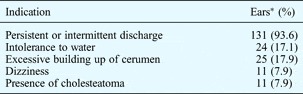
Between 1988 and 2008, 140 revision mastoidectomies were performed for troublesome mastoid cavities in 131 patients, aged between eight and 79 years. There were 25 children (aged 16 years and below) and 106 adults. Post-operatively, patients were followed up at three, six and 12 months and then yearly. Nine patients had revision mastoidectomy procedures on both ears. The main indications for surgery are listed in Table I. The commonest indication by far was ear discharge that could not be controlled by conservative treatments, such as aural toilet and topical medications. Cases requiring meatoplasty alone or tympanoplasty without surgery of the mastoid bowl were not included in the present cohort.
Indications for revision mastoid surgery

*Of 140 ears studied.
Of the 140 troublesome mastoid cavities in the present cohort, 126 (90 per cent) were created originally by other surgeons, and 14 were created originally by the senior author. As the senior author's institution was a tertiary referral centre, 77 patients with 84 (60 per cent) troublesome mastoid cavities were tertiary referrals from other centres. Of the 140 mastoid cavities, 99 had previously received one mastoid operation, 32 two mastoid operations, and nine three or more mastoid operations.
Surgical intervention
The surgical technique of revision mastoidectomy used by the senior author has evolved since 1988, although the surgical principles remain the same. These involve reducing the bony overhang of the mastoid cavity, meticulous removal of residual mastoid cells, skeletonisation of the semicircular canals and dural and sinus plates, creating an adequate meatoplasty, reducing the size of the mastoid cavity, and repairing defects of the tympanic membrane. Before 1994, the size of the mastoid cavity was reduced by removing the mastoid tip, or by partial obliteration of the mastoid cavity using a Palva flap and/or bone paste. Since 1994, obliteration of the mastoid cavity has been performed using hydroxyapatite granules. Initially, these granules were covered with an inferiorly based periosteal flap.Reference Yung4 Since 1999, the hydroxyapatite granules have been covered using cartilage sheets, an inferiorly based periosteal flap and a mid-temporal flap.Reference Yung and Smith5
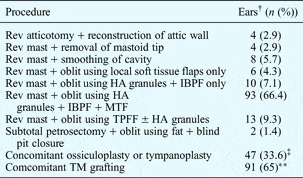
In the present cohort, two-thirds of the ears also received concomitant grafting or reinforcement of the tympanic membrane. The material of choice for the tympanoplasty was cartilage sheets or palisades to stiffen the tympanic membrane. Although the main purpose of the revision mastoidectomy was not to improve hearing, concomitant hearing restorative procedures were carried out in one-third of the ears at the same operation. Table II shows a summary of the surgical interventions performed on the present cohort.
Surgical procedures performed*

* Some ears received several procedures. †Of 140 ears studied. ‡13 total ossicular replacement procedures + 10 partial ossicular replacement procedures + 20 type III + 4 type IV. **59 cartilage + 28 fascia + 4 perichondrium. Rev = revision; mast = mastoidectomy; oblit = obliteration; HA = hydroxyapatite; IBPF = inferiorly based periosteal flap; MTF = mid-temporal flap; TPFF = temporo-parietal fascial flap; TM = tympanic membrane
Data analysis
In the analysis of otorrhoea, intermittent discharge was not categorized in the present study as “dry ear”. We performed cut-off analyses of the percentage of dry ear as well as intact tympanic membrane, at six months and one and three years post-operatively. Hearing outcomes at one year post-operatively were determined. Mean air conduction thresholds were determined using four-tone averages at 0.5, 1, 2 and 3 kHz, following the recommendations of the Committee on Hearing and Equilibrium.6
In general, residual or recurrent cholesteatoma takes longer to manifest. Hence, only a subset of ears operated upon before 2004 were included in the present analysis, as all the ears would have been given the chance to complete five years' follow up. Recurrent and residual cholesteatoma rates were studied using cut-off analysis at five years. Residual cholesteatoma usually took the form of an epithelial pearl arising from remnants of the cholesteatoma matrix left behind after the operation. Recurrent cholesteatoma was defined as a newly formed retraction pocket. In order to detect residual cholesteatoma beneath the hydroxyapatite granules, a 12-month post-operative computed tomography scan of the mastoid bone was performed on all patients with mastoid cavities obliterated with hydroxyapatite granules.Reference Yung and Karia7
Results
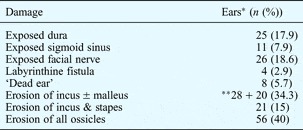
Of the 140 mastoid cavities, 125 were still discharging at the time of the revision mastoidectomy. Of these actively discharging ears, 60 were discharging from the mastoid segment, eight from the tympanic segment, and 57 from both the mastoid and tympanic segments. The bony covering of many important structures were found to be missing at surgery, making the performance of revision mastoidectomy hazardous. Many ears had exposed dura, sigmoid sinus or facial nerve (the latter was seen in almost one in five ears), and some ears had labyrinthine fistulae. Eight ‘dead ears’ were seen. Table III summarises the damage to important structures observed at the time of surgery. Only seven of the 140 ears (5 per cent) were found to have an intact ossicular chain.
Observed damage to important structures

*Of 140 ears studied.
**28 ears had erosion of incus; 20 ears with erosion of both incus and stapes.
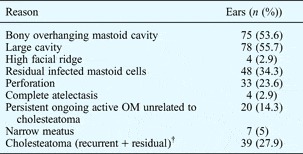
At surgery, the senior author attempted to identify the reasons for surgical failure. Table IV lists these apparent reasons. There were five cases of recurrent cholesteatoma, four of which consisted of retraction pockets at the location of the attic cartilage graft from previous atticotomies or attico-antrostomies. There were also 34 cases of residual cholesteatoma within the middle ear or the residual mastoid cells. In total, about one-quarter of the ears harboured cholesteatoma.
Reasons for surgical failureFootnote *

* Of the 140 ears studied, most mastoid cavities had multiple reasons for surgical failure. †n = 5 recurrent + 34 residual. OM = otitis media
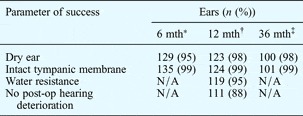
The main aims of revision mastoidectomy were to stop ear discharge and make the ear waterproof while preserving hearing. The post-operative parameters of success are listed in Table V, and included dry ear, intact tympanic membrane and water resistance. Twelve months after surgery, only six of the 140 ears (4.3 per cent) were still intolerant to water. Hearing preservation was defined in the present study as a ‘deterioration of air conduction threshold of no more than 10 dB following surgery’; this was another parameter of post-operative success. Table V shows hearing outcomes and water resistance 12 months post-operatively, and the presence of a dry ear and intact tympanic membrane at six months and one and three years post-operatively. No patients suffered facial palsy or a dead ear as a result of revision mastoidectomy.
Ears with successful revision mastoid surgery, assessed 6, 12 and 36 MTHS post-op

Not all ears from the original cohort of 140 cases were available for follow-up assessments at six, 12 and 36 months. *n = 136; †n = 125; ‡n = 102. Mth = months; post-op = post-operative; N/A = data not available
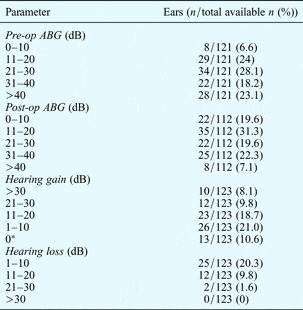
In the 140 ears studied, the mean pre-operative hearing level before surgery was 53.3 dB (standard deviation (SD), 20.4; 95 per cent confidence interval (CI), 13.4–93.2), and the mean pre-operative air–bone gap was 29.1 dB (SD, 13.6; 95 per cent CI, 3.4–54.8). Twelve months after surgery, the mean hearing level was 47.6 dB (SD, 21.6; 95 per cent CI, 5.3–89.9), the mean air–bone gap was 22.2 dB (SD, 12.2; 95 per cent CI, −1.8 to 46.2) and the mean hearing gain was 6.5 dB (SD, 16.0; 95 per cent CI, −24.9 to 37.9). In the 140 revision mastoidectomies studied, concomitant hearing restoration procedures were carried out in 44 cases (one in three cases) (see Table II). Table VI summarises the hearing gains and post-operative air–bone gaps observed one year post-operatively in the studied ears. Data on post-operative air–bone gap were not available for some ears because of difficulty in obtaining a reliable masked bone conduction threshold, e.g. for ears with severe sensorineural hearing loss. Overall, 36.6 per cent of the ears showed a hearing gain of 10 dB or more at 12 months post-operatively. Of the ears with air–bone gap data available, 50.9 per cent had a 12-month post-operative air–bone gap of 20 dB or less.
Hearing parameters 12 months after revision mastoidectomy

*Hearing unchanged since before operation. ABG = air–bone gap
One hundred ears (operated upon between 1988 and 2004) were eligible for the study of five-year data regarding recurrent or residual cholesteatoma. Of these, 18 ears were not available for five-year follow up. In the remaining 82 ears, there were two cases of residual cholesteatoma, manifesting two and six years after surgery. Another ear developed a false membrane in the attic area three years after surgery; keratin was trapped behind the membrane, and was regarded as a recurrent cholesteatoma. Hence, using cut-off analysis, the five-year cholesteatoma rate for the 82 analysable ears was 3.7 per cent.
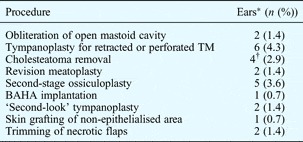
The study also recorded any further surgical ear interventions conducted following revision mastoidectomy. Table VII lists these subsequent surgical procedures. Seventeen ears (12.1 per cent) underwent further surgical procedures regarded as essential. Other procedures were regarded as non-essential but desirable, such as ossiculoplasty or bone-anchored hearing aid procedures.
Further surgery required after revision mastoidectomy

*Of 140 ears studied. †One cholesteatoma was from an ear operated upon in 2006. TM = tympanic membrane; BAHA = bone-anchored hearing aid
Discussion
Open cavity mastoidectomy is a commonly performed operation for cholesteatoma. However, the resultant mastoid cavities may create problems for some patients. The cavities need to be cleaned regularly to avoid excessive accumulation of cerumen. Some cavities are intolerant to water because of the caloric effect. Occasionally, the cavity may become infected, resulting in otorrhoea when the lining breaks down. In a study of the out-patient attendance pattern of open cavity mastoidectomy patients over a three-year period, Khalil and Windle-Taylor noted an average of 13.3 visits per patient; the majority of visits were for chronic cavity inflammation.Reference Khalil and Windle-Taylor2
Otorrhoea and clinician dependence were the main indications for revision mastoidectomies in the present cohort. It is also interesting that almost one-quarter of the patients wished to have treatment to make their ears water-resistant. Pre-operatively, cholesteatoma was noted in only 11 of the 140 ears, yet in reality 39 ears (around one-quarter of cases) had cholesteatoma discovered at the time of surgery. Many of these cholesteatomas were hidden behind an intact tympanic membrane or within residual mastoid cells. Therefore, the possibility of hidden cholesteatoma must be considered in a continuously discharging mastoid cavity.
Performance of a revision mastoidectomy procedure could be quite hazardous, as the normal anatomy is often distorted by infection and previous surgery. It is slightly surprising that only 3 per cent of ears in the present cohort had labyrinthine fistulae, taking into consideration the eight dead ears also present in this cohort. Many ears undergoing revision mastoidectomy have an exposed facial nerve, sigmoid sinus or tegmen dura. Therefore, revision mastoidectomy should be performed by experienced otologists and/or in tertiary referral centres. Although ossicular damage was found in the majority of cases, the senior author chose to perform single-stage ossiculoplasty in only 23 of the 140 ears.
In the present cohort, the three commonest causes for troublesome mastoid cavities were residual bony overhang, large mastoid cavity and the presence of residual mastoid cells. The presence of a bony overhang over a large, deep mastoid cavity hinders self-cleaning of the mastoid cavity and makes aural toilet difficult. Residual mastoid cells may harbour chronic inflammation or cholesteatoma. In the present cohort, 65 ears were found to be discharging from the tympanic segment. Some of these cases were due to perforation of the tympanic membrane, but some were due to active chronic otitis media existing behind an intact tympanic membrane. In general, the difficult part of the operation was often the removal of granulation from within the middle ear, rather than from the mastoid cavity.
The current study was not designed to determine whether one particular procedure was better than others. The senior author attempted to individualise each patient's surgery. As most ears in the present cohort had big mastoid cavities, elimination of the mastoid cavity was favoured, using the obliteration technique. All but 16 cavities in the present cohort were treated with mastoid obliteration, the majority using hydroxyapatite granules and the mid-temporal flap. Before obliterating the mastoid cavity, the mastoid cells were meticulously removed, especially around the labyrinthine block, the supra-facial area, the sino-dural angle and the mastoid tip. The senior author preferred using hydroxyapatite granules for obliteration because they maintain their volume over time.Reference Yung4 The mid-temporal flap is a pedicled flap based on the mid-temporal artery.Reference Yung and Smith5 In the experience of the senior author, the outcome of such flaps was predictably good, with re-epithelialisation of the flap within weeks of surgery. Patients could usually allow water into the ear within three months of surgery. Over the study period (1988–2008), the senior author experienced no major problems, e.g. undetected cholesteatoma hidden behind hydroxyapatite granules and resulting in intracranial complications. Tympanic membranes which were atrophic or retracted were stiffened using cartilage plates or palisades to prevent pars tensa retraction. Considering that 93.6 per cent of the mastoid cavities studied had otorrhoea before surgery, the reported medium-term results of revision mastoidectomy are excellent. Almost all the cavities had become dry, and 95 per cent had become water-resistant, by 12 months post-operatively. Furthermore, approximately 50 per cent had an air–bone gap of 20 dB or less.
• This case series study examined the reasons for discharging mastoid cavities, the operative findings during revision surgery and the medium-term outcome
• Troublesome mastoid cavities were due to large cavity size, bony overhang, residual infected mastoid cells, presence of cholesteatoma or perforations, and/or inadequate meatoplasty
• Revision mastoidectomy was highly successful in converting troublesome mastoid cavities into dry, water-resistant ears
One difficulty in reporting the incidence of recurrent or residual cholesteatoma is that such lesions take many years to manifest.Reference Stangerup, Drozdziewicz, Tos and Hogaard-Jensen8 Many patients may not comply with the follow-up regime. In this study, the five-year follow-up rate for the 100 eligible ears was 82 per cent. Using cut-off analysis, the rate of residual and recurrent cholesteatoma combined was 3.7 per cent.
In the present study, the outcome of revision mastoidectomy appeared to be excellent, with high rates of post-operative dry ear, intact tympanic membrane and water resistance. However, 25 of the 140 ears (17.9 per cent) required further surgery. Excluding ‘second-look’ procedures and second-stage hearing restorative procedures, 17 ears (12.1 per cent) had problems requiring further surgical correction. The main problems were residual cholesteatoma and retracted tympanic membrane.
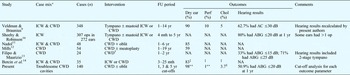
There are relatively few published reports on the outcome of revision mastoid surgery. Table VIII summarises the case mix and outcome of some of these studies. Direct comparison of these studies is not easy because of the different case mixes and follow-up periods employed.
Published studies on revision mastoidectomy outcomes

*Previous mastoid surgery. †With concomitant canal wall reconstruction or obliteration. ‡29/35 dry ears with no cholesteatoma. **At 1 year; §At 5 year. FU = follow-up; perf = perforation; chol = cholesteatoma; ICW = intact canal wall procedure; CWD = canal wall down procedure; tympano = tympanoplasty; mastoid = mastoidectomy; AC = air conduction threshold; op = operation; mth = months; NA = data not available; ABG = air-bone gap; oblit = obliteration.
Conclusion
This study found that, in general, revision mastoidectomy has a high success rate in converting troublesome mastoid cavities into dry, water-resistant ears. However, approximately 10 per cent of ears will eventually need further surgery. Also, hearing restoration may not be achievable in the majority of ears.