Transmission of multidrug-resistant organisms (MDROs) in long-term care facilities is an emerging challenge for infection control professionals. It has been made more complex by the significant amount of movement of residents between acute-care hospitals and long-term care facilities, where transmission and acquisition of hospital-acquired infections may occur frequently, including MDROs.Reference Smith, Bennett and Bradley 1 In our transmission dynamic analysis, the likelihood of methicillin-resistant Staphylococcus aureus (MRSA) transmission in long-term care facilities was 3 times higher than in hospital settings.Reference Cheng, Tai and Wong 2 With the advances in laboratory diagnostics, resident-to-resident transmissions have been documented more accurately by whole-genome sequencing, as illustrated in a cluster of MRSA isolates in a long-term care facility.Reference Stine, Burrowes, David, Johnson and Roghmann 3 Infection control measures against nosocomial transmission of MDROs currently focus on the most basic interventions, hand hygiene practice, and environmental cleanliness. Specifically, hand hygiene interventions have been shown to reduce infection transmission risks,Reference Hocine and Temime 4 , Reference Schweon, Edmonds, Kirk, Rowland and Acosta 5 but hand hygiene compliance has remained low in long-term care facilities. In Hong Kong, a multifaceted hand hygiene intervention with the provision of alcohol-based hand rub (ABHR), hand hygiene posters, training materials, and feedback was implemented in long-term care facilities.Reference Ho, Seto, Wong and Wong 6 Although the hand hygiene compliance improved from 27% to 60% during the study period, the prevalence of MDROs continued to increase, especially MRSA, which has risen from 21.6% to 32.2% in our long-term care facilities.Reference Cheng, Tai and Wong 2 , Reference Cheng, Chen and Ng 7 The effect of the WHO Five Moments hand hygiene campaign was not sustained, which may be attributed to the relatively low education level of staff in our long-term care facilities, where almost 50% of the staff have an education below the secondary level.Reference Chan, Luk, Chu and Chan 8
Directly observed hand hygiene (DOHH) with delivery of ABHR to conscious patients before meals and medication rounds by a designated healthcare worker, namely a hand hygiene ambassador,Reference Cheng, Tai and Li 9 has been evaluated in the hospital setting with proven success in the control of vancomycin-resistant enterococci (VRE) and multidrug-resistant Acinetobacter baumannii. Reference Cheng, Tai and Chau 10 , Reference Cheng, Chen and Poon 11 Therefore, we performed a cluster-randomized controlled trial to evaluate the practicality and effect of DOHH for residents in long-term care facilities, also known as residential care homes for the elderly (RCHEs) in our locality. Colonization with MDROs on the hands of residents were significantly associated with environmental contamination,Reference Patel, Mantey and Mody 12 and environmental contamination by MDROs have been shown to precede patients’ acquisition of MDROs.Reference Hardy, Oppenheim, Gossain, Gao and Hawkey 13 – Reference Cheng, Wong and Chen 15 We hypothesized that the degree of environmental contamination by MDROs would be significantly lower in the intervention arm than in the nonintervention arm during our serial monitoring throughout the study period. These findings may facilitate strategic planning of infection control programs in long-term care facilities.
METHODS
Setting
This cluster-randomized controlled study was conducted between July 1, 2017, and August 31, 2017, to assess the implementation of DOHH among 10 of the 65 RCHEs in a healthcare region in the Hong Kong Western District, which serves a population of 0.53 million. The study was conducted within a relatively short period in summer because the rate of hospitalization among residents is generally lower when the ambient temperature is higher in Hong Kong. The role of RCHEs was described previously.Reference Cheng, Tai and Wong 2 , Reference Cheng, Chen and Ng 7 Briefly, an RCHE is a long-term care facility that provides daily nursing care to residents, including the use of feeding tubes, urinary catheters, and other medical devices in Hong Kong. Community geriatric assessment teams (CGATs) comprising of a team of geriatricians, nurses, and allied health professionals provide regular on-site visits to the RCHEs to perform comprehensive medical assessments. A hospital infection control team and the Infection Control Branch of the Center for Health Protection provide recommendations on infection control measures. This study was approved by the Institutional Review Board of the University of Hong Kong/Hospital Authority Hong Kong West Hospital Cluster. Written consent was obtained from recruited residents.
Participants
Based on the prevalence survey of MDROs, including MRSA, VRE and carbapenem-resistant Acinetobacter spp (CRA), among RCHEs in July and August 2015,Reference Cheng, Chen and Ng 7 RCHEs of comparable size with similar prevalence of MDROs were selected to participate in this study (Supplementary Figure 1). We stratified the RCHEs into 2 groups according to their prevalence of MDROs (MRSA colonization <35% vs ≥35%), and their size as reflected by number of resident registrations. An RCHE was classified as small if it had 25–60 residents, moderate if it had 61–120 residents, and large if it had 121–180 residents. In each group, the RCHEs were randomized and allocated into the intervention arm or the nonintervention arm in a 1:1 ratio. The investigators, staff, and residents of the RCHEs were not blinded to the allocations. To establish the updated MDRO prevalence among residents and environment, research nurses who received prior training from the infection control team obtained nasal swabs, axillary swabs, rectal swabs, and environmental samples using sponge swabs according to a standard protocol as previously described.Reference Cheng, Chen and Ng 7 , Reference Cheng, Li and Wu 16 , Reference Cheng, Chen and Wong 17 Written consent forms were obtained from the participating residents. Subjects were excluded if they were not able to provide consent. Demographic information, dependency status, Barthel index, presence of indwelling devices and comorbidities were retrieved for each resident. History of hospitalization and antimicrobial usage in the prior 6 months were also analyzed. Risk factors for MDROs colonization among residents in RCHEs were assessed.
Intervention
In the intervention arm, DOHH was performed by a hand hygiene ambassador (a designated research nurse) immediately before meals and medication rounds in conscious residents and at 2-hour intervals between 9:00am and 6:00pm during weekdays in each RCHE. The hand hygiene ambassador delivered 3 mL ABHR to the hands of residents per occurrence of DOHH either at the communal areas or at the bedside. A pocket-sized 60-mL ABHR container was used by the research nurse, and standard-sized 500-mL ABHR containers were placed in the cubicle, corridor, and communal areas of RCHEs for the residents, staff, and visitors. The World Health Organization (WHO) formulation (I and II) of ABHR was used. In the nonintervention arm, DOHH was not performed, but the WHO formulation of ABHR was provided at each RCHE. In both the intervention and nonintervention arms, the volume of ABHR consumption was measured by the research nurses in all recruited RCHEs on a weekly basis during the entire study period as an indirect surrogate marker of hand hygiene compliance as previously described.Reference Cheng, Wong and Wong 18 The baseline volume of ABHR consumption by each RCHE was estimated from the purchase invoices of ABHR.
Environmental samples were also collected from 10 selected sites in the communal areas (cuff of the portable blood pressure machine, meal table top, activity table top, chair’s armrest, hand rail of corridor, and remote control of television), and staff area (staff station table top, computer keyboard and mouse, trolley top and handle, and telephone handle), respectively, twice weekly immediately before environmental cleaning in each RCHE. Environmental samples were collected using Polywipe sponge swabs 5 cm×10 cm in size (Medical Wire and Equipment, UK) as previously described.Reference Cheng, Chen and Wong 17 These swabs were sterile, premoistened, thin flexible sponges tailormade for sampling environmental surfaces. Each sampled sponge swab was placed in an individual sterile plastic bag, which was sealed and clearly labeled before further processing in the laboratory. The protocol of twice-daily environmental cleaning with sodium hypochlorite 500 ppm in each RCHE remained unchanged throughout the study period. The serial environmental culture results of MDROs in the communal areas were analyzed.
Laboratory Investigation
The screening specimens from the residents were processed, and suspected isolates of MRSA, CRA, and extended-spectrum β-lactamase (ESBL)–producing Enterobacteriaceae from nasal, axillary, groin, and rectal swabs were identified using standard techniques described previously.Reference Cheng, Chen and Ng 7 , Reference Cheng, Chan and Lau 19 We did not screen for VRE and CPE because of its low prevalence in our RCHE.Reference Cheng, Chen and Ng 7 , Reference Cheng, Chen and So 20 For each sponge swab, 2 mL sterile normal saline (0.85% sodium chloride) was added to the sterile plastic bag. The sponge was squeezed repeatedly for proper mixing, then 100 µL suspension was transferred from the bag for processing as previously described.Reference Cheng, Chen and Ng 7 , Reference Cheng, Chan and Lau 19
Statistical Analysis
The Fisher exact test and Student t test were used where appropriate. SPSS version 20 software (SPSS Institute, Cary, NC) was used to perform the statistical analyses. All reported P values were 2-sided. A P value of <.05 was considered statistically significant.
RESULTS
Baseline Characteristics
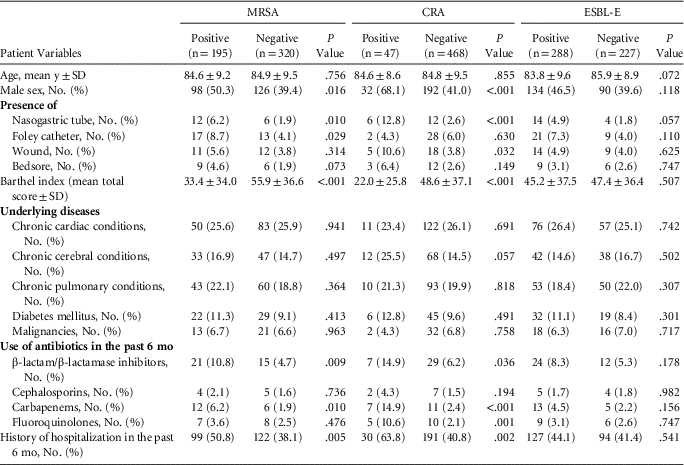
In this study, we randomized 5 RCHEs to the intervention arm and 5 RCHEs to the nonintervention control arm. The postrandomization baseline characteristics of the intervention and nonintervention arms were not statistically different (Supplementary Table 1). Of the 774 residents registered in 10 RCHEs in the healthcare region of the Hong Kong Western District, 515 (66.5%) consented for MDROs screening. The cohort consisted of 291 women (56.5%) and 224 men (43.5%), with an overall mean age of 84.7±9.4 years. At baseline, the prevalence of MRSA was 37.9%; the prevalence of CRA was 9.1%, and the prevalence of ESBL-producing Enterobacteriaceae was 55.9%. Overall, 369 of 515 residents (71.7%) were colonized with at least 1 MDRO. The bedside environmental samples from the bedside rails of 515 residents were found to be contaminated by MRSA (14.4% of samples), CRA (7.6%), and ESBL-producing Enterobacteriaceae (0.6%). Samples from the table tops of these residents were also contaminated by MRSA (17.9% of samples), CRA (9.5%), and ESBL-producing Enterobacteriaceae (1.4%). For residents known to be colonized with MRSA, in their bedside environment, MRSA cultured positive for 26.7% of bedside rail samples and 33.3% of table top samples. For residents known to be colonized with CRA, the prevalence of CRA was 36.2% for bedside rails and 38.3% for table tops. For residents known to be colonized with ESBL-producing Enterobacteriaceae, the prevalence of ESBL-producing Enterobacteriaceae was 1.0% for bedside rails and 2.1% for table tops. At baseline, positive culture results were noted from the communal environment, where 33 of 100 swabs yielded MRSA (33%), 26 of 100 swabs yielded CRA (26%), and 3 of 100 swabs yielded ESBL-producing Enterobacteriaceae (3%). The epidemiological characteristics of these 515 residents, as well as the risk factors for MRSA, CRA, and ESBL-producing Enterobacteriaceae colonization are illustrated in Table 1 and Supplementary Table.
Epidemiological Characteristics of Residents Colonized With Multidrug-Resistant Organisms in the Residential Care Home for the Elderly in Both Intervention Arm (5 Homes) and Nonintervention Arm (5 Homes)

NOTE. CRA, carbapenem-resistant Acinetobacter spp; ESBL-E; extended-spectrum β-lactamase-producing Enterobacteriaceae; MDROs, multidrug-resistant organisms; MRSA, methicillin-resistant Staphylococcus aureus; SD, standard deviation.
Reduction of Environmental Contamination
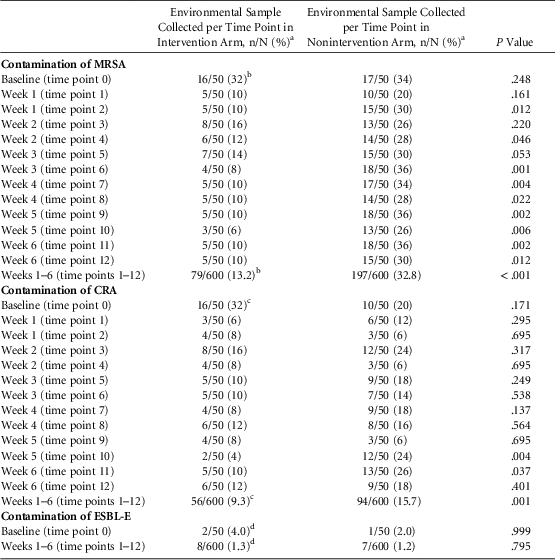
Serial environmental specimens in the communal areas revealed a significant reduction of environmental MRSA contamination in the intervention arm when compared with the nonintervention arm during the study period: 79 of 600 (13.2%) versus 197 of 600 (32.8%) (P<.001) (Table 2). In addition, a significant reduction of environmental CRA contamination was observed in the intervention arm compared with the nonintervention arm during the study period: 56 of 600 (9.3%) versus 94 of 600 (15.7%) (P=.001).
Serial Monitoring of Environmental Contamination in Communal Areas by Multidrug-Resistant Organisms in 10 Residential Care Homes for the Elderly Under the Category of Intervention Arm (5 Homes) and Nonintervention Arm (5 Homes)

NOTE. CRA, carbapenem-resistant Acinetobacter spp; ESBL-E; extended-spectrum β-lactamase–producing Enterobacteriaceae; MRSA, methicillin-resistant Staphylococcus aureus.
a 10 selected sites in the communal area (ie, cuff of the portable blood pressure machine, meal table top, activity table top, chair’s armrest, hand rail of corridor, and remote control of television) and staff area (ie, staff station table top, computer keyboard and mouse, trolley top and handle, and telephone handle) twice weekly immediately before environmental cleanliness in each RCHE. A total of 50 environmental samples were collected in 5 RCHEs in the intervention arm and another 50 environmental samples were collected in 5 RCHEs in the nonintervention arm at each time point.
b A significant reduction in environmental MRSA contamination in the intervention arm compared with the baseline (79/600, 13.2% vs 16/50, 32.0%; P=.005).
c A significant reduction in environmental CRA contamination in the intervention arm compared with the baseline (56/600, 9.3% vs 16/50, 32.0%; P<.001).
d No significant difference of environmental ESBL-producing Enterobacteriaceae contamination between baseline and study period in the intervention arm (P=.176).
Consumption of Alcohol-Based Hand Rub
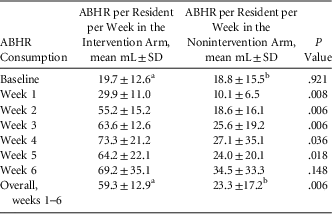
With the implementation of DOHH in the intervention arm during the study period, the volume of ABHR consumed per resident per week was 3 times higher in the intervention arm compared with the baseline (59.3±12.9 mL vs 19.7±12.6 mL; P<.001) and was significantly higher than the nonintervention arm (59.3±12.9 mL vs 23.3±17.2 mL; (P=.006) (Table 3). In the nonintervention arm, no significant difference was noted in ABHR consumption compared with the baseline (23.3±17.2 mL vs 18.8±15.5; P=.207).
Consumption of Volume of Alcohol-Based Hand Rub (ABHR) per Conscious Resident per Week in 10 Residential Care Homes for the Elderly Under the Category of Intervention Arm (5 Homes) and Nonintervention Arm (5 Homes)

NOTE. SD, standard deviation.
a The volume of ABHR consumption per resident per week was statistically higher compared with the baseline (P<.001).
b The volume of ABHR consumption per resident per week was not statistically difference compared with the baseline (P=.207).
DISCUSSION
With the implementation of DOHH by hand hygiene ambassadors in the RCHEs, we have demonstrated a significant reduction of environmental contamination of MRSA and CRA in the communal environment of the RCHEs. In fact, RCHEs are important reservoirs for MDROs. As illustrated in this study, environmental contamination rates of MRSA, CRA, and ESBL-producing Enterobacteriaceae were 33%, 26%, and 3%, respectively, in the communal areas, while the rates of resident colonization by MRSA, CRA, and ESBL-producing Enterobacteriaceae, reached 38%, 9%, and 56%, respectively.
The burden of MDROs in Hong Kong is comparatively higher than in many European countriesReference Aschbacher, Pagani and Confalonieri 21 or in the United States.Reference Cassone and Mody 22 The high prevalence of MDROs in our RCHEs may be multifactorial. First, overcrowding is a significant problem in Hong Kong, and we have previously shown that the prevalence of MRSA in RCHEs was inversely associated with the average living area (square feet per person) per RCHE resident.Reference Cheng, Tai and Wong 2 One-third of sites sampled from the communal area of the RCHE were shown to be culture positive for MRSA, which was twice the corresponding figure in nursing homes in the United States.Reference Murphy, Eells and Quan 23 Because communal areas have a high contamination rate, secondary contamination of the surrounding patients may occur regardless of the patient’s MRSA status. Data on environmental contamination by CRA in long-term care facilities or nursing homes remained limited in the literature. However, we noticed that CRA contamination was up to 26% in the RCHE environment. The degree of contamination was even more astounding in the context of a lower resident colonization rate of 9%, and CRA has been an emerging threat in RCHEs in recent years.Reference Cheng, Chen and Ng 7 Second, the frequent movements of residents between RCHEs and acute-care hospitals may further increase the risk of MDRO acquisition and a previous study showed that a significant fraction of RCHE residents acquired MDRO colonization or infection during their stay in acute-care hospitals.Reference Kahvecioglu, Ramiah and McMaughan 24 Nearly 50% of our residents have a history of hospitalization in the 6 months prior to the study. The use of broad-spectrum antibiotics, especially β-lactam-β-lactamase inhibitors and carbapenems, was also invariably a risk factor for MRSA and CRA colonization in this study. In addition, residents colonized with MRSA and CRA were more dependent in daily activity as evidenced by a significantly lower Barthel index, which was similar to another recent finding.Reference Rollnik, Bertram and Bucka 25
To control the emergence of MDROs in RCHEs, effective infection control programs are required in both RCHEs and acute-care hospitals. Proactive infection control measures have been promulgated in our acute-care hospitals to combat emerging VRE and CPE with success.Reference Cheng, Tai and Chen 26 , Reference Cheng, Chan and Wong 27 This may explain the very low prevalence of VRE and CPE in our RCHEs.Reference Cheng, Chen and Ng 7 We believe that the promotion of proactive infection control measures have greatly reduced the risk of hospital outbreaks due to epidemiologically important viruses and MDROs and that these measurements can be applied to our RCHEs.Reference Cheng, Tai and Wong 28
Of these proactive infection control measures, the use of DOHH in all conscious hospitalized patients before meal and medication rounds is a promising strategy.Reference Cheng, Wong, Ho and Yuen 29 The compliance of hand hygiene among hospitalized patients or residents in RCHEs can be assured if the ABHR is delivered directly by the healthcare workers at these most critical times. Therefore, we implemented DOHH in the RCHEs and evaluated its effect through this randomized control trial. A hand hygiene ambassador was responsible for delivering 3 mL ABHR to all conscious residents on a regular basis and before meal and medication rounds. This measure was well received by the residents. It was shown to reduce the risk of oral ingestion of MDROs via contaminated hands, and vice versa because there is lower risk of environmental contamination when fewer residents are carrying MDROs.Reference Patel, Mantey and Mody 12 Throughout the study period, the proportion of environmental samples culture positive with MRSA and CRA was significantly lower in the RCHEs with DOHH (intervention arm) than in those without (nonintervention arm). The volume of ABHR delivered per resident per week was also significantly higher in the intervention arm.
This study has several limitations. First, the study period was only 8 weeks, thus the long-term impact of this intervention could not be assessed. Second, although the reduction of environmental contamination by MRSA and CRA in the intervention arm showed an immediate and promising effect of DOHH, we could not exclude the possibility of spillage of ABHR onto the sampled surfaces resulting in reduced contamination by inadvertently disinfecting surfaces.Reference Adams, Smith, Watson, Robertson and Dancer 30 Third, the change of environmental contamination by ESBL-producing Enterobacteriaceae was not obvious in this study. Despite a high prevalence of residents colonized with ESBL-producing Enterobacteriaceae, a disproportionally low culture-positive rate of ESBL-producing Enterobacteriaceae in the environment was noted. This could be due to the shorter duration of viability of Enterobacteriaceae on hands and inanimate surface, compared with Staphylococcus aureus and Acinetobacter spp.Reference Kampf and Kramer 31 , Reference Kramer, Schwebke and Kampf 32 Finally, the infection control program required a hand hygiene ambassador assigned to facilitate DOHH. This may affect the practicality of routine implementation of such strategies in RCHEs. Further study is warranted to investigate the cost-effectiveness of the implementation of DOHH in the control of MDROs in RCHEs.
ACKNOWLEDGMENTS
Financial support: This study was partially supported by the Health and Medical Research Fund (HMRF), Food and Health Bureau, Hong Kong SAR Government (grant no. HKM-15-M12), and the Infection Control Branch of Centre for Health Protection, Department of Health, Hong Kong SAR Government.
Potential conflicts of interest: All authors report no conflicts of interest relevant to this article.
SUPPLEMENTARY MATERIAL
To view supplementary material for this article, please visit https://doi.org/10.1017/ice.2018.21.