Introduction
Neuropsychiatric disturbances including affective symptoms, delusions, hallucinations, aggression, and agitation affect 12.2%–74.1% of patients with Alzheimer disease (AD) and other forms of dementia (Ropacki and Jeste, Reference Ropacki and Jeste2005). Currently, there is no general consensus on the optimal pharmacological treatment for the Behavioral and Psychological Symptoms of Dementia (BPSD) (Haupt et al., Reference Haupt, Cruz-Jentoft and Jeste2006); nevertheless, antipsychotic agents are commonly prescribed in the clinical practice, despite no FDA indication. Some concerns in the use of such drugs arose from the association between antipsychotic agents and cardio- and cerebrovascular side effects (Stollberger et al., Reference Stollberger, Huber and Finsterer2005; Salzman et al., Reference Salzman2008), which resulted in a small increased risk of death (Schneider et al., Reference Schneider, Dagerman and Insel2005; Wang et al., Reference Wang2005; Kales et al., Reference Kales2012) even if causality is not proven.
In older adults, the use of Second Generation Antipsychotics (SGAs) is usually preferred, due to their fewer neurological adverse events and similar effectiveness compared with First Generation Antipsychotics (FGAs). SGAs, however, are associated with more severe metabolic side effects than FGAs are (Alexopoulos et al., Reference Alexopoulos, Streim, Carpenter and Docherty2004; Sink et al., Reference Sink, Holden and Yaffe2005; Peuskens et al., Reference Peuskens, Gillain, De Graeve, Van Vleymen and Albert2009). Indeed, a significant body of data has been published about adverse metabolic consequences of the use of clozapine, olanzapine, quetiapine, and risperidone in adult individuals affected by severe and persistent mental illness. These effects include weight gain, glucose intolerance or type 2 diabetes mellitus (DM), hyperlipidemia, and metabolic syndrome (Henderson and Doraiswamy, Reference Henderson and Doraiswamy2008; Sicras-Mainar et al., Reference Sicras-Mainar, Blanca-Tamayo, Rejas-Gutierrez and Navarro-Artieda2008; Tarricone et al., Reference Tarricone, Ferrari Gozzi, Serretti, Grieco and Berardi2010).
Low potency FGA drugs together with clozapine and olanzapine are associated with the highest risk of weight gain, in studies conducted with young adults (Allison and Casey, Reference Allison and Casey2001; Lieberman et al., Reference Lieberman2005; Newcomer, Reference Newcomer2007a; 2007b; Tarricone et al., Reference Tarricone, Ferrari Gozzi, Serretti, Grieco and Berardi2010). More recently, two new drugs, aripiprazole and ziprasidone, have been associated with lower rates of adverse metabolic effects than other SGAs (Kudla et al., Reference Kudla, Lambert, Domin, Kasper and Naber2007; L'Italien et al., 2007; Newcomer, Reference Newcomer2007a; 2007b; Makhzoumi et al., Reference Makhzoumi, McLean, Lee and Ibe2008).
In terms of specific findings, the prevalence of DM is two- to four-fold higher in patients with schizophrenia than in the general population (Keskiner et al., Reference Keskiner, el-Toumi and Bousquet1973). Young adult patients with schizophrenia treated with antipsychotics, particularly SGAs, have shown the additional risks of developing hyperglycemia and DM especially with clozapine and olanzapine (Bottai et al., Reference Bottai, Quintin and Perrin2005; Scheen and De Hert, 2007).
Some studies have shown that clozapine and olanzapine are also associated with a pro-atherogenic lipid profile, including increased levels of triglyceride (TG) and low-density lipoprotein cholesterol (LDL-C), and decreased high-density lipoprotein cholesterol (HDL-C). Conversely, risperidone is associated with a lower risk of hyperlipidemia whereas quetiapine tends to increase serum TG, although it has fewer effects on total cholesterol (TC) (Meyer and Koro, Reference Meyer and Koro2004; Koro and Meyer, Reference Koro and Meyer2005; de Leon et al., 2007; Newcomer, Reference Newcomer2007b; Scheen and De Hert, 2007).
These data have been mainly obtained in samples of young-adult patients with schizophrenia or bipolar disorder treated for decades for psychotic symptoms. Conversely, much less is known about the metabolic side effects of antipsychotic drugs in older adults.
In general, it is known that older patients are at increased risk for malnutrition, tend to have lower basal metabolism (Henry, Reference Henry2000) and reduced liver and kidney function (Katona, Reference Katona2001). First, older persons might have a reduced pharmaco-tolerance to metabolic side effects compared to young adults. Second, somatic comorbidities might reduce absorption and differences in body composition (e.g. fat vs. lean mass) and might impair drugs distribution, whereas polypharmacy might lead to adverse drugs interactions. It is therefore plausible that metabolic side effects observed among older individuals might differ from those typically presented by adult populations. In order to verify this hypothesis, we implemented a comprehensive review of the literature.
Our specific aim was of describing the current state of knowledge on the effects of antipsychotic drugs on (1) body weight, (2) glycemia, and (3) serum lipids in older individuals affected by dementia.
Material and methods
Search strategy for study identification
A Medline, Embase, PsycInfo, and Cochrane Library database search (January 1996–December 2012) was conducted to identify studies reporting data on the metabolic side effects of antipsychotic use in elderly individuals with dementia.
The search terms used were: “antipsychotic agents” [MeSH, including “antipsychotic drugs,” “antipsychotics,” “neuroleptics”], and “aged” and “aged, 80 and over” [MeSH], and “therapeutic use” or “antipsychotic agents and geriatric population” or “antipsychotic agents and Alzheimer disease” or “antipsychotic agents and dementia.” The search was supplemented by additional relevant papers identified through a manual reference list search conducted for all the retrieved review articles. Only English-language publications were considered.
Selection and inclusion criteria
Inclusion criteria:
(1) published experimental and naturalistic studies addressing the metabolic side effects of antipsychotics;
(2) study participants meeting the criteria for dementia according to ICD 10 (International classification of disease; World Health Organization, 1992), DSM III, DSM IV (Diagnostic and Statistical Manual of Mental Disorders; American Psychiatric Association, 2000), NINCDS-ADRDA (National Institute of Neurological and Communicative Disorders and Stroke-Alzheimer's Disease and Related Disorders Association; McKhann et al., 1984), and NINDS-AIREN (Association Internationale pour la Recherché et l'Ensegnement; Roman et al., 1993) criteria for possible or probable AD.
(3) studies including samples of institutionalized patients or outpatients;
(4) enrollment protocols using antipsychotic drugs as compared to:
a) placebo
b) other antipsychotic drugs; and
(5) studies evaluating weight at baseline or/and metabolic parameters (cholesterol, triglyceride, or glucose levels) with at least one follow up.
We first examined the metabolic changes reported in all the included studies, and successively we considered drug metabolic effects by dividing the studies into four groups: (1) institutionalized patients, (2) outpatients, (3) patients with severe cognitive impairment (Mini-Mental State Examination, MMSE <14; Folstein et al., Reference Folstein, Folstein and McHugh1975), and (4) patients with mild/moderate cognitive impairment (MMSE ≥14).
These four groups were created since older individuals with severe dementia might reduce their caloric intake due to poor appetite and/or difficulties in feeding themselves (van Staveren et al., Reference van Staveren, de Graaf and de Groot2002) and this could confound metabolic parameters. On the other hand, especially in the advanced stages of the disease, elderly people with dementia are more likely to live in nursing homes having their diet and caloric intake closely monitored. Based on this hypothesis, we divided the articles by dementia severity and patient allocation with the aim of understanding whether the metabolic side effects related to antipsychotics use was consistent.
We excluded studies enrolling patients with dementia associated with other neuropsychiatric conditions (e.g. Parkinson disease, residual schizophrenia, and other psychotic disorders).
Results
The search strategy retrieved 2,043 articles (including 325 reviews). Analysis of abstracts and/or of the entire articles yielded 27 of interest.
Briefly, out of 27 articles, 16 were drug-placebo randomized controlled trials (RCTs); five were drug–drug RCTs (Fontaine et al., Reference Fontaine, Hynan, Koch, Martin-Cook, Svetlik and Weiner2003; Gareri et al., Reference Gareri2004; Verhey et al., Reference Verhey, Verkaaik and Lousberg2006; Rainer et al., Reference Rainer, Haushofer, Pfolz, Struhal and Wick2007; Jalbert et al., Reference Jalbert, Daiello, Eaton, Miller and Lapane2011); two were open-label studies (Moretti et al., Reference Moretti, Torre, Antonello, Cattaruzza and Cazzato2005; Lim et al., Reference Lim, Pae, Lee and Lee2006); and four had a retrospective design (Goldberg, Reference Goldberg2001; Gurevitz et al., Reference Gurevitz, Costakis and Leiter2004; Rondanelli et al., Reference Rondanelli2006; Rocca et al., Reference Rocca, Marino, Montemagni, Perrone and Bogetto2007). The age of patients included into these studies ranged from 75.1 to 84.4 years. With the exception of one study (Moretti et al., Reference Moretti, Torre, Antonello, Cattaruzza and Cazzato2005), a relatively higher proportion of women (55%–81%) was enrolled.
Twenty studies had a mean follow-up duration ≤11 weeks, while seven lasted up to one year (Goldberg, Reference Goldberg2001; Kennedy et al., Reference Kennedy2005; Moretti et al., Reference Moretti, Torre, Antonello, Cattaruzza and Cazzato2005; Rondanelli et al., Reference Rondanelli2006; Rocca et al., Reference Rocca, Marino, Montemagni, Perrone and Bogetto2007; Zheng et al., Reference Zheng2009; Jalbert et al., Reference Jalbert, Daiello, Eaton, Miller and Lapane2011). Twelve studies included only patients with a diagnosis of AD, whereas 14 articles also included cases of vascular (VaD) or mixed dementia; one study (Moretti et al., Reference Moretti, Torre, Antonello, Cattaruzza and Cazzato2005) examined only patients with VaD.
Dementia severity and setting (in- or outpatients) varied widely per study as described in Table 1.
Summary of the studies reviewed based on setting and MMSE
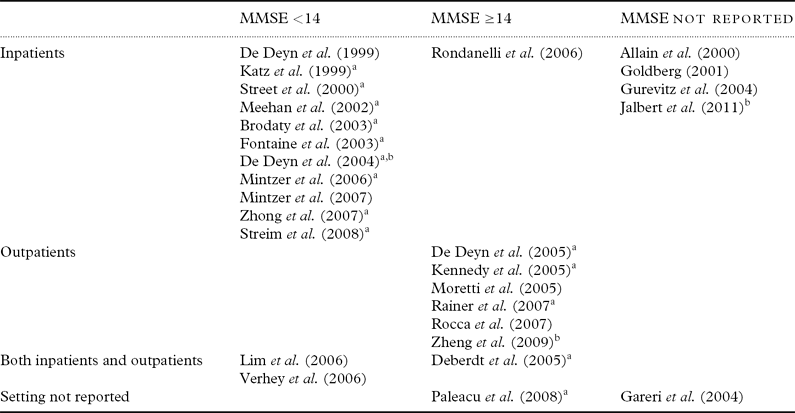
aGranted by pharmaceutical companies.
bStatistical significance reported.
MMSE = Mini-Mental State Examination.
Sixteen studies involved institutionalized patients, eleven with MMSE <14, and one with MMSE >14 (Rondanelli et al., Reference Rondanelli2006). Four did not report MMSE score (Allain et al., Reference Allain, Dautzenberg, Maurer, Schuck, Bonhomme and Gerard2000; Goldberg, Reference Goldberg2001; Jalbert et al., Reference Jalbert, Daiello, Eaton, Miller and Lapane2011), six studies (De Deyn et al., 2005; Moretti et al., Reference Moretti, Torre, Antonello, Cattaruzza and Cazzato2005; Rainer et al., Reference Rainer, Haushofer, Pfolz, Struhal and Wick2007; Rocca et al., Reference Rocca, Marino, Montemagni, Perrone and Bogetto2007; Zheng et al., Reference Zheng2009) described outpatients, while three examined both in- and outpatients (Deberdt et al., Reference Deberdt2005; Kennedy et al., Reference Kennedy2005; Lim et al., Reference Lim, Pae, Lee and Lee2006; Verhey et al., Reference Verhey, Verkaaik and Lousberg2006). Two studies did not report information about the setting (Gareri et al., Reference Gareri2004; Paleacu et al., Reference Paleacu, Barak, Mirecky and Mazeh2008).
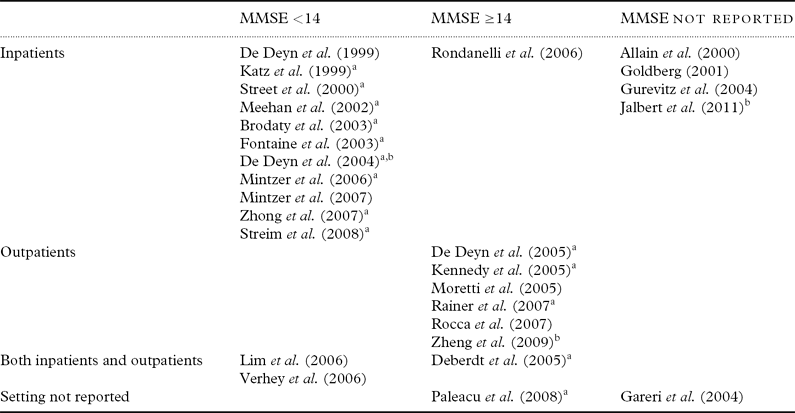
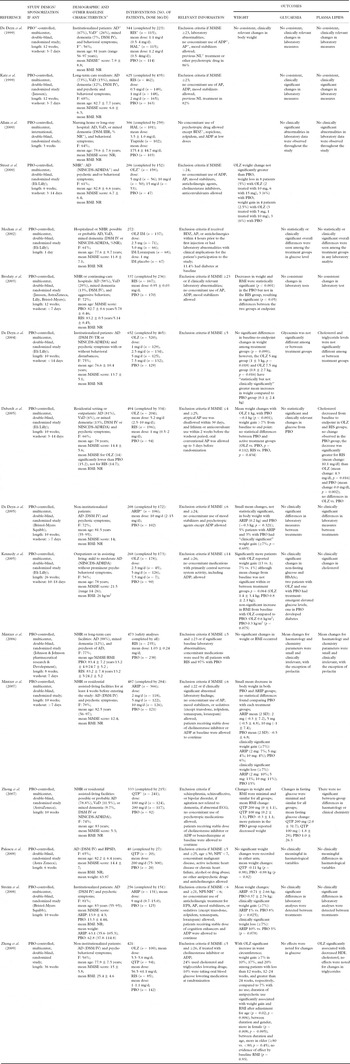
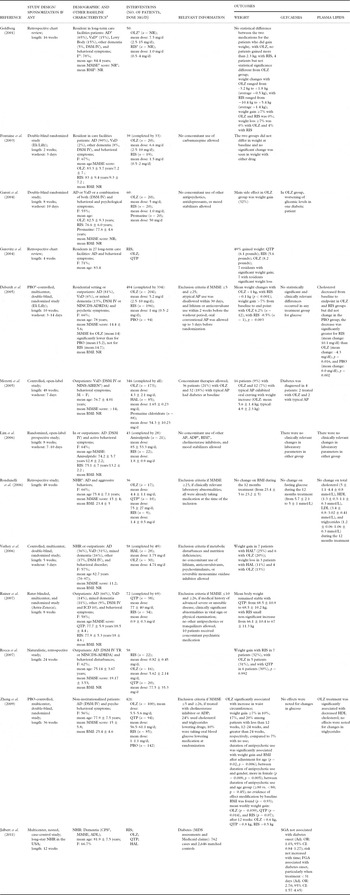
Four studies excluded patients with baseline laboratory abnormalities (De Deyn et al., 1999; Brodaty et al., Reference Brodaty2003; Mintzer et al., Reference Mintzer2006; 2007). One study significantly differed from the others due to its short duration (one day), and to the use of intramuscular drug administration (Meehan et al., Reference Meehan2002). More details on the studies are reported in Tables 2 and 3.
Comparison of metabolic effects between antipsychotic drugs and placebo in patients with dementia and BPSD

*Setting, diagnosis, and criteria adopted; mean age in years ± SD or (range); gender % female F; mean MMSE score ± SD; mean BMI score ± SD; mean weight in kilograms.
PBO = placebo; AD = Alzheimer dementia; VaD = Vascular Dementia; ADP = antidepressant; HAL = Haloperidol; AP = antipsychotic; ARIP = aripiprazole; NL = neuroleptic; OLZ = olanzapine; IM = intra-muscular; QTP = quetiapine; RIS = risperidone; F = female; M = male; MMSE = Mini-Mental State Examination; NR = not reported; NHR = nursing home residents; BDZ = Benzodiazepine; NINCDS-ADRDA = National Institute of Neurological and Communicative Disorders and Stroke-Alzheimer's Disease and Related Disorders Association criteria for possible or probable AD; NINDS-AIREN = Association Internationale pour la Recherché etl'Ensegnement; NPI-NH = Neuropsychiatric Inventory-Nursing Home Version scale.
Comparison of metabolic effects between different antipsychotic drugs in patients with dementia and BPSD

aSetting, diagnosis, and criteria adopted; mean age in years ± SD or (range); gender % female F; mean MMSE score ± SD; mean BMI score ± SD; mean weight in kilograms.
AD = Alzheimer dementia; VaD = Vascular Dementia; ADP = antidepressant; AP = antipsychotic; ARIP = aripiprazole; HAL = haloperidol; NL = neuroleptic; OLZ = olanzapine; PBO = placebo; QTP = quetiapine; RI = risperidone; F = female; M = male; MMSE = Mini-Mental State Examination; NR = not reported; NHR = nursing home residents; BDZ = Benzodiazepine; NINCDS-ADRDA = National Institute of Neurological and Communicative Disorders and Stroke-Alzheimer's Disease and Related Disorders Association criteria for possible or probable AD; NINDS-AIREN = Association Internationale pour la Recherché etl'Ensegnement; NPI-NH = Neuropsychiatric Inventory-Nursing Home Version; CPS = Cognitive Performance Scale.
Body weight
Drug-placebo comparison (data from 13 studies)
Four studies (De Deyn et al., 2004; Deberdt et al., Reference Deberdt2005; Kennedy et al., Reference Kennedy2005; Zheng et al., Reference Zheng2009) reported weight increases in the antipsychotic treatment arms (see Table 2). Specifically, Kennedy et al. (Reference Kennedy2005) observed a significantly higher proportion of patients treated with olanzapine reporting weight gain over 26 weeks, as compared to placebo (7% vs. 1%), although the differences in mean weight gain were not significant (mean BMI increase +0.6 kg/m2 vs. +0.3 kg/m2; p: 0.075). Deberdt et al. (Reference Deberdt2005) observed significant weight gain in older patients treated with olanzapine, as compared to placebo (1 kg vs. −0.1 kg) over ten weeks.
Data from the Clinical Antipsychotic Trials of Intervention Effectiveness-Alzheimer Disease (CATIE-AD; Zheng et al., 2009) documented that SGA use was associated with weight gain, and the probability of gaining weight increased with increasing length of follow up. The odds ratio (OR), 95% confidence interval (CI) was 1.53 (0.53–4.58) for use duration ≤12 weeks, 2.89 (0.97–8.64) for use duration between 12 and 24 weeks, and 3.38 (1.24–9.23) for use duration >24 weeks. Previous findings on the same cohort (Schneider et al., Reference Schneider2006) had estimated body weight and BMI increase per month (due to antipsychotic drug) of 0.18–0.45 kg and 0.2 BMI units, respectively (Schneider et al., Reference Schneider2006; Zheng et al., Reference Zheng2009).
De Deyn et al. (2004) reported that patients treated with olanzapine for ten weeks (5 and 7.5 mg/day) showed significant mean body weight increases (1 kg and 0.8 kg, respectively) as compared to placebo (0.1 kg).
Conversely, Brodaty et al. (Reference Brodaty2003) found significant weight and BMI decreases in the placebo group, but not in the risperidone group.
Streim et al. (Reference Streim2008) showed a weight loss (≥7%) with aripripazole as compared to placebo (p = 0.078).
Finally, in five studies (Street et al., Reference Street2000; De Deyn et al., 2005; Mintzer et al., Reference Mintzer2007; Zheng et al., Reference Zheng2009) no significant differences in baseline to endpoint body weight changes was observed, while in two studies (De Deyn et al., 1999; Mintzer et al., Reference Mintzer2006) authors merely reported “no clinical or significant changes in body weight.”
Drug–drug comparison (data from 11 studies)
A RCT conducted by Deberdt et al. (Reference Deberdt2005) found a significant weight gain in patients treated with olanzapine as compared to risperidone (+1.0 kg vs. +0.1 kg over ten weeks; see Table 3).
Gareri et al. (Reference Gareri2004) found weight gain in 32% olanzapine treated patients but not in risperidone and promazine treated patients after eight weeks.
On the contrary, six SGA studies (Goldberg, Reference Goldberg2001; Fontaine et al., Reference Fontaine, Hynan, Koch, Martin-Cook, Svetlik and Weiner2003; Rondanelli et al., Reference Rondanelli2006; Rainer et al., Reference Rainer, Haushofer, Pfolz, Struhal and Wick2007; Rocca et al., Reference Rocca, Marino, Montemagni, Perrone and Bogetto2007; Zheng et al., Reference Zheng2009) found no significant body weight changes between different treatment groups.
Goldberg (Reference Goldberg2001) in a 16-week retrospective chart review found weight changes with olanzapine of −0.5 kg (from −3.2 kg to + 1.8 kg) and with risperidone of −1.4 kg (from −10.4 kg to +5.4 kg). Gurevitz et al. (Reference Gurevitz, Costakis and Leiter2004) did not observe any significant weight change in individuals receiving risperidone, olanzapine, or quetiapine although seven persons demonstrated some weight gain and seven some degree of weight loss.
Two studies reported similar proportion of patients with weight gain among both FGA and SGA groups (Moretti et al., Reference Moretti, Torre, Antonello, Cattaruzza and Cazzato2005; Verhey et al., Reference Verhey, Verkaaik and Lousberg2006).
Glucose homeostasis
Drug-placebo comparison (data from 14 studies)
Kennedy et al. (Reference Kennedy2005) detected a “treatment emergent elevation” in glucose levels in two patients after 26 weeks of olanzapine treatment and in one patient treated with placebo, but no data on serum glucose concentration were provided (see Table 2). Overall, the Authors concluded that “no clinically significant changes in non-fasting glucose and HbA1c were observed.” Zheng et al. (Reference Zheng2009) reported that “changes in fasting glucose were minimal and similar for all groups.”
Four studies mentioned glucose metabolism but did not report actual glycemia levels. They stated “no differences among or between treatment groups in glucose level” (Meehan et al., Reference Meehan2002; De Deyn et al., 2004; Deberdt et al., Reference Deberdt2005) or “no effects were noted for changes in glucose” (Zheng et al., Reference Zheng2009).
Lastly, eight studies merely reported “no change on laboratory tests or in hematology and chemistry” without mentioning glucose homeostasis (De Deyn et al., 1999; Katz et al., Reference Katz, Jeste, Mintzer, Clyde, Napolitano and Brecher1999; Allain et al., Reference Allain, Dautzenberg, Maurer, Schuck, Bonhomme and Gerard2000; Brodaty et al., Reference Brodaty2003; De Deyn et al., 2005; Mintzer et al., Reference Mintzer2006; Paleacu et al., Reference Paleacu, Barak, Mirecky and Mazeh2008; Streim et al., Reference Streim2008).
Drug–drug comparison (data from seven studies)
In a 12-month long, controlled, open-label study including patients without DM at baseline, Moretti et al. (Reference Moretti, Torre, Antonello, Cattaruzza and Cazzato2005) detected two new cases of DM among 173 patients treated with olanzapine and two new cases among 85 patients treated with typical antipsychotics (see Table 3).
In an eight-week randomized double-blind study, Gareri et al. (Reference Gareri2004) found a worsening of glycemic levels in one diabetic patient treated with olanzapine.
In the nested case-control study by Jalbert et al. (Reference Jalbert, Daiello, Eaton, Miller and Lapane2011), an increased diabetes risk was found for people treated with FGA, especially within 30 days, but not for those treated with SGA.
Other four studies reported data on glucose homeostasis; of them, two were RCTs. The first showed no differences in “non-fasting glucose concentration among treatment groups” (Deberdt et al., Reference Deberdt2005) and the second reported: “no effects were noted for changes in glucose” (Streim et al., Reference Streim2008). The third study had a retrospective design, and provided specific glucose data; no changes in fasting glucose over a 12-month period were reported (Rondanelli et al., Reference Rondanelli2006). The fourth study merely reported “no clinically relevant changes in laboratory parameters (Lim et al., Reference Lim, Pae, Lee and Lee2006).”
Serum lipids
Drug-placebo comparison (data from 14 studies)
Deberdt et al. (Reference Deberdt2005) observed a baseline-to-endpoint decrease of TC in patients treated with olanzapine and risperidone, but not in the placebo group; risperidone showed a significantly higher decrease in TC levels (see Table 2). One study (De Deyn et al., 2004) merely reported “no significant changes in TC and TG” and another study (Kennedy et al., Reference Kennedy2005) found “no clinically significant change in TC,” without reporting data, however; and ten studies simply mentioned “no change in laboratory measures or in hematology or chemistry” (De Deyn et al., 1999; Katz et al., Reference Katz, Jeste, Mintzer, Clyde, Napolitano and Brecher1999; Allain et al., Reference Allain, Dautzenberg, Maurer, Schuck, Bonhomme and Gerard2000; Meehan et al., Reference Meehan2002; Brodaty et al., Reference Brodaty2003; De Deyn et al., 2005; Mintzer et al., Reference Mintzer2006; Rondanelli et al., Reference Rondanelli2006; Zhong et al., Reference Zhong, Tariot, Mintzer, Minkwitz and Devine2007; Paleacu et al., Reference Paleacu, Barak, Mirecky and Mazeh2008; Streim et al., Reference Streim2008).
Drug–drug comparison (data from four studies)
Rondanelli et al. (Reference Rondanelli2006) conducted a retrospective study specifically designed to examine whether older patients with AD undergoing SGA treatment had a higher probability of developing lipid metabolism disturbances, but found no changes in TC, LDL-C, HDL-C, or in TG (see Table 3). Deberdt et al. (Reference Deberdt2005) ran a RCT and observed a two-fold higher TC decrease with risperidone, as compared to olanzapine (p = 0.016). Finally, the CATIE-AD study observed a significant HDL-C decrease in patients treated with olanzapine, but not with risperidone or quetiapine (Lim et al., Reference Lim, Pae, Lee and Lee2006; Zheng et al., Reference Zheng2009), while another study found “no clinically relevant changes in laboratory parameters in either group” (Lim et al., Reference Lim, Pae, Lee and Lee2006).
Discussion
The currently available literature provides limited evidence for the issue of metabolic side effects due to antipsychotic drugs use in older adults affected by dementia and BPSD. Surprisingly, the search of studies investigating the effect of antipsychotic drugs on body weight, glucose homeostasis, and lipid metabolism in late life revealed that only few articles were designed with this specific aim; thus, the type of information collected for the present review are highly heterogeneous. For example, some studies reported the proportion of patients with a certain side effect whereas other studies described the mean change of a certain parameter. Furthermore, the majority of the studies with a randomized controlled design (15 out of 20) were underwritten by pharmaceutical companies. These limitations considered, we provide a detailed overview of the current available literature on this topic.
Body weight
Four placebo RCTs (De Deyn et al., 2004; Deberdt et al., Reference Deberdt2005; Kennedy et al., Reference Kennedy2005; Zheng et al., Reference Zheng2009) and two drug–drug comparisons (Fontaine et al., Reference Fontaine, Hynan, Koch, Martin-Cook, Svetlik and Weiner2003; Deberdt et al., Reference Deberdt2005) showed some evidence for weight gain with olanzapine. The three-month mean weight gain observed was minimal and is less than 7% of baseline body weight (which is the threshold judged to be clinically relevant according to U.S. Drug Administration guidelines; Sachs and Guille, Reference Sachs and Guille1999; Lipkovich et al., Reference Lipkovich, Ahl, Nichols, Hardy and Poole Hoffmann2007).
Among patients with MMSE ≥14, four RCTs (De Deyn et al., 2005; Deberdt et al., Reference Deberdt2005; Kennedy et al., Reference Kennedy2005; Zheng et al., Reference Zheng2009) reported an increase in body weight, and two of these showed significant results (Deberdt et al., Reference Deberdt2005; Zheng et al., Reference Zheng2009). None of the studies on inpatients with MMSE <14 reported exhaustive information. Only one RCT found an increase in body weight with olanzapine at 5 and 7.5 mg/day (De Deyn et al., 2004). It is therefore plausible that weight gained during antipsychotic treatment might be “masked” by weight loss (Street et al., Reference Street2000; 2001) that is known to be more pronounced during the advanced stages of dementia.
When comparing the body weight effect of SGA or FGA, results are inconclusive: Gareri et al. (Reference Gareri2004) and Moretti et al. (Reference Moretti, Torre, Antonello, Cattaruzza and Cazzato2005) found major effects with OLZ versus FGA; conversely, in the study by Verhey et al. (Reference Verhey, Verkaaik and Lousberg2006), both weight gain and weight loss occurred in similar proportion in patients treated with HAL and OLZ.
Glucose homeostasis
Findings available from few studies reporting detailed information on hyperglycemia or DM among older patients treated for BPSD are not sufficient to make definite conclusions.
In the retrospective analysis of diabetes risk in older patients with dementia enrolled in olanzapine clinical trials (Micca et al., Reference Micca, Hoffmann, Lipkovich, Ahl, Baker and Hardy2006), a baseline casual glucose ≥140 mg/dL was the only risk factor significantly associated with subsequent development of treatment-emergent diabetes independently of treatment group assignment. The risk for older populations, however, seems to be much lower than for adult schizophrenic patients (Henderson et al., Reference Henderson2000; Wirshing et al., Reference Wirshing, Boyd, Meng, Ballon, Marder and Wirshing2002).
Antipsychotic drug use might exacerbate an underlying predisposition to DM in patients with schizophrenia (Mukherjee et al., Reference Mukherjee, Roth, Sandyk and Schnur1989). Alternatively, among the schizophrenic population, antipsychotic drug use could be entirely coincidental to a pre-existing comorbidity for diabetes due to other causes (Mukherjee et al., Reference Mukherjee, Decina, Bocola, Saraceni and Scapicchio1996). In this regard, a possible age-related difference might be that by the time older patients entered the above studies, their risk of developing DM might have already peaked. Three studies (Sernyak et al., Reference Sernyak, Leslie, Alarcon, Losonczy and Rosenheck2002; Feldman et al., Reference Feldman2004; Hammerman et al., Reference Hammerman, Dreiher, Klang, Munitz, Cohen and Goldfracht2008) carried on in young adult with schizophrenia as well as in geriatric patients provided evidence for this hypothesis by reporting a stronger association between DM and antipsychotics in younger age groups compared with older ones.
Besides psychiatric disease and drug profile, it is also likely that environmental factors including nutrition, exercise, smoking, alcohol use, comorbidity, and polypharmacy might play a role in predisposing patients to glucose dysregulation.
Serum lipids
Whereas no doubt remains concerning increased TC levels in the antipsychotic treatment of young adults (Meyer and Koro, Reference Meyer and Koro2004; de Leon et al., 2007; L'Italien et al., 2007), the scarce and contrasting data available in older person affected by dementia do not provide evidence for an association between antipsychotic drugs and lipid abnormalities. We hypothesize that any antipsychotic drug-induced increase in TC might overlap the trend toward a reduction in TC levels associated with the dementing process, resulting thereby in a null effect. Indeed, TC levels may decrease (especially in the advanced stages of dementia) because of malnutrition, dysphagia, impairment in instrumental activities of daily living (IADL), and diminished odor perception and appetite (Gillette Guyonnet et al., Reference Gillette Guyonnet2007). This hypothesis, however, will require further investigations.
Conclusions
Despite the increased frequency of use of antipsychotic drugs in older patients with dementia, few studies have reported detailed information on possible drugs-related metabolic abnormalities in this population.
The available data suggest that: (1) a possible association between antipsychotic drugs use and weight gain might exist, in particular in subjects with mild to moderate dementia, and is better acknowledged for SGA; and (2) no significant effects had been reported in older patients with dementia regarding glucose homeostasis and lipid metabolism but specifically designed studies are needed to better elucidate this matter.
As regards the issue of research methodology, we note that in most of the studies reviewed treatment exposure had a limited duration (maximum 8–12 weeks). Although it is possible that such a brief exposure to antipsychotics might not be sufficient to produce metabolic side effects in the older patients affected by dementia, it is also true that most drug-related cases of DM observed with schizophrenic patients usually occur within the first months of treatment (Koller and Doraiswamy, Reference Koller and Doraiswamy2002; Lindenmayer et al., Reference Lindenmayer2003).
The level of frailty between these young adults and older patients is markedly different and the vulnerability and the significance of metabolic adverse events in these two groups might be different as well. Stratifying the results according to setting (in- or outpatients) and according to dementia severity, we conclude that no metabolic side effects were observed in severe inpatients. Conversely, in cognitively well-functioning outpatients, evidence of some metabolic effects were observed in around 30% of the studies retrieved but the clinical significance of a mild body weight increase in such population remains to be established.
Since many older patients with dementia live in a frail status, it is plausible that an increase in body weight and serum lipids in this peculiar group of people might be not as harmful as it is in younger individuals. If the drug's metabolic effects overshadowed the “wasting syndrome” occurring in advanced ages (Morley et al., Reference Morley, Thomas and Wilson2006), the overall effect of antipsychotics might also paradoxically become beneficial.
Furthermore, in a temporal perspective, the cardio- or cerebrovascular events are unlikely to be related to the drug-induced metabolic side effects in this population since the antipsychotic use often has short duration.
We excluded studies enrolling patients with dementia associated with other neuropsychiatric conditions (such as schizophrenia); thus, the current literature revision is based on older patients, mainly with senile dementia. Even if this reduces the generalizability of our findings, it constitutes also a strength since it provides a reliable summary of drugs-related metabolic side effects in geriatric patients with dementia that is especially needed since the large use of antipsychotics in this population (Chen et al., Reference Chen, Briesacher, Field, Tjia, Lau and Gurwitz2010; Devanand and Schultz, Reference Devanand and Schultz2011). Indeed, today SGAs continue to be prescribed for BPSD treatment because of a lack of effective alternatives and a perceived clinical benefit by care providers. Furthermore, agitated behaviors may cause patients and caregivers to feel that imminent danger has a higher precedence than other issues. Hence, a thoughtful and balanced evaluation with an appreciation of individual vulnerabilities and goals of care should be made before any decision is taken, the occurrences of metabolic syndrome have to be discussed (Naarding et al., Reference Naarding, van Grevenstein and Beekman2010; Steinberg and Lyketsos, Reference Steinberg and Lyketsos2012), and the regular monitoring of the metabolic parameters have to be reinforced (Steinberg and Lyketsos, Reference Steinberg and Lyketsos2012).
Conflict of interest
None
Description of author roles
Atti formulated the research question, designed the study, rated the articles, and wrote the paper developing alternative hypotheses for the findings; Menchetti formulated the research question and wrote the paper developing alternative hypotheses for the findings; De Ronchi formulated the research question; Bernabei independently searched the literature under the supervision of Scudellari and edited the paper; Tarricone independently searched the literature under the supervision of Scudellari; Ferrari Gozzi and Berardi designed the study and rated the articles; Zuliani wrote the paper developing alternative hypotheses for the findings; and Scudellari supervised the independent literature search by Bernabei and Tarricone. All Authors were involved in a critical evaluation of the results and in the final discussion.