Introduction
The development of fetal ovarian follicles has a significant effect on reproductive competence. The uterine environment, especially during the periconceptual period, has a significant effect on oocyte and embryo qualities (Ashworth et al., Reference Ashworth, Toma and Hunter2009), and therefore, maternal periconceptual nutrition has a significant effect on oocyte and embryo development in adulthood (Bloomfield, Reference Bloomfield2011). Exposure to endocrine-disrupting compounds (EDC) over 80-day periods during early, mid-, or late gestation reduced the proportion of healthy early-stage fetal follicles in the ovarian reserve of pregnant ewes (Lea et al., Reference Lea, Amezaga, Loup, Mandon-Pépin, Stefansdottir, Filis, Kyle, Zhang, Allen, Purdie, Jouneau, Cotinot, Rhind, Sinclair and Fowler2016). Elevated EDC exposure at mating can cause significant changes in fetal ovarian histology and in the transcription of genes critical for ovarian development, which suggests that the pre-conception period is crucial for the conditioning of the long-term effects of EDC exposure on ovarian development and future fertility (Bellingham et al., Reference Bellingham, Amezaga, Mandon-Pepin, Speers, Kyle, Evans, Sharpe, Cotinot, Rhind and Fowler2013).
Organic-farming procedures include avoiding the use of additional fertilizers, soil conditioners, and plant protection products, which might be converted into EDCs, and using livestock feed that is composed of agricultural ingredients that come from organic farming (European Commission, 2007); therefore, we hypothesized that organic farming might improve the oocyte quality of ewe lambs whose mothers were fed pollutant-free feed. We tested whether feeding certified organic feed from 15 days before mating until lamb weaning to ewes bred on a conventional farm improved the oocyte quality in their offspring. In a second experiment, the ovaries from ewe lambs that had been bred on a fully organic farm were compared with the ovaries from ewe lambs that had been born on a conventional farm.
Materials and methods
Experiment 1
This study was conducted at the experimental farm of the University of Zaragoza, Spain (latitude 41°N). In mid-April 2015, a flock of 30 Rasa Aragonesa ewes was synchronized in estrus by intravaginal fluorogestone acetate (FGA) sponges (Chronogest, MSD Animal Health) for 12 days, and 250 IU eCG (Folligon, MSD Animal Health) at pessary withdrawal. Rams were introduced into the flock 36 h later, and kept there for 48 h.
Fifteen days before sponge insertion, ewes were fed a diet that provided the daily requirements for maintenance (0.5 kg barley, 0.5 kg alfalfa hay, and 1 kg barley straw) (AFRC, 1993). At the beginning of the hormonal treatment, ewes were allocated to one of two groups to be fed one of two diets: The conventional (C) group (n = 15) received the same diet that they had been receiving and the organic (O) group (n = 15) received a diet that had the same feed components as did the C group, but they were produced on a certified organic farm. After the fourth month of pregnancy, pregnant ewes (n = 25) were fed the same diets, but rations were increased to maintain their live weight plus the growth and development of the fetus (1 kg barley, 1 kg alfalfa hay, and 1 kg barley straw). Those diets were maintained until weaning (60 days). At that time, 12 ewe lambs that had been born a singleton and within a 3-day period (6 from each group of ewes) were selected and their ovaries were collected at the abattoir at 60-days old. Ewe lambs did not receive any supplemental feeding during lactation, so that they were only fed their mothers’ milk.
Experiment 2
In mid-March 2016, the ovaries of six 45-day-old Rasa Aragonesa ewe lambs that had been bred on an organic-certified farm (Monegrillo, Zaragoza, Spain) were collected at the local abattoir to study their oocyte population. Animals on that farm had been bred following organic-farming principles and official EU laws. At the same time, six ewe lambs of the same breed born in the main flock of the experimental sheep flock of the University of Zaragoza, Spain, were sent to the abattoir and their ovaries were collected. That flock served as a ‘conventional’ flock. Both groups of ewe lambs were fed their dams’ milk until slaughter.
In vitro oocyte maturation and fertilization
Within a half-hour after slaughter, ovaries were recovered and stored at 39°C until they were examined. Puncture and slicing techniques were used to collect oocytes, which were classified based on their cumulus cells and cytoplasm morphology as follows (Wani et al., Reference Wani, Wani, Khan and Sidiqi1999): good (all oocytes have many complete layers of granulose cells and homogeneous cytoplasm), fair (all oocytes have few or incomplete layers of granulose cells and homogeneous cytoplasm), or poor (oocytes have few or no granulose cells and non-homogeneous cytoplasm). Good and fair (healthy) oocytes were selected for IVM. At the end of IVM, the oocytes were denuded from the cumulus cells and transferred to the fertilization medium. On the day of fertilization, the semen collected from two rams was pooled, diluted to 1:10 in a saline medium, and kept at 15°C until IVF. Highly motile spermatozoa were selected based on the Swim-up technique and added to the fertilization medium that contained the oocytes at a final concentration of 1 × 10⁶ spermatozoa/ml, covered with mineral oil, and incubated for 24 h at 39°C in an atmosphere of 5% CO2 in air and saturated humidity. After 48 h, presumptive zygotes were assessed for cleavage. Non-cleaved oocytes were stained with Hoechst 33342 and examined to identify their maturation stage. After fertilization, cleaved embryos were placed in a culture medium for 8 days. Media used for oocyte collection and in vitro culture were described elsewhere (Forcada et al., Reference Forcada, Buffoni, Abecia, Asenjo, Palacín, Vázquez, Rodríguez-Castillo, Sánchez-Prieto and Casao2011).
Statistical analysis
The proportions of mature and fertilized oocytes, cleaved embryos, and blastocysts were expressed as percentages for each group. Maturation and cleavage rates were calculated based on the number of healthy oocytes, fertilization rate was based on the number of mature oocytes, and blastocyst rates were based on the number of cleaved embryos or oocytes. They were evaluated statistically using chi-squared or Fisher Exact Tests, as appropriate. Total number and classification of oocytes recovered, and number of healthy oocytes selected for maturation were subjected to ANOVA.
Results and Discussion
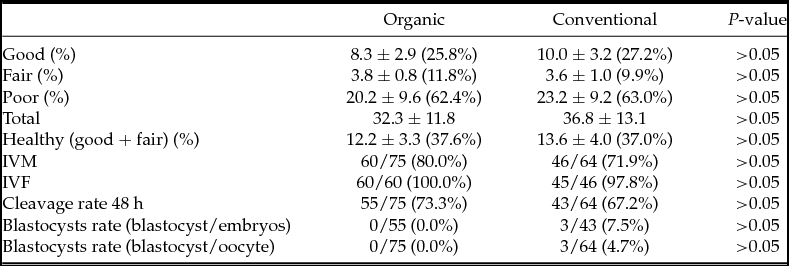
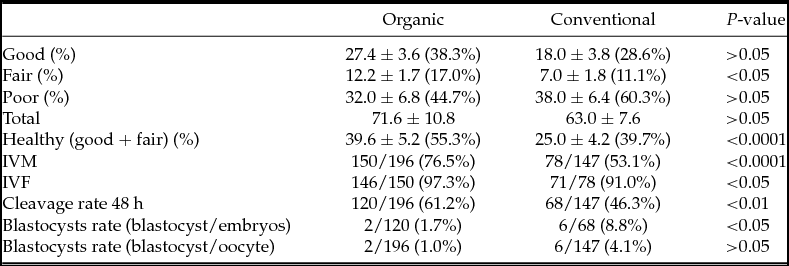
In experiment 1, the oocyte quality and in vitro results did not differ significantly between the offspring of organic feed and conventional feed ewes (Table 1), however, in experiment 2, the number and proportion of fair oocytes in the ovaries of the ewe lambs born on the organic farm were significantly (P < 0.05) higher than they were in the conventionally bred ewe lambs (Table 2). Furthermore, the population of healthy oocytes was significantly (P < 0.0001) higher in the ovaries of the ewe lambs born on the organic farm than it was in the ewe lambs that had been born on the conventional farm. The proportions of mature (P < 0.0001) and fertilized (P < 0.05) oocytes, and cleavage rate at 48 h (P < 0.01) were higher in the organic group than they were in the conventional group. However, the blastocyst/embryo rate was significantly (P < 0.05) higher in the conventional farm (Table 2).
Number (mean ± SEM) and percentage of good, fair, poor, and healthy oocytes, and the results of the in vitro maturation (IVM) and fertilization (IVF) procedures per ewe lamb, recovered from the ovaries of 2-month-old ewe lambs born from ewes fed either organic feed (n = 6) or conventional feed (n = 6) from 15 days before mating until weaning

Number (mean ± SEM) of good, fair, and poor oocytes, and the results of the in vitro maturation (IVM) and fertilization (IVF) procedures per ewe lamb, recovered from ovaries of 45-day-old ewe lambs born on an organic (n = 6) or a conventional (n = 6) sheep farm
To our knowledge, this is the first study to demonstrate the effects of organic-farming procedures on the oocyte quality of ewe lambs, however, organic feed alone did not have a significant effect, and hence, it is likely that non-nutritional factors associated with the organic-farming system affected the development of the ovaries of the ewe lambs. Organic production is an integrated agroecosystem of farm management and food production that combines best environmental practices, high animal welfare standards, and particular attention should be paid to housing conditions, husbandry practices, and stocking densities (European Commission, 2007). The organic approach seems to offer more solutions to welfare problems than do changes in farm routines or the handling of the animals (Alrøe et al., Reference Alrøe, Vaarst and Kristensen2001), which might reduce the amount of stress experienced by the animals on organic farms, thereby, enhancing their immunological status. The acute elevation of glucocorticoids (cortisol) caused by the activation of the hypothalamic–pituitary–adrenal (HPA) axis, and immunosuppression are important aspects of the stress response in sheep (Lepherd et al., Reference Lepherd, Canfield, Hunt, Thomson and Bosward2011). In their review of the effects of nutritional and environmental factors on the fetal programming of the reproductive axis, Rhind et al. (Reference Rhind, Rae and Brooks2001) concluded that adult reproductive performance reflects the combined effects of multiple factors as diverse as nutrition, stress and EDC exposure during prenatal development. A combination of physical and psychological stressors that cause short-term perturbations in the post-conception maternal environment had measurable effects on fetal development and gestation length (Smith et al., Reference Smith, Ferguson, Jauregui, Panarce, Medina, Lehnert and Hill2008). Although the chemical contents of the raw materials fed to the ewes in our experiments were not quantified, some of the ingredients in the conventional diet might have contained any substances that are not allowed in the organic feeding system. For instance, mycotoxins, which are commonly found in many food commodities, might impair the growth and reproductive efficiency of livestock and humans, e.g., mycotoxin-fed mice had reduced ovarian and germinal vesicle oocyte indices (Hou et al., Reference Hou, Xiong, Zheng, Duan, Cui, Kim, Wang, Xu and Sun2014). In addition, long-term exposure to low doses of a complex, ‘real-life’ cocktail of environmental chemicals, including some organochlorine pesticides that have been used extensively in agriculture in Europe, affects the developing fetal ovary of sheep (Fowler et al., Reference Fowler, Dora, McFerran, Amezaga, Miller, Lea, Cash, McNeilly, Evans, Cotinot, Sharpe and Rhind2008).
In both experiments, few mature and fertilized oocytes reached the blastocyst stage, although in experiment 2, blastocyst rate was higher in the conventional group. Potential causes of this differences remain to be elucidated, and both intrinsic (due to the own embryo) and extrinsic (laboratorial procedures) mechanisms may be involved. Developmental competence after IVM and IVF is lower for prepubertal lamb oocytes than it is for adult ewe oocytes (Ledda et al., Reference Ledda, Bogliolo, Leoni and Naitana1999). The lack of an effect of the organic feed alone in experiment 1 might have been because of the age of the ewe lambs, which were 15 days older than were the ewes in experiment 2. Hormonal stimulation and lamb age increased the production of embryos from prepubertal lambs. In addition, the response to stimulation did not affect embryo production from 3–4-week-old lambs, although by 6–7 weeks of age a high response to stimulation reduced blastocyst formation (Morton et al., Reference Morton, Catt, Maxwell and Evans2005).
The results from the organic-fed and the conventional-fed ewes in experiment 1, and by the conventionally fed ewes in experiment 2, were similar to the results from similarly aged ewe lambs of the same breed in our previous studies (Abecia et al., Reference Abecia, Casao, Pascual-Alonso, Lobón, Aguayo-Ulloa, Meikle, Forcada, Sosa, Marín, Silva and Maria2014, Reference Abecia, Casao, Pascual-Alonso, Lobón, Aguayo-Ulloa, Forcada, Meikle, Sosa, Marín, Silva and Maria2015). Our studies did not include an induced ‘polluted-fed’ group because the control group was fed a conventional diet that was not artificially contaminated and, presumably, met sheep requirements. Therefore, it seems that the ovaries from organic-bred ewe lambs can be a better source of oocytes for IV procedures. It is still to be determined why these oocytes did not achieve a higher blastocyst yield.
In conclusion, the results of our preliminary study indicated that the total integration of the animals in a fully organic system improved oocyte quality in ewe lambs. Future experiments, including a higher number of animals from different organic and conventional farms, a chemical analysis of the feed ingredients, measurement of stress, and standardizing the age of the animals are necessary.
Acknowledgements
We thank the organic farmer for his collaboration, and Bruce MacWhirter (Fortaleza Edicion) for suggestions on the English version of the manuscript. The research was partially supported by the Gobierno de Aragón (A26) and project AGL2012–37219 from Ministerio de Ciencia e Innovación (MICNN) (Spain).
Statement of interest
None
Ethical standards
The authors assert that all procedures contributing to this work comply with the ethical standards of the relevant national (Spanish Policy for Animal Protection RD1201/05) and institutional (Ethic Committee for Animal Experiments from the University of Zaragoza) guides on the care and use of laboratory animals, which meets the European Union Directive 2010/63/EU on the protection of animals used for experimental and other scientific purposes.