Introduction
The red palm weevil Rhynchophorus ferrugineus Oliv. (Coleoptera: Curculionidae) is expensive to rear on its natural host, the date palm, in the laboratory. Therefore, an alternative diet from locally available sources is needed. In the laboratory, the red palm weevil can be successfully maintained on both natural (sugarcane stem and banana fruit) and synthetic (semi-artificial) diets (Salama and Abdul-Razek, Reference Salama and Abdul-Razek2002). In India, Krishnakumar and Maheshwari (Reference Krishnakumar and Maheshwari2004) devised a new method for mass-rearing of red palm weevil using coconut petiole. The red palm weevil can also be cultured using cut petiole or stem tissue from coconut palms (Rananavare et al., Reference Rananavare, Shantarum, Harwalkar and Rahalkar1975) and date palm trunks (Al-Ayedh, Reference Al-Ayedh2008). Rahalkar et al. (Reference Rahalkar, Harwalkar and Rananavare1972) reported that sugarcane could substitute for coconut stem for rearing of the insects. This method was improved by incorporating sugarcane in nutrient agar for young larvae and whole sugarcane stem pieces for older larvae (Rananavare et al., Reference Rananavare, Shantarum, Harwalkar and Rahalkar1975). The production of the insects was further improved by the development of an artificial diet containing sugarcane bagasse (fibre), coconut cake, yeast, sucrose, minerals, vitamins and preservatives (Rahalkar et al., Reference Rahalkar, Tamhankar and Shanthram1978; Rahalkar et al., Reference Rahalkar, Harwalkar, Rananavare, Tamhankar, Shanthram, Singh and Moore1985).
Numerous artificial diets have been described for phytophagous insects, especially for noctuid and curculionid pest species (Singh, Reference Singh1977). The most important components of an insect artificial diet include a nitrogen source (commonly protein, but sometimes free amino acids), lipids, carbohydrates, vitamins, minerals, stabilizers, preservatives and often fillers or bulking agents (Cohen, Reference Cohen2003). Some insects, especially herbivores, fail to survive on diets that are deficient in carbohydrates (House, Reference House and Rockstein1974).
Analysis of an insect's natural foods can help determine the chemical profile of required nutrients for the species. The resulting nutrient profile can be used as a model for an incipient diet (Cohen, Reference Cohen, Anderson and Leppla1992). The analytical process is based on gross analysis of the insect's diet, which includes water, protein, complex and simple carbohydrates, lipid and overall minerals (ash), and more specific analysis of the major food components. Cohen and Smith (Reference Cohen and Smith1998) and Cohen (Reference Cohen1999) used such an analytic approach to develop a diet for predatory insects.
Existing successful diets for insects with similar feeding habits can serve as templates for the development of artificial diets for other insect species. Blossey et al. (Reference Blossey, Eberts, Morrison and Hunt2000) developed a semi-artificial diet for the weevil Hylobius transversovittatus (Goeze) by modifying an existing diet for two other species belonging to the same genus, H. radicis Buchanan and H. pales (Herbst).
Cohen (Reference Cohen2003) pointed out several reasons for including natural host plant material in an artificial diet, as natural host plants have complex chemicals that may serve as token stimuli, provide cryptic nutrients and provide nutrients in suitable proportions needed for the insect's specialized feeding habits as well as attract insects toward a particular plant tissue. Wheeler and Zahniser (Reference Wheeler and Zahniser2001) successfully reared the Australian weevil Oxyops vitiosa Pascoe in the laboratory from egg hatch to pupation on artificial diets modified with host plant tissues. Several other authors, including Beavers (Reference Beavers1982), Mau and Lai (Reference Mau and Lai1988), Hunt et al. (Reference Hunt, Lintereur and Raffa1992), Trudel et al. (Reference Trudel, LaVallee, Bauce, Cabana and Guertin1994), Weissling and Giblin-Davis (Reference Weissling and Giblin-Davis1995) and Quintela et al. (Reference Quintela, Jun and McCoy1998), have also reported successful rearing of weevils on artificial diets.
Blossey et al. (Reference Blossey, Eberts, Morrison and Hunt2000) addressed the challenges of rearing insects on artificial diets, which include development of appropriate diet composition, quality control to assess field performance of mass-produced adults (Williams and Leppla, Reference Williams, Leppla, Kauffmann and Nechols1992), concerns over potential loss of genetic variation through inbreeding, random genetic drift and unintentional selection for improved laboratory adaptation (Roush, Reference Roush, Mackauer, Ehler and Rollands1990; Briscoe et al., Reference Briscoe, Malpica, Robertson, Smith, Frankham, Banks and Barker1992; Roush and Hopper, Reference Roush and Hopper1995), and pathogen infections (Kluge and Caldwell, Reference Kluge and Caldwell1992; Hopper et al., Reference Hopper, Roush and Powell1993) that may reduce field performance (Blossey and Hunt, Reference Blossey and Hunt1999). In addition, the absence or presence of dietary ingredients such as secondary plant compounds may alter the interactions of herbivores with predators, parasitoids, nematodes or fungi (Hajek and Renwick, Reference Hajek and Renwick1993; Epsky and Capinera, Reference Epsky and Capinera1994; Hofstetter and Raffa, Reference Hofstetter and Raffa1997; Camara, Reference Camara1997).
Bhattacharya and Pant (Reference Bhattacharya and Pant1968) studied the effect of amino acids on the growth and development of the Khapra beetle Trogoderma granarium (Everts). They found that omission of any one of the essential amino acids resulted in no adult insects, and the omission of any one or more of the non-essential amino acids yielded few adults and a prolonged larval period.
The objective of the present study was to develop a semi-synthetic diet based on locally available materials that could support the growth of the red palm weevil.
Materials and methods
Diet development
Experiments were carried out during 2006 at the Natural Resources and Environmental Research Institute, King Abdulaziz City for Science and Technology, Riyadh, Saudi Arabia.
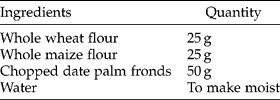
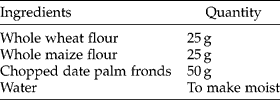
A semi-synthetic diet for the red palm weevil was developed by screening a number of ingredients from locally available sources along with information obtained from the literature. Protein, amino acids, lipids, carbohydrates, vitamins and minerals were the significant components for choosing the best diet. Wheat and maize as fibre sources, protein, carbohydrates, starches, lipids and amino acids were essential components. However, necessary minerals and vitamins can be obtained from date palm fronds. The diet was prepared by cutting 40–50-cm-long date palm fronds, washed in distilled water and left to dry for 2–3 h. The material was then cut into 4–5-cm pieces and ground (Thomas-Wiley laboratory mill model 4; Thomas Scientific, USA) until it became a powder. Then, 50 g date palm fronds, 25 g wheat flour, 25 g maize flour and 150 ml of distilled water were mixed in a 15 × 15 cm container. After screening several ingredients, we chose the most appropriate and locally available ones listed in Table 1. Additionally, these ingredients which were selected as semi-synthetic diet had total amino acids from a dry weight of 7.8% (Unpublished data).
Composition of the final semi-synthetic diet used for the development of red palm weevil
We used chopped date palm fronds instead of sugarcane bagasse because fronds were easily obtained from farmers carrying out a local cultural practice called ‘takreeb’ in their plantations. They also proved to be a good source for the needed minerals and were cheaper than sugarcane. However, sugarcane pieces were used as medium for pupation because the insect requires a place to hide when undergoing pupation. The chopped fronds were provided as phagostimulants.
Weevils were collected as cocoons from a red palm weevil colony established from the Khasab cultivar in the laboratory of the King Abdulaziz City for Science and Technology. Cocoons were placed individually in covered containers (7.0 cm diameter × 8.5 cm height) with wide mouths (6.5 cm diameter) containing moistened tissue papers, at 25 °C and 30–50% relative humidity (RH) until adult emergence.
Newly emerged weevils were kept for mating in a mating arena for 2 days. Thereafter, the females were transferred to egg-laying containers provided with sugarcane juice-soaked cotton for egg laying. Eggs were collected and transferred to Petri dishes containing moist filter paper, using a camel hair brush.
Petri dishes were kept for 3 days in an incubator at 30 °C and 50% RH. Three days later, neonate larvae were collected and divided into four groups (A, B, C and D) as described below.
Group A consisted of 50 neonate larvae fed a semi-synthetic diet composed of 25 g whole wheat flour (one part), 25 g whole maize flour (one part), 50 g shredded date palm frond tissue (two parts) and distilled water until desired moistness. This group was used for measurements of larval development and larval instars. Measurements of ten randomly selected larvae from each group were carried out. Larval length, width, weight, head capsule length and head capsule width were taken to evaluate larval development. The observations were taken every 3 days until pupation.
Group B consisted of 50 neonate larvae fed the semi-synthetic diet described above. This group was used for measurement of pupal development. When larvae fed on the diet showed the desire for material to spin a cocoon, they were provided with sugarcane pieces with holes for pupation. Larvae fed on date palm tissues made their cocoons with date palm tissues. After pupation, cocoons were removed and placed individually in plastic bottles with moist tissue paper. The pupal length, width and weight were also recorded to compare pupae developed from semi-synthetic and control diets.
Group C consisted of 50 neonate larvae fed the semi-synthetic diet described above. Newly emerged adults were fed on sugarcane. Measurement of adults, including length, maximum width and weight, was recorded separately for ten males and ten females randomly selected. All lengths and widths were measured in millimetres using vernier calipers, while weight was recorded in grams using an electronic weighing balance (Precisa Instruments Ltd., Switzerland). For more accurate measurements, insects were chilled to cease their movements before measurements, using a BioQuip Laboratory Chill Table (BioQuip Products, Rancho Dominguez, USA).
To compare egg laying, ten pairs of newly emerged adults from control and the semi-synthetic diets were kept as individual pairs for mating in 500-ml containers with longitudinally split pieces of sugarcane. After 3 days, females were transferred into oviposition cages (26 × 16 × 9 cm height) provided with sugarcane juice-soaked cotton pads. The cotton pads were replaced on alternate days. The eggs were collected from the cotton pads, counted and transferred to Petri dishes containing moist filter paper, using a camel hair brush. The Petri dishes were kept for 3 days in an incubator at 30 °C and 50% RH to record percentage egg hatchability.
Group D consisted of 50 neonate larvae fed on date palm tissues (Khasab date palm cultivar). According to Al-Ayedh (Reference Al-Ayedh2008), Khasab is considered one of the best cultivars for rearing red palm weevil in the laboratory. These insects served as controls for the other three groups.
Larval instars
The weevils were collected as cocoons from a red palm weevil colony established from the Khasab cultivar in the laboratory of the King Abdulaziz City for Science and Technology. The cocoons were placed individually in covered containers (7.0 cm diameter × 8.50 cm height) with wide mouths (6.5 cm diameter) containing moistened tissue paper at 25 °C and 30–50% RH until adult emergence. Newly emerged weevils were kept for mating in a mating arena for 2 days. Thereafter, the females were transferred to egg-laying containers provided with sugarcane-soaked cotton. The eggs were collected and transferred to Petri dishes containing moist filter paper, using a camel hair brush. The Petri dishes were kept for 3 days in an incubator at 30 °C and 50% RH. Three days later, the neonate larvae were collected and divided into two groups, each containing 90 larvae. Each group of larvae was subdivided into three sub-groups containing 30 larvae each. One group of 90 larvae was fed the semi-synthetic diet and the other one the control diet. Each subgroup of 30 larvae served as a replicate. Each larva was kept in an individual container, and data were recorded for all larvae. Only ten larvae/replication survived until pupation and were separated for analysis. The diet was changed on alternate days, and larvae were observed for moulting. When a larva moulted, it was carefully observed and the exuviae with head capsule was collected and preserved in 80% ethyl alcohol for measurement of the head capsule. Time for each instar and total number of larval instars on each diet were recorded until pupation.
Mating behaviour assessment
The cocoons of larvae raised on Khasab cultivar and the semi-synthetic diets were collected separately. The cocoons were placed individually in covered containers (7.0 cm diameter × 8.50 cm height) with wide mouths (6.5 cm diameter) containing moistened tissue papers at 25 °C and 30–50% RH, until adult emergence. Mating behaviour of red palm weevils was recorded by putting the newly emerged males and females that developed on the respective diets in mating arenas. The mating arenas (15 cm diameter × 3.2 cm height) were made by joining two lower parts of Petri dishes lined with moist filter paper. Three-millimetre diameter holes were made in the centre of the upper part for aeration. Mating was recorded for the parameters described in Table 2.
Mating behaviour variables of male and female red palm weevils reared on control and semi-synthetic diets

TBIM, time between introduction and actual mating; MD1, first mating duration; MD2, second mating duration; MD3, third mating duration; DBM1, duration between first and second mating; DBM2, duration between second and third mating; MF, mating frequency/30 min; NMF, sex ratio or number of males (M) and females (F) introduced for mating (1M:1F, 1M:2F and 2M:1F).
Mating behaviour was recorded for newly emerged males and females in single pairs (1M:1F), then once using two males:one female (2M:1F) and two females: one male (2F:1M) in mating arenas. The time for each observation was 30 min. Each observation was repeated nine times for weevils developing on both natural and semi-synthetic diets. Time was recorded with a stopwatch. All studies were conducted at 26 ± 2 °C; 25–30% RH.
The data were transformed into log in (x+0.375) and then subjected to analysis of variance (ANOVA) PROC GLM. The means were separated using Tukey's test (SAS 2009, Cary, USA).
Results and Discussion
Larval growth assessment
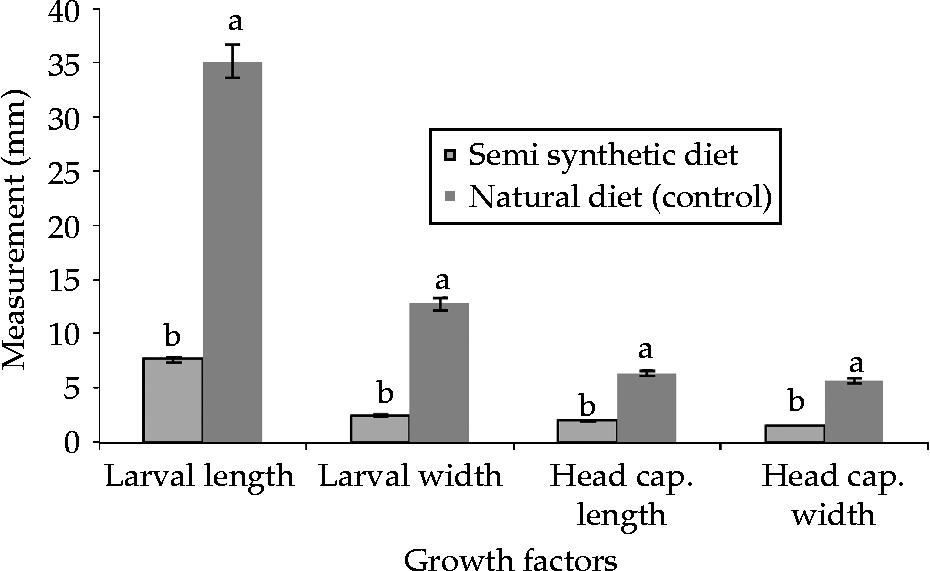
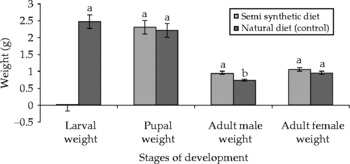
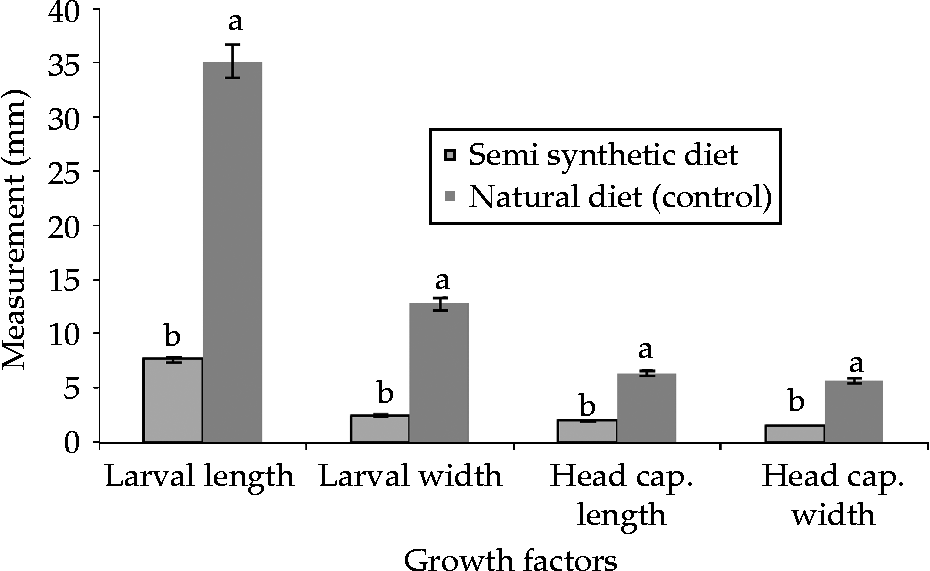
Our results indicated that the semi-synthetic diet had an impact on larval measurements (F = 298.54; df = 1; P < 0.0001). Overall, the size of larvae fed on the natural diet was fourfold those fed the semi-synthetic diet. Fig. 1 shows that both larval length and width were significantly affected by the quality of the food (F = 300.59; df = 1; P < 0.0001 for length, and F = 297.80; df = 1; P < 0.0001 for width). Length and width of the larval head capsule were also affected (F = 250.74; df = 1; P < 0.0001) and (F = 266.9; df = 1; P < 0.0001), respectively (Fig. 1). Although our diet contained whole wheat flour, results indicated a large difference in the weight of larvae reared on the semi-synthetic diet (0.01 g) from those on the natural diet (2.47 g) (F = 138.47; df = 1; P < 0.0001) (Fig. 2). Similarly, Giblin-Davis et al. (Reference Giblin-Davis, Gerber and Griffith1989) showed that larvae of R. cruentatus Fab. gained less weight when fed an artificial diet than those fed a control diet. Host plant quality has a direct impact on food consumption, survival and development of larvae (Leather, Reference Leather and Bernays1990; Dodds et al., Reference Dodds, Clancy, Leyva, Greenberg and Price1996; Tammaru, Reference Tammaru1998). The red palm weevil can be reared on artificial diets (Rahalkar et al., Reference Rahalkar, Tamhankar and Shanthram1978) and on sugarcane and banana fruits (Salama and Abdul-Razek, Reference Salama and Abdul-Razek2002) which have a higher sugar content. However, Hunter and McNeil (Reference Hunter and McNeil1997) found that larval growth was influenced by the quality of the host plant. Understanding the chemical reactions of the semi-synthetic diet ingredients in the larvae midgut might help in improving the diet.
Larval developmental parameters of red palm weevils fed a semi-synthetic or natural diet (control). Means with similar letters are not significantly different (P ≥ 0.05; Tukey's test, ANOVA)
Weight records of larvae, pupae and adult stages of red palm weevils fed a semi-synthetic or natural diet (control). Means with similar letters are not significantly different (P ≥ 0.05; Tukey's test, ANOVA)

Larval instars
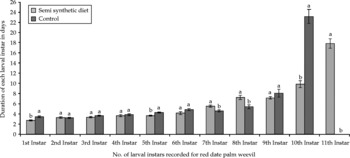
Larval instars showed no significant differences in development time between the two treatments (F = 2.57; df = 1; P>0.1144), although we recorded 11 instars from the larvae fed the semi-synthetic diet and only ten from those fed the natural diet (Fig. 3). Kaakeh (Reference Kaakeh2005) showed developmental times of larvae ranging from 70.8 to 102.2 days due to the different ingredients from the natural host plant material, while our study showed shorter larval developmental times with the semi-synthetic diet (69 days; Fig. 3), corroborating earlier results of El-Ezaby (Reference El-Ezaby1997). However, our results differed from those of Ghosh (Reference Ghosh1912) (30–35 days), Viado and Bigornia (Reference Viado and Bigornia1949) (35–38 days), Nirula (Reference Nirula1956) (55 days) and Aldhafer et al. (Reference Aldhafer, Alahmadi and Alsuhaibani1998) (165–182 days). Interestingly, the duration of each instar varied between treatments, which is due to the differences in ingredients. The 1st, 5th, 7th, 8th, 10th and 11th instars showed significant differences in development time but only with small changes of 1 or 2 days (F = 14.04; df = 1; P < 0.0004); (F = 13.98; df = 1; P < 0.0004); (F = 3.56; df = 1; P < 0.064); (F = 8.95; df = 1; P < 0.0004); (F = 10.11; df = 1; P < 0.0024); (F = 75.01; df = 1; P < 0.0001) and (F = 356.29; df = 1; P < 0.0001, respectively). Other instars showed no significant differences in their duration (Fig. 3). Most probably, the food quality would have played an important role in the larval development and hence larval duration was longer on the semi-synthetic diet, although there was no significant difference in the total larval development time between the two diets.
Larval instars and duration of red palm weevil larvae reared on a semi-synthetic or natural diet (control). Means with similar letters are not significantly different (P ≥ 0.05; Tukey's test, ANOVA)

Pupal growth assessment
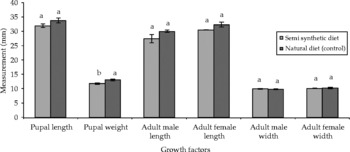
Pupal measurements were not significantly affected by diet differences (F = 3.43; df = 1; P < 0.0803). Pupae developed on a natural diet were longer (33.75 mm) and wider (13.05 mm) than pupae developed on the semi-synthetic diet (31.90 mm long and 11.53 mm wide). Differences in length were insignificant (F = 3.19; df = 1; P < 0.0909), whereas those for width were significant (F = 8.36; df = 1; P < 0.0097) (Fig. 4). However, pupal weight was not affected by the diets (F = 0.18; df = 1; P < 0.6804) (Fig. 2). Viado and Bigornia (Reference Viado and Bigornia1949) recorded an average pupal length of 33.5 mm and an average pupal width of 18.5 mm for red palm weevil reared on coconut. In another study on coconut palm, Nirula (Reference Nirula1956) reported an average pupal length of 35 mm and an average pupal width of 15 mm. A significant correlation was noted between the fecundity of adults and pupal weight or length for the diamondback moth Plutella xylostella (L.) (Wan, Reference Wan1970). Williams (Reference Williams1963) observed that the correlation between pupal weight and fecundity was greater than that between pupal length and fecundity in the spotted sugarcane borer Chilo sacchariphagus Bojer.
Pupal and adult developmental parameters of red palm weevils reared on an artificial or natural diet (control). Means with similar letters are not significantly different (P ≥ 0.05; Tukey's test, ANOVA)

Adult growth assessment
Adult male and female weevils developed on the natural diet were somewhat longer (29.95 and 32.23 mm, respectively) than those reared on the semi-synthetic diet (28.6 and 30.38 mm, respectively) (Fig. 4). However, males and females developed on either diet were similar in width (9.75 and 10.23 mm, respectively). Males and females developing on the semi-synthetic diet gained more weight (0.94 and 1.05 g, respectively) than males and females developed on the semi-synthetic diet (0.74 and 0.95 g, respectively) (Fig. 2).
Viado and Bigornia (Reference Viado and Bigornia1949) recorded average body lengths (39 and 41.50 mm for males and females, respectively) and average body widths (13.40 and 14.60 mm for males and females, respectively) of the red palm weevil reared on coconut. In another study, Nirula (Reference Nirula1956) reported the length and width of the red palm weevil as 35 and 12 mm, respectively, when fed coconut. Rodrigues and Moreira (Reference Rodrigues and Moreira2004) determined that seasonal variation of the Red Postman Heliconius erato (L.) adult size in a given place is primarily determined by the availability and quality of host plant species used by larvae. Determinants of larval development, such as temperature and food plant, may influence fecundity through their effects on pupal weight and adult body size (Calvo and Molina, Reference Calvo and Molina2005). Awmack and Leather (Reference Awmack and Leather2002) reported that adult performance is affected by host plant quality in many phytophagous insects.
Egg laying and egg hatchability
Neither the number of eggs laid (total n = 650) (F = 0.51; df = 1; P < 0.473) (Table 3) nor egg hatchability (F = 3.15; df = 1; P < 0.0767) (Table 3) differed significantly between the two diets. In contrast, Kaakeh (Reference Kaakeh2005) showed some variation in egg number with different diets. This could be due to the differences in the nutritional status of the diets. The number of eggs laid by females fed the semi-synthetic diet was 338 (n = 10) and the number of eggs was 332 (n = 10) when fed with the natural diet over a 2-month period. These numbers were higher than those found by Kaakeh (Reference Kaakeh2005) and Ghosh (Reference Ghosh1912). In other insects, food quality has a clear effect on the fecundity, which was not the case in our study, indicating that the semi-synthetic diet (Table 3) was as suitable as the natural one in terms of fecundity and egg hatchability in R. ferrugineus.
Comparison of egg laying and egg hatchability of red palm weevils reared on control and semi-synthetic diets

Mating behaviour
Data showed that weevils reared on both diets presented multiple matings with consistent sequences of behaviours, including rostral rubbing and antennal tapping during mating, and guarding after mating. Identical behaviour in red palm weevil was observed by Al-Ayedh and Rasool (Reference Al-Ayedh and Rasool2009) and Vanderbilt et al. (Reference Vanderbilt, Robin, Giblin-Davis and Weissling1998), and in bark beetles (Brich, Reference Brich1978), where rostral rubbing and antennal tapping were considered as placating gestures, while guarding behaviour serves to deter mating attempts by other males. Females remained very still in all mating attempts and readily accepted each mate. In our study, no differences in these behavioural parameters were observed in females fed the two different diets (Table 2).
Conclusion
Red palm weevils can be successfully reared on the semi-synthetic diet described herein. The ingredients used in the diet were found capable of supporting the larval development of the red palm weevil. The larval growth rate was comparable to the growth rate obtained on the control diet. Our study on survival, growth rate and behaviour suggests the potential of the semi-synthetic diet. However, further refinement of the diet is needed so that the insect is able to complete its entire life cycle (including cocoon formation) on the semi-synthetic medium.
Acknowledgements
The authors thank Professor John L. Capinera from the University of Florida for reviewing and commenting on the manuscript. This manuscript was prepared during my Fulbright scholarship program at University of Florida, Department of Entomology and Nematology, and I am grateful for that. Thanks are also due to Mr Khawaja Gulam Rasool, Mr Waleed S. Al Waneen and Mr Waleed K. Al Abdulsalam for technical help during this study. This project was funded by the King Abdulaziz City for Science and Technology (KACST) through internal funding number (01-23-BM).