Composed shortly after the saint's canonisation in 1173, the liturgical Office of Thomas Becket of Canterbury achieved immense popularity and widespread dissemination across Europe throughout the late Middle Ages. Benedict of Peterborough has been established as author for both the text and the music, although the authorship of the lessons is still a subject of current debate.Footnote 1 The Thomas Office hallmarks a new era of compositional practices in liturgical Offices:Footnote 2 it is one of the first to make use of rhymed accentual verse, and is thought to have been the model for many subsequent rhymed Offices. Also, the versified liturgical items follow a serial modal order, which David Hiley describes as a structural development in Offices of the eleventh century.Footnote 3 Importantly, Benedict's Office was written for the monastic cursus,Footnote 4 thereby containing four responsories for Matins in each nocturn rather than three, as is common in secular use. The modal scheme in the original Office, thus, would have been constructed to follow the items of the (extended) monastic cursus. Unfortunately, many of the earliest manuscript witnesses of Benedict's Office were destroyed during the dissolution of the monasteries ordered by Henry VIII; the earliest complete monastic source that survives is a Cluniac Breviary from the Fitzwilliam museum (Cfm 369),Footnote 5 dating from 1263–1300.
Upon preparing the Thomas Office for secular use in England and on the continent, the modal scheme was disrupted as some items were omitted and others re-arranged. Additionally, over centuries of dissemination, the modal scheme has been varied in many ways as the Office was appropriated and tailored to specific cultural, liturgical, or even political contexts. Consequently, present-day scholars are faced with a complex trail of manuscript and printed versions of the same liturgical ‘text’, the variations of which have yet to be systematically investigated. In his large-scale electronic project entitled ‘Thomas Becket: Sources and Variants of his Office’, Andrew Hughes has catalogued and analysed over 1200 Thomas Offices, using manuscript and printed sources dating from 1173 to c.1600.Footnote 6 One of the valuable results revealed by this project is that changes in the modal scheme, in many cases, are crucial in grouping manuscripts according to geographic location or ecclesiastical use. This in turn allows for a nuanced study of chant variation and transmission within specific geographic and temporal parameters.
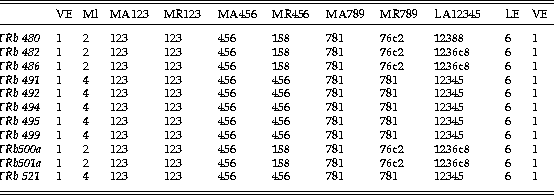
The focus of this article is on one of these subsets identified by the aforementioned electronic project: a group of manuscripts from the Diocese of Trier, Germany. As is displayed in Table 1, an examination of the modal schemes reveals two source groups: one in which the modal scheme appears disrupted and one in which the modal scheme has been restored. As is evident, changes in the modal order occur in the invitatory, in the responsories for Matins of the second and third nocturns, and in the antiphons for Lauds.
Usually, liturgical items (both text and music) appear as indivisible units consistently enough that scholars frequently derive the modal order of an Office by examining the order of the texts.Footnote 7 The Diocese of Trier is unique, however, in that four new melodies have been composed which, in effect, restore the modal scheme of the Office at various points. The items for which new melodies are substituted are: the invitatory, Adsunt Thome martyris; the fourth responsory for Matins, Post sex annos; the ninth responsory for Matins, Iesu bone per Thome;Footnote 8 and the fourth antiphon for Lauds, Ad Thome memoriam. Although the invitatory does not typically play a role in the serial modal order of an Office, since a new melody has been composed for this item, it has been included in this study.
Modal schemes of the Thomas Office in manuscripts from the Diocese of Trier. Disruptions in the modal scheme are indicated in bold

Abbreviations: VE – Magnificat Antiphon; MI – Matins Invitatory; MA – Matins Antiphon; MR – Matins Responsory; LA – Lauds Antiphon; LE – Magnificat/Benedictus at Lauds.
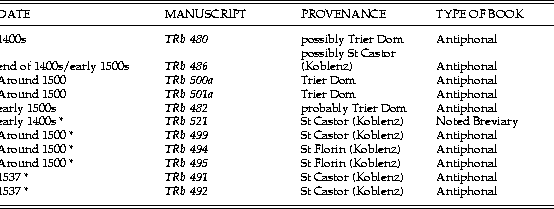
Furthermore, the date and provenanceFootnote 9 of each manuscript group reveals that the four newly composed melodies are (within the Diocese of Trier) a regional variant particular to KoblenzFootnote 10 (see Table 2).
Manuscripts from the Diocese of Trier

Dates and provenances of manuscripts from the Diocese of Trier containing the Office of Thomas Becket (those asterisked contain new melodies that restore the modal order).
In this article, I shall provide an overview and comparative analysis of these four items. As a point of comparison, I will use a base melodyFootnote 11 (essentially a conflation of Sarum melodies from thirteenth-century British sources), the old Trier melodies (typically the base melody with variants as a result of transmission) and the new Koblenz melodies. Hereafter, I will refer only to the base melody, old Trier melodies and new Koblenz melodies. At present, I shall concern myself only with the four new melodies and their modal implications; I will not consider modal disruption and restoration caused by re-ordering items within the Office.Footnote 12
I. Invitatory: Adsunt Thome martiris
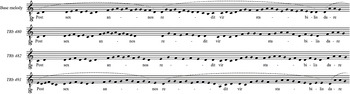
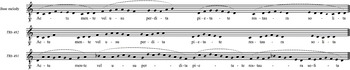
The first item for which a new melody has been substituted is the invitatory Adsunt Thome martiris (this corresponds to Transcription I, see page 55).

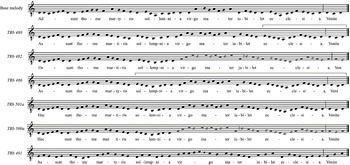
Although the old Trier melodies are melodically similar to the base melody, immediately apparent are numerous problems in transcription, which often cause the Psalm tone at the end to read a third higher (the segment affected by a transposition error occurs in grey in Transcription I). Prior to discussing the melodic and modal tendencies of the item, errors of transmission and transcription in the old Trier melodies will be examined, since they relate directly to the need for composing the new Koblenz invitatory melody.
Copying errors and variants in the old Trier melodies
TRb 501a and TRb 500a
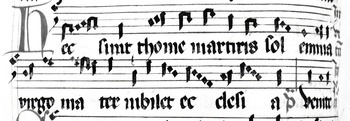
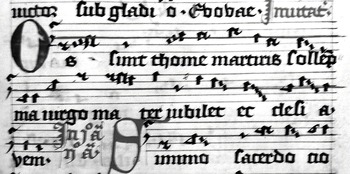
TRb 501a may be taken as a point of departure and model for comparison, since it contains the invitatory melody as it appears in the base melody. The text in both TRb 501a and TRb 500a, however, differs from the base melody in that ‘Hec sunt Thome’ is used instead of ‘Assunt Thome’. TRb 500a is visually very similar to TRb 501a, although it appears that the scribe made an error of a third in copying TRb 500a when going to a new stave at the word ‘virgo’ (Figure 1).
Invitatory antiphon: TRb 500a fol. 223r.

One can be certain that this is in fact a copying error, since the (barely visible) custos indicates the melody going to a D (second line), rather than F (third line). In order to compensate for the augmented fourth resulting from the new transposition, the scribe has added a B-flat in front of the word ‘iubilet’ in TRb 500a. The augmented fourth resulting from ‘virgo mater’, however, has not been resolved.
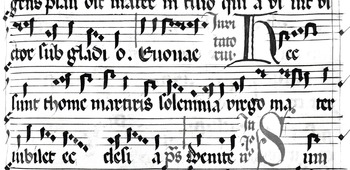
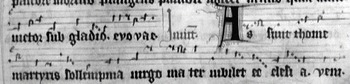
Although it is tempting to suggest that TRb 500a was copied erroneously from a ‘correct’ version, possibly TRb 501a, other evidence points against this deduction. First, at the word ‘iubilet’ in TRb 501a, a flat has been erased and at the word ecclesia, a group of notes were originally written a third higher, then erased, and notated at the correct pitch beside the erasure (Figure 2). The scribe copying TRb 500a appears to have been correcting the chant while copying it out.
Invitatory antiphon: TRb 501a fol. 202r.

TRb 500a and TRb 482
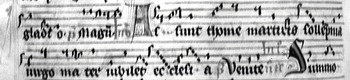
While a transposition error in itself is not unusual in the copying of manuscripts, what remains intriguing is that the melody in TRb 482 is transcribed with the exact transposition error of TRb 500a, at ‘virgo’, but occurring in the middle of the stave (Figure 3).
Invitatory antiphon: TRb 482 fol. 220r.

One can infer that the scribe of TRb 482 did not copy the pitches incorrectly as the scribe of TRb 500a did, since the error does not occur at the beginning of a new stave. It is more likely that TRb 482 was copied from an already erroneous source (one such as TRb 500a).
Moreover, in TRb 482 the B-flat that compensates for the transposed melody occurs in the same position as it does in TRb 500a. In both TRb 500a and TRb 482, therefore, the flat has been added only in front of the word ‘iubilet’ while the word immediately preceding, ‘mater’, which also contains a B, has been left natural, leaving the augmented fourth somewhat exposed to the ear.
TRb 486 and TRb 480
The remaining two manuscripts containing the old Trier melody (TRb 486 and TRb 480) demonstrate a different palaeographic issue: that of clef changes and the use of the Guidonian red F-line and yellow C-line. TRb 486, at first glance (reading the red line as F), appears to contain a transposition error (a third higher) from the word ‘solempnia’ to the end. However, the scribe has inserted an F-clef, which looks very much like a pitch since the tail has faded considerably. Also, the colours of F- and C-lines have not been altered according to the new clef. Correcting the colours of the F- and C-lines, which would have been difficult to accomplish, has not been carried out, leaving a potential problem for the singer, to the end of the line (Figure 4).
Invitatory antiphon: TRb 486 fol. 261r.

The melody is in fact transmitted correctly, if the ‘pitch’ between ‘martyris’ and ‘solempnia’ is interpreted as an F clef and the red and yellow lines are ignored from after ‘martyris’ until the end of the chant.
Similarly, TRb 480 also contains an apparent error in transposition isolated at the word ‘martiris’ and then at the word ‘ecclesia’. It also contains a red F-line and a yellow C-line, with a change of clef, which appears to be omitted before the word ‘martiris’ and another at the word ‘ecclesia’ (Figure 5).
Invitatory antiphon: TRb 480 fol. 328r.

One can deduce that the clef change has been omitted before ‘martiris’, since an F clef has been inserted immediately after ‘martiris’, identical to that of the beginning of the stave, and is thus superfluous. Once again, the likelihood of making a transposition error is very high, since the F clefs look very much like a regular pitch and the red F-line and yellow C-line have not been altered to accommodate the clef changes.
Summation: transmission errors in the old Trier melodies
The transmission of the old Trier invitatory melody in the Thomas Office was subject to numerous and considerable errors. A palaeographic analysis of the manuscripts containing this melody reveals two main types of musical problems: first, transposition errors of a third resulted in incorrect copying of segments of the melody; and, second, inconsistencies between red and yellow Guidonian lines and clef symbols resulted in potential errors of composition. Both of these situations could cause difficulty in a performance context.Footnote 14 All the manuscripts appear to be well used and are therefore unlikely to have been presentation copies. Furthermore, the addition of flat symbols to compensate for transposition errors also indicates that the manuscripts were performance copies. Thus, the need for the new Koblenz melody likely stems from numerous errors, which, in turn, caused difficulty for the singers. Even for the sake of obtaining and transmitting a theoretically sound invitatory melody, the errors inherent in the old Trier melodies warrant the composition of the new Koblenz melody.
Comparison of the old Trier melodies and the new Koblenz melody
Discounting the numerous transmission errors, the old Trier melodies musically correspond to the base melody and are in mode two, while the new Koblenz melody is in mode four, a more usual mode for the invitatory (the new Koblenz melody, represented by TRb 491, may be found in the lowest stave of Transcription I). Benedict's original choice of mode two for the invitatory antiphon, however, is not unjustified for the Becket Office; tones were often thematically related to the liturgical day and in Sarum Use, the second mode was often used in Proper Offices of individual saints as well as historiae (Offices based on Old Testament texts that occur after Pentecost in the liturgical calendar).Footnote 15 Both the mode two tone particular to the old Trier melodies and the mode four tone used in the new Koblenz melodies are usual; the fourth mode, however, is much more widely used for the invitatory.Footnote 16
Within their respective modes, the old Trier and new Koblenz invitatory melodies exhibit remarkable similarity in their compositional technique, particularly in the manner that the melodies occupy tonal space. This compositional procedure exemplifies the so-called ‘new post-Carolingian style’ and is distinguished from the old style in that ‘the mode is not a sum of motivic elements but is rather a general tonal framework (‘scale’) for melodic motions’.Footnote 17 According to David Hiley, this modal order seems to have formed part of a larger theoretical and compositional movement in which chant was no longer composed based on melodic formulae but was composed instead by exploring particular areas of tonal space associated with each mode. The scale was generally divided into four- and five-note segments: ‘the fourth below the finalis, the fifth above it, the fourth between the upper fifth and the upper octave, and even the fifth above that’.Footnote 18 Since modes two (pertaining to the old Trier melodies) and four (pertaining to the new Koblenz melodies) are plagal modes, the tonal areas for each can be divided as follows:
Mode two: A–D, D–a, a–d
Mode four: B–E, E–b, b–e
Indeed, the old Trier melodies and new Koblenz melody display a similar design in their occupation of tonal space. The area between D and a is established at ‘virgo mater’, whilst the lower tetrachord between D and A, which is essential in confirming the plagal mode, is re-affirmed in the final segment of the melody.
Moreover, the melodic phrase structure is similar in the old Trier melodies and the new Koblenz melody: in both cases, the melodic setting of ‘sollemnia’ (which completes the first half of the melody) is expanded into ‘ecclesia’ (which brings the second half of the melody to conclusion), resulting in an elaboration of musical rhyme (Example 1).
Musical rhyme in the Old Trier and New Koblenz melodies of the invitatory.

This compositional technique was deemed sufficiently innovative (or perhaps stylistically appropriate) to imitate in the new Koblenz melody. Also, this procedure obviously supports and enhances the poetic rhyme scheme and musical verse – one of the features of the new Carolingian style. Moreover, the new Koblenz melody follows the poetic structure slightly more closely as the ends of the two phrases are melodically similar: both ‘Thome’ and ‘mater’ end on D and start the next words, ‘martiris’ and ‘jubilat’, respectively, on F.
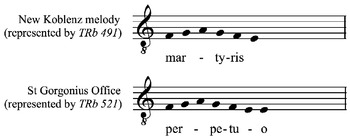
Finally, the new Koblenz melody seems to make use of a melodic allusion to another Office. Since the old Trier melodies correspond to Benedict's Becket Office, composed at the end of the twelfth century and one of the first rhymed Offices, it is unlikely that the old melodies would contain many melodic allusions. By contrast, the new Koblenz melodies, composed during the early fifteenth century, are much more likely to contain melodic allusions to other late medieval Offices. Melodic allusions in chant can be measured by the use of ‘chant-words’ (that is, fragments of melody corresponding to single words in chants): where these fragments recur across several chants, they may be evidence of deliberate or unconscious allusion.Footnote 19 In the invitatory of the new Koblenz melody, however, the only chant-word that appears elsewhere in the late medieval Office repertory is ‘martyris’ (martyr). The sole occurrence (amongst some 96,000 chant-words) of the intervallic transposition of this melody occurs in the Office for St Gorgonius, venerated in St Florin, Koblenz during the early fifteenth century; both melodies are in mode four (Example 2).
Comparison of melodic settings of ‘martyris’ in the new Koblenz melody of the invitatory and ‘perpetuo’ in Expleto iam luctamine, MR9 in the Office of St Gorgonius.

This chant-word concludes the verse of the ninth responsory for Matins in the Office of St Gorgonius. Within the larger context of the poetic verse, ‘perpetuo’ forms part of a description of the martyrs reigning eternally with God; the verb ‘regno’ is used to express one reigning or ruling in the manner of a King, Master, or Lord. The melodic allusion appears to remind one of the assurance of the eternal reign of the martyrs.
Moreover, there are some striking similarities between the two martyrs: both held high positions with rulers – Thomas, prior to their conflict, was working at the right hand of Henry II and Gorgonius held a high position at the household of emperor Diocletian; both were martyred as a result of strong disagreement with a ruler. According to Madeleine Bernhard, the Office of St Gorgonius can be attributed to Leo IX, who is thought to have crafted it during the eleventh century.Footnote 20 However, it appears that only two sources for the Office of St Gorgonius are currently known to have survived:Footnote 21 the full musical setting is available in TRb 521, a Koblenz breviary dating from the early 1400s, and the text is available in another fifteenth-century source.Footnote 22 However, I am aware of five additional sources containing this Office: the five comprise the remaining sources that contain the new Koblenz melodies in the Thomas Office.Footnote 23 Judging by the high concentration of Offices and issues in musical style (discussed later) it is possible that the Office for St Gorgonius could have been revised in Koblenz or even written there for the first time; the surviving sources remain insufficient to make a judgement on this matter at this time.Footnote 24 Issues surrounding musical allusion between the two Offices, however, will be expanded upon in the discussion of the remaining new Koblenz melodies.
II. Fourth responsory for Matins: Post sex annos
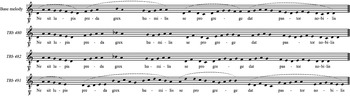
The second item for which a new melody is composed is the fourth responsory for Matins Post sex annos (this corresponds to Transcription II, see page 56).

The base melody and old Trier melodies are in mode one while the new Koblenz melody is in mode four, thereby restoring the overall modal scheme in the Office at this point. Of the four new Koblenz melodies, Post sex annos is unique in that it draws upon the melodic material of the base melody and old Trier melodies. In an ongoing spectrum ranging from trivial variant to substantial variant, recomposed and newly composed,Footnote 25 the new Koblenz melody to this responsory appears in part recomposed and in part newly composed. At the beginning of the responsory and verse, it appears initially related to the base melody and old Trier melodies, while towards the middle and end of the responsory and verse, the melody appears increasingly newly composed. This analysis, however, is based on a comparison of individual words set to music. For instance, ‘annos’, ‘redit’, ‘vir’, and ‘dare’ appear varied rather than recomposed. The underlying structure of the chant, I shall demonstrate, reveals a more substantial modal shift.
Responsories are typically the most florid, elaborate and melismatic items in the liturgical Office; Post sex annos is no exception. In his analysis of Studens livor Thomae, the first responsory for Matins in the Becket Office, Bruno Stäblein was the first to suggest the notion of modal integrity in individual words.Footnote 26 His analysis suggests that individual words in plainchant for Offices begin and end on pitches that are modally important, thereby creating stability and overall modal integrity in the item. Subsequently, both John Stevens and Andrew Hughes have made use of this idea of modal unity in individual words in their analysis of responsories in the Thomas Office.Footnote 27 Most recently, Hughes' chant-word dictionary contains information relating to the mode, position in the item, and initial and final pitches of individual words in all late medieval Offices. A preliminary investigation of modal integrity of individual words in the Thomas Office, however, has revealed that about 32 per cent of the words begin and end on modally important pitches. Perhaps the most prominent example in the base melody and old Trier melodies is that of ‘Christo’, beginning and ending on the reciting tone A in the first mode.
Expanding upon this approach, it seems reasonable that more attention be paid to the poetic structure of the text – the beginnings and endings of each line of rhymed poetry,Footnote 28 rather than each individual word (Example 3). In view of the underlying modal structure based on the phrasing of the poetic form, it appears that this particular responsory has undergone a significant modal alteration. For instance, the opening phrase Post sex annos clearly begins and ends on E, the final of the newly selected mode, rather than beginning on C and ending on D, the final of mode one. The alteration of the mode in this opening line, thus, is more substantial and occurs at a deeper structural level than that of melodic variation on each individual word .
Underlying structure of Post sex annos.

The question of what constitutes a modally important pitch also needs to be re-examined. Stevens, Hughes, and Stäblein rely primarily on a theoretical understanding of the modes and their respective ‘important’ pitches: the final and the tenor – in mode one, for example, D and A. In contrast, Lásló Dobszay and Janka Szendrei, at least in their study on antiphons, are concerned more with trichords that form the melodic core of modes. Mode one, for instance, is governed by the ‘fga trichord’ of which A is the most important note. Also, the C is noted to function either in establishing a cadence of D or preparing a transition from D to F, often forming part of an opening gestureFootnote 29 – such is the case also in the opening of the old Trier melodies to Post sex annos. Within the rhymed Office repertory, it seems necessary first to examine systematically the idea of modal integrity and poetic structure and second to investigate what constitutes modally important pitches, whether this changes over four centuries of compositional practice, and whether certain modal and melodic tendencies can be associated with particular geographic or ecclesiastic areas. The notion of modal stability and integrity within each item is central to the rhymed Office: it is a prerequisite for the series tonarum (the overall serial modal order), a principal structural development particular to this repertory, which forms part of the new Carolingian style ushered in during the eleventh century.
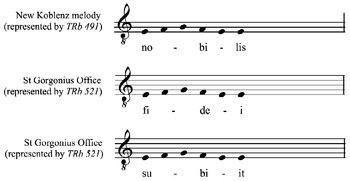
In a manner similar to the invitatory, the new Koblenz melody of Post sex annos contains a melodic allusion to the Office of Gorgonius. The final word of the responsory verse, ‘nobilis’, describing the noble Shepherd giving himself for his people (in this case it refers literally to Thomas Becket, who in turn is viewed as a Christ-figure, the ultimate noble shepherd), corresponds melodically with the word ‘fidei’ (faith, confidence and reliance) and then again to ‘subiit’ (meaning to enter, in this case, into the pasture) both in the ninth responsory for Matins in the Office for St Gorgonius (Example 4). Importantly, this is the same responsory (MR9) in the Gorgonius Office from which the previous allusion in the new Koblenz melody for the invitatory was drawn.
Comparison of melodic settings of ‘nobilis’ in the new Koblenz melody of Post sex annos, MR4 in the Office of Thomas Becket, and ‘fidei’ and ‘subiit’ in Expleto iam luctamine, MR9 in the Office of St Gorgonius.

Finally, amongst the highly ornate text settings in the Office, one of the most striking features in the new Koblenz melody is the extensive melisma on ‘Christo’ (Example 5).
‘Christo’ melisma in Post sex annos.

Within this long melisma, a substantial fragment of the melody is repeated, which is in turn followed by a closing motif, thus resulting in an overall structure of XXY. The flourish occurs within the octave from D to d, although neither of these pitches bears particular weight in the fourth mode. In comparison with the base melody and old Trier melodies, it certainly places a much greater emphasis on the word, by means of amplification.
What is remarkable is that a melisma even greater in length, but similar in melodic structure (XXY), exists in the ninth responsory for Matins in the Office of Gorgonius for the word ‘pascua’ (shown in Example 6 with the repeated ‘coo’ syllables as copied in TRb 521). In both cases, the range covers an octave, although ‘pascua’ makes much greater use of the plagal range. Since the issues of musical allusion and lengthy melismas resurface in the responsory, Iesu bone per Thome, a more conclusive analysis of the relation of the melismas will follow next.
‘Pascua’ melisma in Expleto iam luctamine, MR9 in the Office of St Gorgonius.

III. Ninth responsory for Matins: Iesu bone per Thome
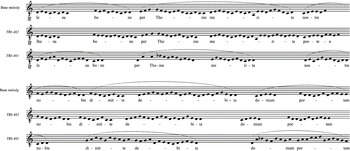
The third item for which a new melody is substituted is the ninth responsory for Matins, Iesu bone per Thome (this corresponds to Transcription III, see page 59).

The base and old Trier melodies are in mode two, while the new Koblenz melody is in mode one, thereby restoring the overall modal order in the Office at this point. In a manner similar to Post sex annos, the overall modal structure of Iesu bone per Thome appears to have been altered in order that the underlying modal structure might be better aligned with the poetic structure (Example 7).
Underlying structure of Iesu bone per Thome.

The underlying modal structure in the new Koblenz melody is remarkably different, considering that the modal change from mode two in the old Trier melodies to mode one in the new Koblenz melody is a very close alteration (the two are partner melodies). In fact, the two modes share D as a final and the overall range covered by the old Trier melodies and the new Koblenz melody is almost identical. Within the verse of the responsory, however, the new Koblenz melody occupies a higher range, one that is expected for mode one.
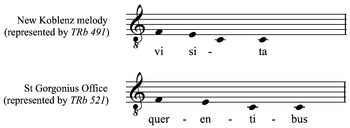
The new Koblenz melody to Iesu bone per Thome also contains a musical allusion to the Office of St Gorgonius. The melody for the word ‘visita’, in this case meaning to visit or see the tomb, corresponds to ‘querentibus’ (present participle of ‘queror’, meaning to express grief, lament or bewail) of the fourth responsory for St Gorgonius (Example 8). Presumably, this melodic motif would have reminded one of the emotions attached to grieving at the tomb.
Comparison of melodic settings of ‘visita’ in Iesu bone per Thome and ‘querentibus’ in MR4 in the Office of St Gorgonius.

Finally, in a manner similar to Post sex annos, an immediately striking change in word emphasis is the long melisma on ‘trina’ in the new Koblenz melody, which is much shorter in the old Trier melody (Example 9). Once again, the melisma contains a melodic cell which is repeated and is followed by a closing motif; this produces an overall XXY structure in the melisma. In this particular example, the flourish appears to be much more tied to modally important pitches, in comparison to the extended melisma on ‘Christo’ in Post sex annos.
‘Trina’ melisma in Iesu bone per Thome.

Of interest – although its significance is not immediately apparent – is a melisma from the fourth responsory of St Gorgonius: the same responsory from which the aforementioned musical allusion is taken. It occurs at the final word of the responsory section, ‘pollicitus’ (Example 10). Within the range of the octave, the melodic structure is similar to the other three melismas (XXY) and the opening motif covering a seventh is similar to the opening of ‘Christo’ in Post sex annos. Two issues are of importance here. First, while lengthy melismas do occur in the responsories in both the Thomas and the Gorgonius Offices, these four melismas are significantly longer and their structure (XXY) makes them unique within their Offices (no other melisma in either Office displays this repetitive structure). It should be noted that the melismas occur in both cases in the fourth responsory for Matins (MR4) and in the ninth responsory for Matins (MR9). Second, the only items in which musical allusion occurs between the Thomas Office and the Gorgonius Office are in these same four items, MR4 and MR9 in both Offices, as well as the new Koblenz invitatory in the Thomas Office. Thus, both the distinctive melismas as well as the musical allusions between these two Offices are limited to five items.
‘Pollicitus’ melisma in MR4 in the Office of St Gorgonius.

This evidence suggests that in both Offices MR4 and MR9 were newly composed melodies, which are stylistically distinct from the (presumably) older melodies. Highly elaborate melismas containing repetitive segments such as the ones discussed above are most common in late chant repertories. Thus, the melismas themselves are not unique to Koblenz but, rather, are characteristic of a later compositional style,Footnote 30 thus betraying the later addition of these items. The melodic allusions within the newly composed melodies in the Offices, however, are unique to the Koblenz area. As the melodies were recomposed, they were crafted in such a manner as to allude to Offices of similar saints and martyrs venerated in St Florin and St Castor. The new Koblenz melodies in the Thomas Office, thus, are uniquely and specifically appropriated for liturgical practices within the Koblenz area.
IV. Fourth antiphon for Lauds: Ad Thome memoriam
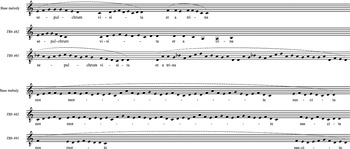
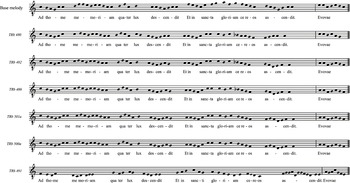
The last item for which a new melody is substituted is the fourth antiphon for Lauds, Ad Thome memoriam (this corresponds to Transcription IV, see page 62).

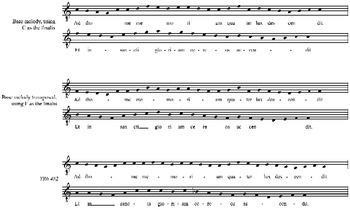
This antiphon contains numerous unusual modal ambiguities and inconsistencies. The base melody is in mode six with a finalis on C. The old Trier melodies contain two problems: first, a transposition error of a third occurs at the word ‘memoriam’ in the first half of the antiphon; second, the mode switches inexplicably at the beginning of the second half of the antiphon. The most interesting feature of this modal change mid-way through the antiphon is that it is corresponds with the base melody transposed to the usual finalis for mode six, which is F (Example 11).
Ad Thome memoriam: transpositions of the base melody using F and C compared to the old Trier melody, using TRb 482 as a representative source.

Thus, in the old Trier melodies, the first half resembles the base melody transposed with the finalis on C while the second half resembles the base melody transposed with a finalis on F. Within these two transpositions, individual notes have been sufficiently altered to avoid the tritone. The initial variant on ‘memoriam’ that causes the transposition error of a third appears to be a result of avoiding the B natural, as is the pitch A on ‘Et’, at the beginning of the latter half of the antiphon. Despite efforts to avoid the tritone in the old Trier melodies, at ‘cereos’ the interval is not only exposed but also filled in. Given the difficulties with transposition early on in the melody, an inexplicable modal switch mid-way through the antiphon, and melodic difficulties as a result of avoiding or concealing the augmented fourth, it seems reasonable that the need for a new Koblenz melody may have stemmed from a varied, modally inconsistent and melodically problematic old Trier melody.
While the base melody for this item was in mode six, the new Koblenz melody is in mode four, thereby restoring the modal order in the series of antiphons for Lauds. In a manner similar to the invitatory, the new melody is crafted to complement the rhyme scheme more closely. The first poetic line begins on F and ends on E, the finalis of the fourth mode; the second line begins on G and ends on E; the third line begins on G and ends on E, and the fourth line begins on F and ends on E. Thus, various modally important pitches create a balanced and palindromic melodic structure:
F–E, G–E; G–E, F–E.
Broadly speaking, the new Koblenz melody pays closer attention to the rhyme scheme and phrases in the text and the overall melody and individual phrases are modally more stable.
Summation
The Office of Thomas Becket is preserved in a cluster of manuscripts in the Diocese of Trier, Germany. Within this group, a subset particular to the Koblenz area exists, in which four new melodies have been substituted at various points in order to restore a previously disrupted modal order. Importantly, the modal scheme that is restored is necessarily a theoretical one. The initial disruption in the modal scheme would have occurred when Benedict's monastic Office was re-ordered to be used as a secular Office. Since all the sources from the Diocese of Trier are for secular use, the new Koblenz order is likely one of the only modally ordered Thomas Offices for secular use. This suggests a keen theoretical knowledge of plainchant for liturgical Offices in the Koblenz area.
Although the new melody for the invitatory, Adsunt Thome martiris, does not play a role in the overall modal order, it does employ a more usual mode for the item. Moreover, numerous copying and transmission errors are present in the old Trier melody, many of which are potentially problematic for singers in a performance context. The new Koblenz melody for the invitatory effectively solves many of these melodic transcription problems and also corrects textual errors in the old Trier melodies. Similarly, in the fourth antiphon for Lauds, Ad Thome memoriam, the old Trier melodies contain an error relating to modal consistency that is corrected in the new melody; its mode is more clearly defined and consistent throughout the melody.
The two new Koblenz melodies for the responsories Post sex annos and Iesu bone per Thome have been composed in such a manner that the underlying modal structure is aligned with each individual line of rhymed poetry; the beginning and ending pitch of each line serves to define the melodic framework of the mode. Moreover, the two responsories (and the new Koblenz melody to the invitatory) contain melodic allusions to the Office for St Gorgonius, a martyr also venerated in Koblenz. Both MR4 and MR9 contain these allusions and display a later melismatic aesthetic, in which extensive melismas contain a repetition of the initial melodic cell, followed by a closing motif. The melodic allusions to the Office of St Gorgonius betray a desire to establish, reflect and cultivate a local liturgical identity in Koblenz. Musical allusions such as these are effective only within a community that is intimately familiar with the sound, content and local significance of both the Thomas and the Gorgonius Offices.
Finally, a close analysis of the modal order and disorder in liturgical Offices is highly valuable in identifying clusters of related manuscripts. These clusters of variants serve to highlight the intricate details of how a liturgical Office can be adapted for use within a particular ecclesiastical, regional or even political context. Within these localised variants, fresh insight can be gained into the ever-changing and living identities of distinct communities, traces of which are preserved in liturgical plainsong.
Invitatory – Adsunt Thome martiris
The base melody and old Trier melodies are in mode one while the new Koblenz melody (represented by TRb 491) is in mode four. The grey areas in TRb 482 and TRb 500a indicate melodic segments affected by a transposition error. The bracketed areas in TRb 480 and TRb 496 indicate a discrepancy between red and yellow Guidonian lines representing the F and C clef, respectively, and additional clef signs. This transcription follows the clef signs rather than the coloured Guidonian lines.

Fourth Responsory for Matins – Post Sex Annos.
TRb 480 contains several variants unique to itself while TRb 482 represents the remainder of the manuscripts with the old Trier melodies. TRb 491 has been selected to represent the new Koblenz melodies, which do not contain any substantial variants.
(a)

(b)

(c)

Ninth Responsory for Matins – Iesu bone per Thome
(a)

(b)

(c)

Fourth Antiphon for Lauds – Ad Thome memoriam.