Introduction
In a recent article published in this journal, Langgut et al. (Reference Langgut, Yahalom-Mack, Lev-Yadun, Kremer, Ulman and Davidovich2016: 973) proposed five Late Chalcolithic (c. 4300–4000 BC) wooden shafts to be “the earliest Near Eastern wooden spinning implements”. Here we discuss these unique finds in light of their cultural and technological contexts, and suggest an alternative interpretation according to which these wooden shafts, one with a lead macehead lodged on its upper end, were components of the cultic practices of the southern Levantine Ghassulian culture.
As a background to our alternative interpretation, we present the current status of research on the early stages of two disparate technologies—textile production and metallurgy. Based on the available evidence, we demonstrate that the early advancements of the two did not coincide, and that the use of metal for spinning implements occurred several millennia after the Chalcolithic, and not before metal was already integrated into the production of mundane and utilitarian artefacts.
The new discovery
The five wooden shafts were discovered in two caves in the northern Negev Desert (Israel), where low humidity enabled their preservation. They were found together with other artefacts typical of the Late Chalcolithic Ghassulian culture and dated by radiocarbon to the last three centuries of the fifth millennium BC. One of these shafts, from Ashalim Cave, was found with a metallic object still attached, which was introduced by Yahalom-Mack et al. (Reference Yahalom-Mack, Langgut, Dvir, Tirosh, Eliyahu-Behar, Erel, Langford, Frumkin, Ulman and Davidovich2015: 1) as a macehead made of “the earliest lead in the Levant”. This object is interpreted by Langgut et al. (Reference Langgut, Yahalom-Mack, Lev-Yadun, Kremer, Ulman and Davidovich2016: 986) as a ‘whorl’, with the possibility that this function was secondary to its use as a macehead.
The context of these new finds indicates that they should be associated with some of the most quintessential attributes of the Ghassulian culture, including cultic practices, burial customs and sophisticated metallurgy (see an overview of this culture in Levy Reference Levy1986; Gilead Reference Gilead1988; Rowan & Golden Reference Rowan and Golden2009). As demonstrated below, this has to be taken into account when interpreting the function of the wooden shafts, together with technological considerations based on current knowledge of early spinning and textile production.
Late Chalcolithic metallurgy
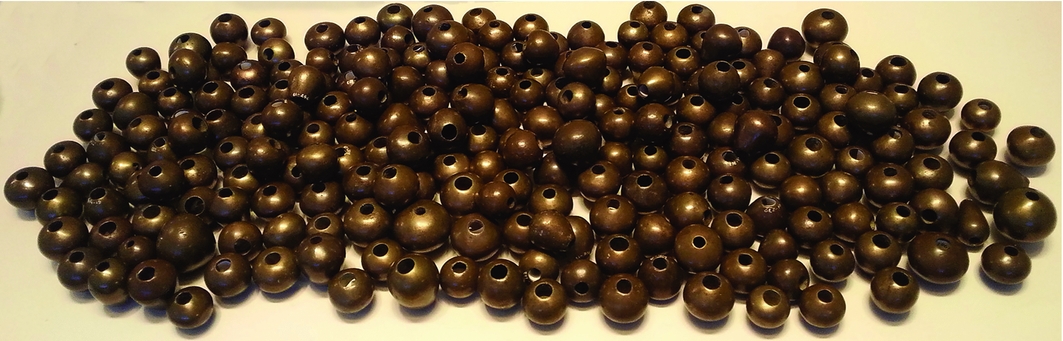
Some of the most extraordinary achievements of the southern Levantine Ghassulian culture were related to metallurgy. Not only were copper-based artefacts first introduced into the southern Levant during this cultural period, but so were two discrete techniques of their manufacture: simple open casting and highly sophisticated casting in the lost wax technique (e.g. Goren Reference Goren2014). The latter, used to produce intricate metal objects, was a Ghassulian phenomenon, unparalleled among other nearby cultures and those of the successive Early Bronze Age. The most famous collection of such artefacts was also discovered in a cave (‘Cave of the Treasure’, Bar-Adon Reference Bar-Adon1980; Sebbane Reference Sebbane, Sebbane, Misch-Brandl and Master2014), in one of the canyons of the Judean Desert. Over 400 artefacts were found, including crowns, sceptres and other unique objects, with the most frequent find being maceheads (Figure 1, Sebbane Reference Sebbane, Finkelstein, Robin and Römer2016). These artefacts were made with exotic, non-local, copper-based alloys (with varying concentrations of arsenic, antimony and nickel), indicating considerable effort expended in procuring these ores/ingots through long-distance trade. In addition, various types of evidence demonstrate that they constituted an integral part of Ghassulian cultic practices (e.g. Gosic & Gilead Reference Gosic, Gilead and Laneri2015, and references therein). This was probably the case for all metallic objects, including those made of pure copper by simple casting, which replicated the shapes of ‘utilitarian’ tools (such as axes and adzes, e.g. Gosic Reference Gosic2015; Ben-Yosef et al. Reference Ben-Yosef, Vassal, van den Brink and Beeri2016). In fact, it seems that metal rarely, if at all, had a utilitarian function in the Ghassulian culture.
Various maceheads found at the Cave of the Treasure in the Judean Desert (now on exhibition in the Israel Museum, http://www.imj.org.il/imagine/collections/departments/5). This extraordinary collection demonstrates advanced casting technology made with exotic copper alloys obtained through long-distance trade. (Photograph by permission of O. Shamir.)

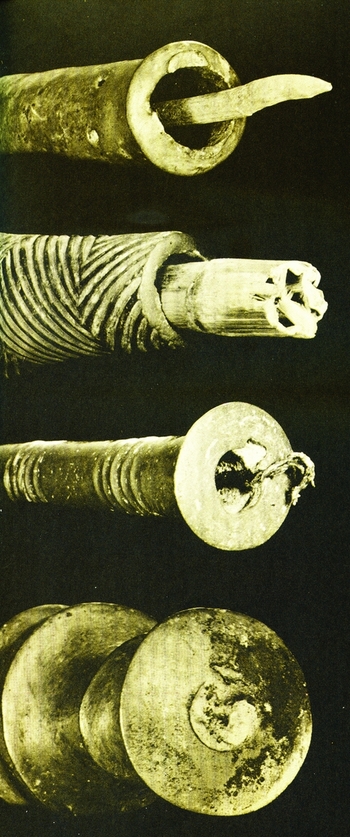
As mentioned above, the wooden shaft from the Ashalim Cave was found inserted into a spherical lead object, which was interpreted as a macehead by Yahalom-Mack et al. (Reference Yahalom-Mack, Langgut, Dvir, Tirosh, Eliyahu-Behar, Erel, Langford, Frumkin, Ulman and Davidovich2015: 11) based on typological similarity to the previously published metallic maceheads from the Cave of the Treasure (while noting its slightly smaller size, cf. Bar-Adon Reference Bar-Adon1980; Sebbane Reference Sebbane, Finkelstein, Robin and Römer2016). We agree with this interpretation, and consider this find as a rare case in which a macehead was found together with its shaft. It should be noted that some maceheads and sceptres with intact wooden shafts and sticks, similar to those from Ashalim and Qina Caves, were also found in the Cave of the Treasure assemblage (Figure 2, Bar-Adon Reference Bar-Adon1980: 116). As with other metal maceheads of the period, the Ashalim artefact should be interpreted as part of the Ghassulian cultic practices, and utilitarian functions (weapon or whorl) should be excluded. This is reinforced by the unique composition of the object—namely pure metallic lead—as this material was even rarer than the exotic alloys typically used to produce other maceheads. Indeed, as emphasised by Yahalom-Mack et al. (Reference Yahalom-Mack, Langgut, Dvir, Tirosh, Eliyahu-Behar, Erel, Langford, Frumkin, Ulman and Davidovich2015), the find from Ashalim Cave is the only lead object reported so far for the Chalcolithic southern Levant. Similar to the other alloys, lead also had to be obtained by long-distance trade, possibly with eastern Anatolia (Yahalom-Mack et al. Reference Yahalom-Mack, Langgut, Dvir, Tirosh, Eliyahu-Behar, Erel, Langford, Frumkin, Ulman and Davidovich2015), a substantial investment that further stresses its unique role in Ghassulian society.
Sceptres made of copper-based alloys found with wooden shafts and sticks at the Cave of the Treasure (Bar-Adon Reference Bar-Adon1971: 44, reprinted by permission of the Israel Exploration Society). The excavator suggests that these objects and the maceheads were carried on wooden shafts as sacred standards in processional ceremonies. Note that the wooden stick in the upper sceptre is thinner than the diameter of the cavity and has similar characteristics to some of the sticks found in Qina Cave. In addition, the sceptre third from the top has a linen thread, probably used to fasten some light-weight object.

Recently, Ben-Yosef et al. (Reference Ben-Yosef, Vassal, van den Brink and Beeri2016) suggested that this object, together with a newly discovered macehead of leaded copper (up to 70wt% lead in inclusions), represent an episode of shortage in the arsenic-antimony-nickel bronzes, and the subsequent emergence of an alternative trade system focused on lead. The use of alternative material was predominantly a technological solution, sought in order to continue the production of objects in the lost wax technique, which required low viscosity of the molten metal (of the quality of lead, leaded copper or the other alloys used in the Chalcolithic) in order for it to flow smoothly through the moulds. The rarity of lead might account for the somewhat smaller size of the Ashalim macehead compared to the published metallic maceheads from the Cave of the Treasure and elsewhere (cf. Ben-Yosef et al. Reference Ben-Yosef, Vassal, van den Brink and Beeri2016).
The rarity of the raw material is only one of several strong arguments that link maceheads to Ghassulian cultic practices (Sebbane Reference Sebbane, Finkelstein, Robin and Römer2016, and references therein). These include, for example, the association of maceheads with other metallic objects that had a clear symbolic and ritualistic function, and several maceheads found with decorative motifs that repeat in other Ghassulian cultic contexts (e.g. ibexes). In addition, the discovery of 25 maceheads in the Late Chalcolithic sanctuary of Gilat (Levy et al. Reference Levy, Conner, Rowan, Alon and Levy2006a) testify to their important role in temple ceremonial activity; in this regard, it should be noted that the maceheads from the Cave of the Treasure—the largest assemblage of maceheads from this period—is assumed by many scholars to originate from the Chalcolithic temple of ‘Ein-Gedi (Ussishkin Reference Ussishkin2014). Lastly, there are many parallels to the use of maceheads as part of cultic practices in the Ancient Near East, and although the Ghassulian record constitutes one of the earliest examples, it is definitely not unique (Sebbane Reference Sebbane, Finkelstein, Robin and Römer2016).
In summary, the association of the lead object from Ashalim Cave with Ghassulian metallurgy strongly suggests that it bore cultic meanings, and that the wooden shaft was used to bear aloft the unique metal, shaped as a macehead, in processional ceremonies. As metals were always a valuable commodity in antiquity, it is reasonable to assume that metallic artefacts were the first to be robbed. Thus, it is not surprising that the wooden shafts at Qina Cave were found without the metal objects (maceheads, sceptres and the like) that probably were once part of the burial assemblage.
Late Chalcolithic textile production
Rare Chalcolithic textiles found in the Judean Desert offer exceptional insights into early textile production, which entailed a long series of processes from the cultivation of flax—requiring knowledge of local agriculture—to the processing of fibres—involving specialised knowledge of fibre properties and textile production (Shamir Reference Shamir2015: 12). The raw material used in all southern Levantine Chalcolithic textiles is flax (Linum usitatissimum) (Shamir Reference Shamir2015: 16). The Neolithic domestication of flax was an essential prerequisite for Chalcolithic textiles, as experimental fibre extraction from the predominant indigenous wild flax (L. pubescens) in Israel proved that these plants had surfaces that were too coarse to allow the creation of threads suitable for textiles (Abbo et al. Reference Abbo, Zezak, Lev-Yadun, Shamir, Friedman and Gopher2014: 59). Flax was the sole material used for the manufacture of textiles in the southern Levant until the Middle Bronze Age (Shamir Reference Shamir2002: 21*; Rast-Eicher Reference Rast-Eicher, Bichler, Grömer, Hofman, Keijzer, Kern and Reschreiter2005). The earliest attested linen yarn of the region is radiocarbon dated to 10 220±45 BP (Bonani Reference Bonani1995; 10 163–9812 cal BC at 95.4% confidence, calibrated by OxCal v.4.2 and calibration curve IntCal13; Bronk Ramsey Reference Bronk Ramsey2009; Reimer et al. Reference Reimer, Bard, Bayliss, Beck, Blackwell, Ramsey, Buck, Cheng, Edwards, Friedrich, Grootes, Guilderson, Haflidason, Hajdas, Hatté, Heaton, Hoffmann, Hogg, Hughen, Kaiser, Kromer, Manning, Niu, Reimer, Richards, Scott, Southon, Staff, Turney and van der Plicht2013); it was recovered from one of the Wadi Murabba'at caves. The yarn, worked in a weft-twining technique, bound together disparate, sharpened, myrtle sticks into a coherent comb (Schick Reference Schick1995; Shimony Reference Shimony1995). Linen fabrics from the Pre-Pottery Neolithic period were preserved only in the deposits of Nahal Hemar Cave (Schick Reference Schick1988; Shimony & Jucha Reference Shimony and Jucha1988). They were not woven, but were made in a variety of techniques such as interlinking, looping and knotted netting (Schick Reference Schick1988; Barber Reference Barber and Meyers1997: 191); that is, without the use of a loom.
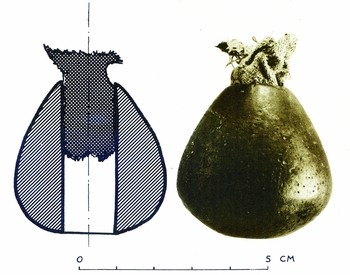
The key observation that triggered the interpretation of the new finds as early spindles by Langgut et al. (Reference Langgut, Yahalom-Mack, Lev-Yadun, Kremer, Ulman and Davidovich2016) was the identification of bast fibres (probably linen) attached to the wooden shafts of the Qina Cave. These fibres may, however, equally be interpreted as the remains of linen textiles used to cover/wrap the wooden shafts that held cultic metal objects, used as part of ritual practices. In the finds from the Cave of the Treasure (Bar-Adon Reference Bar-Adon1971), there is direct evidence for the use of linen textiles to wrap maceheads or wedge them onto a wooden shaft (Figure 3), and possibly to tie an additional lightweight artefact to the shaft immediately below the macehead with linen threads (Figure 2).
A macehead made of a copper-based alloy, found with linen textile still attached at the Cave of the Treasure (Bar-Adon Reference Bar-Adon1971: 124, reprinted by permission of the Israel Exploration Society).

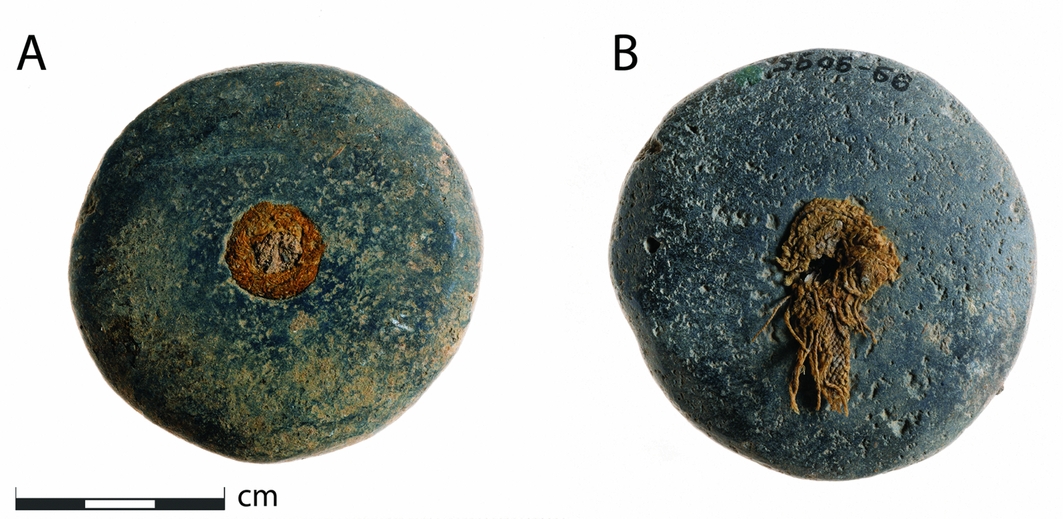
Furthermore, in the storage of the Israel Antiquities Authority (IAA) we were able to locate two unpublished Late Chalcolithic basalt spindle whorls (Figure 4) with fragments of wooden shafts still attached and wedged in place using linen textile (IAA nos 1999–9094; 1999–9095). These unique artefacts were discovered in one of the Nahal Ze'elim caves as part of Aharoni's expedition to the Judean Desert (Aharoni Reference Aharoni1961). They have attributes typical of whorls from this period, and their future study may indeed shed more light on this early stage of textile production.
Two unpublished Late Chalcolithic basalt whorls found by Y. Aharoni in the Judean Desert. They weigh 63.3g and 94.8g respectively (A = IAA number 99–9094; B = IAA number 99–9095). Note the fragments of wood shafts wedged into the whorls’ holes using textile and fibres. (Photographs by permission of Clara Amit.)

Early spinning technology: spindle shapes and materials
Several aspects of the wooden shaft and macehead from Ashalim Cave render their interpretation as spindle and whorl difficult (cf. Langgut et al. Reference Langgut, Yahalom-Mack, Lev-Yadun, Kremer, Ulman and Davidovich2016: fig. 6; Yahalom-Mack et al. Reference Yahalom-Mack, Langgut, Dvir, Tirosh, Eliyahu-Behar, Erel, Langford, Frumkin, Ulman and Davidovich2015: fig. 5), including the rough surface of the shaft and its asymmetrical pointed tip. Both shaft and whorl are typically made as smooth as possible to eliminate the possibility of snagging the newly formed/forming yarn, and the shaft is typically symmetrical for spinning efficiency (Levy & Gilead Reference Levy, Gilead, Nosch, Koefoed and Strand2013: 31, fig. 2.3; Shamir Reference Shamir, Sebbane, Misch-Brandl and Master2014: 148, figs 7–17). The lead macehead itself is also asymmetrical. Although not all whorls are symmetrical, the ideal for rotational efficiency is that a whorl should be symmetrically disposed around a central axis (cf. Shamir Reference Shamir and Ariel1996: 149); consequently, this is a common practice worldwide (Liu Reference Liu1978: 92). We argue that the lead artefact was used only as a (cultic) macehead, and, as such, dissymmetry is not functionally significant, as opposed to a whorl—a flywheel—whose raison d’être is to augment and maximise rotational efficiency.
We could also not find any reference for whorls made of lead that originated from secure archaeological contexts. This is the case not only in the Chalcolithic—when lead was extremely rare in the southern Levant (the Ashalim object is the only lead artefact found so far)—but also in any other period as far as we know. Barber (Reference Barber1991, Reference Barber1994), even with a very extensive survey of textile-production practices, does not mention lead whorls, nor has she encountered any (Barber pers. comm. 8 December 2016), while some references to the use of lead (e.g. Liu Reference Liu1978: 94; Hochberg Reference Hochberg1980: 12) lack sufficient contextual information to contribute to the discussion.
A deep notch at the head of the wooden shaft was suggested by Langgut et al. (Reference Langgut, Yahalom-Mack, Lev-Yadun, Kremer, Ulman and Davidovich2016: 982, tab. 2) to be a “groove to catch the yarn while the spindle was whirling”. Grooves at the heads of spindle shafts, diagonally disposed, veering to left or right in accordance with the direction of spin, are used to augment spinning efficiency by guiding the newly formed yarn to the fibre mass. This is first evidenced on intact copper spindles recovered from Mesopotamian sphere burials (third millennium BC; Barber Reference Barber1991: figs 2.19, 2.20, 2.21) and Middle Kingdom Egyptian wooden spindles (c. 2000 BC; Barber Reference Barber1991: 65, fig. 2.32). Use of a groove was undoubtedly preceded by a half hitch at the head of the shaft, looped around the thumb, as when adding stitches in knitting (Ryder Reference Ryder1968: 79). The notch above the macehead on the item from Ashalim Cave is not a typical groove as known from archaeology and ethnography (cf. Barber Reference Barber1991: 65, fig. 2.32), but rather a laterally expanded round hole (Langgut et al. Reference Langgut, Yahalom-Mack, Lev-Yadun, Kremer, Ulman and Davidovich2016: fig. 8). Its length is more than half the width of the shaft, and if used for drop spinning, would considerably weaken the shaft. In drop spinning, as proposed by Langgut et al. (Reference Langgut, Yahalom-Mack, Lev-Yadun, Kremer, Ulman and Davidovich2016: fig. 1b), the shaft is subject to incessant impact when hitting the ground. The proposed lead whorl is extremely heavy (see below), and using it in the drop-spinning mode together with a weakened shaft would make the spindle's use-life rather short. This hole might be related to the way the macehead was used or adorned, but without further evidence, any reconstruction would be too speculative.
Langgut et al. (Reference Langgut, Yahalom-Mack, Lev-Yadun, Kremer, Ulman and Davidovich2016: 986) also refer to abrasion at the base of the whorl engendered by yarn movement. Yarn is, however, manufactured above the whorl and wound up below, meaning that the yarn at the base of the whorl is static, and that the observed abrasion cannot testify to the action of spinning. The maximum abrasion that could occur would be a measure of symmetrical polishing at the widest point of the whorl perimeter (maximum circumference) from contact with the newly formed yarn.
Most ethnographic examples of wooden spindles from south-west Asia weigh around 50g and range from 50–55cm in length (e.g. Weir Reference Weir1976: fig. 57; Watson Reference Watson1979: 178, tab. 5.4), whereas the Ashalim Cave spindle weighs 155g and its length is just 22cm. Moreover, studies on Late Chalcolithic whorls made of clay and stone found that such artefacts typically weigh between 21 and 64g, depending on the particular type of raw material used (Levy Reference Levy2006: 168–69; Levy et al. Reference Levy, Alon, Anderson, Rowan, Kersel and Levy2006b: 714–15; Levy & Gilead Reference Levy, Gilead, Nosch, Koefoed and Strand2013: 31). Although it was possible to produce yarn using a replica of the lead object (Langgut et al. Reference Langgut, Yahalom-Mack, Lev-Yadun, Kremer, Ulman and Davidovich2016: supplementary material), the process was not very efficient, in particular because of the weight of the proposed lead whorl in relation to the length of the shaft; heavy or large whorls are ethnographically associated with thigh-supported spinning (Frodin & Nordenskiöld Reference Frodin and Nordenskiöld1918: pl. 43; Kissell Reference Kissell1918: fig. 4), and not with the drop-spinning mode as suggested here.
The earliest artistic representations of spinning come from fourth-millennium BC Mesopotamia and early third-millennium BC Egypt, and feature spindles with high-positioned whorls (Barber Reference Barber1991: 53, figs 2.16 & 2.43). This was the predominant mode of spinning in many regions, including Egypt, Sudan, Ethiopia and Saudi Arabia (Crowfoot Reference Crowfoot1931; Weir Reference Weir1970: pls 2–3; Hilden Reference Hilden2010: 54), and has also been observed in Iran and Turkey (Hochberg Reference Hochberg1980: 63). Although the top-whorl spindle has been used in the Levant in the recent past, it is not certain if this was the case in antiquity, as no depictions of spinning from this region have been found (Boertien Reference Boertien2013: 20). Moreover, a tenth-century BC wooden spinning implement from Tell el-Hama, found with linen threads still wrapped around it, indicates the use of the low-positioned whorls in this region (Shamir Reference Shamir and Ariel1996: 142, Reference Shamir, Cohen and Bernick-Greenberg2007: 265).
The use of distaffs in the southern Levant
The wooden sticks from the Qina Cave were identified by Langgut et al. (Reference Langgut, Yahalom-Mack, Lev-Yadun, Kremer, Ulman and Davidovich2016) as possible distaffs. These are, however, very much a Classical and historical European phenomenon (Hochberg Reference Hochberg1980: 11, 41, 33, 50–57). It is so internalised in European traditions of textile production that it has been difficult for European scholars to conceive otherwise for ancient Near Eastern civilisations. For example, in Schliemann's (Reference Schliemann1979 [1884]: 296) discussion of textile representations from the tombs of Beni Hassan (c. 2000 BC Egypt), the cornerstone for understanding south-west Asian prehistoric and protohistoric textiles, he expressed bewilderment at the absence of distaffs, and proposed that they were concealed in the baskets at the spinners’ feet. The classical distaff with a stick was introduced into Egypt in the Roman period (Crowfoot Reference Crowfoot1931: 29; Krauss Reference Krauss1945: 108–109), but was culturally rejected. All the many images of spinning wool, cotton and flax along the length of the Nile are without distaffs. Two distaffs illustrated by Crowfoot (Reference Crowfoot1931: pls 39, 40) are circlets of rough cord, shaped like a noose, around which rove is wound and hung from the wrist. Ethnographic observations across south-west Asia attest to the prepared rove/fibre mass held in the left hand, looped around the wrist or thrown across the shoulder (Crowfoot Reference Crowfoot1931: 29, 37, pls 3–10, 12–15, 22–23, 26–30; Weir Reference Weir1976: pl. 36; Watson Reference Watson1979; Hochberg Reference Hochberg1980: 63).
Furthermore, all Ghassulian yarn is spliced (Shamir Reference Shamir, Sebbane, Misch-Brandl and Master2014: 145, Reference Shamir2015: 17), as is early Egyptian yarn (Barber Reference Barber1991: 47, pls 2.8, 5.1) and linen yarn in Neolithic Europe from the second half of the fifth millennium BC (Leuzinger & Rast-Eicher Reference Leuzinger and Rast-Eicher2011). Aligned, processed flax fibres are drawn out of the prepared hanks and spliced/stuck together end to end with water or, preferably, saliva. The join is consolidated between the palm of the hand and a smooth hard surface, given a twist while supported on the thigh and the continuous strand is rolled up into a ball. Once the join has dried and set, the proto-yarn is spun into single-ply yarn with the aid of a spindle. Hence, there is no fibre mass as proposed by Langgut et al. (Reference Langgut, Yahalom-Mack, Lev-Yadun, Kremer, Ulman and Davidovich2016) to be held on a distaff as occurs in draft spinning, and thus no place for the use of a distaff in the Ghassulian textile industry. The traces of bast fibres, purported to be linen (Langgut et al. Reference Langgut, Yahalom-Mack, Lev-Yadun, Kremer, Ulman and Davidovich2016: 986), could, as suggested earlier, have resulted from the use of a piece of linen wedged into a macehead perforation for a tight, secure fit on the shaft, or, alternatively, for wrapping material for transportation (Figure 3).
Late Chalcolithic burial practices
The wooden shafts were discovered in deep, almost inaccessible cave chambers, together with human skeletal remains (Langgut et al. Reference Langgut, Yahalom-Mack, Lev-Yadun, Kremer, Ulman and Davidovich2016: 979). These clear mortuary contexts indicate that the artefacts played a part in Ghassulian burial practices, which were rich in symbolic meanings and involved certain rituals (e.g. Golden Reference Golden and Golden2010; Gal et al. Reference Gal, Shalem and Smithline2011). It should be noted that Late Chalcolithic occupations of Judean Desert caves were not exclusively related to mortuary or hoarding contexts, but also included mundane activities (e.g. Davidovich Reference Davidovich2014), such as indicated by the three basalt spindle whorls found at Qina (Langgut et al. Reference Langgut, Yahalom-Mack, Lev-Yadun, Kremer, Ulman and Davidovich2016: 979) along with the two found at Nahal Ze'elim (Figure 4; the Qina whorls were found 30m away from the wooden shafts).
In light of current knowledge of Ghassulian burial practices, the suggestion that these purported spinning items were placed in the burials as grave goods of individuals related to the textile industry (Langgut et al. Reference Langgut, Yahalom-Mack, Lev-Yadun, Kremer, Ulman and Davidovich2016: 988) would appear to be lacking a cultural precedent. Although spindle whorls frequently appear in post-Chalcolithic female burials (e.g. Guy Reference Guy1938: 33; Rosenthal-Heginbottom Reference Rosenthal-Heginbottom and Mazar2013: 243), there is no such evidence in any of the many excavated burials of the Ghassulian culture at Grar (Gilead Reference Gilead1995), Shiqmim (Levy Reference Levy1987) or Teleilat Ghassul (Mallon et al. Reference Mallon, Koeppel and Neuville1934). Finds from Gilat (Smith et al. Reference Smith, Zagerson, Sabari, Golden, Levy, Dawson and Levy2006: 330, 335, 337; contra Levy et al. Reference Levy, Alon, Anderson, Rowan, Kersel and Levy2006b: tab. 14.1 #67, 68, 69) and Bir es-Safadi (IAA storeroom records) are probably fills related to domestic activities.
On the other hand, metallic maceheads and other metal objects used as indicators of prestige are known from clear Late Chalcolithic mortuary contexts, including Pequi'in Cave (Gal et al. Reference Gal, Shalem and Smithline2011; Segal & Goren Reference Segal, Goren, Gal, Smithline and Shalem2013), Palmahim Cemetery (Gophna & Lifshitz Reference Gophna and Lifshitz1980; Shalev Reference Shalev, Gopher and Tsuk1996) and Nahal Qanah (Shalev Reference Shalev, Gopher and Tsuk1996).
Conclusions
Several different lines of evidence indicate that the newly discovered wooden artefacts from the Negev were not related to the Late Chalcolithic textile industry, but rather to cultic aspects of the Ghassulian culture. These included the use of rare metal artefacts, such as maceheads and sceptres, in processional ceremonies and other rituals. Such artefacts were wielded using shafts, which, as the new finds demonstrate, were made of wood (cf. Figure 2; Bar-Adon Reference Bar-Adon1971: 44). Linen textiles and threads were evidently also used together with these cultic items, probably to wrap them, tie them to other artefacts or wedge them securely onto their shaft (cf. Figure 3; Bar-Adon Reference Bar-Adon1971: 124).
Moreover, the overview of the current evidence presented above clearly demonstrates that there is no indication for the use of distaffs in the southern Levant with Ghassulian textiles; thus any attempt to identify such implements in the archaeological record of this period should employ extra caution, and be detached from what we know for historical Europe (contra to some of the earlier studies of this topic). Based on the available evidence, the wooden sticks from the Judean Desert cannot be identified as distaffs.
Up until now, the oldest wooden spinning implement from the Ancient Near East was the Early Bronze Age broken shaft attached to a basalt spindle whorl discovered at Tell Abu al-Kharaz in Jordan (Fischer Reference Fischer2008: fig. 315). Here we reported for the first time on two Late Chalcolithic basalt spindle whorls found in the early 1960s by Y. Aharoni in the Judean Desert (Figure 4). These whorls, still mounted on broken wooden shafts, may indeed represent the oldest wooden spinning implements from the Ancient Near East; as might be expected, they are made of stone—a relatively easily acquired material—and have attributes typical of whorls previously reported from Ghassulian contexts.
Metallic spinning implements are extremely rare, and the earliest finds are copper spindles, comprising both shafts and whorls, from the late third-millennium BC cemetery of Kish, Mesopotamia, and a third-millennium female grave at Tepe Hissar (Barber Reference Barber1991: figs 2.19 & 2.20 respectively). It is therefore clear that the two disparate technologies—metallurgy and textile production—had no direct connection in their early stages. Each of these technologies fulfilled different roles within Chalcolithic societies, and metallurgy—being in its inception at this time—was centred on prestige and cultic objects, and only rarely, if at all, on more mundane tools (cf. Roberts et al. Reference Roberts, Thornton and Pigott2009). It took many centuries for the role of metals to change before they became more widely incorporated into the manufacturing of everyday tools, including those used in textile spinning, although in this case, their use was only ever rare.
Acknowledgements
Our thanks are due to Naama Sukenik who drew our attention to the unpublished spindle whorls from Aharoni's excavations. This research was partially supported by the Marie Curie FP7-PEOPLE-2012-CIG grant #334274 to E. Ben-Yosef.