Many youth exposed to a life-threatening natural disaster report posttraumatic stress symptoms (PTSS) that are directly related to their experiences during, and in the first few months after, the disaster (Masten & Osofsky, Reference Masten and Osofsky2010; Norris et al., Reference Norris, Friedman, Watson, Byrne, Diaz and Kaniasty2002; Vernberg, La Greca, Silverman, & Prinstein, Reference Vernberg, La Greca, Silverman and Prinstein1996). Although these disaster-related PTSS typically decrease in intensity and frequency over time, some youth continue to report elevated levels of PTSS many years after the event (Lai, Lewis, Livings, La Greca, & Esnard, Reference Lai, Lewis, Livings, La Greca and Esnard2017). The current study examines two processes that may help to explain the link between disaster exposure and enduring PTSS related to the disaster: caregiver emotion socialization (ES) and youth recollection qualities. Caregiver ES (i.e., how caregivers talk about emotions and respond to their youth's emotional expressions) has been linked to a variety of mental health outcomes in youth (Eisenberg et al., Reference Eisenberg, Losoya, Fabes, Guthrie, Reiser, Murphy and Padgett2001). ES practices used by caregivers during caregiver–youth co-reminiscing around traumatic events may be one factor that influences how youth remember and make meaning out of stressful events (Campos, Frankel, & Camras, Reference Campos, Frankel and Camras2004; Stocker, Richmond, Rhoades, & Kiang, Reference Stocker, Richmond, Rhoades and Kiang2007) and, ultimately, how youth cope with trauma. In addition, caregivers engage their youth in the co-construction of narratives as they reminisce about past events, particularly events that are stressful and evoke negative emotions (Larson, Richards, Moneta, Holmbeck, & Duckett, Reference Larson, Richards, Moneta, Holmbeck and Duckett1996; McLean & Mansfield, Reference McLean, Mansfield and Habermas2011). Thus, caregivers likely have a significant influence on how their youth make meaning out of shared traumatic events, such as natural disasters. To date, the role of caregiver ES in how youth respond to traumatic events has been largely theoretical (Fivush, Reference Fivush, Quas and Fivush2009). The current study examined the relations among caregiver ES during a caregiver–adolescent co-reminiscing task around a shared experience of a natural disaster, adolescents’ recollections of the event, and youth PTSS in the long-term aftermath of a category EF-4 tornado in Tuscaloosa, Alabama.
Caregiver ES and Youth Outcomes
Caregivers’ communication with their children regarding emotions (i.e., ES), influences the ways in which children learn to respond to life events and self-regulate (Bögels & Brechman-Toussaint, Reference Bögels and Brechman-Toussaint2006). Supportive caregivers are likely to model appropriate expression of both positive and negative emotions and engage in conversations about their children's emotional experiences. Much of the literature on caregiver ES focuses on the role parents play in shaping their children's early emotion regulation skills (e.g., Katz, Wilson, & Gottman, Reference Katz, Wilson, Gottman, Cox and Brooks-Gunn1999). However, caregivers continue to be an important supportive resource for adolescents and will engage in a variety of ES practices, including responding to and discussing adolescents’ emotions (see, for review, Miller-Slough & Dunsmore, Reference Miller-Slough and Dunsmore2016). Many youth have learned core emotion knowledge by the time they reach adolescence. However, adolescents will continue to learn from their caregivers about how to use self-regulatory skills during this potentially stressful developmental transition period. In addition, ES strategies appear to influence adolescents differently than younger children, warranting the need for more research on ES strategies across development. For example, overriding, defined as discouraging emotion expression and generally considered a dismissive ES practice, may actually be supportive for adolescents because it serves to alleviate distress and decrease emotional reactivity (Garside & Klimes-Dougan, Reference Garside and Klimes-Dougan2002; Miller-Slough & Dunsmore, Reference Miller-Slough and Dunsmore2016). In contrast, caregiver magnification or mirroring of adolescents’ emotional expression may interfere with their abilities to teach their adolescents about emotions because these parents may be overfocused on their own emotional reactions. Regardless, the literature consistently notes that it is integral to healthy development for caregivers to continue to validate and respond empathically to their adolescents’ emotional experiences (Miller-Slough & Dunsmore, Reference Miller-Slough and Dunsmore2016; Stocker et al., Reference Stocker, Richmond, Rhoades and Kiang2007). Caregivers who engage in these emotionally supportive behaviors have adolescents with fewer externalizing and internalizing symptoms overall (Katz & Hunter, Reference Katz and Hunter2007; Klimes-Dougan et al., Reference Klimes-Dougan, Brand, Zahn-Waxler, Usher, Hastings, Kendziora and Garside2007; Shortt, Stoolmiller, Smith-Shine, Mark Eddy, & Sheeber, Reference Shortt, Stoolmiller, Smith-Shine, Mark Eddy and Sheeber2010).
However, remaining child-centered during emotionally salient discussions requires caregivers to set aside their own needs and acknowledge their children's emotions (Izard, Reference Izard1991; Izard & Ackerman, Reference Izard, Ackerman, Lewis and Haviland2000; Klimes-Dougan et al., Reference Klimes-Dougan, Brand, Zahn-Waxler, Usher, Hastings, Kendziora and Garside2007). Unsupportive caregiver behaviors may include exerting a large amount of control over the content of the conversation by giving little acknowledgment of their children's negative emotions and being overly focused on their own emotions and experiences (i.e., egocentrism). Moreover, high egocentrism and control, particularly during discussions about negative events with their adolescents, is associated with elevated youth internalizing problems (Hastings, Klimes-Dougan, Kendziora, Brand, & Zahn-Waxler, Reference Hastings, Klimes-Dougan, Kendziora, Brand and Zahn-Waxler2014).
Caregiver ES seems to play a unique role in helping youth to regulate emotional reactions to trauma exposure. Certain patterns of caregiver ES may exacerbate or maintain youth PTSS. For example, lack of sensitivity and responsiveness to children's emotional reactions may increase severity of youth PTSS because caregivers are not able to engage in emotion-coaching behaviors (e.g., Katz, Maliken, & Stettler, Reference Katz, Maliken and Stettler2012). When caregivers are able to encourage their adolescents to think about positive experiences, this helps to minimize adolescents’ distress and excessive focus on negative experiences and emotions. This pattern of overfocusing on negative experiences has been shown to increase risk for psychopathology (Brand & Klimes-Dougan, Reference Brand and Klimes-Dougan2010). Accordingly, caregiver emotion coaching has been shown to moderate the association between intimate partner violence exposure and youth internalizing symptoms (Katz & Windecker-Nelson, Reference Katz and Windecker-Nelson2006). Another study with children ages 6–12 years who had been exposed to domestic violence found that mothers' acceptance of their children's anger and sadness during individual parent interviews about the event was related to better anger regulation and fewer depressive symptoms (Katz, Stettler, & Gurtovenko, Reference Katz, Stettler and Gurtovenko2016). In a sample of adolescents living in a high-violence neighborhood, maternal supportive ES behaviors when independently discussing their children's experiences were linked to fewer internalizing and externalizing symptoms (Cunningham, Kliewer, & Garner, Reference Cunningham, Kliewer and Garner2009). These studies provide emerging evidence that caregiver ES is linked to posttraumatic adjustment following exposure to violence. However, limited research has examined the link between ES and PTSS, and to our knowledge, no research to date has been conducted on linking caregiver ES to adjustment in the aftermath of a natural disaster trauma. The current study aims to address this gap in the literature.
Narrative Research and Recollection Qualities in Youth
Qualities of autobiographical narratives may provide clues for how individuals’ memory of events shapes their conception of themselves, others, and the world. Exposure to negative and stressful events creates a salient context in which to study these autobiographical narrative qualities, as individuals are struggling to make sense out of, and derive meaning from, seemingly senseless and unpredictable events (Park & Blumberg, Reference Park and Blumberg2002; Waters, Shallcross, & Fivush, Reference Waters, Shallcross and Fivush2013). Furthermore, it is widely accepted that attempts to find meaning are part of natural and healthy responses to experiencing a stressful event (Fivush, Sales, & Bohanek, Reference Fivush, Sales and Bohanek2008; Greenhoot, Sun, Bunnell, & Lindboe, Reference Greenhoot, Sun, Bunnell and Lindboe2013). Coherence, one type of recollection quality, is thought to be an essential component of adjustment and meaning making. Recollections that are coherent (e.g., organized, and situated in time, place, and around central themes) may help create a structure for linking different events together. Coherent trauma narratives also scaffold evaluation of events in relation to one's understanding of the self, others, and the world (Waters et al., Reference Waters, Shallcross and Fivush2013). In general, more coherent recollections have been thought to be indicators of better psychological adjustment and well-being (Baerger & McAdams, Reference Baerger and McAdams1999; Waters & Fivush, Reference Waters and Fivush2015). However, emerging literature has suggested that more coherent trauma recollections are not universally signs of good adjustment and that coherence may be associated with elevated mental health problems in some circumstances (e.g., Hambrick, Vernberg, Greenhoot, & Hendrickson, Reference Hambrick, Vernberg, Greenhoot and Hendrickson2018). For example, Hambrick et al. (Reference Hambrick, Vernberg, Greenhoot and Hendrickson2018) found that among a community sample of children exposed to a devastating tornado in Joplin, Missouri, coherent recollections were associated with increased mental health symptoms when children discussed bad things that happened during the tornado. It is also possible that children who provide more coherent trauma narratives about their negative experiences may still be emotionally and cognitively processing the trauma.
An important aspect of trauma recollections that may help to explain why coherence is not always an indicator of better adjustment is the quality of the constructed narrative. How much, and which details, of the event are recollected may indicate whether individuals are avoiding, or becoming overengaged with, anxiety-provoking aspects of the event (Hambrick, Reference Hambrick2014; Mossige, Jensen, Gulbrandsen, Reichelt, & Tjersland, Reference Mossige, Jensen, Gulbrandsen, Reichelt and Tjersland2005). For example, interpretive statements that reference personal impact may represent how an individual is currently understanding a stressful or traumatic event in relation to his or her personal beliefs, goals, and subjective sense of purpose (Greenhoot et al., Reference Greenhoot, Sun, Bunnell and Lindboe2013; Hambrick et al., Reference Hambrick, Vernberg, Greenhoot and Hendrickson2018; Park, Reference Park2010). Discussion of personal impacts of the event may include references to psychological or relational impact of the event on the narrator for better or worse (Greenhoot et al., Reference Greenhoot, Sun, Bunnell and Lindboe2013). In the context of recollections, personal impacts can also reference the effect the memory has on the individual (e.g., “thinking about this makes me feel bad”). This is distinct from coherence, which assesses the context, chronology, and theme of each whole narrative. Overfocus on the negative personal impact of an event, particularly when done in a coherent manner, may increase youth maladjustment following a trauma because they may think about negative topics in a repetitive, albeit cohesive, manner.
Caregiver ES as Part of Co-Reminiscing
ES appears to be an inherent part of caregiver–youth co-reminiscing, particularly around stressful and traumatic events. Conversations about shared stressful events, such as natural disasters, provide an especially salient opportunity for caregiver socialization of how to reflect on, label, regulate, and cope with difficult emotions (Bauer, Burch, Van Abbema, & Ackil, Reference Bauer, Burch, Van Abbema and Ackil2007; Bauer et al., Reference Bauer, Stark, Lukowski, Rademacher, Van Abbema and Ackil2005; Fivush, Haden, & Reese, Reference Fivush, Haden and Reese2006). Caregivers have been observed to alter their style during recollections about stressful and traumatic events, such as becoming more elaborative and emotionally expressive (Bauer et al., Reference Bauer, Stark, Lukowski, Rademacher, Van Abbema and Ackil2005; Peterson, Sales, Rees, & Fivush, Reference Peterson, Sales, Rees and Fivush2007). These behaviors may be evidence that caregivers are attempting to help their children regulate emotional responses to these difficult events.
Caregivers’ level of success at helping their children modulate emotions during co-reminiscing is thought to influence the quality and coherence of children's recollections for stressful events (Fivush, Reference Fivush, Quas and Fivush2009). One study demonstrated that the extent to which caregivers engaged in supportive ES behaviors during conversations about important, emotionally salient events influenced how comfortable adolescents were expressing their negative emotions (McLean & Mansfield, Reference McLean and Mansfield2012). In this same study, caregivers’ ES behaviors were also related to adolescents’ ability to successfully resolve and create meaning around situations that prompted these negative emotions. Another study found that children had fewer internalizing and externalizing symptoms when mothers discussed emotions and provided explanations during co-reminiscing about stressful experiences related to their child's asthma (Sales & Fivush, Reference Sales and Fivush2005). Extant research has also demonstrated that maternal engagement and use of expressive and causal language when co-reminiscing with their children about stressful events is linked to children's flexible coping and overall adjustment (Alexander et al., Reference Alexander, Goodman, Schaaf, Edelstein, Quas and Shaver2002; Fivush & Sales, Reference Fivush and Sales2006). Thus, it seems likely that ES processes shape qualities of caregiver–youth conversations regarding traumatic events and influence emotional adjustment.
However, it may be difficult for caregivers who have shared a trauma experience with their adolescent to be able to set aside their own emotional reactions and engage in supportive ES practices. Nevertheless, limited research has explored how caregivers talk to their children about emotions and respond to their children's emotional expression in the context of a shared traumatic experience, such as a natural disaster. ES practices have been shown to be present when caregivers and adolescents have conversations about a shared traumatic natural disaster (Hendrickson, Reference Hendrickson2016). Despite the strong theoretical link, more research is needed to examine how specific caregiver ES practices used during caregiver–adolescent co-reminiscing around shared traumatic events are related to youth recollection qualities and PTSS. We were particularly interested in whether specific unsupportive behaviors, like a parent focusing on her own experience more than focusing on her child's experience, may be detrimental to recovery.
Cultural Influences on ES
Ethnicity and culture can have a large influence on the goals, beliefs, and practices caregivers use to socialize emotions (Cole & Tan, Reference Cole, Tan, Grusec and Hastings2007). One critique of the ES literature summarized above is the dearth of ethnically and culturally diverse samples and overrepresentation of middle-class, European American families (Bowie et al., Reference Bowie, Carrère, Cooke, Valdivia, McAllister and Doohan2013). Studies have found that emotion coaching around strong emotions plays a similar role in youth outcomes in low-income and African American families compared to middle- and upper-class European American families (Bowie et al., Reference Bowie, Carrère, Cooke, Valdivia, McAllister and Doohan2013; Cunningham et al., Reference Cunningham, Kliewer and Garner2009). However, cultural values and norms may impact the degree to which caregivers engage in supportive versus unsupportive ES behaviors and also have implications for how these ES behaviors are related to child development. For example, African American mothers tend to hold beliefs that their children's (especially sons’) displays of negative emotions are less acceptable because they may be associated with more negative social consequences (Nelson, Leerkes, O'Brien, Calkins, & Marcovitch, Reference Nelson, Leerkes, O'Brien, Calkins and Marcovitch2012). These beliefs may influence African American mothers’ willingness to engage in supportive response to their children's negative emotions. These findings provide an example for how environmental and cultural factors may play a complex role in the ES behaviors observed in different cultural and socioeconomic groups. The current study sample is predominantly low income and African American and will allow for a greater understanding of how ES processes operate within diverse populations.
The Tuscaloosa Tornado
Participants in the current study lived in communities that experienced an outbreak of devastating tornadoes, which struck the city of Tuscaloosa, Alabama, and surrounding areas on April 27, 2011. One of these tornados was rated an EF-4 on the Enhanced Fujita Scale with winds up to 190 miles per hour. The tornado stayed on the ground for 80 miles and the widest point was 1.5 miles, flattening many businesses and devastating several residential neighborhoods. Twelve percent of the buildings in the city of Tuscaloosa were destroyed and close to 2,500 residential structures were damaged by the storm. The storm resulted in 1,500 injuries and 65 fatalities; 52 deaths occurred in Tuscaloosa, making this tornado the deadliest natural disaster in the state in nearly 40 years and the second-worst natural disaster in state history in terms of fatalities (National Centers for Environmental Information, 2017).
Present Study
Although the literature reviewed above provides evidence that caregiver ES practices are associated with youth adjustment, the pathways underlying this association, particularly in the context of traumatic events, warrant further exploration, particularly among adolescents and their caregivers. As noted, both caregivers’ inability to set aside their own emotional reactions (i.e., egocentrism) and youth narrative coherence appear to individually influence children's posttrauma adjustment and ability to make meaning out of the trauma event. However, to our knowledge, the combined association of caregiver ES and youth narrative coherence has not been explored in the context of natural disasters. This type of model could help to clarify the specific pathways through which caregiver ES quality is associated with youth outcomes in disaster contexts. The current study tested one pathway through which caregiver ES and youth's trauma recollections are related to youth postdisaster mental health. One possible pathway that emerged, based on our understanding of the impact of disasters on youth mental health, is a moderated mediation model in which (a) the coherence of youth individual recollections mediates the link between caregiver egocentrism during co-reminiscing and youth posttraumatic stress, and (b) the number of negative personal impacts mentioned in the youth individual trauma recollections moderates the extent to which coherence plays a mediating role. We hypothesized that the association of coherence with PTSS would be moderated by how focused the adolescent individual narrative was on negative personal events (e.g., everything bad happens to me). That is, it was expected that egocentrism would show stronger links to youth PTSS when adolescents coherently described their experience in the disaster as negative. The current study tested this model to evaluate the relation among caregiver–adolescent communication patterns and youth PTSS years after a devastating tornado. In addition, to date, limited research has explored caregiver ES practices during adolescence, particularly those from culturally diverse backgrounds who are at risk for aggression problems. Examination of the model described above may fill a gap in the ES literature by evaluating a predominantly African American, low-income group of youth who were identified as being at risk for aggression prior to study enrollment. This study also provides an opportunity to extend the literature by evaluating the role of caregiver ES and meaning making about a trauma event during adolescence.
Method
Participants
The current study sample was drawn from an ongoing, longitudinal, preventive intervention study with children who were identified as at risk for aggression in their fourth-grade year, between 2009 and 2011 (Lochman, Dishion, Powell, Boxmeyer, Qu, & Sallee, Reference Lochman, Dishion, Powell, Boxmeyer, Qu and Sallee2015). Although previous studies with this data set have examined the impact of the intervention on youth outcomes (e.g., Lochman, et al., Reference Lochman, Dishion, Powell, Boxmeyer, Qu and Sallee2015), only one published manuscript has presented these youths’ psychological adjustment before and after the tornado (Lochman, Vernberg, Powell, Boxmeyer, Jarrett, McDonald, & Kassing, Reference Lochman, Vernberg, Powell, Boxmeyer, Jarrett, McDonald and Kassing2017). A dissertation (Hendrickson, Reference Hendrickson2016) developed and evaluated coding of caregiver ES and caregiver–adolescent co-reminiscing about this disaster. The current study is the first to examine the relation among caregiver ES, caregiver–youth co-reminiscing, and youth PTSS. Participants were recruited from 20 elementary schools using a multiple-gate screening procedure of both teacher reports on the Proactive–Reactive Aggression Questionnaire (Dodge & Coie, Reference Dodge and Coie1987) at school (Gate 1) and caregiver-reported aggression on the Behavior Assessment System for Children (top 30%, T score = 55; Gate 2). The 6 children who were rated as the most aggressive in their fourth-grade class were selected from each school to participate in the Coping Power school-based prevention program. Students were between 9 and 13 years old when the tornado struck in April 2011.
A total of 122 female caregiver and adolescent dyads completed conversations and adolescent individual interviews about the tornado at the same time point. Youth were between the ages of 12 and 17 years (M age = 14.45) when tornado interviews were conducted (66% male; 77% African American). Female caregivers were the adults identified as adolescents’ primary caregivers over the 6 months prior to data collection: 87% of the caregivers were birth mothers, 3% were adoptive mothers, and 5% were grandmothers. In regard to living arrangements, 47% of the adolescents lived with single mothers, 20% lived with their mother and another adult male, and 15% lived with both biological caregivers. The sample was considered to be low income, with 53% of families earning less than $25,000 a year.
Procedure
Data were collected from caregivers and adolescents in five waves as part of a larger, longitudinal study on the effects of the tornado on a sample of at-risk youth. In this study, we used data only from Waves 3 to 5. We describe the other waves in order to give context for the study. Wave 1 data were collected prior to the tornado; Wave 2 data were collected within the first 6 months following the tornado; Wave 3 data were collected approximately 1 year after the tornado; Wave 4 and Wave 5 data were collected approximately 3 and 4 years after the tornado, respectively. Tornado joint and individual interviews data were collected in either Wave 4 or Wave 5, depending on research staff availability. Thirteen percent of parent–adolescent dyads completed their interviews at Wave 4, and the remaining 87% completed their interviews at Wave 5. Caregivers and adolescents met with researchers at the family's place of residence or in research offices, depending on participant preference. Caregivers and adolescents separately completed assessment measures, and adolescents completed an individual interview. Then caregivers and adolescents reconvened to complete the caregiver–adolescent co-reminiscing in which participants were asked to discuss together their experiences during the tornado. Adolescent individual interviews were always conducted prior to caregiver–adolescent combined interviews. Families were given $80 for completing the interviews and assessment battery ($65 for caregivers, $15 for adolescents).
Trained upper level undergraduate research assistants conducted interviews by reading aloud a standard protocol of five open-ended prompts designed to elicit recollections of tornado-related events and experiences. These interviews were conducted individually with adolescents and then together with the caregiver–adolescent dyad. Prompt 1 was “Tell me some things that happened to you or your family because of the tornado”; Prompt 2 was “What were some challenging or difficult things that happened to you or your family because of the tornado”; Prompt 3 was “What were some positive things, if any, that happened to you or your family because of the tornado”; Prompt 4 was “How have things been different for you or your family since the tornado?”; and Prompt 5 was “Is there anything else you would like to say about the tornado?” Similar prompts have been used by other researchers who obtained caregiver–child recollections of natural disasters (Bauer et al., Reference Bauer, Burch, Van Abbema and Ackil2007; Hambrick, Reference Hambrick2014).
Measures
Caregiver egocentrism
The coding scheme used in the present study was adapted from previous observational research on methods used to capture supportive and unsupportive caregiver ES practices during emotionally salient conversations with children in middle childhood (Emotion-Talk task; Dunsmore, Booker, & Ollendick, Reference Dunsmore, Booker and Ollendick2013; Dunsmore, Booker, Ollendick, & Green, Reference Dunsmore, Booker, Ollendick and Greene2016; Lunkenheimer, Shields, & Cortina, Reference Lunkenheimer, Shields and Cortina2007) and adolescence (Emotion Discussion Coding System; Hastings et al., Reference Hastings, Klimes-Dougan, Kendziora, Brand and Zahn-Waxler2014). Interviews were transcribed verbatim and then coded for overall patterns of behavior (global codes), caregiver verbal and nonverbal responses to adolescents’ emotional content (emotion codes), content, and meaning-making codes. Three research assistants were trained in the coding system. Twenty-five percent of the transcripts were coded by the first author, who was masked to the codes assigned by the research assistants, for reliability. Coders listened to each interview in its entirety before coding. They could read the transcript and listen to the audio as many times as necessary until they were confident with a code. See Hendrickson (Reference Hendrickson2016) for a full description of the coding process and all the created codes.
In the current study, we selected one specific code from the overall global coding scheme for the caregiver–youth discussion: egocentrism. The global code of egocentrism was meant to reflect the overall tendency of the caregiver to center the conversation on her own emotions, perceptions, experiences, and concerns at the expense of the adolescent's emotions and perspectives. Egocentrism was coded when the caregiver redirected conversation away from things the youth wanted to discuss and toward self and own emotions, the caregiver dismissed youth expression or experience of emotion, and the caregiver attributed feelings onto the adolescent that they denied. This code was based on the degree to which the caregiver engaged in these practices during conversation with the adolescent and rated on a 5-point Likert-type scale from 1 (little or no egocentrism) to 5 (caregiver focused almost completely on his/her own feelings and experiences of the situation). The egocentrism variable was considered to have an adequate normal distribution based on skewness (–0.01) and kurtosis (–0.01). Intraclass correlation coefficient for egocentrism was .82.
Adolescent recollection quality codes
Individual adolescent interviews were coded for coherence and personal impact. The coherence of transcripts for the child individual interviews was coded using a scheme developed by Reese et al. (Reference Reese, Haden, Baker-Ward, Bauer, Fivush and Ornstein2011). Three dimensions of coherence were analyzed on a scale of 0 (completely absent) to 3 (fully present) per prompt for context, chronology, and theme. Coherence variables were coded per prompt because each prompt encouraged adolescents to switch topics and share a different part of their story (Hambrick, Reference Hambrick2014). Context referred to the adolescent being able to place the event in a specific time and place, chronology referred to the temporal organization of the story, and theme referred to creating a logical story with links to autobiographical memory. Context, chronology, and theme are the three dimensions that are considered to be essential and independent aspects of coherence in personal recollections (Reese et al., Reference Reese, Haden, Baker-Ward, Bauer, Fivush and Ornstein2011). The coherence variable was found to have an adequate normal distribution based on skewness (0.85) and kurtosis (–0.14). Intraclass correlations used to determine interrater reliability for coherence were .90 for context, .86 for chronology, and .88 for theme. Coherence had acceptable internal consistency within prompts for Prompt 1 (α = 0.75), Prompt 2 (α = 0.71), and Prompt 4 (α = 0.64). In the current study, we used Prompt 1 to evaluate coherence of youth tornado-related trauma narrative (Prompt 1: “Tell me some things that happened to you or your family because of the tornado”). We used this prompt because it was an open-ended question intended to elicit responses from participants without scaffolding or prompting answers.
A meaning making code, personal impact, was coded based on the scheme used by Greenhoot et al. (Reference Greenhoot, Sun, Bunnell and Lindboe2013). Prior to coding personal impacts, interviews were divided into smaller units of language containing a subject and verb pairing (Sales & Fivush, Reference Sales and Fivush2005). Frequency of references to personal impacts were then summed to create a total score. A personal impact was coded when the narrative contained reference to the psychological or interpersonal impact that the tornado had on the individual. We also coded for consequences of the event that extended beyond the event itself. For example, a reference to the effect memory has on the subject would be coded as a personal impact (e.g., “thinking about this makes me feel sad”). Personal impacts were coded separately for whether the content was positive (impact perceived as good, beneficial, or neutral) or negative (impact perceived as bad, harmful, or distressing). Example negative personal impacts were “my friend died,” “I was hurt during the tornado,” or “this memory makes me feel bad,” whereas example positive personal impacts were “I made new friends at my new school” or “I got new neighbors.” Of note, all references to people dying or being injured during the tornado were coded as negative personal impacts. Similarly, people not dying or being injured were coded as positive personal impacts. For example, “a lot of people didn't survive” would be coded as a negative personal impact and “some people lived” would be coded as a positive personal impact. A code of present (1) or absent (0) was assigned to each language unit, and they were then summed to generate total negative and positive personal impacts per individual recollection. Negative personal impact was not considered to be normally distributed based on skewness (2.64) and kurtosis (8.67). With square root transformation, the skewness and kurtosis values improved (1.01 and 0.08, respectively). Similarly, positive personal impact was not normally distributed based on skewness (2.62) and kurtosis (10.94); however, the skewness and kurtosis values improved with square root transformation (0.526 and –0.486, respectively). We use the transformed variables in all analyses. Intraclass correlations between two raters were .88 for positive personal impact, and .94 for negative personal impact. Only the negative personal impact code was used in the present study.
Disaster exposure
The Tornado-Related Traumatic Experiences Questionnaire (Vernberg & Jacobs, Reference Vernberg and Jacobs2005) was administered to assess for severity of tornado exposure at Wave 3. The Tornado-Related Traumatic Experiences Questionnaire was modeled after the Hurricane-Related Traumatic Experiences Questionnaire originally developed to measure children's disaster exposure and distress during and after Hurricane Andrew (Vernberg et al., Reference Vernberg, La Greca, Silverman and Prinstein1996). Exposure is measured through 6 categorical yes/no exposure items of traumatic events during the tornado (e.g., windows or doors broke or saw someone get hurt badly), 1 yes/no item of perceived life threat (“At any time, did you think you might die during the tornado?), and 10 categorical yes/no items assessing traumatic events, loss, and disruption after the tornado (e.g., “home badly damaged or destroyed”). Exposure experiences were measured by summing these 17 items endorsed as occurring during the storm and after the storm.
Youth PTSS
Youth PTSS were assessed using the PTSD Reaction Index (PTSD-RI), an 18-item self-report questionnaire. The measure was initially developed as an interview (Frederick, Reference Frederick, Laube and Murphy1985) and subsequently adapted for use in questionnaire format (Frederick, Pynoos, & Nader, Reference Frederick, Pynoos and Nader1992). The PTSD-RI has demonstrated good internal consistency when compared to the DSM-IV symptom clusters (Anthony et al., Reference Anthony, Lonigan, Vernberg, Silverman, La Greca and Prinstein2005; Vernberg et al., Reference Vernberg, La Greca, Silverman and Prinstein1996). The PTSD-RI was collected in Waves 3 through 5. PTSD-RI data used in the current study were collected in Wave 5 in order to specifically assess enduring tornado-related PTSS. We used Wave 3 PTSD-RI as a covariate in all analyses. Children answered all items in relation to their experience during and after the tornado. For ease of administration to children, and according to an adaptation by La Greca, Silverman, Vernberg, and Prinstein (Reference La Greca, Silverman, Vernberg and Prinstein1996), the original 5-point Likert scale was reduced to a 3-point Likert scale (none of the time, some of the time, most of the time). The items were scored 0, 2, 4, respectively, so as to match the original scale scoring. Items are summed to create a total scale score, and higher scores indicate greater symptom severity. Previous studies that have used this scoring reported mean scores of 20.8 (SD = 14.8) approximately 10 months following disaster exposure (La Greca et al., Reference La Greca, Silverman, Vernberg and Prinstein1996). Although there is no established clinical cutoff using the revised scoring, some studies have drawn a clinical level line at 40 points (e.g., La Greca et al., Reference La Greca, Lai, Llabre, Silverman, Vernberg and Prinstein2013). In the current study, the α coefficients were 0.89 and 0.90 for the total score at Wave 3 and Wave 5, respectively.
Analytic plan
The analytic plan was selected to allow evaluation of a moderated mediation pathway in which (a) the coherence of children's trauma narratives mediates the link between caregiver egocentrism and youth tornado-related PTSS, and (b) the negative personal impact of children's trauma narratives moderates the extent to which coherence is related to enduring disaster-related PTSS. Using procedures recommended by Preacher and Hayes (Reference Preacher and Hayes2008), we first tested the mediation pathway alone to determine whether an additional evaluation of a moderated mediation model was warranted. Mediation occurs when an independent variable (X) is associated with a dependent variable (Y) through a third variable (M). The total pathway is examined through a direct effect (X × Y) and two indirect effects (X × M and M × Y). We used bootstrapped confidence intervals (CIs), as recommended by Preacher and Hayes (Reference Preacher and Hayes2008), because they reduce possible power problems when sampling distributions are nonnormal. Preacher, Rucker, and Hayes (Reference Preacher, Rucker and Hayes2007) describe that moderated mediation occurs when X or M interact with a third variable significantly and the 95% CI with bootstrapping for the indirect effect does not contain zero. If significant moderation exists, the strength of the indirect effect (the mediation) can be evaluated at different levels of the moderator. That is, moderated mediation is demonstrated when the conditional indirect effect of M on Y differs in strength across low and high levels of a third variable Z. In this study, the moderated mediation pathway was conducted using the PROCESS macro for SPSS (Hayes, Reference Hayes2017). The indirect effect was estimated using the Sobel test and with bootstrapping to obtain bias-corrected CIs. To address the possible confounding effects of youth disaster-related PTSS immediately following the tornado and severity of tornado exposure, we controlled for Wave 3 PTSS and number of tornado-related traumatic experiences in all analyses. Findings for all significant models in this study remained significant both with and without covariates. Models presented in text include all covariates.
Results
Descriptive statistics and correlations
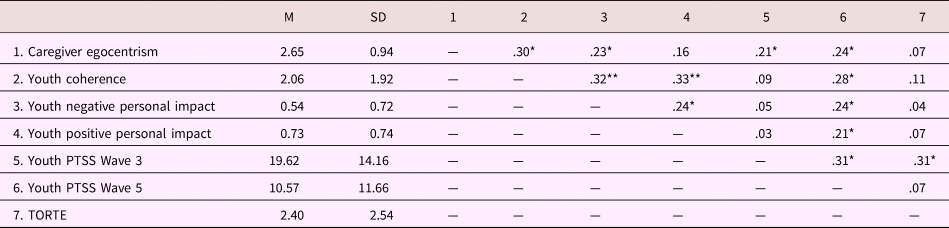
Means, standard deviations, and correlations for caregiver ES practices, youth recollection qualities, and youth PTSS are presented for the total sample in Table 1. Correlations were generally in the expected directions. As shown, caregiver egocentrism was moderately and positively correlated with youth negative personal impact and youth PTSS. Egocentrism was also positively correlated with youth coherence.
Descriptive statistics and zero-order correlations of caregiver egocentrism, youth interview qualities, and youth symptom variables

Note: PTSS, posttraumatic stress symptoms. TORTE, tornado-related traumatic experiences total score. Wave 3 = approximately 1 year after the tornado. Wave 5 = approximately 4 years after the tornado. *p < .01. **p < .001.
Caregiver egocentrism and youth PTSS: Mediated by adolescent coherence
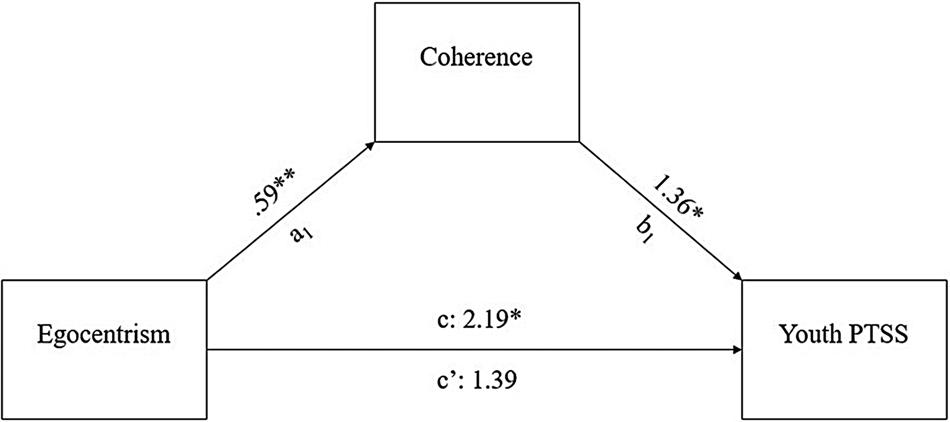
Figure 1 shows the mediation model including the unstandardized coefficients for all paths. Based on the unstandardized regression coefficients, there was a significant effect of caregiver egocentrism on youth PTSS (c path), t (118) = 2.02, p = .045, a significant effect of caregiver egocentrism on youth coherence (a path), t (118) = 3.26, p = .001, and a significant effect of youth coherence on youth PTSS (b path), t (118) = 2.51, p = .01. Further, the indirect effect of egocentrism on youth PTSS through coherence (c-c’ path) had a 95% CI that did not contain zero [0.07, 2.18] suggesting a significant indirect effect. Because the overall indirect effect for the model was significant, results supported a model wherein the effect of egocentrism on youth PTSS was explained by adolescent coherence. The main effect of egocentrism on youth PTSS became nonsignificant after controlling for the mediator (c’ path), t (118) = 1.25, p = .21. This suggests a full mediation pathway.
Mediation model with unstandardized regression coefficients. PTSS = post-traumatic stress symptoms; *p < .05; **p < .01.

Negative personal impact as a moderator of the indirect effect of caregiver egocentrism on adolescent PTSS
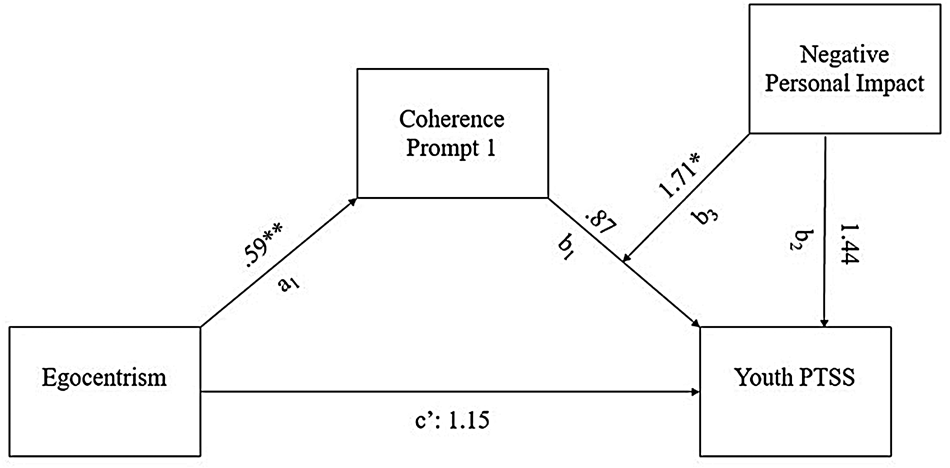
Given that there was a significant mediation effect for egocentrism and youth PTSS, we then examined whether negative personal impact moderated the mediational model. Figure 2 shows the moderated mediation model including the unstandardized coefficients for all paths. Based on the unstandardized regression coefficients, there was a nonsignificant effect of youth negative personal impact on youth PTSS (path b2), t (115) = 0.97, p = .33. However, the interaction of negative personal impact and coherence was significant, t (115) = 2.39, p = .018, suggesting that negative personal impact significantly moderated the association between coherence and youth PTSS (b3 path).
Moderated mediation model with unstandardized regression coefficients. PTSS = post-traumatic stress symptoms; *p < .05; **p < .01.

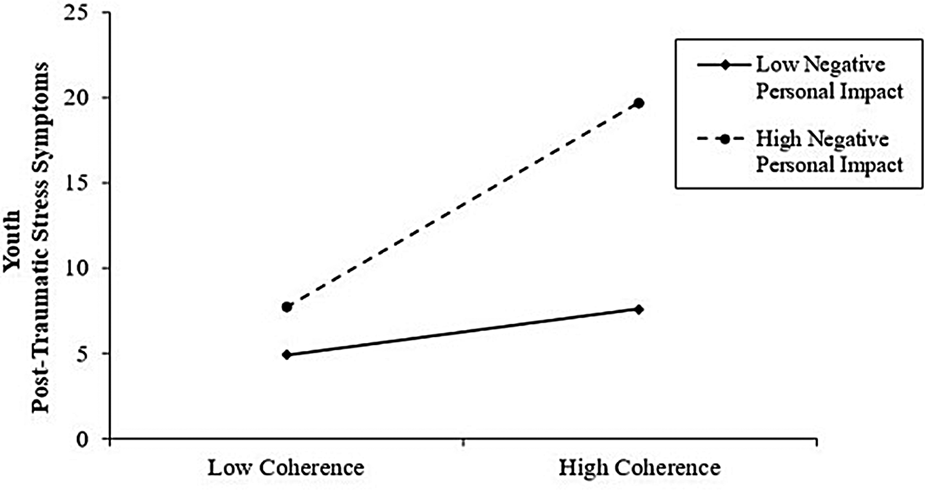
The conditional indirect effects of egocentrism on PTSS through coherence were evaluated at high and low levels of negative personal impact (1 SD above and below the mean, respectively). The simple slope of coherence when negative personal impact was high was significant (B = 1.24, SE = 0.64, 95% CI [0.28, 2.91]). This result indicates that, at high levels of negative personal impact, there was a positive association between coherence and youth PTSS. In contrast, the simple slope for coherence at low levels of negative personal impact was not significant (B = –0.03, SE = 0.64, 95% CI [–1.14, 1.46]), indicating that at low levels of negative personal impact there was not a significant relation between coherence and PTSS. These findings suggest that coherence predicts youth PTSS only when the adolescent's trauma narrative was highly negative and personal (see Figure 3). The main effect of coherence on youth PTSS became nonsignificant after including the moderator in the model (b1 path), t (115) = 1.56, p = .12. Results support a full moderated mediation pathway.
Simple slopes of coherence predicting youth post-traumatic stress symptoms for 1 SD below and above the mean of negative personal impact.

Discussion
The goal of the current study was to provide a greater understanding of two processes that may influence the association between natural disaster exposure and enduring PTSS: caregiver ES used during caregiver–adolescent co-reminiscing and aspects of adolescent recollection qualities (coherence and negative personal impact). Drawing from theory and research on caregiver roles in both the socialization of emotion regulation and memory development, we tested a pathway by which caregiver ES and youth trauma narrative characteristics might collectively influence youth PTSS following exposure to a devastating tornado. This study is one of the first to investigate, and find initial support for, the notion that caregivers engage in egocentrism, a core ES process, during co-reminiscing about a shared traumatic event and that caregiver egocentrism is related to enduring disaster-related PTSS 4 years following a natural disaster. Further, most ES research has been conducted with middle-class, European American children, and the current sample for this study was composed predominantly of low-income, African American adolescents who were identified as at risk for aggression during elementary school. Therefore, this study provides a unique opportunity to examine the relation between caregiver ES and youth PTSS in a population that is often underrepresented in the ES and natural disaster trauma literature. Evidence emerged for a moderated mediation model, whereby adolescent mention of negative personal impacts moderated the extent to which adolescent narrative coherence mediated the relation between caregiver egocentrism and youth PTSS.
In the proposed moderated mediation model, it was hypothesized that the coherence of adolescents’ trauma narratives would mediate the link between caregiver egocentrism (i.e., the extent to which caregivers focused the discussion on their own emotions, thoughts, and experiences of the tornado) and youth PTSS that were maintained years (38 to 54 months) after the traumatic event, even after controlling for initial PTSS measured 6 months after exposure to the tornado. It was also hypothesized that the negative quality of the trauma narratives would moderate the extent to which coherence plays a mediating role. Results provide support for youth prolonged PTSS in the wake of a natural disaster being influenced by complex interactions between caregiver and youth factors. It was found that, at higher levels of caregiver egocentrism, youth reported higher PTSS. This finding is consistent with the extensive body of literature on caregiver ES and youth adjustment. Specifically, caregivers who demonstrate more egocentrism may have a harder time tuning into their adolescent's needs for support around emotion regulation (Lindsey, Colwell, Frabutt, Chambers, & MacKinnon-Lewis, Reference Lindsey, Colwell, Frabutt, Chambers and MacKinnon-Lewis2008). High egocentrism may also be a reflection of caregivers’ own PTSS related to the tornado, a contextual factor that may further interfere with caretakers’ abilities to help their children make meaning out of this shared trauma. In the aftermath of a natural disaster, caregiver misattunement could be associated with prolonged adolescent PTSS.
Further, the link between caregiver egocentrism and prolonged youth PTSS was accounted for by more coherent narratives of the tornado event. This finding may appear surprising because narrative coherence is generally thought to be a protective factor for youth (Fivush, Hazzard, McDermott Sales, Sarfati, & Brown, Reference Fivush, Hazzard, McDermott Sales, Sarfati and Brown2003). However, further analyses revealed that it was only when youth described their experiences as having highly negative personal impacts that coherence was positively associated with PTSS. This is consistent with an emerging body of research indicating that the content of the narrative, in addition to coherence, is also an important factor associated with posttraumatic adjustment. Coherent narratives that are centered around how an event has personally impacted the adolescent in a negative way could be an indicator of overengaging or rumination on negative content, which acts to maintain PTSS. When recollections are coherent and organized, but focus on the negative impact of that event, this may facilitate thinking about negative topics in an excessive and repetitive way. In turn, these repeated thoughts may increase fear and anxiety about the event. Thus, ruminating about negative experiences may not be the best outlet to assist youth with processing a trauma event and may help to explain why some children tend to get worse before getting better during trauma work (see, for review, Cary & McMillen, Reference Cary and McMillen2012). These findings have potential implications for clinical interventions with disaster-exposed families. For example, it may be important to look at the ways in which caregivers talk to their children about shared trauma experiences. It appears that parents who focus more on their own experiences during these events have children who experience higher levels of PTSS. Clinical interventions for families that provide caregivers with strategies for eliciting and supporting youths’ attempts to express and articulate their personal thoughts and emotions in their own words may be beneficial for helping youth adjust and cope with the trauma. Altogether, these findings point to child recollection qualities that may be associated with caregiver egocentrism. It may be that a coherent, but negative, recollection is a marker of continued distress and rumination. These youth may be less able to self-regulate and their PTSS may stay high or increase over time. With these adolescents, caregiver egocentrism may serve to reinforce their negative attributions and may also create an environment where the adolescent is unable to get help regulating their emotions from their caregiver (Laible, Reference Laible2004).
Research on caregiver–child recollections has found support for the notion that caregivers influence their children's narrative skills and memory for events (Bauer et al., Reference Bauer, Burch, Van Abbema and Ackil2007; Fivush, Reference Fivush, Quas and Fivush2009). However, there is still much to discover about the processes by which caregivers shape their children's narrative skills and memory development. This study provides preliminary evidence that caregiver egocentrism during co-reminiscing with their adolescents, as well as how adolescents are processing the traumatic event, influence youth prolonged PTSS.
Study strengths, limitations, and future directions
This study contains some unique strengths compared to other studies examining caregiver socialization practices and caregiver–adolescent co-reminiscing. First, this study is one of the first to examine how caregiver ES behaviors during caregiver–adolescent conversations interact with independent qualities of adolescent recollections to influence youth PTSS several years after a traumatic event (while controlling for earlier PTSS and degree of disaster exposure). Thus, this study was able to demonstrate that caregiver ES behaviors measured during a co-reminiscing experience do have relevance to how adolescents recall and process trauma-related emotions and cognitions. Second, the current sample was predominantly African American and low income, and there is limited information about the ES practices of ethnically diverse and low-income families. Thus, the current study helps to fill a gap in the literature by examining ES processes in a culturally and socioeconomically diverse group. Third, because participants were given a broad prompt (“Tell me about some things that happened to you during the tornado”), findings may represent a more naturalistic measure of how caregivers approach talking about emotions with their youth around natural disasters. Fourth and finally, all individuals experienced the tornado at the same time and, therefore, have the same latency for their recollections.
Our study also has certain methodological limitations that warrant attention and may suggest directions for future research. First, although the study was able to examine adolescent tornado-related distress and exposure years prior to collecting adolescent narratives, data investigating caregiver ES and adolescent recollection qualities were collected at the same time point. Therefore, the cross-sectional nature of the study design precludes drawing causal implications for the relation between caregiver ES and adolescent reminiscing qualities. Despite this limitation, however, given the longitudinal nature of the current study design, we were able to control for immediate postdisaster PTSS and severity of disaster exposure in all analyses. Second, interviewers did not leave the room during interviews and, therefore, may have introduced “noise” into the data that could not be systematically accounted for in coding procedures. A third limitation, common in research with caregivers, is that all caregiver participants were female. Thus, we are not able to explore potential effects of caregiver gender on the tested models. Minimal paternal participation is an ongoing concern in clinical research and practice (Phares, Reference Phares1992; Phares, Lopez, Fields, Kamboukos, & Duhig, Reference Phares, Lopez, Fields, Kamboukos and Duhig2005). Future studies with both female and male caregivers could help to clarify whether different models are needed to account for links between caregiver ES and youth mental health outcomes following natural disaster exposure. In addition, future studies might employ more comprehensive measures of child symptomology to analyze specific factors underlying the caregiver ES–youth mental health outcomes association.
Fourth and finally, it is possible that caregiver egocentrism is influenced, in part, by the caregiver's current level of PTSS about the disaster. For example, caregivers with elevated PTSS about the tornado may have trouble setting aside their own emotions while co-reminiscing about the tornado with their child. This may make it more difficult for them to listen carefully, and respond empathically, to their children's attempts to articulate their thoughts and feelings about the event. Future research should examine more fully how contextual factors, such as the caregiver's own disaster-related PTSS, may influence ES processes such as egocentrism when co-reminiscing with a child. Given that extant literature documents an association between caregiver PTSS and youth PTSS (e.g., Lambert, Holzer, & Hasbun, Reference Lambert, Holzer and Hasbun2014; Sheeringa & Zeanah, Reference Sheeringa and Zeanah2008), assessment and treatment of enduring caregiver PTSS may enhance the caregivers’ ability to engage in supportive ES behaviors with their children during conversations about a shared trauma, such as a natural disaster, that has the potential to produce enduring PTSS.
Summary
Using a predominantly low-income and African American sample of youth and their caregivers, this study tested whether youth narrative coherence mediated the link between caregiver egocentrism and youth PTSS. It also examined whether these relations might differ for youth with greater negative personal impact. A mediated moderation technique was utilized to test youth coherence as a mediator between caregiver egocentrism and youth PTSS during co-reminiscing about a traumatic natural disaster. Adolescents' mentions of negative personal impact during their recollections of the tornado moderated the extent to which youth narrative coherence mediated the link between caregiver egocentrism and youth PTSS. These findings suggest a specific pattern whereby children's emotional processing of a traumatic event is influenced by caregiver ES practices, most notably the caregiver's ability to engage in child-centered emotional coaching and guidance. Results also point to the fact that the relation between caregiver ES and adolescent adjustment is influenced by youth factors, such as how adolescents remember, process emotions and cognitions, and make meaning out of traumatic events. The ways in which the interaction of adult and adolescent factors influence the development and maintenance of PTSS is not well understood, yet has important implications for therapeutic practices. Overall, results from the current study demonstrate that ES behaviors may alter the ways in which adolescents reflect on, and remember, traumatic and stressful events.
Financial support
The research in this paper has been supported by National Institute of Child Health & Human Development Grant R01 HD079273 and National Institute of Drug Abuse Grant R01 DA023156, and by a Doctoral Research Fellowship Award from the University of Kansas to the first author.