Introduction
Weeds continue to be a major pest problem in sugar beet crops grown in the U.S. Pacific Northwest. Volunteer potato can be a serious weed problem in many crops and can be very competitive and difficult to control. Additional weed pests in beet fields include common lambsquarters (Chenopodium album L.), kochia [Bassia scoparia (L.) A. J. Scott], redroot pigweed (Amaranthus retroflexus L.), hairy nightshade (Solanum physalifolium Rusby), barnyardgrass [Echinochloa crus-galli (L.) Beauv.], green foxtail [Setaria viridis (L.) Beauv], and others (Boydston and Williams Reference Boydston and Williams2003; Williams et al. Reference Williams, Ransom and Thompson2004). In the United Kingdom, studies have shown that up to 370,000 potato tubers per hectare may remain in the field after harvest (Lutman Reference Lutman1977). Up to 50,000 tubers per hectare may sprout the following year if volunteer potatoes are not controlled in the fall or killed by cold winter temperatures (Lutman Reference Lutman1977), resulting in a serious weed problem in the subsequent crop. Sugar beet (common beet) is often grown in rotation with potatoes in southern Idaho and eastern Oregon, but no data currently exist on the effect of volunteer potatoes on sugar beet yield, despite the detrimental effect volunteer potatoes can have on beet growth and yield.
Prior to the introduction and commercialization of glyphosate-tolerant sugar beet cultivars in 2007, there were no herbicides that would effectively control volunteer potatoes in sugar beet, and often, repeated application of different herbicide mixtures was required for satisfactory control. In some cases, hand labor was required to reduce volunteer potato density. Potato can regrow after hoeing or spraying with herbicides, thus systemic herbicides such as glyphosate could provide better control compared with contact herbicides. Lutman and Richardson (Reference Lutman and Richardson1978) and Smid and Hiller (Reference Smid and Hiller1981) demonstrated that glyphosate applied at 560 to 1,000 g ae ha−1 effectively controlled volunteer potatoes. The glyphosate-tolerant sugar beet trait, which allows for glyphosate application after the 2-true leaf stage of sugar beet might provide more flexibility for volunteer potato removal in the crop.
In addition to the limited herbicide options for volunteer potato control in sugar beet, it is not clearly known which growth stage is the best time to remove volunteer plants from sugar beet fields. Lutman and Richardson (Reference Lutman and Richardson1978) found that glyphosate was more effective against volunteer potato when applied in June/July than in May. In addition, another study has shown that volunteer potato competition in sugar beet is reduced if it is removed by the potato tuber initiation stage (Walton et al. Reference Walton, Morishita and Quinn2007). However, it is unclear how much sugar beet root or sucrose yield is lost if volunteer potato removal is delayed until the tuber initiation stage. Thus, the objectives of this study were to 1) determine the effect of volunteer potato density on sugar beet yield, and 2) evaluate volunteer potato removal timing that optimizes the trade-off between improved control and potential for sugar beet yield reductions.
Materials and Methods
Volunteer Potato Density Experiment
Field experiments were conducted in 2005 and 2006 at the University of Idaho Research and Extension Center, in Kimberly, ID, to evaluate the competitive effect of volunteer potato on sugar beet yield. In both years, the experimental design was a randomized complete block with four replications. Individual plots were 2.23 m wide by 9.14 m long. In 2005, the soil was a Portneuf silt loam (5.3% sand, 75.7% silt, and 18.9% clay), pH 8.1, with 1.95% organic matter, and a cation exchange capacity (CEC) of 16.4 mEq 100 g soil−1. In 2006, the soil type was a Portneuf silt loam (18.9% sand, 60.1% silt, and 21% clay), pH 8.1, with 1.83% organic matter, and a CEC of 20 mEq 100 g soil−1. Sugar beet (‘Owyhee’ in 2005 and ‘4490RZ’ in 2006) was planted on May 2, 2005, and May 1, 2006, in 0.56-m rows at 140,900 seeds ha−1. Whole potato tubers averaging 28 g each were planted at eight densities, including the untreated check: 0, 6,741, 10,092, 13,455, 16,818, 20,184, 26,910, and 40,365 tubers ha−1 to determine potato competition. The densities are within the typical volunteer potato density in the spring, which ranges from 4,000 to 100,000 tubers ha−1 (Williams et al. Reference Williams, Ransom and Thompson2004). Weeds in the study area were controlled by applying a combination of ethofumesate + desmedipham + phenmedipham (280 g ai ha−1) and triflusulfuron (17.5 g ai ha−1) at the sugar beet cotyledon growth stage followed by repeat applications of ethofumesate + desmedipham + phenmedipham (370 g ai ha−1) and triflusulfuron (17.5 g ai ha−1) at the 2- and 4-leaf growth stages. Herbicides were broadcast-applied with a CO2-pressurized bicycle-wheel sprayer calibrated to deliver 140 L ha−1 using 8001-type flat-fan nozzles (Flat Fan Spray Tips, TeeJet® Technologies, Glendale Heights, IL). Hand weeding was used to control other weeds not controlled by the herbicides. The two center rows of sugar beet in each plot were harvested mechanically on October 5, 2005, and October 3, 2006, to determine root yield.
Volunteer Potato Removal Timing Experiment
Field experiments were conducted in 2007 and 2009 at the University of Idaho Research and Extension Center, in Kimberly, ID, and in 2007 and 2008 at the Oregon State University Malheur Experiment Station, in Ontario, OR, to determine the optimum timing of volunteer potato removal from glyphosate-tolerant sugar beet using glyphosate. The soil type in Idaho was Portneuf silt loam (20.4% sand, 71.0% silt, and 8.6% clay), pH 8.6, with 1.5% organic matter, and a CEC of 17 mEq 100 g soil−1. In Oregon, the predominant soil was an Owyhee silt loam with 1.9% organic matter, pH 7.1, and a CEC of 19 mEq 100 g of soil−1.
The experimental design was a randomized complete block with four replications at each site. Individual plots were 2.23 m wide by 9.14 m long in Idaho, and 2.23 m wide by 7.62 m long in Oregon. At both locations, ‘Betaseed 26RR-14’ sugar beet seed was planted in April each year, in 56-cm rows at a rate of 140,000 to 148,000 seeds ha−1. To determine potato interference, whole potato tubers (‘Russet Burbank’) averaging 28 g each, were planted within the center rows of each plot at a density of 20,000 tubers ha−1, except for the no-volunteer-potato treatment. A burndown application of a formulated mixture of desmedipham + phenmedipham + ethofumesate at 370 g ai ha−1 was applied each year and prior to planting potato tubers to control all existing volunteer potato and other weeds to ensure uniform potato density.
The volunteer potato removal timings evaluated were as follows: spray at the 10-cm rosette stage, spray at hooking (pre-tuber initiation), spray at tuber initiation, spray at early tuber bulking, spray at mid-tuber bulking, and potato not sprayed. Repeated removal treatments were needed to anticipate shoot regrowth because potato is a perennial plant with starch-filled tubers that can provide energy for shoot regrowth. Those treatments included spray as needed at the 10-cm rosette stage and spray as needed at tuber hooking. Thus, there were a total of 10 potato removal treatments including the untreated control. The spray-as-needed treatments were evaluated weekly to determine whether or not spraying was needed. In those treatments, plants were sprayed each time potato plants had regrown to 10-cm rosettes. Glyphosate, the herbicide used for potato removal, was broadcast-applied with a CO2-pressurized sprayer at the rate of 900 g ae ha−1 plus ammonium sulfate 2% vol/vol.
Volunteer potato was harvested in September each year by digging plants in each plot where plants were present. Tubers were sorted by size (<28 g; 28–112 g; 113–170 g, and >170 g) and weighed. The weight proportion of each size category was calculated by dividing the weight contribution of each size category by total weight per plot. Sugar beet yield in kg per hectare was determined by mechanically harvesting the two center rows of each plot in October each year. Two sample bags of sugar beet roots weighing 9 kg to 11 kg were then collected and sent to the Amalgamated Sugar Company, in Paul, ID, to determine sucrose concentration and yield.
Sugar beet root yield and sucrose loss were calculated (Equation 1) as follows:
 $${Y_L}=100 \times \left( {\frac{{{y_0} - {y_1}}}\over{{{y_0}}}} \right)$$
where YL is the yield loss (%), y0 is the yield of the untreated control, and yl is the yield from the removal timing treatment. The value of yield loss was obtained by multiplying YL by the price of sugar, which was set at $53.13 per 1000 kg, the 9-yr average sugar price (USDA-NASS 2019).
Data Analysis
All data analyses were performed in R statistical language version 4.0.2 (R Core Team 2020) using the lme4, lmerTest, and emmeans packages (Bates et al. Reference Bates, Maechler, Bolker and Walker2015; Kuznetsova et al. Reference Kuznetsova, Brockhoff and Christensen2017; Lenth Reference Lenth2018). Effect of volunteer potato density on sugar beet root yield was analyzed using a mixed-effects model in which volunteer potato planting density was considered a fixed effect and year and block were considered random effects. The linear regression equation (Equation 2) is as follows:
 $$y = a + bx$$
where y is the sugar beet root or sucrose yield at volunteer potato density x, a is the y-intercept (i.e., sugar beet root or sucrose yield at zero volunteer potato density), and b is a slope of the line, and was obtained from the linear mixed-effects model. The marginal coefficient of determination (variance explained by the fixed effect) from the mixed-model was obtained using the multi-model inference (MuMIn) package (Barton Reference Barton2020).
For the volunteer potato removal timing experiment, the effect of volunteer removal timing on volunteer potato tuber size, sugar beet root yield, sucrose yield, sugar beet root and sucrose yield loss were analyzed using a mixed-effects model in which volunteer potato removal timing was considered a fixed effect; and year, location, and block were considered as random effects. Estimated marginal means were calculated from the model and post hoc Tukey-adjusted pairwise treatment comparisons were performed at α = 0.05 using the emmeans and multcomp packages (Hothorn et al. Reference Hothorn, Bretz and Westfall2008; Lenth Reference Lenth2018).
Results and Discussion
Effect of Volunteer Potato Density on Sugar Beet Yield
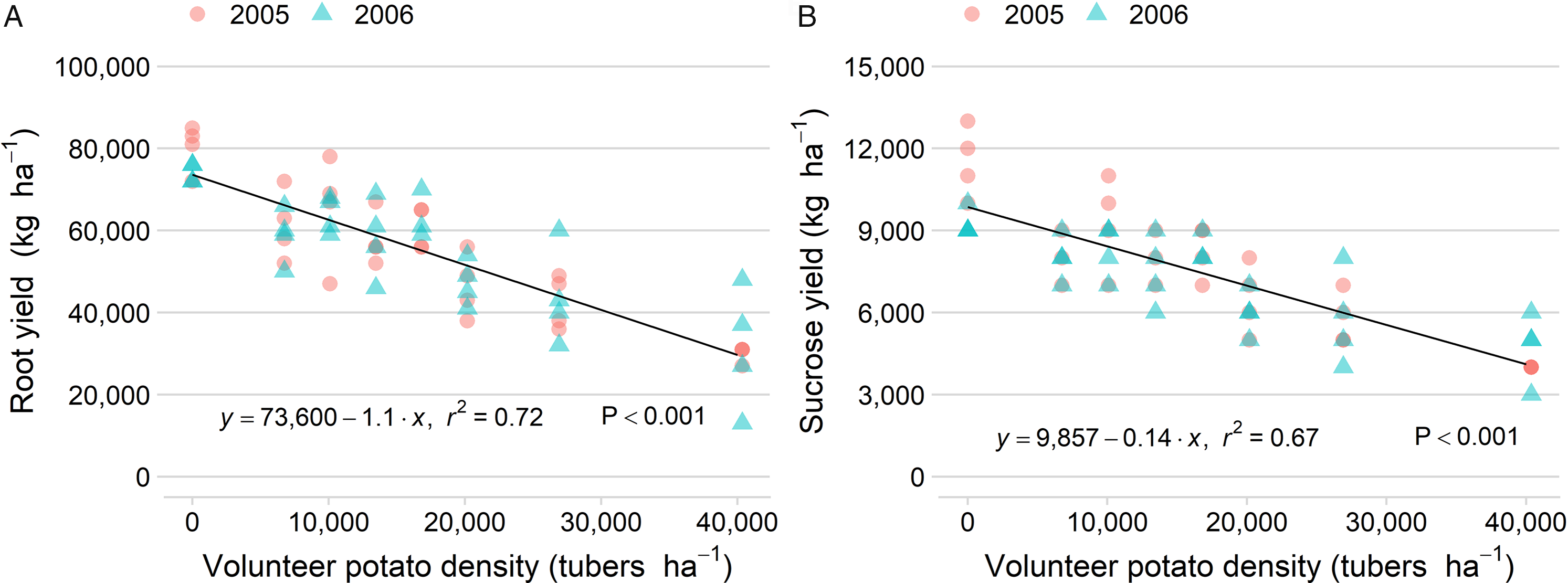
Sugar beet root yield decreased linearly as volunteer potato density increased (Figure 1), such that with every volunteer potato tuber per square meter, sugar beet root yield decreased by 15% and sucrose yield decreased 14%. Volunteer potato density as low as 0.067 plants m−2 reduced bulb onion (Allium cepa L.) yield by 10%, and four volunteer potatoes per square meter caused 100% bulb onion yield loss (Williams et al. Reference Williams, Ransom and Thompson2004). Thus, volunteer potato can be very competitive against short stature crops like sugar beet. Kniss et al. (Reference Kniss, Sbatella and Wilson2012) showed that for every volunteer corn (Zea mays L.) plant per square meter, sugar beet sucrose yield decreased by 19%. Results from this study demonstrate that volunteer potatoes can be as competitive with sugar beet as tall volunteer crops such as corn. The linear regression equation showed that in the absence of volunteer potato, sugar beet root yield was 74,000 kg ha−1 (Figure 1). Thus, at the highest volunteer potato density (40,365 tubers ha−1), sugar beet root yield was 29,600 kg ha−1, representing a 60% reduction in sugar beet root yield.
Effect of volunteer potato planting density on sugar beet root (A) and sucrose yield (B) in 2005 and 2009, in Kimberly, ID. The linear regression equation (Equation 2) was obtained from the linear mixed-effects model.

Volunteer Potato Removal Timing and Sugar Beet Yield
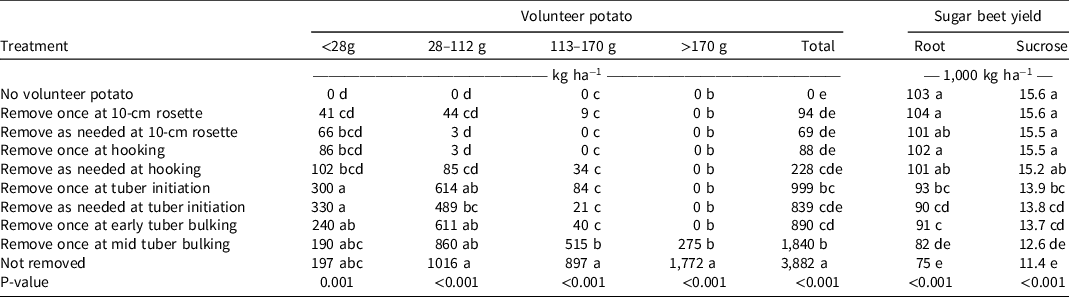
Volunteer potato density and regrowth responded very differently after glyphosate applications. Very few volunteer potatoes resprout when sprayed only one time at the 10-cm rosette, hooking, and tuber initiation stages. Thus, very few volunteer potato tubers weighing more than 28 g were recovered from the fields where volunteer potato was sprayed before or at tuber initiation (Table 1). On the contrary, the proportion of tubers greater than 28 g in size increased when volunteer potato removal was delayed until the tuber bulking stage. Systemic herbicides such as glyphosate are absorbed into the plant, unlike mechanical removal, thus explaining why a one-time application prevented regrowth. For example, up to four mechanical cultivation operations are required during the growing season to suppress volunteer potato growth (Steiner et al. Reference Steiner, Newberry, Boydston, Yenish and Thronton2005). However, a one-time application of mesotrione at the tuber initiation stage provided up to 99% control of volunteer potato in corn (Steiner et al. Reference Steiner, Newberry, Boydston, Yenish and Thronton2005). Similarly, a one-time application of glyphosate at 560 to 1,000 g ai ha−1 effectively controlled volunteer potatoes (Lutman and Richardson Reference Lutman and Richardson1978; Smid and Hiller Reference Smid and Hiller1981).
Tuber weight, tuber number, and sugar beet root and sucrose yield in response to volunteer potato growth stage at removal, from 2007 to 2009 at Kimberly, ID, and Ontario, OR.a,b

a Research was conducted in 2007 and 2009 in Kimberly, ID; and in 2007 and 2008 in Ontario, OR.
b Means within a column followed by the same letter are not significantly different (P = 0.05).
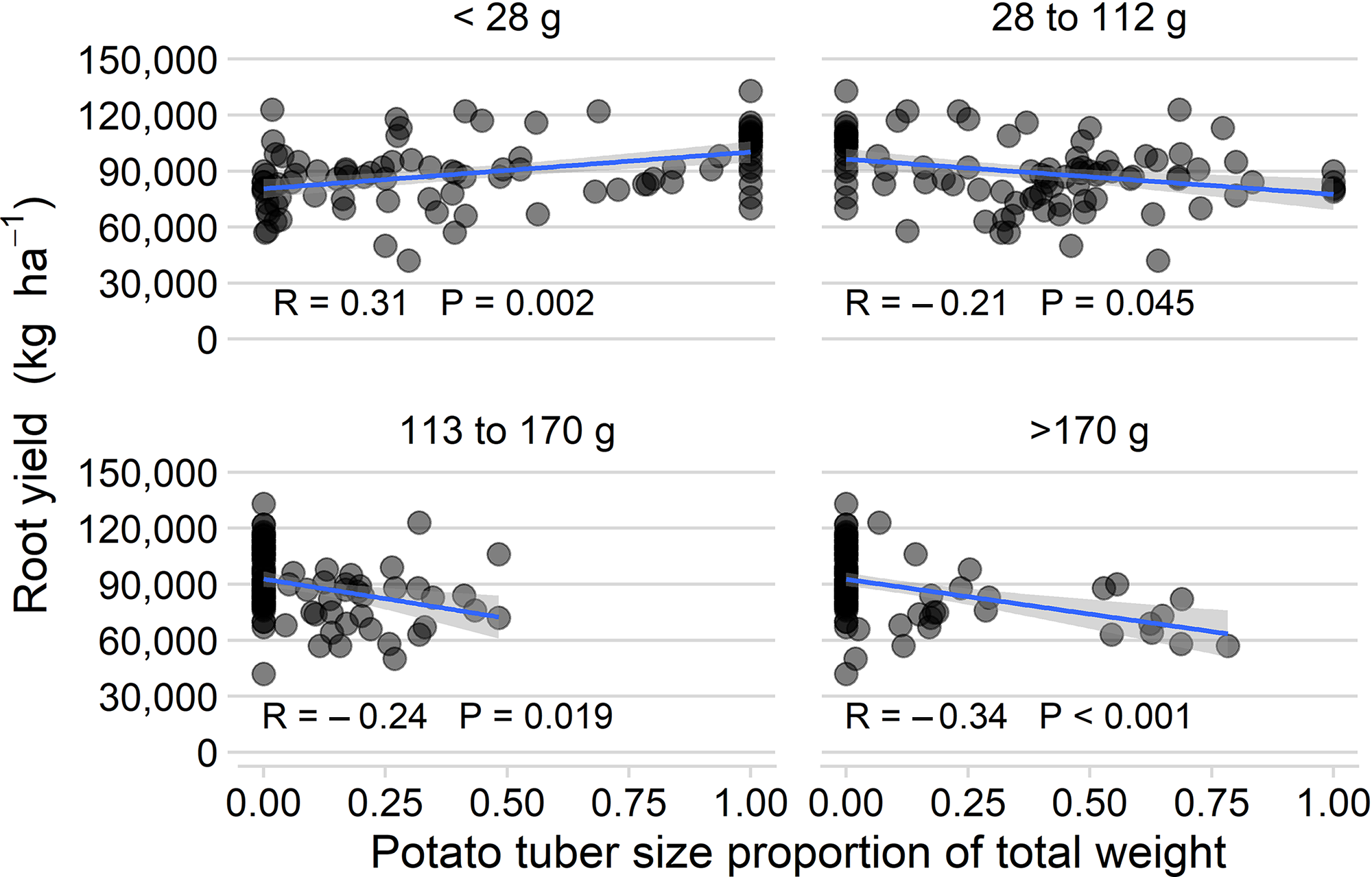
Harvested tuber weight was 890 and 1,840 kg ha−1, respectively, when volunteer potato removal was delayed until early or mid-tuber bulking (Table 1). Thus, delaying volunteer potato removal provided enough time for the potato tubers to increase in size, thereby resulting in greater tuber yield. This was evident in the correlation analysis when the proportion of medium-sized (113 to 170 g) and larger potato tubers (>170 g) increased, sugar beet root yield was reduced significantly (Figure 2).
Pearson correlation between volunteer potato tuber size proportion for different size categories (<28 g; 28 to 112 g; 113 to 170 g, and >170 g) on sugar beet root yield in 2007 and 2009 in Kimberly, ID; and in 2007 and 2008 in Ontario, OR.

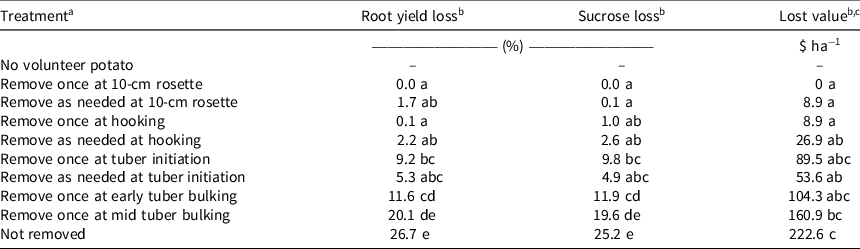
Volunteer potato presence reduced sugar beet root and sucrose yield. The longer the volunteer potatoes were allowed to compete with sugar beet, the more sugar beet yield was reduced. Sugar beet root and sugar yield was reduced by 28,000 and 4,200 kg ha−1, respectively, when volunteer potato was not removed (Table 1). This represents more than 25% yield loss, which translated into an economic loss of more than $222 per hectare (Table 2). Early removal of volunteer potato (at or before the hooking stage) resulted in minimal yield loss (<3%) and economic loss (<$27 ha−1). Removal at tuber initiation resulted in 5% to 10% yield loss ($54 to $90 ha−1). However, delaying volunteer potato removal beyond the tuber initiation stage significantly reduced sugar beet root and sucrose yield (12% to 20%), resulting in an economic loss of $104 to $161 per hectare (Table 2).
Sugar beet root yield and sucrose loss due to volunteer potato interference in Idaho and Oregon, 2007 to 2009.

a Research was conducted in 2007 and 2009 in Kimberly, ID; and in 2007 and 2008 in Ontario, OR.
b Means within a column followed by the same letter are not significantly different (P = 0.05).
c Based on 9-year average sugar price of $53.13 per 1000 kg (USDA-NASS 2019).
Conclusions
Volunteer potato is very competitive with sugar beet. Volunteer potato density as low as one tuber per square meter can reduce sugar beet root yield by 15% and sucrose yield by 14%. A one-time application of glyphosate at the 10-cm rosette, hooking, and tuber initiation stages provided good control (74% to 98% reduction in tuber weight) of volunteer potato in sugar beet. Volunteer potato must be removed by the tuber initiation stage to prevent substantial (>10%) yield and economic loss. Thus, the best potato removal timing, optimizing the trade-off between improved control and potential for sugar beet yield reductions, is before or at the tuber initiation stage.
Acknowledgments
We thank Michael P. Quinn, Robyn C. Walton, Daniel J. Henningsen, Donald L. Shouse, and Joey Ishida for assisting with trial establishment and data collection. Partial funding for this research was provided by the Snake River Sugar Beet Grower Research and Seed Committee. Other funding for this research has previously been provided to the University of Idaho and Oregon State University by Formula Grant nos. 2008-31100-06041 and 2009-31200-06041 from the U.S. Department of Agriculture–National Institute of Food and Agriculture.